
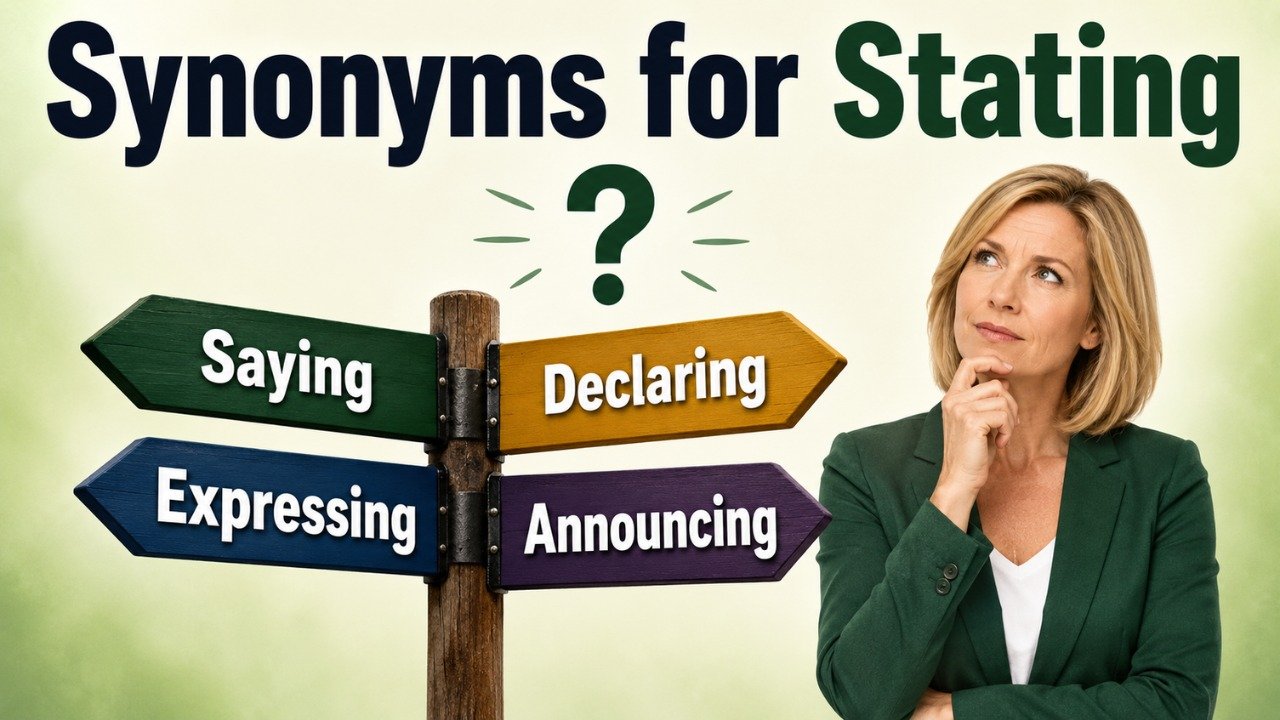
Quick Answer: The best synonyms for stating include saying, declaring, expressing, asserting, mentioning, explaining, reporting, announcing, indicating, and affirming. Saying is the broadest choice for everyday communication. Declaring and asserting sound stronger and more formal. Expressing works well for thoughts, opinions, and feelings. Reporting suits facts or events, while indicating is useful when information is suggested rather than directly spoken.
Pronunciation and Word Details
Word: Stating.
Pronunciation: /ˈsteɪ.tɪŋ/
Part of Speech: Present participle and gerund of the verb state.
Meaning: Expressing information, an opinion, or a fact clearly in spoken or written words.
US Pronunciation:
UK Pronunciation:
What Does “Stating” Mean?
Stating means expressing something clearly and directly in speech or writing.
It is the present participle and gerund form of the verb state. The word often appears when someone gives information, explains a position, presents a fact, or communicates an opinion.
Example: She is stating the main reason for the change.
In this sentence, stating means clearly expressing the reason.
The word is common in formal communication, reports, essays, instructions, legal writing, academic discussions, and professional conversations.
Formal Use: The document is stating the conditions of the agreement.
Everyday Use: He was simply stating what happened.
Opinion Use: She is stating her personal view on the issue.
Stating usually suggests clarity and directness. However, the most accurate synonym depends on whether the speaker is giving facts, making a claim, announcing information, or explaining an idea.
Meaning, Tone, and Context of “Stating”
Stating usually has a neutral, direct, and slightly formal tone.
It is more precise than saying because it often suggests that the information is presented clearly or officially.
Formal Tone: Stating is common in reports, essays, notices, policies, and professional writing.
Example: The report begins by stating its main objective.
Neutral Tone: It can describe the simple act of expressing information without emotion.
Example: He was stating the facts as he understood them.
Strong Tone: In some contexts, stating may sound confident or firm.
Example: She is stating that the decision cannot be changed.
Academic Tone: Writers use stating when presenting arguments, findings, definitions, or positions.
Example: The author is stating the central claim in the opening paragraph.
Conversational Tone: In ordinary speech, saying or mentioning may sound more natural.
Example: He was saying that the meeting had been postponed.
Stating is not usually emotional. Words such as insisting, proclaiming, or emphasizing may carry a stronger emotional or forceful tone.
When and How to Use “Stating”
For Presenting a Fact
Use stating when someone communicates factual information clearly.
Example: The witness is stating what she observed.
For Giving an Opinion
Use stating when a person expresses a position or personal view.
Example: He is stating his opinion without criticizing anyone else.
For Explaining a Rule
Use stating when a document or person clearly communicates a requirement.
Example: The notice is stating that all visitors must register.
For Making a Formal Claim
Use stating when someone presents a claim in an official or professional context.
Example: The company issued a letter stating its position.
For Introducing a Main Idea
Use stating when a writer presents a thesis, purpose, or central point.
Example: The introduction begins by stating the main argument.
For Reporting Information
Use stating when someone communicates known facts, figures, or findings.
Example: The report is stating that sales increased during the final quarter.
For Clarifying a Position
Use stating when a person explains where they stand on an issue.
Example: She is clearly stating her expectations for the project.
Best Synonyms for Stating
Saying
Synonym: Communicating something through spoken or written words.
Example: She was saying that the schedule had changed.
Declaring
Synonym: Expressing something clearly, firmly, or officially.
Example: The leader was declaring the event open.
Expressing
Synonym: Communicating thoughts, feelings, or opinions.
Example: He was expressing concern about the delay.
Asserting
Synonym: Stating something confidently as true.
Example: The writer was asserting that the evidence supported the claim.
Mentioning
Synonym: Referring briefly to a subject or detail.
Example: She was mentioning the issue during the discussion.
Explaining
Synonym: Making an idea or situation easier to understand.
Example: The instructor was explaining how the process worked.
Reporting
Synonym: Providing information about facts, events, or findings.
Example: The journalist was reporting the latest developments.
Announcing
Synonym: Making information publicly or officially known.
Example: The manager was announcing the final decision.
Indicating
Synonym: Showing, suggesting, or communicating a particular meaning.
Example: The results were indicating a gradual improvement.
Affirming
Synonym: Confirming or strongly expressing that something is true.
Example: She was affirming her commitment to the plan.
50 Synonyms for Stating With Short Meanings
- Saying: Communicating something in words.
- Declaring: Expressing something firmly or officially.
- Expressing: Communicating a thought, feeling, or opinion.
- Asserting: Presenting something confidently as true.
- Mentioning: Referring briefly to a subject.
- Explaining: Making information easier to understand.
- Reporting: Giving information about facts or events.
- Announcing: Making information publicly known.
- Indicating: Showing or suggesting a meaning.
- Affirming: Confirming that something is true.
- Telling: Giving someone information.
- Communicating: Sharing information, ideas, or feelings.
- Voicing: Expressing an opinion or concern openly.
- Remarking: Making a spoken observation or comment.
- Observing: Making a thoughtful comment about something.
- Noting: Drawing attention to a detail or fact.
- Specifying: Giving exact or particular information.
- Outlining: Presenting the main points clearly.
- Describing: Explaining what something is like.
- Defining: Giving the exact meaning of a word or idea.
- Clarifying: Making information clearer.
- Articulating: Expressing an idea clearly and effectively.
- Formulating: Putting an idea into carefully chosen words.
- Presenting: Putting information before an audience.
- Relating: Telling or describing an event or experience.
- Recounting: Describing events in sequence.
- Narrating: Telling a story or series of events.
- Disclosing: Revealing information that was not previously known.
- Revealing: Making hidden or unknown information known.
- Confirming: Showing that something is correct or true.
- Maintaining: Continuing to claim that something is true.
- Claiming: Saying that something is true, sometimes without proof.
- Contending: Arguing that a particular position is correct.
- Arguing: Presenting reasons in support of a view.
- Proclaiming: Announcing something publicly and strongly.
- Pronouncing: Declaring something formally or authoritatively.
- Professing: Openly declaring a belief, feeling, or intention.
- Avowing: Openly and firmly admitting or declaring something.
- Testifying: Giving formal evidence or information.
- Citing: Mentioning information as support or evidence.
- Quoting: Repeating someone’s exact words.
- Emphasizing: Giving special importance to a point.
- Stressing: Highlighting something as especially important.
- Insisting: Stating something firmly and repeatedly.
- Admitting: Acknowledging something as true.
- Acknowledging: Recognizing or accepting a fact.
- Replying: Giving an answer in response.
- Responding: Reacting with spoken or written information.
- Informing: Giving someone knowledge or facts.
- Submitting: Presenting information, a proposal, or a statement formally.
Read Also:
Synonyms for Try

Synonyms for Stating by Context
When Stating Means Saying Something
Saying, telling, communicating, remarking, observing, and mentioning are useful for general speech or writing.
Example: She was saying that the room needed better lighting.
Example: He was mentioning a possible change to the schedule.
Saying is the broadest option. Telling usually requires a listener or recipient. Mentioning suggests a brief reference rather than a complete explanation.
When Stating Means Declaring Firmly
Declaring, asserting, proclaiming, affirming, avowing, and professing communicate confidence or strength.
Example: The candidate was declaring support for the proposal.
Example: She was asserting that the figures were correct.
Declaring may sound official. Asserting suggests confidence. Proclaiming often sounds public, forceful, or dramatic.
When Stating Means Explaining Clearly
Explaining, clarifying, articulating, defining, describing, and outlining help make information understandable.
Example: The teacher was explaining the meaning of the term.
Example: The guide was outlining the main steps.
Explaining develops an idea in detail. Clarifying removes confusion. Outlining presents only the main points.
When Stating Means Reporting Facts
Reporting, informing, recounting, relating, narrating, and testifying communicate facts, experiences, or events.
Example: The witness was recounting what happened.
Example: The analyst was reporting the latest results.
Reporting suits facts and findings. Recounting usually describes events in order. Testifying is more formal and often connected with evidence.
When Stating Means Giving an Opinion
Expressing, voicing, maintaining, contending, arguing, and claiming communicate a belief or position.
Example: She was voicing concern about the proposed changes.
Example: The author was contending that the policy required revision.
Expressing is neutral. Contending is formal and argumentative. Claiming may suggest that proof is still needed.
When Stating Means Making Information Public
Announcing, proclaiming, disclosing, revealing, and pronouncing make information known to others.
Example: The organization was announcing its new leadership.
Example: The report was revealing several unexpected findings.
Announcing is suitable for official news. Disclosing often involves private or previously hidden information. Pronouncing may suggest formal authority.
When Stating Means Highlighting a Point
Emphasizing, stressing, noting, specifying, and indicating direct attention toward important information.
Example: The speaker was emphasizing the need for accuracy.
Example: The instructions were specifying the required format.
Emphasizing and stressing add importance. Specifying provides exact detail. Indicating may communicate meaning indirectly.
Another Word for Stating
Saying is the broadest and most natural replacement for stating in everyday communication. However, the best alternative depends on whether the person is expressing an opinion, giving facts, making an official announcement, or explaining an idea.
Original: She was stating that the deadline had changed.
Better Option: She was saying that the deadline had changed.
Original: The report is stating the final results.
Better Option: The report is presenting the final results.
Original: He was stating his concern about the delay.
Better Option: He was expressing his concern about the delay.
Original: The director was stating the new policy publicly.
Better Option: The director was announcing the new policy publicly.
Saying fits ordinary speech. Expressing works for emotions and opinions. Presenting suits reports and formal information. Announcing is best for public news.
When Not to Use “Stating”
When the Communication Is Casual
Stating can sound too formal in relaxed conversation.
Weak: She was stating that she wanted a cup of tea.
Better: She was saying that she wanted a cup of tea.
When Someone Gives a Detailed Explanation
Use explaining or clarifying when the speaker provides reasons or extra detail.
Weak: The instructor was stating how the machine worked.
Better: The instructor was explaining how the machine worked.
When Information Is Publicly Released
Use announcing when news is officially shared with a group.
Weak: The manager was stating the winner to the audience.
Better: The manager was announcing the winner to the audience.
When the Speaker Expresses Emotion
Use expressing or voicing when thoughts or feelings are the main focus.
Weak: He was stating his disappointment.
Better: He was expressing his disappointment.
When a Claim Is Forceful
Use asserting or insisting when the speaker strongly defends a position.
Weak: She kept stating that the figures were accurate.
Better: She kept insisting that the figures were accurate.
When the Word Becomes Repetitive
Replace repeated uses with more precise verbs.
Weak: The report is stating the problem, stating the cause, and stating the solution.
Better: The report identifies the problem, explains the cause, and presents the solution.
Words Commonly Confused With Stating
Stating vs Saying: Stating sounds more formal and direct. Saying is broader and more natural in everyday conversation.
Stating vs Telling: Stating focuses on the information expressed. Telling usually focuses on giving information to a particular person.
Stating vs Declaring: Stating is neutral. Declaring is stronger and often official or public.
Stating vs Asserting: Stating simply presents information. Asserting presents something confidently as true.
Stating vs Claiming: Stating does not necessarily suggest doubt. Claiming may imply that the statement still requires proof.
Stating vs Mentioning: Stating usually communicates a complete point. Mentioning refers briefly to a subject or detail.
Stating vs Explaining: Stating presents information directly. Explaining adds reasons, details, or clarification.
Stating vs Reporting: Stating can express facts or opinions. Reporting usually communicates facts, findings, or events.
Stating vs Indicating: Stating communicates directly. Indicating may suggest or show something indirectly.
Stating vs Expressing: Stating often concerns facts or positions. Expressing commonly relates to thoughts, emotions, and opinions.
Which Synonym Should You Choose?
For Everyday Speech: Choose saying, telling, mentioning, or remarking.
For Formal Writing: Choose stating, declaring, asserting, specifying, or articulating.
For Academic Essays: Choose arguing, contending, maintaining, asserting, or presenting.
For Reports: Choose reporting, indicating, noting, outlining, or confirming.
For Opinions: Choose expressing, voicing, maintaining, or contending.
For Feelings: Choose expressing, voicing, admitting, or acknowledging.
For Official News: Choose announcing, declaring, proclaiming, or disclosing.
For Strong Claims: Choose asserting, insisting, maintaining, or affirming.
For Detailed Information: Choose explaining, describing, clarifying, or specifying.
For Evidence: Choose testifying, citing, quoting, reporting, or confirming.
For Brief References: Choose mentioning, noting, observing, or remarking.
For Public Statements: Choose declaring, announcing, proclaiming, or pronouncing.
Real Life Examples of “Stating” in Sentences
Original: She was stating the main purpose of the meeting.
Better Option: She was explaining the main purpose of the meeting.
Original: The report is stating that costs have increased.
Better Option: The report is indicating that costs have increased.
Original: He was stating his opinion about the proposal.
Better Option: He was expressing his opinion about the proposal.
Original: The manager was stating the new working hours.
Better Option: The manager was announcing the new working hours.
Original: The witness was stating what happened that evening.
Better Option: The witness was recounting what happened that evening.
Original: She kept stating that the figures were correct.
Better Option: She kept insisting that the figures were correct.
Original: The article is stating several reasons for the change.
Better Option: The article is outlining several reasons for the change.
Original: He was stating the definition of the word.
Better Option: He was defining the word.
Original: The speaker was stating the importance of careful planning.
Better Option: The speaker was emphasizing the importance of careful planning.
Original: The notice was stating the required documents.
Better Option: The notice was specifying the required documents.
Synonym Groups and Usage Differences
General Communication Group
Saying, telling, communicating, mentioning, remarking, and observing describe ordinary acts of sharing information.
Saying is broad and flexible. Telling usually involves a listener. Mentioning is brief, while remarking and observing often introduce comments.
Example: She was mentioning a useful detail from the earlier discussion.
Formal Declaration Group
Declaring, asserting, affirming, proclaiming, pronouncing, and avowing communicate confidence or authority.
Declaring often sounds official. Asserting highlights confidence. Affirming confirms a position or belief.
Example: The spokesperson was declaring that the organization supported the plan.
Explanation Group
Explaining, clarifying, describing, defining, outlining, and articulating improve understanding.
Explaining adds detail. Clarifying removes uncertainty. Defining gives exact meaning. Articulating expresses ideas clearly.
Example: The teacher was clarifying the difference between the two terms.
Reporting Group
Reporting, informing, recounting, narrating, relating, and testifying communicate events or factual information.
Reporting is neutral and factual. Recounting presents events in order. Testifying is formal and evidence based.
Example: The researcher was reporting the results of the study.
Opinion Group
Expressing, voicing, maintaining, contending, claiming, and arguing communicate beliefs or viewpoints.
Expressing is neutral. Maintaining suggests a continued position. Arguing and contending usually involve reasons or evidence.
Example: The writer was arguing that the existing method needed improvement.
Public Communication Group
Announcing, proclaiming, revealing, disclosing, and pronouncing make information known to a wider audience.
Announcing is common for official updates. Revealing introduces new information. Disclosing often concerns private or sensitive details.
Example: The committee was announcing the final selection.
Emphasis Group
Emphasizing, stressing, noting, specifying, and indicating draw attention to particular information.
Emphasizing and stressing add importance. Specifying provides precision. Noting briefly highlights a fact.
Example: The guide was stressing the importance of checking every detail.
Antonyms of Stating
The opposite of stating depends on whether the word means expressing, revealing, confirming, or explaining.
Opposites for Expressing Information
Withholding: Refusing or choosing not to provide information.
Concealing: Keeping information hidden.
Suppressing: Preventing information from being expressed or known.
Hiding: Keeping something from being seen or understood.
Silencing: Preventing speech or communication.
Opposites for Speaking Clearly
Mumbling: Speaking in a low and unclear way.
Obscuring: Making information difficult to understand.
Confusing: Making a meaning less clear.
Implying: Suggesting something without saying it directly.
Hinting: Referring indirectly to an idea.
Opposites for Confirming
Denying: Saying that something is not true.
Disputing: Questioning or challenging a statement.
Rejecting: Refusing to accept a claim or idea.
Contradicting: Saying the opposite of what was stated.
Retracting: Formally taking back a statement.
Opposites for Explaining
Ignoring: Giving no attention or response.
Avoiding: Deliberately not discussing a subject.
Omitting: Leaving information out.
Evading: Avoiding a direct answer or statement.
Misrepresenting: Presenting information inaccurately.
Comparison Between Stating and Related Words
Stating vs Saying
Stating is more formal and usually suggests clarity. Saying is broader and more conversational.
Example With Stating: The report is stating the purpose of the review.
Example With Saying: She was saying that the meeting would begin soon.
Stating vs Declaring
Stating presents information directly. Declaring communicates something strongly, officially, or publicly.
Example With Stating: He was stating his preferred option.
Example With Declaring: He was declaring his support for the proposal.
Stating vs Asserting
Stating can be neutral. Asserting communicates confidence and may suggest that the speaker is defending a claim.
Example With Stating: The author is stating the main argument.
Example With Asserting: The author is asserting that the evidence proves the argument.
Stating vs Claiming
Stating does not automatically create doubt. Claiming may suggest that the information has not yet been proven.
Example With Stating: The form is stating the applicant’s current address.
Example With Claiming: The applicant is claiming that the payment was already made.
Stating vs Explaining
Stating gives information directly. Explaining provides reasons, details, or background.
Example With Stating: The notice is stating the new rule.
Example With Explaining: The notice is explaining why the new rule was introduced.
Stating vs Mentioning
Stating communicates a complete idea. Mentioning refers briefly to something.
Example With Stating: She was stating her full position on the issue.
Example With Mentioning: She was mentioning the issue at the end of the meeting.
Stating vs Reporting
Stating may communicate a fact, opinion, or requirement. Reporting mainly communicates facts, events, or findings.
Example With Stating: The policy is stating the required procedure.
Example With Reporting: The analyst is reporting the latest figures.
Stating vs Expressing
Stating often concerns information or positions. Expressing commonly refers to feelings, thoughts, and opinions.
Example With Stating: He was stating the conditions of the agreement.
Example With Expressing: He was expressing concern about the conditions.
Stating vs Indicating
Stating communicates directly. Indicating may communicate through evidence, signs, or suggestion.
Example With Stating: The document is stating that the payment is due.
Example With Indicating: The records are indicating that the payment is overdue.
Common Phrases and Expressions With Stating
Stating a Fact: Presenting information believed to be true.
Stating an Opinion: Clearly expressing a personal view.
Stating the Obvious: Saying something already clear to everyone.
Stating a Position: Explaining one’s view on an issue.
Stating a Claim: Presenting something as true.
Stating a Reason: Giving an explanation for an action or decision.
Stating a Purpose: Explaining the main aim of something.
Stating a Requirement: Clearly describing what is necessary.
Stating the Terms: Presenting the conditions of an agreement.
Stating the Problem: Clearly identifying the issue that needs attention.
Common Mistakes to Avoid
Using Stating in Every Context
Stating is useful, but a more specific verb often improves the sentence.
Weak: She was stating her sadness about the result.
Better: She was expressing her sadness about the result.
Confusing Stating With Explaining
Stating gives information. Explaining helps the reader understand why or how something happens.
Incorrect: The teacher stated the process for thirty minutes.
Better: The teacher explained the process for thirty minutes.
Using Stating for Public Announcements
Announcing is usually clearer when information is shared publicly.
Weak: The host was stating the winner.
Better: The host was announcing the winner.
Choosing Claiming Without Care
Claiming can suggest doubt or lack of evidence. Do not use it as a neutral replacement in every sentence.
Neutral: The report is stating that the figures increased.
Doubtful: The report is claiming that the figures increased.
Repeating Stating Too Often
Use alternatives that match each specific function.
Repetitive: The author is stating the problem, stating the evidence, and stating the conclusion.
Improved: The author identifies the problem, presents the evidence, and explains the conclusion.
Using Telling Without a Recipient
Telling often needs a person who receives the information.
Incomplete: She was telling that the event had ended.
Correct: She was telling us that the event had ended.
Confusing Indicating With Direct Speech
Indicating may describe signs, evidence, or indirect meaning.
Weak: He indicated, “I will attend the meeting.”
Better: He stated, “I will attend the meeting.”
Using Declaring for Ordinary Comments
Declaring can sound overly dramatic in simple situations.
Unnatural: He declared that he wanted another glass of water.
Natural: He said that he wanted another glass of water.
Conclusion
Synonyms for stating should be chosen according to the purpose and tone of the sentence. Saying and telling suit everyday communication, while declaring and asserting sound stronger and more formal. Expressing and voicing work well for feelings or opinions. Reporting, indicating, and confirming fit facts and findings. Explaining and clarifying help readers understand complex information. Selecting the most precise alternative makes communication clearer, more natural, and more appropriate for each situation.
FAQs About Synonyms for Stating
What Is the Best Synonym for Stating?
Saying is the broadest synonym for stating. Declaring, expressing, asserting, reporting, and explaining may be better in more specific contexts.
What Is a Formal Synonym for Stating?
Declaring, asserting, articulating, affirming, specifying, and pronouncing are useful formal alternatives.
Is Saying the Same as Stating?
They are similar, but stating sounds more formal and direct. Saying is more common in everyday conversation.
What Is Another Word for Stating an Opinion?
Expressing, voicing, presenting, maintaining, and sharing are natural alternatives for stating an opinion.
What Is Another Word for Stating a Fact?
Reporting, confirming, noting, declaring, and presenting can replace stating when communicating a fact.
What Is the Difference Between Stating and Claiming?
Stating neutrally presents information. Claiming may suggest that the information has not been proven or accepted.
Can Explaining Replace Stating?
Explaining can replace stating when the sentence includes reasons, details, or clarification. It is not always suitable when information is presented briefly and directly.
