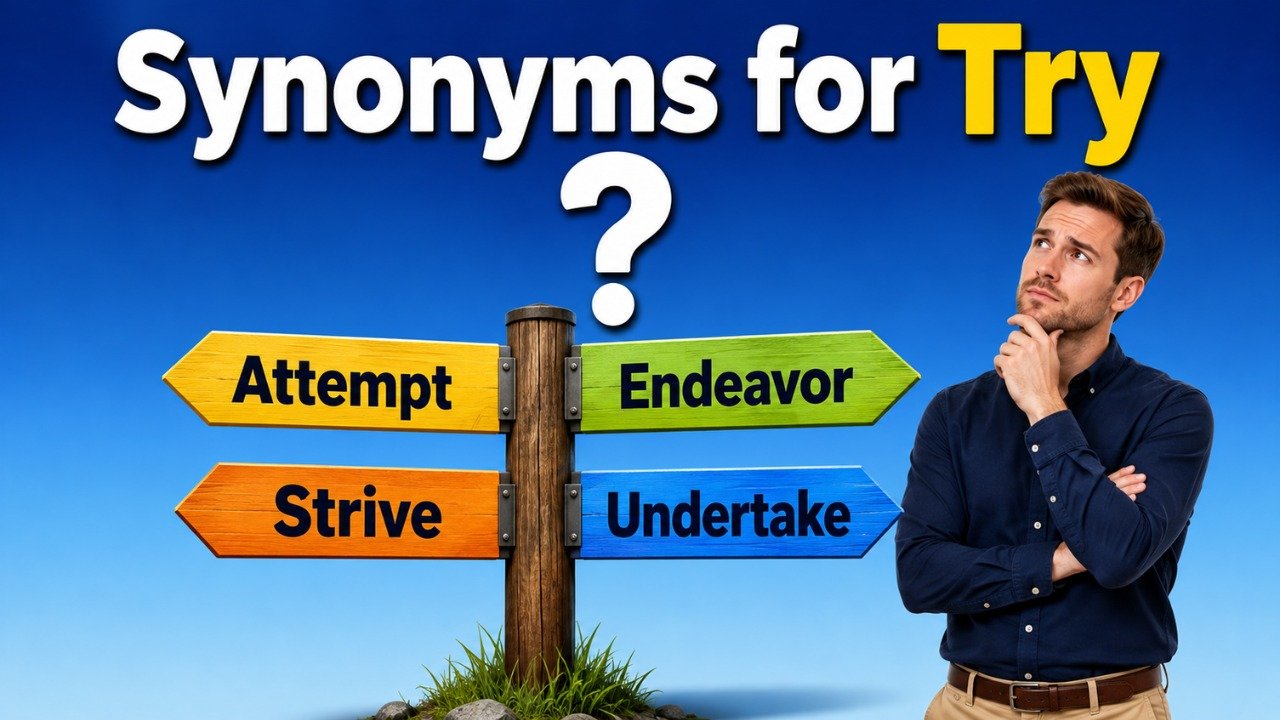
Quick Answer: Common synonyms for try include attempt, endeavor, strive, test, examine, sample, venture, seek, undertake, and pursue. Use attempt for a general effort, endeavor for formal writing, strive for determined effort, test for checking performance, sample for experiencing something briefly, and venture for an attempt involving uncertainty or risk. The best synonym depends on whether you are describing effort, testing, exploration, experience, or a serious goal.
Pronunciation and Word Details
Word: Try.
Pronunciation: /traɪ/.
Part of Speech: Verb and noun.
Meaning: To make an effort to do something, test something, or experience something to discover whether it is suitable.
US Pronunciation:
UK Pronunciation:
What Does “Try” Mean?
Try means to make an effort to perform an action, achieve a result, or discover whether something works.
As a verb, try can describe an attempt, an experiment, a test, or a brief experience. A person may try to finish a task, try a new method, try some food, or try a product before making a decision.
As a noun, try refers to an attempt or effort.
Verb Example: She will try to complete the project today.
Testing Example: Try the new setting before saving the document.
Experience Example: He decided to try a different recipe.
Noun Example: Give the puzzle another try.
The meaning of try changes according to its object and sentence structure. In some contexts, it expresses effort. In others, it means testing, tasting, examining, or experiencing something.
Meaning, Tone, and Context of “Try”
Try is a neutral and widely used word. It appears naturally in casual conversation, professional communication, instructions, stories, and everyday writing.
In formal or academic writing, a more specific synonym may create greater precision. Attempt, endeavor, assess, evaluate, and examine often sound more suitable in reports, essays, and professional documents.
In casual speech, phrases such as give it a go, have a go, and take a shot sound natural and friendly.
Try can also express encouragement without placing too much pressure on someone.
Encouraging Tone: Try your best and focus on your progress.
Neutral Tone: We will try a different approach.
Formal Tone: The researchers attempted to reproduce the results.
Determined Tone: She strove to improve her performance.
The word is flexible, but the surrounding context determines whether it means effort, testing, sampling, exploration, or judgment.
When and How to Use “Try”
For Making an Attempt
Use try when someone makes an effort to complete an action or achieve a goal.
Example: I will try to finish the report before noon.
For Testing Something
Use try when checking whether an object, system, method, or idea works properly.
Example: Try restarting the device before changing the settings.
For Experiencing Something New
Use try when tasting, using, visiting, or experiencing something for the first time.
Example: You should try the vegetable soup.
For Seeking a Result
Use try when someone takes action in the hope of producing a particular result.
Example: We can try calling the office again.
For Giving Advice
Use try before an action when suggesting a possible solution.
Example: Try adding more detail to the opening paragraph.
For Making a Determined Effort
Use try when someone works hard despite difficulty.
Example: She tried to remain calm during the discussion.
For Checking Suitability
Use try when deciding whether clothing, equipment, or a method is appropriate.
Example: He tried the jacket before buying it.
For Legal Judgment
Try can mean to examine a case and decide whether someone is legally responsible.
Example: The court will try the case next month.
Best Synonyms for Try
Attempt: To make an effort to complete something.
Example: She attempted to solve the problem without assistance.
Endeavor: To make a serious and determined effort.
Example: The team endeavored to improve customer satisfaction.
Strive: To work hard toward a difficult goal.
Example: We strive to produce clear and accurate information.
Test: To check the quality, performance, or condition of something.
Example: The engineers tested the equipment before use.
Examine: To inspect something carefully.
Example: The doctor examined the patient’s injured hand.
Sample: To try a small amount of something.
Example: Visitors may sample several kinds of bread.
Venture: To attempt something uncertain or risky.
Example: She ventured to present a completely new proposal.
Seek: To make an effort to find, obtain, or achieve something.
Example: They sought a peaceful solution to the disagreement.
Undertake: To accept responsibility for a task or activity.
Example: The organization undertook a detailed investigation.
Pursue: To continue working toward a goal or interest.
Example: He pursued his ambition despite several difficulties.
50 Synonyms for Try with Short Meanings
- Attempt: Make an effort to do something.
- Endeavor: Make a serious and determined effort.
- Strive: Work hard to achieve a goal.
- Seek: Attempt to find or obtain something.
- Aim: Direct effort toward a result.
- Venture: Attempt something uncertain or risky.
- Undertake: Accept and begin a task.
- Pursue: Continue working toward a goal.
- Work: Apply effort to achieve something.
- Labor: Work with considerable effort.
- Struggle: Try hard despite difficulty.
- Push: Apply greater effort or determination.
- Apply Oneself: Concentrate effort on a task.
- Make an Effort: Use energy to achieve something.
- Give It a Go: Try something in a casual way.
- Have a Go: Make an informal attempt.
- Take a Shot: Attempt something with uncertain success.
- Take a Stab: Make an attempt without complete confidence.
- Test: Check how well something works.
- Check: Examine something for accuracy or condition.
- Examine: Look at something carefully.
- Assess: Judge quality, value, or performance.
- Evaluate: Study something before forming a judgment.
- Inspect: Examine closely for problems or details.
- Investigate: Study something to discover facts.
- Explore: Try or examine different possibilities.
- Experiment: Test an idea or method.
- Sample: Try a small amount or selection.
- Taste: Try food or drink.
- Experience: Encounter or participate in something.
- Use: Try something for a practical purpose.
- Employ: Use a method or tool.
- Apply: Put a method or idea into practice.
- Practice: Repeat an activity to improve.
- Rehearse: Practice before a performance or event.
- Pilot: Test something on a limited scale.
- Trial: Test something before full use.
- Prove: Test the quality or truth of something.
- Verify: Check whether something is correct.
- Challenge: Test someone’s ability or strength.
- Judge: Form an opinion after examination.
- Hear: Examine and decide a legal case.
- Adjudicate: Make a formal judgment in a dispute.
- Assay: Test or examine something carefully.
- Essay: Make an attempt in a formal or literary sense.
- Risk: Attempt something despite possible danger.
- Dare: Attempt something bold or difficult.
- Probe: Examine or test something deeply.
- Review: Examine something again or carefully.
- Measure: Assess the amount, quality, or success of something.
Read Also:
Synonyms for Social Media

Synonyms for Try by Context
When Try Means Make an Attempt
Attempt, endeavor, venture, undertake, seek, aim, and pursue describe efforts to complete an action or reach a goal.
Attempt is the most direct replacement for try. Endeavor suggests greater seriousness, while venture often involves uncertainty.
Example With Try: She tried to answer every question.
Example With Attempt: She attempted to answer every question.
Example With Endeavor: She endeavored to answer every question accurately.
When Try Means Make a Strong Effort
Strive, struggle, labor, push, work, and apply oneself emphasize energy, determination, or difficulty.
Strive is especially useful when a person is making continuous progress toward an important goal.
Example With Try: He tried to become a better writer.
Example With Strive: He strove to become a better writer.
Example With Apply Oneself: He applied himself to improving his writing.
When Try Means Test or Check
Test, assess, evaluate, examine, inspect, verify, and review are appropriate when checking quality, accuracy, condition, or effectiveness.
Test focuses on performance. Examine and inspect focus on careful observation. Assess and evaluate focus on judgment.
Example With Try: Try the software before installing it everywhere.
Example With Test: Test the software before installing it everywhere.
Example With Evaluate: Evaluate the software before approving wider use.
When Try Means Sample or Experience
Sample, taste, experience, explore, and use describe trying something to discover what it is like.
Sample often refers to a small amount. Experience has a broader meaning and may involve an activity, event, or feeling.
Example With Try: We tried several local dishes.
Example With Sample: We sampled several local dishes.
Example With Experience: We experienced several local traditions.
When Try Means Experiment
Experiment, pilot, trial, explore, apply, and employ work well when testing a method, system, or idea.
Experiment suggests uncertainty and discovery. Pilot refers to a limited test before wider use.
Example With Try: The school tried a new teaching method.
Example With Experiment: The school experimented with a new teaching method.
Example With Pilot: The school piloted a new teaching method.
When Try Means Take a Risk
Venture, dare, risk, take a shot, and take a stab describe attempts involving uncertainty, courage, or limited confidence.
Example With Try: She tried to start her own business.
Example With Venture: She ventured into business ownership.
Example With Take a Shot: She took a shot at starting her own business.
Another Word for Try
The best general replacement for try is attempt. It works naturally when someone makes an effort to complete an action.
However, the best alternative depends on meaning. Use test when checking performance, sample when experiencing food or products, strive when showing determination, and experiment when exploring an uncertain method.
Original: I will try to solve the issue today.
Better Option: I will attempt to solve the issue today.
Original: Try the equipment before the event.
Better Option: Test the equipment before the event.
Original: She tried several desserts.
Better Option: She sampled several desserts.
Original: They try to maintain high standards.
Better Option: They strive to maintain high standards.
When Not to Use “Try”
Try can sound vague when a more precise verb would explain the action clearly. Avoid relying on it repeatedly in formal writing, reports, instructions, or detailed descriptions.
When Describing a Formal Attempt
Attempt or endeavor may sound more professional.
Weak: The committee tried to resolve the dispute.
Better: The committee attempted to resolve the dispute.
When Describing a Detailed Evaluation
Assess or evaluate explains the process more accurately.
Weak: The researchers tried the new method.
Better: The researchers evaluated the new method.
When Describing Product Performance
Test is more precise than try.
Weak: We tried the machine under extreme conditions.
Better: We tested the machine under extreme conditions.
When Describing Determination
Strive may communicate greater commitment.
Weak: The organization tries to improve quality.
Better: The organization strives to improve quality.
When Describing Food or Drink
Taste or sample may provide a clearer image.
Weak: She tried the soup.
Better: She tasted the soup.
When Try Becomes Repetitive
Repeated use can make a paragraph sound plain or monotonous.
Weak: We tried one plan, tried another method, and tried a different system.
Better: We tested one plan, explored another method, and evaluated a different system.
Words Commonly Confused With Try
Try vs Attempt: Try is common and conversational, while attempt can sound more deliberate or formal.
Try vs Test: Try can mean make an effort or experience something. Test specifically means checking performance, quality, or accuracy.
Try vs Strive: Try describes any effort. Strive suggests continuous, determined effort toward a meaningful goal.
Try vs Seek: Try focuses on making an effort. Seek focuses on looking for or attempting to obtain something.
Try vs Experiment: Try is broad. Experiment suggests testing an uncertain idea to learn what happens.
Try vs Sample: Try can describe many actions. Sample usually means experiencing a small amount or limited selection.
Try vs Practice: Try means make an attempt. Practice means repeat an activity to develop skill.
Try vs Undertake: Try emphasizes effort. Undertake emphasizes accepting responsibility and beginning a task.
Which Synonym Should You Choose?
Choose attempt for a direct and slightly more formal replacement for try.
Choose endeavor when describing a serious, organized, or determined effort.
Choose strive when someone works continuously toward improvement or success.
Choose test when checking how well a product, method, system, or person performs.
Choose examine when looking at something carefully for information or problems.
Choose assess when judging quality, value, ability, risk, or progress.
Choose evaluate when analyzing results before making a decision.
Choose sample when trying a small amount of food, drink, or another product.
Choose experiment when testing a new idea without knowing the outcome.
Choose venture when an attempt involves uncertainty, courage, or risk.
Choose give it a go in friendly, casual conversation.
Choose undertake in formal reports, professional writing, and descriptions of major tasks.
Choose pursue when describing a continuing effort to achieve a goal, career, interest, or ambition.
Real Life Examples of “Try” in Sentences
Original: I will try to contact her this afternoon.
Better Option: I will attempt to contact her this afternoon.
Original: Try the new password before requesting another one.
Better Option: Test the new password before requesting another one.
Original: She tries to improve her communication skills.
Better Option: She strives to improve her communication skills.
Original: We tried several solutions before finding the answer.
Better Option: We explored several solutions before finding the answer.
Original: He tried the chocolate cake.
Better Option: He sampled the chocolate cake.
Original: The company tried a new training program.
Better Option: The company piloted a new training program.
Original: They tried to reach an agreement.
Better Option: They sought to reach an agreement.
Original: She tried to complete the difficult assignment.
Better Option: She endeavored to complete the difficult assignment.
Original: Try the jacket to see whether it fits.
Better Option: Test the fit of the jacket before making a decision.
Original: He tried starting the computer again.
Better Option: He experimented with restarting the computer.
Synonym Groups and Usage Differences
General Attempt Group
Attempt, try, take a shot, have a go, and give it a go describe making an effort.
Attempt is neutral and versatile. Have a go and give it a go are more casual.
Example: She decided to have a go at solving the puzzle.
Determined Effort Group
Strive, endeavor, struggle, labor, push, and apply oneself emphasize effort and commitment.
Strive and endeavor sound positive. Struggle suggests difficulty, while labor emphasizes hard work.
Example: The team endeavored to complete the work on time.
Testing Group
Test, check, verify, inspect, assess, and evaluate involve examining quality or accuracy.
Test focuses on performance. Verify focuses on correctness. Inspect focuses on visible details.
Example: The technician inspected the equipment for damage.
Exploration Group
Explore, experiment, probe, investigate, and venture involve discovery or uncertainty.
Explore is broad and open. Investigate is more systematic. Probe suggests deep examination.
Example: The researchers investigated several possible causes.
Experience Group
Sample, taste, experience, use, and trial describe discovering what something is like.
Taste is limited to flavor. Sample often involves a small amount. Experience is the broadest option.
Example: Guests sampled a variety of fresh dishes.
Formal Action Group
Undertake, endeavor, assess, adjudicate, and assay are suitable for formal or technical contexts.
These words are useful when try sounds too informal or imprecise.
Example: The agency undertook a complete review of the process.
Antonyms of Try
The opposite of try depends on whether the word means attempt, test, experience, or make an effort.
Quit: Stop making an effort.
Abandon: Leave an attempt or plan unfinished.
Surrender: Stop resisting or working toward success.
Avoid: Stay away from an action or experience.
Refuse: Decline to make an attempt.
Ignore: Give no attention to something that could be tested or examined.
Neglect: Fail to give proper effort or attention.
Desist: Stop performing an action.
Withdraw: Remove oneself from an activity or attempt.
Overlook: Fail to examine or consider something.
Reject: Decide not to accept or test an option.
Give Up: Stop trying to achieve something.
Comparison: Try vs Related Words
Try vs Attempt
Try is more common in everyday conversation. Attempt often sounds more formal, deliberate, or challenging.
Example With Try: I will try to finish the work tonight.
Example With Attempt: I will attempt to finish the work tonight.
Try vs Test
Try may mean make an effort or experience something. Test means check quality, accuracy, ability, or performance.
Example With Try: Try using a different method.
Example With Test: Test the method before applying it widely.
Try vs Strive
Try describes a general effort. Strive suggests strong motivation and continued effort.
Example With Try: We try to provide clear answers.
Example With Strive: We strive to provide clear answers.
Try vs Experiment
Try is broad and may involve one simple action. Experiment suggests testing a new idea to learn from the result.
Example With Try: Try adding more detail.
Example With Experiment: Experiment with adding more detail to different sections.
Try vs Sample
Try can refer to any experience. Sample usually means trying a small quantity or limited selection.
Example With Try: She tried the new tea.
Example With Sample: She sampled the new tea.
Try vs Undertake
Try emphasizes effort and possible success or failure. Undertake emphasizes responsibility and commitment.
Example With Try: He tried to organize the event.
Example With Undertake: He undertook the responsibility of organizing the event.
Common Phrases and Expressions With “Try”
Try Again: Make another attempt after the first one fails.
Try Hard: Use considerable effort.
Try Your Best: Make the greatest effort you can.
Give It a Try: Make an attempt to see what happens.
Try Out: Test or use something before making a decision.
Try On: Put on clothing to check its appearance or fit.
Try For: Attempt to obtain a position, result, or achievement.
Try To: Make an effort to perform an action.
Try Something New: Experience an unfamiliar activity, method, or idea.
Try Your Luck: Attempt something when success depends partly on chance.
Common Mistakes to Avoid
One common mistake is using try when a more precise word would improve clarity. In formal writing, test, evaluate, assess, attempt, or examine may describe the action more accurately.
Another mistake is repeating try several times in the same paragraph. Replace repeated uses with synonyms that match each meaning.
Do not treat every synonym as interchangeable. Strive suggests determination, test suggests evaluation, and sample suggests limited experience.
Writers also confuse try to with try doing. Try to do something means make an effort to complete it. Try doing something means use an action as a possible solution.
Effort: Try to open the locked door.
Possible Solution: Try turning the handle slowly.
Avoid unnatural phrasing created by replacing try without adjusting the sentence structure.
Unnatural: She endeavored the new recipe.
Correct: She tried the new recipe.
Correct Formal Option: She attempted to prepare the new recipe.
Remember that give it a go and take a shot are suitable for conversation but may sound too informal in academic or professional reports.
Conclusion
Synonyms for try help writers express effort, testing, determination, experience, and exploration more precisely. Attempt is the strongest general replacement, while endeavor and strive emphasize serious effort. Test, assess, and evaluate work well when checking performance or quality. Sample and taste suit food or product experiences, while experiment and explore describe uncertain methods or new possibilities. Choosing a synonym based on context makes each sentence clearer, more natural, and more meaningful.
FAQs About Synonyms for Try
What Is the Best Synonym for Try?
Attempt is the best general synonym for try because it describes making an effort to do something.
What Is a Formal Synonym for Try?
Endeavor, attempt, undertake, and seek are useful formal alternatives, depending on the sentence.
What Is Another Word for Trying Hard?
Striving, struggling, laboring, pushing, and applying oneself all describe trying hard.
What Is a Casual Synonym for Try?
Give it a go, have a go, take a shot, and take a stab are common casual alternatives.
What Is a Synonym for Trying a Product?
Test, sample, use, trial, and evaluate can describe trying a product.
Is Test Always a Synonym for Try?
No. Test is a synonym only when try means checking quality, ability, accuracy, or performance.
What Is the Difference Between Try and Attempt?
Try is more common and conversational. Attempt often sounds more deliberate, formal, or connected to a difficult action.
