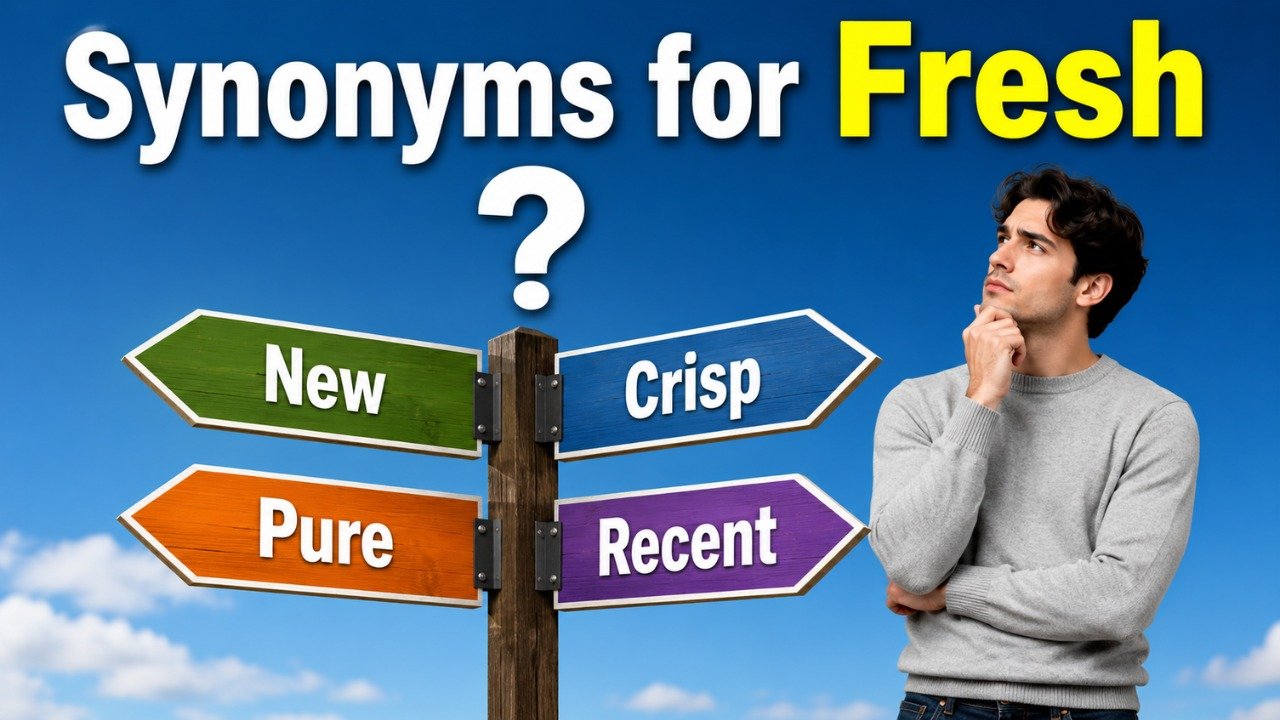
Quick Answer: The best synonyms for fresh include new, recent, crisp, clean, pure, lively, vibrant, original, renewed, and unspoiled. New is best for something that has just been created or obtained. Recent suits news, events, and information. Crisp describes food, air, fabric, or a neat appearance. Clean and pure work for air, water, scents, and environments. Original fits ideas and designs, while lively and vibrant describe energy. Unspoiled is useful for food, produce, and natural places.
Pronunciation and Word Details
Word: Fresh.
Pronunciation: /freʃ/.
Part of Speech: Adjective.
Meaning: New, recently made, clean, energetic, original, or not spoiled.
US Pronunciation:
UK Pronunciation:
What Does “Fresh” Mean?
Fresh means new, recently created, recently gathered, clean, cool, energetic, or original. It is mainly used as an adjective.
Fresh can describe food that has been recently prepared or has not become spoiled. Fresh bread, fresh fruit, and fresh milk are considered suitable for eating or drinking.
The word can also describe something new or recent. Fresh information is newly received, while a fresh idea is original or different from previous ideas.
When used for air, water, clothing, or rooms, fresh often means clean, pure, cool, or pleasant.
Fresh may also describe a person who appears energetic, rested, healthy, or youthful. A fresh appearance usually looks bright, clean, and lively.
In informal language, fresh can sometimes describe rude, overly confident, or disrespectful behavior. The intended meaning depends on the sentence and situation.
Meaning, Tone, and Context of “Fresh”
Fresh usually has a positive, neutral, and conversational tone.
In food related contexts, fresh suggests quality, good condition, and recent preparation. It is commonly used for fruit, vegetables, bread, meat, flowers, and ingredients.
In professional or academic writing, fresh often means new, recent, updated, or original. Writers may discuss fresh evidence, fresh research, fresh insight, or a fresh approach.
In descriptions of appearance, fresh suggests cleanliness, brightness, energy, or youthfulness. A fresh face or fresh outfit appears neat, lively, and pleasant.
When describing air or weather, fresh can mean cool, clean, or slightly cold. A fresh breeze may feel pleasant and energizing.
Fresh can also describe a renewed beginning. A fresh start means leaving previous difficulties behind and beginning again.
In informal conversation, calling someone fresh may mean that the person is being cheeky, bold, rude, or disrespectful. This use is less common in formal writing.
When and How to Use “Fresh”
For Recently Prepared Food
Use fresh for food that has been recently cooked, baked, picked, caught, or prepared.
Example: The bakery sells fresh bread every morning.
For New Information
Use fresh for facts, evidence, news, or information that has recently become available.
Example: The investigation produced fresh evidence.
For Original Ideas
Use fresh for ideas, designs, opinions, or approaches that feel original and interesting.
Example: The team needs a fresh approach to the problem.
For Clean Air and Water
Use fresh when air, water, or a space feels clean, pure, and pleasant.
Example: She opened the window to let in fresh air.
For Energy and Appearance
Use fresh for someone who looks rested, lively, clean, or healthy.
Example: He looked fresh after a full night of sleep.
For a New Beginning
Use fresh for a new opportunity, start, attempt, or stage.
Example: Moving to a new city gave her a fresh start.
For Bright Style
Use fresh for colors, clothing, interiors, or designs that appear clean, modern, and lively.
Example: The white curtains gave the room a fresh look.
For Cool Weather
Use fresh for cool, pleasant, or slightly cold air.
Example: A fresh breeze came through the open door.
For Rude Behavior
Use fresh informally when someone behaves in an overly bold or disrespectful way.
Example: Do not get fresh with your teacher.
Best Synonyms for Fresh
New
Synonym: Recently created, obtained, introduced, or discovered.
Example: She bought a new notebook for the course.
Recent
Synonym: Happening or existing not long ago.
Example: Recent reports show a change in customer behavior.
Crisp
Synonym: Firm, cool, neat, or pleasantly fresh.
Example: The salad contained crisp lettuce and cucumber.
Clean
Synonym: Free from dirt, pollution, or unpleasant smells.
Example: The room smelled clean after the windows were opened.
Pure
Synonym: Not mixed with harmful, dirty, or unwanted substances.
Example: The mountain stream contained pure water.
Lively
Synonym: Full of energy, movement, or enthusiasm.
Example: The discussion became lively after the first question.
Vibrant
Synonym: Bright, energetic, and full of life.
Example: The artist used vibrant colors in the design.
Original
Synonym: New, creative, and not copied from something else.
Example: She presented an original solution to the problem.
Renewed
Synonym: Made active, strong, or effective again.
Example: The successful meeting gave the team renewed confidence.
Unspoiled
Synonym: Still in good condition and not damaged or rotten.
Example: The vegetables remained unspoiled in the cool storage area.
50 Synonyms for Fresh with Short Meanings
- New: Recently created, obtained, or introduced.
- Recent: Happening or existing not long ago.
- Latest: Most recently produced or received.
- Current: Belonging to the present time.
- Modern: Related to present styles or ideas.
- Novel: New, unusual, or original.
- Original: Creative and not copied.
- Innovative: Introducing a new method or idea.
- Creative: Producing new and imaginative ideas.
- Updated: Changed to include recent information.
- Renewed: Made active, strong, or effective again.
- Refreshed: Made clean, rested, or energetic again.
- Restored: Returned to a good condition.
- Revived: Brought back to life or activity.
- Rejuvenated: Made to feel younger or more energetic.
- Invigorated: Filled with strength and energy.
- Energetic: Full of physical or mental activity.
- Lively: Full of life, movement, or enthusiasm.
- Vibrant: Bright, active, and full of energy.
- Spirited: Showing energy, courage, or enthusiasm.
- Youthful: Appearing young, active, or lively.
- Alert: Awake, attentive, and ready to act.
- Crisp: Firm, cool, neat, or pleasantly fresh.
- Cool: Slightly cold and refreshing.
- Clean: Free from dirt or unpleasant smells.
- Pure: Free from harmful or unwanted substances.
- Clear: Clean, transparent, or easy to understand.
- Bracing: Pleasantly cool and energizing.
- Fragrant: Having a pleasant, fresh smell.
- Aromatic: Having a noticeable and pleasant scent.
- Unspoiled: Still good and not rotten or damaged.
- Wholesome: Healthy, natural, and beneficial.
- Natural: Existing without artificial treatment.
- Raw: Not cooked or processed.
- Uncooked: Not prepared through heating.
- Newly Made: Produced only a short time ago.
- Newly Prepared: Recently made and ready to use.
- Newly Baked: Recently cooked in an oven.
- Newly Picked: Recently gathered from a plant.
- Newly Harvested: Recently collected from a crop.
- Just Caught: Recently taken from water or the wild.
- Unwilted: Still firm and not drooping.
- Blooming: Producing flowers or appearing healthy.
- Verdant: Green, growing, and full of plant life.
- Green: Fresh, young, or not fully mature.
- Bright: Clear, vivid, cheerful, or energetic.
- Pristine: Completely clean and untouched.
- Unused: Not previously used.
- Untouched: Not changed, handled, or damaged.
- Cheeky: Bold or slightly disrespectful in behavior.
Read Also:
Synonyms for Stating

Synonyms for Fresh by Context
When Fresh Means New
New, latest, current, modern, novel, updated, and recent describe something that has recently appeared, happened, or become available.
New is the most general replacement. Recent is better for events, reports, changes, and information. Latest refers to the newest available version.
Example: The writer added fresh information to the article.
Alternative: The writer added recent information to the article.
When Fresh Means Original
Original, innovative, creative, and novel describe ideas, designs, solutions, and approaches that feel different from what came before.
Original emphasizes uniqueness. Innovative suggests a useful improvement or method. Creative emphasizes imagination.
Example: We need a fresh idea for the campaign.
Alternative: We need an original idea for the campaign.
When Fresh Means Recently Prepared
Newly made, newly prepared, newly baked, newly picked, newly harvested, and just caught describe food or ingredients obtained or prepared recently.
Newly baked works for bread, cakes, and pastries. Newly picked suits fruit, vegetables, and flowers. Just caught is commonly used for fish.
Example: The restaurant serves fresh bread.
Alternative: The restaurant serves newly baked bread.
When Fresh Means Not Spoiled
Unspoiled, wholesome, natural, raw, unwilted, and pristine can describe food, flowers, ingredients, or natural environments that remain in good condition.
Unspoiled is best when the main concern is decay. Unwilted suits leaves, herbs, and flowers. Wholesome emphasizes health and quality.
Example: Make sure the vegetables are fresh.
Alternative: Make sure the vegetables are unspoiled.
When Fresh Means Clean
Clean, pure, clear, pristine, and untouched describe air, water, clothing, rooms, and environments without dirt, pollution, or unpleasant smells.
Clean is the most direct replacement. Pure emphasizes the absence of harmful substances. Pristine suggests an exceptionally clean or untouched condition.
Example: The open windows brought fresh air into the room.
Alternative: The open windows brought clean air into the room.
When Fresh Means Cool
Cool, crisp, and bracing describe air or weather that feels pleasantly cold and refreshing.
Crisp often describes cool autumn air. Bracing describes air that feels strongly refreshing and energizing.
Example: We enjoyed the fresh morning air.
Alternative: We enjoyed the crisp morning air.
When Fresh Means Energetic
Energetic, lively, vibrant, spirited, youthful, alert, invigorated, refreshed, and rejuvenated describe people who appear active, healthy, or rested.
Refreshed is best after rest or relaxation. Invigorated suggests new strength. Youthful describes a young or energetic appearance.
Example: She looked fresh after the holiday.
Alternative: She looked refreshed after the holiday.
When Fresh Means Renewed
Renewed, restored, revived, refreshed, and rejuvenated describe something that becomes strong, useful, attractive, or active again.
Renewed works for interest, confidence, hope, and energy. Restored is suitable for objects, buildings, systems, and relationships.
Example: The conversation gave him fresh hope.
Alternative: The conversation gave him renewed hope.
When Fresh Means Bright or Attractive
Bright, vibrant, crisp, clean, and modern can describe style, colors, clothing, interiors, and visual presentation.
Bright emphasizes light or cheerful color. Crisp suggests neatness. Modern suggests a current and updated appearance.
Example: The room has a fresh design.
Alternative: The room has a modern design.
When Fresh Means Rude
Cheeky, bold, impudent, disrespectful, and forward describe behavior that is too confident or lacking respect.
Cheeky may sound playful. Impudent and disrespectful have a stronger negative meaning.
Example: The student became fresh with the instructor.
Alternative: The student became disrespectful toward the instructor.
Another Word for Fresh
New is often the best single replacement for fresh when describing something recently created, introduced, or obtained.
However, the best alternative depends on context. Use recent for information, crisp for food or air, clean for rooms and clothing, original for ideas, lively for energy, and unspoiled for food.
Original: The report contains fresh information.
Better Option: The report contains recent information.
Original: She brought fresh bread to the table.
Better Option: She brought newly baked bread to the table.
Original: The designer offered a fresh perspective.
Better Option: The designer offered an original perspective.
Original: He looked fresh after resting.
Better Option: He looked refreshed after resting.
When Not to Use “Fresh”
Do not use fresh when a more specific synonym would make the sentence clearer.
Fresh has several meanings, so it may sound vague when readers cannot tell whether it means new, clean, cool, original, energetic, or recently prepared.
When Referring to Time
Use recent, latest, or current when the exact time relationship matters.
Weak: The article discusses fresh developments.
Better: The article discusses recent developments.
When Describing an Idea
Use original, innovative, or creative when you want to emphasize uniqueness.
Weak: She suggested a fresh solution.
Better: She suggested an innovative solution.
When Describing Food Quality
Use unspoiled when the focus is on whether food is still safe or suitable to eat.
Weak: Check whether the milk is fresh.
Better: Check whether the milk is unspoiled.
When Describing Preparation
Use newly baked, newly cooked, newly picked, or newly prepared when the method matters.
Weak: They served fresh pastries.
Better: They served newly baked pastries.
When Describing Cleanliness
Use clean or pure when the absence of dirt or pollution is the main point.
Weak: The room felt fresh after cleaning.
Better: The room felt clean after being aired.
When Describing Energy
Use refreshed, lively, energetic, or alert when referring to a person’s condition.
Weak: I felt fresh after the short break.
Better: I felt refreshed after the short break.
When Describing Weather
Use crisp, cool, or bracing when the temperature or sensation matters.
Weak: The air was fresh that morning.
Better: The air was crisp that morning.
When Describing Behavior
Fresh can be unclear because its meaning changes by region and context. Use cheeky, rude, bold, or disrespectful for greater clarity.
Weak: He was fresh with the staff.
Better: He was disrespectful toward the staff.
Words Commonly Confused With Fresh
Fresh vs New: Fresh can mean new, clean, cool, recently prepared, or energetic. New mainly means recently created, obtained, or introduced.
Fresh vs Recent: Fresh may describe food, air, appearance, or ideas. Recent refers specifically to something that happened or appeared not long ago.
Fresh vs Crisp: Fresh is broader. Crisp describes firmness, coolness, neatness, or a pleasant texture.
Fresh vs Clean: Fresh may suggest cleanliness, but clean specifically means free from dirt, stains, or unwanted substances.
Fresh vs Pure: Fresh can describe something pleasant and new. Pure means unmixed, uncontaminated, or free from harmful substances.
Fresh vs Original: Fresh can suggest a new feeling or appearance. Original specifically describes something creative and not copied.
Fresh vs Raw: Fresh food is recently obtained or prepared. Raw food has not been cooked.
Fresh vs Ripe: Fresh means recently picked or still in good condition. Ripe means fully developed and ready to eat.
Fresh vs Refreshed: Fresh describes a current quality. Refreshed describes someone or something that has regained energy, cleanliness, or strength.
Which Synonym Should You Choose?
Choose new for recently created products, experiences, objects, systems, or opportunities.
Choose recent for reports, events, evidence, information, changes, and developments.
Choose latest for the newest available update, version, result, or announcement.
Choose current for information, rules, conditions, or trends that apply at the present time.
Choose original for ideas, writing, artwork, designs, and solutions that are not copied.
Choose innovative for methods, technology, strategies, and solutions that introduce useful change.
Choose crisp for vegetables, fruit, air, clothing, paper, sounds, or neat visual presentation.
Choose clean for rooms, clothing, air, scents, and environments without dirt or unpleasant smells.
Choose pure for water, air, ingredients, materials, or substances without contamination.
Choose unspoiled for food that has not become rotten or damaged.
Choose newly baked for bread, cakes, pastries, and other oven prepared foods.
Choose newly picked for fruit, vegetables, herbs, and flowers gathered recently.
Choose refreshed when a person feels rested, cleaner, calmer, or more energetic.
Choose invigorated when someone gains noticeable strength, excitement, or energy.
Choose lively for conversations, performances, personalities, events, and environments full of activity.
Choose vibrant for colors, communities, designs, and personalities that feel bright and energetic.
Choose renewed for confidence, hope, effort, interest, strength, and commitment.
Choose pristine for places, objects, or materials that are exceptionally clean and untouched.
Choose cheeky when describing mildly bold or disrespectful behavior in casual speech.
Real Life Examples of “Fresh” in Sentences
Original: The store received fresh vegetables this morning.
Better Option: The store received newly harvested vegetables this morning.
Original: We need fresh information before making a decision.
Better Option: We need updated information before making a decision.
Original: The team presented a fresh idea.
Better Option: The team presented an original idea.
Original: She opened the door to get some fresh air.
Better Option: She opened the door to get some clean air.
Original: He felt fresh after taking a short nap.
Better Option: He felt refreshed after taking a short nap.
Original: The room has a fresh and cheerful appearance.
Better Option: The room has a bright and cheerful appearance.
Original: The bread was still fresh when we arrived.
Better Option: The bread was still newly baked when we arrived.
Original: A fresh breeze moved through the trees.
Better Option: A cool breeze moved through the trees.
Original: The meeting gave everyone fresh confidence.
Better Option: The meeting gave everyone renewed confidence.
Original: The child became fresh with his parents.
Better Option: The child became cheeky with his parents.
Synonym Groups and Usage Differences
Newness Group
New, recent, latest, current, modern, updated, and novel relate to time, change, or recent creation.
New is broad and flexible. Recent emphasizes time. Latest identifies the newest available version. Current means relevant at the present moment.
Example: The document contains updated information about the policy.
Originality Group
Original, innovative, creative, and novel describe ideas or methods that differ from previous ones.
Original emphasizes uniqueness. Innovative often suggests practical improvement. Creative focuses on imagination.
Example: The writer introduced an original argument.
Food Quality Group
Unspoiled, wholesome, natural, raw, newly made, newly prepared, newly baked, newly picked, and newly harvested describe food quality or preparation.
Unspoiled emphasizes good condition. Newly prepared describes recent cooking or preparation. Wholesome suggests healthy quality.
Example: The meal was made with wholesome ingredients.
Cleanliness Group
Clean, pure, clear, pristine, untouched, and unused relate to cleanliness, purity, or an undisturbed condition.
Pure is best for substances. Pristine suggests perfect cleanliness. Untouched describes something that remains unchanged.
Example: The hikers found a pristine lake beyond the forest.
Coolness Group
Cool, crisp, and bracing describe pleasant, refreshing air or weather.
Cool is neutral. Crisp often feels pleasantly cold and clear. Bracing suggests stronger, energizing coldness.
Example: The crisp morning air helped everyone wake up.
Energy Group
Energetic, lively, vibrant, spirited, youthful, alert, refreshed, rejuvenated, and invigorated describe energy and activity.
Energetic refers to active behavior. Lively suggests movement and enthusiasm. Refreshed indicates energy regained after rest.
Example: She appeared refreshed and alert after the break.
Renewal Group
Renewed, restored, revived, rejuvenated, and refreshed describe improvement or a return to a better condition.
Restored often applies to objects, buildings, or systems. Revived means brought back into activity. Renewed suits feelings, promises, and efforts.
Example: The good results renewed their confidence.
Appearance Group
Bright, crisp, modern, clean, vibrant, and youthful describe a neat, attractive, or energetic appearance.
Crisp works well for clothing and design. Bright emphasizes cheerful color or light. Modern describes a current style.
Example: The new paint gave the office a bright appearance.
Antonyms of Fresh
The opposite of fresh depends on whether the word refers to food, information, air, energy, ideas, or appearance.
Stale: No longer fresh, new, or interesting.
Spoiled: No longer safe or suitable to eat.
Rotten: Decayed and unpleasant.
Wilted: Drooping or no longer firm.
Old: Existing for a long time.
Outdated: No longer current or accurate.
Obsolete: No longer used because something newer exists.
Used: Previously owned, handled, or operated.
Dirty: Covered with dirt or unwanted substances.
Polluted: Contaminated by harmful materials.
Musty: Having a stale and unpleasant smell.
Warm: Not cool or refreshing.
Tired: Lacking energy or alertness.
Exhausted: Extremely tired and without energy.
Dull: Lacking brightness, excitement, or energy.
Faded: Having lost brightness or strength.
Unoriginal: Not new or creative.
Conventional: Following familiar or traditional methods.
Rude: Lacking politeness or respect.
Mature: Fully developed rather than young or green.
Comparison: Fresh vs Related Words
Fresh vs New
Fresh has several meanings, including recently prepared, clean, energetic, and original. New mainly describes something recently created, purchased, or introduced.
Example With Fresh: We bought fresh vegetables from the market.
Example With New: We bought a new refrigerator for the kitchen.
Fresh vs Recent
Fresh may describe food, air, ideas, or appearance. Recent refers to something that happened or appeared a short time ago.
Example With Fresh: The team introduced a fresh approach.
Example With Recent: Recent results show steady improvement.
Fresh vs Crisp
Fresh is a broad word for newness, quality, cleanliness, or energy. Crisp describes firmness, coolness, clarity, or neatness.
Example With Fresh: The fruit is still fresh.
Example With Crisp: The apple has a crisp texture.
Fresh vs Clean
Fresh can mean pleasant, cool, new, or recently prepared. Clean specifically means free from dirt, stains, pollution, or unpleasant smells.
Example With Fresh: Fresh air entered through the window.
Example With Clean: The kitchen floor is clean.
Fresh vs Pure
Fresh often describes condition or quality. Pure means free from contamination, mixture, or unwanted substances.
Example With Fresh: The flowers had a fresh scent.
Example With Pure: The bottle contains pure spring water.
Fresh vs Original
Fresh can suggest a new feeling, look, or approach. Original means unique, creative, and not copied.
Example With Fresh: The room needs a fresh look.
Example With Original: The designer created an original pattern.
Fresh vs Raw
Fresh means recently obtained or still in good condition. Raw means not cooked, processed, or refined.
Example With Fresh: The café uses fresh ingredients.
Example With Raw: The recipe includes raw vegetables.
Fresh vs Refreshed
Fresh describes a current condition. Refreshed describes someone or something that has regained energy, cleanliness, or strength.
Example With Fresh: She looked fresh and confident.
Example With Refreshed: She felt refreshed after resting.
Fresh vs Ripe
Fresh means recently picked or still suitable for use. Ripe means fully developed and ready to eat.
Example With Fresh: These berries are fresh.
Example With Ripe: These peaches are ripe and sweet.
Common Phrases and Expressions With “Fresh”
Fresh Start: A new beginning after a difficult or unsuccessful period.
Fresh Air: Clean outdoor air that feels pleasant to breathe.
Fresh Idea: A new or original thought.
Fresh Perspective: A different and useful way of viewing something.
Fresh Look: A new, clean, modern, or attractive appearance.
Fresh Food: Food that is recently prepared or not spoiled.
Fresh Produce: Recently harvested fruit and vegetables.
Fresh Evidence: New information that may affect an investigation or decision.
Fresh Coat of Paint: A recently applied layer of paint.
Fresh From the Oven: Recently baked and still warm.
Fresh as a Daisy: Looking healthy, energetic, and well rested.
Fresh Opportunity: A new chance to achieve something.
Common Mistakes to Avoid
Using Fresh for Every Type of Newness
Fresh is flexible, but it may not always be precise. Use recent for events, latest for the newest version, and updated for revised information.
Weak: The report contains fresh statistics.
Better: The report contains updated statistics.
Confusing Fresh With Raw
Fresh food may be cooked or uncooked. Raw food has not been cooked.
Incorrect: The restaurant served fresh chicken without cooking it.
Improved: The restaurant stored raw chicken before cooking it.
Confusing Fresh With Ripe
Fruit can be fresh but not ripe. Fresh describes its condition, while ripe describes its stage of development.
Incorrect: The green mango is fresh, so it must be ready to eat.
Improved: The mango is fresh but not yet ripe.
Using Fresh Instead of Original
Fresh can describe an idea, but original is clearer when uniqueness is the main point.
Weak: The author gave a fresh argument.
Better: The author gave an original argument.
Repeating Fresh Too Often
Using fresh repeatedly can make writing sound vague or monotonous.
Repetitive: The café serves fresh bread, fresh fruit, and fresh juice in a fresh setting.
Improved: The café serves newly baked bread, ripe fruit, and recently prepared juice in a bright setting.
Choosing Clean When Pure Is Needed
Clean means free from visible dirt. Pure means free from contamination or unwanted substances.
Weak: The laboratory requires clean water for the test.
Better: The laboratory requires pure water for the test.
Using Fresh for Formal Time References
In reports and academic writing, recent, current, or updated may sound more precise.
Weak: Fresh research supports the conclusion.
Better: Recent research supports the conclusion.
Misusing the Informal Meaning
Fresh can mean rude or cheeky, but this meaning may not be understood in every context.
Unclear: He became fresh during the discussion.
Better: He became disrespectful during the discussion.
Conclusion
Synonyms for fresh change according to the intended meaning. New, recent, latest, and updated suit information and events. Crisp, clean, pure, and bracing describe food, air, and pleasant conditions. Original, creative, and innovative work well for ideas and solutions. Refreshed, lively, vibrant, and energetic describe people with renewed energy. Unspoiled, newly baked, and newly picked are useful for food. Choosing the most accurate alternative helps your writing sound clearer, more natural, and more specific.
FAQs About Synonyms for Fresh
What Is the Best Synonym for Fresh?
New is the broadest synonym for fresh. Recent, crisp, clean, original, refreshed, or unspoiled may be better depending on the context.
What Is Another Word for Fresh Food?
Unspoiled, wholesome, newly prepared, newly baked, newly picked, and newly harvested can describe fresh food.
What Is a Synonym for Fresh Ideas?
Original, creative, innovative, novel, and imaginative are useful alternatives for fresh ideas.
What Is Another Word for Fresh Air?
Clean air, pure air, crisp air, cool air, and bracing air are suitable alternatives.
What Is a Synonym for Feeling Fresh?
Refreshed, rejuvenated, invigorated, alert, energetic, and rested can describe someone who feels fresh.
Can Recent Replace Fresh?
Recent can replace fresh when discussing news, evidence, information, events, or developments that appeared not long ago.
What Is the Opposite of Fresh?
Common opposites include stale, spoiled, rotten, wilted, old, outdated, dirty, tired, dull, and unoriginal.
