
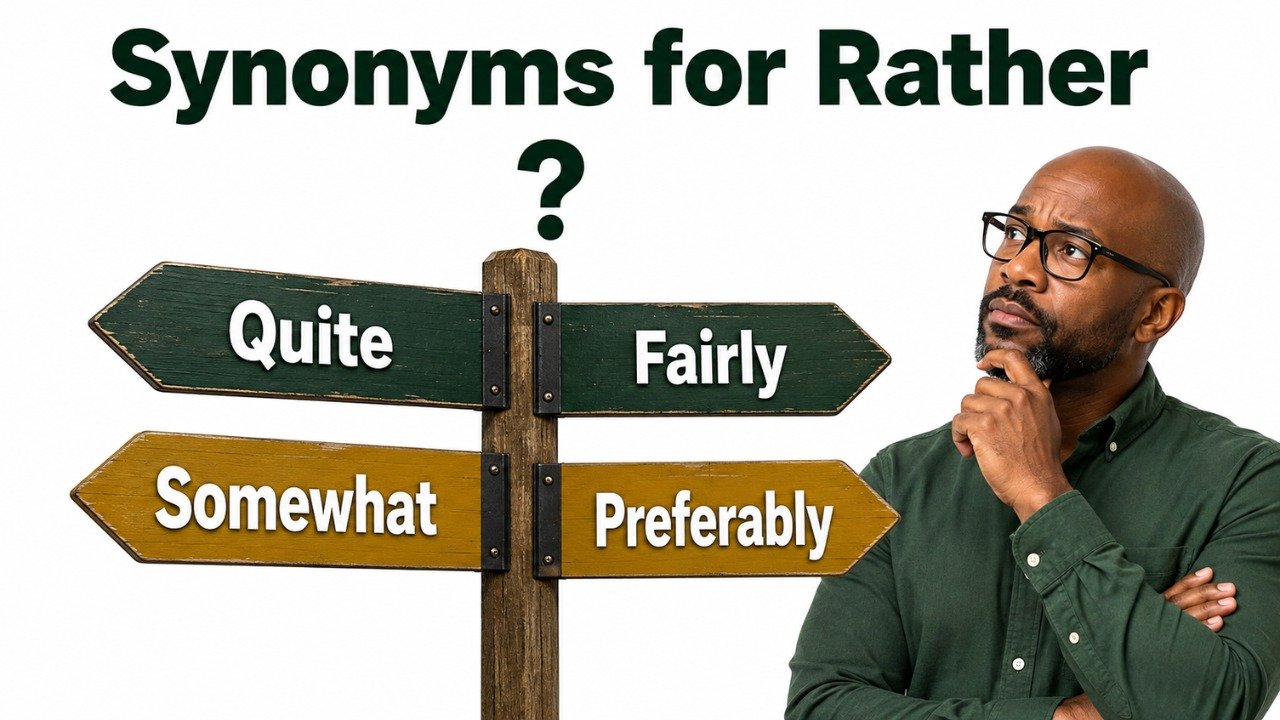
Quick Answer: Common synonyms for rather include instead, preferably, somewhat, quite, fairly, relatively, alternatively, sooner, more accurately, and more precisely. Use instead when choosing one option over another, preferably when expressing a desired choice, somewhat or fairly when rather means to a moderate degree, and more accurately when correcting or refining a statement. The best synonym depends on whether rather expresses preference, substitution, degree, contrast, or correction.
Pronunciation and Word Details
Word: Rather
Pronunciation: /ˈrɑːðər/
Part of Speech: Adverb
Meaning: Rather can mean preferably, instead, to some degree, or more accurately depending on context.
US Pronunciation:
UK Pronunciation:
What Does “Rather” Mean?
Rather is an adverb with several common meanings. It can express preference, indicate an alternative, describe degree, or correct an earlier statement.
When rather expresses preference, it often means preferably or sooner.
Example: I would rather stay home tonight.
When rather introduces an alternative, it can mean instead.
Example: She chose to walk rather than drive.
Rather can also mean somewhat, fairly, or quite when describing degree.
Example: The room was rather cold.
It may also introduce a more accurate description.
Example: It was not anger, but rather disappointment.
Because rather has several meanings, the best synonym depends strongly on sentence structure and context.
Meaning, Tone, and Context of “Rather”
Rather is neutral and versatile. It appears in everyday conversation, formal writing, essays, professional communication, and descriptive language.
Preference Context: Rather commonly appears with would to express one choice over another.
Example: I would rather finish the work today.
Alternative Context: Rather than introduces an alternative or contrast.
Example: They invested in training rather than new equipment.
Degree Context: Rather can mean fairly, somewhat, or quite.
Example: The explanation was rather complicated.
Correction Context: Rather can refine or correct an earlier statement.
Example: The issue was not financial but rather organizational.
Formal Context: Rather works naturally in analytical and academic writing when clarifying distinctions.
Example: The results reflect gradual change rather than sudden improvement.
Conversational Context: It is also common in ordinary speech, especially when expressing preferences.
Example: I would rather order something simple.
When and How to Use “Rather”
For Expressing Preference
Use rather when you prefer one action, choice, or situation over another.
Example: I would rather read than watch television.
For Choosing an Alternative
Rather than can introduce the option not chosen.
Example: She decided to save the money rather than spend it.
For Moderate Degree
Rather can describe something as moderately or noticeably true.
Example: The journey was rather tiring.
For Stronger Degree
In some contexts, rather can mean quite or surprisingly.
Example: The final result was rather impressive.
For Correcting an Idea
Use rather when replacing one description with a more accurate one.
Example: The problem was not technical but rather administrative.
For Contrasting Two Possibilities
Rather than is useful when distinguishing between competing explanations, actions, or outcomes.
Example: The change resulted from planning rather than luck.
Best Synonyms for Rather
Instead: In place of something else.
Example: We stayed home instead.
Preferably: In a way that shows one option is desired more than another.
Example: Please arrive early, preferably before nine.
Somewhat: To a moderate or limited degree.
Example: The instructions were somewhat confusing.
Quite: To a considerable degree.
Example: The performance was quite impressive.
Fairly: To a moderate degree.
Example: The assignment was fairly difficult.
Relatively: In comparison with something else.
Example: The process is relatively simple.
Alternatively: As another possible choice.
Example: Alternatively, we could meet tomorrow.
Sooner: Preferably or more willingly.
Example: I would sooner wait than make a rushed decision.
More Accurately: In a way that corrects or refines a previous description.
Example: It was concern, or more accurately, disappointment.
More Precisely: In a more exact way.
Example: The change affected the region, or more precisely, its coastal areas.
50 Synonyms for Rather with Short Meanings
- Instead: In place of another option.
- Preferably: In a more desirable way.
- Somewhat: To a moderate degree.
- Quite: To a considerable degree.
- Fairly: To a moderate extent.
- Relatively: In comparison with something else.
- Alternatively: As another possible option.
- Sooner: With greater willingness or preference.
- Preferentially: In a way that favors one choice.
- More Willingly: With greater readiness or preference.
- By Preference: As the favored choice.
- In Preference: With one option favored over another.
- In Place Of: As a substitute for something.
- As an Alternative: As another possible choice.
- In Substitution: In replacement of something else.
- In Lieu Of: In place of something else.
- Rather Than: In preference to or instead of.
- On the Contrary: Used to introduce an opposing idea.
- Conversely: In an opposite or contrasting way.
- Instead Of: In place of another thing or action.
- More Accurately: With greater correctness.
- More Precisely: With greater exactness.
- More Exactly: In a more exact way.
- More Properly: In a more suitable or accurate way.
- More Correctly: With improved accuracy.
- To Be Precise: Used to make a statement more exact.
- To Be Exact: Used to clarify precise meaning.
- Strictly Speaking: Used to state something more accurately.
- Technically: According to exact facts or rules.
- Actually: In fact or more accurately.
- Moderately: To a medium degree.
- Reasonably: To a fairly acceptable degree.
- Comparatively: In relation to something else.
- Slightly: To a small degree.
- A Little: To a small extent.
- To Some Extent: Partly or moderately.
- To a Degree: To a certain extent.
- Pretty: Fairly or quite in informal speech.
- Decidedly: Clearly or noticeably.
- Considerably: To a significant degree.
- Notably: To a noticeable degree.
- Surprisingly: To an unexpected degree.
- Especially: To a particularly high degree.
- Particularly: More than usually or specifically.
- Indeed: Used to strengthen a statement.
- Certainly: Definitely or clearly.
- More Appropriately: In a more suitable way.
- Better Yet: Used to introduce a preferable option.
- By Choice: Because it is preferred.
- As Preferred: According to the favored option.
Read Also:
Synonyms for Recently

Synonyms for Rather by Context
When Rather Means Instead
Useful alternatives include instead, instead of, in place of, in lieu of, alternatively, and as an alternative.
Example With Rather: She chose tea rather than coffee.
Example With Instead: She chose tea instead of coffee.
Instead is usually the clearest choice when one option replaces another.
When Rather Means Preferably
Useful alternatives include preferably, sooner, more willingly, by preference, and as preferred.
Example With Rather: I would rather leave early.
Example With Preferably: I would preferably leave early.
In natural conversation, would rather is usually more common than would preferably, while preferably works especially well in instructions and recommendations.
When Rather Means Somewhat
Useful synonyms include somewhat, fairly, moderately, relatively, slightly, and to some extent.
Example With Rather: The room was rather warm.
Example With Somewhat: The room was somewhat warm.
Somewhat usually suggests a moderate degree without sounding especially strong.
When Rather Means Quite
Useful alternatives include quite, considerably, decidedly, notably, and surprisingly.
Example With Rather: The result was rather impressive.
Example With Quite: The result was quite impressive.
Quite often works well when rather emphasizes a noticeable or considerable degree.
When Rather Corrects a Statement
Useful alternatives include more accurately, more precisely, more correctly, more properly, actually, and strictly speaking.
Example With Rather: It was not fear but rather uncertainty.
Example With More Accurately: It was not fear but, more accurately, uncertainty.
More accurately works well when refining an earlier description.
Another Word for Rather
The best single replacement for rather is often instead when the sentence presents one choice in place of another.
However, rather has several meanings. Preferably works for preference, somewhat for moderate degree, quite for stronger degree, and more accurately for correction.
Original: She decided to wait rather than complain.
Better Option: She decided to wait instead of complain.
Original: I would rather finish the task today.
Better Option: I would preferably finish the task today.
Original: The movie was rather long.
Better Option: The movie was somewhat long.
Original: It was not anger but rather disappointment.
Better Option: It was not anger but, more accurately, disappointment.
When Not to Use “Rather”
Rather is flexible, but it can become vague when readers are unsure which meaning is intended.
When the Alternative Should Be Explicit
Use instead or instead of when replacement is the main idea.
Weak: She selected the smaller option rather.
Better: She selected the smaller option instead.
When Degree Needs Greater Precision
Rather can mean somewhat or quite, so a more exact modifier may be clearer.
Weak: The increase was rather large.
Better: The increase was considerably large.
When Formal Instructions Need a Clear Preference
Preferably can sound clearer in instructions.
Weak: Submit the form rather before Friday.
Better: Submit the form preferably before Friday.
When Correcting a Technical Statement
Use more accurately or more precisely when exact wording matters.
Weak: The process is chemical, or rather physical.
Better: The process is chemical, or more accurately, physical.
When Casual Speech Sounds More Natural With Instead
Rather can occasionally sound more formal than necessary.
Weak: I chose to remain home rather than attend.
Better: I stayed home instead.
Words Commonly Confused With Rather
Rather vs Instead: Rather often appears in expressions of preference or contrast. Instead directly means in place of another option.
Rather vs Preferably: Rather commonly follows would when expressing personal preference. Preferably often introduces a desired condition or recommended option.
Rather vs Somewhat: Somewhat specifically describes moderate degree, while rather can express degree, preference, contrast, or correction.
Rather vs Quite: Both can express degree. Quite may sound stronger in some contexts, while rather can sometimes suggest surprise or mild criticism.
Rather vs Fairly: Fairly generally means to a moderate degree. Rather can sometimes be stronger or more noticeable.
Rather vs Alternatively: Alternatively introduces another possible option. Rather often indicates that one option is preferred over another.
Rather vs More Accurately: More accurately specifically corrects or refines a statement, while rather has several broader uses.
Which Synonym Should You Choose?
Choose instead when one thing replaces another.
Choose preferably when expressing a preferred condition, time, method, or choice.
Choose somewhat when describing a moderate degree.
Choose fairly when you want a neutral description of moderate intensity.
Choose quite when the degree is stronger or more noticeable.
Choose relatively when comparing something with a standard or another situation.
Choose alternatively when introducing another possible course of action.
Choose sooner when expressing strong personal preference, especially with would.
Choose more accurately when correcting the meaning of an earlier statement.
Choose more precisely when refining a statement with greater detail.
Choose instead of when directly contrasting two nouns, actions, or choices.
Choose in lieu of in more formal writing when one thing substitutes for another.
Real Life Examples of “Rather” in Sentences
Original: I would rather stay home tonight.
Better Option: I would prefer to stay home tonight.
Original: She walked rather than drove.
Better Option: She walked instead of driving.
Original: The weather was rather cold.
Better Option: The weather was somewhat cold.
Original: The presentation was rather impressive.
Better Option: The presentation was quite impressive.
Original: He chose to listen rather than interrupt.
Better Option: He chose to listen instead of interrupting.
Original: The task was rather complicated.
Better Option: The task was fairly complicated.
Original: It was not a failure but rather a temporary setback.
Better Option: It was not a failure but, more accurately, a temporary setback.
Original: I would rather finish this now.
Better Option: I would sooner finish this now.
Original: The process is rather simple compared with the old method.
Better Option: The process is relatively simple compared with the old method.
Original: We could travel tomorrow, or rather wait until Monday.
Better Option: Alternatively, we could wait until Monday.
Synonym Groups and Usage Differences
Preference Group
Preferably, sooner, more willingly, by preference, by choice, and as preferred express one option being favored over another.
Example: I would sooner wait than make the wrong decision.
Alternative Group
Instead, instead of, in place of, in lieu of, alternatively, and as an alternative describe substitution or another choice.
Example: We used recycled material instead of new material.
Moderate Degree Group
Somewhat, fairly, moderately, reasonably, slightly, and to some extent describe limited or moderate intensity.
Example: The final instructions were somewhat unclear.
Stronger Degree Group
Quite, considerably, decidedly, notably, and particularly can describe a more noticeable degree.
Example: The final chapter was quite surprising.
Correction Group
More accurately, more precisely, more correctly, more properly, and strictly speaking refine or correct earlier wording.
Example: The problem was not financial but, more precisely, organizational.
Contrast Group
Conversely, on the contrary, instead, and rather than can introduce opposing or contrasting ideas.
Example: The change reduced costs rather than increasing them.
Antonyms of Rather
The opposite of rather depends on whether the word expresses preference, substitution, or degree.
Unpreferably: In a way that is not preferred.
Reluctantly: Without willingness or preference.
Unwillingly: Without wanting to do something.
Entirely: Completely rather than moderately.
Absolutely: Completely and without qualification.
Definitely: With complete certainty.
Exactly: With complete precision rather than approximation.
Completely: To the fullest degree.
Equally: Without preferring one option over another.
Neither: Not one option or the other.
Both: The two options together rather than one instead of another.
Indifferently: Without preference between choices.
Comparison: Rather vs Related Words
Rather vs Instead
Instead means in place of something else. Rather often expresses preference or introduces a contrast.
Example With Rather: She chose to rest rather than continue working.
Example With Instead: She stopped working and rested instead.
Rather vs Preferably
Rather is common after would for personal preference. Preferably is often used for desirable conditions or recommendations.
Example With Rather: I would rather meet tomorrow.
Example With Preferably: We should meet tomorrow, preferably in the morning.
Rather vs Somewhat
Rather can express moderate degree, but somewhat has a narrower and clearer meaning.
Example With Rather: The instructions were rather confusing.
Example With Somewhat: The instructions were somewhat confusing.
Rather vs Quite
Quite can indicate a considerable degree. Rather may also express noticeable degree, sometimes with surprise or mild criticism.
Example With Rather: The room was rather expensive.
Example With Quite: The room was quite expensive.
Rather vs Fairly
Fairly usually communicates moderate intensity in a neutral way.
Example With Rather: The examination was rather difficult.
Example With Fairly: The examination was fairly difficult.
Rather vs Alternatively
Alternatively introduces another possible option without necessarily showing preference.
Example With Rather: I would rather travel by train.
Example With Alternatively: Alternatively, we could travel by train.
Rather vs More Accurately
More accurately explicitly corrects or improves an earlier description.
Example With Rather: It was not confusion but rather hesitation.
Example With More Accurately: It was not confusion but, more accurately, hesitation.
Common Phrases and Expressions With Rather
Would Rather: Used to express preference.
Example: I would rather leave early.
Rather Than: Used to show preference, substitution, or contrast.
Example: She chose quality rather than quantity.
Or Rather: Used to correct or refine what was just said.
Example: He arrived late, or rather, just before the meeting ended.
Rather Well: Quite successfully or effectively.
Example: She handled the situation rather well.
Rather Good: Quite good or better than expected.
Example: The final result was rather good.
Rather Difficult: Fairly or considerably difficult.
Example: The puzzle was rather difficult.
Rather Different: Noticeably different.
Example: The final version was rather different from the original.
Rather Like: Somewhat similar to.
Example: The texture is rather like soft cotton.
Rather More: To a somewhat greater extent.
Example: The project required rather more time than expected.
Would Rather Not: Used to politely express unwillingness or preference against something.
Example: I would rather not discuss the matter yet.
Common Mistakes to Avoid
Confusing Rather With Instead
Rather often needs a comparison structure, while instead can stand alone more easily.
Incorrect: She went home rather.
Correct: She went home instead.
Using Rather Than With Unbalanced Grammar
The words or phrases on both sides of rather than should usually follow a parallel structure.
Weak: She prefers reading rather than to watch television.
Better: She prefers reading rather than watching television.
Assuming Rather Always Means Somewhat
Rather can express preference, substitution, degree, or correction.
Unclear: He rather chose the first option.
Better: He chose the first option instead.
Using Rather Too Often
Repeating rather can make writing vague because the word has several meanings.
Repetitive: The plan was rather expensive, rather complicated, and rather difficult.
Better: The plan was fairly expensive, somewhat complicated, and particularly difficult.
Choosing Quite When the Meaning Is Preference
Quite expresses degree, not preference.
Incorrect: I would quite stay home.
Correct: I would rather stay home.
Using Preferably in an Unnatural Personal Construction
Preferably does not always replace would rather smoothly.
Unnatural: I would preferably not go.
Better: I would rather not go.
Ignoring the Meaning of Degree
Rather can sometimes mean mildly, while in other sentences it suggests a stronger or surprising degree. Use somewhat, fairly, considerably, or quite when exact intensity matters.
Conclusion
Synonyms for rather include instead, preferably, somewhat, quite, fairly, relatively, alternatively, and more accurately. Use instead for substitution, preferably for a desired choice, somewhat or fairly for moderate degree, and quite for stronger emphasis. When correcting a statement, more accurately or more precisely may be clearer. Because rather has several meanings, the best alternative depends on sentence structure and context. Choosing a precise synonym helps make preferences, contrasts, descriptions, and corrections easier for readers to understand.
FAQs About Synonyms for Rather
What Is the Best Synonym for Rather?
Instead is one of the best alternatives when rather introduces another choice. For preference, preferably may be more suitable.
What Is Another Word for Rather Meaning Somewhat?
Useful alternatives include somewhat, fairly, moderately, relatively, and to some extent.
Is Instead a Synonym for Rather?
Yes. Instead is a close synonym when rather means in place of another option.
What Is a Synonym for Would Rather?
Useful alternatives include would prefer, would sooner, preferably, and would choose, depending on sentence structure.
What Does Rather Than Mean?
Rather than usually means instead of or in preference to.
What Is a Formal Synonym for Rather?
Depending on context, preferably, alternatively, in lieu of, more accurately, or more precisely can work in formal writing.
What Is the Difference Between Rather and Quite?
Both can describe degree, but quite usually emphasizes intensity, while rather can also express preference, contrast, substitution, or correction.
