
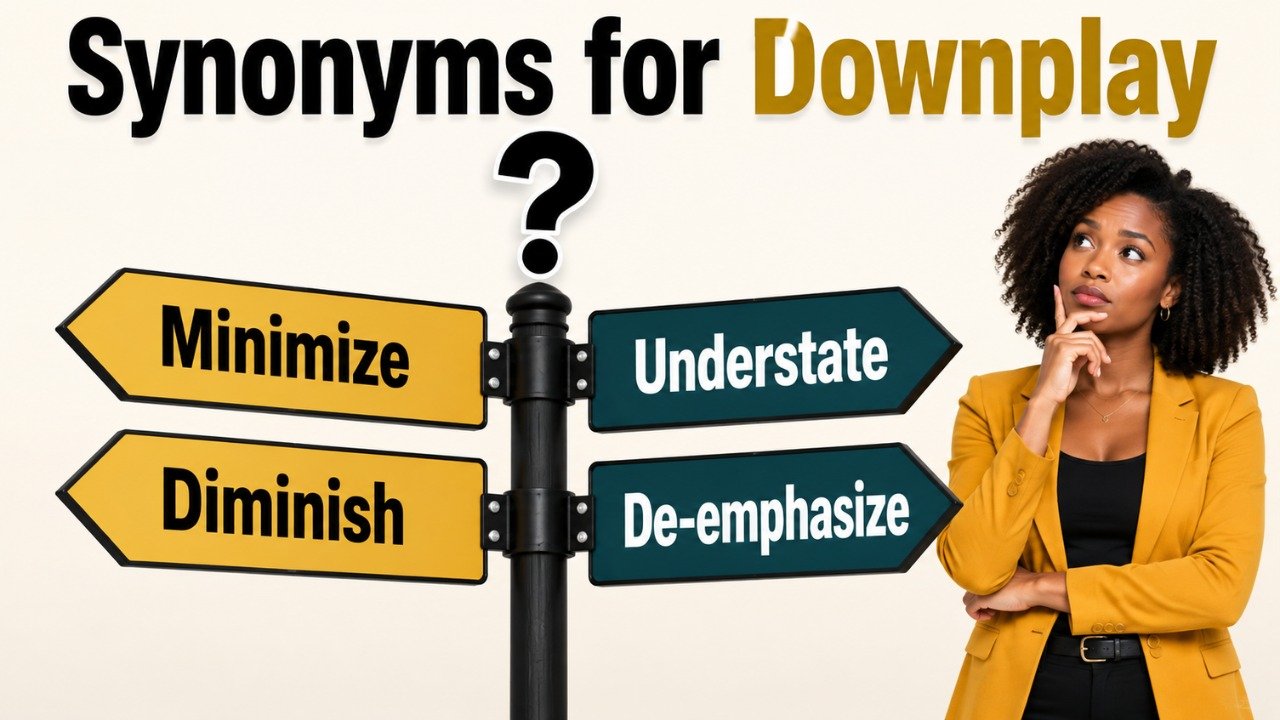
Quick Answer: The best synonyms for downplay include minimize, understate, diminish, deemphasize, underplay, trivialize, discount, make light of, play down, and tone down. Use minimize when reducing perceived importance, understate in formal or careful writing, deemphasize when shifting attention away from something, trivialize when treating a serious matter as unimportant, discount when giving something less weight, and make light of in casual conversation. The best choice depends on whether you are reducing importance, seriousness, attention, impact, or emotional intensity.
Pronunciation and Word Details
Word: Downplay
Pronunciation: /ˌdaʊnˈpleɪ/
Part of Speech: Verb
Meaning: To make something seem less important, serious, impressive, or significant than it actually is.
US Pronunciation:
UK Pronunciation:
What Does “Downplay” Mean?
Downplay means to present something as less important, serious, impressive, or significant than it really is.
It is a verb commonly used when a person reduces attention to a fact, problem, achievement, risk, disagreement, or emotional reaction.
Someone may downplay a mistake to avoid criticism, downplay an achievement out of modesty, or downplay a risk to make a situation appear less concerning.
The word can work in several sentence contexts.
Importance: A speaker may downplay the importance of an event.
Seriousness: Someone may downplay the seriousness of a problem.
Achievement: A person may downplay personal success to sound modest.
Risk: A report may downplay potential dangers.
Emotion: Someone may downplay fear, disappointment, or concern.
Conflict: A person may downplay a disagreement to make it seem less significant.
Downplay does not necessarily mean that something is false. Instead, it usually means that its significance is presented as smaller or less worthy of attention.
Meaning, Tone, and Context of “Downplay”
Downplay has a generally neutral grammatical meaning, but its tone can become critical depending on context.
Neutral Tone: It can simply describe giving less emphasis to something.
Critical Tone: It may suggest that someone is deliberately making a serious issue appear less important.
Formal Writing: Downplay is acceptable in reports, essays, analysis, journalism, and professional writing, although understate, minimize, or deemphasize may sometimes sound more precise.
Conversational Use: The word is common in everyday speech when discussing reactions, achievements, disagreements, mistakes, and concerns.
Academic Context: In analytical writing, downplay may describe how an argument, interpretation, or presentation reduces the perceived importance of evidence or consequences.
Professional Context: It may be used when discussing risks, results, performance, responsibilities, or organizational problems.
Emotional Context: Downplay can describe a person hiding or reducing the apparent strength of fear, sadness, excitement, pain, or concern.
The word can therefore be neutral, strategic, modest, dismissive, or critical depending on why something is being made to seem less important.
When and How to Use “Downplay”
For Reducing Importance
Use downplay when someone presents an issue as less important than others believe it is.
Example: The speaker tried to downplay the importance of the disagreement.
For Reducing Seriousness
Downplay works when a problem, risk, mistake, or consequence is presented as less serious.
Example: The manager did not want to downplay the seriousness of the safety concern.
For Showing Modesty
A person may downplay an achievement, talent, contribution, or success to avoid appearing boastful.
Example: She tended to downplay her role in the successful project.
For Reducing Attention
Use downplay when attention is intentionally moved away from a particular fact or detail.
Example: The presentation downplayed the weaker results and focused on the strongest findings.
For Minimizing Risk
The word can describe an attempt to make a potential danger seem smaller.
Example: It would be unwise to downplay the risks involved in the decision.
For Reducing Emotional Intensity
Someone can downplay feelings to make an emotional reaction seem less powerful.
Example: He downplayed his disappointment and congratulated the winner.
For Making Conflict Seem Smaller
Downplay may describe an effort to reduce the apparent importance of tension or disagreement.
Example: Both sides tried to downplay their differences during the discussion.
For Discussing Mistakes
The word is useful when someone presents an error as less significant than it may actually be.
Example: She acknowledged the mistake rather than attempting to downplay it.
Best Synonyms for Downplay
Minimize: To make something seem smaller, less important, or less serious.
Example: The report should not minimize the potential consequences.
Understate: To describe something as less significant, severe, or impressive than it actually is.
Example: Calling the challenge difficult would understate its complexity.
Diminish: To reduce the apparent importance, value, strength, or impact of something.
Example: His explanation seemed to diminish the importance of her contribution.
Deemphasize: To give something less prominence or attention.
Example: The revised presentation will deemphasize technical details.
Underplay: To give less importance or emotional force to something than it deserves.
Example: She underplayed the difficulty of completing the assignment.
Trivialize: To make a serious matter appear unimportant or insignificant.
Example: We should not trivialize concerns that affect people’s safety.
Discount: To give less importance, value, or credibility to something.
Example: The committee should not discount the concerns raised by employees.
Make Light of: To treat something serious as though it were unimportant or amusing.
Example: He tried to make light of the embarrassing mistake.
Play Down: To make something appear less important or serious.
Example: She played down her contribution to the successful outcome.
Tone Down: To reduce the strength, intensity, or force of something.
Example: He toned down his criticism before sending the final message.
50 Synonyms for Downplay with Short Meanings
- Minimize: Make something seem less important or serious.
- Understate: Describe something as less significant than it is.
- Diminish: Reduce perceived importance, value, or impact.
- Deemphasize: Give something less attention or prominence.
- Underplay: Present something with less importance or intensity.
- Trivialize: Treat a serious matter as unimportant.
- Discount: Give something less weight or consideration.
- Belittle: Make something seem less valuable or important.
- Play Down: Present something as less significant.
- Make Light of: Treat something serious as relatively unimportant.
- Tone Down: Reduce strength, intensity, or emphasis.
- Gloss Over: Give insufficient attention to a problem or detail.
- Brush Aside: Treat a concern as undeserving of attention.
- Brush Off: Dismiss something as unimportant.
- Shrug Off: Treat something as not worth serious concern.
- Dismiss: Decide that something deserves little consideration.
- Undervalue: Give something less value than it deserves.
- Underrate: Judge something as less impressive or important.
- Underestimate: Judge the size, importance, or effect as smaller.
- Undersell: Present something less positively than its value deserves.
- Mute: Reduce the force or prominence of something.
- Temper: Make something less intense or extreme.
- Moderate: Reduce the intensity or strength of something.
- Soften: Make something seem less harsh or severe.
- Lessen: Reduce the degree, importance, or strength.
- Reduce: Make something smaller in degree or emphasis.
- Downgrade: Treat something as having lower importance or status.
- Marginalize: Push something toward a less important position.
- Sideline: Move something away from central attention.
- Overlook: Fail to give something sufficient attention.
- Ignore: Give no attention to something significant.
- Neglect: Fail to give something proper consideration.
- Disregard: Treat something as unworthy of attention.
- Wave Aside: Dismiss a concern without much consideration.
- Pass Over: Give little or no attention to something.
- Skim Over: Deal with a topic only briefly.
- Treat Lightly: Give something less seriousness than it deserves.
- Take Lightly: Regard something as less serious than it is.
- Treat as Minor: Present something as relatively unimportant.
- Make Seem Minor: Cause something to appear less significant.
- Reduce the Importance of: Present something as having less significance.
- Reduce the Significance of: Make something appear less meaningful.
- Minimize the Impact of: Make consequences appear less substantial.
- Minimize the Seriousness of: Make a problem appear less severe.
- Give Less Weight To: Treat something as less influential or important.
- Give Less Attention To: Reduce focus on a particular issue.
- Push Into the Background: Make something less noticeable or prominent.
- Divert Attention From: Shift focus away from a subject.
- Play as Unimportant: Present something as having little significance.
- Treat as Insignificant: Regard something as lacking importance.
Read Also:
Synonyms for Piece
Synonyms for Downplay by Context
When Downplay Means Minimize Importance
When downplay means making something seem less important, minimize, understate, diminish, discount, and deemphasize are strong choices.
Example: The report should not minimize the importance of early preparation.
Example: His brief explanation understated the significance of the discovery.
Example: Changing the headline could deemphasize that particular issue.
When Downplay Means Reduce Seriousness
For problems, risks, dangers, mistakes, or consequences, minimize, trivialize, make light of, treat lightly, and brush aside are useful alternatives.
Example: We should never trivialize a serious safety concern.
Example: She refused to make light of the problem.
Example: The risks should not be treated lightly.
When Downplay Means Show Modesty
When someone makes personal success appear less impressive, understate, underplay, undersell, minimize, and play down are natural choices.
Example: He understated his contribution to the project.
Example: She tends to underplay how much work she actually completes.
Example: Do not undersell your experience during the interview.
When Downplay Means Reduce Attention
When the focus is on attention rather than importance, deemphasize, sideline, marginalize, gloss over, and push into the background may work well.
Example: The revised design deemphasized the secondary information.
Example: The discussion should not sideline the central concern.
Example: The summary glossed over several important weaknesses.
When Downplay Means Dismiss a Concern
Dismiss, brush aside, brush off, shrug off, disregard, and wave aside describe stronger forms of downplaying a concern.
Example: She dismissed the criticism without examining the evidence.
Example: The team should not brush aside legitimate concerns.
Example: He shrugged off the warning and continued.
When Downplay Means Reduce Emotional Intensity
Tone down, soften, temper, mute, and moderate work when the meaning involves reducing emotional force or intensity.
Example: She softened her criticism before giving feedback.
Example: He tempered his excitement with a reminder that more work remained.
Example: The speaker muted the emotional language in the final version.
Another Word for Downplay
The best general replacement for downplay is minimize. Both words can describe making something seem less important, serious, or significant than it actually is.
However, context determines the strongest choice. Understate works well when describing something too mildly. Deemphasize is better when reducing attention. Trivialize is stronger when a serious matter is treated as unimportant.
Original: The report seemed to downplay the risks.
Better Option: The report seemed to minimize the risks.
Original: She downplayed how difficult the project had been.
Better Option: She understated how difficult the project had been.
Original: The presentation downplayed the technical details.
Better Option: The presentation deemphasized the technical details.
Original: His response downplayed a serious concern.
Better Option: His response trivialized a serious concern.
When Not to Use “Downplay”
Downplay is useful, but it can become vague when the exact action needs to be identified.
When Someone Directly Rejects a Concern
If a person completely rejects an idea rather than merely reducing its importance, dismiss may be clearer.
Weak: She downplayed every concern the team raised.
Better: She dismissed every concern the team raised without discussion.
When Something Is Described Too Mildly
Understate is more precise when a description fails to communicate the true degree of difficulty, size, or importance.
Weak: Saying the project was difficult would downplay the challenge.
Better: Saying the project was difficult would understate the challenge.
When Attention Is Deliberately Reduced
Use deemphasize when something is simply receiving less prominence.
Weak: The new layout downplays the secondary information.
Better: The new layout deemphasizes the secondary information.
When a Serious Issue Is Treated Casually
Trivialize communicates stronger criticism.
Weak: His comments downplayed the seriousness of the problem.
Better: His comments trivialized the seriousness of the problem.
When Emotional Intensity Is Reduced
Tone down or soften may be more natural.
Weak: She downplayed the language in the final paragraph.
Better: She toned down the language in the final paragraph.
Avoid using downplay repeatedly when several more precise verbs can show whether someone is minimizing, dismissing, understating, softening, or deemphasizing something.
Words Commonly Confused With Downplay
Downplay vs Minimize: Downplay means making something seem less important or serious. Minimize can have the same meaning, but it can also mean literally reducing something to the smallest possible degree.
Downplay vs Understate: Downplay involves reducing emphasis or perceived importance. Understate means describing something in terms that make it seem smaller, weaker, or less significant than reality.
Downplay vs Dismiss: Downplaying reduces importance, while dismissing may involve rejecting something almost completely.
Downplay vs Trivialize: Trivialize is stronger and more critical. It suggests treating something genuinely serious as though it were insignificant.
Downplay vs Deemphasize: Deemphasize usually means deliberately giving something less attention. It does not necessarily suggest dishonesty or unfairness.
Downplay vs Belittle: Belittle often applies to people, achievements, abilities, or contributions and suggests making them seem less valuable.
Downplay vs Underplay: Underplay is very close to downplay and often suggests presenting importance, emotion, or difficulty with deliberate restraint.
Downplay vs Discount: Discount means giving evidence, information, opinions, or possibilities less weight when judging a situation.
Which Synonym Should You Choose?
Choose minimize when discussing risks, problems, consequences, mistakes, or importance in general.
Choose understate when something is described more mildly than reality justifies.
Choose deemphasize when discussing presentation, design, writing, reports, essays, or information that should receive less attention.
Choose underplay when a person deliberately presents an achievement, difficulty, emotion, or event with restraint.
Choose trivialize when criticizing someone for treating a serious issue as though it were unimportant.
Choose discount when evidence, opinions, possibilities, or concerns are being given less weight.
Choose belittle when someone makes another person’s ability, achievement, contribution, or value seem smaller.
Choose make light of in casual conversation when someone treats a serious or uncomfortable subject lightly.
Choose tone down when reducing the force of language, criticism, emotion, style, or presentation.
Choose gloss over in reports, essays, discussions, or conversations when important difficulties receive too little explanation.
Choose dismiss when a concern or argument is rejected rather than merely given less emphasis.
Real Life Examples of “Downplay” in Sentences
Original: The manager tried to downplay the seriousness of the delay.
Better Option: The manager tried to minimize the seriousness of the delay.
Original: She downplayed her contribution to the successful project.
Better Option: She understated her contribution to the successful project.
Original: The report downplayed the importance of the early findings.
Better Option: The report deemphasized the importance of the early findings.
Original: He downplayed the danger despite repeated warnings.
Better Option: He minimized the danger despite repeated warnings.
Original: She downplayed how difficult the assignment had been.
Better Option: She underplayed how difficult the assignment had been.
Original: The speaker downplayed a concern that deserved serious attention.
Better Option: The speaker trivialized a concern that deserved serious attention.
Original: The discussion downplayed several weaknesses in the proposal.
Better Option: The discussion glossed over several weaknesses in the proposal.
Original: He downplayed the criticism and continued with his plan.
Better Option: He brushed aside the criticism and continued with his plan.
Original: She downplayed her disappointment after hearing the result.
Better Option: She muted her disappointment after hearing the result.
Original: The final version downplayed the stronger emotional language.
Better Option: The final version toned down the stronger emotional language.
Synonym Groups and Usage Differences
Importance Group
Minimize, understate, diminish, deemphasize, and underplay all reduce perceived importance.
Minimize is broad, understate focuses on description, and deemphasize focuses on attention.
Example: The summary understated the importance of the discovery.
Seriousness Group
Trivialize, make light of, treat lightly, take lightly, and minimize describe making a serious matter appear less concerning.
Trivialize carries the strongest criticism because it suggests that real importance is being unfairly reduced.
Example: We should not trivialize the consequences of the mistake.
Dismissal Group
Dismiss, brush aside, brush off, shrug off, disregard, and wave aside involve giving limited attention to a concern.
These words can be stronger than downplay because they may suggest almost complete rejection.
Example: She brushed aside the objection without considering it carefully.
Modesty Group
Understate, underplay, undersell, and play down can describe restrained discussion of personal achievements or abilities.
These words do not always carry a negative meaning.
Example: He tends to understate his role in the team’s success.
Attention Group
Deemphasize, sideline, marginalize, gloss over, and push into the background relate to reducing visibility or attention.
Deemphasize is relatively neutral, while marginalize can imply unfair exclusion from importance.
Example: The revised report deemphasized the less relevant statistics.
Intensity Group
Tone down, soften, temper, moderate, and mute describe reducing intensity rather than importance alone.
They are especially useful for language, emotions, criticism, reactions, and presentation.
Example: She softened her criticism to make the feedback more constructive.
Antonyms of Downplay
The opposite of downplay usually involves increasing importance, visibility, seriousness, or attention.
Emphasize: Give special importance or attention to something.
Highlight: Make something especially noticeable.
Stress: Give strong emphasis to an important point.
Underline: Draw attention to the significance of something.
Accentuate: Make a feature or quality more noticeable.
Spotlight: Direct strong attention toward something.
Magnify: Make something appear greater or more significant.
Exaggerate: Present something as greater than it really is.
Overstate: Describe something as more important or extreme than reality.
Amplify: Increase the strength, effect, or prominence of something.
Elevate: Raise the importance or status of something.
Promote: Give greater attention or support to something.
Feature: Give something a noticeable or important position.
Prioritize: Treat something as especially important.
Draw Attention To: Deliberately make others notice something.
Comparison: Downplay vs Related Words
Downplay vs Minimize
Downplay and minimize can both mean making something seem less important. Minimize is especially common with risks, consequences, difficulties, and problems.
Example With Downplay: He tried to downplay the seriousness of the error.
Example With Minimize: He tried to minimize the seriousness of the error.
Downplay vs Understate
Understate focuses more strongly on how something is described.
Example With Downplay: She downplayed the difficulty of the task.
Example With Understate: She understated the difficulty of the task.
Downplay vs Deemphasize
Deemphasize means giving less prominence or attention and is often more neutral than downplay.
Example With Downplay: The report downplayed the financial concerns.
Example With Deemphasize: The report deemphasized the financial concerns.
Downplay vs Trivialize
Trivialize suggests treating something genuinely important or serious as though it hardly matters.
Example With Downplay: His reply downplayed their concerns.
Example With Trivialize: His reply trivialized their concerns.
Downplay vs Dismiss
Downplay reduces significance, while dismiss can mean rejecting a concern or argument almost entirely.
Example With Downplay: She downplayed the criticism.
Example With Dismiss: She dismissed the criticism without responding to it.
Downplay vs Belittle
Belittle is often directed toward a person’s qualities, achievements, abilities, or contributions.
Example With Downplay: He downplayed her contribution to the project.
Example With Belittle: He belittled her contribution to the project.
Downplay vs Tone Down
Tone down usually reduces intensity rather than importance.
Example With Downplay: The article downplayed the controversy.
Example With Tone Down: The editor toned down the emotional wording.
Common Phrases and Expressions With Downplay
Downplay the Importance: Make something seem less significant.
Downplay the Risk: Present a possible danger as less serious.
Downplay the Seriousness: Make a problem appear less severe.
Downplay the Impact: Reduce the apparent effect of something.
Downplay the Problem: Make a difficulty seem smaller than it is.
Downplay the Differences: Make disagreements or contrasts appear less significant.
Downplay the Achievement: Present a success modestly or as less impressive.
Downplay the Concern: Give a worry less importance or attention.
Downplay the Role: Make someone’s involvement seem smaller.
Downplay the Consequences: Present possible results as less serious than they may be.
Common Mistakes to Avoid
A common mistake is treating every synonym for downplay as interchangeable. Each alternative carries a slightly different meaning.
Use understate when language makes something sound smaller than reality. Use deemphasize when attention is intentionally reduced. Use trivialize when a serious issue is treated as unimportant.
Another mistake is confusing downplay with dismiss. A person who downplays an argument may still acknowledge it, while someone who dismisses it may reject it completely.
Avoid using belittle for every situation. Belittle often carries a personal or insulting tone and frequently relates to achievements, abilities, ideas, or people.
Do not use minimize when you mean physically reduce something unless that literal meaning is intended.
Repetition can also weaken writing.
Repetitive: The report downplayed the risks, downplayed the costs, and downplayed the concerns.
Improved: The report minimized the risks, understated the costs, and glossed over several concerns.
Avoid unnatural phrasing by checking what follows the verb.
Natural: She downplayed the importance of the mistake.
Natural: He downplayed his involvement.
Unnatural: She downplayed about the problem.
Downplay normally takes a direct object. Say downplay the problem, not downplay about the problem.
Finally, consider tone. Trivialize may sound accusatory, while deemphasize can sound neutral. Choosing the right word helps communicate both meaning and attitude accurately.
Conclusion
Synonyms for downplay help express different ways of reducing importance, seriousness, attention, or intensity. Minimize is the strongest general replacement, while understate suits restrained descriptions, deemphasize works for reduced attention, and trivialize describes treating serious matters as insignificant. Use discount for giving something less weight, tone down for reducing intensity, and gloss over when important details receive too little attention. Choosing a precise alternative makes essays, reports, emails, and everyday conversations clearer and more accurate.
FAQs About Synonyms for Downplay
What Is the Best Synonym for Downplay?
Minimize is one of the best general synonyms for downplay. Understate, deemphasize, and underplay are also useful depending on context.
What Is a Formal Synonym for Downplay?
Understate, minimize, deemphasize, diminish, and discount are suitable formal alternatives. The best word depends on whether you mean reducing importance, attention, or credibility.
What Does It Mean to Downplay Something?
To downplay something means to make it seem less important, serious, impressive, or significant than it actually is.
Is Downplay the Same as Minimize?
They are very similar when referring to importance or seriousness. Minimize can also mean literally reducing something, while downplay mainly concerns how something is presented or perceived.
Is Downplay the Same as Trivialize?
Not exactly. Trivialize is stronger and usually critical because it suggests treating a genuinely serious issue as though it barely matters.
What Is Another Word for Downplaying an Achievement?
Understate, underplay, undersell, minimize, and play down can describe making an achievement seem less impressive, often because of modesty.
What Is the Opposite of Downplay?
Common opposites include emphasize, highlight, stress, spotlight, accentuate, amplify, and overstate. The best antonym depends on whether you are increasing attention, importance, or perceived magnitude.
