
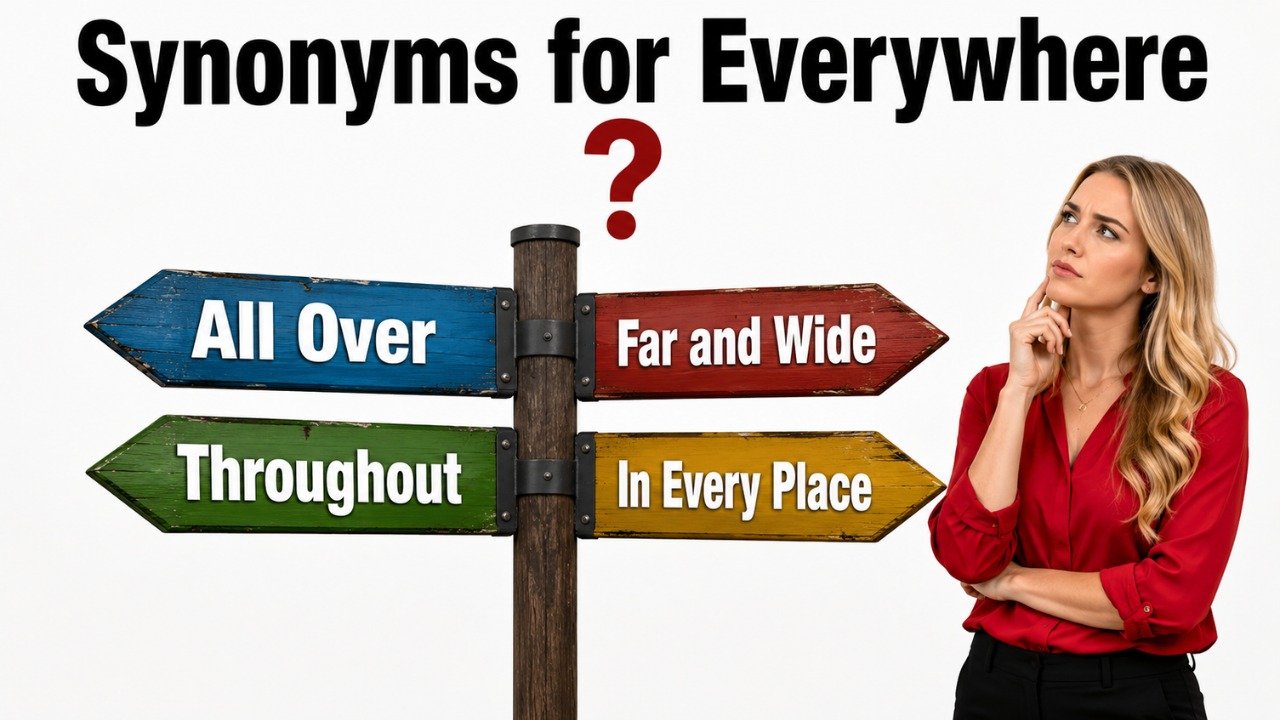
Quick Answer: The best synonyms for everywhere include throughout, all around, universally, worldwide, in every place, far and wide, all over, throughout the area, on every side, and wherever you look. Use throughout when something exists across an entire place, all around for casual descriptions of nearby presence, universally for broad or abstract situations, and worldwide when referring to global reach. Far and wide adds emphasis to extensive spread, while in every place is a simple and direct replacement.
Pronunciation and Word Details
Word: Everywhere.
Pronunciation: /ˈev.ri.weər/
Part of Speech: Adverb.
Meaning: In, at, or to every place, or throughout all parts of an area.
US Pronunciation:
UK Pronunciation:
What Does “Everywhere” Mean?
Everywhere means in every place or throughout all parts of a particular area.
It is mainly used as an adverb and describes something that exists, happens, appears, or can be found in many places or all places within a given context.
Example: Flowers were growing everywhere in the garden.
Everywhere can refer to a small physical area, a city, a country, the world, or even an abstract situation.
Example: Her work seemed to be everywhere during the exhibition.
It can also create emphasis by suggesting that something is extremely common or widespread.
Example: Discussions about the issue were everywhere.
The exact meaning depends on the scale. In casual speech, everywhere may simply mean in many noticeable places rather than literally every possible location.
Meaning, Tone, and Context of “Everywhere”
Everywhere is a neutral and highly common word. It works naturally in casual conversation, descriptive writing, storytelling, essays, reports, and everyday communication.
Its tone can become expressive when a writer wants to emphasize abundance, widespread presence, or a strong sense of being surrounded.
Casual Context: Everywhere is common when talking about things found in many places.
Example: There were boxes everywhere after the move.
Descriptive Context: Writers use everywhere to create a strong visual impression.
Example: Bright leaves were scattered everywhere across the path.
Formal Context: In reports or academic writing, alternatives such as throughout, universally, widely, or across the region may sound more precise.
Example: The practice is widespread throughout the region.
Global Context: Everywhere can imply broad international reach, but worldwide or globally may be clearer when the entire world is meant.
Example: The tradition became known worldwide.
Emphatic Context: Everywhere can suggest that something feels impossible to avoid.
Example: Signs of change were everywhere.
Because everywhere is broad, a more specific synonym can often make writing clearer.
When and How to Use “Everywhere”
For Physical Presence
Use everywhere when something is located in many parts of a place.
Example: Books were stacked everywhere in the room.
For Widespread Activity
Everywhere works when an action or event is happening across many locations.
Example: People were celebrating everywhere after the announcement.
For Visual Description
Use everywhere to create an image of something covering or filling an area.
Example: Colorful petals were scattered everywhere.
For Broad Reach
Everywhere can describe something that reaches many people or places.
Example: The idea seemed to spread everywhere.
For Strong Emphasis
Use everywhere when you want to stress how common, noticeable, or unavoidable something feels.
Example: Reminders of the event were everywhere.
For Global Meaning
Everywhere can sometimes refer to the whole world, although worldwide or globally may be more precise.
Example: The discovery attracted attention everywhere.
Best Synonyms for Everywhere
Throughout: In every part of a place or period.
Example: Decorations appeared throughout the building.
All Around: In many places surrounding someone or something.
Example: Trees stood all around the lake.
All Over: In many or all parts of a place.
Example: Notes were scattered all over the desk.
Universally: In a way that applies or occurs everywhere.
Example: The principle is universally understood.
Worldwide: Across the entire world.
Example: The event received worldwide attention.
Globally: Across the world as a whole.
Example: The technology is used globally.
Far and Wide: Across a very large area.
Example: News of the discovery traveled far and wide.
In Every Place: At all locations within the relevant area.
Example: Similar signs appeared in every place they visited.
On Every Side: In all surrounding directions.
Example: Mountains rose on every side.
Wherever You Look: In many visible places around you.
Example: Wildflowers appeared wherever you looked.
50 Synonyms for Everywhere with Short Meanings
- Throughout: In every part of a place.
- All Around: In many surrounding places.
- All Over: Across many or all parts.
- Universally: In all applicable places or cases.
- Worldwide: Across the entire world.
- Globally: Throughout the world.
- Far and Wide: Across a large geographical area.
- In Every Place: At all locations.
- On Every Side: In all surrounding directions.
- Wherever You Look: In many visible places.
- In All Places: Present at every location.
- In Every Direction: Extending toward all sides.
- Throughout the Area: Across the whole local region.
- Throughout the Region: Across all parts of a region.
- Throughout the Country: Across a whole nation.
- Throughout the World: Across all parts of the world.
- Across the Area: Spread over a particular place.
- Across the Region: Existing in many parts of a region.
- Across the Country: Found throughout a nation.
- Across the World: Existing in many countries or regions.
- All Across: Spread from one part to another.
- All About: Present in surrounding places.
- Round About: Located in various nearby places.
- Here, There, and Everywhere: In many different places.
- Near and Far: Across nearby and distant places.
- High and Low: In many possible places.
- From Place to Place: Across multiple locations.
- From End to End: Across the complete length of an area.
- From Corner to Corner: Throughout all parts of a space.
- From One Side to the Other: Across the whole area.
- In All Directions: Toward or within every direction.
- In Every Corner: Present throughout even small areas.
- At Every Turn: Appearing repeatedly in many places.
- At Every Point: Present at all relevant locations.
- At Every Location: Existing in all specified places.
- In Every Part: Present throughout all sections.
- In All Parts: Spread across the entire area.
- Over the Whole Area: Covering the entire space.
- Over the Entire Region: Spread across a whole region.
- Around Every Corner: Seemingly present in many places.
- Scattered Throughout: Distributed across an area.
- Spread Throughout: Extended across every part.
- Widely: Across a broad area.
- Broadly: Across a large range or area.
- Extensively: Over a large amount of space.
- Pervasively: In a way that spreads throughout.
- Ubiquitously: In a way that seems present everywhere.
- Omnipresently: In a way that appears to exist everywhere.
- Every Which Way: In many different directions.
- Anywhere You Go: In almost any place visited.
Read Also:
Synonyms for Rather

Synonyms for Everywhere by Context
When Everywhere Means Throughout
Throughout, in every part, all over, spread throughout, and scattered throughout are strong choices when something exists across an entire physical area.
Example: Flowers were blooming everywhere in the park.
Alternative: Flowers were blooming throughout the park.
Throughout is especially useful in clear descriptive and formal writing.
When Everywhere Means All Around
All around, on every side, in every direction, and round about work well when something surrounds a person or object.
Example: Trees were everywhere around the house.
Alternative: Trees stood all around the house.
All around sounds natural in casual descriptions.
When Everywhere Means Worldwide
Worldwide, globally, throughout the world, and across the world are best when the intended scale is international.
Example: The story became famous everywhere.
Alternative: The story became famous worldwide.
Worldwide makes the global meaning more precise.
When Everywhere Means Widespread
Widely, extensively, broadly, pervasively, and ubiquitously can describe something that occurs across many places.
Example: The practice is seen everywhere.
Alternative: The practice is widely observed.
Widely is concise and suitable for professional or academic writing.
When Everywhere Adds Emphasis
Far and wide, at every turn, around every corner, wherever you look, and here, there, and everywhere add a stronger sense of abundance.
Example: Signs of spring were everywhere.
Alternative: Signs of spring appeared wherever you looked.
These expressions are especially effective in descriptive or conversational writing.
Another Word for Everywhere
The best general replacement for everywhere is throughout when the sentence refers to something existing across all parts of a particular place.
However, the best alternative depends on context. All around works well for nearby surroundings, worldwide fits global reach, and widely is often stronger in formal writing.
Original: Flowers were growing everywhere in the garden.
Better Option: Flowers were growing throughout the garden.
Original: People knew the story everywhere.
Better Option: People knew the story worldwide.
Original: Boxes were everywhere in the room.
Better Option: Boxes were scattered all around the room.
Original: The practice can be found everywhere in the region.
Better Option: The practice is widely found throughout the region.
When Not to Use “Everywhere”
Avoid everywhere when a more precise location would improve clarity.
Weak: The new system is used everywhere.
Better: The new system is used throughout the organization.
Everywhere can also sound exaggerated when something is merely common rather than literally present in all places.
Weak: This type of building is everywhere in the country.
Better: This type of building is widespread across the country.
In formal reports, everywhere may feel too conversational.
Weak: Problems were found everywhere in the process.
Better: Problems were identified throughout the process.
Avoid unnecessary repetition.
Weak: People were everywhere, signs were everywhere, and decorations were everywhere.
Better: People filled the streets, signs appeared at every turn, and decorations covered the area.
Use worldwide or globally when the intended meaning is specifically international.
Weak: The organization operates everywhere.
Better: The organization operates globally.
Words Commonly Confused With Everywhere
Everywhere vs Anywhere: Everywhere means in all places, while anywhere means in any place without specifying which one.
Everywhere vs Somewhere: Everywhere refers to all or many places, while somewhere means an unspecified single place.
Everywhere vs Nowhere: Everywhere means in every place, while nowhere means in no place.
Everywhere vs Throughout: Everywhere is broader and often more conversational. Throughout usually refers to every part of a specific place, period, or object.
Everywhere vs Worldwide: Everywhere can refer to any size of area. Worldwide specifically refers to the whole world.
Everywhere vs Widely: Everywhere suggests presence in all or nearly all places, while widely means over a broad area without necessarily implying every location.
Everywhere vs Universally: Everywhere usually describes location, while universally often describes something accepted, true, or applicable in all cases.
Which Synonym Should You Choose?
Choose throughout when describing something present in every part of a specific place, document, period, or area.
Choose all around in casual conversation when something appears in surrounding locations.
Choose all over for informal descriptions of things spread across an area.
Choose worldwide when the meaning is specifically global.
Choose globally in professional, academic, or business related writing when discussing worldwide reach.
Choose universally when describing something accepted, recognized, or applicable broadly rather than physically located everywhere.
Choose widely when something occurs across many places but not necessarily every place.
Choose far and wide when you want an expressive sense of broad geographical spread.
Choose wherever you look when creating a vivid visual description.
Choose ubiquitously in formal or advanced writing when something seems to occur almost everywhere.
Choose at every turn when something appears repeatedly or seems difficult to avoid.
Real Life Examples of “Everywhere” in Sentences
Original: Leaves were everywhere after the storm.
Better Option: Leaves were scattered throughout the yard after the storm.
Original: Bright lights were everywhere in the city center.
Better Option: Bright lights appeared all around the city center.
Original: The tradition is known everywhere.
Better Option: The tradition is known worldwide.
Original: Signs of change were everywhere.
Better Option: Signs of change appeared at every turn.
Original: The new idea spread everywhere in the region.
Better Option: The new idea spread throughout the region.
Original: Children were playing everywhere in the park.
Better Option: Children were playing all across the park.
Original: The pattern can be found everywhere in nature.
Better Option: The pattern can be found widely throughout nature.
Original: Decorations were everywhere in the hall.
Better Option: Decorations covered every part of the hall.
Original: The smell of flowers was everywhere.
Better Option: The scent of flowers filled the entire area.
Original: Similar concerns appeared everywhere during the discussion.
Better Option: Similar concerns appeared throughout the discussion.
Synonym Groups and Usage Differences
Complete Coverage Group
Throughout, in every part, in all parts, over the whole area, and from end to end suggest coverage across an entire defined space.
Example: Artwork appeared throughout the building.
Surrounding Area Group
All around, on every side, in every direction, round about, and around every corner focus on surrounding locations.
Example: Tall hills rose on every side.
Global Reach Group
Worldwide, globally, across the world, and throughout the world describe international presence or influence.
Example: The discovery gained worldwide attention.
Broad Spread Group
Widely, broadly, extensively, pervasively, and ubiquitously describe something spread across many locations or situations.
Example: The method is widely used in different settings.
Expressive Emphasis Group
Far and wide, here, there, and everywhere, wherever you look, at every turn, and anywhere you go add vivid emphasis.
Example: Colorful banners appeared wherever you looked.
Direction Group
In every direction, in all directions, every which way, and from one side to the other emphasize movement or spread toward multiple sides.
Example: People moved in every direction after the doors opened.
Antonyms of Everywhere
The main opposite of everywhere is nowhere, but other alternatives apply depending on context.
Nowhere: In no place.
Somewhere: In one unspecified place rather than every place.
Locally: Within a limited nearby area.
Regionally: Within a particular region rather than everywhere.
Partially: In only part of an area.
Sparsely: In relatively few places.
Rarely: Infrequently or in few situations.
Occasionally: Only at certain times or places.
Selectively: Only in chosen places or cases.
Limitedly: Within a restricted range or area.
Comparison: Everywhere vs Related Words
Everywhere vs Throughout
Everywhere emphasizes presence in all or many places. Throughout refers more specifically to all parts of a defined place or period.
Example With Everywhere: There were flowers everywhere.
Example With Throughout: Flowers were placed throughout the hall.
Everywhere vs Anywhere
Everywhere means in all places, while anywhere means in any possible place.
Example With Everywhere: We saw decorations everywhere.
Example With Anywhere: You can sit anywhere you like.
Everywhere vs Somewhere
Everywhere refers to many or all locations. Somewhere refers to one unspecified location.
Example With Everywhere: Music could be heard everywhere.
Example With Somewhere: Music was playing somewhere nearby.
Everywhere vs Nowhere
Everywhere means in every place, while nowhere means in no place.
Example With Everywhere: The signs were everywhere.
Example With Nowhere: The signs were nowhere to be found.
Everywhere vs Worldwide
Everywhere can refer to a room, town, country, or broader area. Worldwide specifically means across the world.
Example With Everywhere: Posters appeared everywhere in the neighborhood.
Example With Worldwide: The story received worldwide attention.
Everywhere vs Widely
Everywhere suggests very broad or complete presence. Widely means across many places without necessarily meaning all locations.
Example With Everywhere: The flowers seemed to grow everywhere.
Example With Widely: The plant is widely grown in warm regions.
Everywhere vs Universally
Everywhere usually concerns location. Universally often describes something true, accepted, understood, or applicable in all cases.
Example With Everywhere: Similar designs appeared everywhere.
Example With Universally: The principle is universally accepted.
Common Phrases and Expressions With Everywhere
Everywhere You Look: In many visible places.
Everywhere You Go: In nearly every place someone visits.
Almost Everywhere: In most places but not literally all.
Practically Everywhere: In nearly all relevant locations.
Seemingly Everywhere: Appearing to exist in all places.
Everywhere at Once: In many locations at the same time.
Here, There, and Everywhere: In many different places.
Everywhere Around: In surrounding locations.
Everywhere in the World: Across many or all global locations.
Everywhere Else: In all other relevant places.
Common Mistakes to Avoid
One common mistake is using everywhere when the intended meaning is anywhere.
Incorrect: You can put the chair everywhere you like.
Better: You can put the chair anywhere you like.
Everywhere means all places, while anywhere means any location you choose.
Another mistake is exaggerating with everywhere when only a broad distribution is meant.
Weak: The species lives everywhere.
Better: The species is widely distributed across the region.
Writers should also avoid using everywhere repeatedly in descriptive passages. Throughout, all around, at every turn, widely, and wherever you look can create more natural variety.
Do not automatically replace everywhere with universally. Universally often describes ideas, rules, acceptance, or truth rather than physical location.
Weak: The flowers grew universally across the valley.
Better: The flowers grew throughout the valley.
Use worldwide only when you genuinely mean global reach.
Finally, choose a synonym that reflects scale. Throughout the room, across the country, and worldwide each communicate a different geographical range.
Conclusion
The most useful synonyms for everywhere include throughout, all around, all over, worldwide, globally, widely, far and wide, and wherever you look. Throughout is best when something covers every part of a defined area, while worldwide and globally suit international contexts. All around works naturally in casual descriptions, and widely is often more precise in formal writing. Choosing an alternative based on scale, location, tone, and degree of spread makes sentences clearer and more expressive.
FAQs About Synonyms for Everywhere
What Is the Best Synonym for Everywhere?
Throughout is one of the best general synonyms when something exists in every part of a defined place. All around is also useful in casual contexts.
What Is Another Word for Everywhere?
Common alternatives include throughout, all over, all around, worldwide, globally, widely, and far and wide.
What Is a Formal Synonym for Everywhere?
Throughout, universally, widely, globally, pervasively, and ubiquitously can work in formal writing depending on the intended meaning.
Is Throughout a Synonym for Everywhere?
Yes. Throughout is a close synonym when everywhere means in every part of a particular place, area, period, or object.
What Is a Synonym for Everywhere in the World?
Worldwide, globally, across the world, and throughout the world are strong alternatives.
What Is the Difference Between Everywhere and Anywhere?
Everywhere means in all places, while anywhere means in any place without specifying a particular location.
What Is a Stronger Way to Say Everywhere?
Far and wide, at every turn, wherever you look, ubiquitously, and throughout the entire area can add stronger emphasis depending on context.
