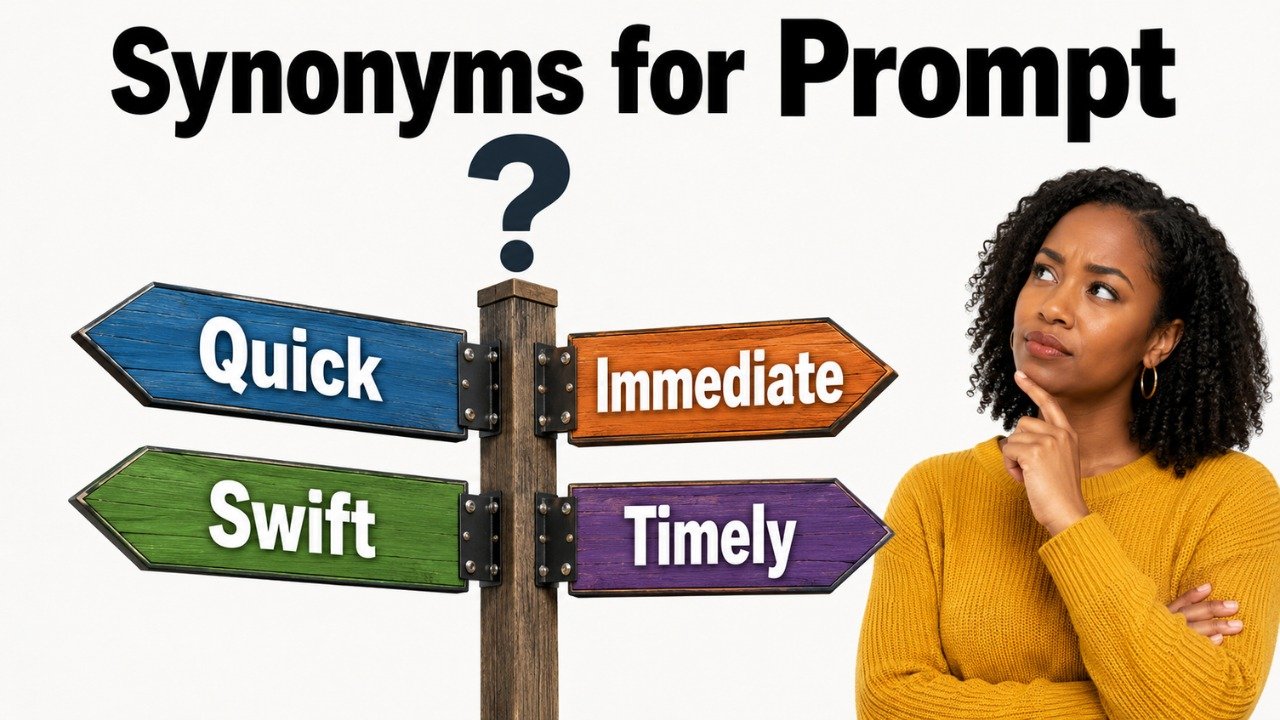
Quick Answer: The best synonyms for prompt include quick, immediate, timely, punctual, swift, cue, reminder, instruction, encourage, and inspire. Use quick or swift when prompt means fast, punctual when something happens at the expected time, timely when an action occurs when it is needed, cue or reminder when prompt is a noun, instruction when it gives someone directions, and encourage or inspire when prompt is a verb meaning to cause someone to think, speak, or act. The best synonyms for prompt therefore depend on whether the word describes speed, a signal, an instruction, or an action that causes a response.
Pronunciation and Word Details
Word: Prompt.
Pronunciation: /prɒmpt/.
Part of Speech: Adjective, noun, and verb.
Meaning: Prompt can mean quick and timely, a cue or instruction, or an action that causes someone to respond.
US Pronunciation:
UK Pronunciation:
What Does “Prompt” Mean?
Prompt means happening quickly, without unnecessary delay, or at the expected time. It can also mean a cue, reminder, question, or instruction that encourages a response.
As an adjective, prompt describes something done quickly or on time.
Example: She gave a prompt reply to the request.
As a noun, prompt refers to something that guides, reminds, or encourages a person to respond.
Example: The teacher gave the class a writing prompt.
As a verb, prompt means to cause, encourage, or remind someone to do, say, or think something.
Example: The unexpected question prompted him to reconsider his decision.
The correct synonym therefore depends heavily on how prompt functions in the sentence.
Meaning, Tone, and Context of “Prompt”
Prompt is generally a neutral word that works naturally in formal, professional, academic, educational, and everyday contexts.
When prompt describes speed, it often has a positive tone. A prompt response suggests efficiency, attention, and a lack of unnecessary delay.
When it describes punctuality, prompt emphasizes that something happens at the expected or required time.
As a noun, prompt is common when discussing questions, instructions, reminders, writing activities, conversations, or other situations where a response is expected.
As a verb, prompt can describe anything that causes a thought, emotion, statement, decision, or action.
Formal Use: Prompt often describes timely responses, actions, decisions, attention, or service.
Educational Use: A prompt may be a question, topic, instruction, or idea designed to produce a response.
Conversational Use: Prompt can mean a reminder, hint, or cue.
Academic Use: The verb prompt may describe an event or factor that produces a reaction or change.
Emotional Use: Something may prompt curiosity, concern, anger, reflection, or action.
When and How to Use “Prompt”
For Quick Action
Use prompt when something is done rapidly and without avoidable delay.
Example: The staff took prompt action to solve the problem.
For Timely Responses
Prompt works well when emphasizing that someone responded at the right time.
Example: Thank you for your prompt reply.
For Punctuality
Prompt can describe someone who arrives or acts exactly when expected.
Example: She was always prompt for morning meetings.
For Instructions
As a noun, prompt can describe information telling someone what to write, discuss, answer, or consider.
Example: Read the prompt carefully before writing your response.
For Reminders
Prompt can refer to something that helps a person remember an action or idea.
Example: The note served as a prompt to call the client.
For Encouraging Action
As a verb, prompt means causing or encouraging someone to act.
Example: The announcement prompted many residents to ask questions.
For Causing Thought
Prompt is useful when something makes a person think more deeply about an issue.
Example: Her comment prompted me to reconsider my assumptions.
For Producing a Response
A question, image, event, or statement can prompt an answer or reaction.
Example: The question prompted an interesting discussion.
Best Synonyms for Prompt
Quick
Synonym: Quick means happening or being completed in a short amount of time.
Example: She gave a quick response to the message.
Immediate
Synonym: Immediate means happening without delay.
Example: The situation required immediate attention.
Timely
Synonym: Timely means occurring at a suitable or useful moment.
Example: His timely intervention prevented further confusion.
Punctual
Synonym: Punctual means arriving or happening at the scheduled time.
Example: She is always punctual for appointments.
Swift
Synonym: Swift means happening rapidly and efficiently.
Example: The manager took swift action.
Cue
Synonym: Cue means a signal that tells someone when or how to respond.
Example: Her smile was my cue to begin speaking.
Reminder
Synonym: Reminder means something that helps someone remember.
Example: The calendar note was a useful reminder.
Instruction
Synonym: Instruction means information explaining what someone should do.
Example: The first instruction asked students to describe the scene.
Encourage
Synonym: Encourage means to give someone a reason or confidence to act.
Example: The positive feedback encouraged her to continue.
Inspire
Synonym: Inspire means to produce an idea, feeling, or desire to act.
Example: The experience inspired him to write a story.
50 Synonyms for Prompt with Short Meanings
- Quick: Done in a short amount of time.
- Rapid: Happening at a high speed.
- Swift: Fast and efficient.
- Immediate: Occurring without delay.
- Punctual: Happening at the expected time.
- Timely: Occurring at a suitable moment.
- Speedy: Completed or happening quickly.
- Expeditious: Done efficiently and without unnecessary delay.
- Ready: Prepared to respond or act.
- Responsive: Reacting quickly and appropriately.
- Instant: Happening immediately.
- Fast: Moving or occurring quickly.
- Brisk: Quick, active, and energetic.
- Cue: A signal for a response or action.
- Reminder: Something that helps a person remember.
- Signal: A sign that indicates what should happen.
- Hint: A small clue or suggestion.
- Suggestion: An idea offered for consideration.
- Instruction: A direction explaining what to do.
- Question: A statement designed to request an answer.
- Stimulus: Something that produces a reaction.
- Trigger: Something that starts a reaction or event.
- Nudge: A gentle reminder or encouragement.
- Clue: Information that helps someone find an answer.
- Indication: A sign pointing toward an idea or action.
- Encouragement: Support that makes action more likely.
- Incentive: Something that encourages a particular action.
- Impetus: A force or reason that causes action or progress.
- Encourage: To make someone more willing to act.
- Inspire: To create an idea, feeling, or motivation.
- Motivate: To give someone a reason to act.
- Provoke: To cause a reaction or response.
- Induce: To cause or persuade something to happen.
- Elicit: To draw out a response or reaction.
- Stimulate: To encourage activity, thought, or interest.
- Spur: To encourage faster or stronger action.
- Urge: To strongly encourage someone to act.
- Remind: To cause someone to remember something.
- Activate: To cause something to begin working or responding.
- Cause: To make something happen.
- Lead: To result in or encourage a particular action.
- Move: To cause someone to feel or act.
- Evoke: To bring a feeling, memory, or reaction to mind.
- Generate: To produce a thought, response, or result.
- Initiate: To cause something to begin.
- Instigate: To bring about or encourage an action.
- Push: To encourage someone toward an action or decision.
- Compel: To strongly cause or force someone to act.
- Persuade: To convince someone to take an action.
- Incite: To encourage a strong reaction or action.
Read Also:
Synonyms for Everywhere

Synonyms for Prompt by Context
When Prompt Means Quick
When prompt describes something done without unnecessary delay, useful alternatives include quick, rapid, swift, speedy, immediate, fast, and expeditious.
Quick: Natural in both casual and formal communication.
Example: She gave a quick answer.
Swift: Often suggests decisive and efficient action.
Example: The organization made a swift decision.
Immediate: Emphasizes that no delay occurred or should occur.
Example: The problem needs immediate attention.
Rapid: Focuses strongly on speed.
Example: The team experienced rapid progress.
When Prompt Means On Time
When prompt refers to punctuality, the best alternatives include punctual and timely.
Punctual: Best when someone arrives or acts at a scheduled time.
Example: He is punctual for every appointment.
Timely: Best when something happens at a useful or appropriate moment.
Example: Her timely advice helped us avoid a mistake.
Prompt and punctual are similar in this context, but punctual is usually more specific when a clock time or schedule matters.
When Prompt Means a Cue
As a noun, prompt can mean something that tells a person when to respond or act.
Useful alternatives include cue, signal, hint, clue, reminder, and indication.
Cue: A direct signal to begin or respond.
Example: That was my cue to leave.
Signal: A sign that communicates what should happen.
Example: Her gesture was a signal to continue.
Hint: An indirect suggestion.
Example: He gave me a hint about the answer.
When Prompt Means an Instruction
A prompt may be a question or statement that tells someone what to consider, discuss, or write.
Useful synonyms include instruction, question, suggestion, clue, and topic.
Instruction: Best when the wording clearly tells someone what to do.
Example: Follow each instruction carefully.
Question: Best when an answer is directly requested.
Example: The opening question encouraged detailed responses.
Suggestion: Suitable when the prompt offers an idea rather than a command.
Example: The suggestion gave her a starting point for the story.
When Prompt Means a Reminder
Prompt may refer to something that helps a person remember what to do.
Useful alternatives include reminder, nudge, cue, hint, and signal.
Reminder: The clearest choice for remembering an obligation or task.
Example: I left myself a reminder to submit the form.
Nudge: A softer and more conversational alternative.
Example: His message was a helpful nudge to finish the work.
When Prompt Means to Encourage
As a verb, prompt may mean to encourage someone to take action.
Useful alternatives include encourage, motivate, spur, urge, inspire, and persuade.
Encourage: Neutral and broadly useful.
Example: The results encouraged the team to continue.
Motivate: Focuses on giving someone a reason or desire to act.
Example: Her progress motivated others to participate.
Spur: Suggests pushing someone toward faster or stronger action.
Example: The competition spurred him to improve.
When Prompt Means to Cause a Reaction
Prompt can mean causing a thought, feeling, answer, or event.
Useful alternatives include provoke, elicit, evoke, trigger, cause, stimulate, and generate.
Elicit: Especially useful when something produces an answer or response.
Example: The question elicited several thoughtful comments.
Evoke: Best when feelings, memories, or images are produced.
Example: The photograph evoked memories of childhood.
Trigger: Best when one event starts another reaction.
Example: The announcement triggered widespread discussion.
Another Word for Prompt
The best single replacement for prompt is often quick when prompt is an adjective, cue when it is a noun, and encourage or cause when it is a verb.
There is no single alternative that works naturally in every sentence because prompt has several distinct meanings.
Original: She gave a prompt response.
Better Option: She gave a quick response.
Original: The teacher provided a discussion prompt.
Better Option: The teacher provided a discussion question.
Original: His comment prompted further investigation.
Better Option: His comment encouraged further investigation.
Original: The news prompted concern among residents.
Better Option: The news caused concern among residents.
When Not to Use “Prompt”
Prompt is useful, but another word can sometimes make the intended meaning clearer.
When You Mean Exact Punctuality
Prompt can describe punctual behavior, but punctual is more precise when a schedule is involved.
Weak: She was prompt for the appointment.
Better: She was punctual for the appointment.
When You Mean Extreme Urgency
Prompt suggests quick action, but immediate is stronger when no delay is acceptable.
Weak: The patient needed prompt treatment.
Better: The patient needed immediate treatment.
When You Mean a Specific Instruction
Prompt can be vague if readers need to know that someone was directly told what to do.
Weak: He followed the prompt.
Better: He followed the instruction.
When You Mean a Reminder
If something simply helps a person remember, reminder may sound more natural.
Weak: The note was a prompt to pay the bill.
Better: The note was a reminder to pay the bill.
When You Mean a Direct Cause
Prompted can sound less precise when a clear cause and effect relationship exists.
Weak: Heavy rain prompted the flooding.
Better: Heavy rain caused the flooding.
When Repetition Becomes Noticeable
Repeatedly using prompted in formal writing can make sentences sound mechanical.
Weak: The report prompted questions, which prompted discussion and prompted further investigation.
Better: The report raised questions, encouraged discussion, and led to further investigation.
Words Commonly Confused With Prompt
Prompt vs Quick: Quick emphasizes speed. Prompt usually suggests both speed and readiness, especially when responding to something.
Prompt vs Immediate: Immediate means without any delay. Prompt means reasonably quick and timely but does not always imply absolute immediacy.
Prompt vs Punctual: Prompt can mean on time, while punctual specifically emphasizes meeting an expected time or schedule.
Prompt vs Timely: Prompt emphasizes speed or lack of delay. Timely emphasizes that something occurs at a useful or appropriate moment.
Prompt vs Cue: Prompt has several meanings, while cue specifically describes a signal that tells someone when to act or respond.
Prompt vs Reminder: A reminder helps someone remember something. A prompt may remind someone, but it can also encourage a new thought or response.
Prompt vs Instruction: An instruction tells someone what to do. A prompt may provide an instruction, question, topic, hint, or starting point.
Prompt vs Trigger: Trigger usually describes something that starts a reaction. Prompt can also mean causing a reaction, but it often sounds less sudden or automatic.
Prompt vs Encourage: Encourage focuses on increasing willingness or confidence. Prompt simply means causing or leading someone toward a response and does not always involve support.
Which Synonym Should You Choose?
Choose quick when you simply mean something happened fast.
Choose immediate when an action happens without delay or needs urgent attention.
Choose swift when describing decisive and efficient action.
Choose punctual when referring to appointments, meetings, schedules, or arrival times.
Choose timely when something happens at an especially useful or appropriate moment.
Choose cue when referring to a signal that tells someone to speak, move, or respond.
Choose reminder when something helps a person remember an obligation, event, or task.
Choose instruction when someone is clearly being told what to do.
Choose question when a prompt directly asks for an answer.
Choose stimulus in academic or technical writing when something produces a measurable reaction.
Choose encourage when someone is being supported or influenced to take action.
Choose motivate when the emphasis is on providing a reason or desire to act.
Choose elicit when a question or event draws out a response.
Choose evoke when something produces memories, emotions, or mental images.
Choose trigger when one event clearly starts another reaction.
Choose cause when expressing a straightforward cause and effect relationship.
Real Life Examples of “Prompt” in Sentences
Original: Thank you for your prompt response.
Better Option: Thank you for your quick response.
Original: The staff took prompt action.
Better Option: The staff took swift action.
Original: Her prompt arrival helped the meeting begin on time.
Better Option: Her punctual arrival helped the meeting begin on time.
Original: The teacher gave us a writing prompt.
Better Option: The teacher gave us a writing topic.
Original: The notification served as a prompt.
Better Option: The notification served as a reminder.
Original: His question prompted a long conversation.
Better Option: His question sparked a long conversation.
Original: The discovery prompted further research.
Better Option: The discovery encouraged further research.
Original: Her speech prompted the audience to take action.
Better Option: Her speech motivated the audience to take action.
Original: The photograph prompted memories of childhood.
Better Option: The photograph evoked memories of childhood.
Original: The unexpected result prompted several questions.
Better Option: The unexpected result generated several questions.
Synonym Groups and Usage Differences
Speed Group
Quick, rapid, swift, speedy, fast, immediate, and expeditious belong to the speed group.
These words work when prompt means something happens without unnecessary delay.
Quick is broad and conversational. Swift often sounds more deliberate and formal. Immediate expresses the strongest absence of delay.
Example: The team made a swift decision after reviewing the evidence.
Punctuality Group
Punctual and timely are useful when prompt relates to timing.
Punctual describes meeting an exact schedule. Timely emphasizes appropriateness rather than exact clock time.
Example: Her timely warning prevented a serious mistake.
Cue Group
Cue, signal, hint, clue, indication, and nudge describe something that guides or encourages a response.
Cue is often the closest noun replacement for prompt.
Example: His expression was my cue to change the subject.
Reminder Group
Reminder, nudge, hint, and cue can describe something that brings an intended action back to mind.
Reminder is the most direct choice when remembering is the main idea.
Example: The note served as a reminder to return the document.
Instruction Group
Instruction, question, suggestion, and clue can replace prompt when someone receives information designed to guide a response.
Instruction is strongest when a task must be completed in a particular way.
Example: The instruction asked participants to explain their reasoning.
Encouragement Group
Encourage, motivate, inspire, urge, spur, and persuade describe influence that leads someone toward action.
These alternatives differ in strength. Encourage is supportive, urge is stronger, and persuade suggests changing someone’s mind.
Example: The positive result encouraged them to continue.
Reaction Group
Trigger, provoke, elicit, evoke, stimulate, generate, and cause describe something producing another response.
Elicit is especially useful for answers and reactions. Evoke works well for emotions and memories. Trigger emphasizes the start of a reaction.
Example: The announcement elicited several questions.
Antonyms of Prompt
The opposite of prompt changes according to its meaning.
Delayed: Happening later than expected.
Late: Occurring after the appropriate or scheduled time.
Slow: Taking more time than expected.
Sluggish: Responding or moving with little speed.
Hesitant: Slow to act because of uncertainty.
Unresponsive: Failing to react quickly or appropriately.
Tardy: Arriving or happening late.
Discouragement: Something that reduces someone’s willingness to act.
Deterrent: Something that prevents or discourages an action.
Discourage: To make someone less willing to act.
Suppress: To prevent a reaction, expression, or action.
Prevent: To stop something from happening.
Comparison: Prompt vs Related Words
Prompt vs Quick
Prompt and quick both describe speed, but prompt often suggests an appropriate and efficient response to a particular need or request.
Example With Prompt: She gave a prompt reply to the complaint.
Example With Quick: She gave a quick answer to the question.
Quick focuses mainly on speed, while prompt can also suggest attentiveness and readiness.
Prompt vs Immediate
Immediate expresses a stronger sense of urgency than prompt.
Example With Prompt: The request received prompt attention.
Example With Immediate: The emergency required immediate attention.
Prompt means without unreasonable delay. Immediate means without any delay.
Prompt vs Punctual
Prompt and punctual can both describe someone being on time, but punctual is more specific.
Example With Prompt: He was prompt for the interview.
Example With Punctual: He was punctual for every scheduled interview.
Punctual is usually the clearer choice for exact schedules.
Prompt vs Timely
Prompt focuses on speed. Timely focuses on suitability of timing.
Example With Prompt: She sent a prompt response.
Example With Timely: She offered timely advice before the decision was made.
Something can be timely without being especially quick.
Prompt vs Cue
Prompt is broader than cue.
Example With Prompt: The question served as a prompt for discussion.
Example With Cue: His gesture was the cue for me to begin.
A cue usually signals when or how to act, while a prompt may also provide ideas, instructions, questions, or reminders.
Prompt vs Reminder
A reminder specifically brings forgotten or planned information back to mind.
Example With Prompt: The image was a prompt for reflection.
Example With Reminder: The message was a reminder to attend the meeting.
Prompt is broader because it may generate a new response rather than simply remind someone.
Prompt vs Trigger
Both words can describe causation, but trigger often suggests a more direct or sudden reaction.
Example With Prompt: The findings prompted further study.
Example With Trigger: The alarm triggered an immediate evacuation.
Prompt often sounds more deliberate or gradual.
Prompt vs Elicit
Prompt can mean causing a response, while elicit specifically means drawing that response out.
Example With Prompt: The comment prompted several questions.
Example With Elicit: The interview question elicited a detailed answer.
Elicit is particularly useful in formal or academic writing.
Common Phrases and Expressions With “Prompt”
Prompt Response: A reply given quickly.
Prompt Action: Action taken without unnecessary delay.
Prompt Attention: Fast consideration of an issue or request.
Prompt Reply: A response sent soon after receiving a message.
Prompt Payment: Payment made on or before the expected time.
Prompt Service: Service provided quickly and efficiently.
Writing Prompt: A topic, question, or idea used to begin writing.
Discussion Prompt: A question or statement designed to begin discussion.
Prompt Decision: A decision reached without unnecessary delay.
Prompt Someone to Act: To cause or encourage someone to take action.
Common Mistakes to Avoid
Treating Every Meaning as the Same
Prompt has adjective, noun, and verb meanings. A synonym that works in one sentence may fail in another.
Incorrect Choice: The teacher gave students an immediate.
Better Choice: The teacher gave students a prompt.
Immediate can replace prompt as an adjective, but not as a noun in this sentence.
Confusing Prompt With Punctual
Prompt may mean on time, but punctual is usually clearer when discussing scheduled arrivals.
Less Precise: She is always prompt for class.
More Precise: She is always punctual for class.
Using Immediate When the Situation Is Not Urgent
Immediate can sound unnecessarily strong.
Less Natural: Thank you for your immediate reply.
More Natural: Thank you for your prompt reply.
Using Trigger for Every Cause
Trigger can imply a sudden or strong reaction. Prompt is often more neutral.
Awkward: Her suggestion triggered me to reconsider the plan.
Better: Her suggestion prompted me to reconsider the plan.
Repeating Prompted Too Often
Formal writing can become monotonous when every cause and effect sentence uses prompted.
Instead, vary your wording with caused, encouraged, led to, elicited, generated, inspired, or triggered when those words accurately match the meaning.
Choosing a Synonym Without Checking Tone
Incite, compel, encourage, inspire, and persuade are not interchangeable.
Incite often suggests encouraging strong or disruptive action. Compel suggests pressure or necessity. Inspire usually has a positive tone.
Choose according to the strength and emotional meaning of the sentence.
Using Cue and Reminder as Identical Words
A cue usually tells someone when to respond. A reminder helps someone remember something.
Cue Example: The light was her cue to begin.
Reminder Example: The note reminded her to call.
Conclusion
The best synonyms for prompt depend on whether the word refers to speed, punctuality, a cue, an instruction, or something that causes a response. Quick, swift, immediate, timely, and punctual work well for fast or properly timed action. Cue, reminder, instruction, and question fit noun uses, while encourage, inspire, elicit, evoke, trigger, and cause suit verb meanings. Understanding these differences helps you choose synonyms for prompt that sound natural, precise, and appropriate in formal writing, everyday conversation, education, and professional communication.
FAQs About Synonyms for Prompt
What Is the Best Synonym for Prompt?
The best synonym depends on meaning. Quick works for speed, punctual for being on time, cue for a signal, reminder for remembering, and encourage for causing someone to act.
What Is Another Word for a Prompt Response?
Quick response, swift response, timely response, and speedy response are useful alternatives. Prompt often carries the additional idea of responding efficiently and without unnecessary delay.
What Is a Synonym for Prompt as a Noun?
Cue, reminder, signal, instruction, question, hint, and suggestion are useful noun alternatives. The best choice depends on what the prompt is intended to do.
What Is a Synonym for Prompt as a Verb?
Encourage, motivate, inspire, elicit, provoke, stimulate, trigger, and cause can replace prompt as a verb depending on context.
Is Prompt the Same as Punctual?
Not completely. Prompt can mean punctual, but it also means quick, immediate, or ready. Punctual specifically refers to meeting an expected time or schedule.
Can Prompt Mean Encourage?
Yes. Prompt can mean causing or encouraging someone to say, think, feel, or do something. Encourage, motivate, spur, and urge are possible alternatives depending on the sentence.
What Is the Difference Between Prompt and Cue?
A cue is specifically a signal for someone to respond or act. Prompt is broader and can be a cue, reminder, question, instruction, or stimulus that produces a response.
