
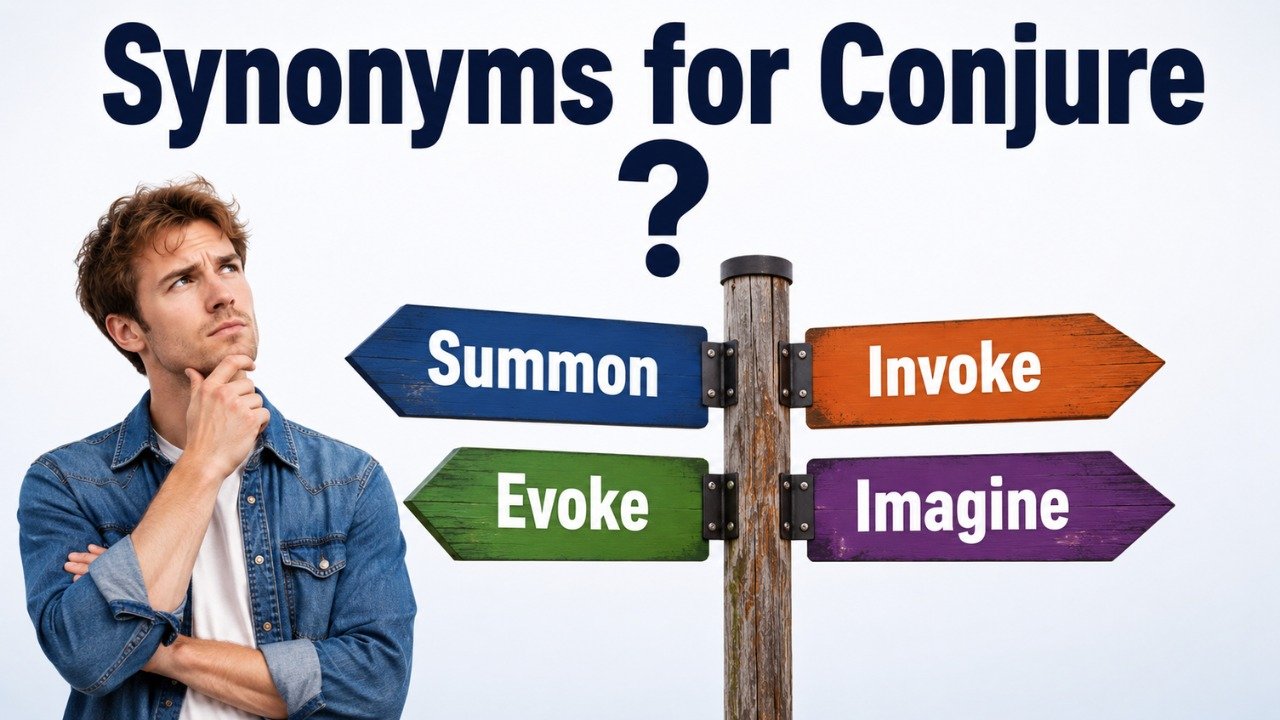
Quick Answer: Synonyms for conjure include summon, invoke, evoke, imagine, envision, create, manifest, produce, recall, and invent. Use summon when calling a person, spirit, or force to appear. Invoke is suitable for formally calling upon authority, help, or a supernatural power. Evoke works best when something brings a feeling, memory, or image to mind. Imagine and envision describe forming mental pictures, while create and produce refer to bringing something into existence. The best synonym depends on whether conjure means performing magic, recalling a memory, forming an image, or creating an unexpected result.
Pronunciation and Word Details
Word: Conjure.
Pronunciation: /ˈkʌndʒər/
Part of Speech: Verb.
Meaning: To call something into existence, bring an image or feeling to mind, or perform an apparently magical act.
US Pronunciation:
UK Pronunciation:
What Does “Conjure” Mean?
Conjure means to make something appear, bring an idea or image to mind, or call upon a supernatural power.
As a verb, conjure can describe magic. A performer may conjure an object from an empty container, or a character in a story may conjure a spirit.
The word also has a common figurative meaning. A smell, sound, photograph, or description can conjure memories and emotions. In this context, nothing physically appears. Instead, something becomes vivid in the mind.
Conjure can also mean creating a solution, explanation, image, or result through imagination or effort. For example, someone may conjure a clever excuse or conjure a meal from a few simple ingredients.
The exact meaning depends on the sentence. It can suggest magic, imagination, recollection, creativity, or the unexpected production of something.
Meaning, Tone, and Context of “Conjure”
Conjure usually has a vivid, imaginative, and slightly dramatic tone. It is more expressive than ordinary verbs such as make, create, remember, or imagine.
In fantasy and supernatural writing, conjure has a magical meaning. It may describe calling spirits, casting spells, creating illusions, or making objects appear.
In descriptive writing, conjure often refers to mental images. A detailed description can conjure a peaceful landscape, a childhood home, or a frightening scene.
In emotional contexts, the word may describe memories and feelings. A familiar song can conjure happiness, sadness, nostalgia, or excitement.
In everyday conversation, conjure can describe producing something through creativity or limited resources. Someone might conjure a meal from leftovers or conjure an explanation at the last moment.
In academic or professional writing, evoke, produce, create, generate, or suggest may sound more precise. Conjure is still useful when the writer wants a vivid or imaginative effect.
When and How to Use “Conjure”
For Magic: Use conjure when someone appears to create, summon, or control something through magical power.
Example: The magician seemed to conjure a bird from thin air.
For Mental Images: Use conjure when words, sounds, or descriptions create a clear picture in someone’s mind.
Example: The poem conjured images of quiet forests and silver lakes.
For Memories: Use conjure when something causes a past experience to return to the mind.
Example: The scent of fresh bread conjured memories of her childhood.
For Emotions: Use conjure when an experience awakens a particular feeling.
Example: The old photograph conjured a strong sense of nostalgia.
For Imagination: Use conjure when someone invents or imagines an idea, situation, or explanation.
Example: He conjured an elaborate story to explain his absence.
For Creation: Use conjure when someone manages to produce something unexpectedly or with limited materials.
Example: She conjured a delicious dinner from a nearly empty cupboard.
For Solutions: Use conjure when someone develops an answer or plan through creative thought.
Example: The team conjured a practical solution before the deadline.
Best Synonyms for Conjure
Summon: To call someone, something, or a supernatural force to appear.
Example: The ancient ritual was believed to summon protective spirits.
Invoke: To call upon a power, authority, rule, or principle for help or support.
Example: The speaker invoked the principle of fairness during the debate.
Evoke: To bring a memory, image, feeling, or response into the mind.
Example: The melody evoked memories of peaceful summer evenings.
Imagine: To form a picture, idea, or situation in the mind.
Example: She imagined herself walking through the distant city.
Envision: To picture a future event, possibility, or result clearly.
Example: The architect envisioned a bright and welcoming public space.
Create: To bring something new into existence.
Example: The artist created a striking image with simple materials.
Manifest: To make something visible, clear, or real.
Example: Her confidence manifested itself in the way she spoke.
Produce: To make, generate, or bring about a result.
Example: The experiment produced an unexpected reaction.
Recall: To bring a fact, image, or past experience back into the mind.
Example: The photograph helped him recall the details of the journey.
Invent: To create a new idea, object, explanation, or story.
Example: The child invented an adventurous tale about a hidden kingdom.
50 Synonyms for Conjure with Short Meanings
- Summon: To call someone or something to appear.
- Invoke: To call upon a power, authority, or spirit.
- Evoke: To bring a feeling, memory, or image to mind.
- Call Forth: To cause something to appear or develop.
- Call Up: To bring something into the mind or presence.
- Summon Up: To gather or bring forward a feeling, memory, or quality.
- Raise: To call up or cause something to appear.
- Raise Up: To bring forward or cause to emerge.
- Awaken: To cause a feeling, memory, or awareness to become active.
- Arouse: To produce a feeling, reaction, or interest.
- Stir: To awaken an emotion, memory, or response.
- Rouse: To cause a feeling or state to become active.
- Elicit: To draw out a reaction, answer, or emotion.
- Prompt: To cause or encourage a thought or action.
- Provoke: To cause a strong reaction, thought, or feeling.
- Inspire: To fill someone with an idea, emotion, or creative desire.
- Kindle: To begin or awaken a feeling or interest.
- Suggest: To bring an idea or image indirectly to mind.
- Recall: To bring a past experience or fact back to mind.
- Remember: To bring stored information or experiences into awareness.
- Imagine: To form a mental picture or idea.
- Envision: To picture something clearly in the mind.
- Visualize: To create a detailed mental image.
- Picture: To imagine a person, place, event, or situation.
- Conceive: To form an idea or plan mentally.
- Dream Up: To invent an imaginative idea or explanation.
- Invent: To create something original or imaginary.
- Devise: To develop a plan, method, or solution.
- Formulate: To create an idea, plan, or explanation carefully.
- Fabricate: To invent a story, claim, or object.
- Create: To bring something new into existence.
- Produce: To make or cause something to happen.
- Generate: To create or cause a result, idea, or response.
- Form: To bring something into a particular shape or existence.
- Fashion: To make or shape something with care.
- Craft: To create something skillfully and deliberately.
- Bring Forth: To produce, reveal, or cause something to appear.
- Bring About: To cause an event, change, or result.
- Cause: To make something happen or exist.
- Induce: To bring about a particular condition or response.
- Manifest: To make something visible, evident, or real.
- Materialize: To appear or become physically real.
- Make Appear: To cause something to become visible.
- Create an Illusion: To make something seem real through deception or skill.
- Perform Magic: To produce an effect that appears supernatural.
- Enchant: To affect through magic, charm, or fascination.
- Bewitch: To influence through supposed magic or powerful attraction.
- Charm: To influence, delight, or affect through attraction or magic.
- Cast a Spell: To use magical words or actions to create an effect.
- Recreate: To produce again or represent a past scene or experience.
Read Also:
Synonyms for Meet

Synonyms for Conjure by Context
When Conjure Means Summon
When conjure refers to calling a person, spirit, force, or supernatural being into presence, use summon, invoke, call forth, raise, or call up.
Summon Example: The legend claimed that the ceremony could summon a spirit.
Invoke Example: The healer invoked a protective power before beginning the ritual.
Call Forth Example: The mysterious words appeared to call forth an unseen force.
When Conjure Means Evoke
When conjure describes causing a memory, image, emotion, or reaction, use evoke, awaken, stir, arouse, elicit, or kindle.
Evoke Example: The painting evoked a feeling of deep calm.
Awaken Example: The familiar melody awakened memories of school.
Stir Example: Her speech stirred hope among the audience.
When Conjure Means Imagine
When conjure means creating a picture or possibility in the mind, use imagine, envision, visualize, picture, or conceive.
Imagine Example: He imagined a world in which everyone had equal opportunities.
Envision Example: The planners envisioned a cleaner and safer city.
Visualize Example: She visualized each step before beginning the performance.
When Conjure Means Invent
When conjure refers to creating a story, excuse, explanation, or idea, use invent, devise, fabricate, formulate, or dream up.
Invent Example: He invented an excuse for missing the appointment.
Devise Example: The engineers devised a simpler solution.
Dream Up Example: The students dreamed up several creative characters.
When Conjure Means Create
When conjure describes bringing something into existence, use create, produce, generate, fashion, craft, or bring forth.
Create Example: The designer created an inviting atmosphere with soft lighting.
Produce Example: The discussion produced several useful ideas.
Craft Example: She crafted a thoughtful response to the criticism.
When Conjure Means Make Appear
When conjure describes an apparently magical appearance, use materialize, manifest, make appear, create an illusion, or perform magic.
Materialize Example: A figure seemed to materialize from the mist.
Create an Illusion Example: The performer created an illusion of floating above the stage.
Manifest Example: The strange shape manifested slowly in the darkness.
Another Word for Conjure
Evoke is often the best single replacement for conjure when discussing memories, feelings, or mental images. Summon is better when something is being called into presence, while imagine suits mental pictures and create suits physical or abstract production.
Original: The music conjured memories of her childhood.
Better Option: The music evoked memories of her childhood.
Original: The magician conjured a flower from an empty box.
Better Option: The magician made a flower appear from an empty box.
Original: She conjured an image of a peaceful future.
Better Option: She envisioned a peaceful future.
Original: The group conjured a solution within minutes.
Better Option: The group devised a solution within minutes.
When Not to Use “Conjure”
Do not use conjure when a simpler and more precise verb communicates the meaning better. In formal reports, words such as create, produce, generate, recall, or evoke may sound clearer.
Avoid conjure when the action is ordinary and contains no sense of imagination, surprise, memory, or apparent magic.
Do not use conjure as a replacement for every form of creation. A factory produces goods, a writer drafts a report, and a technician repairs a machine. Conjure would sound overly dramatic in these contexts.
Weak: The factory conjured five hundred boxes during the shift.
Better: The factory produced five hundred boxes during the shift.
Weak: She conjured the meeting notes after the discussion.
Better: She wrote the meeting notes after the discussion.
Weak: The technician conjured the damaged machine.
Better: The technician repaired the damaged machine.
Weak: He conjured the correct answer from the document.
Better: He found the correct answer in the document.
Words Commonly Confused With Conjure
Conjure vs Summon: Conjure may involve magic, imagination, memories, or creation. Summon mainly means calling someone or something to appear.
Conjure vs Invoke: Conjure often suggests making something appear. Invoke means calling upon an authority, principle, law, spirit, or power for support.
Conjure vs Evoke: Conjure can describe both magical appearance and mental imagery. Evoke specifically means bringing a feeling, memory, image, or reaction to mind.
Conjure vs Imagine: Conjure often creates a vivid or dramatic mental image. Imagine is the broader and more neutral term for forming ideas or pictures in the mind.
Conjure vs Envision: Conjure may relate to memories, magic, or invented ideas. Envision usually refers to picturing a future possibility or planned result.
Conjure vs Create: Create means bringing something new into existence. Conjure adds a sense of imagination, mystery, surprise, or unusual effort.
Conjure vs Recall: Conjure can cause a memory to appear indirectly. Recall means deliberately bringing information or an experience back into the mind.
Conjure vs Manifest: Conjure suggests causing something to appear. Manifest means becoming visible, evident, or physically real.
Which Synonym Should You Choose?
Choose summon when describing a person, spirit, force, courage, or resource being called forward.
Choose invoke when referring to laws, principles, authority, divine help, supernatural power, or formal support.
Choose evoke when a sound, image, smell, description, or experience brings feelings or memories to mind.
Choose imagine when someone forms a general mental picture, idea, or possibility.
Choose envision when someone pictures a future plan, result, or ambition clearly.
Choose visualize when the mental image is detailed, deliberate, or connected to preparation.
Choose recall when someone brings a fact, detail, or past experience back into awareness.
Choose invent when someone creates an original story, explanation, object, or idea.
Choose devise when someone develops a plan, method, or solution through careful thought.
Choose create or produce in formal writing when the focus is simply on making something or causing a result.
Choose generate for ideas, energy, data, interest, income, reactions, or measurable results.
Choose manifest or materialize when something becomes visible, clear, or physically present.
Real Life Examples of “Conjure” in Sentences
Original: The smell of cinnamon conjured memories of family celebrations.
Better Option: The smell of cinnamon evoked memories of family celebrations.
Original: She conjured an image of the house as it once looked.
Better Option: She visualized the house as it once looked.
Original: The performer conjured a coin from behind the child’s ear.
Better Option: The performer made a coin appear from behind the child’s ear.
Original: He conjured an excuse for arriving late.
Better Option: He invented an excuse for arriving late.
Original: The novel conjured a world filled with strange creatures.
Better Option: The novel created a world filled with strange creatures.
Original: The photograph conjured feelings of sadness and affection.
Better Option: The photograph stirred feelings of sadness and affection.
Original: The manager conjured a plan to reduce unnecessary expenses.
Better Option: The manager devised a plan to reduce unnecessary expenses.
Original: She conjured enough courage to speak before the audience.
Better Option: She summoned enough courage to speak before the audience.
Original: The description conjured a vivid picture of the coastline.
Better Option: The description evoked a vivid picture of the coastline.
Original: The cook conjured a satisfying meal from a few ingredients.
Better Option: The cook created a satisfying meal from a few ingredients.
Synonym Groups and Usage Differences
Summoning Group
Summon, invoke, call forth, call up, raise, and summon up describe bringing a person, force, quality, or supernatural presence forward.
Summon is the clearest choice for calling something into presence. Invoke is more formal and often involves authority or spiritual power.
Example: She summoned the courage to answer the difficult question.
Memory and Emotion Group
Evoke, awaken, stir, arouse, elicit, provoke, and kindle describe causing feelings, memories, thoughts, or reactions.
Evoke is usually neutral and suitable for formal writing. Provoke often suggests a stronger or less pleasant reaction.
Example: The speech evoked admiration and hope.
Imagination Group
Imagine, envision, visualize, picture, and conceive describe forming ideas or images in the mind.
Imagine is broad, while envision often concerns the future. Visualize suggests a clear and detailed mental picture.
Example: The designer envisioned a spacious and practical interior.
Invention Group
Invent, devise, formulate, fabricate, and dream up describe developing stories, explanations, solutions, or ideas.
Devise is useful for practical plans. Fabricate often suggests that a story or claim is false.
Example: The team devised a method for completing the work safely.
Creation Group
Create, produce, generate, form, fashion, craft, and bring forth describe causing something to exist.
Craft emphasizes skill and care. Generate is common for ideas, power, interest, revenue, and data.
Example: The workshop generated several promising ideas.
Magical Appearance Group
Materialize, manifest, make appear, perform magic, enchant, bewitch, and cast a spell relate to magical or seemingly supernatural effects.
Materialize means becoming physically visible. Enchant and bewitch may also describe captivating someone emotionally.
Example: The mysterious figure appeared to materialize near the doorway.
Antonyms of Conjure
The opposite of conjure depends on whether the word refers to creating, remembering, imagining, summoning, or causing something to appear.
Dismiss: To send away or remove from consideration.
Banish: To force someone or something to leave.
Dispel: To make a belief, feeling, or illusion disappear.
Suppress: To prevent a feeling, thought, or reaction from developing.
Forget: To lose or fail to recall a memory.
Ignore: To give no attention to an idea, feeling, or presence.
Conceal: To keep something hidden from view.
Destroy: To cause something to stop existing.
Eliminate: To remove something completely.
Erase: To remove a mark, memory, or record.
Prevent: To stop an event or result from occurring.
Inhibit: To limit or hold back an action, feeling, or response.
Comparison Between Conjure and Related Words
Conjure vs Summon
Conjure has a broader meaning and can relate to magic, mental images, memories, or creative production. Summon mainly means calling someone, something, or a personal quality forward.
Example With Conjure: The story conjured images of an ancient kingdom.
Example With Summon: She summoned the courage to enter the room.
Conjure vs Evoke
Conjure suggests creating a vivid image, feeling, or apparent presence. Evoke focuses specifically on causing a memory, feeling, image, or reaction.
Example With Conjure: The description conjured a peaceful mountain village.
Example With Evoke: The description evoked a sense of peace.
Conjure vs Invoke
Conjure may mean causing something to appear, often through magic or imagination. Invoke means formally calling upon a power, authority, law, or principle.
Example With Conjure: The magician claimed he could conjure a spirit.
Example With Invoke: The lawyer invoked a rule protecting confidential information.
Conjure vs Imagine
Conjure is more vivid and dramatic than imagine. Imagine is a broad, neutral word for forming an idea or picture mentally.
Example With Conjure: The music conjured an image of waves beneath moonlight.
Example With Imagine: She imagined living near the ocean.
Conjure vs Envision
Conjure can refer to past memories, magical acts, or invented images. Envision usually describes picturing a possible future.
Example With Conjure: The photograph conjured memories of the old neighborhood.
Example With Envision: The community envisioned a safer neighborhood.
Conjure vs Create
Conjure often carries a sense of surprise, imagination, or mystery. Create is a general word for bringing something into existence.
Example With Conjure: She conjured a meal from the remaining ingredients.
Example With Create: She created a detailed plan for the event.
Common Phrases and Expressions With Conjure
Conjure Up an Image: To create a mental picture.
Conjure Up Memories: To cause past experiences to return to mind.
Conjure Up a Vision: To imagine a clear scene or possibility.
Conjure Up a Story: To invent or imagine a narrative.
Conjure Up an Excuse: To invent an explanation quickly.
Conjure Up a Solution: To develop an answer through creative thought.
Conjure Up Courage: To gather enough bravery for an action.
Conjure Something From Nothing: To create a result with few or no visible resources.
Conjure a Spirit: To call a supernatural being into presence.
Conjure an Atmosphere: To create a particular mood or feeling.
Common Mistakes to Avoid
A common mistake is assuming that conjure only relates to magic. It can also describe bringing memories, emotions, images, ideas, and solutions into the mind.
Avoid using conjure when a more precise word is needed. In formal reports, produced, generated, created, or caused may communicate the result more clearly.
Do not confuse conjure with invoke. You conjure an image or apparently make something appear, but you invoke a law, principle, authority, or power.
Do not use evoke when you mean physically summoning something. Evoke describes feelings, memories, images, and responses rather than physical appearances.
Avoid treating conjure up as incorrect. Both conjure and conjure up are standard expressions, although conjure up is especially common when discussing memories, images, excuses, or ideas.
Do not overuse conjure in descriptive writing. Repeating it can weaken its vivid effect. Alternate it with evoke, imagine, summon, create, recall, or envision when those words match the context.
Be careful with fabricate. It can mean making or constructing something, but it often suggests inventing a false story or claim.
Conclusion
Synonyms for conjure include summon, invoke, evoke, imagine, envision, create, recall, devise, and manifest. Summon works best for calling someone or something forward, while invoke suits authority or supernatural power. Evoke is ideal for memories and emotions, and imagine or envision fits mental pictures. Create, produce, and generate are clearer for ordinary results. Choosing the right alternative depends on whether conjure describes magic, imagination, recollection, emotional response, or creative production.
FAQs About Synonyms for Conjure
What Is the Best Synonym for Conjure?
Evoke is the best synonym when conjure refers to memories, emotions, or images. Summon is better for calling something forward, while create suits general production.
Does Conjure Mean Imagine?
Conjure can mean imagine when someone forms a vivid mental image. However, it can also mean summon, evoke, invent, or make something appear.
Can Summon Replace Conjure?
Summon can replace conjure when a person, spirit, force, feeling, or quality is being called forward. It does not fit every imaginative or creative context.
What Is a Formal Synonym for Conjure?
Formal alternatives include evoke, invoke, generate, produce, formulate, manifest, and elicit. The correct choice depends on the intended meaning.
What Is the Difference Between Conjure and Evoke?
Conjure can involve magic, imagination, creation, or memory. Evoke specifically means bringing a feeling, memory, image, or reaction to mind.
Is Conjure Up Grammatically Correct?
Yes. Conjure up is a standard expression meaning to create, imagine, recall, or produce something, often with effort or creativity.
What Is the Opposite of Conjure?
Possible opposites include dismiss, banish, dispel, suppress, forget, conceal, destroy, and prevent. The best antonym depends on the sentence.
