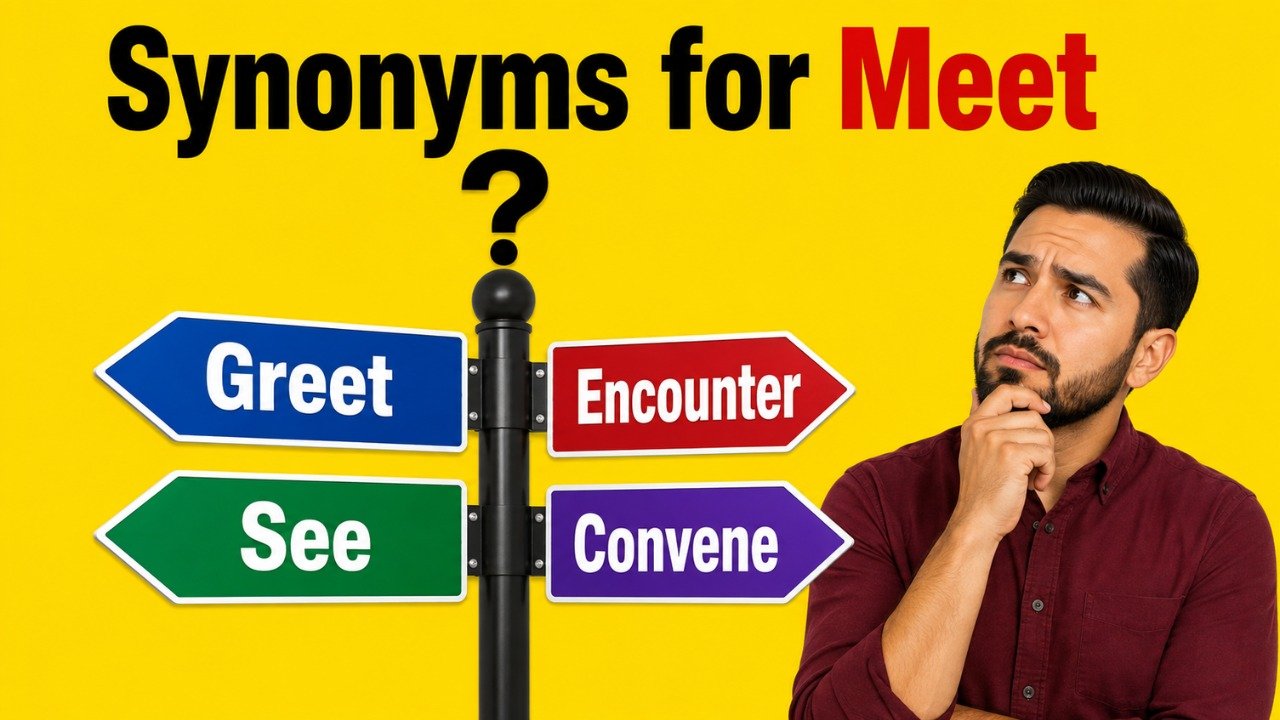
Quick Answer: The best synonyms for meet include encounter, see, greet, gather, assemble, convene, reunite, face, satisfy, and fulfill. Use encounter when meeting someone unexpectedly, greet when welcoming a person, and gather or assemble when people come together as a group. Choose convene for a formal meeting, face for dealing with a challenge, satisfy for meeting a need or condition, and fulfill for completing an obligation, promise, or requirement.
Pronunciation and Word Details
Word: Meet.
Pronunciation: /miːt/.
Part of Speech: Verb, noun, and adjective.
Meaning: To come together with someone, encounter something, satisfy a requirement, or deal with a situation.
US Pronunciation:
UK Pronunciation:
What Does “Meet” Mean?
Meet means to come into the presence of another person, gather with others, encounter a situation, or satisfy a condition. It is most commonly used as a verb, but it can also function as a noun or adjective in specific contexts.
When meet refers to people, it can describe a planned or unexpected encounter.
Planned Encounter: I will meet the manager at noon.
Unexpected Encounter: She met an old friend near the station.
Meet can also describe a group coming together for discussion, work, or social activity.
Group Gathering: The committee meets every Friday.
The word may refer to facing a challenge, problem, or difficult situation.
Challenge: The team met every obstacle with patience.
Meet can also mean satisfying a need, standard, expectation, condition, or deadline.
Requirement: The application meets all legal requirements.
As a noun, meet can refer to an organized sporting event.
Noun Use: The school held a swimming meet.
As an adjective, meet is an old or formal word meaning suitable or proper, although this use is uncommon in modern everyday English.
Meaning, Tone, and Context of “Meet”
Meet is a common, neutral, and flexible word. It appears naturally in casual speech, professional communication, academic writing, business reports, social conversations, and formal instructions.
Conversational Tone: Meet is widely used when talking about seeing friends, relatives, colleagues, or new people.
Professional Tone: It can describe appointments, discussions, interviews, conferences, and workplace gatherings.
Formal Tone: In reports and policies, meet often means satisfy, comply with, or fulfill a standard.
Social Context: Meet can describe becoming acquainted with someone for the first time.
Organizational Context: It can describe people gathering to exchange ideas or make decisions.
Challenge Context: Meet may mean face, confront, address, or handle a difficult situation.
Requirement Context: It can mean reaching a standard, fulfilling an obligation, or satisfying a need.
Because meet has several meanings, a specific synonym can make a sentence more accurate. Encounter, assemble, face, satisfy, and connect are not interchangeable in every context.
When and How to Use “Meet”
For Seeing Someone
Use meet when arranging to see another person at a particular place or time.
Example: We will meet the designer after lunch.
For Meeting Someone for the First Time
Use meet when becoming acquainted with someone new.
Example: It was a pleasure to meet your family.
For an Unexpected Encounter
Use meet when someone comes across another person or situation without planning it.
Example: She met her former teacher while shopping.
For a Group Gathering
Use meet when several people come together for discussion or activity.
Example: The planning team meets twice each month.
For a Formal Discussion
Use meet when officials, representatives, or professionals gather to discuss an issue.
Example: The directors met to review the financial report.
For Facing a Challenge
Use meet when responding directly to a difficulty or obstacle.
Example: The community met the crisis with courage.
For Satisfying a Need
Use meet when something provides what is necessary.
Example: The new service meets the needs of working parents.
For Fulfilling a Requirement
Use meet when a person, product, or process reaches an expected standard.
Example: Every applicant must meet the eligibility conditions.
For Reaching a Deadline
Use meet when completing something by the required time.
Example: The team worked late to meet the deadline.
For Lines or Objects Joining
Use meet when two surfaces, roads, lines, or objects touch or connect.
Example: The two paths meet near the river.
Best Synonyms for Meet
Encounter
Synonym: Encounter means to come across a person, situation, or difficulty, often unexpectedly.
Example: The travelers encountered heavy rain during their journey.
See
Synonym: See means to spend time with someone or attend an arranged appointment.
Example: I am seeing the consultant on Monday.
Greet
Synonym: Greet means to welcome or acknowledge someone when they arrive.
Example: The host greeted every guest warmly.
Gather
Synonym: Gather means to come together in one place as a group.
Example: Residents gathered in the hall for the announcement.
Assemble
Synonym: Assemble means to bring people together for a particular purpose.
Example: The students assembled in the main auditorium.
Convene
Synonym: Convene means to arrange or hold a formal meeting.
Example: The committee convened to discuss the proposed changes.
Face
Synonym: Face means to deal directly with a challenge, danger, or difficult situation.
Example: The organization faced several financial difficulties.
Satisfy
Synonym: Satisfy means to provide what is required or reach an expected condition.
Example: The evidence satisfied the legal standard.
Fulfill
Synonym: Fulfill means to complete a promise, duty, requirement, or expectation.
Example: The course fulfills the graduation requirement.
Connect
Synonym: Connect means to join, touch, communicate, or establish a relationship.
Example: The new road connects the two villages.
50 Synonyms for Meet with Short Meanings
- Encounter: To come across someone or something.
- See: To spend time with someone by arrangement.
- Greet: To welcome or acknowledge someone.
- Gather: To come together in one place.
- Assemble: To form a group for a purpose.
- Convene: To organize or hold a formal gathering.
- Reunite: To come together again after separation.
- Join: To become part of a person, group, or activity.
- Visit: To go and spend time with someone.
- Receive: To welcome or accept a visitor.
- Welcome: To greet someone with warmth or approval.
- Rendezvous: To meet at an agreed place and time.
- Confer: To meet and discuss an important matter.
- Consult: To meet someone for information or advice.
- Interview: To meet someone and ask formal questions.
- Negotiate: To meet and discuss an agreement.
- Socialize: To meet people for friendly interaction.
- Mingle: To move around and speak with different people.
- Associate: To spend time or connect with others.
- Accompany: To meet and go somewhere with someone.
- Come Across: To meet or discover unexpectedly.
- Run Into: To meet someone by chance.
- Cross Paths: To encounter someone during daily activity.
- Make Acquaintance: To meet and begin knowing someone.
- Be Introduced: To meet someone through another person.
- Face: To deal directly with a difficulty.
- Confront: To meet a problem or opponent directly.
- Address: To deal with a need, problem, or concern.
- Tackle: To make a serious effort to handle a challenge.
- Handle: To manage a situation or responsibility.
- Cope With: To deal successfully with a difficulty.
- Answer: To provide a suitable response to a need.
- Satisfy: To meet a condition, need, or standard.
- Fulfill: To complete a duty, promise, or requirement.
- Comply With: To act according to a rule or condition.
- Conform To: To match a required standard or pattern.
- Match: To equal or correspond with something.
- Equal: To reach the same level or amount.
- Measure Up To: To reach an expected standard.
- Qualify: To meet the conditions for something.
- Reach: To arrive at a target, level, or point.
- Attain: To achieve a required level or goal.
- Achieve: To successfully reach an objective.
- Cover: To provide enough for a cost, need, or demand.
- Supply: To provide what is needed.
- Accommodate: To provide for a particular need.
- Touch: To come into physical contact.
- Intersect: To cross or meet at a point.
- Converge: To move toward and meet at one place.
- Connect: To join or establish contact.
Read Also:
Synonyms for Enterprise

Synonyms for Meet by Context
When Meet Means Encounter Someone
Use these alternatives when people come into one another’s presence, either intentionally or unexpectedly.
Encounter: To come across someone, often without planning.
Example: She encountered her former neighbor at the market.
See: To spend time with someone by arrangement.
Example: I will see the doctor on Thursday.
Come Across: To find or meet someone unexpectedly.
Example: We came across an old classmate during the trip.
Run Into: To meet someone by chance in an informal situation.
Example: He ran into his cousin outside the library.
Cross Paths: To encounter someone while following separate activities.
Example: The two writers crossed paths at a conference.
When Meet Means Become Acquainted
These alternatives describe meeting someone for the first time or beginning a relationship.
Make Acquaintance: To meet and begin knowing a person.
Example: She made the acquaintance of several local artists.
Be Introduced: To meet someone through a formal or social introduction.
Example: I was introduced to the new director after the meeting.
Greet: To acknowledge or welcome someone upon arrival.
Example: The receptionist greeted the visitors politely.
Welcome: To receive someone in a friendly way.
Example: The family welcomed their new neighbors warmly.
When Meet Means Gather as a Group
Use these synonyms when people come together for discussion, work, celebration, or another shared purpose.
Gather: To come together informally or generally.
Example: The volunteers gathered near the entrance.
Assemble: To form an organized group.
Example: The staff assembled for an important announcement.
Convene: To begin or arrange a formal meeting.
Example: The council convened to consider the budget.
Reunite: To gather again after being apart.
Example: Former students reunited for the school celebration.
Rendezvous: To meet at a place and time agreed in advance.
Example: The research team rendezvoused near the field station.
When Meet Means Discuss Something
These words describe meetings held for advice, negotiation, planning, or decision making.
Confer: To discuss an important issue with another person or group.
Example: The advisers conferred before announcing their recommendation.
Consult: To seek professional information or guidance.
Example: The manager consulted an expert before changing the system.
Negotiate: To discuss terms in order to reach an agreement.
Example: Representatives negotiated a new employment agreement.
Interview: To meet and ask questions for employment, research, or information.
Example: The journalist interviewed several witnesses.
When Meet Means Face a Challenge
Use these alternatives when meet describes dealing with an obstacle, risk, crisis, or responsibility.
Face: To accept and deal directly with a difficult situation.
Example: The region faces a serious water shortage.
Confront: To deal with something difficult in a direct and determined way.
Example: Leaders must confront the causes of inequality.
Address: To give attention to a problem or need.
Example: The new policy addresses several safety concerns.
Tackle: To begin working seriously on a difficult problem.
Example: The program aims to tackle youth unemployment.
Handle: To manage a responsibility, problem, or situation.
Example: She handled the complaint calmly and professionally.
When Meet Means Satisfy a Need
These synonyms work when something provides enough support, service, money, or resources.
Satisfy: To provide what is necessary or expected.
Example: The revised design satisfies the client’s requirements.
Answer: To provide a suitable solution to a need.
Example: The service answers the needs of small businesses.
Cover: To provide enough money or resources for something.
Example: The grant will cover the cost of training.
Supply: To provide a necessary item, service, or resource.
Example: Local farms supply the region’s food needs.
Accommodate: To adjust or provide for a particular need.
Example: The building can accommodate visitors with limited mobility.
When Meet Means Fulfill a Requirement
Use these alternatives when discussing conditions, rules, expectations, qualifications, or standards.
Fulfill: To complete or satisfy an obligation.
Example: The applicant fulfills every condition for admission.
Comply With: To follow a rule, law, or official requirement.
Example: All equipment must comply with safety regulations.
Conform To: To match an established standard or expectation.
Example: The final report conforms to the required format.
Qualify: To meet the conditions needed for a position, benefit, or opportunity.
Example: Applicants must qualify for financial assistance.
Measure Up To: To reach an expected level of quality.
Example: The final product did not measure up to customer expectations.
When Meet Means Match or Equal
These alternatives describe reaching the same standard, amount, quality, or level.
Match: To be equal or suitable in quality, appearance, or performance.
Example: Few candidates matched her level of experience.
Equal: To reach the same amount, value, or standard.
Example: This year’s sales equaled the previous record.
Reach: To arrive at a particular level or target.
Example: The organization reached its annual fundraising goal.
Attain: To achieve a desired standard after effort.
Example: Students must attain a minimum score to pass.
Achieve: To successfully reach a goal or result.
Example: The team achieved its performance target.
When Meet Means Join or Touch
Use these words when objects, roads, lines, or paths come together physically.
Touch: To come into physical contact.
Example: The edge of the table touches the wall.
Join: To connect with another object, line, or route.
Example: The smaller road joins the main highway.
Intersect: To cross at a particular point.
Example: The two streets intersect near the courthouse.
Converge: To move toward the same point and meet there.
Example: Several walking paths converge near the lake.
Connect: To link two places, objects, or systems.
Example: A narrow bridge connects the island to the mainland.
Another Word for Meet
Encounter is a strong general replacement for meet when describing coming across a person or situation. However, the best alternative depends on the intended meaning.
Use gather when several people come together, greet when welcoming someone, and convene for a formal meeting. Choose face for a challenge, satisfy for a need or standard, and fulfill for an obligation or requirement.
Original: I met an old friend near the station.
Better Option: I encountered an old friend near the station.
Original: The committee will meet on Tuesday.
Better Option: The committee will convene on Tuesday.
Original: The product meets every safety requirement.
Better Option: The product satisfies every safety requirement.
Original: The organization must meet its responsibilities.
Better Option: The organization must fulfill its responsibilities.
When Not to Use “Meet”
Meet may sound unclear when the sentence does not show whether it means encounter, gather, satisfy, face, or connect. Use a more exact word when clarity is important.
When Describing a Formal Gathering
Use convene, confer, or consult when the purpose of the meeting matters.
Weak: Senior officials met about the emergency.
Better: Senior officials convened to discuss the emergency.
When Referring to a Legal Requirement
Use comply with, conform to, or satisfy for clearer formal writing.
Weak: The building meets the law.
Better: The building complies with legal safety requirements.
When Describing an Unexpected Encounter
Use encounter, come across, or run into when the meeting was not planned.
Weak: She met her former colleague by accident.
Better: She ran into her former colleague by accident.
When Describing a Difficult Problem
Use face, confront, address, tackle, or handle to clarify the type of response.
Weak: The city must meet the housing crisis.
Better: The city must address the housing crisis.
When Discussing a Standard
Use satisfy, fulfill, match, or measure up to when evaluating quality.
Weak: The service meets customer hopes.
Better: The service satisfies customer expectations.
When Referring to Objects Joining
Use touch, intersect, converge, join, or connect for physical relationships.
Weak: The two roads meet outside the village.
Better: The two roads intersect outside the village.
When Meet Becomes Repetitive
Repeating meet can make writing sound vague and monotonous.
Weak: The team met the clients, met their needs, and met the deadline.
Better: The team consulted the clients, satisfied their needs, and completed the work by the deadline.
Words Commonly Confused With Meet
Meet vs Greet: Meet means to come into someone’s presence or become acquainted. Greet means to welcome or acknowledge someone after they arrive.
Meet vs Encounter: Meet may be planned or unexpected. Encounter often suggests an unplanned meeting or contact with a situation.
Meet vs See: Meet focuses on coming together. See often refers to an arranged appointment or spending time with someone.
Meet vs Gather: Meet can involve two or more people. Gather emphasizes several people coming together as a group.
Meet vs Convene: Meet is general and neutral. Convene is formal and usually refers to an official group gathering.
Meet vs Satisfy: Meet can refer to people, challenges, standards, or needs. Satisfy specifically means to provide what a need or condition requires.
Meet vs Fulfill: Meet may describe reaching a standard. Fulfill emphasizes completing an obligation, promise, duty, or purpose.
Meet vs Face: Meet has several meanings. Face specifically means to confront or deal with a challenge or difficult situation.
Meet vs Match: Meet can mean satisfy a standard. Match means to equal, correspond with, or be suitable for something.
Meet vs Join: Meet describes people or things coming together. Join often means becoming part of a group or connecting one object to another.
Which Synonym Should You Choose?
Choose encounter when someone comes across a person, situation, or difficulty.
Choose see when describing an appointment or an arranged visit.
Choose greet when welcoming or acknowledging someone.
Choose gather for an informal group coming together.
Choose assemble for an organized gathering with a clear purpose.
Choose convene for formal committees, councils, boards, or official discussions.
Choose confer when people meet to exchange advice or make a decision.
Choose consult when seeking professional guidance or information.
Choose negotiate when parties meet to reach an agreement.
Choose reunite when people meet again after a period of separation.
Choose face when dealing directly with a challenge, risk, or difficulty.
Choose confront when the response is direct, serious, or forceful.
Choose address when giving attention to a problem or need.
Choose tackle when making an active effort to solve something difficult.
Choose satisfy when a product, service, or action meets a need or condition.
Choose fulfill for promises, responsibilities, duties, and requirements.
Choose comply with for laws, regulations, and official rules.
Choose measure up to when comparing performance with an expectation.
Choose reach or attain when describing a target, level, or standard.
Choose intersect when roads, lines, or paths cross at a point.
Choose converge when several routes or movements come together.
Choose connect when two people, places, systems, or objects become linked.
Real Life Examples of “Meet” in Sentences
Original: I met my former teacher near the library.
Better Option: I encountered my former teacher near the library.
Original: The staff will meet in the conference room.
Better Option: The staff will gather in the conference room.
Original: The council met to review the proposal.
Better Option: The council convened to review the proposal.
Original: She met every visitor with a smile.
Better Option: She greeted every visitor with a smile.
Original: The organization met several serious challenges.
Better Option: The organization faced several serious challenges.
Original: The new service meets the needs of older residents.
Better Option: The new service satisfies the needs of older residents.
Original: The applicant meets all educational requirements.
Better Option: The applicant fulfills all educational requirements.
Original: The product meets current safety rules.
Better Option: The product complies with current safety rules.
Original: The team met its annual target.
Better Option: The team achieved its annual target.
Original: The two roads meet near the city center.
Better Option: The two roads intersect near the city center.
Synonym Groups and Usage Differences
Encounter Group
Encounter, come across, run into, cross paths, and see describe people entering one another’s presence.
Encounter is neutral and may sound formal. Come across and run into often suggest chance. See commonly refers to an arrangement or appointment.
Example: She ran into a colleague whom she had expected to see later that week.
Greeting Group
Greet, welcome, receive, and be introduced describe the beginning of social contact.
Greet means to acknowledge someone. Welcome suggests warmth and approval. Receive can sound formal, while be introduced refers to meeting someone through another person.
Example: The host welcomed the guests and introduced them to the other participants.
Gathering Group
Gather, assemble, convene, reunite, and rendezvous describe people coming together.
Gather is general and often informal. Assemble suggests organization. Convene is formal. Reunite means meeting again after separation.
Example: The members assembled in the hall before the committee formally convened.
Discussion Group
Confer, consult, interview, and negotiate describe meetings with a clear communication purpose.
Confer involves exchanging views. Consult means seeking advice. Interview involves structured questions. Negotiate aims to produce an agreement.
Example: The representatives conferred with legal advisers before negotiating the final terms.
Challenge Group
Face, confront, address, tackle, handle, and cope with describe responses to difficulties.
Face is broad and neutral. Confront is stronger. Address means give attention to an issue. Tackle suggests active effort, while cope with means manage difficulty successfully.
Example: The organization addressed minor concerns before tackling the larger financial problem.
Requirement Group
Satisfy, fulfill, comply with, conform to, qualify, and measure up to describe reaching conditions or expectations.
Satisfy works for needs and standards. Fulfill suits duties and obligations. Comply with applies to rules. Qualify means meeting conditions for eligibility.
Example: Every candidate must satisfy the entry standard and comply with the application rules.
Achievement Group
Reach, attain, achieve, match, and equal describe arriving at a level or result.
Reach is general. Attain is more formal. Achieve emphasizes successful effort. Match and equal compare one level with another.
Example: The team achieved its goal and matched its highest previous result.
Connection Group
Touch, join, intersect, converge, and connect describe physical or abstract contact.
Touch means direct contact. Join means link together. Intersect means cross. Converge means move toward one point. Connect is the broadest alternative.
Example: Several paths converge where the forest road joins the highway.
Antonyms of Meet
The opposite of meet depends on whether the word refers to encountering, gathering, satisfying, achieving, or connecting.
Avoid: To stay away from someone or something.
Miss: To fail to encounter or arrive in time for something.
Separate: To move or remain apart.
Depart: To leave a person, place, or gathering.
Disperse: To move away from a group or gathering.
Scatter: To spread in different directions.
Ignore: To give no attention to a person, need, or problem.
Evade: To avoid facing a responsibility or difficulty.
Fail: To be unsuccessful in reaching a goal or standard.
Fall Short: To fail to reach an expected level.
Violate: To act against a law, rule, or condition.
Disqualify: To fail to meet the conditions for eligibility.
Diverge: To move apart instead of coming together.
Disconnect: To break a physical or personal connection.
Reject: To refuse to receive, accept, or approve something.
Comparison: Meet vs Related Words
Meet vs Encounter
Meet may describe a planned or unexpected interaction. Encounter often emphasizes chance or contact with an unusual person, event, or difficulty.
Example With Meet: I will meet the editor at three o’clock.
Example With Encounter: We encountered several delays during the journey.
Meet vs Greet
Meet means to come into someone’s presence or become acquainted. Greet means to acknowledge or welcome someone.
Example With Meet: She met the new employees during orientation.
Example With Greet: She greeted the new employees at the entrance.
Meet vs See
Meet focuses on coming together at a place or time. See often describes an appointment, visit, or ongoing social contact.
Example With Meet: Let us meet outside the office.
Example With See: I am seeing the dentist tomorrow.
Meet vs Gather
Meet can involve two people or a group. Gather emphasizes several people moving or coming together in one place.
Example With Meet: The director met the adviser privately.
Example With Gather: The employees gathered for the announcement.
Meet vs Convene
Meet is suitable for general gatherings. Convene is more formal and often describes official groups beginning a session.
Example With Meet: The team will meet after lunch.
Example With Convene: The review board will convene on Monday.
Meet vs Face
Meet has many meanings, including encounter and satisfy. Face specifically refers to dealing directly with a difficult situation.
Example With Meet: The company met several obstacles during expansion.
Example With Face: The company faced several obstacles during expansion.
Meet vs Satisfy
Meet can mean reach a need or condition. Satisfy clearly emphasizes providing what is required.
Example With Meet: The proposal meets the community’s needs.
Example With Satisfy: The proposal satisfies the community’s needs.
Meet vs Fulfill
Meet may refer to reaching a condition or expectation. Fulfill emphasizes completing a responsibility, promise, duty, or requirement.
Example With Meet: The candidate meets the selection conditions.
Example With Fulfill: The candidate fulfills the selection conditions.
Meet vs Match
Meet can describe encountering or satisfying. Match means equal, correspond with, or suit something.
Example With Meet: The design meets the required standard.
Example With Match: The design matches the required style.
Meet vs Intersect
Meet is a general word for roads, lines, or objects coming together. Intersect specifically means to cross at a point.
Example With Meet: The paths meet near the bridge.
Example With Intersect: The paths intersect near the bridge.
Common Phrases and Expressions With “Meet”
Meet Someone: To come into a person’s presence.
Meet for the First Time: To become acquainted with someone new.
Meet Up: To gather informally at an arranged place or time.
Meet With Someone: To have a planned discussion or appointment.
Meet the Requirements: To satisfy all necessary conditions.
Meet a Deadline: To complete work by the required time.
Meet Expectations: To perform at the level people anticipate.
Meet a Need: To provide what is necessary.
Meet a Challenge: To respond successfully to a difficult situation.
Meet a Goal: To reach an intended result.
Common Mistakes to Avoid
Confusing Meet With Greet
Meet describes coming together or becoming acquainted. Greet refers to welcoming or acknowledging someone.
Incorrect: The receptionist met every visitor at the door with a welcome.
Correct: The receptionist greeted every visitor at the door.
Using Meet for Every Formal Discussion
Meet is correct but may be too general when the exact purpose is important.
General: The experts met about the issue.
Precise: The experts conferred about the issue.
Confusing Meet With Meat
Meet is a verb relating to encounters, gatherings, or requirements. Meat is a noun referring to animal flesh used as food.
Incorrect: We will meat outside the building.
Correct: We will meet outside the building.
Using Meet Instead of Satisfy
In formal writing, satisfy can be clearer when discussing needs or conditions.
Less Precise: The evidence meets the legal test.
More Precise: The evidence satisfies the legal test.
Using Meet Instead of Comply With
Meet may sound vague when referring to laws or official rules.
Less Precise: The factory meets environmental regulations.
More Precise: The factory complies with environmental regulations.
Confusing Meet and Met
Meet is the present form. Met is both the past tense and past participle.
Incorrect: We meet the consultant yesterday.
Correct: We met the consultant yesterday.
Using Meeted as a Past Form
Meeted is not a standard English word.
Incorrect: The directors meeted last week.
Correct: The directors met last week.
Repeating Meet in One Sentence
Use precise alternatives to make the sentence smoother.
Repetitive: We met the clients to meet their needs and meet the project deadline.
Improved: We consulted the clients to satisfy their needs and complete the project by the deadline.
Using the Wrong Preposition
Meet does not always require with. Use meet someone for direct contact and meet with someone for a planned discussion.
Natural: I met the manager at the event.
Natural: I met with the manager to discuss the report.
Using Meet Up in Very Formal Writing
Meet up is conversational and may sound too informal in reports or official documents.
Casual: The committee will meet up next week.
Formal: The committee will convene next week.
Conclusion
The best synonyms for meet depend on whether the word describes an encounter, gathering, discussion, challenge, requirement, or connection. Encounter and see suit personal contact, while gather, assemble, and convene describe groups coming together. Face and confront work for difficulties, while satisfy, fulfill, and comply with suit needs, duties, and rules. Intersect, converge, and connect describe lines or places joining. Choosing precise synonyms for meet will make your writing clearer, more varied, and better suited to its context.
FAQs About Synonyms for Meet
What Is the Best Synonym for Meet?
Encounter is a strong general synonym when meet means coming across a person or situation. Gather, satisfy, face, or connect may be better for other meanings.
What Is Another Word for Meeting Someone?
Useful alternatives include seeing, encountering, greeting, visiting, coming across, running into, and making someone’s acquaintance.
What Is a Formal Synonym for Meet?
Convene is a formal alternative for a group meeting. Confer, consult, interview, and negotiate are useful when the meeting has a specific purpose.
What Is a Synonym for Meet a Requirement?
Satisfy, fulfill, comply with, conform to, qualify, and measure up to can replace meet when discussing requirements.
What Is a Synonym for Meet a Challenge?
Face is the most direct alternative. Other useful choices include confront, address, tackle, handle, and cope with.
Are Meet and Greet the Same?
No. Meet means to come into someone’s presence or become acquainted. Greet means to welcome or acknowledge someone when they arrive.
What Is the Past Tense of Meet?
The past tense and past participle of meet are both met. For example, “We met the new manager yesterday.”
