
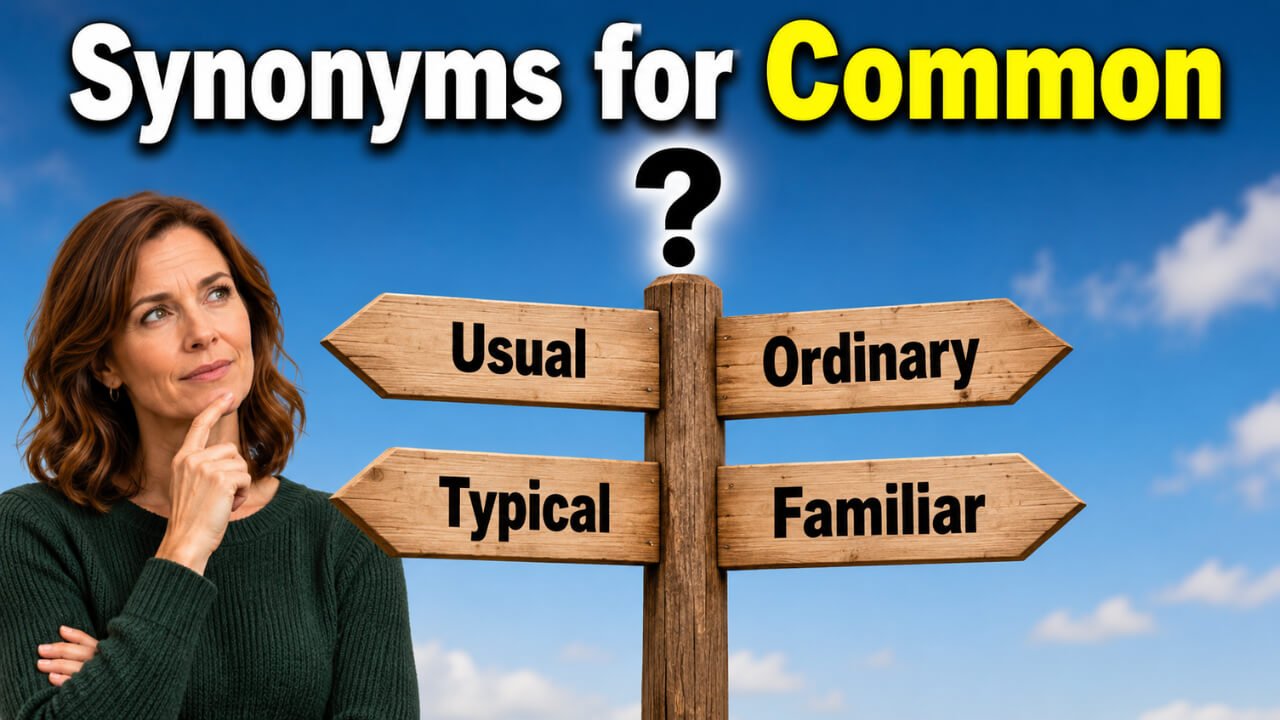
Quick Answer: The best synonyms for common are usual, ordinary, regular, frequent, widespread, popular, general, shared, standard, and everyday. The right choice depends on context. Use usual for something expected, frequent for something that happens often, widespread for something found in many places, ordinary for something not special, and shared when something belongs to or affects more than one person.
Pronunciation and Word Details
Word: Common.
Pronunciation: /ˈkɑːmən/
Part of Speech: Adjective.
Meaning: Common means usual, frequent, ordinary, or shared by many people.
US Pronunciation:
UK Pronunciation:
What Does “Common” Mean?
Direct Answer: Common means something that is seen often, happens often, is used by many people, or is not unusual.
Common is mainly used as an adjective. It can describe things, habits, problems, ideas, places, names, diseases, mistakes, interests, goals, and experiences. In one sentence, common may mean frequent. In another sentence, it may mean ordinary, shared, public, or widely known.
For example, a common mistake is a mistake many people make. A common interest is an interest shared by two or more people. A common name is a name many people have. Because the word has several meanings, choosing the right synonym depends on the exact idea you want to express.
Meaning, Tone, and Context of “Common”
Common is usually a neutral word. It is simple, clear, and suitable for everyday conversation, school writing, reports, grammar explanations, and general communication.
In most cases, common does not sound too formal or too casual. It works well when you want to describe something that is normal, regular, familiar, or widely found. However, in some contexts, common can sound negative when it means plain, low quality, or lacking refinement.
Neutral Use: A common problem affects many people.
Positive Use: They found common ground after a long discussion.
Negative Use: The room looked common and lacked style.
Academic Use: The study examined common causes of stress.
Conversational Use: That is a common question.
When and How to Use “Common”
For Frequency: Use common when something happens often or appears many times.
Example: Headaches are a common reason people visit a doctor.
For Ordinary Things: Use common when something is normal, plain, or not special.
Example: She chose a common design for the invitation.
For Shared Ideas: Use common when something belongs to, affects, or connects more than one person.
Example: The two friends had a common goal.
For General Knowledge: Use common when something is known by many people.
Example: It is common knowledge that regular practice improves skill.
For Public Use: Use common when a place or resource is open to several people.
Example: The building has a common area for residents.
For Problems and Mistakes: Use common when many people face the same issue.
Example: Spelling confusion is a common mistake in English.
Best Synonyms for Common
Usual: Something that normally happens or is expected.
Example: It is usual for him to arrive early.
Ordinary: Something normal and not special.
Example: They spent an ordinary day at home.
Regular: Something that happens again and again in a normal pattern.
Example: She takes regular walks after dinner.
Frequent: Something that happens often.
Example: Frequent delays made the trip tiring.
Widespread: Something found or accepted in many places.
Example: The idea became widespread across the region.
Popular: Something liked, used, or chosen by many people.
Example: That name is popular among new parents.
General: Something that applies to most people, cases, or situations.
Example: The teacher gave general advice to the class.
Shared: Something held, used, felt, or experienced by more than one person.
Example: They worked toward a shared purpose.
Standard: Something accepted as normal or usual.
Example: The form asks for standard information.
Everyday: Something ordinary and part of daily life.
Example: Cooking is an everyday task in many homes.
50 Synonyms for Common with Short Meanings
- Usual: Normal or expected.
- Ordinary: Not special or unusual.
- Regular: Happening in a normal pattern.
- Frequent: Happening often.
- Widespread: Found in many places.
- Popular: Liked or used by many people.
- General: Applying to many people or cases.
- Shared: Used, felt, or held by more than one person.
- Standard: Accepted as normal or typical.
- Everyday: Normal in daily life.
- Typical: Showing the usual qualities of something.
- Normal: Usual and expected.
- Familiar: Well known through experience.
- Routine: Done as a regular part of life.
- Customary: Usual according to habit or tradition.
- Habitual: Done often as a habit.
- Prevalent: Common in a particular place or time.
- Universal: Found or understood everywhere.
- Collective: Shared by a group.
- Mutual: Shared by two or more people.
- Public: Open or known to people in general.
- Plain: Simple and not special.
- Simple: Not complex or fancy.
- Average: Normal or typical in quality or amount.
- Conventional: Following accepted habits or standards.
- Established: Accepted through long use.
- Recognized: Known and accepted by many.
- Accepted: Approved or treated as normal.
- Prevailing: Most common or strongest at a time.
- Current: Common or active at the present time.
- Everywhere: Found in many places.
- Commonplace: Very ordinary or widely seen.
- Run of the mill: Ordinary and not special.
- Mainstream: Accepted or followed by most people.
- Conventionalized: Made normal by repeated use.
- Popularized: Made known or used by many people.
- Known: Familiar to people.
- Repeated: Happening more than once.
- Recurrent: Returning again and again.
- Everydayness: The quality of being ordinary.
- Frequented: Visited or used often.
- Regularized: Made normal or systematic.
- Broad: Covering many people or cases.
- Shared out: Distributed among people.
- Community: Related to a group of people.
- Joint: Done or held by two or more people.
- Usable: Suitable for ordinary use.
- Plainspoken: Simple and direct in expression.
- Routine based: Connected with regular practice.
- Ordinary looking: Having a normal appearance.
Read Also:
Synonyms for Ability

Synonyms for Common by Context
When Common Means Frequent
Use these synonyms when common means something happens often, appears many times, or occurs repeatedly.
Frequent: Happening many times.
Example: Frequent rain made the roads slippery.
Regular: Happening again and again in a steady way.
Example: Regular practice helped him improve.
Repeated: Happening more than once.
Example: Repeated errors lowered the score.
Recurrent: Returning again and again.
Example: Recurrent headaches should not be ignored.
When Common Means Ordinary
Use these words when common means normal, plain, or not special.
Ordinary: Normal and not unusual.
Example: It was an ordinary evening at home.
Everyday: Part of normal daily life.
Example: The book explains everyday grammar problems.
Plain: Simple and not fancy.
Example: She wore a plain dress to the meeting.
Average: Typical in quality, number, or level.
Example: The result was average compared with earlier tests.
When Common Means Widespread
Use these synonyms when common means found in many places or among many people.
Widespread: Existing across many areas.
Example: Widespread interest made the event successful.
Prevalent: Common in a particular place, group, or period.
Example: The issue is prevalent among beginners.
Universal: Found or understood almost everywhere.
Example: Respect is a universal value.
Popular: Chosen, liked, or used by many people.
Example: The style became popular among students.
When Common Means Shared
Use these synonyms when common means held, experienced, or used by more than one person.
Shared: Belonging to or affecting more than one person.
Example: They had a shared interest in music.
Mutual: Felt or done by two or more people toward each other.
Example: Their friendship was built on mutual respect.
Collective: Belonging to a group as a whole.
Example: The team made a collective decision.
Joint: Done or owned by two or more people.
Example: They opened a joint account.
When Common Means General or Public
Use these words when common means not private, not limited, or applying to many people.
General: Applying to most cases.
Example: The guide gives general grammar advice.
Public: Open to people in general.
Example: The park is a public space.
Broad: Covering a wide range.
Example: The rule has broad use in writing.
Mainstream: Accepted by most people.
Example: The idea entered mainstream discussion.
Another Word for Common
A strong single replacement for common is usual, but the best alternative depends on the sentence. Use usual when something is expected, frequent when something happens often, widespread when something appears in many places, and shared when something belongs to more than one person.
Original: This is a common problem for new writers.
Better Option: This is a frequent problem for new writers.
Original: They have a common interest in history.
Better Option: They have a shared interest in history.
Original: It is a common practice in formal writing.
Better Option: It is a standard practice in formal writing.
Original: That word is common in daily speech.
Better Option: That word is usual in daily speech.
When Not to Use “Common”
Avoid common when a more exact word would make your sentence clearer. Common can sound too general if you need to show whether something is frequent, ordinary, shared, public, popular, or widespread.
Do not use common repeatedly in the same paragraph. It can make writing sound flat. Choose a specific synonym that matches the meaning.
Weak: This is a common issue and a common topic in common discussions.
Better: This is a frequent issue and a regular topic in general discussions.
Weak: They had a common plan.
Better: They had a shared plan.
Weak: The disease is common in many areas.
Better: The disease is widespread in many areas.
Weak: He gave a common answer.
Better: He gave an ordinary answer.
Weak: The rule is common in formal writing.
Better: The rule is standard in formal writing.
Words Commonly Confused With Common
Common vs Usual: Common means found often or shared by many. Usual means expected or normal in a specific situation.
Common vs Ordinary: Common can mean frequent, shared, or general. Ordinary usually means not special or not unusual.
Common vs Frequent: Common describes something seen often or widely found. Frequent focuses mainly on how often something happens.
Common vs Popular: Common means many people know, use, or experience something. Popular means many people like or choose it.
Common vs Shared: Common can mean shared, but shared is clearer when two or more people have the same interest, goal, problem, or resource.
Common vs Standard: Common means often found or normal. Standard means accepted as the correct or usual form.
Common vs General: Common can describe something usual or frequent. General describes something broad and not specific.
Which Synonym Should You Choose?
Choose usual when writing about something expected in a normal situation.
Choose ordinary when describing something plain, normal, or not special.
Choose frequent when the focus is how often something happens.
Choose widespread when something exists in many places or affects many people.
Choose popular when something is liked, chosen, or used by many people.
Choose shared when two or more people have the same interest, goal, feeling, or problem.
Choose standard when writing about accepted rules, forms, methods, or practices.
Choose general when writing about broad advice, broad ideas, or information that applies to many cases.
Choose everyday when describing something related to normal daily life.
Choose prevalent for more formal writing about conditions, trends, problems, or patterns.
Real Life Examples of “Common” in Sentences
Original: It is common for students to feel nervous before exams.
Better Option: It is usual for students to feel nervous before exams.
Original: This is a common mistake in grammar.
Better Option: This is a frequent mistake in grammar.
Original: They found a common interest in reading.
Better Option: They found a shared interest in reading.
Original: The problem is common in older buildings.
Better Option: The problem is widespread in older buildings.
Original: That is a common way to introduce a topic.
Better Option: That is a standard way to introduce a topic.
Original: He wore common clothes to the event.
Better Option: He wore ordinary clothes to the event.
Original: The phrase is common in daily conversation.
Better Option: The phrase is familiar in daily conversation.
Original: These symptoms are common in winter.
Better Option: These symptoms are prevalent in winter.
Original: The teacher explained common writing errors.
Better Option: The teacher explained typical writing errors.
Original: Their common goal was to finish the project.
Better Option: Their mutual goal was to finish the project.
Synonym Groups and Usage Differences
Frequency Group
Words like frequent, regular, repeated, and recurrent focus on how often something happens.
Example: Frequent practice improves vocabulary.
Ordinary Group
Words like ordinary, plain, average, and everyday show that something is normal and not special.
Example: The story describes everyday life in a small town.
Widespread Group
Words like widespread, prevalent, universal, and popular show that something appears in many places or among many people.
Example: The habit is widespread among learners.
Shared Group
Words like shared, mutual, collective, and joint show connection between people, groups, or experiences.
Example: They reached a mutual understanding.
Standard Group
Words like standard, customary, conventional, and accepted show that something follows normal rules, habits, or expectations.
Example: The office follows standard procedures.
Antonyms of Common
Rare: Not found or seen often.
Unusual: Different from what normally happens.
Uncommon: Not common or not frequent.
Unique: Being the only one of its kind.
Exceptional: Better or different than ordinary.
Special: Different from the usual in a positive way.
Private: Not public or not shared by everyone.
Individual: Belonging to one person.
Exclusive: Limited to a particular person or group.
Scarce: Not available in large amounts.
Extraordinary: Very unusual or impressive.
Specific: Clearly limited to one thing or case.
Comparison: Common vs Related Words
Common vs Usual
Common means something is found often, used by many people, or shared. Usual means something is normal or expected in a particular situation.
Example With Common: Rain is common in this region.
Example With Usual: It is usual for him to drink tea after dinner.
Common vs Ordinary
Common can mean frequent, widespread, or shared. Ordinary mainly means normal and not special.
Example With Common: This is a common spelling error.
Example With Ordinary: It was an ordinary school day.
Common vs Frequent
Common can describe something widely found. Frequent focuses only on repeated occurrence.
Example With Common: Back pain is a common complaint.
Example With Frequent: Frequent breaks can improve focus.
Common vs Popular
Common means many people know, use, or experience something. Popular means many people like or choose it.
Example With Common: This is a common word in English.
Example With Popular: That style is popular among young readers.
Common vs Shared
Common can mean shared, but shared is usually clearer when the sentence involves people having the same thing.
Example With Common: They have a common purpose.
Example With Shared: They have a shared purpose.
Common Phrases and Expressions With Common
Common Sense: Practical judgment that most people are expected to have.
Common Ground: A shared opinion, interest, or agreement.
Common Knowledge: Information known by many people.
Common Practice: A usual way of doing something.
Common Mistake: An error many people make.
Common Goal: A purpose shared by more than one person.
Common Interest: Something liked or valued by two or more people.
Common Area: A space used by several people.
Common Name: A name used widely by ordinary people.
Common Cause: A shared reason or purpose that brings people together.
Common Mistakes to Avoid
Using Common Too Often: Repeating common several times can make writing sound plain. Replace it with words like usual, frequent, shared, standard, or widespread when they fit better.
Choosing the Wrong Synonym: Do not use ordinary when you mean frequent. Ordinary describes something not special, while frequent describes something that happens often.
Ignoring Context: Common has different meanings in different sentences. A common mistake is frequent, a common goal is shared, and a common method is standard.
Using Popular Incorrectly: Popular means liked or chosen by many people. It does not always mean common. A problem can be common without being popular.
Using Shared Too Late: When the meaning is about people having the same interest, goal, or experience, shared is often clearer than common.
Making the Sentence Vague: Common can be broad. Strong writing often needs a more exact synonym.
Conclusion
Synonyms for common help you write with more accuracy, variety, and natural expression. Use usual for something expected, frequent for something that happens often, ordinary for something normal, widespread for something found in many places, and shared for something held by more than one person. The best synonym always depends on meaning, tone, and sentence context. By choosing a more specific word, your writing becomes clearer, stronger, and easier to understand.
FAQs About Synonyms for Common
What is the best synonym for common?
The best synonym for common is usual when the meaning is normal or expected. Use frequent when something happens often and shared when something belongs to more than one person.
What is another word for common in writing?
Another word for common in writing is standard, regular, ordinary, or widespread, depending on the sentence.
Is common a formal word?
Common is neutral. It works in formal writing, casual speech, grammar explanations, reports, and everyday conversation.
What is a better word than common?
A better word than common depends on the meaning. Use widespread for something found in many places, frequent for repeated actions, and ordinary for something not special.
What is the opposite of common?
The opposite of common can be rare, unusual, uncommon, unique, special, or exclusive, depending on the context.
What is the difference between common and ordinary?
Common can mean frequent, widespread, shared, or general. Ordinary mainly means normal, plain, or not special.
Can common mean shared?
Yes, common can mean shared. For example, a common goal means a goal shared by two or more people
