
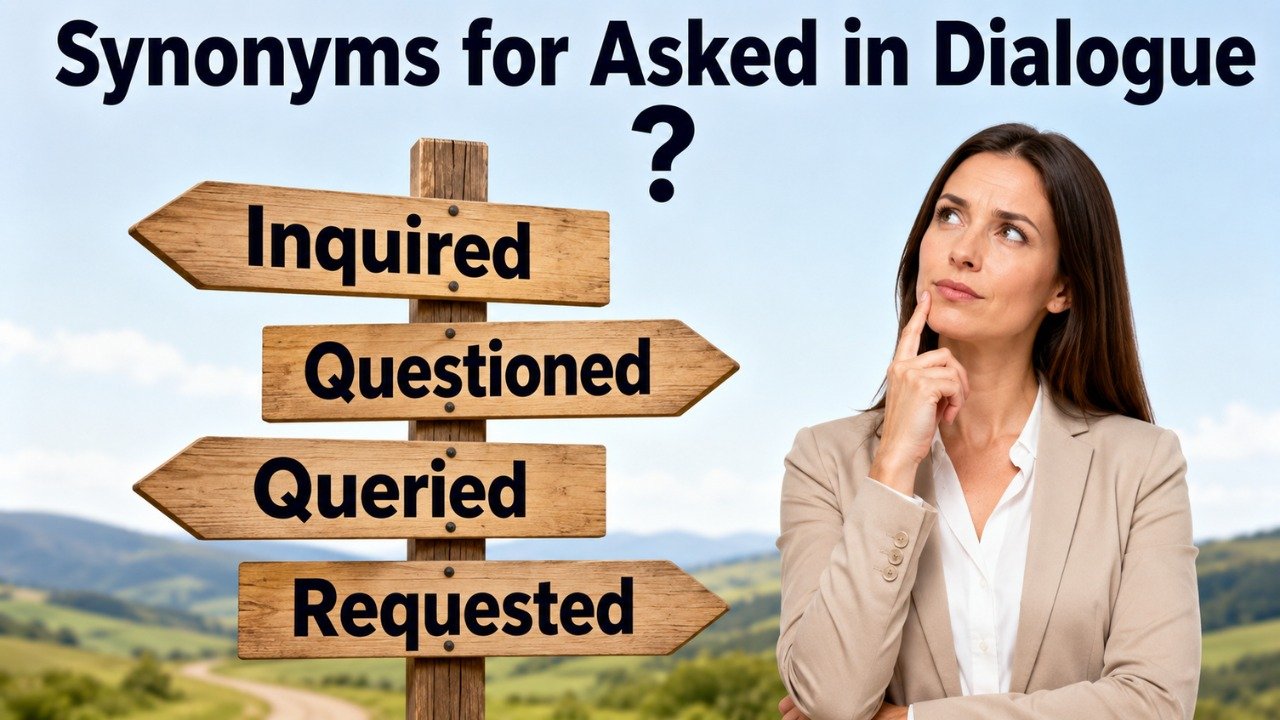
Quick Answer: The best synonyms for asked in dialogue include inquired, questioned, queried, requested, wondered, pressed, probed, demanded, pleaded, and appealed. Use inquired for polite or formal questions, questioned for direct information seeking, and queried for careful clarification. Use wondered for thoughtful or uncertain dialogue, pressed when a speaker insists on an answer, and probed for deeper investigation. Demanded expresses authority or anger, while pleaded and appealed show urgency or emotion. The best dialogue tag depends on the speaker’s purpose, tone, relationship, and emotional state.
Pronunciation and Word Details
Word: Asked
Pronunciation: /æskt/
Part of Speech: Verb, past tense and past participle of ask
Meaning: Spoke to someone in order to receive information, make a request, or seek permission.
US Pronunciation:
UK Pronunciation:
What Does “Asked” Mean?
Asked means spoke or wrote to someone in order to receive an answer, obtain information, make a request, or seek permission.
Asked is the past tense and past participle form of the verb ask. In dialogue, it commonly appears as a reporting verb after or before a spoken question.
After Dialogue: “Where are you going?” Maya asked.
Before Dialogue: Daniel asked, “Have you completed the report?”
Between Dialogue: “Do you think,” she asked, “that we should wait?”
The word can describe several different actions. A character may ask for information, request an object, seek permission, invite someone, or question a decision.
Seeking Information: “What time does the train leave?” he asked.
Making a Request: She asked him to close the window.
Seeking Permission: “May I sit here?” the visitor asked.
Inviting Someone: He asked her to join the discussion.
Asked is one of the clearest and most natural dialogue tags. It is usually invisible to readers, which makes it especially useful in fiction, scripts, interviews, and narrative writing.
Meaning, Tone, and Context of “Asked”
Asked has a neutral tone. It does not automatically show whether a speaker is angry, nervous, polite, curious, confused, or excited.
The emotion usually comes from the spoken words, surrounding action, or a more specific reporting verb.
Neutral Tone: “When does the class begin?” she asked.
Nervous Tone: “Are you sure this is safe?” she asked, twisting the strap of her bag.
Angry Tone: “Why did you lie to me?” he demanded.
Polite Tone: “Could you explain that again?” she inquired.
Asked works in formal, informal, academic, conversational, and literary writing. It is often the best option when the question itself already makes the speaker’s intention clear.
In dialogue, writers should not replace asked merely to avoid repetition. A simple dialogue tag is often less distracting than an unusual verb.
Natural: “Did you hear the announcement?” Nina asked.
Distracting: “Did you hear the announcement?” Nina vocalized.
Specific alternatives are useful when they add meaningful information about tone, purpose, volume, or pressure.
When and How to Use “Asked”
For a Neutral Question
Use asked when the speaker simply wants information and no special emotion needs to be emphasized.
Example: “Where did you leave the keys?” Amir asked.
For a Polite Inquiry
Use inquired when the question is courteous, formal, or professional.
Example: “Could you confirm the appointment time?” the receptionist inquired.
For Clarification
Use queried when the speaker questions a detail or requests a clearer explanation.
Example: “Do you mean the first entrance or the second?” Lena queried.
For Persistent Questioning
Use pressed when the speaker continues seeking an answer after receiving an incomplete response.
Example: “But where were you last night?” the detective pressed.
For Careful Investigation
Use probed when the speaker asks deeper questions to discover hidden facts, motives, or feelings.
Example: “What made you change your mind?” the counselor probed.
For an Authoritative Question
Use demanded when the speaker expects an immediate answer and speaks with anger, power, or urgency.
Example: “Who gave you permission to enter?” the guard demanded.
For an Emotional Request
Use pleaded when the speaker asks desperately or emotionally for help, mercy, or agreement.
Example: “Please do not leave yet,” she pleaded.
For a Quiet Question
Use whispered when the speaker asks in a very low voice.
Example: “Is someone following us?” he whispered.
For an Uncertain Question
Use wondered when the speaker expresses curiosity, uncertainty, or private thought.
Example: “Could the message have been sent by mistake?” she wondered.
For a Challenging Question
Use challenged when the speaker questions another person’s statement, authority, or reasoning.
Example: “What evidence supports that claim?” the student challenged.
Best Synonyms for Asked in Dialogue
Inquired
Synonym: Asked for information in a polite, careful, or formal way.
Example: “Is the manager available?” the customer inquired.
Questioned
Synonym: Asked someone for information, an explanation, or evidence.
Example: “Why was the meeting canceled?” Priya questioned.
Queried
Synonym: Asked about a detail because it seemed unclear, doubtful, or incorrect.
Example: “Should this number be lower?” the editor queried.
Requested
Synonym: Politely asked for something to be given, done, or provided.
Example: “Could you send me the final copy?” he requested.
Wondered
Synonym: Asked with curiosity, uncertainty, or thoughtful interest.
Example: “What could have caused the delay?” she wondered.
Pressed
Synonym: Continued asking firmly because the first answer was incomplete or avoided.
Example: “What exactly did you see?” the officer pressed.
Probed
Synonym: Asked careful questions to uncover deeper information.
Example: “Why does that memory still trouble you?” the therapist probed.
Demanded
Synonym: Asked forcefully while expecting an immediate answer or action.
Example: “Where have you been?” his father demanded.
Pleaded
Synonym: Asked urgently and emotionally for help, mercy, or agreement.
Example: “Please give me one more chance,” she pleaded.
Appealed
Synonym: Asked earnestly by referring to fairness, sympathy, reason, or shared values.
Example: “Will you reconsider for the sake of the children?” he appealed.
50 Synonyms for Asked in Dialogue With Short Meanings
- Inquired: Asked politely or formally for information.
- Questioned: Asked someone to explain or provide facts.
- Queried: Asked about something doubtful or unclear.
- Requested: Politely asked for something to be done or given.
- Wondered: Asked with curiosity or uncertainty.
- Pressed: Continued asking firmly for a clearer answer.
- Probed: Asked deeply to uncover hidden information.
- Demanded: Asked forcefully while expecting an immediate response.
- Pleaded: Asked with strong emotion or desperation.
- Appealed: Asked earnestly for sympathy, fairness, or support.
- Begged: Asked desperately and humbly.
- Implored: Asked with intense urgency or emotion.
- Beseeched: Asked desperately in a formal or literary way.
- Urged: Strongly encouraged someone to act or respond.
- Prompted: Encouraged someone to answer or continue speaking.
- Invited: Asked someone to join, attend, or participate.
- Proposed: Asked someone to consider a plan or idea.
- Suggested: Offered an idea in the form of a question or request.
- Consulted: Asked someone for expert advice or guidance.
- Interviewed: Asked a planned series of questions.
- Interrogated: Questioned someone formally, intensely, or aggressively.
- Examined: Questioned carefully to test knowledge or facts.
- Cross examined: Questioned closely to test truth or consistency.
- Challenged: Asked in a way that questioned a claim or authority.
- Confronted: Questioned someone directly about a difficult matter.
- Quizzed: Asked several questions to test knowledge.
- Polled: Asked several people for their opinions or preferences.
- Surveyed: Asked a group a planned set of questions.
- Canvassed: Asked different people for views or support.
- Sought: Asked for information, advice, help, or permission.
- Solicited: Formally asked for information, support, or an opinion.
- Petitioned: Formally asked an authority for action or permission.
- Applied: Formally asked to receive a role, service, or benefit.
- Enquired: British spelling of inquired.
- Murmured: Asked in a quiet and gentle voice.
- Whispered: Asked in a very low voice.
- Muttered: Asked in a low and unclear voice.
- Mumbled: Asked indistinctly or without clear pronunciation.
- Stammered: Asked with repeated sounds caused by nervousness.
- Stuttered: Asked with interrupted or repeated speech.
- Gasped: Asked while surprised, shocked, frightened, or breathless.
- Cried: Asked loudly with strong emotion.
- Shouted: Asked in a very loud voice.
- Called: Asked loudly to someone at a distance.
- Barked: Asked sharply and commandingly.
- Snapped: Asked suddenly with irritation or anger.
- Hissed: Asked quietly with anger or threat.
- Insisted: Asked firmly while refusing to accept opposition.
- Persisted: Continued asking despite resistance or delay.
- Clarified: Asked or explained something to remove confusion.
Read Also:
Synonyms for Disgusted

Synonyms for Asked in Dialogue by Context
When Asked Means Inquired Politely
Inquired is ideal for polite, professional, or formal dialogue.
Example: “Would you like assistance with your luggage?” the attendant inquired.
Enquired carries the same meaning and is commonly used as an alternative spelling in British English.
Example: “When will the office reopen?” the visitor enquired.
Consulted is appropriate when a person asks someone with knowledge or authority for advice.
Example: “Which treatment would you recommend?” the patient consulted the specialist.
Solicited is more formal and means deliberately asking for an opinion, response, or contribution.
Example: The chairperson solicited comments from each member.
When Asked Means Requested Something
Requested is suitable when the speaker politely asks for an object, service, action, or favor.
Example: “Please send the revised figures by noon,” the manager requested.
Appealed shows that the speaker is asking by using reason, fairness, or emotion.
Example: “Can we find a solution that protects everyone?” she appealed.
Petitioned is formal and often involves asking an authority to approve a change or take action.
Example: Residents petitioned the council to repair the road.
Applied is appropriate when someone formally asks for a position, service, place, or benefit.
Example: She applied for permission to attend the training session.
When Asked Means Questioned Closely
Questioned is a broad alternative for seeking explanations, facts, or reasons.
Example: “Why did the figures change?” the director questioned.
Probed suggests deeper questioning intended to reveal motives, feelings, or hidden information.
Example: “What were you afraid would happen?” the interviewer probed.
Pressed shows persistence when the speaker believes an answer is incomplete or evasive.
Example: “You still have not explained the missing hour,” the lawyer pressed.
Interrogated is much stronger and suggests formal, aggressive, or extended questioning.
Example: The suspect was interrogated about his movements that evening.
When Asked Means Spoke With Uncertainty
Wondered is useful when a character expresses curiosity, doubt, or private thought.
Example: “Could this be the wrong address?” Elena wondered.
Queried works when a particular fact, instruction, or statement seems questionable.
Example: “Was this figure copied correctly?” the accountant queried.
Murmured can show a quiet, thoughtful, or hesitant question.
Example: “Do you think she remembers me?” he murmured.
Stammered may describe a question spoken with nervous pauses or repeated sounds.
Example: “Are you saying I won?” he stammered.
When Asked Means Spoke Forcefully
Demanded communicates authority, anger, impatience, or urgency.
Example: “Why was I not informed?” the director demanded.
Barked suggests a short, sharp, commanding question.
Example: “Who is responsible for this?” the captain barked.
Snapped shows irritation or sudden anger.
Example: “Why are you staring at me?” she snapped.
Insisted is useful when the speaker continues firmly and refuses to let the matter end.
Example: “When will the payment arrive?” he insisted.
When Asked Means Spoke Emotionally
Pleaded shows an emotional and urgent request.
Example: “Please let me explain,” she pleaded.
Begged is stronger and more desperate.
Example: “Do not send him away,” the child begged.
Implored is formal or literary and expresses deep urgency.
Example: “Will you listen before making your decision?” he implored.
Beseeched is highly emotional and more common in dramatic or historical writing.
Example: “Have mercy on them,” she beseeched.
When Asked Means Spoke Quietly
Whispered indicates that the question was spoken very softly.
Example: “Can they hear us?” he whispered.
Muttered suggests a low voice that may express irritation or reluctance.
Example: “Why do I always have to do this?” she muttered.
Mumbled means the words were spoken unclearly.
Example: “Could you repeat the address?” he mumbled.
Hissed suggests a low voice filled with anger, warning, or hostility.
Example: “What do you think you are doing?” she hissed.
When Asked Means Spoke Loudly
Shouted shows that the question was spoken at high volume.
Example: “Can anyone hear me?” he shouted.
Called is useful when the speaker addresses someone at a distance.
Example: “Are you coming with us?” Maya called.
Cried can express fear, excitement, pain, or alarm.
Example: “Where is my brother?” she cried.
Gasped suggests shock, fear, breathlessness, or sudden realization.
Example: “You knew all along?” he gasped.
When Asked Means Tested Knowledge
Quizzed describes asking several questions to test knowledge or memory.
Example: The teacher quizzed the students about the chapter.
Examined is more formal and often refers to testing knowledge or checking facts.
Example: The panel examined the candidate on legal principles.
Interviewed means asking a planned series of questions for information, evaluation, or publication.
Example: The reporter interviewed the witness about the incident.
Cross examined refers to detailed questioning intended to test accuracy or expose inconsistency.
Example: The lawyer cross examined the witness about the timeline.
Another Word for Asked in Dialogue
The best general replacement for asked in dialogue is inquired. It clearly communicates that a speaker requested information and works well in polite, neutral, and formal scenes.
However, asked is usually more natural than inquired in ordinary dialogue. The best alternative depends on how the question is spoken and why it is being asked.
Use questioned for direct investigation, wondered for curiosity, pressed for persistence, and demanded for authority or anger.
Original: “Could you tell me where the station is?” Maria asked.
Better Option: “Could you tell me where the station is?” Maria inquired.
Original: “Why did you change the password?” Noah asked.
Better Option: “Why did you change the password?” Noah questioned.
Original: “What if we have misunderstood the message?” she asked.
Better Option: “What if we have misunderstood the message?” she wondered.
Original: “When will you tell me the truth?” the officer asked.
Better Option: “When will you tell me the truth?” the officer pressed.
When Not to Use “Asked”
Do not use asked when the dialogue is not actually a question or request.
Weak: “I finished the report,” she asked.
Better: “I finished the report,” she said.
Do not replace asked with an unusual verb merely to avoid repetition. A distracting tag can pull attention away from the dialogue.
Weak: “Where are you going?” he vocalized.
Better: “Where are you going?” he asked.
Avoid using asked when the speaker is clearly giving an order rather than seeking an answer.
Weak: “Leave the room immediately,” the guard asked.
Better: “Leave the room immediately,” the guard ordered.
Do not use asked when a more precise verb is necessary to communicate strong emotion.
Weak: “Who destroyed my work?” she asked angrily.
Better: “Who destroyed my work?” she demanded.
Avoid combining asked with an adverb when a precise reporting verb would communicate the same idea more clearly.
Weak: “Please help me,” she asked desperately.
Better: “Please help me,” she pleaded.
Do not use a speech verb that cannot logically produce spoken words.
Weak: “Are you ready?” he smiled.
Better: “Are you ready?” he asked with a smile.
Better: He smiled. “Are you ready?”
Avoid using asked repeatedly in every line of a fast conversation when the speaker is already clear.
Repetitive: “Are you ready?” Liam asked. “Where are we going?” Ava asked. “Did you bring the map?” Liam asked.
Better: “Are you ready?” Liam asked.
“Where are we going?” Ava replied.
“Did you bring the map?”
Words Commonly Confused With Asked
Asked vs Inquired: Asked is neutral and common. Inquired sounds more polite, deliberate, or formal.
Example With Asked: “What time is dinner?” he asked.
Example With Inquired: “At what time will dinner be served?” he inquired.
Asked vs Questioned: Asked can describe any request for information. Questioned often suggests doubt, investigation, or a desire for explanation.
Example With Asked: “Where is the library?” she asked.
Example With Questioned: “Why was this evidence ignored?” she questioned.
Asked vs Requested: Asked may seek information or action. Requested specifically asks for something to be done, given, or provided.
Example With Asked: She asked when the report would be ready.
Example With Requested: She requested a copy of the report.
Asked vs Demanded: Asked is neutral. Demanded is forceful and suggests that the speaker expects obedience or an immediate answer.
Example With Asked: “Can you explain the delay?” he asked.
Example With Demanded: “Explain the delay immediately,” he demanded.
Asked vs Wondered: Asked usually addresses another person directly. Wondered often expresses private curiosity, uncertainty, or thought.
Example With Asked: “Could the door be unlocked?” she asked him.
Example With Wondered: “Could the door already be unlocked?” she wondered.
Asked vs Begged: Asked is emotionally neutral. Begged expresses desperation, dependence, or intense need.
Example With Asked: “Could I stay a little longer?” she asked.
Example With Begged: “Please let me stay,” she begged.
Asked vs Told: Asked seeks information, permission, or action. Told gives information or an instruction.
Example With Asked: She asked him to wait.
Example With Told: She told him to wait.
Asked vs Invited: Asked is broad. Invited specifically requests someone’s presence or participation.
Example With Asked: He asked whether she was free on Saturday.
Example With Invited: He invited her to dinner on Saturday.
Which Synonym Should You Choose?
Choose asked for neutral questions when the wording already makes the speaker’s tone clear.
Choose inquired for polite, formal, or professional questions.
Choose questioned when a speaker seeks reasons, explanations, evidence, or accountability.
Choose queried when a detail appears doubtful, inconsistent, or unclear.
Choose requested when someone politely asks for an action, object, document, favor, or service.
Choose wondered when the speaker is curious, uncertain, thoughtful, or speaking partly to themselves.
Choose pressed when the speaker continues asking because the answer is incomplete or evasive.
Choose probed when questions are designed to uncover deeper facts, feelings, motives, or memories.
Choose demanded when the speaker uses authority, anger, or urgency.
Choose pleaded when a request is emotional and urgent.
Choose begged when the speaker sounds desperate or powerless.
Choose appealed when the speaker uses fairness, reason, sympathy, or shared values.
Choose challenged when a speaker disputes a claim, assumption, decision, or authority.
Choose confronted when a character directly raises a difficult accusation or problem.
Choose interviewed when someone asks a planned series of questions.
Choose interrogated for intense, official, or aggressive questioning.
Choose quizzed when testing someone’s knowledge.
Choose whispered, murmured, muttered, or mumbled when the volume or clarity of speech matters.
Choose shouted, called, cried, or gasped when the question is loud or emotionally intense.
Choose snapped, barked, or hissed when the speaker is angry, sharp, impatient, or threatening.
Choose stammered or stuttered when nervousness affects the speaker’s delivery.
Choose persisted or insisted when a speaker refuses to stop seeking an answer.
Real Life Examples of “Asked” in Dialogue
Original: “Could you show me the correct entrance?” the visitor asked.
Better Option: “Could you show me the correct entrance?” the visitor inquired.
Original: “Why was this information removed?” the editor asked.
Better Option: “Why was this information removed?” the editor questioned.
Original: “Are these figures correct?” the accountant asked.
Better Option: “Are these figures correct?” the accountant queried.
Original: “Would you send me the full document?” she asked.
Better Option: “Would you send me the full document?” she requested.
Original: “Could there be another explanation?” he asked.
Better Option: “Could there be another explanation?” he wondered.
Original: “What did you see after the lights went out?” the detective asked.
Better Option: “What did you see after the lights went out?” the detective probed.
Original: “Why have you ignored my messages?” she asked.
Better Option: “Why have you ignored my messages?” she demanded.
Original: “Please do not cancel the program,” the students asked.
Better Option: “Please do not cancel the program,” the students pleaded.
Original: “Is someone standing outside?” he asked quietly.
Better Option: “Is someone standing outside?” he whispered.
Original: “Who gave you that document?” the supervisor asked sharply.
Better Option: “Who gave you that document?” the supervisor snapped.
Synonym Groups and Usage Differences
Neutral Question Group
This group includes asked, inquired, questioned, queried, and enquired.
Asked is the most natural and flexible choice. Inquired sounds polite or formal. Questioned suggests examination or doubt. Queried focuses on an unclear detail.
Example: “Could you explain the final step?” the student inquired.
Investigation Group
This group includes probed, pressed, interrogated, examined, cross examined, confronted, and challenged.
Probed explores deeper information. Pressed seeks a fuller answer. Interrogated is intense and formal. Challenged disputes an idea or claim.
Example: “What evidence supports your conclusion?” the reviewer challenged.
Request Group
This group includes requested, appealed, petitioned, applied, solicited, invited, and sought.
Requested is polite and direct. Appealed uses reason or emotion. Petitioned is formal and directed toward authority. Invited asks someone to participate.
Example: The residents petitioned the officials to improve road safety.
Desperate Request Group
This group includes pleaded, begged, implored, and beseeched.
Pleaded is emotional and urgent. Begged suggests desperation. Implored and beseeched are stronger and more literary.
Example: “Please allow me to speak with her,” he implored.
Quiet Speech Group
This group includes whispered, murmured, muttered, mumbled, and hissed.
Whispered focuses on low volume. Murmured sounds gentle or thoughtful. Muttered may show irritation. Mumbled suggests unclear speech. Hissed conveys controlled anger.
Example: “Why did you bring him here?” she hissed.
Loud Speech Group
This group includes shouted, called, cried, gasped, and barked.
Shouted describes loud speech. Called is useful across distance. Cried expresses strong emotion. Gasped suggests shock. Barked sounds sharp and commanding.
Example: “Who goes there?” the guard barked.
Nervous Speech Group
This group includes stammered, stuttered, mumbled, faltered, and wondered.
Stammered and stuttered describe interrupted speech. Mumbled may show low confidence. Wondered expresses uncertainty.
Example: “D do you really mean that?” he stammered.
Persistent Question Group
This group includes pressed, persisted, insisted, urged, and prompted.
Pressed and persisted show continued questioning. Insisted expresses firmness. Prompted encourages someone to speak or provide an answer.
Example: “What happened after you entered the building?” the interviewer prompted.
Antonyms of Asked
The opposite of asked depends on whether asked means seeking information, making a request, or inviting a response.
Answered: Provided information in response to a question.
Replied: Spoke or wrote back to someone.
Responded: Reacted verbally or in writing.
Explained: Made an idea or situation clearer.
Stated: Expressed information directly.
Declared: Announced something firmly or publicly.
Told: Gave information or instructions.
Informed: Provided someone with facts or knowledge.
Revealed: Made hidden information known.
Confirmed: Verified that something was correct or true.
Denied: Stated that something was not true.
Refused: Declined a request or invitation.
Rejected: Did not accept a proposal, request, or suggestion.
Ordered: Gave a command rather than making a request.
Commanded: Directed someone with authority.
Withheld: Chose not to provide information.
Ignored: Gave no attention or response.
Remained Silent: Did not speak or answer.
Comparison: Asked vs Related Words
Asked vs Inquired
Asked is simple and neutral. Inquired is more formal and often sounds especially polite or deliberate.
Example With Asked: “Is the room available?” he asked.
Example With Inquired: “Is the conference room available this afternoon?” he inquired.
Asked vs Questioned
Asked seeks information. Questioned may also express doubt, suspicion, or criticism.
Example With Asked: “What time did you arrive?” she asked.
Example With Questioned: “Why did you arrive after the doors were locked?” she questioned.
Asked vs Requested
Asked can seek an answer or action. Requested specifically seeks something to be provided or done.
Example With Asked: He asked when the package would arrive.
Example With Requested: He requested faster delivery.
Asked vs Queried
Asked is general. Queried highlights uncertainty about a specific fact, figure, instruction, or statement.
Example With Asked: “Who prepared this table?” she asked.
Example With Queried: “Should this total include the final payment?” she queried.
Asked vs Demanded
Asked is neutral and leaves room for refusal. Demanded is forceful and expects compliance.
Example With Asked: “Could you return the key?” he asked.
Example With Demanded: “Return the key immediately,” he demanded.
Asked vs Pleaded
Asked is emotionally neutral. Pleaded expresses urgency, fear, desperation, or strong hope.
Example With Asked: “Can I speak with the manager?” she asked.
Example With Pleaded: “Please let me speak with the manager,” she pleaded.
Asked vs Wondered
Asked usually addresses another person. Wondered often reflects curiosity or uncertainty and may represent internal thought.
Example With Asked: “Will the road be open tomorrow?” he asked.
Example With Wondered: “Will the road be open tomorrow?” he wondered.
Asked vs Pressed
Asked may be a single question. Pressed means continuing to seek an answer after resistance or avoidance.
Example With Asked: “Where were you?” she asked.
Example With Pressed: “Where were you between eight and ten?” she pressed.
Common Phrases and Expressions With “Asked”
Asked a Question: Requested information from someone.
Example: The student asked a thoughtful question.
Asked for Help: Requested assistance.
Example: She asked for help with the final calculation.
Asked for Permission: Requested approval before acting.
Example: He asked for permission to leave early.
Asked for Advice: Requested guidance or an opinion.
Example: Maya asked for advice about her career options.
Asked for Clarification: Requested a clearer explanation.
Example: The reader asked for clarification about the instructions.
Asked to Speak: Requested an opportunity to talk.
Example: He asked to speak with the department manager.
Asked Whether: Introduced an indirect yes or no question.
Example: She asked whether the office was open.
Asked Why: Requested a reason or explanation.
Example: The child asked why the moon appeared so bright.
Asked Again: Repeated a question or request.
Example: When no one answered, he asked again.
Frequently Asked: Commonly presented as a question.
Example: The guide answers several frequently asked questions.
Common Mistakes to Avoid
Using Asked With a Statement
Asked should introduce a genuine question or request.
Incorrect: “The door is locked,” he asked.
Correct: “Is the door locked?” he asked.
Correct: “The door is locked,” he said.
Forgetting the Question Mark
Direct questions in dialogue normally require a question mark.
Incorrect: “Where are you going,” she asked.
Correct: “Where are you going?” she asked.
Capitalizing the Dialogue Tag Incorrectly
When a dialogue tag follows a question, the tag normally begins with a lowercase letter.
Incorrect: “Where are you going?” She asked.
Correct: “Where are you going?” she asked.
A capital letter is correct when the next words begin a separate action sentence.
Correct: “Where are you going?” She stepped into the hallway.
Using a Comma Instead of a Question Mark
A direct question keeps its question mark even when followed by a dialogue tag.
Incorrect: “Are you ready,” he asked.
Correct: “Are you ready?” he asked.
Treating an Action as a Dialogue Tag
Actions such as smiled, laughed, nodded, and shrugged do not describe speech.
Incorrect: “Will you join us?” she smiled.
Correct: “Will you join us?” she asked with a smile.
Correct: She smiled. “Will you join us?”
Overusing Unusual Dialogue Tags
Rare or dramatic tags can distract readers when the dialogue already communicates the emotion.
Distracting: “Do you know the answer?” she articulated.
Better: “Do you know the answer?” she asked.
Adding Unnecessary Adverbs
A precise dialogue verb or clear action often works better than an adverb.
Weak: “Where have you been?” he asked angrily.
Better: “Where have you been?” he demanded.
Using Demanded for a Polite Question
Demanded should communicate authority, anger, or urgency.
Unnatural: “Would you like some tea?” she demanded.
Better: “Would you like some tea?” she asked.
Confusing Asked and Told
Ask usually introduces a question or request. Tell normally introduces information or a command.
Incorrect: She asked him that the meeting was canceled.
Correct: She told him that the meeting was canceled.
Correct: She asked him whether the meeting was canceled.
Repeating the Speaker’s Name Too Often
Dialogue can become mechanical when every sentence includes the speaker’s name and asked.
Repetitive: “Are you ready?” Amina asked. “Did you bring the notes?” Amina asked. “Should we leave?” Amina asked.
Better: “Are you ready?” Amina asked. “Did you bring the notes? Should we leave?”
Conclusion
Synonyms for asked in dialogue include inquired, questioned, queried, requested, wondered, pressed, probed, demanded, and pleaded. Use asked for neutral questions, inquired for polite exchanges, and questioned for investigation or doubt. Pressed and probed suit persistent or detailed questioning, while demanded expresses authority or anger. Whispered, shouted, stammered, and snapped can show delivery, but they should be used only when the manner of speaking matters. The best dialogue tag makes the speaker’s purpose and emotion clearer without distracting from the conversation.
FAQs About Synonyms for Asked in Dialogue
What Is the Best Synonym for Asked in Dialogue?
Inquired is the best general synonym for asked, especially in polite or formal dialogue. However, asked is often the most natural choice for neutral questions.
What Can I Use Instead of Asked in a Story?
You can use inquired, questioned, wondered, pressed, whispered, demanded, pleaded, or queried. Choose a word that accurately matches the speaker’s tone and purpose.
Is Said a Synonym for Asked?
Said is related but not an exact synonym. Said reports a statement, while asked normally introduces a question or request.
What Is a Stronger Word Than Asked?
Demanded, pressed, interrogated, challenged, and confronted are stronger alternatives. Each one adds authority, persistence, suspicion, or conflict.
What Is a Polite Synonym for Asked?
Inquired, requested, consulted, and appealed can express polite or respectful questioning, depending on what the speaker wants.
What Is an Emotional Synonym for Asked?
Pleaded, begged, implored, cried, gasped, and beseeched can show fear, urgency, desperation, surprise, or intense emotion.
Should Writers Avoid Repeating Asked?
No. Asked is a clear and unobtrusive dialogue tag. Replace it only when another verb adds useful information about the speaker’s purpose, tone, or delivery.
