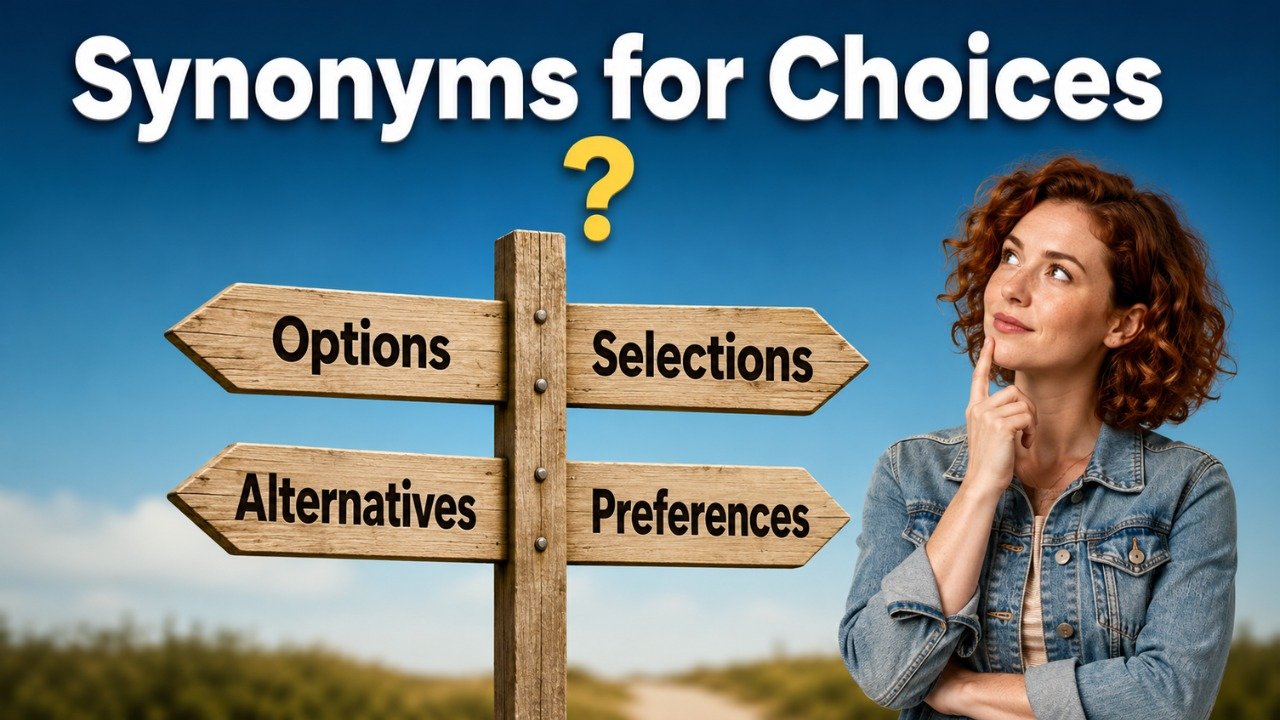
Quick Answer: The best synonyms for choices include options, alternatives, selections, decisions, picks, preferences, possibilities, courses of action, judgments, and routes. Use options for things available to choose from, alternatives when replacing one possibility with another, and selections for items that have been chosen. Decisions works best for completed acts of choosing, while preferences describe what someone likes more. Picks is natural in casual speech, and courses of action suits formal planning or problem solving.
Pronunciation and Word Details
Word: Choices
Pronunciation: /ˈtʃɔɪsɪz/
Part of Speech: Plural noun
Meaning: The available possibilities someone can select or the decisions someone makes.
US Pronunciation:
UK Pronunciation:
What Does “Choices” Mean?
Choices means the different possibilities available for selection or the decisions people make after considering those possibilities.
Choices is the plural form of choice. It is usually used as a countable noun.
The word can refer to available options.
Example: Customers have several choices of color.
It can also refer to completed decisions.
Example: Her career choices shaped her future.
Choices may involve simple matters, such as selecting a meal, or important matters, such as choosing a career, home, treatment, or course of action.
The word works in personal, professional, academic, commercial, and everyday contexts.
Available Possibilities: The menu offers many choices.
Personal Decisions: People should take responsibility for their choices.
Preferred Selections: His clothing choices reflect his personality.
Strategic Decisions: The company must reconsider its financial choices.
Choices can be positive when freedom and variety are available. It can also carry a serious or emotional meaning when a person must make a difficult decision.
Meaning, Tone, and Context of “Choices”
Choices has a neutral and widely understood tone. It can be used naturally in formal writing, casual conversation, academic discussion, workplace communication, and personal advice.
In everyday speech, choices often refers to the things someone can select.
Example: We have three choices for dinner.
In formal writing, it may refer to decisions, alternatives, or possible courses of action.
Example: The committee evaluated the available policy choices.
In emotional contexts, choices can suggest responsibility, consequences, regret, freedom, or personal values.
Example: Our choices often reveal what matters most to us.
The tone depends on the surrounding words.
Positive Tone: Students now have more choices than before.
Serious Tone: Each choice may have long term consequences.
Critical Tone: His poor choices created unnecessary problems.
Supportive Tone: You have several reasonable choices available.
Choices does not always mean the same thing as decisions. Choices can be the possibilities available before a decision, while decisions are the conclusions reached after considering those possibilities.
When and How to Use “Choices”
For Available Options
Use choices when someone has several things, actions, or possibilities from which to select.
Example: The store offers a wide range of choices.
For Personal Decisions
Use choices when discussing decisions related to lifestyle, relationships, education, health, or personal values.
Example: Her educational choices helped her develop valuable skills.
For Products and Services
Use choices to describe the available colors, sizes, styles, plans, features, or service levels.
Example: Buyers can compare several payment choices.
For Career Planning
Use choices when discussing jobs, qualifications, professional directions, or future opportunities.
Example: Students should research their career choices carefully.
For Courses of Action
Use choices when a person or organization must decide how to respond to a situation.
Example: The manager explained the choices available to the team.
For Preferences
Use choices when selected items reflect someone’s personal tastes or priorities.
Example: Her design choices created a calm and welcoming space.
For Moral Decisions
Use choices when actions involve responsibility, values, fairness, or consequences.
Example: People are responsible for the choices they make.
For Academic Questions
Use choices when referring to possible answers in an examination, survey, or exercise.
Example: Read all the answer choices before selecting a response.
For Limited Possibilities
Use choices when only a small number of alternatives are available.
Example: Because of the weather, we had very few choices.
For Freedom and Control
Use choices when emphasizing a person’s ability to decide independently.
Example: Giving people more choices can increase their sense of control.
Best Synonyms for Choices
Options
Synonym: Things or actions available for someone to select.
Example: We discussed all the available options before making a decision.
Alternatives
Synonym: Other possibilities that can replace an existing choice.
Example: The team considered several alternatives to the original plan.
Selections
Synonym: Items that have been chosen or are available to be chosen.
Example: The shop offers an impressive selection of handmade products.
Decisions
Synonym: Conclusions reached after considering different possibilities.
Example: Important decisions should be based on reliable information.
Picks
Synonym: Informal selections chosen from a group.
Example: These books are my top picks for beginners.
Preferences
Synonym: Things someone likes, values, or wants more than others.
Example: The survey asked customers about their food preferences.
Possibilities
Synonym: Things that may be chosen, done, or considered.
Example: We explored several possibilities for improving the room.
Courses of Action
Synonym: Possible plans or steps that someone can follow.
Example: The adviser explained the available courses of action.
Judgments
Synonym: Decisions or opinions formed after careful consideration.
Example: Managers must make fair judgments based on the evidence.
Routes
Synonym: Different ways of reaching a goal or result.
Example: Students can take several routes into the profession.
50 Synonyms for Choices With Short Meanings
- Options: Things available for selection.
- Alternatives: Other possibilities that can be considered.
- Selections: Items chosen from a larger group.
- Decisions: Conclusions reached after considering possibilities.
- Picks: Informal selections from a group.
- Preferences: Things liked or wanted more than others.
- Possibilities: Actions or outcomes that may be considered.
- Courses of Action: Possible plans or steps to follow.
- Judgments: Decisions formed through thought or evaluation.
- Determinations: Firm decisions reached after consideration.
- Resolutions: Final decisions or settled intentions.
- Conclusions: Decisions reached after examining information.
- Verdicts: Formal judgments or final opinions.
- Votes: Expressions of a preference or decision.
- Elections: Acts of selecting people or possibilities.
- Nominations: Formal suggestions of people or options.
- Appointments: Selections of people for particular positions.
- Designations: Official selections or assigned roles.
- Adoptions: Decisions to accept ideas, plans, or methods.
- Electives: Optional subjects or activities available for selection.
- Candidates: People or things being considered for selection.
- Contenders: Strong possibilities competing to be chosen.
- Prospects: Possible future choices or opportunities.
- Opportunities: Favorable possibilities available for action.
- Routes: Different ways of reaching a goal.
- Paths: Directions or courses someone may follow.
- Directions: Possible ways in which something can develop.
- Approaches: Methods of handling a task or situation.
- Methods: Ways of doing or achieving something.
- Strategies: Planned approaches for reaching an objective.
- Plans: Intended courses of future action.
- Solutions: Possible answers to problems.
- Answers: Responses that may be selected or accepted.
- Responses: Available replies to a question or situation.
- Variations: Different forms of the same basic thing.
- Variants: Alternative versions with particular differences.
- Versions: Different forms or interpretations of something.
- Varieties: Distinct types available within a category.
- Assortments: Groups containing several different choices.
- Ranges: Collections of available products or possibilities.
- Menus: Lists of items or actions available for selection.
- Lineups: Groups of available people, products, or possibilities.
- Shortlists: Reduced lists of the strongest possibilities.
- Offerings: Products, services, or possibilities made available.
- Preferred Options: Possibilities favored over the others.
- Available Options: Possibilities that can currently be selected.
- Possible Alternatives: Other courses that could be considered.
- Selected Items: Things chosen from a larger collection.
- Final Decisions: Completed and settled choices.
- Personal Preferences: Individual likes, priorities, or favored options.
Read Also:
Synonyms for Efficiently

Synonyms for Choices by Context
When Choices Means Available Options
Options is the clearest and most flexible replacement when discussing things available for selection.
Example: Customers can compare several payment options.
Possibilities works well when the available outcomes are uncertain or still being explored.
Example: We considered several possibilities for the unused space.
Alternatives emphasizes options that can replace an existing plan, product, or method.
Example: The doctor explained several alternatives to surgery.
Offerings is useful for products, services, courses, and features made available by an organization.
Example: The school expanded its course offerings.
When Choices Means Decisions
Decisions is the best replacement when referring to completed acts of choosing.
Example: Her financial decisions helped her avoid unnecessary debt.
Determinations suggests firm and carefully considered decisions.
Example: The committee made its final determinations after reviewing the evidence.
Resolutions refers to settled decisions or intentions.
Example: They reached several important resolutions during the meeting.
Judgments often involves evaluating facts, behavior, quality, or circumstances.
Example: Leaders must make sound judgments during difficult situations.
When Choices Means Selections
Selections refers to items chosen from a group or a collection available for choosing.
Example: The editor reviewed the final selections for the publication.
Picks is a casual alternative used for recommended or favored selections.
Example: These are our top picks for small gardens.
Selected items works well when identifying particular products, answers, or objects that have already been chosen.
Example: Selected items are displayed near the entrance.
Shortlists refers to a reduced group of the strongest possibilities.
Example: The judges announced their final shortlists.
When Choices Means Preferences
Preferences describes the things a person likes, values, or favors.
Example: The form allows users to record their communication preferences.
Personal preferences emphasizes that selections are based on individual taste.
Example: Decorating decisions often depend on personal preferences.
Favored options are the possibilities someone prefers over others.
Example: Flexible hours were among the employees’ favored options.
Priorities may be more suitable when choices reflect what someone considers most important.
Example: Your spending habits should reflect your financial priorities.
When Choices Means Courses of Action
Courses of action is a formal phrase for the possible steps someone can take.
Example: The lawyer explained the available courses of action.
Routes describes different ways of reaching the same goal.
Example: There are several routes into a teaching career.
Paths is common when discussing education, careers, personal development, or long term plans.
Example: Graduates can follow many different career paths.
Strategies refers to planned choices intended to achieve a particular result.
Example: The team compared several marketing strategies.
When Choices Means Answer Possibilities
Answers works well when discussing questions, tests, puzzles, or exercises.
Example: Compare the possible answers before making your selection.
Responses is suitable for surveys, forms, interviews, and questionnaires.
Example: Participants could choose from four possible responses.
Options is commonly used for multiple choice questions.
Example: Only one of the answer options is correct.
Selections may be used when a respondent must select one or more items.
Example: Review your selections before submitting the form.
When Choices Means Product Variety
Varieties describes different types within the same product category.
Example: The market sells several varieties of fresh apples.
Ranges refers to a collection of products available in different styles, prices, or specifications.
Example: The company offers a wide range of storage solutions.
Assortments emphasizes a mixed collection of different items.
Example: The gift box contains an assortment of chocolates.
Versions describes different forms of the same product, document, design, or idea.
Example: The application is available in several versions.
Another Word for Choices
The best general replacement for choices is options. It is clear, natural, and suitable for most situations involving possibilities that are available for selection.
However, choices and options are not always identical. Options usually refers to what is available before a decision, while choices can also refer to the decisions someone has already made.
Use alternatives when discussing replacements, selections for chosen items, decisions for completed acts of choosing, and preferences for personal likes.
Original: We have several choices for completing the project.
Better Option: We have several options for completing the project.
Original: Her choices affected the final result.
Better Option: Her decisions affected the final result.
Original: The store provides many furniture choices.
Better Option: The store provides a wide selection of furniture.
Original: His clothing choices are simple and practical.
Better Option: His clothing preferences are simple and practical.
When Not to Use “Choices”
Do not use choices when a more specific word would make the meaning clearer.
Weak: The committee discussed several choices.
Better: The committee discussed several policy alternatives.
Avoid choices when referring only to completed decisions and their consequences.
Weak: His choices were approved during the meeting.
Better: His decisions were approved during the meeting.
Do not use choices when there is only one possible action.
Weak: Our only choices were to remain in the building.
Better: Our only option was to remain in the building.
Avoid the phrase different choices when alternatives already makes the difference clear.
Weak: We considered several different choices.
Better: We considered several alternatives.
Do not use choices as a vague replacement for products, designs, methods, or plans.
Weak: The store has good choices.
Better: The store has a wide range of affordable clothing.
Avoid choices when you mean personal likes rather than actual decisions.
Weak: The survey examined customers’ choices about color.
Better: The survey examined customers’ color preferences.
Do not use an overly casual alternative such as picks in formal reports or academic analysis.
Weak: The report explains the committee’s final picks.
Better: The report explains the committee’s final selections.
Words Commonly Confused With Choices
Choices vs Options: Options are the possibilities available before someone decides. Choices can refer to those possibilities or to the decisions that have already been made.
Example With Choices: Her career choices affected her long term income.
Example With Options: She reviewed her career options before applying.
Choices vs Alternatives: Choices is a broad term for available possibilities. Alternatives usually refers to possibilities that replace an existing plan, method, or item.
Example With Choices: The menu provides many choices.
Example With Alternatives: The restaurant offers dairy free alternatives.
Choices vs Decisions: Choices may refer to available possibilities or selected actions. Decisions usually refers to final conclusions reached after thought.
Example With Choices: We have several choices available.
Example With Decisions: We must make several decisions today.
Choices vs Selections: Choices can describe possibilities or decisions. Selections usually refers to things that have been chosen or collections available for choosing.
Example With Choices: Her choices were practical and affordable.
Example With Selections: Her final selections were placed in the basket.
Choices vs Preferences: Choices are what people select or can select. Preferences are the things they like or favor.
Example With Choices: Customers made their choices before the deadline.
Example With Preferences: Customers recorded their communication preferences.
Choices vs Opportunities: Choices are possibilities available for selection. Opportunities are favorable situations that allow progress, experience, or success.
Example With Choices: Students have several subject choices.
Example With Opportunities: Students have several opportunities to gain practical experience.
Choices vs Picks: Choices is neutral and suitable for most contexts. Picks is informal and often refers to recommended, favorite, or selected items.
Example With Choices: The committee reviewed the available choices.
Example With Picks: These are my top picks for summer reading.
Choices vs Courses of Action: Choices is broad and conversational. Courses of action is more formal and specifically refers to possible actions or plans.
Example With Choices: We discussed our choices.
Example With Courses of Action: We evaluated three possible courses of action.
Which Synonym Should You Choose?
Choose options when referring to things, services, plans, or actions available for selection.
Choose alternatives when replacing an existing method, plan, product, or solution.
Choose selections when referring to chosen items or a collection available for selection.
Choose decisions when focusing on completed acts of choosing.
Choose preferences when discussing personal tastes, likes, priorities, or favored settings.
Choose picks in casual speech, recommendations, reviews, and informal lists.
Choose possibilities when discussing uncertain outcomes or ideas that are still being explored.
Choose courses of action in formal discussions about planning, law, management, or problem solving.
Choose judgments when a decision requires careful evaluation of facts, quality, or behavior.
Choose routes or paths when describing different ways of reaching a goal.
Choose strategies when the choices are planned methods for achieving a result.
Choose solutions when discussing possible ways to solve a problem.
Choose answers or responses for tests, surveys, forms, interviews, and questionnaires.
Choose varieties when describing different types of the same product or subject.
Choose ranges when emphasizing the breadth of available products, styles, prices, or features.
Choose shortlists when only the strongest candidates or possibilities remain.
Choose candidates when people, products, or ideas are being considered for selection.
Choose electives when referring to optional school or university subjects.
Choose offerings for products, services, classes, or features that are available to customers or participants.
Real Life Examples of “Choices” in Sentences
Original: The menu provides several healthy choices.
Better Option: The menu provides several healthy options.
Original: We examined all our choices before making a decision.
Better Option: We examined all the available alternatives before making a decision.
Original: Her career choices surprised her family.
Better Option: Her career decisions surprised her family.
Original: The shop has many furniture choices.
Better Option: The shop has a wide selection of furniture.
Original: His clothing choices reflect his personality.
Better Option: His clothing preferences reflect his personality.
Original: The students discussed their choices after graduation.
Better Option: The students discussed their possible career paths after graduation.
Original: The manager explained the choices available to us.
Better Option: The manager explained the available courses of action.
Original: These are my favorite choices from the collection.
Better Option: These are my favorite picks from the collection.
Original: The team considered several choices for solving the problem.
Better Option: The team considered several possible solutions to the problem.
Original: Review your choices before submitting the test.
Better Option: Review your answer selections before submitting the test.
Synonym Groups and Usage Differences
Available Possibilities Group
This group includes options, alternatives, possibilities, opportunities, prospects, and available options.
Options is the most general term. Alternatives usually replace an existing idea. Possibilities may still be uncertain. Opportunities normally offer a potential benefit.
Example: The adviser explained all the available options.
Decision Group
This group includes decisions, judgments, determinations, conclusions, resolutions, and verdicts.
Decisions is the broadest word. Judgments involves evaluation. Determinations sounds firm and formal. Verdicts usually refers to final or official judgments.
Example: The committee reached several important decisions.
Selection Group
This group includes selections, picks, selected items, shortlists, appointments, nominations, and designations.
Selections is neutral. Picks is informal. Shortlists includes only the strongest remaining possibilities. Appointments and nominations are used when people are chosen for roles.
Example: The final selections will be announced next week.
Preference Group
This group includes preferences, personal preferences, favored options, priorities, and picks.
Preferences focuses on what a person likes. Priorities shows what matters most. Picks refers to items someone personally recommends or selects.
Example: The design can be adjusted to match your personal preferences.
Route and Planning Group
This group includes courses of action, routes, paths, approaches, methods, plans, and strategies.
Courses of action refers to possible steps. Routes and paths describe ways of reaching a goal. Strategies involve deliberate planning.
Example: The team evaluated several strategies for increasing efficiency.
Product Variety Group
This group includes varieties, assortments, ranges, offerings, versions, variations, and variants.
Varieties describes different types. Assortments refers to mixed collections. Ranges emphasizes the number or breadth of available products.
Example: The store offers a broad range of affordable products.
Question and Survey Group
This group includes answers, responses, options, and selections.
Answers works naturally for questions and tests. Responses suits surveys and interviews. Options refers to the available answers before selection.
Example: Participants selected their responses from a list.
Antonyms of Choices
The opposite of choices depends on whether the word refers to freedom, possibilities, preferences, or decisions.
Necessity: Something that must be done or selected.
Requirement: A condition or action that is compulsory.
Obligation: A duty that limits a person’s freedom to decide.
Compulsion: Strong pressure or force to act in a particular way.
Inevitability: A result that cannot be avoided or changed.
Restriction: A rule or condition that limits available possibilities.
Limitation: A factor that reduces freedom or available options.
Constraint: A condition that restricts possible actions.
Mandate: An official order that removes personal discretion.
Single Option: One possibility with no available alternative.
Fixed Outcome: A result that cannot be changed through selection.
Predetermination: A result decided before personal choice is possible.
Prohibition: A rule preventing a particular action or selection.
Refusal: A decision not to accept an available possibility.
Lack of Choice: A situation in which no real alternatives are available.
Comparison: Choices vs Related Words
Choices vs Options
Choices can refer to available possibilities and completed decisions. Options usually refers only to the possibilities available before a decision.
Example With Choices: Her educational choices influenced her career.
Example With Options: She reviewed her educational options before enrolling.
Choices vs Alternatives
Choices is a general term for possibilities. Alternatives usually refers to other possibilities that can replace the current plan or selection.
Example With Choices: We have several choices for lunch.
Example With Alternatives: We need alternatives to the current delivery method.
Choices vs Decisions
Choices may describe available possibilities or actions selected. Decisions describes conclusions reached after considering those possibilities.
Example With Choices: The design choices created a modern appearance.
Example With Decisions: The design decisions were approved by the client.
Choices vs Selections
Choices emphasizes the act or freedom of choosing. Selections emphasizes the items that have been chosen or are available.
Example With Choices: Her choices showed careful planning.
Example With Selections: Her selections were placed on the display table.
Choices vs Preferences
Choices are actual or possible selections. Preferences indicate what a person likes or values more.
Example With Choices: Customers made their choices at the counter.
Example With Preferences: Customers can save their language preferences.
Choices vs Possibilities
Choices are possibilities available for deliberate selection. Possibilities can include outcomes that may happen without anyone selecting them.
Example With Choices: We have three choices for solving the issue.
Example With Possibilities: There is a possibility that the event will be delayed.
Choices vs Opportunities
Choices are things someone can select. Opportunities are favorable circumstances that may lead to progress or success.
Example With Choices: The course offers several assessment choices.
Example With Opportunities: The course offers opportunities for practical learning.
Choices vs Picks
Choices is neutral and appropriate in formal or casual writing. Picks is more informal and often refers to favorites or recommendations.
Example With Choices: These choices meet the required standards.
Example With Picks: These are the editor’s top picks.
Common Phrases and Expressions With “Choices”
Make Choices: Decide between available possibilities.
Example: People make choices based on their needs and priorities.
Available Choices: Possibilities that can currently be selected.
Example: Review all the available choices before deciding.
Difficult Choices: Decisions that involve risk, sacrifice, or uncertainty.
Example: Leaders sometimes have to make difficult choices.
Informed Choices: Decisions based on useful and accurate information.
Example: Clear labels help customers make informed choices.
Personal Choices: Decisions based on individual values or preferences.
Example: Clothing styles are often matters of personal choice.
Healthy Choices: Decisions that support physical or emotional wellbeing.
Example: Planning meals can make healthy choices easier.
Career Choices: Decisions about jobs, education, or professional direction.
Example: Work experience can influence future career choices.
Limited Choices: A small number of available possibilities.
Example: Travelers had limited choices because of the severe weather.
Wise Choices: Decisions showing good judgment.
Example: Careful planning helps people make wise choices.
Poor Choices: Decisions likely to produce negative results.
Example: A series of poor choices caused the project to fail.
Final Choices: Selections that have been completed and confirmed.
Example: Please submit your final choices by Friday.
Range of Choices: A collection of different possibilities.
Example: The program offers a broad range of choices.
Common Mistakes to Avoid
Confusing Choice and Choose
Choice is a noun, while choose is a verb.
Incorrect: You must choice one answer.
Correct: You must choose one answer.
Correct: You must make one choice.
Using Choices for One Possibility
Choices is plural and should refer to more than one possibility or decision.
Incorrect: My only choices was to leave.
Correct: My only choice was to leave.
Correct: My choices were to leave or remain.
Using Less Choices Instead of Fewer Choices
Use fewer with countable plural nouns such as choices.
Incorrect: We have less choices this year.
Correct: We have fewer choices this year.
Confusing Choices With Decisions
Use decisions when referring specifically to conclusions that have already been reached.
Unclear: The board announced its choices about the budget.
Better: The board announced its decisions about the budget.
Using Alternatives Without an Existing Option
Alternative usually suggests another possibility that can replace a current one.
Unclear: The menu has many alternatives.
Better: The menu has many options.
Better: The restaurant offers alternatives to dairy products.
Repeating Choices Too Often
Repeated use can make writing sound vague and monotonous.
Repetitive: Her choices included career choices, education choices, and lifestyle choices.
Better: Her decisions involved her career, education, and lifestyle.
Using Picks in Formal Writing
Picks may sound too casual in reports, evaluations, or professional documents.
Informal: The committee announced its top picks.
Formal: The committee announced its final selections.
Using Vague Phrases
Words such as good choices or bad choices may need more explanation.
Vague: She made good choices.
Better: She selected affordable courses that supported her career goals.
Confusing Between and Among
Between is commonly used when comparing two distinct choices. Among is used when selecting from a larger group.
Example With Between: She chose between the blue and green designs.
Example With Among: She chose among several available designs.
Assuming More Choices Are Always Better
A large number of options can sometimes make a decision more difficult. Explain why the variety is useful rather than assuming quantity alone creates value.
Weak: More choices always improve the experience.
Better: A carefully organized range of relevant options can improve the experience.
Conclusion
Synonyms for choices include options, alternatives, selections, decisions, preferences, possibilities, and courses of action. Options is the best general replacement for available possibilities, while decisions describes completed acts of choosing. Use alternatives for replacements, selections for chosen items, and preferences for personal tastes. Picks suits casual recommendations, while routes, paths, and strategies work well for planning. Choosing the most precise word helps readers understand whether you mean available possibilities, personal preferences, final decisions, or selected items.
FAQs About Synonyms for Choices
What Is the Best Synonym for Choices?
Options is the best general synonym when referring to possibilities available for selection. Decisions is better when referring to choices that have already been made.
Are Choices and Options the Same?
They are similar, but not always identical. Options are usually the possibilities available before deciding, while choices can also mean completed decisions.
What Is a Formal Synonym for Choices?
Formal alternatives include alternatives, selections, decisions, determinations, judgments, and courses of action.
What Is a Casual Synonym for Choices?
Picks is a natural casual synonym, especially when discussing favorite products, recommendations, books, meals, or designs.
What Is Another Word for Personal Choices?
Preferences, personal decisions, priorities, and individual selections can replace personal choices, depending on the context.
What Is the Difference Between Choices and Alternatives?
Choices includes all possibilities available for selection. Alternatives usually refers to other possibilities that can replace an existing choice, method, or plan.
What Is the Opposite of Having Choices?
The opposite may be necessity, obligation, restriction, compulsion, a single option, or lack of choice.
