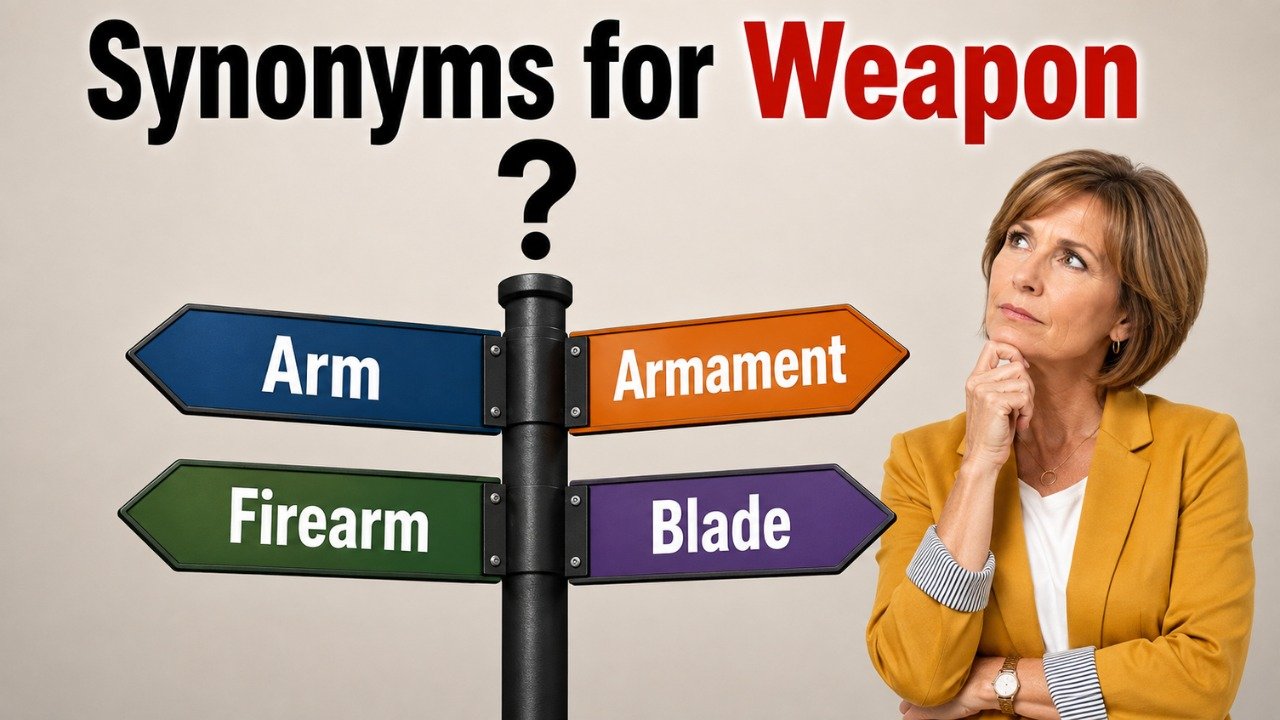
Quick Answer: The best synonyms for weapon include arm, firearm, gun, armament, blade, missile, ordnance, deterrent, tool, and leverage. Use arm as a broad formal alternative, firearm when referring specifically to a gun, and armament for military equipment. Blade works for knives and swords, while missile and ordnance describe military weapons. In figurative language, tool, leverage, advantage, or deterrent may express the intended meaning more naturally.
Pronunciation and Word Details
Word: Weapon
Pronunciation: /ˈwɛpən/
Part of Speech: Noun
Meaning: An object, device, method, or resource used to attack, defend, threaten, or gain an advantage.
US Pronunciation:
UK Pronunciation:
What Does “Weapon” Mean?
A weapon is an object, device, substance, or method used to cause harm, provide protection, threaten an opponent, or gain power.
Weapon is primarily a countable noun. Its plural form is weapons. The word commonly refers to physical objects such as guns, knives, swords, bombs, and missiles. However, it can also describe nonphysical resources used to influence a situation.
In a literal sentence, weapon may describe an object designed for combat or defense.
Example: The guard was trained to handle the weapon safely.
In a figurative sentence, weapon may refer to knowledge, language, patience, information, or another useful advantage.
Example: Clear evidence became her strongest weapon in the debate.
The exact meaning depends on whether the sentence discusses crime, law, military activity, personal protection, competition, communication, politics, or a metaphorical struggle.
Meaning, Tone, and Context of “Weapon”
Weapon is generally a neutral but serious word. It often carries strong associations with danger, violence, defense, conflict, and power.
In legal and official writing, weapon is a broad term that may include firearms, blades, explosives, or objects used to threaten or injure someone. A more precise word is often necessary when the exact object is known.
In military writing, weapon can describe an individual object or a complete system designed for combat. Formal alternatives such as armament, ordnance, missile, artillery, and munition may provide greater precision.
In everyday conversation, weapon often refers to a gun, knife, or another dangerous object. However, gun and weapon are not always interchangeable because a weapon can be something other than a firearm.
In figurative language, weapon can sound dramatic or forceful. People may describe humor, knowledge, silence, evidence, kindness, or confidence as a weapon when it helps someone gain an advantage.
Literal Tone: Serious, direct, and often connected with danger.
Military Tone: Formal, technical, and strategic.
Legal Tone: Broad unless a specific type of weapon is named.
Figurative Tone: Strong, expressive, and sometimes dramatic.
Conversational Tone: Common when discussing safety, crime, defense, or conflict.
When and How to Use “Weapon”
For Physical Objects
Use weapon when the exact type of harmful or defensive object is unknown or unimportant.
Example: Officers found a weapon near the entrance.
For Firearms
Use firearm, gun, pistol, rifle, or shotgun when the object is specifically a gun.
Example: The licensed owner stored the firearm securely.
For Military Equipment
Use armament, ordnance, artillery, missile, or munition in formal military contexts.
Example: The report examined the country’s defensive armaments.
For Bladed Objects
Use blade, knife, dagger, sword, or bayonet when describing a sharp weapon.
Example: The museum displayed a ceremonial sword.
For Explosive Devices
Use bomb, explosive, grenade, mine, warhead, or missile when the particular device is known.
Example: Specialists safely removed the unexploded bomb.
For Protection
Use deterrent or defense when the purpose is to prevent an attack rather than begin one.
Example: A visible security presence can act as a deterrent.
For Figurative Advantage
Use tool, leverage, advantage, asset, or strategy when weapon is being used metaphorically.
Example: Reliable information gave the negotiator valuable leverage.
For Strong Emotional Language
Use weapon when you intentionally want the sentence to sound forceful or dramatic.
Example: He used silence as a weapon during the argument.
Best Synonyms for Weapon
Arm
Synonym: An object designed for fighting, attack, or defense.
Example: Each soldier was issued an arm suitable for the mission.
Firearm
Synonym: A weapon that fires a projectile through an explosive force.
Example: The firearm was kept inside a locked case.
Gun
Synonym: A common term for a firearm.
Example: Investigators recovered a gun from the scene.
Armament
Synonym: Military weapons and combat equipment.
Example: The agreement limited the development of heavy armaments.
Blade
Synonym: A sharp weapon such as a knife, dagger, or sword.
Example: The ancient blade was displayed behind protective glass.
Ordnance
Synonym: Military weapons, ammunition, and related equipment.
Example: The unit was responsible for inspecting stored ordnance.
Missile
Synonym: A projectile or guided weapon launched toward a target.
Example: The defensive system detected the incoming missile.
Deterrent
Synonym: Something that discourages an attack or unwanted action.
Example: The security measures were intended to serve as a deterrent.
Tool
Synonym: A figurative means used to achieve a particular result.
Example: Education can be a powerful tool against misinformation.
Leverage
Synonym: Power or influence used to gain an advantage.
Example: The new evidence gave the lawyer greater leverage.
50 Synonyms for Weapon With Short Meanings
- Arm: An object made for fighting or defense.
- Arms: Weapons considered collectively.
- Armament: Military weapons and combat equipment.
- Firearm: A gun that launches a projectile.
- Gun: A common weapon that fires bullets or shells.
- Handgun: A small firearm designed for one hand.
- Sidearm: A handgun carried as a secondary weapon.
- Pistol: A compact handheld firearm.
- Revolver: A handgun with a rotating chamber.
- Rifle: A long firearm designed for accurate shooting.
- Carbine: A shorter and lighter type of rifle.
- Shotgun: A firearm that commonly fires shot or shells.
- Cannon: A large weapon that fires heavy projectiles.
- Artillery: Large military weapons used for long range attacks.
- Blade: A sharp object used for cutting or fighting.
- Knife: A cutting tool that may be used as a weapon.
- Dagger: A short pointed blade designed for stabbing.
- Sword: A long bladed weapon used in combat.
- Sabre: A curved sword with a cutting edge.
- Bayonet: A blade attached to the end of a rifle.
- Axe: A heavy cutting tool that can be used in combat.
- Hatchet: A small axe that may serve as a weapon.
- Spear: A long pole with a sharp pointed end.
- Lance: A long pointed weapon traditionally used by mounted fighters.
- Bow: A weapon used to launch arrows.
- Crossbow: A mechanical bow mounted on a frame.
- Slingshot: A handheld device used to launch small objects.
- Club: A heavy object used for striking.
- Cudgel: A short thick stick used as a weapon.
- Baton: A short stick carried for control or defense.
- Truncheon: A heavy baton used as a defensive weapon.
- Mace: A heavy striking weapon with a weighted head.
- Bludgeon: A heavy object used to strike someone.
- Grenade: A small explosive weapon designed to be thrown or launched.
- Bomb: An explosive device intended to damage a target.
- Explosive: A substance or device capable of producing a destructive blast.
- Missile: A projectile directed or launched toward a target.
- Rocket: A self propelled projectile that may carry a warhead.
- Torpedo: An underwater weapon designed to strike ships or submarines.
- Mine: A concealed explosive device activated by contact or proximity.
- Warhead: The explosive or destructive part of a missile.
- Ordnance: Military weapons, explosives, and ammunition.
- Munition: A military weapon, projectile, or item of ammunition.
- Projectile: An object launched toward a target.
- Deterrent: Something that discourages attack or aggression.
- Defense: A means of resisting or preventing harm.
- Tool: A figurative method used to achieve a result.
- Instrument: A means through which an action is carried out.
- Leverage: Influence used to gain an advantage.
- Advantage: A favorable resource or position used strategically.
Read Also:
Synonyms for Asked in Dialogue
Synonyms for Weapon by Context
When Weapon Means a Firearm
Firearm, gun, handgun, pistol, revolver, rifle, carbine, shotgun, and sidearm are suitable when discussing weapons that fire projectiles.
Example: The officer carried a sidearm while on duty.
Firearm is usually more precise and formal than gun. Handgun covers pistols and revolvers, while rifle and shotgun identify long firearms.
When Weapon Means a Blade
Blade, knife, dagger, sword, sabre, bayonet, axe, and hatchet describe sharp or cutting weapons.
Example: The historical collection included a decorated dagger.
Blade is a broad alternative. Knife and dagger describe smaller objects, while sword and sabre refer to longer bladed weapons.
When Weapon Means a Striking Object
Club, cudgel, baton, truncheon, mace, and bludgeon describe objects used for striking.
Example: The ceremonial mace represented authority rather than combat.
Some of these words describe a particular object, while bludgeon can describe almost any heavy object used for striking.
When Weapon Means Military Equipment
Armament, arms, ordnance, artillery, munition, missile, warhead, torpedo, and rocket are common in military contexts.
Example: The inspection focused on stored ordnance.
Armament usually refers to military equipment collectively. Ordnance can include weapons, ammunition, and explosives. Artillery refers to large weapons used over considerable distances.
When Weapon Means an Explosive Device
Bomb, explosive, grenade, mine, missile, warhead, and torpedo are precise alternatives for explosive weapons.
Example: The abandoned mine was removed by trained specialists.
Using the specific device name gives the reader more useful information than the general word weapon.
When Weapon Means Protection
Defense and deterrent work when the object or method is intended to prevent an attack.
Example: Diplomacy can sometimes be a stronger deterrent than force.
A deterrent discourages an opponent from acting. A defense protects against an action that has already begun or may occur.
When Weapon Is Figurative
Tool, instrument, leverage, advantage, asset, tactic, and strategy can replace weapon in figurative sentences.
Example: Accurate information became an important tool during negotiations.
Tool is neutral and flexible. Leverage suggests influence, while advantage describes a beneficial position or resource.
Another Word for Weapon
Arm is one of the best general replacements for weapon. It is concise, formal, and closely connected with combat or defense. However, the most accurate alternative depends on the object, purpose, and context.
Use firearm when the weapon is a gun. Use blade for a knife or sword. Use armament for military equipment. Use tool, leverage, or advantage when the meaning is figurative.
Original: The guard carried a weapon under his jacket.
Better Option: The guard carried a sidearm under his jacket.
Original: The military displayed its newest weapons.
Better Option: The military displayed its newest armaments.
Original: Knowledge was her greatest weapon.
Better Option: Knowledge was her greatest advantage.
Original: The police recovered a weapon from the vehicle.
Better Option: The police recovered a firearm from the vehicle.
When Not to Use “Weapon”
Avoid weapon when a more specific word would give the reader important information. The word can be too general in legal, technical, historical, or military writing.
Weak: The museum displayed an old weapon.
Better: The museum displayed a medieval sword.
Do not use weapon as a direct replacement for firearm when the object may be a knife, explosive, club, or another dangerous item.
Weak: Every weapon in the collection was a rifle.
Better: Every firearm in the collection was a rifle.
Avoid aggressive metaphors when a neutral word communicates the idea more clearly.
Weak: Kindness is a weapon for improving relationships.
Better: Kindness is a tool for improving relationships.
Do not repeat weapon throughout a paragraph when the specific object has already been identified.
Weak: The weapon was a pistol. The weapon was stored in a case. The weapon was unloaded.
Better: The weapon was a pistol. It was stored unloaded in a secure case.
Avoid armament when referring casually to one small object because armament often describes military equipment collectively.
Weak: He placed his armament on the table.
Better: He placed his pistol on the table.
Words Commonly Confused With Weapon
Weapon vs Firearm: Weapon is a broad category that includes guns, knives, explosives, clubs, and other harmful objects. A firearm is specifically a gun that launches a projectile.
Weapon vs Gun: Gun is an everyday term for a firearm. Weapon has a broader meaning and may refer to many objects besides guns.
Weapon vs Arm: Arm is a close formal synonym for weapon. However, arms often refers collectively to military weapons.
Weapon vs Armament: Weapon may describe one object. Armament usually refers to a collection or system of military weapons and equipment.
Weapon vs Ammunition: A weapon is the object used to attack or defend. Ammunition is the material fired, launched, or used by certain weapons.
Weapon vs Munition: Munition can refer to ammunition, bombs, missiles, or other military supplies. Weapon is the broader everyday term.
Weapon vs Tool: A tool is designed to perform a task. It becomes a weapon when it is intended or used to harm or threaten.
Weapon vs Deterrent: A weapon can be used to attack or defend. A deterrent is intended mainly to prevent an opponent from acting.
Weapon vs Ordnance: Weapon is common in general language. Ordnance is a formal military term for weapons, ammunition, and explosives.
Which Synonym Should You Choose?
Choose arm when you need a broad and formal alternative to weapon.
Choose firearm when discussing a gun in legal, official, or safety related writing.
Choose gun for clear and natural everyday conversation about a firearm.
Choose handgun, pistol, revolver, rifle, or shotgun when the particular firearm is known.
Choose blade when discussing knives, daggers, swords, or similar sharp objects collectively.
Choose armament when describing a country’s military weapons and equipment.
Choose ordnance when discussing military weapons, ammunition, explosives, and related materials.
Choose artillery when referring to large military weapons used for distant targets.
Choose missile, bomb, grenade, mine, or torpedo when the exact explosive device is known.
Choose deterrent when something is intended to discourage an attack.
Choose defense when emphasizing protection rather than aggression.
Choose tool in neutral figurative writing.
Choose leverage when information, power, or influence helps someone negotiate.
Choose advantage when describing a resource that improves someone’s position.
Choose instrument when something serves as the means through which an action is carried out.
Real Life Examples of “Weapon” in Sentences
Original: The officer found a weapon inside the vehicle.
Better Option: The officer found a firearm inside the vehicle.
Original: The soldier cleaned his weapon before the inspection.
Better Option: The soldier cleaned his rifle before the inspection.
Original: The museum displayed an ancient weapon from the region.
Better Option: The museum displayed an ancient sword from the region.
Original: The country invested heavily in new weapons.
Better Option: The country invested heavily in new armaments.
Original: The specialists removed the weapon from the damaged building.
Better Option: The specialists removed the unexploded bomb from the damaged building.
Original: Reliable evidence became her strongest weapon during the hearing.
Better Option: Reliable evidence became her strongest advantage during the hearing.
Original: He used confidential information as a weapon in the negotiation.
Better Option: He used confidential information as leverage in the negotiation.
Original: Education is an effective weapon against ignorance.
Better Option: Education is an effective tool against ignorance.
Original: The security system was designed to be a weapon against theft.
Better Option: The security system was designed to be a deterrent against theft.
Original: The guard carried a weapon at his side.
Better Option: The guard carried a sidearm at his side.
Synonym Groups and Usage Differences
Firearm Group
Firearm, gun, handgun, pistol, revolver, rifle, carbine, shotgun, and sidearm describe weapons that fire projectiles.
Firearm is formal and precise. Gun is conversational. Handgun includes pistols and revolvers, while rifle and shotgun describe long firearms.
Example: The report identified the recovered firearm as a revolver.
Bladed Weapon Group
Blade, knife, dagger, sword, sabre, bayonet, axe, and hatchet describe cutting or pointed weapons.
Blade is the broadest term in this group. Dagger and bayonet usually imply stabbing, while sword and sabre suggest longer weapons.
Example: The ceremonial sabre had an engraved handle.
Impact Weapon Group
Club, cudgel, baton, truncheon, mace, and bludgeon describe objects used for striking.
Club and cudgel are simple striking weapons. Baton and truncheon often appear in security or law enforcement contexts. Bludgeon may describe any heavy striking object.
Example: The guard carried a baton for defensive purposes.
Projectile Weapon Group
Bow, crossbow, slingshot, firearm, cannon, artillery, missile, and rocket launch or propel something toward a target.
These words differ according to size, technology, range, and purpose.
Example: The restored crossbow was displayed beside several traditional bows.
Explosive Weapon Group
Bomb, grenade, mine, explosive, missile, warhead, rocket, and torpedo involve explosive force.
Bomb is broad, while grenade, mine, missile, and torpedo identify particular designs or methods of delivery.
Example: The naval vessel detected an approaching torpedo.
Military Equipment Group
Arms, armament, ordnance, artillery, and munitions are common in military and formal writing.
Arms and armament describe weapons collectively. Ordnance includes weapons, ammunition, and explosives. Artillery refers to large combat weapons.
Example: The agreement called for a reduction in heavy armaments.
Defensive Group
Defense and deterrent focus on protection and prevention.
Defense resists harm. A deterrent discourages an opponent from beginning an attack.
Example: The visible patrol acted as a deterrent.
Figurative Group
Tool, instrument, leverage, advantage, asset, strategy, and tactic describe nonphysical resources used to achieve an objective.
Tool is neutral. Leverage suggests influence. Advantage describes a favorable position, while tactic and strategy describe planned actions.
Example: Careful preparation gave the team a clear advantage.
Antonyms of Weapon
The opposite of weapon depends on whether the word means an attacking object, a source of danger, or a figurative advantage.
Shield: An object used to block or resist an attack.
Safeguard: Something that protects against harm or loss.
Protection: The act or means of keeping someone safe.
Shelter: A place or structure that provides safety.
Peace: A condition without violence or armed conflict.
Disarmament: The reduction or removal of weapons.
Restraint: Control that prevents harmful or aggressive action.
Aid: Help given to support rather than harm someone.
Remedy: Something intended to solve a problem or reduce harm.
Reconciliation: The restoration of peaceful relations after conflict.
Comparison: Weapon vs Related Words
Weapon vs Firearm
Weapon is a broad term for anything used to attack, threaten, or defend. Firearm refers specifically to a gun that launches a projectile.
Example With Weapon: Investigators searched the area for the missing weapon.
Example With Firearm: Investigators confirmed that the recovered object was a firearm.
Weapon vs Arm
Weapon is more common in everyday English. Arm is more formal and often appears in military, political, or historical writing.
Example With Weapon: The weapon was placed inside a secure container.
Example With Arm: Each arm was inspected before the training exercise.
Weapon vs Armament
Weapon can describe one object or many objects. Armament usually describes a collection, supply, or system of military weapons.
Example With Weapon: The soldier inspected his weapon.
Example With Armament: The country reduced its heavy armament.
Weapon vs Gun
Weapon includes guns, knives, explosives, and many other objects. Gun describes one particular category of weapon.
Example With Weapon: No weapon was found during the search.
Example With Gun: The recovered gun was unloaded.
Weapon vs Ammunition
A weapon is used to attack or defend. Ammunition is fired, launched, or used by a weapon.
Example With Weapon: The weapon was stored in a locked cabinet.
Example With Ammunition: The ammunition was stored separately.
Weapon vs Ordnance
Weapon is understandable in general conversation. Ordnance is more technical and usually appears in military contexts.
Example With Weapon: The object was identified as a military weapon.
Example With Ordnance: Trained specialists inspected the unexploded ordnance.
Weapon vs Tool
A weapon is intended or used to harm, threaten, or defend. A tool is designed to complete a task, although a tool can become a weapon depending on how it is used.
Example With Weapon: The object was used as a weapon during the confrontation.
Example With Tool: The object was originally designed as a gardening tool.
Weapon vs Deterrent
A weapon may be used actively in conflict. A deterrent aims to prevent conflict by making an attack less attractive.
Example With Weapon: The weapon was prepared for defensive use.
Example With Deterrent: The visible security measures acted as a deterrent.
Weapon vs Leverage
Weapon sounds aggressive and dramatic in figurative language. Leverage is more suitable for professional negotiations and discussions of influence.
Example With Weapon: The documents became his weapon in the dispute.
Example With Leverage: The documents gave him leverage in the negotiation.
Common Phrases and Expressions With “Weapon”
Deadly Weapon: An object capable of causing death or severe injury.
Concealed Weapon: A weapon hidden on a person or among personal belongings.
Offensive Weapon: An object intended or used to attack another person.
Defensive Weapon: An object kept or used primarily for protection.
Weapon of Choice: The preferred tool, method, or resource for a particular purpose.
Secret Weapon: A hidden ability, resource, or advantage that may produce success.
Powerful Weapon: A highly effective object, method, argument, or resource.
Weapon System: A combination of equipment and technology designed for combat.
Chemical Weapon: A weapon that uses toxic chemical substances to cause harm.
Biological Weapon: A weapon involving harmful biological agents.
Nuclear Weapon: A weapon that releases energy through a nuclear reaction.
Use as a Weapon: To employ an object, fact, emotion, or resource to harm or gain power over someone.
Common Mistakes to Avoid
One common mistake is treating weapon and firearm as exact synonyms in every sentence. A firearm is always a type of weapon, but a weapon is not always a firearm.
Another mistake is using weapon when the exact object is known. Specific words such as pistol, knife, sword, grenade, or missile make writing clearer.
Writers sometimes confuse weapon with ammunition. The weapon launches or uses ammunition. The ammunition is not normally the weapon itself, although certain explosive munitions may function as weapons.
Avoid using armament for one ordinary personal object. Armament usually describes military weapons or equipment collectively.
Do not overuse violent metaphors. Calling every useful skill or resource a weapon can make writing sound unnecessarily aggressive. Tool, advantage, asset, or leverage may be more natural.
Be careful with plural forms. Weapon becomes weapons. Arm can become arms when referring collectively to military weapons.
Avoid vague legal wording. When accuracy matters, identify whether the object was a firearm, knife, explosive device, blunt object, or another item.
Do not assume an ordinary tool is automatically a weapon. Context, design, intention, and actual use affect how the object is described.
Vary sentence structure when weapon appears repeatedly. Once the object has been identified, use its specific name or an appropriate pronoun.
Conclusion
The best synonyms for weapon depend on what the word describes. Arm is a strong general replacement, while firearm, gun, pistol, rifle, and shotgun suit firearm contexts. Blade, dagger, sword, and knife describe sharp weapons. Armament, ordnance, artillery, and munition are more appropriate in formal military writing. In figurative contexts, tool, leverage, advantage, and deterrent often sound clearer. These synonyms for weapon help writers choose language that is accurate, natural, and appropriate for the intended tone.
FAQs About Synonyms for Weapon
What Is the Best Synonym for Weapon?
Arm is the closest general synonym. Firearm is better for a gun, armament for military equipment, and tool or leverage for a figurative meaning.
Is Gun a Synonym for Weapon?
Gun can be a synonym when the weapon is a firearm. However, weapon is broader and can also include knives, explosives, clubs, and other harmful objects.
What Is a Formal Word for Weapon?
Arm, armament, ordnance, and munition are formal alternatives. The best choice depends on whether you mean one object, military equipment, or ammunition.
What Is Another Word for a Military Weapon?
Armament, ordnance, artillery, munition, missile, and warhead are useful military terms. Each describes a different category of equipment.
What Is a Figurative Synonym for Weapon?
Tool, leverage, advantage, asset, tactic, and strategy are useful figurative alternatives. They usually sound less aggressive than weapon.
Are Weapon and Firearm the Same?
No. A firearm is one type of weapon. Weapon may also refer to a knife, sword, explosive, club, missile, or another dangerous object.
What Is the Opposite of Weapon?
Possible opposites include shield, protection, safeguard, peace, restraint, and disarmament. The best antonym depends on whether weapon means attack, danger, or conflict.
