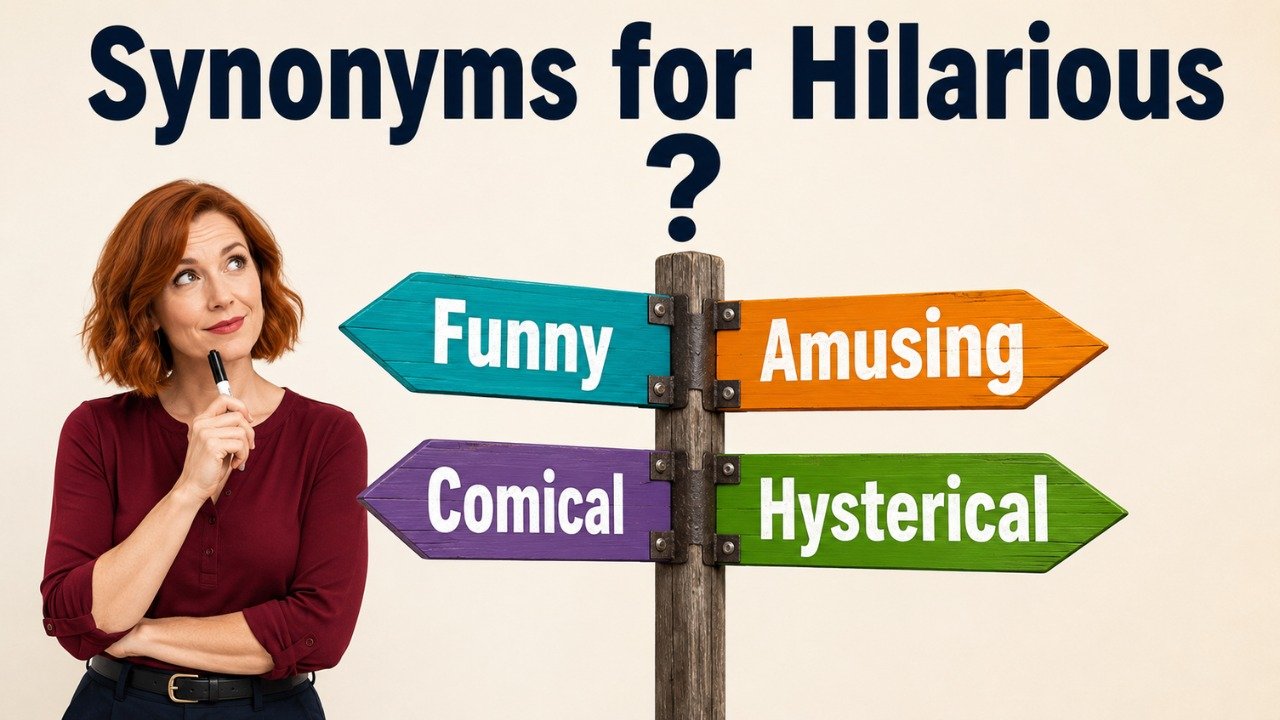
Quick Answer: The best synonyms for hilarious are funny, amusing, humorous, comical, uproarious, riotous, sidesplitting, witty, absurd, and hysterical. Use funny as the most natural general alternative, amusing for mild entertainment, and humorous for formal or neutral writing. Comical suits amusing behavior or situations, while witty describes clever humor. Uproarious, riotous, sidesplitting, and hysterical express extremely strong laughter. Absurd works when something is funny because it is strange, unreasonable, or exaggerated.
Pronunciation and Word Details
Word: Hilarious.
Pronunciation: /hɪˈleriəs/.
Part of Speech: Adjective.
Meaning: Extremely funny or likely to make people laugh loudly.
US Pronunciation:
UK Pronunciation:
What Does “Hilarious” Mean?
Hilarious means extremely funny and capable of causing strong laughter. It is an adjective used to describe jokes, stories, films, comments, mistakes, expressions, people, and situations.
The word usually suggests a stronger reaction than funny or amusing. Something funny may make a person smile, but something hilarious often causes loud or uncontrollable laughter.
Hilarious can describe intentional humor, such as a clever performance, or accidental humor, such as an unexpected mistake. It is common in casual speech, reviews, storytelling, and friendly conversations.
For a Joke: The joke was so hilarious that everyone laughed.
For a Situation: The confusion at the party became hilarious.
For a Person: Her hilarious personality kept the group entertained.
For a Story: He told a hilarious story about his first day at work.
For an Accidentally Funny Moment: His surprised expression was hilarious.
Meaning, Tone, and Context of “Hilarious”
Hilarious has a lively, positive, and expressive tone. It communicates a strong emotional reaction and is usually more enthusiastic than funny, amusing, or humorous.
The word is common in everyday conversation because it clearly shows that something caused a great deal of laughter. It may also appear in informal reviews, personal writing, descriptions, and humorous storytelling.
In formal or academic writing, hilarious may sound too emotional or subjective. Humorous, comical, satirical, or amusing may be more appropriate when a measured tone is needed.
Hilarious can occasionally be used sarcastically. A speaker may say that something is hilarious even when it is annoying, embarrassing, or not funny at all. The intended meaning depends on tone and context.
Casual Tone: Hilarious is natural in conversations about jokes, stories, and entertaining experiences.
Enthusiastic Tone: It strongly communicates enjoyment and laughter.
Emotional Tone: It expresses a personal reaction rather than an objective fact.
Formal Tone: Humorous, comical, or satirical may sound more controlled.
Sarcastic Tone: Hilarious may express irritation when the speaker does not actually find something funny.
Creative Context: It works well in dialogue, reviews, storytelling, and descriptions of entertaining events.
When and How to Use “Hilarious”
For Extremely Funny Jokes
Use hilarious when a joke causes immediate and powerful laughter.
Example: His final joke was absolutely hilarious.
For Funny Stories
Use hilarious for a story filled with amusing details, surprising events, or comic misunderstandings.
Example: She shared a hilarious story about getting on the wrong bus.
For Comical Behavior
Use hilarious when someone’s actions, reactions, or expressions are extremely entertaining.
Example: The puppy’s attempt to climb the stairs was hilarious.
For Entertaining Performances
Use hilarious for a performance, speech, scene, or character that makes an audience laugh repeatedly.
Example: The actor gave a hilarious performance.
For Unexpected Situations
Use hilarious when an ordinary situation becomes funny because of confusion, timing, or coincidence.
Example: The mix up at the restaurant became hilarious.
For Clever Humor
Use hilarious when a comment combines intelligence, timing, and humor.
Example: Her hilarious response surprised everyone in the room.
For Friendly Reactions
Use hilarious as a direct reaction when someone shares something extremely funny.
Example: That story is hilarious.
For Sarcasm
Use hilarious carefully when the intended meaning is the opposite of the literal meaning.
Example: It is hilarious that the printer stopped working before the deadline.
In this sentence, the speaker probably means the situation is frustrating rather than genuinely funny.
Best Synonyms for Hilarious
Funny
Synonym: Causing laughter or amusement.
Example: The story was funny from beginning to end.
Amusing
Synonym: Pleasantly entertaining and mildly funny.
Example: We found his description of the event amusing.
Humorous
Synonym: Intentionally funny or showing a sense of humor.
Example: The writer used a humorous tone throughout the article.
Comical
Synonym: Funny because of unusual behavior, appearance, or circumstances.
Example: His oversized hat gave him a comical appearance.
Uproarious
Synonym: Extremely funny and causing loud laughter.
Example: The audience gave an uproarious response to the final scene.
Riotous
Synonym: Wildly funny, energetic, and entertaining.
Example: The dinner became a riotous evening of stories and laughter.
Sidesplitting
Synonym: So funny that it seems to cause physical pain from laughing.
Example: Her description of the mistake was sidesplitting.
Witty
Synonym: Cleverly and quickly funny.
Example: His witty reply impressed the entire group.
Absurd
Synonym: Funny because it is unreasonable, strange, or impossible.
Example: The absurd misunderstanding made everyone laugh.
Hysterical
Synonym: Extremely funny and causing uncontrollable laughter.
Example: We thought the unexpected ending was hysterical.
50 Synonyms for Hilarious with Short Meanings
- Funny: Causing laughter or amusement.
- Amusing: Pleasantly entertaining and mildly funny.
- Humorous: Showing or creating humor.
- Comical: Funny because of appearance, behavior, or circumstances.
- Comic: Intended to make people laugh.
- Uproarious: Causing extremely loud laughter.
- Riotous: Wildly funny and energetic.
- Hysterical: Extremely funny or causing uncontrollable laughter.
- Sidesplitting: So funny that laughing seems physically painful.
- Rib Tickling: Extremely amusing and laughter producing.
- Gut Busting: Informally describing something extremely funny.
- Knee Slapping: So funny that a person may slap a knee while laughing.
- Rollicking: Cheerful, lively, and highly entertaining.
- Witty: Clever and quick in humor.
- Clever: Showing intelligence in an amusing way.
- Droll: Amusing in a strange, quiet, or unexpected manner.
- Jocular: Cheerful and fond of joking.
- Facetious: Treating a serious subject with playful humor.
- Playful: Light, lively, and humorously energetic.
- Whimsical: Amusingly unusual, imaginative, or unpredictable.
- Zany: Wildly strange and comical.
- Wacky: Unusually silly and funny.
- Goofy: Foolishly playful and amusing.
- Silly: Funny because of foolishness or lack of seriousness.
- Madcap: Wild, energetic, and amusingly reckless.
- Absurd: Ridiculously unreasonable or strange.
- Ridiculous: Extremely unreasonable and therefore amusing.
- Ludicrous: So unreasonable that it causes laughter.
- Preposterous: Completely unreasonable or unbelievable.
- Farcical: Absurdly exaggerated and comical.
- Clownish: Behaving in a foolishly comic manner.
- Slapstick: Based on exaggerated physical humor.
- Satirical: Using humor to criticize people, ideas, or society.
- Ironic: Funny because the result is opposite to what was expected.
- Dry: Quietly humorous without showing obvious emotion.
- Sharp: Clever, direct, and quickly humorous.
- Priceless: Extremely funny, memorable, or entertaining.
- Entertaining: Holding attention and providing enjoyment.
- Diverting: Pleasantly amusing or distracting.
- Lighthearted: Cheerful, relaxed, and not serious.
- Mirthful: Full of laughter and happiness.
- Jovial: Cheerful, friendly, and humorous.
- Merry: Happy, cheerful, and full of laughter.
- Cheerful: Noticeably happy and positive.
- Laughable: So foolish or weak that it deserves laughter.
- Risible: Capable of causing laughter.
- Outrageous: Shockingly exaggerated and sometimes very funny.
- Bizarre: Strange enough to seem amusing.
- Antic: Playfully foolish or comically exaggerated.
- Screamingly Funny: So amusing that it causes intense laughter.
Read Also:
Synonyms for Searching

Synonyms for Hilarious by Context
When Hilarious Means Extremely Funny
Uproarious, riotous, hysterical, sidesplitting, rib tickling, gut busting, and screamingly funny express powerful amusement.
Uproarious and riotous often describe loud group laughter. Sidesplitting and gut busting are highly expressive and informal. Hysterical commonly describes something that causes uncontrollable laughter.
Example: The final scene was absolutely uproarious.
Example: His impression was sidesplitting.
Example: The unexpected reply was hysterical.
When Hilarious Means Generally Funny
Funny, amusing, humorous, comical, comic, and entertaining are broader and less intense alternatives.
Funny is the most flexible choice. Amusing suggests mild enjoyment. Humorous sounds more neutral and may suit formal descriptions. Comical often describes a funny appearance, action, or situation.
Example: The speaker gave a humorous account of the incident.
Example: The child made a comical face.
Example: We found the story amusing.
When Hilarious Means Cleverly Funny
Witty, clever, sharp, dry, ironic, and satirical describe humor based on intelligence, language, or observation.
Witty suggests quick and intelligent humor. Dry humor is delivered calmly. Satirical humor criticizes through exaggeration, irony, or ridicule.
Example: She gave a witty response to the question.
Example: His dry remarks were quietly amusing.
Example: The article used satirical humor to expose the problem.
When Hilarious Means Silly or Wild
Zany, wacky, goofy, silly, madcap, clownish, and antic describe exaggerated or foolish humor.
Zany and wacky suggest unusual behavior. Goofy is friendly and informal. Clownish may sound more critical because it suggests foolish attention seeking.
Example: The character’s zany behavior entertained the children.
Example: We took several goofy photographs.
Example: His madcap plan created a series of funny mistakes.
When Hilarious Means Absurd
Absurd, ridiculous, ludicrous, preposterous, farcical, bizarre, and outrageous describe humor caused by something unreasonable or exaggerated.
Absurd is useful for strange situations. Ludicrous and preposterous are stronger and may express criticism. Farcical suggests an event that has become absurdly disorganized.
Example: The explanation was so absurd that everyone laughed.
Example: The meeting became farcical after several misunderstandings.
Example: His exaggerated excuse sounded preposterous.
When Hilarious Means Cheerful and Entertaining
Rollicking, lighthearted, mirthful, jovial, merry, diverting, and playful describe positive entertainment and good humor.
These alternatives may not express intense laughter, but they work well for cheerful stories, gatherings, conversations, and performances.
Example: The book offers a rollicking adventure.
Example: They enjoyed a lighthearted conversation.
Example: His jovial manner made the guests comfortable.
Another Word for Hilarious
Funny is the best general replacement for hilarious because it works naturally in most conversations and descriptions. However, the best alternative depends on the strength and type of humor.
Use amusing for mild humor, witty for clever humor, comical for funny behavior, uproarious for loud laughter, and absurd for humor created by unreasonable situations.
Original: The story was hilarious.
Better Option: The story was extremely funny.
Original: Her response was hilarious and intelligent.
Better Option: Her response was witty and intelligent.
Original: The misunderstanding was hilarious.
Better Option: The misunderstanding was comical.
Original: The performance was hilarious from beginning to end.
Better Option: The performance was uproarious from beginning to end.
When Not to Use “Hilarious”
Do not use hilarious when something is only slightly amusing. The word suggests strong laughter, so it may sound exaggerated if the reaction was only a smile.
Avoid hilarious in serious academic, technical, legal, or professional writing unless the emotional tone is appropriate. Humorous, comical, amusing, or ironic may sound more precise.
Do not use hilarious for situations involving genuine suffering, humiliation, danger, or loss. Describing a painful experience as hilarious may sound insensitive.
Avoid repeating hilarious several times in one paragraph. Choose alternatives that explain the exact type of humor.
Do not use hilarious as a replacement for happy. It describes something extremely funny, not simply something cheerful or enjoyable.
Weak: The mildly amusing comment was hilarious.
Better: The mildly amusing comment made us smile.
Weak: The research paper presents a hilarious analysis of language.
Better: The research paper presents a humorous analysis of language.
Weak: His painful injury was hilarious.
Better: His harmless mistake was comical.
Weak: The party was hilarious because everyone felt relaxed.
Better: The party was cheerful because everyone felt relaxed.
Weak: She told a hilarious joke, and then another hilarious story about a hilarious event.
Better: She told a witty joke and followed it with an uproarious story about a comical event.
Words Commonly Confused With Hilarious
Hilarious vs Funny: Funny is a broad word for anything that causes amusement. Hilarious is much stronger and suggests intense laughter.
Hilarious vs Humorous: Hilarious describes the audience’s strong reaction. Humorous describes something that contains or expresses humor.
Hilarious vs Amusing: Hilarious means extremely funny, while amusing usually means mildly entertaining.
Hilarious vs Comical: Hilarious focuses on how funny something is. Comical often focuses on an unusual appearance, action, or situation.
Hilarious vs Witty: Hilarious describes the strength of the laughter. Witty describes clever use of language or ideas.
Hilarious vs Ridiculous: Hilarious is positive and means extremely funny. Ridiculous may criticize something as foolish, unreasonable, or unacceptable.
Hilarious vs Hysterical: Both can mean extremely funny. Hysterical can also describe uncontrolled emotion, fear, or panic, so context must be clear.
Hilarious vs Laughable: Hilarious usually expresses enjoyment. Laughable often criticizes something as foolish, weak, or undeserving of respect.
Hilarious vs Ironic: Hilarious describes something very funny. Ironic describes a contrast between what was expected and what actually happened.
Hilarious vs Satirical: Hilarious describes the reaction to humor. Satirical describes humor that exposes or criticizes faults.
Which Synonym Should You Choose?
Choose funny as the most natural general alternative in everyday speech.
Choose amusing when something is pleasant and mildly funny rather than extremely funny.
Choose humorous in formal writing, essays, reviews, or neutral descriptions of humor.
Choose comical for amusing appearances, actions, expressions, and misunderstandings.
Choose witty for clever comments, intelligent dialogue, and quick responses.
Choose uproarious for performances, stories, or scenes that cause loud laughter.
Choose riotous for lively events filled with wild humor and energy.
Choose sidesplitting for highly informal descriptions of intense laughter.
Choose hysterical when something causes nearly uncontrollable laughter.
Choose droll for quiet, unusual, and understated humor.
Choose dry when the humor is delivered seriously without visible emotion.
Choose ironic when the humor comes from an unexpected contrast.
Choose satirical when humor is used to criticize behavior, institutions, or ideas.
Choose absurd when the situation is funny because it makes no logical sense.
Choose ludicrous or preposterous when something is so unreasonable that it deserves ridicule.
Choose zany or wacky for unusual, energetic, and unpredictable humor.
Choose goofy for harmless, friendly, and foolish behavior.
Choose slapstick for exaggerated physical comedy, falls, collisions, and visual action.
Choose lighthearted when something is cheerful and entertaining without being intensely funny.
Real Life Examples of “Hilarious” in Sentences
Original: His story about the missed train was hilarious.
Better Option: His story about the missed train was uproarious.
Original: Her answer to the question was hilarious.
Better Option: Her answer to the question was witty.
Original: The child’s expression was hilarious.
Better Option: The child’s expression was comical.
Original: We watched a hilarious performance.
Better Option: We watched a riotous performance.
Original: The misunderstanding became hilarious.
Better Option: The misunderstanding became farcical.
Original: His hilarious dancing entertained everyone.
Better Option: His goofy dancing entertained everyone.
Original: The book contains several hilarious observations.
Better Option: The book contains several humorous observations.
Original: The ending was completely hilarious.
Better Option: The ending was sidesplitting.
Original: Her description of the event was hilarious.
Better Option: Her description of the event was screamingly funny.
Original: The ridiculous excuse was hilarious.
Better Option: The preposterous excuse was laughable.
Synonym Groups and Usage Differences
General Humor Group
Funny, amusing, humorous, comical, comic, and entertaining describe humor without always suggesting extreme laughter.
Funny is broad and conversational. Amusing is milder. Humorous is controlled and suitable for formal descriptions. Comical often describes a visible situation or behavior.
Example: The writer included several humorous observations.
Strong Laughter Group
Uproarious, riotous, hysterical, sidesplitting, rib tickling, gut busting, and screamingly funny communicate intense amusement.
These words are useful when funny is too weak. Some, such as gut busting and rib tickling, are highly informal.
Example: The comedian’s final story was sidesplitting.
Clever Humor Group
Witty, clever, sharp, dry, ironic, droll, and satirical describe humor that depends on intelligence, language, timing, or observation.
Witty and sharp suit quick replies. Dry humor is understated. Satirical humor includes criticism.
Example: His dry response made the audience laugh.
Silly Humor Group
Silly, goofy, zany, wacky, madcap, clownish, and antic describe playful foolishness.
Goofy is usually friendly, while clownish may sound critical. Zany and wacky suggest strange, exaggerated behavior.
Example: Their goofy dance made everyone smile.
Absurdity Group
Absurd, ridiculous, ludicrous, preposterous, farcical, bizarre, and outrageous describe humor caused by unreasonable or exaggerated circumstances.
These words can express amusement, criticism, or both. Ludicrous and preposterous are especially strong.
Example: The entire explanation sounded ludicrous.
Cheerful Humor Group
Lighthearted, playful, mirthful, jovial, merry, rollicking, and diverting describe cheerful entertainment.
These words are useful when the mood matters more than the strength of the laughter.
Example: The guests enjoyed a lighthearted evening.
Physical Humor Group
Slapstick, clownish, antic, goofy, and comical describe humor created through movement, expressions, accidents, or exaggerated physical behavior.
Slapstick is the most specific term for exaggerated physical comedy.
Example: The scene relied on slapstick humor and exaggerated movements.
Antonyms of Hilarious
The opposite of hilarious may describe something serious, dull, sad, unamusing, or emotionally heavy.
Serious: Not intended to cause laughter.
Unfunny: Failing to create amusement.
Dull: Lacking interest, excitement, or humor.
Boring: Not entertaining or engaging.
Tedious: Too long, repetitive, or tiring.
Solemn: Deeply serious and formal.
Grave: Serious because of danger, importance, or concern.
Somber: Dark, serious, or sad in mood.
Depressing: Causing sadness or loss of hope.
Tragic: Involving great suffering, loss, or sadness.
Mournful: Expressing sorrow or grief.
Joyless: Lacking happiness or amusement.
Dry: Lacking humor or excitement in some contexts.
Flat: Failing to create the intended emotional effect.
Awkward: Uncomfortable rather than entertaining.
Comparison: Hilarious vs Related Words
Hilarious vs Funny
Funny is the general word for something that causes laughter. Hilarious expresses a much stronger degree of amusement.
Example With Hilarious: The entire audience found the story hilarious.
Example With Funny: The story contained a few funny moments.
Hilarious vs Amusing
Hilarious suggests loud or intense laughter. Amusing suggests gentle enjoyment or a smile.
Example With Hilarious: His imitation was hilarious.
Example With Amusing: His observation was mildly amusing.
Hilarious vs Humorous
Hilarious describes the effect something has on people. Humorous describes the presence or style of humor.
Example With Hilarious: The final scene was hilarious.
Example With Humorous: The essay used a humorous writing style.
Hilarious vs Comical
Hilarious describes extreme funniness. Comical often describes an appearance, movement, expression, or situation that looks amusing.
Example With Hilarious: Her story was hilarious.
Example With Comical: Her oversized shoes gave her a comical appearance.
Hilarious vs Witty
Hilarious refers to the strength of amusement. Witty refers to clever and quick humor.
Example With Hilarious: The conversation became hilarious.
Example With Witty: She made a witty remark about the situation.
Hilarious vs Uproarious
Both express strong laughter, but uproarious often emphasizes loud group laughter and noisy enjoyment.
Example With Hilarious: The speech was hilarious.
Example With Uproarious: The speech received an uproarious response.
Hilarious vs Ridiculous
Hilarious expresses positive amusement. Ridiculous often expresses criticism because something is unreasonable or foolish.
Example With Hilarious: His harmless mistake was hilarious.
Example With Ridiculous: His demand for special treatment was ridiculous.
Hilarious vs Hysterical
Both can mean extremely funny. Hysterical may also describe uncontrolled fear, distress, or emotion.
Example With Hilarious: The story was hilarious.
Example With Hysterical: We became hysterical with laughter.
Hilarious vs Satirical
Hilarious describes a powerful comic effect. Satirical describes humor that criticizes through irony, exaggeration, or ridicule.
Example With Hilarious: The performance was hilarious.
Example With Satirical: The performance offered a satirical view of office culture.
Hilarious vs Laughable
Hilarious is usually approving and enjoyable. Laughable often means something is so poor or foolish that it deserves ridicule.
Example With Hilarious: Her impression was hilarious.
Example With Laughable: Their weak excuse was laughable.
Common Phrases and Expressions With “Hilarious”
Absolutely Hilarious: Extremely funny without any doubt.
Really Hilarious: Very funny and entertaining.
Genuinely Hilarious: Truly funny rather than forced or exaggerated.
Simply Hilarious: Funny in a clear and uncomplicated way.
Completely Hilarious: Funny from beginning to end.
Hilarious Story: A story that causes strong laughter.
Hilarious Joke: A joke that is extremely amusing.
Hilarious Moment: An event or reaction that causes laughter.
Hilarious Reaction: A highly amusing response or expression.
Hilarious Performance: A performance filled with effective humor.
Common Mistakes to Avoid
Overusing Hilarious
Repeating hilarious can make writing sound exaggerated and limited. Use synonyms that describe the specific kind of humor.
Repetitive: The hilarious actor told a hilarious story during a hilarious scene.
Better: The witty actor told an uproarious story during a comical scene.
Using Hilarious for Mild Humor
Hilarious is stronger than amusing. Do not use it when something only causes a small smile.
Weak: The mildly pleasant comment was hilarious.
Better: The mildly pleasant comment was amusing.
Confusing Hilarious With Humorous
Hilarious describes something extremely funny. Humorous describes something that contains humor, even if it does not cause loud laughter.
Incorrect: The academic article was hilarious in tone.
Better: The academic article was humorous in tone.
Confusing Hilarious With Ridiculous
Ridiculous often expresses criticism, while hilarious usually expresses enjoyment.
Incorrect: The unfair rule was hilarious.
Better: The unfair rule was ridiculous.
Using Hilarious in Serious Situations
Avoid the word when discussing genuine pain, tragedy, humiliation, or danger.
Insensitive: The accident was hilarious.
Better: The harmless misunderstanding after the accident was comical.
Using Hysterical Without Clear Context
Hysterical can mean extremely funny, but it may also describe panic or uncontrollable emotion.
Unclear: She became hysterical during the performance.
Clear: She became hysterical with laughter during the performance.
Using Funny When Witty Is More Precise
Funny is broad. Use witty when the humor is clever, quick, or based on language.
General: She gave a funny answer.
Precise: She gave a witty answer.
Using Hilarious as a Synonym for Enjoyable
An enjoyable event is not necessarily funny.
Incorrect: The peaceful walk was hilarious.
Better: The peaceful walk was enjoyable.
Adding Unnecessary Intensifiers
Hilarious already has a strong meaning. Expressions such as very hilarious may sound awkward.
Awkward: The story was very hilarious.
Better: The story was absolutely hilarious.
Conclusion
The best synonyms for hilarious depend on the type and strength of humor. Funny is the broadest alternative, while amusing and humorous suit milder or more formal contexts. Witty and dry describe clever humor, and comical suits amusing behavior or situations. Uproarious, riotous, hysterical, and sidesplitting express intense laughter. Absurd, ludicrous, and farcical work when humor comes from unreasonable events. Choosing the right alternative makes descriptions clearer, more expressive, and better matched to the intended tone.
FAQs About Synonyms for Hilarious
What Is the Best Synonym for Hilarious?
Funny is the best general synonym. Uproarious, hysterical, and sidesplitting are stronger alternatives.
What Is a Formal Synonym for Hilarious?
Humorous, comical, amusing, and satirical are suitable choices for formal or neutral writing.
What Is a Stronger Word Than Funny?
Hilarious, uproarious, riotous, sidesplitting, and hysterical all express stronger amusement than funny.
What Is a Synonym for a Hilarious Person?
Funny, witty, comical, jocular, playful, and entertaining can describe a person who regularly makes others laugh.
Are Hilarious and Humorous the Same?
Not exactly. Hilarious means extremely funny, while humorous means containing or expressing humor.
Can Hysterical Mean Hilarious?
Yes. Hysterical can mean extremely funny, but it can also describe uncontrolled fear, distress, or emotion.
What Is Another Word for a Hilarious Situation?
Comical, absurd, farcical, ridiculous, riotous, or uproarious may describe a highly amusing situation.
