
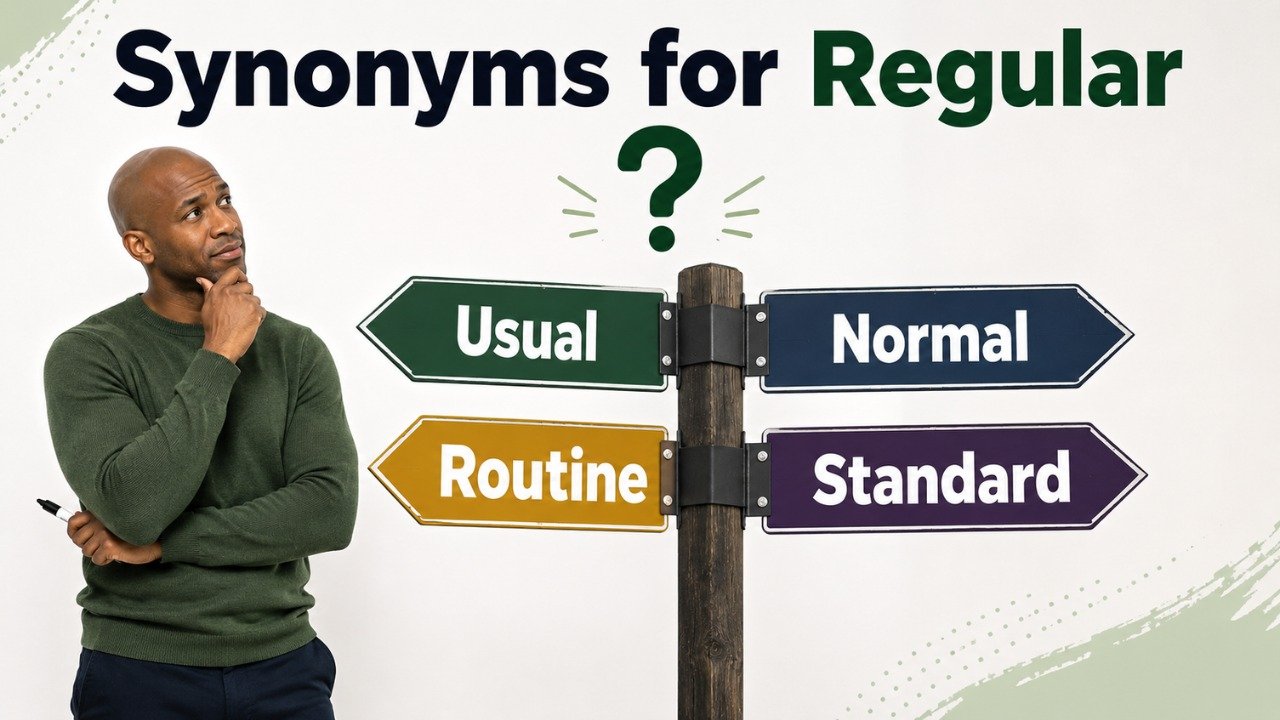
Quick Answer: The best synonyms for regular are usual, normal, routine, standard, consistent, steady, habitual, uniform, recurring, and periodic. Use usual or normal for something ordinary, routine or habitual for repeated behavior, and consistent or steady for dependable performance. Standard works well for accepted forms, sizes, or procedures. Uniform describes something even or unchanged, while recurring and periodic are best for events that happen repeatedly at planned or recognizable intervals.
Pronunciation and Word Details
Word: Regular.
Pronunciation: /ˈreɡjələr/.
Part of Speech: Adjective and noun.
Meaning: Happening repeatedly, following a pattern, or being normal, standard, even, or consistent.
US Pronunciation:
UK Pronunciation:
What Does “Regular” Mean?
Regular means happening repeatedly, following an established pattern, or being considered normal and usual.
As an adjective, regular can describe routines, schedules, behavior, shapes, prices, customers, grammar patterns, and levels of performance.
Routine Meaning: A regular activity happens repeatedly as part of a routine.
Example: Walking after dinner is part of her regular routine.
Timing Meaning: A regular event occurs at expected or planned intervals.
Example: The committee holds regular meetings.
Normal Meaning: Something regular may be ordinary rather than special or unusual.
Example: He ordered a regular cup of coffee.
Consistent Meaning: Regular can describe something that remains steady or dependable.
Example: The machine requires regular maintenance to work efficiently.
Even Meaning: A regular pattern, shape, or movement is balanced and uniform.
Example: The fabric has a regular pattern of squares.
As a noun, regular may describe a person who frequently visits a place or repeatedly participates in an activity.
Example: She is a regular at the neighborhood bookshop.
The exact meaning of regular depends on whether it refers to normality, repetition, timing, consistency, shape, behavior, or frequent attendance.
Meaning, Tone, and Context of “Regular”
Regular usually has a neutral and practical tone. It is widely used in casual conversation, formal writing, professional communication, academic explanations, schedules, reports, instructions, and everyday descriptions.
Neutral Tone: Regular is normally factual rather than emotional.
Example: Regular practice improves confidence.
Conversational Tone: In everyday speech, regular can mean ordinary, usual, or familiar.
Example: I will have my regular order.
Professional Tone: In workplace writing, regular often describes meetings, reviews, reports, maintenance, or communication.
Example: Regular progress reports will be shared with the team.
Academic Tone: In academic contexts, regular can describe patterns, intervals, forms, or grammatical structures.
Example: A regular verb follows the standard pattern when forming the past tense.
Technical Tone: In mathematics and science, regular may describe equal, uniform, symmetrical, or predictable structures.
Example: A regular polygon has equal sides and equal angles.
Habitual Context: Regular describes an activity performed repeatedly.
Example: Regular reading helps build vocabulary.
Timing Context: Regular refers to events occurring according to a schedule or pattern.
Example: Trains arrive at regular intervals.
Because regular has several meanings, writers should select a synonym that matches the exact context.
When and How to Use “Regular”
For Repeated Habits
Use regular to describe an activity that someone performs frequently or as part of an established routine.
Example: Regular exercise can improve strength and flexibility.
For Planned Events
Use regular when a meeting, appointment, class, payment, or review occurs according to a schedule.
Example: The department conducts regular safety inspections.
For Normal Products or Services
Regular can describe an ordinary version rather than a special, large, premium, or customized version.
Example: He purchased a regular ticket instead of the premium option.
For Consistent Performance
Use regular when results, attendance, communication, or progress remain steady over time.
Example: Her regular attendance helped her understand every lesson.
For Standard Forms
Regular may describe something that follows an accepted form, rule, or model.
Example: This word follows a regular grammatical pattern.
For Even Patterns
Use regular when shapes, movements, arrangements, or spaces are equal and orderly.
Example: The tiles were placed in a regular pattern.
For Frequent Visitors
As a noun, regular describes someone who repeatedly visits a place or participates in an activity.
Example: The staff recognized him as one of their regulars.
For Ongoing Communication
Regular can describe communication that happens frequently enough to maintain awareness or coordination.
Example: Regular updates helped everyone understand the project’s progress.
Best Synonyms for Regular
Usual: Normal or commonly expected in a particular situation.
Example: She arrived at her usual time.
Normal: Typical, ordinary, or within an expected range.
Example: Business returned to normal after the interruption.
Routine: Performed repeatedly as part of a familiar practice.
Example: The technician completed a routine inspection.
Standard: Following an accepted level, form, method, or measurement.
Example: The package is available in a standard size.
Consistent: Remaining dependable, similar, or unchanged over time.
Example: His work has been consistently accurate.
Steady: Continuing at an even and dependable rate.
Example: The company experienced steady growth.
Habitual: Done repeatedly because it has become a habit.
Example: Her habitual morning walk begins at sunrise.
Uniform: Remaining the same throughout without noticeable variation.
Example: The workers applied a uniform layer of paint.
Recurring: Happening repeatedly, sometimes without fixed intervals.
Example: The report identified a recurring technical problem.
Periodic: Happening at separate and usually predictable intervals.
Example: The equipment requires periodic testing.
50 Synonyms for Regular with Short Meanings
- Usual: Commonly expected or normally experienced.
- Normal: Ordinary or within an expected range.
- Routine: Repeated as part of an established practice.
- Customary: Commonly done according to tradition or habit.
- Habitual: Performed repeatedly because it has become a habit.
- Conventional: Following commonly accepted methods or standards.
- Standard: Meeting an accepted form, level, or measurement.
- Ordinary: Not unusual, special, or exceptional.
- Typical: Showing the usual qualities of a person or thing.
- Common: Frequently found, experienced, or used.
- Consistent: Remaining dependable and similar over time.
- Steady: Continuing at an even and reliable rate.
- Dependable: Able to be trusted to perform consistently.
- Reliable: Producing expected results repeatedly.
- Constant: Continuing without significant change.
- Stable: Remaining firm, balanced, or unchanged.
- Uniform: The same throughout in form, quality, or appearance.
- Even: Equal, balanced, or without sudden variation.
- Orderly: Arranged or performed in a controlled pattern.
- Systematic: Done according to an organized method.
- Scheduled: Planned to occur at a particular time.
- Periodic: Happening at predictable intervals.
- Recurring: Happening repeatedly over time.
- Recurrent: Returning or appearing repeatedly.
- Repeated: Done or occurring more than once.
- Frequent: Happening often.
- Continual: Happening repeatedly with short interruptions.
- Ongoing: Continuing to happen or develop.
- Predictable: Occurring in an expected way.
- Established: Accepted or followed for a long time.
- Fixed: Set and unlikely to change.
- Set: Arranged or decided in advance.
- Formal: Following accepted rules or procedures.
- Official: Authorized or recognized by an organization.
- Legitimate: Proper, lawful, or officially accepted.
- Proper: Correct, suitable, or accepted.
- Disciplined: Controlled through consistent habits or rules.
- Methodical: Performed carefully in an organized order.
- Organized: Arranged clearly and efficiently.
- Balanced: Evenly arranged or maintained.
- Symmetrical: Having matching and evenly arranged parts.
- Equal: The same in amount, size, value, or level.
- Measured: Controlled, regular, and carefully paced.
- Smooth: Continuing evenly without interruption.
- Uninterrupted: Continuing without a break.
- Permanent: Continuing for a long or unlimited period.
- Returning: Coming back repeatedly.
- Loyal: Continuing to support or visit consistently.
- Familiar: Well known through repeated experience.
- Everyday: Ordinary and commonly experienced.
Read Also:
Synonyms for Hilarious

Synonyms for Regular by Context
When Regular Means Usual or Normal
Usual, normal, ordinary, typical, common, familiar, and everyday describe something that is expected or not unusual.
Usual: Best for something that normally happens in a particular situation.
Example: He followed his usual route to work.
Normal: Best for something within an expected condition or range.
Example: Her temperature returned to normal.
Ordinary: Best for something that is not special or exceptional.
Example: It seemed like an ordinary morning.
Typical: Best when something represents the usual qualities of a group or situation.
Example: Rain is typical during this season.
Everyday: Best for common experiences, objects, or language.
Example: The guide explains difficult ideas using everyday words.
When Regular Means Routine or Habitual
Routine, habitual, customary, established, disciplined, and familiar describe repeated actions or behaviors.
Routine: Describes an activity performed as part of an established practice.
Example: Cleaning the equipment is a routine task.
Habitual: Describes behavior repeated so often that it becomes a habit.
Example: His habitual lateness frustrated the team.
Customary: Describes something commonly done because of tradition or accepted practice.
Example: It is customary to thank guests before they leave.
Established: Describes a practice that has existed and been accepted for some time.
Example: The office follows an established review process.
When Regular Means Consistent or Steady
Consistent, steady, dependable, reliable, stable, constant, and smooth describe performance or conditions that remain controlled and predictable.
Consistent: Best for quality, behavior, or results that remain similar.
Example: Her consistent effort produced strong results.
Steady: Best for gradual movement, growth, progress, or rhythm.
Example: Sales showed steady improvement.
Reliable: Best for people, systems, or information that can be trusted.
Example: The device provides reliable measurements.
Stable: Best for conditions that do not change suddenly.
Example: The patient remained in a stable condition.
When Regular Means Recurring
Recurring, recurrent, periodic, repeated, continual, frequent, and scheduled describe events that happen more than once.
Recurring: Best for something that returns repeatedly.
Example: The technician investigated a recurring error.
Periodic: Best for something happening at separate intervals.
Example: The building receives periodic safety checks.
Scheduled: Best for an event planned for a specific time.
Example: The scheduled meeting begins at ten.
Frequent: Best when something happens often, whether planned or not.
Example: Frequent delays affected the service.
When Regular Means Even or Uniform
Uniform, even, balanced, symmetrical, equal, measured, and orderly describe shapes, movements, spacing, or patterns.
Uniform: Best when every part has the same appearance or quality.
Example: The wall had a uniform finish.
Even: Best for surfaces, spacing, rates, or distribution.
Example: Spread the mixture in an even layer.
Symmetrical: Best for shapes with matching parts.
Example: The design has a symmetrical structure.
Measured: Best for calm, controlled, or evenly paced movement.
Example: She spoke in a measured voice.
When Regular Means Standard or Official
Standard, conventional, formal, official, legitimate, and proper describe accepted forms, rules, or procedures.
Standard: Best for accepted measurements, methods, products, or quality levels.
Example: Complete the form using the standard procedure.
Conventional: Best for widely accepted methods or ideas.
Example: They selected a conventional design.
Official: Best for something formally approved or authorized.
Example: The official schedule was published yesterday.
Legitimate: Best for something lawful, valid, or properly recognized.
Example: The organization addressed every legitimate concern.
When Regular Means a Frequent Customer
Returning, loyal, familiar, and frequent can describe someone who visits, purchases, or participates repeatedly.
Returning: Emphasizes that the person comes back again.
Example: Returning customers received early access to the event.
Loyal: Emphasizes continuing support or preference.
Example: Loyal customers appreciated the personal service.
Frequent: Emphasizes how often the person visits.
Example: Frequent visitors knew the staff well.
Another Word for Regular
Usual is often the best general replacement for regular when the meaning is normal or commonly expected. However, the best alternative depends on context.
Use routine for repeated tasks, consistent for dependable performance, periodic for events occurring at intervals, standard for accepted forms, and uniform for equal patterns or appearance.
Original: She arrived at her regular time.
Better Option: She arrived at her usual time.
Original: The office performs regular inspections.
Better Option: The office performs routine inspections.
Original: He has shown regular improvement.
Better Option: He has shown steady improvement.
Original: The machine needs regular maintenance.
Better Option: The machine needs periodic maintenance.
When Not to Use “Regular”
Do not use regular when the reader needs to know exactly how often something occurs. A more precise time word may be clearer.
Weak: The reports are submitted regularly.
Better: The reports are submitted every Friday.
Avoid regular when a more specific synonym can explain whether something is normal, repeated, uniform, scheduled, or dependable.
Weak: The company achieved regular growth.
Better: The company achieved steady growth.
Do not use regular for a person when the meaning could sound unclear or judgmental.
Weak: He is a regular employee.
Better: He is a permanent employee.
Regular may be too vague in instructions involving timing.
Weak: Take regular breaks.
Better: Take a short break every hour.
Avoid repeating regular several times in one paragraph.
Weak: Regular meetings support regular communication and regular progress.
Better: Routine meetings support consistent communication and steady progress.
Do not replace regular with normal when discussing schedules unless normal truly means expected rather than repeated.
Weak: The machine receives normal maintenance every month.
Better: The machine receives scheduled maintenance every month.
Words Commonly Confused With Regular
Regular vs Normal: Regular often means repeated or following a pattern. Normal means expected, ordinary, or within a typical range.
Regular vs Usual: Regular may describe frequency, consistency, or form. Usual describes what normally happens in a particular situation.
Regular vs Routine: Regular is broad and can mean normal, even, repeated, or standard. Routine mainly describes familiar and repeated tasks.
Regular vs Consistent: Regular focuses on repeated occurrence or pattern. Consistent focuses on dependable quality, behavior, or results.
Regular vs Periodic: Regular may mean frequent, even, or customary. Periodic specifically means happening at separate intervals.
Regular vs Frequent: Regular suggests a pattern or schedule. Frequent means happening often, even without a predictable pattern.
Regular vs Uniform: Regular can describe repeated events or ordinary things. Uniform means the same throughout.
Regular vs Standard: Regular may mean normal or recurring. Standard refers to an accepted level, form, size, or method.
Regular vs Permanent: Regular can describe repeated attendance or work. Permanent means continuing without an intended end.
Which Synonym Should You Choose?
For Formal Writing: Choose standard, consistent, periodic, systematic, or established.
For Casual Speech: Choose usual, normal, ordinary, familiar, or everyday.
For Daily Habits: Choose routine or habitual.
For Traditional Practices: Choose customary or conventional.
For Reliable Performance: Choose consistent, steady, dependable, or reliable.
For Planned Events: Choose scheduled or periodic.
For Problems That Return: Choose recurring or recurrent.
For Events That Happen Often: Choose frequent or repeated.
For Stable Conditions: Choose stable, constant, or steady.
For Shapes and Patterns: Choose uniform, even, symmetrical, equal, or balanced.
For Accepted Methods: Choose standard, conventional, proper, or established.
For Official Procedures: Choose formal, official, or legitimate.
For Reports and Data: Choose consistent when results remain similar and periodic when reports appear at set intervals.
For Professional Emails: Choose regular for general repetition, scheduled for fixed timing, and routine for familiar procedures.
For Conversation: Choose usual or normal when describing an ordinary choice, event, or experience.
Real Life Examples of “Regular” in Sentences
Original: We hold regular meetings to discuss progress.
Better Option: We hold scheduled meetings to discuss progress.
Original: Regular exercise helped him become stronger.
Better Option: Routine exercise helped him become stronger.
Original: She is a regular visitor to the library.
Better Option: She is a frequent visitor to the library.
Original: The company has experienced regular growth.
Better Option: The company has experienced steady growth.
Original: The pattern contains regular lines.
Better Option: The pattern contains evenly spaced lines.
Original: The machine needs regular testing.
Better Option: The machine needs periodic testing.
Original: He ordered his regular meal.
Better Option: He ordered his usual meal.
Original: Her work is regular and dependable.
Better Option: Her work is consistent and dependable.
Original: The teacher provides regular feedback.
Better Option: The teacher provides frequent feedback.
Original: The product is available in a regular size.
Better Option: The product is available in a standard size.
Synonym Groups and Usage Differences
Normality Group
Usual, normal, ordinary, typical, common, familiar, and everyday describe things that are expected or commonly experienced.
Usual focuses on what normally happens. Normal describes an expected state. Ordinary emphasizes the absence of anything special. Typical describes representative qualities.
Example: The shop opened at its usual time.
Habit and Routine Group
Routine, habitual, customary, established, and disciplined describe repeated actions and practices.
Routine is often neutral. Habitual may describe behavior that is difficult to change. Customary connects repetition with tradition or accepted practice.
Example: Checking the equipment became part of her routine.
Consistency Group
Consistent, steady, dependable, reliable, stable, and constant describe something that performs or continues without sudden change.
Consistent focuses on repeated quality. Steady focuses on an even rate. Reliable and dependable emphasize trust.
Example: The team maintained consistent performance throughout the season.
Frequency Group
Frequent, repeated, continual, recurring, recurrent, periodic, and scheduled describe events that happen more than once.
Frequent means often. Recurring means returning repeatedly. Periodic suggests intervals. Scheduled indicates advance planning.
Example: Periodic reviews help identify developing problems.
Uniformity Group
Uniform, even, balanced, symmetrical, equal, measured, and smooth describe consistency in appearance, movement, spacing, or structure.
Uniform means the same throughout. Even describes equality or smoothness. Symmetrical describes matching sides or parts.
Example: The artist created an even pattern across the surface.
Standard Group
Standard, conventional, proper, established, formal, official, and legitimate describe accepted methods, forms, or rules.
Standard refers to an accepted model. Conventional refers to common practice. Official indicates authorization.
Example: The document follows the standard format.
Frequent Customer Group
Returning, loyal, frequent, and familiar describe people who repeatedly visit a place, use a service, or take part in an activity.
Returning emphasizes repeated visits. Loyal suggests continuing support. Familiar suggests recognition created through repeated contact.
Example: The owner greeted every returning customer warmly.
Antonyms of Regular
The opposite of regular changes according to whether the word means normal, repeated, consistent, scheduled, or even.
Irregular: Not following a fixed pattern or rule.
Unusual: Different from what normally happens.
Abnormal: Outside an expected or typical range.
Inconsistent: Changing in quality, behavior, or results.
Occasional: Happening only from time to time.
Sporadic: Happening at scattered and unpredictable times.
Random: Occurring without a clear pattern or plan.
Erratic: Unpredictable and uneven.
Uneven: Not equal, smooth, or balanced.
Unstable: Likely to change suddenly.
Exceptional: Unusually different or better than normal.
Rare: Not happening or appearing often.
Temporary: Continuing for only a limited time.
Unofficial: Not formally approved or authorized.
Unscheduled: Not planned for a particular time.
Comparison: Regular vs Related Words
Regular vs Usual
Regular can describe repeated timing, consistent behavior, uniform patterns, or ordinary choices. Usual mainly describes what is normally expected in a particular situation.
Example With Regular: She attends regular training sessions.
Example With Usual: She arrived at her usual time.
Regular vs Normal
Regular often emphasizes repetition or pattern. Normal emphasizes an expected state, condition, or level.
Example With Regular: The doctor recommended regular checkups.
Example With Normal: His breathing returned to normal.
Regular vs Routine
Regular has several meanings, including normal, repeated, even, and standard. Routine describes something familiar that is performed repeatedly.
Example With Regular: The team holds regular meetings.
Example With Routine: The technician completed a routine inspection.
Regular vs Consistent
Regular describes something that happens repeatedly or follows a pattern. Consistent describes something that maintains similar quality or behavior.
Example With Regular: She submits regular reports.
Example With Consistent: Her reports are consistently accurate.
Regular vs Frequent
Regular suggests repeated occurrence according to a pattern. Frequent means happening often without necessarily following a schedule.
Example With Regular: Buses arrive at regular intervals.
Example With Frequent: Frequent traffic delays affected the route.
Regular vs Periodic
Regular is broad and may mean usual, steady, even, or recurring. Periodic specifically describes something that happens at separate intervals.
Example With Regular: The building receives regular maintenance.
Example With Periodic: The alarm requires periodic testing.
Regular vs Uniform
Regular can describe habits, schedules, forms, or frequency. Uniform means the same throughout in appearance, quality, or arrangement.
Example With Regular: She followed a regular study schedule.
Example With Uniform: The material had a uniform texture.
Regular vs Standard
Regular can mean ordinary or recurring. Standard describes an accepted size, quality, procedure, or form.
Example With Regular: He ordered his regular drink.
Example With Standard: The document uses the standard format.
Common Phrases and Expressions With “Regular”
On a Regular Basis: Happening repeatedly or consistently.
Example: The equipment is checked on a regular basis.
Regular Schedule: A timetable that remains consistent.
Example: The service follows a regular schedule.
Regular Customer: Someone who repeatedly visits or purchases from a place.
Example: The staff recognized every regular customer.
Regular Exercise: Physical activity performed consistently.
Example: Regular exercise became part of her morning routine.
Regular Intervals: Equal or predictable spaces of time.
Example: The lights flashed at regular intervals.
Regular Pattern: A repeated and orderly arrangement.
Example: The shapes formed a regular pattern.
Regular Meeting: A discussion held repeatedly according to an established arrangement.
Example: The team discussed results during its regular meeting.
Regular Price: The usual price before a discount or special offer.
Example: The item later returned to its regular price.
Regular Size: The standard or ordinary available size.
Example: She selected the regular size.
Regular Verb: A verb that follows the usual pattern when changing form.
Example: Walk is a regular verb because its past form is walked.
Common Mistakes to Avoid
Using Regular When Timing Should Be Exact
Regular may be too vague when instructions require specific timing.
Unclear: Check the system regularly.
Better: Check the system every Monday morning.
Confusing Regular With Normal
Regular often means repeated, while normal means expected.
Incorrect: The office holds normal meetings every week.
Better: The office holds regular meetings every week.
Confusing Regular With Frequent
Something may happen frequently without following a pattern.
Example: Frequent calls may occur at unpredictable times.
Example: Regular calls occur according to an established schedule.
Using Regular for Permanent Employment
Regular and permanent do not always mean the same thing. A regular employee may work consistently, while a permanent employee has an ongoing employment arrangement.
Unclear: She became a regular employee.
Better: She became a permanent employee.
Repeating Regular Too Often
Repeated use can make a sentence sound vague and monotonous.
Repetitive: Regular practice and regular feedback create regular improvement.
Better: Routine practice and consistent feedback create steady improvement.
Using a Weak Synonym for Patterns
Normal and usual may not clearly describe equal spacing or arrangement.
Weak: The tiles formed a normal pattern.
Better: The tiles formed a uniform pattern.
Confusing Recurring With Periodic
Recurring means happening repeatedly, while periodic usually suggests recognizable or planned intervals.
Recurring: The software has a recurring error.
Periodic: The software receives periodic updates.
Replacing Regular in Fixed Terms
Some expressions have specialized meanings and should not be changed casually.
Correct: Regular verb.
Incorrect: Usual verb.
Correct: Regular polygon.
Incorrect: Routine polygon.
Conclusion
Synonyms for regular vary according to meaning and context. Use usual or normal for ordinary situations, routine or habitual for repeated behavior, and consistent or steady for dependable performance. Periodic and scheduled are useful for planned events, while recurring describes something that repeatedly returns. Standard suits accepted forms and sizes, and uniform or even describes balanced patterns. Choosing a precise alternative makes writing clearer, reduces repetition, and helps readers understand whether regular refers to normality, frequency, consistency, timing, or structure.
FAQs About Synonyms for Regular
What Is the Best Synonym for Regular?
Usual is a strong general synonym when regular means normal or expected. Routine, consistent, periodic, and standard are better in more specific contexts.
What Is a Formal Synonym for Regular?
Consistent, periodic, systematic, established, and standard are suitable formal alternatives.
What Is a Casual Synonym for Regular?
Usual, normal, ordinary, familiar, and everyday sound natural in casual conversation.
What Is Another Word for Regular Meetings?
Scheduled meetings, routine meetings, recurring meetings, and periodic meetings are useful alternatives.
What Is a Synonym for Regular Practice?
Routine practice, consistent practice, habitual practice, and repeated practice are natural options.
What Is the Difference Between Regular and Consistent?
Regular describes something that happens repeatedly. Consistent emphasizes dependable quality, behavior, or results.
Can Regular Mean Ordinary?
Yes. Regular can mean ordinary, normal, or standard, especially when describing a product, size, price, or familiar choice.
