
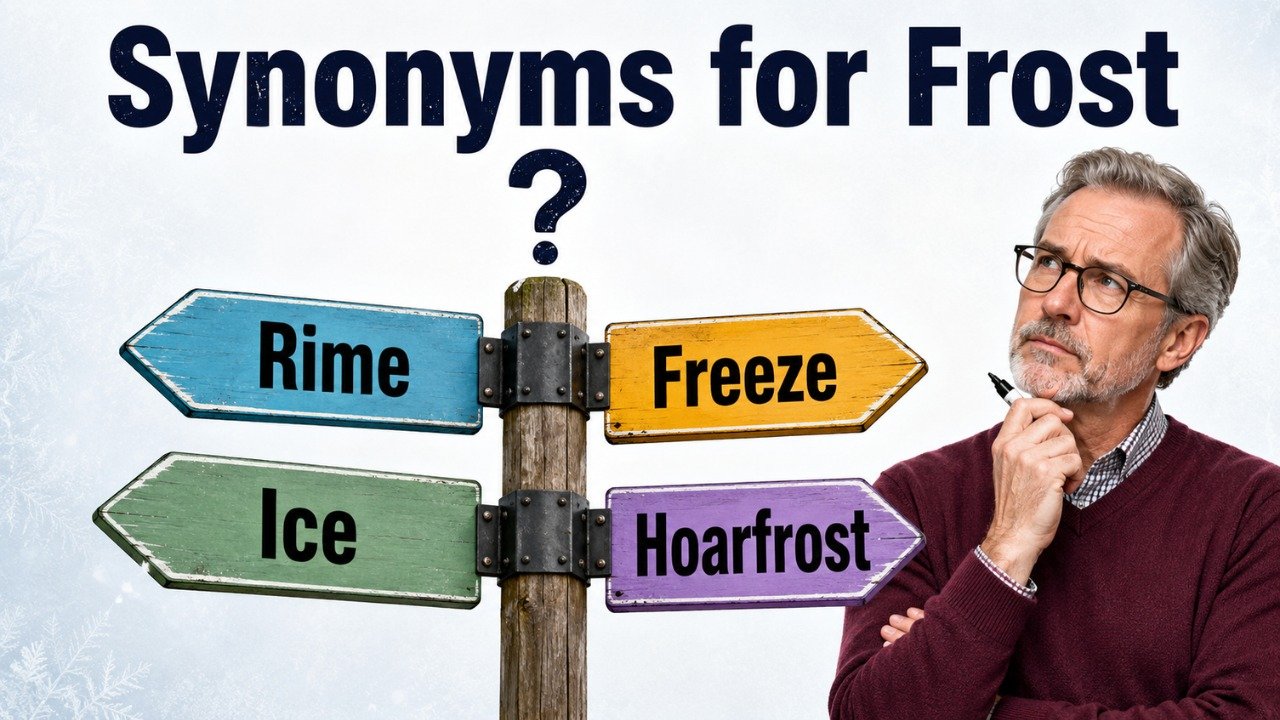
Quick Answer: The best synonyms for frost are rime, hoarfrost, ice crystals, frozen dew, glaze, ice, freeze, chill, icing, and cloud. Use rime or hoarfrost for ice crystals forming on cold outdoor surfaces. Glaze and ice describe a smooth frozen coating, while freeze and chill relate to cold temperatures. In baking, icing is the best alternative when frost means covering a cake. Use cloud or mist when frost describes making glass less transparent.
Pronunciation and Word Details
Word: Frost.
Pronunciation: /frɒst/.
Part of Speech: Noun and verb.
Meaning: A thin layer of ice crystals that forms in cold conditions, or the action of covering, freezing, decorating, or clouding a surface.
US Pronunciation:
UK Pronunciation:
What Does “Frost” Mean?
Frost is a thin layer of ice crystals that forms when water vapor freezes on cold surfaces. It commonly appears on grass, plants, windows, roofs, roads, and vehicles during cold weather.
As a noun, frost can describe the icy coating itself, a period of freezing weather, or damage caused to plants by low temperatures.
As a verb, frost can mean covering something with ice crystals, damaging plants through cold, applying icing to a cake, or making glass cloudy and less transparent.
The meaning of frost therefore depends strongly on context.
Weather Meaning: A layer of ice crystals created by cold conditions.
Temperature Meaning: A period when the temperature falls low enough for frost to form.
Plant Meaning: Cold conditions that injure leaves, flowers, or crops.
Surface Meaning: A frozen coating that forms on an object.
Baking Meaning: To cover a cake or dessert with icing.
Glass Meaning: To make glass cloudy, patterned, or less transparent.
Meaning, Tone, and Context of “Frost”
Frost is generally a neutral and descriptive word. It is commonly used in weather reports, gardening advice, farming, everyday conversation, baking, manufacturing, and interior design.
In weather contexts, frost has a factual and natural tone. It describes frozen moisture rather than falling snow. Words such as rime, hoarfrost, ground frost, and ice crystals provide greater precision.
In gardening and farming, frost often has a serious or cautionary tone because freezing temperatures can damage plants and crops. Phrases such as frost damage, hard frost, and killing frost communicate the severity of the conditions.
In baking, frost is mainly used as a verb meaning to apply icing. This use is conversational and practical.
When discussing glass, frost can describe a decorative or functional treatment that reduces transparency. Cloud, obscure, mist, or film over may express similar ideas depending on the sentence.
Neutral Context: Frost is suitable for general descriptions of cold weather and icy surfaces.
Formal Context: Rime, hoarfrost, ice deposit, freezing, or crystalline coating may be more precise.
Conversational Context: Frost sounds natural when discussing mornings, gardens, windows, cakes, and cold weather.
Technical Context: Crystallize, solidify, obscure, glaze, or ice deposit may be better choices.
Emotional Context: Frost may create an image of coldness, silence, beauty, damage, or discomfort.
When and How to Use “Frost”
For Ice Crystals
Use frost when a thin white layer of ice crystals forms on a cold outdoor surface.
Example: Frost covered the grass early in the morning.
For Cold Weather
Use frost when temperatures become low enough to freeze moisture near the ground.
Example: The weather forecast predicts frost overnight.
For Plant Damage
Use frost when cold temperatures injure leaves, flowers, vegetables, or crops.
Example: The late frost damaged several young plants.
For Frozen Windows
Use frost when ice crystals form on glass because of cold conditions.
Example: Frost formed around the edges of the window.
For Covering a Surface
Use frost as a verb when something becomes covered with a thin frozen layer.
Example: The metal railing frosted during the cold night.
For Decorating Cakes
Use frost when applying a layer of icing to a cake, biscuit, or dessert.
Example: She frosted the cake with vanilla icing.
For Clouding Glass
Use frost when making glass less transparent for privacy or decoration.
Example: They frosted the bathroom window.
For Figurative Coldness
Frost may occasionally describe emotional coldness, distance, or an unfriendly atmosphere.
Example: A sense of frost entered the conversation after the disagreement.
This figurative use is less common and usually appears in creative writing.
Best Synonyms for Frost
Rime
Synonym: A white deposit of ice crystals formed on cold surfaces.
Example: Thick rime covered the branches after the freezing fog.
Hoarfrost
Synonym: A delicate white layer of ice crystals formed directly from water vapor.
Example: Hoarfrost made the field appear silver in the morning light.
Ice Crystals
Synonym: Small frozen formations created when water vapor freezes.
Example: Ice crystals sparkled across the roof.
Frozen Dew
Synonym: Dew that has frozen after forming on a cold surface.
Example: Frozen dew covered the leaves before sunrise.
Glaze
Synonym: A smooth, thin coating of ice on a surface.
Example: A dangerous glaze formed on the road overnight.
Ice
Synonym: Frozen water covering or forming on a surface.
Example: Ice appeared around the edge of the pond.
Freeze
Synonym: A period or process in which temperatures fall below the freezing point.
Example: The sudden freeze damaged the fruit trees.
Chill
Synonym: A feeling or period of unpleasant coldness.
Example: A sharp chill remained in the air all morning.
Icing
Synonym: A sweet coating placed on cakes and desserts.
Example: She covered the cake with smooth chocolate icing.
Cloud
Synonym: To make glass or another surface unclear or less transparent.
Example: Warm moisture began to cloud the cold window.
50 Synonyms for Frost with Short Meanings
- Rime: A white deposit of ice formed on cold surfaces.
- Hoarfrost: Delicate white ice crystals formed from water vapor.
- Ice Crystals: Small frozen formations on a cold surface.
- Frozen Dew: Dew that has changed into ice.
- Ground Frost: Frost that forms close to the surface of the ground.
- White Frost: A visible white coating of frozen moisture.
- Black Frost: Severe freezing conditions that damage plants without leaving a clear white coating.
- Air Frost: Conditions in which the air temperature falls below freezing.
- Ice: Frozen water on a surface.
- Glaze: A smooth coating of ice.
- Icy Glaze: A thin and slippery frozen layer.
- Ice Coating: A covering of frozen water.
- Frozen Coating: A cold, hardened layer on a surface.
- Crystalline Layer: A covering made of small ice crystals.
- Frozen Film: A very thin layer of ice.
- Ice Deposit: Frozen moisture collected on a surface.
- Wintry Coating: A cold white covering associated with winter.
- Freeze: A period or process of freezing weather.
- Freezing: The process of becoming frozen.
- Chill: An uncomfortable feeling or period of coldness.
- Cold: A low temperature or lack of warmth.
- Coldness: The condition of being cold.
- Wintry Chill: Coldness associated with winter weather.
- Biting Cold: Severe cold that feels painful.
- Cold Snap: A sudden short period of cold weather.
- Nip: To damage or affect something through cold.
- Freeze Over: To become completely covered with ice.
- Ice Over: To develop a frozen surface.
- Glaze Over: To become covered with a smooth frozen layer.
- Rim: To cover the edge of something with frost or ice.
- Encrust: To cover with a hard outer layer.
- Crystallize: To form or change into crystals.
- Solidify: To become firm or solid.
- Harden: To become stiff or solid because of cold.
- Congeal: To become thick or solid through cooling.
- Whiten: To make or become white in appearance.
- Silver: To give a pale, shining appearance.
- Coat: To cover with a thin layer.
- Cover: To spread a layer over a surface.
- Dust: To cover lightly with fine particles or crystals.
- Cloud: To make a surface unclear or less transparent.
- Mist: To cover with tiny droplets or a cloudy film.
- Obscure: To make something difficult to see through.
- Blur: To make an image or surface unclear.
- Film Over: To become covered with a thin cloudy layer.
- Icing: A sweet covering applied to cakes.
- Frosting: A soft sweet mixture used to cover desserts.
- Cake Glaze: A smooth sweet coating for baked goods.
- Ice: To cover a cake with icing.
- Decorate: To add an attractive covering or finish.
Read Also:
Synonyms for Enjoyable

Synonyms for Frost by Context
When Frost Means Ice Crystals
Rime, hoarfrost, ice crystals, frozen dew, ground frost, white frost, and ice deposit describe frozen moisture forming on cold surfaces.
Rime often develops during freezing fog or when supercooled droplets freeze onto objects. Hoarfrost forms as delicate crystals when water vapor freezes directly onto a surface.
Frozen dew differs slightly because the liquid dew forms first and then freezes.
Example: Hoarfrost covered the field with delicate white crystals.
Example: Rime collected on the exposed branches.
Example: Frozen dew made the grass sparkle.
When Frost Means a Frozen Coating
Glaze, ice coating, crystalline layer, frozen film, icy glaze, and ice deposit describe a layer covering a surface.
Glaze often suggests a smooth, slippery layer. Crystalline layer emphasizes visible crystal shapes, while frozen film describes an especially thin covering.
Example: A thin glaze made the pavement slippery.
Example: The pipe had developed a crystalline layer.
Example: A frozen film covered the metal surface.
When Frost Means Cold Weather
Freeze, freezing, chill, cold, cold snap, biting cold, and wintry chill describe low temperatures.
Freeze is often used for a specific period of very cold weather. Cold snap describes a sudden and relatively brief change. Chill refers to how the cold feels.
Example: The unexpected freeze harmed the early crops.
Example: A cold snap arrived at the end of the month.
Example: A wintry chill remained in the air.
When Frost Means Cover With Ice
Rim, encrust, coat, cover, glaze over, ice over, and freeze over describe a surface becoming covered with ice.
Rim means covering the edge of an object. Encrust suggests a thicker, harder covering. Ice over and freeze over are natural choices for ponds, windows, and roads.
Example: Ice rimmed the edge of the window.
Example: Frozen moisture encrusted the branches.
Example: The shallow pond began to freeze over.
When Frost Means Damage Through Cold
Freeze, nip, harm, damage, injure, and chill describe the effects of low temperatures on plants or other materials.
Nip is especially common when cold slightly damages leaves or flowers. Freeze and damage are clearer when the harm is more serious.
Example: The cold nipped the young leaves.
Example: Freezing temperatures damaged the blossoms.
Example: The severe weather injured the vegetable plants.
When Frost Means Apply Icing
Ice, decorate, coat, cover, glaze, icing, frosting, and cake glaze relate to covering a dessert.
Ice is the closest verb replacement for frost in baking. Glaze usually describes a thinner and shinier covering, while frosting often means a thicker and softer mixture.
Example: Ice the cake after it has cooled completely.
Example: She glazed the pastries with a sweet mixture.
Example: He decorated the cake with thick frosting.
When Frost Means Make Glass Cloudy
Cloud, mist, obscure, blur, film over, and whiten describe making glass unclear or less transparent.
Cloud and mist are natural for moisture. Obscure is more formal and focuses on reduced visibility. Frosted glass is intentionally treated to provide privacy.
Example: Steam clouded the bathroom mirror.
Example: Moisture misted the cold window.
Example: The textured surface obscured the view.
Another Word for Frost
Rime is often the best single replacement for frost when describing a white deposit of ice crystals on an outdoor surface. However, the best alternative depends on the sentence.
Use hoarfrost for delicate visible crystals, glaze for a smooth ice coating, freeze for a period of severe cold, icing for a cake covering, and cloud when glass becomes unclear.
Original: Frost covered the branches.
Better Option: Rime covered the branches.
Original: Frost damaged the flowers overnight.
Better Option: The overnight freeze damaged the flowers.
Original: She frosted the birthday cake.
Better Option: She iced the birthday cake.
Original: Moisture frosted the window.
Better Option: Moisture clouded the window.
When Not to Use “Frost”
Do not use frost when a more precise term can explain the exact type of frozen material, weather event, damage, decoration, or surface treatment.
Frost should not be used as a general synonym for snow. Snow falls from clouds, while frost normally forms directly on cold surfaces.
Do not use frost when describing a thick sheet of frozen water. Ice is usually more accurate.
In scientific or technical writing, frost may be too general. Rime, hoarfrost, ice deposit, crystallization, or frozen condensation may communicate the process more precisely.
In baking, frosting and icing are related but not always identical. Frosting is commonly thicker and softer, while a glaze is thinner and smoother.
Weak: Frost fell heavily from the clouds.
Better: Snow fell heavily from the clouds.
Weak: The lake was covered with deep frost.
Better: The lake was covered with thick ice.
Weak: The machine developed some frost like material.
Better: The machine developed a crystalline ice deposit.
Weak: She frosted the pastries with a thin liquid coating.
Better: She glazed the pastries with a thin liquid coating.
Weak: The warm room was filled with frost.
Better: The cold window was covered with condensation and ice crystals.
Words Commonly Confused With Frost
Frost vs Ice: Frost is a thin deposit of ice crystals that forms on a cold surface. Ice is the broader term for frozen water and may form thick layers.
Frost vs Snow: Frost forms directly on surfaces, while snow develops in clouds and falls to the ground.
Frost vs Rime: Frost is the general word. Rime commonly forms when freezing fog or cold droplets freeze onto exposed surfaces.
Frost vs Hoarfrost: Frost is broad, while hoarfrost specifically describes delicate, feather like ice crystals formed from water vapor.
Frost vs Frozen Dew: Frost forms directly from water vapor. Frozen dew begins as liquid droplets that later freeze.
Frost vs Freeze: Frost is the visible ice deposit. A freeze is a period or process of very low temperature.
Frost vs Glaze: Frost usually appears white and crystalline. Glaze is smoother, clearer, and often more slippery.
Frost vs Icing: Frost is a natural frozen deposit. Icing is a sweet mixture used on cakes, although the verb frost can mean applying icing.
Frost vs Condensation: Frost is frozen moisture. Condensation consists of liquid water droplets forming on a cooler surface.
Which Synonym Should You Choose?
Choose rime when describing a white ice deposit caused by freezing fog or cold moisture.
Choose hoarfrost for delicate, visible crystals on grass, leaves, fences, and branches.
Choose ice crystals when explaining the physical structure of frost in clear and neutral language.
Choose frozen dew when liquid dew formed before freezing.
Choose glaze for a smooth, thin, and potentially dangerous ice coating.
Choose ice when describing a broad or thick layer of frozen water.
Choose freeze when referring to a period of severely cold weather.
Choose cold snap for a sudden and brief period of unusually cold conditions.
Choose chill when emphasizing how cold air feels.
Choose nip when cold causes light damage to plants.
Choose freeze or damage when plants suffer serious harm from cold.
Choose rim when frost or ice forms around the edge of an object.
Choose encrust when a hard frozen layer covers a surface.
Choose crystallize in scientific or technical discussions of crystal formation.
Choose icing or frosting when referring to a sweet cake covering.
Choose ice as a verb when telling someone to cover a cake with icing.
Choose glaze when a dessert receives a thin, smooth, and often shiny coating.
Choose cloud or mist when moisture makes glass unclear.
Choose obscure when discussing glass designed to reduce visibility.
Real Life Examples of “Frost” in Sentences
Original: Frost covered the lawn before sunrise.
Better Option: Hoarfrost covered the lawn before sunrise.
Original: The branches were white with frost.
Better Option: The branches were white with rime.
Original: Frost formed on the metal gate.
Better Option: Ice crystals formed on the metal gate.
Original: A heavy frost damaged the vegetable garden.
Better Option: A severe freeze damaged the vegetable garden.
Original: Frost made the road slippery.
Better Option: An icy glaze made the road slippery.
Original: The pond frosted over during the night.
Better Option: The pond froze over during the night.
Original: Frost rimmed the car window.
Better Option: Ice rimmed the car window.
Original: She frosted the cake with chocolate.
Better Option: She iced the cake with chocolate icing.
Original: Steam frosted the bathroom mirror.
Better Option: Steam clouded the bathroom mirror.
Original: The glass was frosted for privacy.
Better Option: The glass was obscured for privacy.
Synonym Groups and Usage Differences
Ice Crystal Group
Rime, hoarfrost, ice crystals, frozen dew, ground frost, and white frost describe visible frozen moisture.
Rime and hoarfrost are more specific than frost. Ice crystals is the clearest explanatory phrase, while ground frost identifies where the freezing occurs.
Example: Delicate hoarfrost sparkled on the grass.
Frozen Surface Group
Glaze, ice coating, frozen film, ice deposit, crystalline layer, and icy glaze describe frozen coverings.
Glaze emphasizes smoothness and danger. Frozen film suggests a very thin layer, while ice deposit works well in technical descriptions.
Example: A clear glaze covered the pavement.
Cold Weather Group
Freeze, freezing, cold, chill, cold snap, biting cold, and wintry chill describe temperature conditions.
Freeze focuses on temperatures low enough to cause damage or solidification. Chill describes physical discomfort, while cold snap refers to a sudden weather change.
Example: The sudden cold snap threatened the fruit crop.
Freezing Action Group
Freeze over, ice over, glaze over, crystallize, harden, solidify, and congeal describe a substance changing because of cold.
Crystallize focuses on crystal formation. Solidify and harden are broader terms, while congeal often describes liquids becoming thick or solid.
Example: The water began to crystallize along the edges.
Surface Covering Group
Coat, cover, rim, encrust, dust, whiten, and silver describe changes in surface appearance.
Dust suggests a light covering. Encrust suggests a harder or thicker layer. Silver is a descriptive choice for a pale and shining appearance.
Example: Frost silvered the field in the early light.
Baking Group
Icing, frosting, cake glaze, ice, decorate, coat, and cover relate to finishing cakes and desserts.
Icing and frosting are the closest noun alternatives. Ice is a direct verb replacement, while glaze describes a thinner coating.
Example: She iced the cake with a smooth vanilla mixture.
Clouded Glass Group
Cloud, mist, obscure, blur, whiten, and film over describe reduced transparency.
Cloud and mist often result from moisture. Obscure is more formal and may describe an intentional privacy treatment.
Example: Warm air clouded the cold glass.
Antonyms of Frost
The opposite of frost depends on whether the word describes frozen moisture, cold weather, cake decoration, or cloudy glass.
Thaw: A rise in temperature that melts frost or ice.
Melting: The process of changing from solid ice into liquid water.
Warmth: A comfortable or raised temperature.
Heat: A high level of temperature.
Warm Weather: Conditions that prevent frost from forming.
Defrosting: Removing frost or ice from a surface.
Clear: Free from frost, mist, or visual obstruction.
Transparent: Allowing light and images to pass through clearly.
Bare: Not covered by frost, ice, or another layer.
Uncovered: Having no coating over the surface.
Liquid: Existing in a flowing rather than frozen state.
Softened: Made less hard through warmth.
Melted: Changed from frozen material into liquid.
Protected: Kept safe from frost damage.
Heated: Made warmer through the addition of heat.
Comparison: Frost vs Related Words
Frost vs Ice
Frost is a thin crystalline deposit that forms on surfaces. Ice is the general term for frozen water and may be much thicker.
Example With Frost: Frost sparkled on the grass.
Example With Ice: Thick ice covered the pond.
Frost vs Snow
Frost forms on cold surfaces, while snow forms in the atmosphere and falls from clouds.
Example With Frost: Frost appeared on the roof overnight.
Example With Snow: Snow fell throughout the afternoon.
Frost vs Rime
Frost is the general term for frozen moisture on a surface. Rime often develops when freezing fog or supercooled droplets collect and freeze.
Example With Frost: Frost formed on the window.
Example With Rime: Rime covered the exposed mountaintop equipment.
Frost vs Hoarfrost
Frost can describe several kinds of frozen deposits. Hoarfrost specifically forms delicate and often feather shaped crystals.
Example With Frost: Frost covered the garden.
Example With Hoarfrost: Hoarfrost created delicate patterns on the leaves.
Frost vs Frozen Dew
Frost forms directly from water vapor. Frozen dew begins as liquid moisture before it freezes.
Example With Frost: Frost formed before any visible dew appeared.
Example With Frozen Dew: The dew droplets froze after the temperature dropped.
Frost vs Glaze
Frost is generally white and crystalline. Glaze is often smooth, clear, and slippery.
Example With Frost: White frost covered the grass.
Example With Glaze: A thin glaze covered the road.
Frost vs Freeze
Frost is the visible frozen deposit. A freeze is the cold condition or event that may produce frost.
Example With Frost: Frost appeared on the plants.
Example With Freeze: The overnight freeze damaged the plants.
Frost vs Chill
Frost is frozen moisture on a surface. Chill is the feeling or condition of unpleasant coldness.
Example With Frost: Frost formed on the car.
Example With Chill: A sharp chill filled the morning air.
Frost vs Icing
Frost is a natural ice deposit, while icing is a sweet cake covering. However, to frost a cake means to apply icing.
Example With Frost: Frost covered the roof.
Example With Icing: Icing covered the cake.
Frost vs Condensation
Frost consists of frozen crystals. Condensation consists of liquid droplets.
Example With Frost: Frost formed when the surface temperature dropped below freezing.
Example With Condensation: Condensation formed on the cold drinking glass.
Common Phrases and Expressions With “Frost”
Morning Frost: Frost that appears during the cold early hours.
Ground Frost: Frost forming near or directly on the ground.
Light Frost: A mild frost that produces a thin covering.
Heavy Frost: A strong frost that creates a substantial frozen coating.
Hard Frost: Severe freezing conditions that may penetrate the soil.
Killing Frost: Frost severe enough to destroy sensitive plants.
Frost Damage: Injury caused to plants, crops, pipes, or materials by freezing temperatures.
Frost Warning: A notice that temperatures may become low enough for frost to form.
Frost Line: The depth to which the ground normally freezes.
Frost Over: To become covered with frost or ice crystals.
Common Mistakes to Avoid
Confusing Frost With Snow
Frost does not normally fall from clouds. It develops directly on cold surfaces.
Incorrect: Frost fell from the sky all morning.
Better: Snow fell from the sky all morning.
Using Frost for Thick Ice
Frost is usually a thin crystalline coating. Use ice for a thick frozen layer.
Incorrect: The pond had several inches of frost.
Better: The pond had several inches of ice.
Confusing Frost With Frozen Dew
Frost forms directly from water vapor, while frozen dew begins as liquid droplets.
Unclear: Every frozen drop on the grass was frost.
Better: Some of the frozen drops were frozen dew.
Confusing Frost With a Freeze
Frost is the visible deposit. A freeze is the cold weather event.
Incorrect: The frost lasted for three days and lowered every daytime temperature.
Better: The freeze lasted for three days.
Using Frosting and Icing Without Context
Frosting often refers to a thicker, softer cake covering. Icing may be thinner, smoother, or firmer.
Unclear: She added frost to the cake.
Better: She added chocolate frosting to the cake.
Using Frost in Vague Technical Writing
Scientific and technical writing may require a more specific term.
Vague: Frost collected inside the machine.
Better: A crystalline ice deposit collected inside the machine.
Using Frost for Every Cloudy Surface
Glass may become cloudy because of steam, condensation, dirt, or intentional treatment. It is not always covered with frost.
Incorrect: Steam frosted the warm mirror.
Better: Steam clouded the mirror.
Repeating Frost Too Often
Use accurate alternatives to improve clarity and avoid repetition.
Repetitive: Frost covered the frosted grass after the frost arrived.
Better: Hoarfrost covered the grass after the overnight freeze.
Ignoring the Intended Meaning
The same alternative cannot replace frost in every context. Rime cannot naturally describe cake icing, and icing cannot describe frozen grass.
Incorrect: Rime the cake after it cools.
Better: Ice the cake after it cools.
Conclusion
The best synonyms for frost depend on the intended meaning. Rime, hoarfrost, ice crystals, and frozen dew describe frozen moisture on outdoor surfaces. Glaze and ice coating suit smooth frozen layers, while freeze, cold snap, and chill describe cold weather. In baking, icing and frosting are the most natural alternatives. Cloud, mist, and obscure work when discussing glass. Choosing a context specific replacement makes descriptions clearer, more accurate, and easier for readers to understand.
FAQs About Synonyms for Frost
What Is the Best Synonym for Frost?
Rime is a strong general synonym for a white deposit of ice. Hoarfrost is better for delicate visible crystals.
What Is Another Word for Frost on Grass?
Hoarfrost, ground frost, ice crystals, and frozen dew may describe frost on grass, depending on how it formed.
Are Frost and Ice the Same?
Not exactly. Frost is a thin deposit of ice crystals, while ice is the general term for frozen water.
What Is a Synonym for Severe Frost?
Hard frost, killing frost, deep freeze, and severe freeze can describe extremely cold conditions.
What Is Another Word for Frosting a Cake?
Icing, decorating, coating, glazing, and covering are useful alternatives. Ice is the closest verb replacement.
What Is a Formal Word for Frost?
Rime, hoarfrost, crystalline deposit, and ice deposit are suitable formal or technical alternatives.
What Is the Opposite of Frost?
Thaw, warmth, heat, melting, and defrosting are common opposites, depending on the context.
