
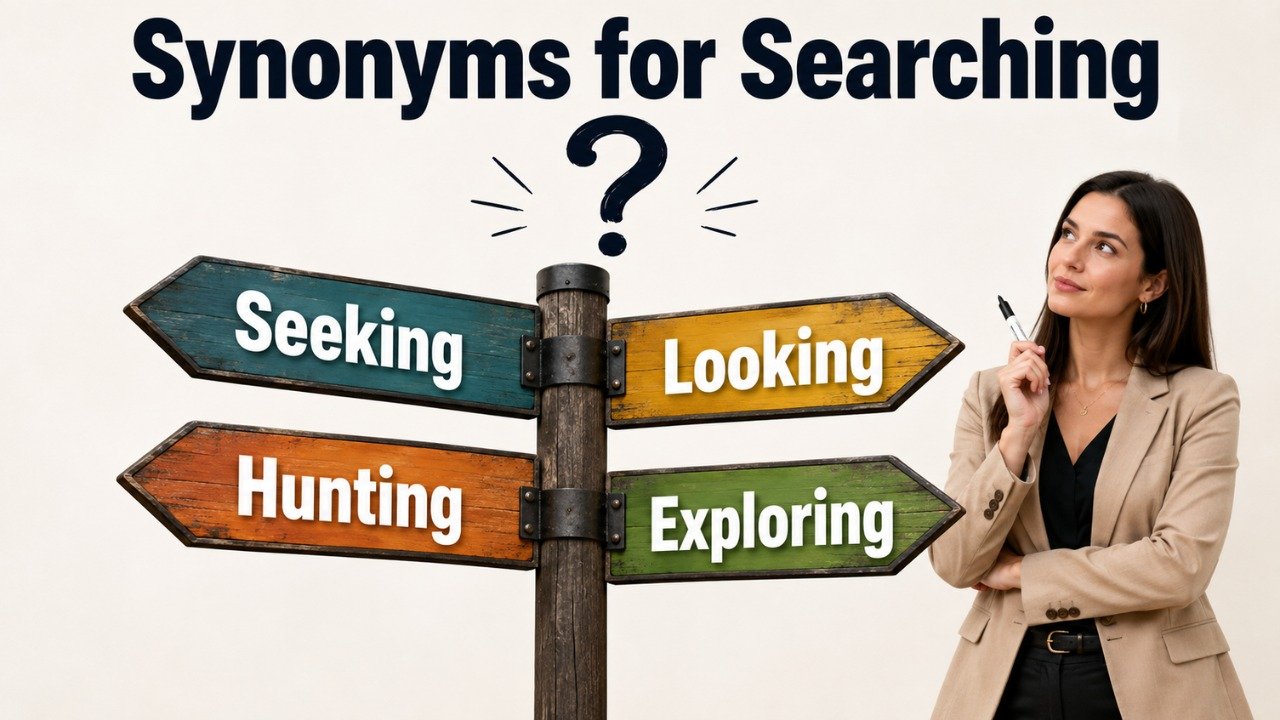
Quick Answer: The best synonyms for searching include looking, seeking, hunting, exploring, researching, investigating, examining, scanning, browsing, and probing. Use looking in everyday conversation, seeking in formal or purposeful writing, and hunting when the effort is active or difficult. Researching works best for academic information, while investigating suits facts, problems, or possible wrongdoing. Scanning describes a quick visual search, browsing suggests casual exploration, and probing emphasizes a deep or detailed examination.
Pronunciation and Word Details
Word: Searching.
Pronunciation: /ˈsɝː.tʃɪŋ/.
Part of Speech: Verb, gerund, and adjective.
Meaning: Trying to find someone, something, information, or an answer by looking carefully.
US Pronunciation:
UK Pronunciation:
What Does “Searching” Mean?
Searching means making an effort to find a person, object, answer, place, or piece of information. It is commonly used as the present participle of the verb search.
As a verb form, searching describes an action that is currently happening.
Example: The officers are searching the building for evidence.
Searching can also function as a gerund, which means it acts like a noun.
Example: Searching for reliable information requires patience.
As an adjective, searching can describe a question, look, or examination that is deep, thoughtful, and thorough.
Example: The interviewer asked several searching questions.
The precise meaning depends on the sentence. It may describe looking physically, exploring information, investigating evidence, or thinking deeply about an issue.
Meaning, Tone, and Context of “Searching”
Searching is generally a neutral word. It can be used in casual conversation, formal writing, academic work, reports, instructions, and professional communication.
In everyday speech, it often means trying to find a missing object, person, or location.
Example: I am searching for my keys.
In academic and professional contexts, searching may refer to finding information, reviewing evidence, or investigating a subject.
Example: The researcher is searching for patterns in the data.
Searching can also carry an emotional tone when it refers to purpose, identity, understanding, or personal fulfillment.
Example: She spent years searching for a sense of belonging.
As an adjective, searching has a thoughtful and serious tone. A searching question is one that explores a subject deeply rather than accepting a simple answer.
Example: His searching questions revealed weaknesses in the proposal.
When and How to Use “Searching”
For Finding an Object
Use searching when someone is carefully trying to locate something that is missing or difficult to find.
Example: We are searching the house for the missing document.
For Finding a Person
Searching can describe an organized or personal effort to locate someone.
Example: The rescue team is searching for the lost climber.
For Gathering Information
Use searching when looking through records, documents, databases, or other sources for useful information.
Example: She is searching the records for the correct date.
For Academic Research
Searching can describe the process of locating evidence, studies, facts, or explanations.
Example: The students are searching for evidence to support their argument.
For Investigating a Problem
Use searching when examining a situation to discover its cause or solution.
Example: Engineers are searching for the source of the system failure.
For Exploring Opportunities
Searching can refer to seeking employment, housing, education, or other opportunities.
Example: He is searching for a position that matches his experience.
For Personal Understanding
The word can describe an emotional or intellectual effort to discover meaning, purpose, or truth.
Example: She is searching for greater meaning in her work.
For Deep Examination
As an adjective, searching describes careful, thoughtful, or penetrating attention.
Example: The committee conducted a searching examination of the evidence.
Best Synonyms for Searching
Looking
Synonym: Directing your attention toward finding someone or something.
Example: She is looking for her glasses.
Seeking
Synonym: Trying purposefully to find, obtain, or achieve something.
Example: The organization is seeking an experienced manager.
Hunting
Synonym: Searching actively and persistently for something difficult to find.
Example: We spent the afternoon hunting for the missing receipt.
Exploring
Synonym: Examining a place, subject, or possibility to discover more about it.
Example: The team is exploring several possible solutions.
Researching
Synonym: Collecting and studying information about a particular subject.
Example: He is researching the history of the building.
Investigating
Synonym: Examining facts or evidence to uncover the truth.
Example: The authorities are investigating the cause of the accident.
Examining
Synonym: Looking at something carefully to understand its condition or details.
Example: The doctor is examining the patient’s injury.
Scanning
Synonym: Looking quickly across an area, page, or collection of information.
Example: She scanned the list for her name.
Browsing
Synonym: Looking through information or choices without a fixed plan.
Example: We were browsing the available courses.
Probing
Synonym: Investigating deeply through questions, analysis, or examination.
Example: The journalist asked probing questions about the decision.
50 Synonyms for Searching with Short Meanings
- Looking: Directing attention toward finding something.
- Seeking: Trying purposefully to find or obtain something.
- Hunting: Searching actively for something difficult to locate.
- Exploring: Examining a place, idea, or possibility.
- Investigating: Studying facts to uncover the truth.
- Researching: Collecting and examining information about a subject.
- Examining: Looking at something carefully.
- Scanning: Looking quickly over an area or text.
- Browsing: Looking through choices or information casually.
- Probing: Investigating a subject deeply.
- Checking: Looking to confirm, locate, or verify something.
- Inspecting: Examining closely for details, faults, or evidence.
- Scrutinizing: Studying something with intense care.
- Surveying: Looking over an entire area or situation.
- Reviewing: Examining information again for understanding or accuracy.
- Analyzing: Studying separate parts to understand the whole.
- Studying: Giving close attention to learn or understand.
- Scouring: Searching an area or source very thoroughly.
- Combing: Searching systematically through a place or collection.
- Rummaging: Moving through items while trying to find something.
- Sifting: Separating useful material from irrelevant material.
- Screening: Examining people or items according to specific conditions.
- Filtering: Narrowing information or choices using selected qualities.
- Tracking: Following movement, progress, activity, or clues.
- Tracing: Following the path, history, or origin of something.
- Pursuing: Continuing an effort to find or achieve something.
- Questing: Searching with determination or a strong purpose.
- Inquiring: Asking for information.
- Querying: Requesting specific information or clarification.
- Questioning: Asking questions to discover facts.
- Canvassing: Searching broadly or gathering information from many sources.
- Detecting: Discovering something hidden or difficult to notice.
- Locating: Finding the position or place of something.
- Finding: Discovering what was being sought.
- Discovering: Coming upon something previously unknown.
- Unearthing: Finding something hidden, buried, or forgotten.
- Uncovering: Revealing information or objects that were concealed.
- Identifying: Recognizing and naming a person, object, or issue.
- Spotting: Noticing or finding something quickly.
- Ferreting Out: Searching persistently until hidden information is found.
- Rooting Around: Searching through items in a casual or untidy way.
- Delving: Exploring a subject deeply.
- Digging: Searching deeply for facts, evidence, or explanations.
- Prospecting: Searching for valuable materials or promising opportunities.
- Looking Up: Searching for a specific fact in a source.
- Looking Into: Investigating a subject, issue, or complaint.
- Penetrating: Reaching deeply into a subject or problem.
- Incisive: Showing clear, direct, and intelligent examination.
- Thorough: Examining every important detail.
- Exhaustive: Covering all possible details, sources, or options.
Read Also:
Synonyms for Frost

Synonyms for Searching by Context
When Searching Means Looking for Something
Looking, seeking, hunting, scouring, combing, rummaging, and locating are useful when someone wants to find a physical object or person.
Looking is the most natural choice in everyday conversation.
Example: I am looking for my phone.
Seeking sounds more formal or purposeful.
Example: The family is seeking information about the missing person.
Hunting suggests greater difficulty or effort.
Example: We have been hunting for a replacement part all morning.
Scouring and combing emphasize a careful and complete search.
Example: Volunteers combed the field for the missing bag.
When Searching Means Researching Information
Researching, browsing, looking up, reviewing, studying, and exploring are useful when finding facts, evidence, or educational material.
Researching suggests an organized and detailed process.
Example: She is researching the effects of urban development.
Browsing is more casual and does not always involve a clear objective.
Example: He was browsing the course descriptions.
Looking up is best when finding one specific fact.
Example: I looked up the meaning of the unfamiliar word.
When Searching Means Investigating
Investigating, probing, examining, inspecting, analyzing, and looking into are appropriate when trying to discover a cause, truth, or explanation.
Investigating is common in formal reports and serious situations.
Example: The committee is investigating the financial discrepancy.
Probing suggests deep and persistent questioning.
Example: The interviewer asked probing questions.
Looking into is less formal and works well in professional conversation.
Example: The manager is looking into the complaint.
When Searching Means Examining Carefully
Scrutinizing, inspecting, checking, scanning, surveying, and reviewing describe different levels of examination.
Scrutinizing means examining something with exceptional care.
Example: The editor scrutinized every sentence.
Scanning means looking quickly rather than studying every detail.
Example: She scanned the page for the important figure.
Surveying involves looking at an entire area or situation.
Example: The architect surveyed the damaged building.
When Searching Describes a Deep Question or Look
Probing, penetrating, incisive, thorough, and exhaustive can replace searching when it is used as an adjective.
Example: The panel asked a searching question about the project’s risks.
Better Option: The panel asked a probing question about the project’s risks.
Penetrating suggests insight that reaches beneath the surface.
Example: She offered a penetrating analysis of the conflict.
Incisive suggests clear, intelligent, and direct thinking.
Example: His incisive comments identified the central problem.
Another Word for Searching
Seeking is often the best single replacement for searching because it works in formal, professional, emotional, and goal focused contexts. However, the best alternative depends on what is being searched for and how the search is being performed.
Use looking for everyday objects, researching for academic information, investigating for facts or causes, and probing for deep examination.
Original: She is searching for a better opportunity.
Better Option: She is seeking a better opportunity.
Original: I am searching for my notebook.
Better Option: I am looking for my notebook.
Original: The team is searching for the cause of the error.
Better Option: The team is investigating the cause of the error.
Original: He is searching the records for supporting evidence.
Better Option: He is examining the records for supporting evidence.
When Not to Use “Searching”
Searching can sound vague when the sentence does not explain what is being examined or how the search is being conducted. A more specific synonym often creates a clearer sentence.
When Describing Academic Work
Researching is usually more precise than searching when someone is collecting and studying information.
Weak: She is searching the topic for her assignment.
Better: She is researching the topic for her assignment.
When Examining a Serious Incident
Investigating is clearer when facts, evidence, causes, or possible wrongdoing are involved.
Weak: Officials are searching the incident.
Better: Officials are investigating the incident.
When Looking Quickly
Scanning is more accurate when someone looks rapidly for one detail.
Weak: He was searching the page for the total.
Better: He was scanning the page for the total.
When Looking Casually
Browsing is more natural when there is no urgent or specific target.
Weak: We were searching the available designs without a particular goal.
Better: We were browsing the available designs without a particular goal.
When Describing a Deep Question
Probing or incisive may sound more natural than searching in modern writing.
Weak: She asked a searching question about his motives.
Better: She asked a probing question about his motives.
When the Word Becomes Repetitive
Avoid repeating searching several times in the same paragraph.
Weak: We were searching the files while another team was searching the office and a third team was searching the records.
Better: We examined the files while another team inspected the office and a third team reviewed the records.
Words Commonly Confused With Searching
Searching vs Looking: Looking is a broad and casual action. Searching usually suggests a clearer goal and greater effort.
Searching vs Seeking: Searching emphasizes the process of trying to find something. Seeking often emphasizes the desired result, opportunity, answer, or goal.
Searching vs Researching: Searching involves finding information. Researching includes collecting, evaluating, comparing, and understanding that information.
Searching vs Browsing: Searching normally has a specific target. Browsing is usually casual and may not have a definite objective.
Searching vs Investigating: Searching means trying to locate something. Investigating means examining facts or evidence to discover the truth.
Searching vs Scanning: Searching may be careful or extensive. Scanning is usually quick and focused on finding a visible detail.
Searching vs Examining: Searching aims to find something. Examining aims to understand the condition, quality, or details of something already available.
Searching vs Exploring: Searching often has a known target. Exploring is more open and may lead to unexpected ideas or discoveries.
Which Synonym Should You Choose?
Choose looking when talking casually about a person, object, or place.
Choose seeking when the search is purposeful, formal, emotional, or related to an opportunity.
Choose hunting when the desired object or answer is difficult to find.
Choose researching when collecting information for an essay, report, study, or project.
Choose investigating when examining an incident, complaint, problem, or possible cause.
Choose scanning when looking quickly through a page, list, room, or screen.
Choose browsing when casually viewing choices without a fixed goal.
Choose inspecting when checking an object, building, product, or area for problems.
Choose scrutinizing when every detail must be examined carefully.
Choose probing when asking deep questions or exploring an issue beneath the surface.
Choose combing or scouring when searching an area or source thoroughly.
Choose tracking when following movement, progress, activity, or changing information.
Choose tracing when following an origin, history, route, or sequence.
Choose locating when the main goal is to find the exact position of something.
Choose reviewing when examining information that has already been collected.
Real Life Examples of “Searching” in Sentences
Original: I am searching for my car keys.
Better Option: I am looking for my car keys.
Original: She is searching for a new job.
Better Option: She is seeking a new job.
Original: The students are searching for information about the event.
Better Option: The students are researching the event.
Original: The police are searching the circumstances surrounding the disappearance.
Better Option: The police are investigating the circumstances surrounding the disappearance.
Original: He was searching the list for his application number.
Better Option: He was scanning the list for his application number.
Original: We are searching several possible solutions.
Better Option: We are exploring several possible solutions.
Original: The technician is searching the equipment for faults.
Better Option: The technician is inspecting the equipment for faults.
Original: The editor was searching every paragraph for errors.
Better Option: The editor was scrutinizing every paragraph for errors.
Original: The manager is searching the complaint.
Better Option: The manager is looking into the complaint.
Original: The interviewer asked a searching question.
Better Option: The interviewer asked a probing question.
Synonym Groups and Usage Differences
General Search Group
Looking, seeking, hunting, and pursuing describe efforts to find or obtain something.
Looking is casual, seeking is purposeful, hunting is active, and pursuing suggests continued effort.
Example: She is seeking a solution that benefits everyone.
Information Group
Researching, browsing, looking up, querying, and reviewing relate to finding information.
Researching is detailed, browsing is casual, looking up is specific, querying involves a direct request, and reviewing means examining existing material.
Example: He is researching the history of the neighborhood.
Investigation Group
Investigating, probing, questioning, analyzing, and looking into involve discovering facts, causes, or explanations.
Investigating is formal, probing is deep, questioning involves asking, and analyzing involves examining separate parts.
Example: Specialists are investigating the cause of the failure.
Physical Search Group
Scouring, combing, rummaging, inspecting, and surveying describe searching a physical place or collection.
Scouring and combing are systematic. Rummaging is less organized. Inspecting is careful, while surveying gives a broad view.
Example: The team scoured the building for evidence.
Quick Search Group
Scanning, checking, spotting, and detecting often describe fast or focused discovery.
Scanning means looking quickly. Checking means confirming. Spotting means noticing, while detecting means discovering something difficult to observe.
Example: She scanned the report for the final figure.
Deep Examination Group
Scrutinizing, delving, digging, penetrating, and incisive describe careful intellectual examination.
Scrutinizing focuses on details. Delving and digging explore deeply. Penetrating and incisive describe clear insight.
Example: The report provides an incisive examination of the issue.
Discovery Group
Finding, locating, discovering, uncovering, and unearthing describe successful results rather than the search process itself.
Finding is general, locating identifies a position, discovering reveals something new, and uncovering or unearthing reveals something hidden.
Example: Researchers uncovered evidence that changed their conclusion.
Antonyms of Searching
The opposite of searching depends on whether the word refers to looking, investigating, or pursuing something.
Ignoring: Refusing to give attention to something.
Overlooking: Failing to notice something important.
Neglecting: Not giving necessary attention or effort.
Avoiding: Deliberately staying away from a subject, person, or task.
Disregarding: Treating information as unimportant.
Abandoning: Stopping an effort before reaching the goal.
Missing: Failing to see, notice, or find something.
Losing: Becoming unable to locate or keep something.
Concealing: Keeping something hidden rather than trying to reveal it.
Settling: Accepting what is available instead of continuing to seek something better.
Comparison: Searching vs Related Words
Searching vs Seeking
Searching emphasizes the action or process of looking. Seeking emphasizes the goal or desired result.
Example With Searching: They are searching the building for the missing file.
Example With Seeking: They are seeking permission to enter the building.
Searching vs Researching
Searching is one part of finding information. Researching is a broader process that includes evaluating and interpreting information.
Example With Searching: She is searching for articles about the subject.
Example With Researching: She is researching how the policy affected local communities.
Searching vs Investigating
Searching aims to locate something. Investigating aims to discover facts, explanations, causes, or responsibility.
Example With Searching: Workers are searching the warehouse for the missing package.
Example With Investigating: Managers are investigating why the package disappeared.
Searching vs Browsing
Searching usually has a clear objective. Browsing is more relaxed and exploratory.
Example With Searching: He is searching for a course that begins in September.
Example With Browsing: He is browsing the available courses.
Searching vs Scanning
Searching may require time and close attention. Scanning is a quick visual examination.
Example With Searching: She spent an hour searching the document for supporting evidence.
Example With Scanning: She scanned the document for the author’s name.
Searching vs Exploring
Searching often involves a specific target. Exploring involves learning about different possibilities.
Example With Searching: The team is searching for the missing data.
Example With Exploring: The team is exploring new ways to present the data.
Common Phrases and Expressions With “Searching”
Searching for Answers: Trying to discover an explanation or solution.
Searching for Meaning: Trying to understand the purpose or significance of something.
Searching for Clues: Looking for evidence that may solve a mystery or problem.
Searching for Work: Trying to find employment.
Searching for Information: Looking for facts, details, or explanations.
Searching for a Solution: Trying to find a way to solve a problem.
Searching for the Truth: Attempting to discover what really happened.
Searching Through Records: Examining stored documents or information.
Searching Everywhere: Looking in many possible places.
Searching Within: Reflecting deeply on personal feelings, beliefs, or desires.
Common Mistakes to Avoid
Repeating Searching Too Often: Replace repeated uses with looking, seeking, examining, researching, or investigating when appropriate.
Using Searching Instead of Researching: Finding one source is searching. Collecting, evaluating, and comparing several sources is researching.
Using Searching Instead of Investigating: Use investigating when examining evidence, causes, complaints, or suspicious activity.
Using Browsing for an Urgent Search: Browsing sounds casual. Use searching, hunting, or seeking when the goal is important or urgent.
Using Scanning for a Detailed Examination: Scanning is quick. Use scrutinizing, examining, or analyzing when careful attention is required.
Using Finding for an Unfinished Search: Finding normally describes a successful result. Searching describes the effort before the result is achieved.
Ignoring the Adjective Meaning: Searching can describe a deep look, question, or examination. In this context, probing, penetrating, and incisive may be suitable alternatives.
Choosing an Overly Formal Synonym: Words such as scrutinizing and exhaustive may sound unnatural in casual sentences about ordinary objects.
Unnatural: I am scrutinizing the kitchen for my cup.
Natural: I am looking around the kitchen for my cup.
Conclusion
Understanding synonyms for searching makes it easier to describe different kinds of discovery, examination, and investigation accurately. Looking works well in casual speech, while seeking expresses a purposeful goal. Researching is suitable for academic information, investigating fits facts and causes, and scanning describes a quick visual search. Use browsing for casual exploration, scrutinizing for close attention, and probing for deep questions. Choosing a context specific alternative creates clearer, more natural, and more engaging sentences.
FAQs About Synonyms for Searching
What Is the Best Synonym for Searching?
Seeking is a strong general synonym, but looking is more natural in casual speech. The best choice depends on the purpose of the search.
What Is a Formal Synonym for Searching?
Seeking, investigating, examining, researching, and scrutinizing are useful formal alternatives.
What Is Another Word for Searching for Information?
Researching is the best choice for detailed information gathering. Looking up works well when finding one specific fact.
What Is a Synonym for Searching Carefully?
Scouring, combing, scrutinizing, inspecting, and examining all suggest a careful search.
What Is the Difference Between Searching and Seeking?
Searching emphasizes the process of looking. Seeking emphasizes the goal, object, opportunity, or result someone wants.
Can Searching Mean Investigating?
Yes. Searching can describe investigating a problem, cause, or situation, although investigating is usually more precise in formal contexts.
What Is a Synonym for a Searching Question?
Probing, penetrating, incisive, thoughtful, and thorough can describe a question that explores a subject deeply.
