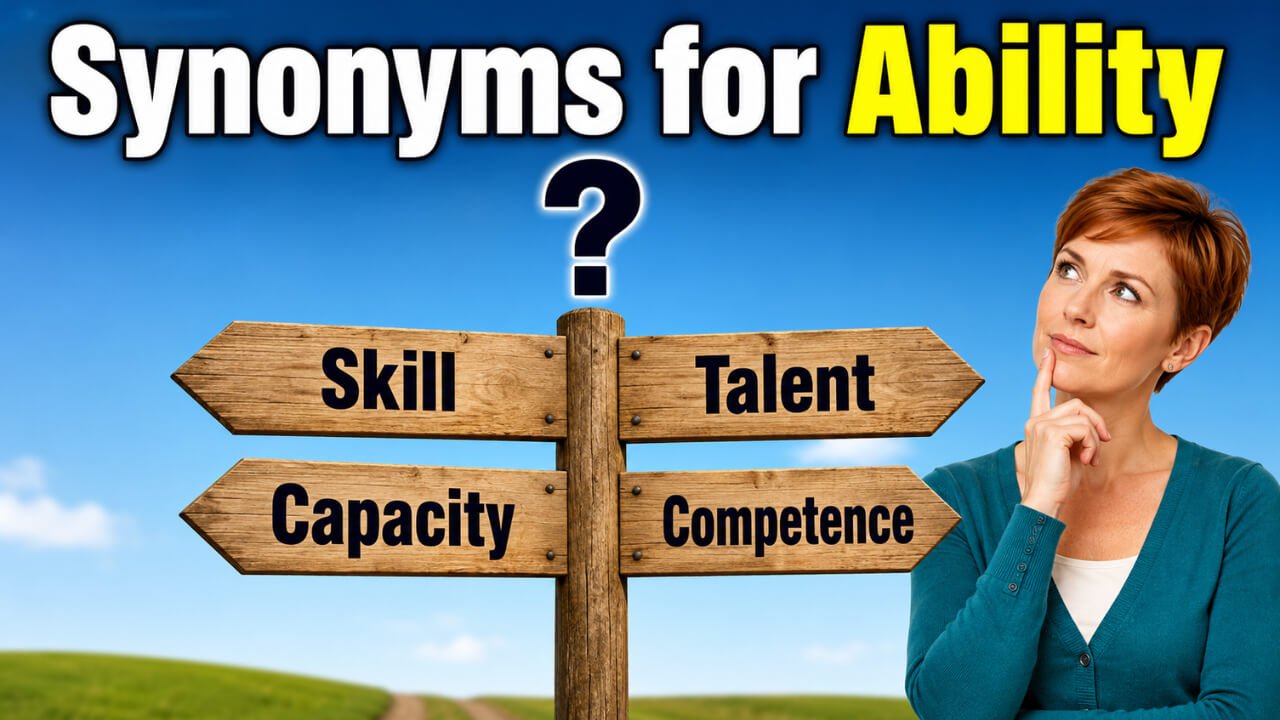
Quick Answer: The best synonyms for ability include capability, capacity, skill, talent, aptitude, competence, proficiency, expertise, power, and potential. Use capability when you mean someone can do something successfully. Use skill for learned practical strength. Use talent for natural ability. Use competence in formal or professional writing. Use capacity when talking about mental, physical, or practical limits.
Pronunciation and Word Details
Word: Ability.
Pronunciation: /əˈbɪləti/
Part of Speech: Noun.
Meaning: Ability means the power, skill, talent, or capacity to do something.
US Pronunciation:
UK Pronunciation:
What Does “Ability” Mean?
Ability means the skill, power, or capacity to do something. It is a noun used to describe what a person, animal, system, or thing can do.
The word can refer to a learned skill, a natural talent, a mental strength, a physical power, or a practical capacity. For example, a person may have the ability to solve problems, speak clearly, lead a team, learn quickly, or complete difficult work.
Ability often appears before an infinitive phrase, such as ability to write, ability to lead, or ability to understand. It can also be used in broader phrases like natural ability, creative ability, physical ability, and technical ability.
Meaning, Tone, and Context of “Ability”
Ability is a neutral and widely used word. It works in formal writing, academic writing, professional communication, everyday speech, and educational contexts.
The tone depends on the sentence. In a report, ability can sound formal and factual. In casual conversation, it can sound simple and direct. In praise, it can sound positive and encouraging. In criticism, it can describe a missing skill or limited capacity.
Ability is commonly used when discussing learning, performance, work, intelligence, sports, creativity, communication, leadership, decision making, and problem solving.
When and How to Use “Ability”
For Skill: Use ability when describing something a person can do well.
Example: Her ability to explain complex ideas makes her a strong teacher.
For Capacity: Use ability when talking about how much someone or something can handle.
Example: The team showed the ability to manage pressure during a difficult project.
For Natural Talent: Use ability when describing a gift that seems natural.
Example: He has a natural ability for music.
For Professional Strength: Use ability when discussing workplace performance.
Example: The manager valued her ability to make careful decisions.
For Mental Power: Use ability when describing thinking, learning, memory, or judgment.
Example: His ability to understand new concepts helped him progress quickly.
For Physical Power: Use ability when discussing movement, strength, fitness, or coordination.
Example: The athlete’s ability to recover quickly impressed the coach.
Best Synonyms for Ability
Capability: The power or quality needed to do something successfully.
Example: She has the capability to handle a leadership role.
Capacity: The amount of mental, physical, or practical power someone has.
Example: He has the capacity to learn several skills at once.
Skill: A learned ability gained through practice and experience.
Example: Writing clearly is a valuable skill.
Talent: A natural ability to do something well.
Example: Her talent for painting was visible from a young age.
Aptitude: A natural or quick ability to learn something.
Example: He showed strong aptitude for mathematics.
Competence: The ability to do something properly and effectively.
Example: The report showed her competence in research.
Proficiency: A high level of skill or ability.
Example: His proficiency in grammar improved his writing.
Expertise: Deep knowledge and strong ability in a subject.
Example: The project needed her expertise in design.
Power: The ability or strength to act, influence, or perform.
Example: Words have the power to change how people feel.
Potential: The ability that may develop or become stronger in the future.
Example: The student has great potential in science.
50 Synonyms for Ability with Short Meanings
- Capability: Power to do something successfully.
- Capacity: Mental, physical, or practical ability to handle something.
- Skill: Learned ability gained through practice.
- Talent: Natural ability to do something well.
- Aptitude: Natural ability to learn or understand quickly.
- Competence: Ability to do something correctly and effectively.
- Competency: Specific ability needed for a task or role.
- Proficiency: Advanced skill or strong practical ability.
- Expertise: High level of knowledge and ability.
- Experience: Ability gained through repeated practice or exposure.
- Know how: Practical knowledge needed to do something.
- Mastery: Complete control or advanced ability in an area.
- Command: Strong control or confident ability.
- Dexterity: Skillful use of the hands or body.
- Agility: Ability to move or think quickly.
- Versatility: Ability to do many different things well.
- Resourcefulness: Ability to solve problems with available options.
- Effectiveness: Ability to produce the desired result.
- Efficiency: Ability to do something well with little waste.
- Power: Strength or ability to act.
- Strength: Strong ability in a particular area.
- Potential: Ability that can develop in the future.
- Faculty: Natural mental or physical ability.
- Gift: Special natural ability.
- Knack: Natural or easy ability to do something.
- Flair: Natural style and ability.
- Prowess: Impressive skill or ability.
- Fitness: Physical ability or suitability for a task.
- Suitability: Ability to fit a purpose or role.
- Qualification: Ability supported by training or credentials.
- Training: Ability developed through instruction and practice.
- Technique: Skilled method used to perform a task.
- Craft: Skilled ability in a practical or creative activity.
- Artistry: Creative ability with beauty or expression.
- Creativity: Ability to produce original ideas.
- Intelligence: Ability to learn, understand, and reason.
- Understanding: Ability to grasp meaning or ideas.
- Insight: Ability to see or understand deeper meaning.
- Judgment: Ability to make wise decisions.
- Acumen: Sharp ability to understand and decide.
- Cleverness: Ability to think quickly and solve problems.
- Giftedness: Natural high ability in a subject or activity.
- Readiness: Prepared ability to act or perform.
- Performance: Actual ability shown through action.
- Facility: Natural ease in doing something.
- Wherewithal: Ability, means, or resources to do something.
- Resources: Practical means or support needed to act.
- Means: Ability or resources needed to achieve something.
- Adroitness: Skillful and quick ability.
- Mettle: Strength, ability, and courage under pressure.
Read Also:
Synonyms for Responsible
Synonyms for Ability by Context
When Ability Means Skill
Use these synonyms when ability refers to learned strength or practical performance.
Skill: She improved her skill through daily practice.
Proficiency: His proficiency in editing made the final draft stronger.
Technique: Better technique helped the singer control her voice.
Mastery: Years of study gave him mastery of the subject.
When Ability Means Natural Talent
Use these synonyms when ability feels natural, instinctive, or gifted.
Talent: Her talent for storytelling made every lesson interesting.
Gift: He has a gift for making people feel calm.
Knack: She has a knack for choosing the right words.
Flair: His flair for design made the room feel elegant.
When Ability Means Capacity
Use these synonyms when ability refers to power, limit, or potential to handle something.
Capacity: The child has a strong capacity for learning languages.
Capability: The machine has the capability to process large files.
Power: The speech had the power to motivate the audience.
Potential: His potential became clear after a few months of training.
When Ability Means Professional Competence
Use these synonyms when ability is about work, responsibility, and performance.
Competence: Her competence made the team trust her decisions.
Expertise: The task required expertise in legal writing.
Qualification: His qualification showed he was ready for the role.
Experience: Experience helped her solve the problem faster.
When Ability Means Mental Strength
Use these synonyms when ability refers to thinking, judgment, learning, or understanding.
Intelligence: Intelligence helped him connect ideas quickly.
Insight: Her insight revealed the real cause of the issue.
Judgment: Good judgment is important in sensitive conversations.
Acumen: His acumen helped him notice risks early.
Another Word for Ability
Another word for ability is capability. It is one of the best single replacements because it works in many contexts and sounds natural in formal and professional writing. However, the best alternative depends on the meaning. Use skill for learned ability, talent for natural strength, competence for reliable performance, and capacity for mental or physical limits.
Original: She has the ability to lead the team.
Better Option: She has the capability to lead the team.
Original: His ability in writing improved quickly.
Better Option: His skill in writing improved quickly.
Original: The student has the ability to become a strong researcher.
Better Option: The student has the potential to become a strong researcher.
Original: The worker showed ability in handling difficult customers.
Better Option: The worker showed competence in handling difficult customers.
When Not to Use “Ability”
Do not use ability when a more exact word would make the sentence clearer. Ability can sound broad if the sentence needs a specific meaning like skill, talent, competence, capacity, or expertise.
Avoid repeating ability too often in the same paragraph. It can make writing sound plain and less polished. Also, avoid using ability when you mean permission. Ability means someone can do something. Permission means someone is allowed to do something.
Weak: She has the ability, ability, and ability to complete the work.
Better: She has the skill, focus, and competence to complete the work.
Weak: He has the ability in medicine.
Better: He has expertise in medicine.
Weak: They gave him the ability to enter the room.
Better: They gave him permission to enter the room.
Weak: The player has good ability.
Better: The player has strong agility, control, and timing.
Words Commonly Confused With Ability
Ability vs Capability: Ability often describes what someone can do now, while capability can describe broader power, potential, or suitability for a task.
Ability vs Capacity: Ability focuses on doing something, while capacity focuses on how much someone or something can handle.
Ability vs Skill: Ability can be natural or learned, while skill is usually developed through practice.
Ability vs Talent: Ability is general, while talent often means natural strength.
Ability vs Competence: Ability can be broad, while competence means doing something properly and reliably.
Ability vs Expertise: Ability may be basic or advanced, while expertise means deep knowledge and advanced skill.
Ability vs Potential: Ability may exist now, while potential means ability that may grow in the future.
Which Synonym Should You Choose?
Choose capability when writing about whether someone or something can complete a task.
Choose skill when talking about learned ability gained through practice.
Choose talent when the ability seems natural or creative.
Choose aptitude when someone learns something quickly or shows natural promise.
Choose competence when describing reliable performance in work, study, or responsibility.
Choose proficiency when describing a strong level of skill in language, writing, tools, or methods.
Choose expertise when the person has advanced knowledge in a field.
Choose capacity when discussing mental power, physical limits, or the amount someone can handle.
Choose potential when the ability is not fully developed yet.
Choose dexterity when talking about skillful hand movement or physical control.
Real Life Examples of “Ability” in Sentences
Original: Her ability to stay calm helped the group.
Better Option: Her composure helped the group.
Original: He has the ability to solve difficult problems.
Better Option: He has the skill to solve difficult problems.
Original: The student has strong ability in science.
Better Option: The student has strong aptitude in science.
Original: Their ability to adapt was impressive.
Better Option: Their versatility was impressive.
Original: She showed ability in managing the project.
Better Option: She showed competence in managing the project.
Original: His ability with numbers is excellent.
Better Option: His proficiency with numbers is excellent.
Original: The child has artistic ability.
Better Option: The child has artistic talent.
Original: The team has the ability to finish on time.
Better Option: The team has the capability to finish on time.
Original: He has the ability to become a leader.
Better Option: He has the potential to become a leader.
Original: Her ability in legal writing is valuable.
Better Option: Her expertise in legal writing is valuable.
Synonym Groups and Usage Differences
Skill Group
This group includes skill, proficiency, technique, mastery, and know how. These words focus on ability gained through learning, training, and repeated practice.
Example: Her skill in editing made the document clearer.
Talent Group
This group includes talent, gift, knack, flair, and giftedness. These words describe ability that feels natural or unusually strong.
Example: He has a gift for explaining difficult ideas simply.
Capacity Group
This group includes capacity, capability, power, potential, and wherewithal. These words focus on what someone or something can handle or achieve.
Example: The organization has the capacity to support more students.
Competence Group
This group includes competence, competency, expertise, qualification, and experience. These words are useful in professional, academic, and practical contexts.
Example: Her competence made the process smooth and dependable.
Mental Ability Group
This group includes intelligence, understanding, insight, judgment, and acumen. These words describe thinking ability, decision making, and mental strength.
Example: His judgment helped the team avoid a costly mistake.
Antonyms of Ability
The opposite of ability depends on the context. If ability means skill, the opposite may be inability or lack of skill. If it means competence, the opposite may be incompetence. If it means capacity, the opposite may be limitation or incapacity.
Inability: Lack of ability to do something.
Incapacity: Lack of physical, mental, or practical capacity.
Incompetence: Lack of skill or effectiveness.
Weakness: Area where someone has less ability.
Limitation: Restriction that reduces ability.
Inefficiency: Poor ability to produce results without waste.
Clumsiness: Lack of physical skill or control.
Ignorance: Lack of knowledge or understanding.
Inexperience: Lack of practice or background.
Unfitness: Lack of suitability for a task or role.
Comparison: Ability vs Related Words
Ability vs Capability
Ability often describes a specific power or skill. Capability can sound broader and may include resources, readiness, and potential.
Example With Ability: She has the ability to write clearly.
Example With Capability: The team has the capability to complete the project.
Ability vs Skill
Ability can be natural or learned. Skill usually comes from practice, training, and repeated use.
Example With Ability: He has the ability to speak confidently.
Example With Skill: He developed strong speaking skills through practice.
Ability vs Talent
Ability is a general word. Talent usually describes natural strength, especially in creative, mental, or physical areas.
Example With Ability: She has the ability to sing well.
Example With Talent: She has a natural talent for singing.
Ability vs Capacity
Ability focuses on doing something. Capacity focuses on how much someone or something can handle.
Example With Ability: He has the ability to manage people.
Example With Capacity: He has the capacity to manage several tasks at once.
Ability vs Competence
Ability can be broad and simple. Competence means reliable ability to do something correctly.
Example With Ability: She has the ability to prepare reports.
Example With Competence: She showed competence in preparing accurate reports.
Ability vs Expertise
Ability may be basic, general, or advanced. Expertise means deep knowledge and strong specialized ability.
Example With Ability: He has ability in teaching.
Example With Expertise: He has expertise in teaching language skills.
Common Phrases and Expressions With Ability
Natural Ability: Skill or strength that appears without much training.
Learning Ability: Power to understand and absorb new information.
Physical Ability: Strength, movement, or fitness needed for an action.
Mental Ability: Power to think, reason, remember, or understand.
Creative Ability: Skill in producing original ideas or artistic work.
Technical Ability: Skill in using tools, systems, or specialized methods.
Leadership Ability: Skill in guiding, organizing, and motivating others.
Communication Ability: Skill in sharing ideas clearly and effectively.
Problem Solving Ability: Skill in finding answers or solutions.
Ability Level: The degree of skill or capacity someone has.
Common Mistakes to Avoid
One common mistake is using ability too often when a more precise synonym would be better. For example, use skill for learned practice, talent for natural strength, capacity for limits, and expertise for advanced knowledge.
Another mistake is confusing ability with permission. Ability means someone can do something. Permission means someone is allowed to do it.
Writers also sometimes use weak phrases like good ability or nice ability. Stronger phrases include strong skill, natural talent, clear competence, or advanced expertise.
Avoid using ability alone when the reader needs detail. Instead of saying someone has ability, explain what kind of ability they have and how they use it.
Conclusion
Learning synonyms for ability helps you choose clearer and more accurate words in writing and speech. Use skill for learned strength, talent for natural gifts, competence for reliable performance, expertise for advanced knowledge, and capacity for mental or physical limits. The word ability is useful and flexible, but stronger synonyms can make your sentence more specific, polished, and meaningful.
FAQs About Synonyms for Ability
What are the best synonyms for ability?
The best synonyms for ability are capability, skill, talent, capacity, competence, proficiency, expertise, aptitude, power, and potential.
What is another word for ability?
Another word for ability is capability. It works well when you mean the power or quality needed to do something successfully.
What is a formal synonym for ability?
Formal synonyms for ability include capability, competence, proficiency, capacity, and expertise. These words work well in reports, essays, and professional writing.
What is the difference between ability and skill?
Ability is a general word for what someone can do. Skill usually means an ability developed through learning, practice, or training.
What is the difference between ability and talent?
Ability can be natural or learned. Talent usually means a natural gift or strong inborn strength in an area.
What is the opposite of ability?
The opposite of ability can be inability, incapacity, incompetence, weakness, or limitation, depending on the sentence.
Can ability mean potential?
Yes, ability can sometimes suggest potential, especially when talking about what someone may develop. However, potential is better when the ability has not fully grown yet
