
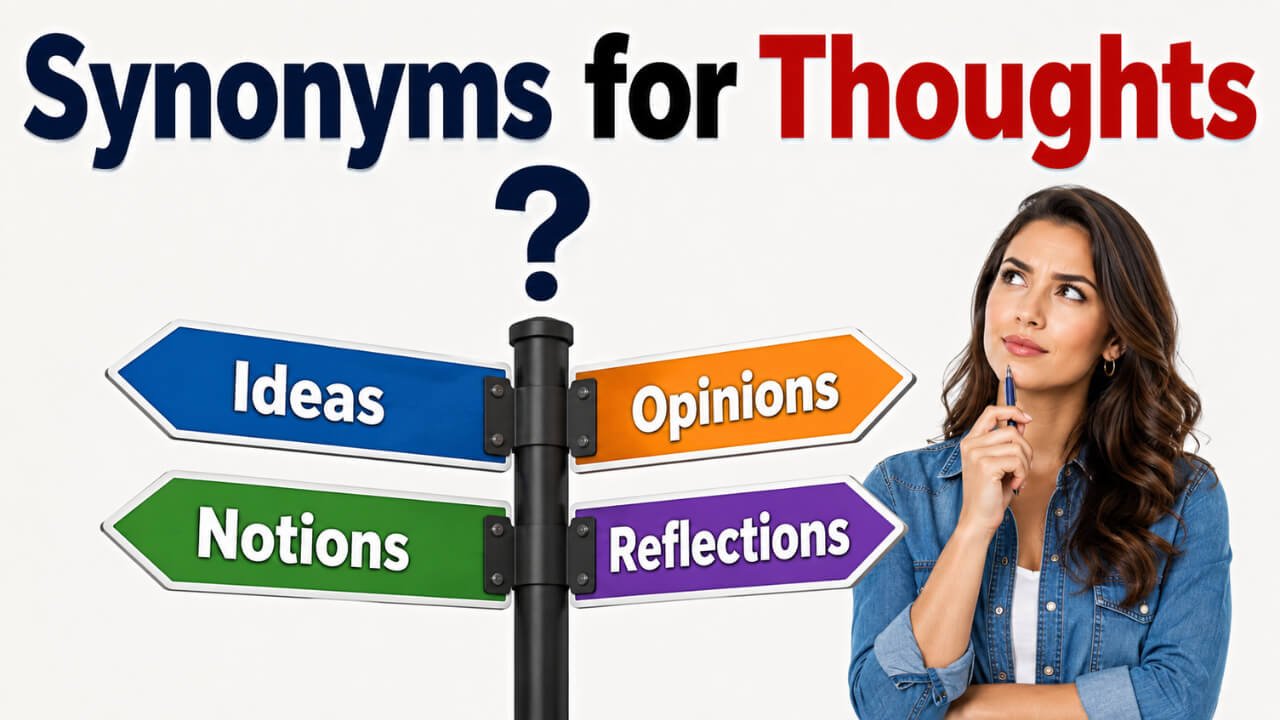
Quick Answer: The best synonyms for thoughts are ideas, opinions, reflections, notions, beliefs, impressions, perceptions, considerations, musings, and viewpoints. Use ideas for general mental concepts, opinions for personal judgments, reflections for careful thinking, and beliefs for ideas someone accepts as true. Perceptions describe how someone understands something, while musings suit creative or informal thinking. Considerations work well in formal writing, and viewpoints are useful when discussing different positions on a subject.
Pronunciation and Word Details
Word: Thoughts
Pronunciation: /θɔːts/
Part of Speech: Plural noun
Meaning: Ideas, opinions, feelings, memories, or mental impressions that exist in a person’s mind.
US Pronunciation:
UK Pronunciation:
What Does “Thoughts” Mean?
Thoughts are ideas, opinions, feelings, memories, or mental images that appear in the mind. The word is the plural form of “thought” and functions mainly as a noun.
A thought may be a quick idea, a carefully formed opinion, a private concern, a memory, or a plan for the future. Its exact meaning depends on the surrounding sentence.
In “She shared her thoughts about the proposal,” the word means opinions. In “His thoughts returned to childhood,” it refers to memories. In “I have some thoughts for the new design,” it means ideas or suggestions.
The word can therefore describe many kinds of mental activity. Choosing a more precise synonym helps readers understand whether you mean ideas, feelings, beliefs, memories, concerns, or reflections.
Meaning, Tone, and Context of “Thoughts”
“Thoughts” is a neutral and widely used word. It appears naturally in casual conversation, professional communication, academic discussion, personal writing, and reflective language.
The tone changes according to context. Asking someone to “share their thoughts” sounds polite and conversational. Referring to “careful thoughts” or “considerations” creates a more formal tone. Describing “private thoughts” or “inner thoughts” can make the language feel personal or emotional.
In academic writing, thoughts may sometimes sound too broad. Words such as arguments, interpretations, observations, findings, and conclusions can communicate a more exact meaning.
In emotional writing, feelings, concerns, hopes, and worries may be more accurate. In discussions about planning, intentions, proposals, or ideas can provide greater clarity.
When and How to Use “Thoughts”
For General Ideas
Use “thoughts” when referring broadly to ideas that have not yet been fully developed.
Example: I have a few thoughts about improving the project.
For Personal Opinions
Use it when asking what someone thinks about a subject, decision, event, or proposal.
Example: What are your thoughts on the new schedule?
For Careful Reflection
The word can describe ideas formed through serious or deliberate thinking.
Example: She recorded her thoughts after reviewing the results.
For Feelings and Reactions
“Thoughts” may refer to a combination of emotional reactions and personal opinions.
Example: He shared his thoughts and feelings about the experience.
For Plans and Suggestions
Use it when presenting possible actions or early recommendations.
Example: The group offered several thoughts on how to solve the problem.
For Memories
The word can refer to memories of people, places, or past experiences.
Example: Her thoughts returned to the summer she spent near the coast.
For Private Mental Activity
Use it when describing ideas that remain unspoken or exist only in someone’s mind.
Example: He kept his thoughts to himself during the discussion.
Best Synonyms for Thoughts
Ideas
Synonym: Mental concepts, suggestions, or possible ways of doing something.
Example: She presented several ideas for improving the lesson.
Opinions
Synonym: Personal judgments or beliefs about a subject.
Example: Everyone expressed their opinions during the meeting.
Reflections
Synonym: Ideas formed through careful and serious consideration.
Example: His reflections revealed how much he had learned.
Notions
Synonym: General ideas or beliefs that may not be fully developed.
Example: She rejected the old notions about leadership.
Beliefs
Synonym: Ideas that someone accepts as true.
Example: Their beliefs influenced the decisions they made.
Impressions
Synonym: Initial ideas or feelings formed about someone or something.
Example: My first impressions of the town were positive.
Perceptions
Synonym: Ways of seeing, understanding, or interpreting something.
Example: Public perceptions changed after the announcement.
Considerations
Synonym: Matters or ideas examined before making a decision.
Example: Cost and safety were important considerations.
Musings
Synonym: Informal, imaginative, or reflective thoughts.
Example: The journal contains her musings about daily life.
Viewpoints
Synonym: Particular positions or ways of thinking about a subject.
Example: The discussion included several different viewpoints.
50 Synonyms for Thoughts with Short Meanings
- Ideas: Mental concepts or possible suggestions.
- Notions: General or partly developed ideas.
- Concepts: Abstract ideas or principles.
- Opinions: Personal judgments about a subject.
- Views: Individual ways of thinking about something.
- Viewpoints: Positions from which a subject is considered.
- Beliefs: Ideas accepted as true.
- Impressions: Initial feelings or understandings.
- Perceptions: Ways of seeing or interpreting something.
- Reflections: Thoughts formed through careful consideration.
- Musings: Quiet, informal, or imaginative thoughts.
- Contemplations: Deep and extended thoughts.
- Meditations: Calm and focused reflections.
- Considerations: Matters examined before a decision.
- Deliberations: Careful discussions or extended thinking.
- Observations: Thoughts based on something noticed.
- Insights: Clear and deep understandings.
- Understandings: Personal interpretations or knowledge.
- Judgments: Opinions formed after consideration.
- Conclusions: Decisions or beliefs reached through reasoning.
- Assumptions: Ideas accepted without complete proof.
- Interpretations: Explanations of meaning or significance.
- Theories: Organized ideas intended to explain something.
- Speculations: Ideas formed without complete evidence.
- Reasoning: Connected thinking used to reach a conclusion.
- Feelings: Emotional reactions or personal responses.
- Sentiments: Attitudes or emotional opinions.
- Reactions: Immediate mental or emotional responses.
- Responses: Thoughts or feelings produced by an experience.
- Attitudes: Established ways of thinking or feeling.
- Concerns: Thoughts involving importance or possible problems.
- Worries: Anxious or troubling thoughts.
- Doubts: Thoughts involving uncertainty.
- Questions: Matters that create uncertainty or curiosity.
- Intentions: Thoughts about what someone plans to do.
- Plans: Organized ideas for future action.
- Aims: Intended goals or purposes.
- Expectations: Beliefs about what will probably happen.
- Hopes: Positive thoughts about desired outcomes.
- Memories: Thoughts connected to past experiences.
- Recollections: Remembered events or experiences.
- Reminiscences: Personal memories of earlier times.
- Images: Mental pictures formed in the mind.
- Visions: Clear mental pictures of possibilities.
- Imaginings: Ideas or images created by imagination.
- Fantasies: Imagined situations that may be unrealistic.
- Inspirations: Ideas that encourage creativity or action.
- Suggestions: Ideas offered for consideration.
- Proposals: Plans or ideas presented formally.
- Mental Notes: Ideas or reminders kept in the mind.
Read Also:
Synonyms for Strengthen

Synonyms for Thoughts by Context
When Thoughts Means Ideas
Use ideas, concepts, notions, suggestions, proposals, or inspirations when “thoughts” refers to possible solutions or creative concepts.
Example With Thoughts: She shared her thoughts for the new layout.
Example With Ideas: She shared her ideas for the new layout.
“Ideas” is usually the strongest general replacement. “Suggestions” works when advice is being offered, while “proposals” suits a more organized or formal plan.
When Thoughts Means Opinions
Use opinions, views, viewpoints, judgments, beliefs, or attitudes when discussing someone’s position on a subject.
Example With Thoughts: What are your thoughts on the decision?
Example With Opinions: What are your opinions on the decision?
“Views” sounds natural in both conversation and professional writing. “Viewpoints” emphasizes different positions, while “judgments” suggests an opinion reached after evaluation.
When Thoughts Means Reflections
Use reflections, contemplations, meditations, considerations, deliberations, or musings when the ideas result from careful thinking.
Example With Thoughts: She wrote down her thoughts about the experience.
Example With Reflections: She wrote down her reflections about the experience.
“Reflections” is appropriate for personal or serious writing. “Contemplations” suggests deeper thinking, while “musings” has a softer and more creative tone.
When Thoughts Means Feelings
Use feelings, sentiments, reactions, responses, concerns, hopes, or worries when emotion is the main focus.
Example With Thoughts: He explained his thoughts after hearing the news.
Example With Reactions: He explained his reactions after hearing the news.
“Feelings” is the clearest choice for emotions. “Sentiments” sounds more formal, while “reactions” describes an immediate response to an event.
When Thoughts Means Plans
Use plans, intentions, aims, proposals, suggestions, or expectations when referring to future actions.
Example With Thoughts: Do you have any thoughts about what to do next?
Example With Plans: Do you have any plans for what to do next?
“Plans” suggests organized action. “Intentions” describes what a person expects to do, while “suggestions” introduces possible actions for others to consider.
When Thoughts Means Memories
Use memories, recollections, reminiscences, images, or impressions when the mind returns to past experiences.
Example With Thoughts: His thoughts returned to his childhood home.
Example With Memories: His memories returned to his childhood home.
“Memories” is the clearest general replacement. “Recollections” suggests specific remembered details, while “reminiscences” often carries a warm or nostalgic tone.
Another Word for Thoughts
“Ideas” is the best broad replacement for “thoughts” in many sentences. However, the most accurate alternative depends on whether the sentence describes opinions, emotions, memories, plans, or careful reflection.
Original: She shared her thoughts about improving the service.
Better Option: She shared her ideas about improving the service.
Original: I would like to hear your thoughts on the proposal.
Better Option: I would like to hear your opinions on the proposal.
Original: His thoughts about the journey appeared in his journal.
Better Option: His reflections about the journey appeared in his journal.
Original: Her thoughts returned to the day they first met.
Better Option: Her memories returned to the day they first met.
When Not to Use “Thoughts”
Avoid using “thoughts” when a more precise word would explain the intended meaning more clearly. Although the word is natural, it can become vague when readers need to know whether you mean facts, opinions, feelings, plans, or conclusions.
When Presenting Research Results
“Thoughts” may sound too personal when describing evidence based findings.
Weak: The report presents the researcher’s thoughts about the results.
Better: The report presents the researcher’s conclusions about the results.
When Describing Emotions
Use “feelings” when the sentence is mainly about an emotional experience.
Weak: She discussed her thoughts after the painful event.
Better: She discussed her feelings after the painful event.
When Giving a Formal Recommendation
Use “recommendations,” “proposals,” or “suggestions” when a specific action is being advised.
Weak: The committee provided its thoughts for improving safety.
Better: The committee provided its recommendations for improving safety.
When Referring to a Firm Position
Use “opinion,” “view,” or “belief” when someone has a clear position.
Weak: His thoughts about education have remained unchanged.
Better: His beliefs about education have remained unchanged.
When the Word Becomes Repetitive
Repeated use can make writing sound vague and monotonous.
Weak: She shared her thoughts, explained her thoughts, and recorded her thoughts.
Better: She shared her ideas, explained her reasoning, and recorded her reflections.
Words Commonly Confused With Thoughts
Thoughts vs Ideas: Thoughts include almost any mental activity, while ideas usually describe concepts, suggestions, or possible solutions.
Thoughts vs Opinions: Thoughts can be uncertain or undeveloped. Opinions are clearer judgments or positions about a subject.
Thoughts vs Feelings: Thoughts occur through mental activity, while feelings are emotional experiences. In everyday speech, the two may overlap.
Thoughts vs Beliefs: Thoughts may be temporary. Beliefs are ideas or principles that a person accepts as true.
Thoughts vs Reflections: Thoughts may appear quickly, while reflections usually result from careful consideration of an experience or subject.
Thoughts vs Perceptions: Thoughts include many types of mental content. Perceptions describe how someone sees, understands, or interprets something.
Thoughts vs Memories: Thoughts can concern the present, past, or future. Memories specifically relate to previous events and experiences.
Thoughts vs Reasoning: Thoughts may be random or emotional. Reasoning follows a connected mental process that leads toward a conclusion.
Which Synonym Should You Choose?
Choose ideas when referring to creative concepts, possible solutions, or general suggestions.
Choose opinions when someone is expressing a personal judgment about a subject.
Choose views or viewpoints when comparing different positions in a discussion.
Choose reflections when describing careful thinking about an experience, decision, or lesson.
Choose considerations when discussing factors that must be examined before making a decision.
Choose beliefs when referring to ideas that someone accepts as true.
Choose perceptions when explaining how a person or group understands something.
Choose feelings when the sentence focuses on an emotional reaction.
Choose concerns or worries when the thoughts involve possible problems or anxiety.
Choose intentions or plans when referring to future actions.
Choose conclusions when writing about findings reached after analysis.
Choose observations when discussing details noticed during research, study, or experience.
Choose musings when the tone is personal, imaginative, relaxed, or creative.
Choose recollections or memories when referring to past events.
Real Life Examples of “Thoughts” in Sentences
Original: She shared her thoughts about the new course.
Better Option: She shared her opinions about the new course.
Original: I have several thoughts for improving the garden.
Better Option: I have several ideas for improving the garden.
Original: His thoughts about the experience became part of the essay.
Better Option: His reflections about the experience became part of the essay.
Original: The group discussed its thoughts on reducing expenses.
Better Option: The group discussed its proposals for reducing expenses.
Original: Her thoughts returned to her first day at school.
Better Option: Her memories returned to her first day at school.
Original: What are your thoughts about the final design?
Better Option: What are your views about the final design?
Original: He could not escape his troubling thoughts.
Better Option: He could not escape his worries.
Original: The report explains the author’s thoughts about the evidence.
Better Option: The report explains the author’s interpretation of the evidence.
Original: She organized her thoughts before speaking.
Better Option: She organized her ideas before speaking.
Original: Their thoughts about the future remained positive.
Better Option: Their expectations about the future remained positive.
Synonym Groups and Usage Differences
Idea Group
Ideas, notions, concepts, suggestions, inspirations, and proposals describe mental content connected to creativity or problem solving.
“Ideas” is the broadest option. “Concepts” often describes abstract principles, while “proposals” refers to organized plans presented for consideration.
Example: The designer presented three ideas for the entrance.
Opinion Group
Opinions, views, viewpoints, judgments, beliefs, and attitudes describe personal positions or ways of thinking.
“Opinions” may change after discussion. “Beliefs” are usually more deeply held, while “attitudes” influence how someone regularly reacts.
Example: The participants expressed different viewpoints on the issue.
Reflection Group
Reflections, contemplations, meditations, considerations, deliberations, and musings describe careful or extended thinking.
“Reflections” often involve learning from an experience. “Deliberations” usually relate to a decision, while “musings” sound more personal and imaginative.
Example: Her reflections showed a deeper understanding of the event.
Understanding Group
Perceptions, impressions, interpretations, insights, observations, and understandings describe how someone recognizes or explains information.
“Impressions” may form quickly. “Insights” suggest deep understanding, while “interpretations” explain what something means.
Example: His observations helped the group identify the problem.
Emotion Group
Feelings, sentiments, reactions, responses, concerns, worries, hopes, and doubts connect mental activity with emotion.
“Feelings” is broad and direct. “Concerns” indicate unease about an issue, while “hopes” express a desire for a positive result.
Example: She openly discussed her concerns about the change.
Planning Group
Intentions, plans, aims, proposals, suggestions, and expectations relate to future action or possible outcomes.
“Intentions” describe what someone means to do. “Plans” include organized steps, while “expectations” describe what someone believes will happen.
Example: They explained their plans for the coming month.
Memory Group
Memories, recollections, reminiscences, images, and impressions describe mental connections to the past.
“Memories” is the most common term. “Recollections” focuses on remembered details, while “reminiscences” often suggests pleasant or emotional remembering.
Example: Her recollections provided valuable details about the event.
Antonyms of Thoughts
“Thoughts” has no single exact antonym because it can describe ideas, opinions, memories, feelings, and plans. Its opposite depends on the meaning used in the sentence.
Action: Physical activity rather than mental consideration.
Fact: Verified information rather than a personal opinion.
Certainty: Complete confidence rather than doubt or speculation.
Reality: What actually exists rather than what is imagined.
Forgetfulness: The inability to remember previous experiences.
Mindlessness: A lack of careful or attentive thinking.
Inattention: Failure to focus the mind on something.
Unawareness: Lack of knowledge or conscious understanding.
Impulsiveness: Acting immediately without careful reflection.
Blankness: A temporary absence of active ideas or mental content.
Comparison Between Thoughts and Related Words
Thoughts vs Ideas
“Thoughts” can include ideas, feelings, memories, opinions, and concerns. “Ideas” usually refers to concepts, suggestions, or possible solutions.
Example With Thoughts: She shared her thoughts about the experience.
Example With Ideas: She shared her ideas for improving the experience.
Thoughts vs Opinions
“Thoughts” may be broad or undeveloped. “Opinions” are personal judgments about a particular subject.
Example With Thoughts: I have a few thoughts about the article.
Example With Opinions: I have strong opinions about the article’s argument.
Thoughts vs Reflections
“Thoughts” may occur quickly or casually. “Reflections” are usually formed through careful consideration.
Example With Thoughts: He recorded his thoughts after the meeting.
Example With Reflections: He recorded his reflections after reviewing the entire project.
Thoughts vs Feelings
“Thoughts” are mental ideas or judgments. “Feelings” are emotional responses, although both may appear together.
Example With Thoughts: Her thoughts focused on finding a solution.
Example With Feelings: Her feelings included disappointment and concern.
Thoughts vs Beliefs
Thoughts can be temporary and uncertain. Beliefs are ideas that someone accepts as true or important.
Example With Thoughts: His thoughts changed after the discussion.
Example With Beliefs: His beliefs guided his major decisions.
Thoughts vs Perceptions
“Thoughts” covers many forms of mental activity. “Perceptions” specifically describes how something is noticed, understood, or interpreted.
Example With Thoughts: Their thoughts about the change were mixed.
Example With Perceptions: Their perceptions of the change depended on their experiences.
Thoughts vs Considerations
“Thoughts” is broad and conversational. “Considerations” refers to specific matters examined before a decision.
Example With Thoughts: We discussed our thoughts about moving.
Example With Considerations: Cost and location were our main considerations before moving.
Common Phrases and Expressions With Thoughts
Share Your Thoughts: Tell others what you think about something.
Final Thoughts: Last ideas or conclusions given at the end of a discussion.
Deep Thoughts: Serious ideas about complex or meaningful subjects.
Inner Thoughts: Private ideas or feelings existing within the mind.
Private Thoughts: Ideas or opinions that are not openly shared.
Second Thoughts: Doubts or changed feelings about an earlier decision.
Thoughts on the Matter: Opinions or views about a particular issue.
Thoughts and Feelings: A person’s mental ideas and emotional reactions.
Collect Your Thoughts: Take time to organize your ideas before speaking or acting.
Put Your Thoughts Into Words: Express mental ideas clearly through speech or writing.
Common Mistakes to Avoid
Using Thoughts When a Precise Word Is Needed
“Thoughts” can be too broad in formal, academic, or technical writing. Replace it with conclusions, findings, observations, interpretations, or recommendations when those words communicate the exact meaning.
Unclear: The study explains the writer’s thoughts.
Clear: The study explains the writer’s conclusions.
Confusing Thoughts With Feelings
A thought is an idea or mental judgment. A feeling is an emotional response. Choose the word that matches the intended meaning.
Thought: I believe the decision was unfair.
Feeling: I feel disappointed about the decision.
Repeating Thoughts Too Often
Using the same word several times can make a paragraph sound weak. Replace repeated uses with ideas, views, reflections, concerns, or observations according to context.
Choosing an Overly Formal Synonym
“Contemplations” and “deliberations” may sound unnatural in simple conversation.
Unnatural: What are your deliberations about the movie?
Natural: What are your thoughts about the movie?
Treating Every Synonym as Interchangeable
Ideas, opinions, feelings, memories, and beliefs do not express exactly the same meaning. Always consider the sentence’s purpose before replacing “thoughts.”
Using the Wrong Preposition
“Thoughts on” and “thoughts about” are both common, but their use may differ slightly.
Use “thoughts on” when asking for an opinion about a defined subject.
Example: What are your thoughts on the proposal?
Use “thoughts about” when referring more generally to ideas, feelings, or reflections.
Example: She recorded her thoughts about living abroad.
Confusing the Singular and Plural Forms
Use “thought” for one idea and “thoughts” for more than one idea or a collection of mental reactions.
Singular: A strange thought entered my mind.
Plural: Several thoughts entered my mind.
Conclusion
Understanding synonyms for thoughts helps you express ideas with greater clarity and precision. Use ideas for general concepts, opinions and viewpoints for personal positions, and reflections for careful thinking. Feelings, worries, and hopes work when emotion is central, while intentions and plans describe future actions. Memories and recollections are better for past experiences. Because “thoughts” has several meanings, the best synonym always depends on what is happening in the sentence and what you want the reader to understand.
FAQs About Synonyms for Thoughts
What Is the Best Synonym for Thoughts?
“Ideas” is the best general synonym. However, opinions, reflections, feelings, beliefs, plans, and memories may be more accurate in specific contexts.
Are Thoughts and Ideas the Same?
Not completely. Ideas are one type of thought, usually connected to concepts, creativity, suggestions, or possible solutions.
Can Opinions Replace Thoughts?
Yes, when “thoughts” refers to personal judgments or views about a subject. Opinions cannot replace thoughts when the meaning involves memories, feelings, or plans.
What Is a Formal Synonym for Thoughts?
“Reflections,” “considerations,” “observations,” and “interpretations” are useful formal alternatives. The correct choice depends on the sentence.
What Is Another Word for Deep Thoughts?
“Contemplations,” “reflections,” “meditations,” and “musings” can describe deep thoughts. Reflections is the most versatile option.
What Is a Synonym for Personal Thoughts?
“Views,” “opinions,” “beliefs,” “feelings,” “reflections,” and “private ideas” can describe personal thoughts.
What Is the Opposite of Thoughts?
There is no single exact opposite. Depending on context, possible antonyms include action, mindlessness, inattention, fact, reality, certainty, or forgetfulness.
