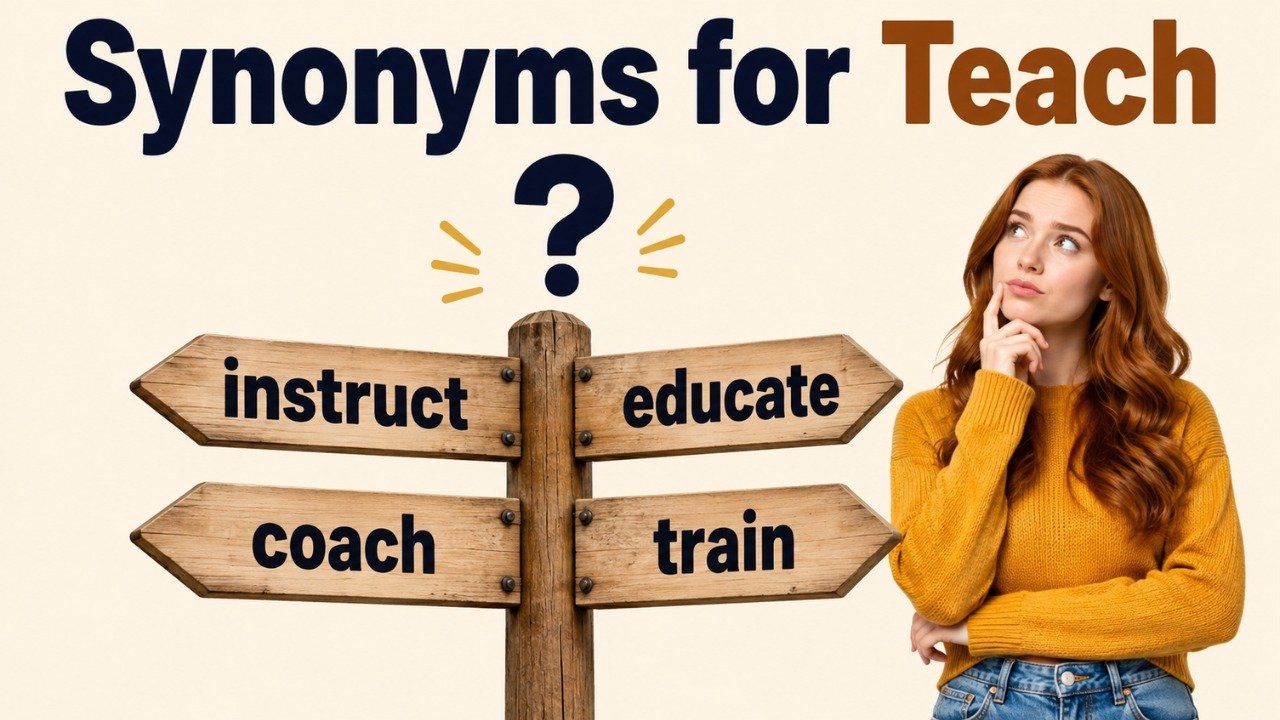
Quick Answer: Common synonyms for teach include educate, instruct, train, coach, tutor, guide, mentor, explain, demonstrate, and enlighten. Use educate for developing general knowledge, instruct for giving clear directions, train for building practical skills, coach for improving performance, and tutor for personalized academic help. Explain and demonstrate work well when showing how something functions, while guide and mentor are better for long term personal or professional development.
Pronunciation and Word Details
Word: Teach
Pronunciation: /tiːtʃ/
Part of Speech: Verb
Meaning: To help someone gain knowledge, understand an idea, or develop a skill.
US Pronunciation:
UK Pronunciation:
What Does “Teach” Mean?
Teach means to help another person learn knowledge, ideas, behavior, or practical skills. It is a verb used for formal education, personal guidance, professional training, explanations, and life lessons.
A teacher may teach mathematics in a classroom. A parent may teach a child good manners. A coach may teach athletes how to improve their performance. An experience can also teach someone an important lesson.
The past tense and past participle of teach are taught.
Present: They teach science at the local school.
Past: She taught me how to prepare the recipe.
Knowledge: The course teaches basic grammar.
Skill: He taught his daughter how to swim.
Behavior: Parents teach children to respect others.
Lesson: The experience taught us to prepare carefully.
Meaning, Tone, and Context of “Teach”
Teach is a neutral and widely used word. It works naturally in casual conversation, academic writing, professional communication, instructions, reports, and educational content.
The tone changes according to the context. In a classroom, teach usually means providing organized education. In a workplace, it may mean training someone to complete a task. In personal development, it can mean guiding someone through experience or advice.
Academic Context: Teach refers to helping students understand subjects such as language, science, history, or mathematics.
Practical Context: Teach can mean showing someone how to perform a physical or technical skill.
Professional Context: Employers teach procedures, systems, safety rules, and workplace responsibilities.
Personal Context: Parents, relatives, and mentors teach values, habits, and life skills.
Figurative Context: Experiences, failures, and challenges can teach lessons without involving a formal instructor.
Emotional Context: Teach may describe helping someone understand patience, kindness, confidence, or responsibility.
When and How to Use “Teach”
For Academic Knowledge
Use teach when someone helps students understand an academic subject.
Example: She teaches English grammar to adult learners.
For Practical Skills
Teach can describe helping someone learn how to perform an activity.
Example: My brother taught me how to drive safely.
For Professional Training
Use teach when explaining workplace procedures, equipment, or responsibilities.
Example: The supervisor taught the new employees how to operate the system.
For Rules and Values
Parents, caregivers, and leaders can teach manners, values, responsibility, and respectful behavior.
Example: The program teaches children the importance of honesty.
For Clear Explanations
Teach can mean making an unfamiliar idea understandable.
Example: This lesson teaches readers how sentence structure works.
For Lessons From Experience
An event or mistake can teach someone something valuable.
Example: That difficult project taught us the value of planning.
For Personal Development
Use teach when a mentor or guide helps someone grow personally or professionally.
Example: Her mentor taught her how to communicate with confidence.
Best Synonyms for Teach
Educate: To develop someone’s knowledge and understanding through learning.
Example: The program educates families about healthy eating habits.
Instruct: To give clear information or directions about a subject or task.
Example: The trainer instructed the employees in emergency procedures.
Train: To develop practical abilities through instruction and repeated practice.
Example: The company trains staff to handle customer concerns.
Coach: To help someone improve a skill, performance, or ability.
Example: She coaches young writers who want to improve their storytelling.
Tutor: To provide individual or small group academic instruction.
Example: He tutors students who need help with mathematics.
Guide: To lead someone through a learning process with advice and direction.
Example: The instructor guided us through every stage of the experiment.
Mentor: To support someone’s long term personal or professional development.
Example: Senior employees mentor new members of the team.
Explain: To make an idea, process, or subject easier to understand.
Example: The teacher explained the grammar rule clearly.
Demonstrate: To teach by showing how something is done.
Example: The chef demonstrated the correct cutting technique.
Enlighten: To give someone useful knowledge or deeper understanding.
Example: The discussion enlightened students about the effects of pollution.
50 Synonyms for Teach with Short Meanings
- Educate: To develop knowledge and understanding.
- Instruct: To provide clear directions or lessons.
- Train: To develop skills through practice.
- Coach: To improve someone’s ability or performance.
- Tutor: To provide personalized academic instruction.
- Guide: To lead someone through learning.
- Mentor: To support long term growth and development.
- School: To educate or train someone systematically.
- Lecture: To deliver a formal educational talk.
- Explain: To make something easier to understand.
- Demonstrate: To show how something is performed.
- Show: To help someone learn through an example.
- Illustrate: To explain with examples or visual details.
- Inform: To provide facts or useful information.
- Enlighten: To give deeper knowledge or understanding.
- Impart: To communicate knowledge, wisdom, or skills.
- Instill: To gradually develop an idea or quality.
- Inculcate: To teach a belief or habit through repetition.
- Drill: To teach through repeated exercises.
- Prepare: To make someone ready for a task or situation.
- Equip: To provide the knowledge or skills someone needs.
- Orient: To introduce someone to a new environment or system.
- Brief: To give essential instructions or information.
- Advise: To offer useful recommendations or guidance.
- Counsel: To guide someone through thoughtful advice.
- Discipline: To teach controlled and responsible behavior.
- Condition: To train someone to respond in a particular way.
- Edify: To improve someone through moral or intellectual instruction.
- Familiarize: To help someone become knowledgeable about something.
- Acquaint: To introduce someone to facts or information.
- Develop: To help knowledge, talent, or ability grow.
- Cultivate: To encourage the growth of a skill or quality.
- Nurture: To support gradual learning and development.
- Lead: To direct someone through an activity or process.
- Direct: To give instructions about what should be done.
- Supervise: To guide and observe someone’s work.
- Facilitate: To make learning easier and more effective.
- Model: To teach by presenting behavior worth copying.
- Clarify: To make a confusing idea clearer.
- Elucidate: To explain a difficult subject in detail.
- Expound: To explain an idea thoroughly.
- Interpret: To explain the meaning of information or ideas.
- Communicate: To share knowledge or understanding.
- Convey: To express information, ideas, or lessons.
- Transmit: To pass knowledge from one person to another.
- Introduce: To present a subject for the first time.
- Initiate: To give someone their first instruction or experience.
- Ground: To provide a strong foundation in a subject.
- Correct: To identify mistakes and teach the right form.
- Enable: To give someone the knowledge or ability to act.
Read Also:
Synonyms for Trapped

Synonyms for Teach by Context
When Teach Means Educate Academically
Educate, instruct, tutor, school, lecture, ground, and enlighten work well when teaching academic knowledge.
Educate is broad and may describe the complete learning process. Instruct focuses on organized lessons. Tutor usually describes personalized help. Ground means giving someone a strong foundation in a subject.
Example: The course educates students about environmental science.
Example: Her tutor instructed her in advanced mathematics.
Example: The introductory classes grounded students in basic grammar.
When Teach Means Develop a Practical Skill
Train, coach, demonstrate, show, drill, prepare, and equip are useful when someone learns how to perform an activity.
Train emphasizes structured practice. Coach focuses on improving performance. Demonstrate means showing the correct method. Drill involves repeating an activity until it becomes familiar.
Example: The instructor trained the group in first aid.
Example: The manager demonstrated how to use the equipment.
Example: Regular exercises prepared the team for the competition.
When Teach Means Explain an Idea
Explain, clarify, illustrate, elucidate, expound, interpret, and inform describe making information understandable.
Explain is the most common option. Clarify removes confusion. Illustrate uses examples or images. Elucidate and expound are more formal and detailed.
Example: The diagram illustrates how the process works.
Example: The professor elucidated a difficult scientific concept.
Example: The speaker expounded the main principles of the theory.
When Teach Means Guide Someone
Guide, mentor, advise, counsel, lead, direct, supervise, and nurture describe learning through personal support.
Guide is broad and practical. Mentor suggests continued development. Counsel involves thoughtful advice. Nurture emphasizes patience and gradual growth.
Example: An experienced colleague guided her through the first project.
Example: The director mentored several new employees.
Example: Supportive feedback nurtured his confidence.
When Teach Means Develop Values or Habits
Instill, inculcate, discipline, condition, cultivate, model, and edify relate to teaching behavior, beliefs, habits, or personal qualities.
Instill means gradually developing a quality. Inculcate often involves repetition. Model means teaching through personal behavior. Discipline focuses on control and responsibility.
Example: Parents can instill kindness through everyday actions.
Example: The program cultivates responsibility and patience.
Example: Leaders should model the behavior they expect from others.
When Teach Means Provide Information
Inform, brief, acquaint, familiarize, communicate, convey, and transmit are useful when the goal is sharing facts or instructions.
Inform is direct and neutral. Brief means giving essential information. Familiarize helps someone become comfortable with a subject or system.
Example: The guide informed visitors about the safety rules.
Example: The supervisor briefed the team before the event.
Example: The orientation familiarized employees with workplace procedures.
Another Word for Teach
Educate is the best broad replacement for teach when discussing knowledge, understanding, or formal learning. However, the most suitable alternative depends on the type of learning involved.
Use instruct for clear directions, train for practical abilities, coach for performance improvement, tutor for academic support, demonstrate for visible methods, and mentor for continued guidance.
Original: The program teaches students about financial planning.
Better Option: The program educates students about financial planning.
Original: She teaches new employees how to use the equipment.
Better Option: She trains new employees to use the equipment.
Original: He teaches young athletes to improve their technique.
Better Option: He coaches young athletes to improve their technique.
Original: The chef taught us how to prepare the meal.
Better Option: The chef demonstrated how to prepare the meal.
When Not to Use “Teach”
Teach may sound too general when a more exact verb can explain how the learning happens. Choose a more specific synonym when your sentence involves formal education, repeated practice, personal guidance, explanation, or demonstration.
Weak: The manager taught the employees about the new software.
Better: The manager trained the employees to use the new software.
The word may also sound inaccurate when someone only provides information without ensuring that learning occurs.
Weak: The notice taught residents about the new rule.
Better: The notice informed residents about the new rule.
Avoid teach when demonstrate better describes learning through observation.
Weak: The instructor taught the correct hand movement.
Better: The instructor demonstrated the correct hand movement.
Do not use teach when advise is the intended meaning.
Weak: She taught me to speak with the manager.
Better: She advised me to speak with the manager.
Avoid unnecessary repetition in educational writing.
Weak: Teachers teach students by teaching lessons that teach important skills.
Better: Educators help students develop important skills through carefully planned lessons.
Teach can also sound too direct when describing mutual or independent learning.
Weak: The discussion taught every participant the answer.
Better: The discussion helped participants discover the answer.
Words Commonly Confused With Teach
Teach vs Learn: Teach means helping someone gain knowledge. Learn means receiving, developing, or discovering knowledge.
Example: She teaches French, and her students learn new vocabulary.
Teach vs Educate: Teach may refer to one lesson or skill. Educate usually suggests a broader and longer process of intellectual development.
Example: The lesson teaches spelling, while the complete course educates students in written communication.
Teach vs Instruct: Teach is a general word for helping someone learn. Instruct emphasizes organized lessons or direct commands.
Example: He teaches science but instructed the class to wear protective glasses.
Teach vs Train: Teach often relates to knowledge and understanding. Train usually focuses on practical ability developed through practice.
Example: The course teaches safety principles and trains workers to respond to emergencies.
Teach vs Coach: Teach introduces knowledge or methods. Coach helps someone improve an existing skill or performance.
Example: She teaches the basic rules and coaches the team during practice.
Teach vs Tutor: Teach can describe instruction for any group size. Tutor usually involves individual or small group academic support.
Example: He teaches a large class and tutors two students after school.
Teach vs Explain: Teach covers the complete learning process. Explain focuses on making one idea understandable.
Example: She teaches biology and explains difficult concepts with diagrams.
Teach vs Mentor: Teach may involve specific knowledge or lessons. Mentor describes continued support for personal or professional growth.
Example: He taught her how to complete the task and mentored her throughout her career.
Which Synonym Should You Choose?
Choose educate when discussing broad knowledge, intellectual growth, or formal learning.
Choose instruct when giving organized lessons, directions, rules, or procedures.
Choose train when helping someone develop a practical or professional skill through practice.
Choose coach when improving performance in sports, writing, speaking, leadership, or another ability.
Choose tutor when providing personalized help with an academic subject.
Choose explain when making an idea, rule, or process understandable.
Choose demonstrate when teaching by physically showing how something is done.
Choose guide when leading someone through a process with advice and support.
Choose mentor when describing long term personal or professional development.
Choose inform when sharing facts without providing a complete lesson.
Choose instill when gradually developing a value, attitude, habit, or quality.
Choose clarify when removing confusion from an explanation.
Choose facilitate when helping learners participate, discuss, and discover answers.
Choose ground when providing essential introductory knowledge.
Choose brief when giving necessary information before a task, meeting, or event.
Real Life Examples of “Teach” in Sentences
Original: She teaches children how to read.
Better Option: She educates children in basic reading skills.
Original: The instructor taught us how to use the machine.
Better Option: The instructor trained us to use the machine.
Original: My uncle taught me how to repair the bicycle.
Better Option: My uncle showed me how to repair the bicycle.
Original: The teacher taught the rule with several examples.
Better Option: The teacher explained the rule with several examples.
Original: The coach teaches players how to improve their balance.
Better Option: The coach trains players to improve their balance.
Original: Her manager taught her how to handle difficult conversations.
Better Option: Her manager guided her through difficult conversations.
Original: The workshop teaches participants how the system operates.
Better Option: The workshop demonstrates how the system operates.
Original: His parents taught him to treat people respectfully.
Better Option: His parents instilled respect for others in him.
Original: That failure taught us to check every detail.
Better Option: That failure showed us the importance of checking every detail.
Original: Experienced employees teach new workers during their first month.
Better Option: Experienced employees mentor new workers during their first month.
Synonym Groups and Usage Differences
Education Group
Educate, instruct, tutor, school, lecture, ground, and enlighten relate to organized learning and academic knowledge.
Educate is the broadest option. Instruct suggests structured lessons. Tutor refers to personalized assistance. Lecture describes teaching through a formal talk.
Example: The course educates students through lectures, discussions, and practical exercises.
Training Group
Train, coach, drill, demonstrate, prepare, equip, and condition focus on practical ability and performance.
Train develops ability through practice. Coach improves performance. Drill uses repetition. Equip gives someone the knowledge and resources needed to succeed.
Example: The program equips new employees with practical communication skills.
Explanation Group
Explain, clarify, illustrate, elucidate, expound, and interpret make ideas easier to understand.
Explain is natural in most situations. Clarify removes uncertainty. Illustrate supports an explanation with examples. Elucidate and expound suit formal or academic writing.
Example: The instructor illustrated the concept with a familiar situation.
Guidance Group
Guide, mentor, advise, counsel, lead, direct, supervise, and nurture involve support and direction.
Guide works for general assistance. Mentor suggests an ongoing relationship. Counsel emphasizes careful advice. Supervise includes observing progress and correcting mistakes.
Example: The experienced designer mentored new team members throughout the project.
Values and Behavior Group
Instill, inculcate, discipline, cultivate, model, and edify describe teaching beliefs, habits, values, and behavior.
Instill suggests gradual development. Inculcate involves repeated teaching. Model means setting an example through actions. Cultivate encourages a quality to grow.
Example: Good leaders model honesty and cultivate mutual respect.
Information Group
Inform, acquaint, familiarize, brief, communicate, convey, and transmit focus on sharing knowledge or facts.
Inform is direct and general. Acquaint and familiarize introduce someone to a subject. Brief provides essential information quickly. Convey focuses on expressing meaning successfully.
Example: The handbook familiarizes new employees with company procedures.
Antonyms of Teach
The opposite of teach depends on whether the word refers to sharing knowledge, developing skills, giving guidance, or correcting misunderstandings.
Misinform: To provide incorrect or misleading information.
Mislead: To cause someone to believe something untrue.
Confuse: To make a subject difficult to understand.
Obscure: To make meaning unclear or hidden.
Conceal: To keep knowledge or information secret.
Withhold: To refuse to provide information or instruction.
Ignore: To give no attention or guidance.
Neglect: To fail to provide necessary support or education.
Discourage: To reduce someone’s confidence or desire to learn.
Prevent: To stop learning or development from happening.
Unlearn: To stop using knowledge, behavior, or habits previously acquired.
Forget: To lose knowledge from memory.
Misguide: To give someone incorrect advice or direction.
Distract: To take attention away from learning.
Mystify: To make something more confusing or difficult to understand.
Comparison: Teach vs Related Words
Teach vs Educate
Teach can describe one subject, lesson, rule, or skill. Educate usually describes a broader process of developing knowledge, judgment, and understanding.
Example With Teach: She teaches students how to write clear sentences.
Example With Educate: The program educates students about language and communication.
Teach vs Instruct
Teach focuses on helping someone learn. Instruct often emphasizes formal lessons, detailed directions, or commands.
Example With Teach: He teaches music to beginners.
Example With Instruct: He instructed the beginners to hold their instruments correctly.
Teach vs Train
Teach may involve knowledge, ideas, or principles. Train focuses on repeated practice that develops practical ability.
Example With Teach: The course teaches workplace safety.
Example With Train: The course trains employees to respond to emergencies.
Teach vs Coach
Teach introduces or develops knowledge. Coach helps someone improve performance through feedback, encouragement, and practice.
Example With Teach: She teaches the basic rules of tennis.
Example With Coach: She coaches players who compete professionally.
Teach vs Tutor
Teach can involve one learner or a large group. Tutor usually refers to personalized academic support.
Example With Teach: He teaches mathematics to a class of students.
Example With Tutor: He tutors a student who needs additional help with algebra.
Teach vs Guide
Teach focuses directly on learning. Guide emphasizes leading someone through a process or decision.
Example With Teach: The lesson teaches students how to research a topic.
Example With Guide: The checklist guides students through the research process.
Teach vs Explain
Teach is a complete learning activity. Explain is one method used to make an idea understandable.
Example With Teach: She teaches grammar to new learners.
Example With Explain: She explains each grammar rule with simple examples.
Teach vs Demonstrate
Teach may involve speaking, reading, practice, or discussion. Demonstrate specifically means showing how something is done.
Example With Teach: The chef teaches basic cooking techniques.
Example With Demonstrate: The chef demonstrates how to prepare the sauce.
Teach vs Mentor
Teach often focuses on particular knowledge or skills. Mentor involves continued guidance, encouragement, and development.
Example With Teach: He taught her how to prepare the report.
Example With Mentor: He mentored her as she developed her professional career.
Common Phrases and Expressions With “Teach”
Teach a Lesson: To help someone understand an important principle or consequence.
Teach a Class: To provide lessons to a group of students.
Teach a Subject: To educate learners in a particular area of knowledge.
Teach by Example: To influence learning through personal behavior.
Teach Someone How: To show or explain the method for completing a task.
Teach the Basics: To provide essential introductory knowledge.
Teach New Skills: To help someone develop new abilities.
Teach Good Habits: To encourage useful and responsible behavior.
Teach Right From Wrong: To help someone understand acceptable and unacceptable behavior.
Teach Yourself: To learn independently without a formal instructor.
Common Mistakes to Avoid
A common mistake is using teach and learn as though they have the same meaning. A person teaches information to someone else, while a learner gains or develops that knowledge.
Incorrect: She learned me how to use the program.
Correct: She taught me how to use the program.
Correct: I learned how to use the program from her.
Another mistake is using the wrong past tense. The past tense of teach is taught, not teached.
Incorrect: He teached us how to solve the problem.
Correct: He taught us how to solve the problem.
Avoid using teach when inform is more accurate. Giving someone a single fact does not always involve teaching.
Unclear: The message taught us that the meeting had changed.
Better: The message informed us that the meeting had changed.
Do not use train when the learning is mainly academic or theoretical unless practical practice is involved.
Unnatural: The professor trained students about ancient history.
Better: The professor taught students about ancient history.
Avoid repeating teach too many times in one paragraph. Use educate, explain, demonstrate, guide, train, or mentor when those words better match the context.
Repetitive: She teaches employees by teaching procedures and teaching practical skills.
Improved: She instructs employees in workplace procedures and trains them in practical skills.
Be careful with instruct. It can mean either teaching or giving a direct command. The surrounding sentence should make the intended meaning clear.
Choose synonyms according to the learning method. Use demonstrate for visible actions, explain for difficult ideas, coach for performance, tutor for personalized academic help, and mentor for continued development.
Conclusion
Understanding synonyms for teach helps you describe different learning methods more accurately. Educate works well for broad knowledge, instruct for organized lessons, train for practical abilities, and coach for performance improvement. Use tutor for personalized academic support, explain for clear understanding, demonstrate for visible methods, and mentor for long term guidance. The best alternative depends on what is being learned, how the knowledge is shared, and whether the context involves education, training, advice, behavior, or experience.
FAQs About Synonyms for Teach
What Is the Best Synonym for Teach?
Educate is the strongest general synonym for teach. Instruct, train, coach, tutor, explain, and guide may be more accurate in specific contexts.
What Is Another Word for Teaching Students?
Educating, instructing, tutoring, guiding, and schooling are suitable alternatives. The best choice depends on the subject and teaching method.
What Is a Formal Synonym for Teach?
Educate, instruct, impart, elucidate, inculcate, and edify are formal alternatives. Educate and instruct are the most widely useful choices.
Is Train a Synonym for Teach?
Yes. Train is a synonym when teaching involves practical skills, repeated exercises, workplace procedures, or performance development.
What Is the Difference Between Teach and Learn?
Teach means helping another person gain knowledge or skills. Learn means gaining that knowledge or developing those skills.
What Word Means to Teach by Showing?
Demonstrate is the best word for teaching through a visible example. Show, illustrate, and model are also useful alternatives.
What Is the Past Tense of Teach?
The past tense and past participle of teach are taught. Teached is not a correct standard form.
