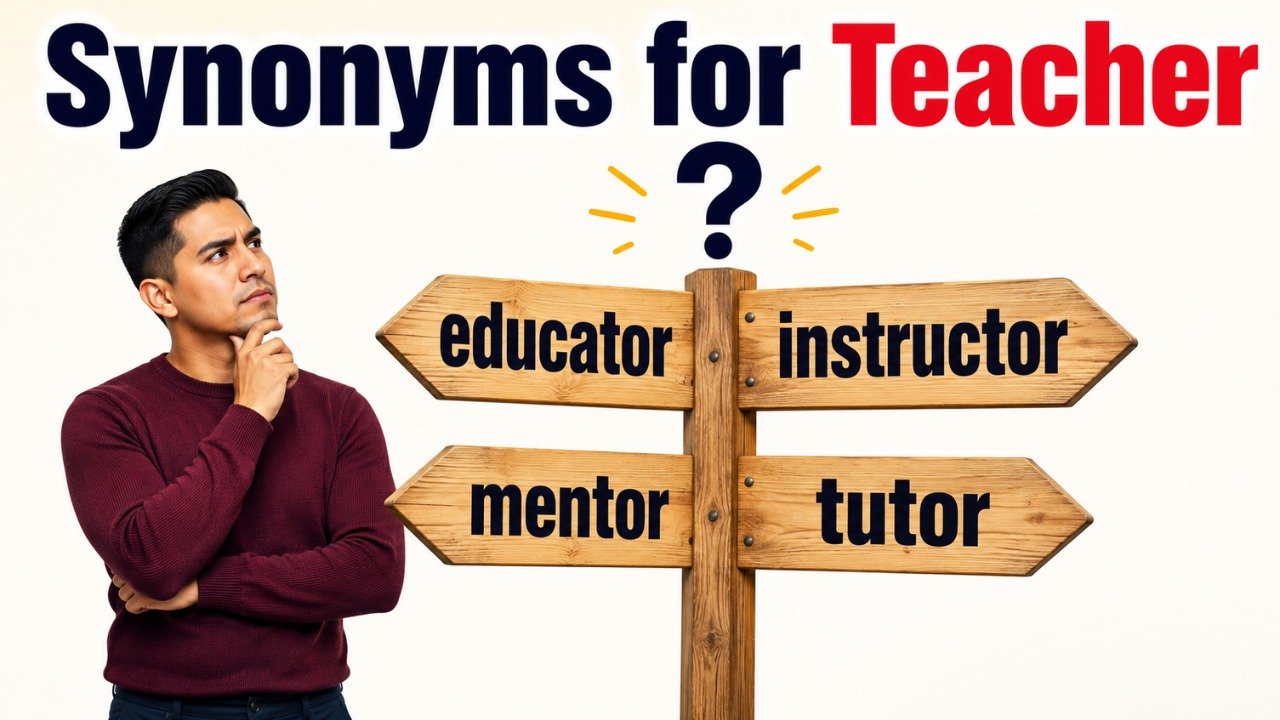
Quick Answer: The best synonyms for teacher include educator, instructor, tutor, mentor, professor, lecturer, trainer, coach, guide, and facilitator. Use educator as a broad and professional term, instructor for practical or technical teaching, tutor for individual support, professor for higher education, and mentor for personal or professional guidance. Trainer works best for workplace skills, while coach suits performance improvement, sports, or focused development.
Pronunciation and Word Details
Word: Teacher
Pronunciation: /ˈtiːtʃər/
Part of Speech: Noun
Meaning: A person who helps others gain knowledge, skills, understanding, or experience.
US Pronunciation:
UK Pronunciation:
What Does “Teacher” Mean?
Teacher means a person who educates, instructs, explains, or helps others learn. It is a countable noun formed from the verb teach.
A teacher may work in a school, college, training center, private setting, workshop, or professional environment. The word can describe someone who teaches academic subjects, practical skills, creative activities, physical techniques, or personal values.
Teacher can also be used figuratively. A difficult experience, mistake, journey, or challenge may be called a teacher because it provides an important lesson.
The word usually refers to a person, but its exact meaning changes according to the subject, setting, teaching method, and relationship with learners.
Meaning, Tone, and Context of “Teacher”
Teacher has a neutral, respectful, and widely understood tone. It is suitable for formal writing, everyday conversation, school communication, academic discussions, and professional descriptions.
In educational contexts, teacher usually refers to someone who works with students in a classroom. Educator is broader and may include teachers, researchers, curriculum planners, trainers, and educational leaders.
Instructor often sounds practical or technical. It is commonly used for driving, fitness, safety, language, or workplace training. Tutor usually describes someone who gives individual or small group instruction.
Professor and lecturer are associated with colleges and universities. Mentor and guide focus more on advice, development, encouragement, and experience than formal classroom instruction.
Teacher can also carry a warm and emotional tone when it describes someone who inspires confidence, curiosity, discipline, or personal growth.
When and How to Use “Teacher”
For School Education: Use teacher for a person who teaches children or teenagers in a school.
Example: The science teacher explained the experiment clearly.
For Academic Subjects: Use teacher when someone provides lessons in mathematics, history, language, art, or another subject.
Example: Her English teacher helped her improve her writing.
For Practical Skills: Teacher can describe someone who shows learners how to perform a task or develop a skill.
Example: The pottery teacher demonstrated how to shape the clay.
For Personal Guidance: Use teacher for someone whose advice, character, or experience helps another person grow.
Example: His grandfather was his first teacher in life.
For Private Instruction: Use teacher when someone provides lessons outside a traditional classroom.
Example: They hired a music teacher for weekly piano lessons.
For Professional Training: Teacher may be used broadly, although instructor or trainer is often more precise.
Example: The workplace teacher introduced the new safety procedures.
For Figurative Lessons: Use teacher when an experience provides knowledge or wisdom.
Example: Failure can be a powerful teacher when people learn from it.
For Respectful Reference: Teacher can be used when speaking generally about the teaching profession.
Example: A dedicated teacher can influence students for many years.
Best Synonyms for Teacher
Educator: A professional who teaches or supports learning and educational development.
Example: The educator designed activities that encouraged critical thinking.
Instructor: A person who teaches a subject, technique, or practical skill.
Example: The driving instructor explained how to park safely.
Tutor: A person who provides individual or small group teaching.
Example: The tutor helped the student understand difficult equations.
Mentor: An experienced person who offers advice, support, and guidance.
Example: Her mentor encouraged her to apply for the leadership position.
Professor: A senior teacher or academic at a college or university.
Example: The professor delivered a lecture on modern literature.
Lecturer: A person who teaches through lectures, usually in higher education.
Example: The lecturer answered questions after the presentation.
Trainer: A person who teaches practical, professional, or workplace skills.
Example: The trainer showed employees how to use the new system.
Coach: A person who helps someone improve performance, ability, or confidence.
Example: The writing coach helped him organize his ideas.
Guide: A person who directs, advises, or helps others understand something.
Example: She became a trusted guide for new students.
Facilitator: A person who supports learning, discussion, or group participation.
Example: The facilitator encouraged everyone to share an opinion.
50 Synonyms for Teacher with Short Meanings
- Educator: A professional who supports teaching and learning.
- Instructor: A person who teaches a subject or practical skill.
- Tutor: Someone who provides individual or small group lessons.
- Mentor: An experienced person who offers guidance and support.
- Professor: A teacher or academic in higher education.
- Lecturer: A person who teaches by delivering lectures.
- Schoolteacher: A person who teaches in a school.
- Trainer: Someone who teaches practical or workplace skills.
- Coach: A person who improves another person’s performance.
- Guide: Someone who directs or supports another person.
- Facilitator: A person who helps learning or discussion happen effectively.
- Academic: A person involved in teaching or research at a college or university.
- Pedagogue: A formal word for a teacher or educational specialist.
- Preceptor: An experienced teacher who supervises practical learning.
- Governess: A woman traditionally employed to teach children in a private home.
- Schoolmaster: A traditional term for a male schoolteacher.
- Schoolmistress: A traditional term for a female schoolteacher.
- Teaching Assistant: A person who supports a teacher and helps students learn.
- Substitute Teacher: A person who temporarily replaces another teacher.
- Classroom Teacher: A teacher responsible for lessons in a classroom.
- Private Teacher: Someone who provides lessons outside a regular class.
- Music Teacher: A person who teaches singing or musical instruments.
- Language Teacher: A person who teaches a language.
- Art Teacher: A person who teaches drawing, painting, or creative skills.
- Dance Teacher: A person who teaches dance techniques and movement.
- Driving Instructor: A person who teaches safe vehicle operation.
- Fitness Instructor: A person who teaches exercise and physical training.
- Workshop Leader: Someone who directs a practical learning session.
- Demonstrator: A person who teaches by showing how something works.
- Adviser: Someone who provides informed guidance and recommendations.
- Counselor: A person who offers guidance, support, or educational advice.
- Supervisor: A person who oversees and supports learning or practical work.
- Master: A highly skilled person who teaches an art, craft, or discipline.
- Guru: An informal term for a highly knowledgeable teacher or expert.
- Docent: A person who educates visitors in a museum or gallery.
- Catechist: A person who teaches religious principles or beliefs.
- Educationalist: A specialist in education, teaching methods, or learning.
- Educationist: A person who studies or promotes education.
- Faculty Member: A teacher or academic employed by an educational institution.
- Homeroom Teacher: A teacher responsible for a particular student group.
- Head Teacher: A teacher who leads or manages a school.
- Learning Coach: Someone who helps learners improve skills and study habits.
- Subject Specialist: A person with advanced knowledge who teaches a specific subject.
- Course Leader: A person responsible for organizing and teaching a course.
- Seminar Leader: Someone who directs an academic discussion or seminar.
- Classroom Leader: A person who manages and guides classroom learning.
- Vocational Trainer: Someone who teaches job related or trade skills.
- Teaching Fellow: An academic who teaches while conducting advanced study or research.
- Role Model: A person whose behavior teaches others through example.
- Sage: A wise and experienced person who shares knowledge.
Read Also:
Synonyms for Sometimes
Synonyms for Teacher by Context
When Teacher Means a School Educator
Educator, schoolteacher, classroom teacher, homeroom teacher, head teacher, and teaching assistant are useful in school contexts.
Schoolteacher clearly identifies someone who teaches in a school. Classroom teacher emphasizes direct responsibility for lessons, while homeroom teacher refers to someone responsible for a particular student group.
Example: The classroom teacher prepared a reading activity for the students.
When Teacher Means a University Academic
Professor, lecturer, academic, faculty member, teaching fellow, and seminar leader are suitable for higher education.
Professor often describes a senior academic, although titles vary between educational systems. Lecturer focuses on teaching through formal presentations, discussions, and courses.
Example: The lecturer introduced several theories during the seminar.
When Teacher Means a Private Instructor
Tutor, private teacher, mentor, learning coach, and subject specialist work well for individual instruction.
Tutor is the most common choice for personalized academic support. A learning coach may focus on study methods, motivation, confidence, and learning habits.
Example: The tutor created a study plan based on the student’s needs.
When Teacher Means a Practical Skills Expert
Instructor, trainer, demonstrator, vocational trainer, workshop leader, and supervisor suit practical or professional learning.
Instructor works well for activities such as driving, fitness, safety, and technical training. Demonstrator emphasizes teaching through direct examples.
Example: The instructor demonstrated the correct way to operate the equipment.
When Teacher Means a Personal Guide
Mentor, guide, adviser, counselor, coach, role model, and sage describe someone who supports personal development.
A mentor usually has greater experience in a particular field. A role model teaches indirectly through behavior rather than formal lessons.
Example: Her mentor helped her make confident career decisions.
When Teacher Means an Expert in a Creative Field
Master, coach, music teacher, art teacher, dance teacher, and subject specialist are useful for creative disciplines.
Master often suggests exceptional skill and long experience. Coach usually focuses on improvement, practice, and performance.
Example: The dance coach helped the performers improve their timing.
When Teacher Means an Educational Leader
Head teacher, course leader, facilitator, educationalist, educationist, and classroom leader describe people who organize or direct learning.
A facilitator guides participation rather than delivering every answer. An educationalist studies teaching methods, systems, and policies.
Example: The facilitator created an open and respectful learning environment.
Another Word for Teacher
Educator is one of the best general replacements for teacher. It sounds professional and includes people who teach, guide learning, design lessons, or support educational development.
However, the strongest alternative depends on the setting. Instructor is better for practical skills, tutor for individual lessons, professor for higher education, and mentor for personal or professional guidance.
Original: The teacher designed an engaging reading lesson.
Better Option: The educator designed an engaging reading lesson.
Original: The teacher helped me prepare for the examination.
Better Option: The tutor helped me prepare for the examination.
Original: The teacher showed us how to use the machine.
Better Option: The instructor showed us how to use the machine.
Original: My first workplace teacher gave me valuable career advice.
Better Option: My first workplace mentor gave me valuable career advice.
When Not to Use “Teacher”
Teacher may sound too general when the person has a specific professional role. In formal writing, a more precise word can help readers understand the setting and type of instruction.
Weak: The teacher explained how to operate the factory equipment.
Better: The trainer explained how to operate the factory equipment.
Avoid using teacher for every person who offers occasional advice. Mentor, adviser, guide, or counselor may be more accurate when formal lessons are not involved.
Weak: My manager became my teacher during the project.
Better: My manager became my mentor during the project.
Teacher may also be inaccurate for senior university staff when their official role is professor or lecturer.
Weak: The university teacher published a new research paper.
Better: The university professor published a new research paper.
Do not use coach and teacher as exact replacements in every context. A coach usually focuses on performance, improvement, practice, and goals.
Weak: The mathematics coach explained the entire school curriculum.
Better: The mathematics teacher explained the entire school curriculum.
Avoid outdated gendered terms such as schoolmaster, schoolmistress, and governess unless discussing history, literature, or a specific traditional role.
Words Commonly Confused With Teacher
Teacher vs Educator: Teacher usually refers to someone who directly teaches learners. Educator is broader and may include researchers, administrators, curriculum specialists, and educational leaders.
Teacher vs Instructor: Teacher is a general educational term. Instructor often refers to someone who teaches a specific practical, technical, or physical skill.
Teacher vs Tutor: A teacher commonly works with a full class. A tutor usually provides individual or small group support.
Teacher vs Mentor: A teacher gives organized instruction. A mentor provides advice, encouragement, experience, and long term guidance.
Teacher vs Professor: Teacher can describe anyone who teaches. Professor is generally associated with advanced teaching and research in higher education.
Teacher vs Lecturer: Teacher is broad, while lecturer usually delivers academic lessons or presentations at a college or university.
Teacher vs Trainer: A teacher may focus on knowledge and understanding. A trainer often develops practical, professional, or workplace abilities.
Teacher vs Coach: A teacher explains knowledge or skills. A coach focuses on practice, goals, performance, and improvement.
Teacher vs Facilitator: A teacher may directly present information. A facilitator creates conditions that help people discuss, explore, and learn together.
Teacher vs Adviser: A teacher provides instruction, while an adviser recommends choices or solutions based on knowledge and experience.
Which Synonym Should You Choose?
Choose educator when you need a broad, respectful, and professional alternative.
Choose instructor when discussing technical skills, driving, fitness, safety, or practical training.
Choose tutor for private lessons, academic support, or individual learning.
Choose mentor when someone provides long term personal or professional guidance.
Choose professor when referring to a senior academic in higher education.
Choose lecturer for someone who teaches courses or delivers academic presentations.
Choose trainer for workplace learning, professional development, or practical skills.
Choose coach when the focus is performance, practice, motivation, or improvement.
Choose guide when someone helps another person understand a process, subject, or experience.
Choose facilitator when the person encourages discussion, participation, and shared learning.
Choose schoolteacher for general school based instruction.
Choose subject specialist when expertise in a particular academic area is important.
Choose demonstrator when teaching happens mainly through practical examples.
Choose role model when someone teaches through actions and behavior.
Real Life Examples of “Teacher” in Sentences
Original: The teacher helped the class understand the difficult topic.
Better Option: The educator helped the class understand the difficult topic.
Original: My teacher gives me additional mathematics lessons.
Better Option: My tutor gives me additional mathematics lessons.
Original: The teacher showed us how to drive safely.
Better Option: The instructor showed us how to drive safely.
Original: Her teacher supported her throughout her career.
Better Option: Her mentor supported her throughout her career.
Original: The university teacher discussed the research findings.
Better Option: The professor discussed the research findings.
Original: The teacher prepared employees to use the new equipment.
Better Option: The trainer prepared employees to use the new equipment.
Original: The teacher helped the athlete improve her technique.
Better Option: The coach helped the athlete improve her technique.
Original: The teacher encouraged the group to discuss each idea.
Better Option: The facilitator encouraged the group to discuss each idea.
Original: The museum teacher explained the historical paintings.
Better Option: The docent explained the historical paintings.
Original: Experience was his greatest teacher.
Better Option: Experience was his greatest guide.
Synonym Groups and Usage Differences
Classroom Education Group
Teacher, educator, schoolteacher, classroom teacher, homeroom teacher, and teaching assistant relate to organized school learning.
Teacher is the most familiar general term. Educator sounds broader and more professional, while teaching assistant describes someone who supports the main teacher.
Example: The teaching assistant helped students complete the reading exercise.
Individual Learning Group
Tutor, private teacher, learning coach, mentor, and subject specialist describe personalized support.
Tutor usually focuses on academic lessons. Mentor and learning coach may also address confidence, goals, organization, and development.
Example: The learning coach taught the student how to manage study time.
Higher Education Group
Professor, lecturer, academic, faculty member, teaching fellow, and seminar leader are associated with colleges and universities.
Professor often suggests senior expertise, while lecturer emphasizes course delivery and academic instruction.
Example: The teaching fellow led a discussion about modern economic theory.
Practical Training Group
Instructor, trainer, demonstrator, vocational trainer, supervisor, and workshop leader relate to practical learning.
Trainer is common in workplaces. Instructor fits technical and physical activities, while demonstrator teaches by showing a process.
Example: The vocational trainer taught learners how to repair electrical systems.
Guidance Group
Mentor, adviser, counselor, guide, coach, role model, and sage involve support beyond formal classroom teaching.
Mentors and coaches usually have an ongoing relationship with the learner. Advisers may provide guidance about a specific decision.
Example: The career adviser helped her compare several professional paths.
Creative Teaching Group
Music teacher, art teacher, dance teacher, master, and coach relate to creative skills and performance.
Master suggests deep expertise, while coach emphasizes repeated practice and improvement.
Example: The music coach helped the singer improve breath control.
Educational Leadership Group
Head teacher, course leader, educationalist, educationist, facilitator, and classroom leader involve planning or directing education.
These roles may include teaching, curriculum design, staff support, educational research, and program management.
Example: The course leader updated the lessons to meet student needs.
Antonyms of Teacher
The opposite of teacher depends on whether the word refers to knowledge, instruction, experience, or authority.
Student: A person who receives instruction or studies a subject.
Learner: Someone who is gaining knowledge or developing a skill.
Pupil: A child or young person taught by a teacher.
Trainee: A person receiving practical or professional training.
Beginner: Someone who has recently started learning a subject or skill.
Novice: A person with limited knowledge or experience.
Amateur: Someone who participates without professional expertise.
Apprentice: A learner who develops practical skills under an expert.
Follower: Someone who accepts guidance from another person.
Disciple: A person who follows the teachings of a leader or mentor.
Ignoramus: An insulting term for someone lacking knowledge.
Nonexpert: A person without specialist knowledge or training.
Comparison: Teacher vs Related Words
Teacher vs Educator
Teacher usually describes someone who directly provides lessons. Educator is a broader professional term that includes people involved in teaching, research, planning, and educational improvement.
Example With Teacher: The teacher explained the grammar rule to the class.
Example With Educator: The educator developed a new approach to reading instruction.
Teacher vs Instructor
Teacher is common in general academic settings. Instructor is more specific to practical, technical, physical, or focused instruction.
Example With Teacher: The teacher introduced a lesson about world history.
Example With Instructor: The instructor demonstrated the correct swimming technique.
Teacher vs Tutor
A teacher often works with a classroom or organized group. A tutor usually teaches one learner or a small group.
Example With Teacher: The teacher assigned homework to the entire class.
Example With Tutor: The tutor reviewed the student’s mistakes individually.
Teacher vs Mentor
A teacher provides structured knowledge and lessons. A mentor shares experience, encouragement, advice, and professional guidance.
Example With Teacher: The teacher explained the principles of graphic design.
Example With Mentor: The mentor helped her build a career in graphic design.
Teacher vs Professor
Teacher is a general term covering many educational settings. Professor is a formal academic title linked to higher education and research.
Example With Teacher: The teacher prepared a lesson for younger students.
Example With Professor: The professor supervised advanced research projects.
Teacher vs Trainer
A teacher often develops knowledge and understanding. A trainer usually develops practical abilities required for work or performance.
Example With Teacher: The teacher explained why the process was important.
Example With Trainer: The trainer showed employees how to complete the process.
Teacher vs Coach
A teacher introduces knowledge and skills. A coach helps someone practise, improve performance, overcome weaknesses, and reach goals.
Example With Teacher: The teacher explained the rules of public speaking.
Example With Coach: The coach helped her speak more confidently before an audience.
Teacher vs Facilitator
A teacher may lead a lesson and provide information directly. A facilitator helps learners discover ideas through discussion, activities, and cooperation.
Example With Teacher: The teacher described the causes of the event.
Example With Facilitator: The facilitator asked questions that encouraged deeper discussion.
Common Phrases and Expressions With “Teacher”
Classroom Teacher: A person responsible for teaching students in a classroom.
School Teacher: A person employed to teach at a school.
Private Teacher: Someone who provides individual lessons outside a regular class.
Qualified Teacher: A person who has completed the required teaching education or training.
Experienced Teacher: A teacher with substantial practical knowledge.
Dedicated Teacher: A teacher who shows strong commitment to learners.
Student Teacher: A person completing supervised teaching practice.
Substitute Teacher: Someone who temporarily replaces a regular teacher.
Head Teacher: A senior teacher responsible for leading a school.
Teacher Training: Professional education that prepares someone to teach.
Teacher Support: Guidance and resources provided to teaching professionals.
Natural Teacher: Someone with an instinctive ability to explain and guide others.
Common Mistakes to Avoid
A common mistake is treating every synonym for teacher as interchangeable. Professor, tutor, coach, instructor, and mentor describe different roles.
Use professor carefully because not every university teacher holds that formal title. Lecturer or faculty member may be more accurate in some contexts.
Do not call someone a tutor when that person teaches a large classroom. Tutor usually suggests personalized or small group instruction.
Avoid using mentor when the relationship consists only of formal lessons. Mentoring normally includes advice, encouragement, and personal or professional development.
Use trainer rather than teacher when the main goal is developing workplace procedures, physical abilities, or technical skills.
Avoid outdated gender specific terms such as schoolmaster and schoolmistress in modern general writing. Teacher or educator is usually clearer and more inclusive.
Remember that teach is a verb, teacher is a person, teaching is an activity, and educational is an adjective.
Incorrect: She is teaching of science.
Correct: She is a teacher of science.
Incorrect: He teacher the class every morning.
Correct: He teaches the class every morning.
Do not overuse teacher within the same paragraph. Use precise alternatives only when they match the person’s actual role.
Conclusion
Synonyms for teacher include educator, instructor, tutor, mentor, professor, lecturer, trainer, coach, guide, and facilitator. Educator is the strongest broad alternative, while instructor suits practical skills and tutor fits individual learning. Professor and lecturer work in higher education, mentor emphasizes guidance, and trainer focuses on professional abilities. Choosing the right term makes your writing clearer because each word reflects a different teaching environment, relationship, level of expertise, or learning purpose.
FAQs About Synonyms for Teacher
What is the best synonym for teacher?
Educator is the best broad and professional synonym for teacher. Instructor, tutor, mentor, and trainer are better for specific contexts.
What is a formal word for teacher?
Educator, instructor, professor, lecturer, pedagogue, and preceptor are formal alternatives.
What is another word for a private teacher?
Tutor and private instructor are the most natural choices for someone who provides individual lessons.
Is mentor a synonym for teacher?
Yes, but mentor emphasizes guidance, experience, encouragement, and personal development rather than formal classroom instruction.
What is another word for a university teacher?
Professor, lecturer, academic, faculty member, and teaching fellow are common alternatives.
What is another word for a workplace teacher?
Trainer, instructor, supervisor, mentor, and vocational trainer are suitable choices.
What is the difference between a teacher and a coach?
A teacher explains knowledge or introduces skills. A coach focuses on practice, improvement, performance, motivation, and goals.
