
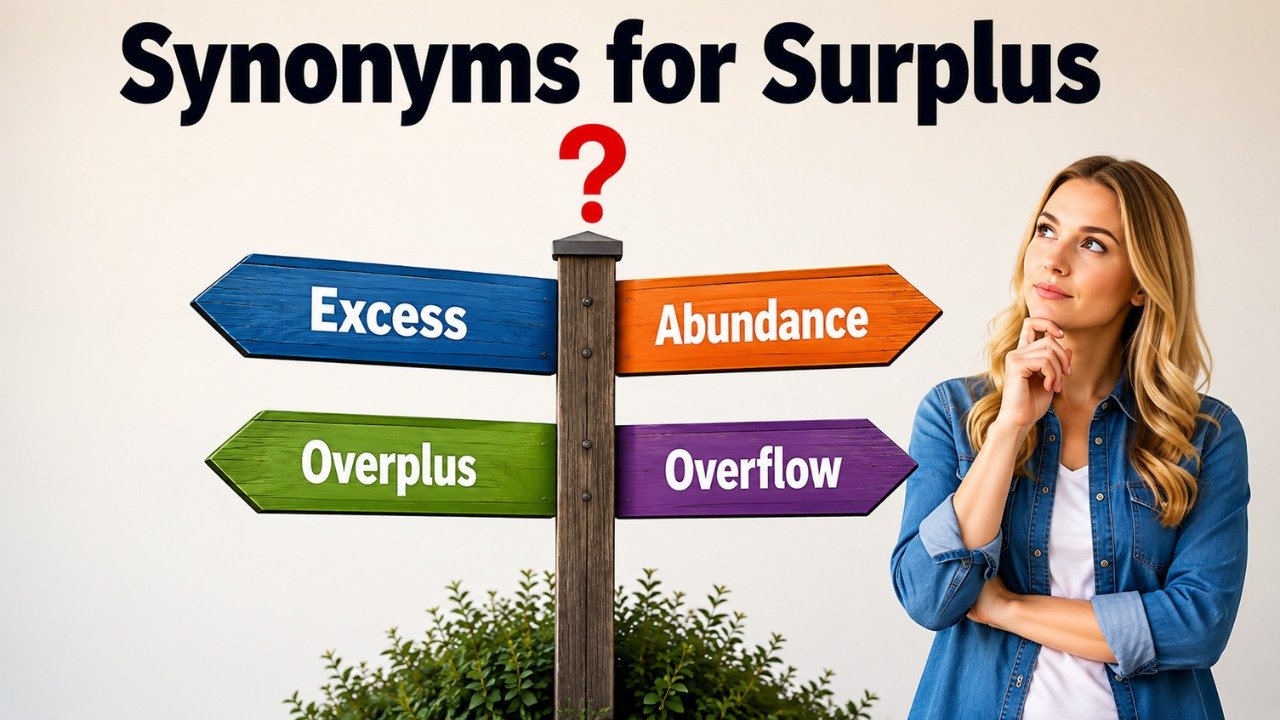
Quick Answer: The best synonyms for surplus are excess, extra, remainder, overage, abundance, oversupply, glut, reserve, leftover, and spare. Use excess when something is greater than necessary, extra in casual conversation, remainder for an amount left after use, and overage for a quantity above a set limit. Abundance suggests a large positive supply, while glut and oversupply often describe more products than people need or want.
Pronunciation and Word Details
Word: Surplus
Pronunciation: /ˈsɜːr.pləs/
Part of Speech: Noun and adjective
Meaning: An amount that remains after needs have been met or a quantity that is greater than required.
US Pronunciation:
UK Pronunciation:
What Does “Surplus” Mean?
Surplus means an amount that is greater than what is needed, used, expected, or demanded. As a noun, it refers to the extra amount itself. As an adjective, it describes goods, money, supplies, or resources that are additional or no longer required.
A surplus can be positive when it provides security, savings, or additional resources. It can also create problems when too many products, workers, or materials remain unused.
Noun Use: The farm produced a surplus of wheat this season.
Adjective Use: The company sold its surplus equipment.
Financial Use: The organization ended the year with a budget surplus.
Supply Use: A surplus of vegetables caused market prices to fall.
The word commonly appears in discussions about economics, finance, agriculture, business inventory, energy, staffing, and resource management.
Meaning, Tone, and Context of “Surplus”
Surplus has a neutral and slightly formal tone. It is common in professional, financial, economic, academic, and technical writing. It can also appear in everyday conversation when someone discusses extra food, money, materials, or supplies.
The emotional meaning depends on the situation. A budget surplus is usually positive because it means more money was received than spent. A surplus of unsold products can be negative because it may represent wasted resources or weak demand.
Formal Context: The department reported a surplus at the end of the financial period.
Business Context: The warehouse contains surplus inventory.
Economic Context: Increased production created a market surplus.
Everyday Context: We donated the surplus food to local families.
Positive Tone: A surplus can suggest security, abundance, savings, or preparation.
Negative Tone: A surplus can suggest waste, overproduction, poor planning, or insufficient demand.
When and How to Use “Surplus”
For Extra Supplies
Use surplus when supplies remain after all immediate needs have been met.
Example: The school stored its surplus stationery for the next term.
For Financial Results
Use surplus when income, revenue, or available money is greater than spending or expenses.
Example: Careful spending helped the committee create a small financial surplus.
For Business Inventory
Use surplus for products or materials that remain unsold or unused.
Example: The retailer reduced prices to clear surplus inventory.
For Agricultural Production
Use surplus when farms produce more crops or food than consumers currently require.
Example: Favorable weather resulted in a surplus of corn.
For Additional Capacity
Use surplus when a system, machine, building, or team has more capacity than it currently needs.
Example: The factory has surplus production capacity during the winter.
For Remaining Resources
Use surplus when some money, food, energy, or material remains after planned use.
Example: Any surplus funds will support future maintenance.
Best Synonyms for Surplus
Excess
Synonym: An amount beyond what is necessary, allowed, or useful.
Example: Excess water collected at the bottom of the container.
Extra
Synonym: An additional amount beyond the usual or required quantity.
Example: We prepared extra meals for unexpected guests.
Remainder
Synonym: The part that is left after the rest has been used, removed, or divided.
Example: The remainder of the budget will be saved.
Overage
Synonym: An amount that is above an expected, permitted, or measured limit.
Example: The customer paid a fee for the data overage.
Abundance
Synonym: A large and often desirable supply of something.
Example: The garden produced an abundance of fresh herbs.
Oversupply
Synonym: A quantity that is greater than current demand or need.
Example: An oversupply of apartments caused rental prices to decrease.
Glut
Synonym: An excessive supply that is difficult to sell or use.
Example: A glut of cheap products weakened the market.
Reserve
Synonym: A supply kept for future use or emergencies.
Example: The community keeps a reserve of clean drinking water.
Leftover
Synonym: Something remaining after the main amount has been used or consumed.
Example: The leftover materials were used for another project.
Spare
Synonym: An additional item or amount kept available for possible use.
Example: Always carry a spare battery during a long journey.
50 Synonyms for Surplus with Short Meanings
- Excess: More than is necessary or required.
- Extra: An additional amount beyond the usual quantity.
- Remainder: The part left after the rest is used.
- Overage: An amount above an expected or allowed limit.
- Abundance: A large and plentiful supply.
- Oversupply: More supply than current demand requires.
- Glut: An excessive amount that is difficult to use or sell.
- Reserve: A supply saved for future use.
- Balance: The amount remaining after deductions or use.
- Residue: A small amount left after a process.
- Leftover: Something remaining after the main portion is used.
- Surplusage: An unnecessary or excessive amount.
- Superabundance: A quantity far greater than necessary.
- Plenty: More than enough of something.
- Profusion: A large and generous quantity.
- Overflow: An amount that exceeds available space or capacity.
- Stockpile: A large supply stored for future use.
- Spare: An additional amount kept available.
- Redundancy: More people, parts, or resources than are necessary.
- Superfluity: An unnecessary or excessive amount.
- Plethora: A very large quantity, sometimes more than needed.
- Bounty: A generous and plentiful supply.
- Accumulation: A quantity collected gradually over time.
- Margin: An additional amount beyond the minimum requirement.
- Cushion: An extra amount that provides protection or security.
- Backup: An additional supply available when needed.
- Overproduction: Production greater than demand.
- Excess Supply: A quantity greater than consumers require.
- Unused Portion: A part that has not been consumed or applied.
- Remaining Amount: The quantity left after use or distribution.
- Excess Stock: Goods remaining beyond normal business needs.
- Extra Capacity: Ability or space beyond current requirements.
- Reserve Supply: Resources saved for later use.
- Carryover: An amount transferred to a later period.
- Excess Inventory: Products held beyond expected sales needs.
- Overabundance: A supply larger than needed or useful.
- Copiousness: The state of existing in large quantities.
- Ampleness: The quality of being plentiful or sufficient.
- Plenitude: A complete or abundant supply.
- Wealth: A large amount of valuable resources.
- Richness: An abundant amount of qualities or resources.
- Fullness: The condition of being completely supplied.
- More Than Needed: A quantity beyond actual requirements.
- Additional Quantity: An amount added to the required total.
- Spare Amount: A quantity kept available for possible use.
- Excess Amount: A quantity above the necessary level.
- Leftover Supply: Resources remaining after current needs are met.
- Remaining Stock: Goods still available after sales or use.
- Unneeded Amount: A quantity that is not currently required.
- Surplus Quantity: An amount greater than present demand or need.
Read Also:
Synonyms for Accountability

Synonyms for Surplus by Context
When Surplus Means More Than Necessary
Excess, extra, superfluity, surplusage, and overabundance describe quantities greater than what is required.
Example: The workers removed excess material from the construction site.
Example: The report contained a superfluity of minor details.
Use excess for the clearest and most widely understood alternative. Use superfluity or surplusage in more formal writing.
When Surplus Means an Amount Left Over
Remainder, balance, residue, leftover, and carryover describe something that remains after use, spending, division, or distribution.
Example: The remainder of the fabric was stored in a cabinet.
Example: The balance of the funds will remain available next month.
Use remainder for physical amounts or sections. Use balance for money and accounts. Use residue for a small amount left after a process.
When Surplus Means Too Much Supply
Oversupply, glut, overproduction, excess inventory, and excess stock describe situations in which production or supply is greater than demand.
Example: Overproduction caused the price of the crop to fall.
Example: The shop offered discounts to reduce excess inventory.
Glut usually carries a negative meaning because it suggests that the supply is difficult to sell or manage.
When Surplus Means a Saved Supply
Reserve, stockpile, backup, cushion, and spare describe extra resources kept for future use.
Example: The family created a financial cushion for emergencies.
Example: The hospital maintained a reserve supply of essential materials.
Reserve is appropriate in formal or professional writing. Backup and spare are more conversational.
When Surplus Means Plenty
Abundance, bounty, profusion, plenitude, and plenty describe a large supply, often with a positive meaning.
Example: The region enjoys an abundance of natural resources.
Example: The harvest provided a bounty of fresh produce.
Abundance is neutral or positive. Profusion suggests a rich display or large quantity. Bounty often carries a warm and generous tone.
Another Word for Surplus
The best single replacement for surplus is excess. Both words describe an amount that is greater than necessary. However, the best alternative depends on whether the sentence refers to extra supply, remaining money, unused products, or saved resources.
Original: The company has a surplus of office furniture.
Better Option: The company has excess office furniture.
Original: The surplus from the monthly budget was placed in savings.
Better Option: The remainder of the monthly budget was placed in savings.
Original: The farm created a surplus of tomatoes.
Better Option: The farm created an oversupply of tomatoes.
Original: We kept the surplus materials for emergencies.
Better Option: We kept the spare materials for emergencies.
When Not to Use “Surplus”
Do not use surplus when a more specific word would explain exactly what remains, why it remains, or how it will be used.
Surplus may sound overly formal in simple conversations. Extra or leftover is often more natural when discussing food, clothing, household items, or everyday supplies.
Weak: Do you have a surplus chair for the guest?
Better: Do you have an extra chair for the guest?
Avoid surplus when you mean profit. A business may have a financial surplus, but profit specifically refers to money earned after business costs are deducted.
Weak: The store made a large surplus from product sales.
Better: The store made a large profit from product sales.
Do not use surplus when the amount remaining is extremely small. Residue, trace, or remainder may be more accurate.
Weak: A surplus of powder remained inside the container.
Better: A small residue of powder remained inside the container.
Avoid repeating surplus in nearby sentences.
Weak: The surplus products were placed in a surplus storage area for surplus goods.
Better: The excess products were placed in a storage area for unused goods.
Words Commonly Confused With Surplus
Surplus vs Excess: Surplus is often an amount remaining after needs are met. Excess is any amount beyond what is necessary, suitable, or permitted.
Surplus vs Profit: Surplus can describe money remaining in many types of budgets. Profit usually describes business income remaining after costs and expenses.
Surplus vs Remainder: Surplus emphasizes that there is more than needed. Remainder simply identifies what is left, even when the amount is small.
Surplus vs Reserve: A surplus exists because more is available than required. A reserve is intentionally saved for future use.
Surplus vs Abundance: Surplus can suggest unwanted extra supply. Abundance usually has a positive meaning and suggests plenty.
Surplus vs Glut: Surplus is neutral and may be useful. Glut is negative and describes an excessive supply that is difficult to sell or consume.
Surplus vs Spare: Surplus is more formal and often describes large quantities. Spare usually describes one additional item or a small extra amount.
Which Synonym Should You Choose?
Choose excess when something is beyond the necessary, safe, permitted, or useful amount.
Choose extra in casual speech when referring to additional food, time, clothing, seating, or supplies.
Choose remainder when describing what is left after something has been used, divided, completed, or removed.
Choose balance when referring to money remaining in an account, budget, or payment.
Choose overage when an amount is above a specific limit, allowance, measurement, or expected total.
Choose oversupply when production or availability is greater than customer demand.
Choose glut when excessive supply is creating economic or practical problems.
Choose reserve when resources have been saved deliberately for future needs or emergencies.
Choose abundance when a large supply is positive, valuable, or welcome.
Choose leftover when discussing food, materials, or everyday objects that remain after use.
Choose spare when referring to an additional item kept available as a replacement.
Choose surplus in reports, essays, financial documents, economic discussions, inventory records, and formal explanations.
Real Life Examples of “Surplus” in Sentences
Original: The restaurant donated its surplus food at the end of the day.
Better Option: The restaurant donated its leftover food at the end of the day.
Original: The council used the budget surplus to repair public buildings.
Better Option: The council used the remaining funds to repair public buildings.
Original: The farm had a surplus of potatoes after the harvest.
Better Option: The farm had an oversupply of potatoes after the harvest.
Original: The factory sold its surplus machinery.
Better Option: The factory sold its excess machinery.
Original: Surplus energy was stored for later use.
Better Option: Extra energy was stored for later use.
Original: The store reduced prices to clear its surplus stock.
Better Option: The store reduced prices to clear its excess inventory.
Original: We used the surplus paint in another room.
Better Option: We used the leftover paint in another room.
Original: The department maintained a surplus of emergency supplies.
Better Option: The department maintained a reserve of emergency supplies.
Original: The building has surplus office space.
Better Option: The building has extra office space.
Original: The project finished with a small financial surplus.
Better Option: The project finished with a small remaining balance.
Synonym Groups and Usage Differences
Excess Quantity Group
Excess, overage, overabundance, superfluity, and surplusage describe an amount beyond what is needed or appropriate.
Example: Excess pressure may damage the equipment.
Excess is the most natural general choice. Overage usually relates to a limit, while superfluity and surplusage are more formal.
Remaining Amount Group
Remainder, balance, residue, leftover, and carryover focus on what remains after use or completion.
Example: The balance of the payment is due next week.
Balance is especially useful for money. Residue usually describes a small physical amount.
Market Supply Group
Oversupply, glut, overproduction, excess stock, and excess inventory relate to products, crops, materials, and market demand.
Example: A market glut caused prices to decline.
Glut suggests a serious or unwanted excess. Excess inventory is common in business and retail contexts.
Saved Resource Group
Reserve, stockpile, backup, cushion, and spare describe resources kept for future needs.
Example: The family maintained a reserve of essential supplies.
Reserve and stockpile are suitable for formal descriptions. Spare and backup are more common in everyday language.
Abundance Group
Abundance, bounty, plenty, profusion, and plenitude describe a generous or plentiful quantity.
Example: The forest contains an abundance of wildlife.
These words are usually more positive than surplus because they emphasize richness rather than unwanted excess.
Antonyms of Surplus
The opposite of surplus depends on whether the sentence describes money, products, supplies, resources, or availability.
Shortage: A situation in which there is not enough of something.
Deficit: An amount by which spending or need exceeds available resources.
Scarcity: A condition in which something is limited or difficult to obtain.
Lack: The absence of something necessary or desired.
Insufficiency: An amount that does not meet requirements.
Deficiency: A shortage of an important quality, substance, or resource.
Depletion: A serious reduction in available supplies.
Need: A condition in which something necessary is missing.
Demand: A level of need or desire that may exceed supply.
Undersupply: A quantity that is smaller than current demand.
Insufficient Stock: A supply that cannot meet expected needs.
Limited Quantity: A restricted or small amount.
Comparison Surplus vs Related Words
Surplus vs Excess
Surplus often refers to an extra amount remaining after needs have been met. Excess has a broader meaning and may suggest that the amount is undesirable, harmful, or above an allowed limit.
Example With Surplus: The organization invested its annual surplus.
Example With Excess: Remove any excess oil from the surface.
Surplus vs Remainder
Surplus suggests more than is required. Remainder simply means the part left after something has been used or divided.
Example With Surplus: The farm sold its surplus grain.
Example With Remainder: She stored the remainder of the grain.
Surplus vs Abundance
Surplus may be useful or unwanted. Abundance usually suggests a welcome and plentiful supply.
Example With Surplus: A surplus of products filled the warehouse.
Example With Abundance: The valley has an abundance of fertile land.
Surplus vs Reserve
Surplus describes an extra quantity that exists. Reserve describes a quantity intentionally saved for later.
Example With Surplus: The project produced a surplus of materials.
Example With Reserve: The project kept a reserve of materials for repairs.
Surplus vs Glut
Surplus is neutral and can be positive. Glut strongly suggests an excessive supply that causes difficulty, waste, or falling prices.
Example With Surplus: The region exported its wheat surplus.
Example With Glut: A wheat glut caused prices to fall sharply.
Surplus vs Profit
Surplus is a broad term for money remaining after expenses or planned use. Profit is mainly connected with business earnings.
Example With Surplus: The community program ended with a budget surplus.
Example With Profit: The business earned a profit from increased sales.
Common Phrases and Expressions With Surplus
Budget Surplus: Money remaining when income is greater than spending.
Trade Surplus: A situation in which the value of exports is greater than the value of imports.
Surplus Stock: Products or materials beyond current needs.
Surplus Supply: A quantity greater than present demand.
Surplus Funds: Money remaining after planned expenses have been paid.
Surplus Goods: Items that are no longer required by their owner.
Surplus Capacity: Production ability, space, or power beyond current use.
Surplus Inventory: Unsold products beyond expected business requirements.
Surplus Food: Food remaining after immediate consumption needs are met.
Surplus Energy: Energy produced beyond current demand.
Common Mistakes to Avoid
One common mistake is using surplus for every type of extra amount. Although it is correct in many cases, words such as extra, remainder, reserve, profit, and leftover may sound more natural or precise.
Avoid choosing a synonym without considering tone. Glut has a negative meaning, while abundance is usually positive. Reserve describes something saved intentionally, while remainder describes something simply left behind.
Do not confuse surplus with profit in business writing. Profit is calculated from business revenue and expenses, while surplus can describe remaining money in a wider range of organizations, projects, or budgets.
Avoid vague sentences that fail to identify what is excessive.
Vague: There was a large surplus.
Clear: There was a large surplus of unused building materials.
Do not repeat the word too frequently in the same paragraph. Replace it naturally with excess, extra amount, remaining balance, or reserve when the meaning stays clear.
Check whether the synonym fits the grammar of the sentence. Surplus can be a noun or adjective, but abundance is usually a noun, while extra can function as an adjective, noun, or adverb.
Conclusion
The best synonyms for surplus depend on what kind of extra amount you are describing. Use excess for more than is needed, extra for casual situations, remainder for something left after use, and overage for an amount above a limit. Oversupply and glut work well for markets, while reserve and stockpile describe saved resources. Understanding these synonyms for surplus helps you write more clearly about money, inventory, food, production, capacity, and remaining supplies without sounding repetitive or vague.
FAQs About Synonyms for Surplus
What Is the Best Synonym for Surplus?
Excess is the best general synonym because it clearly describes an amount greater than what is needed.
Is Extra a Synonym for Surplus?
Yes. Extra is a common and casual synonym for surplus, especially when discussing food, time, space, clothing, or supplies.
What Is a Formal Synonym for Surplus?
Excess, overage, surplusage, superfluity, and overabundance are suitable formal alternatives, depending on the context.
What Is the Difference Between Surplus and Profit?
Surplus is any money remaining after expenses or planned use. Profit specifically refers to business earnings after costs are deducted.
Can Abundance Replace Surplus?
Abundance can replace surplus when the large quantity is positive or welcome. It is less suitable when the extra supply is unwanted.
What Is a Synonym for Surplus Stock?
Excess inventory, excess stock, remaining stock, oversupply, and leftover supply are useful alternatives.
What Is the Opposite of Surplus?
Common opposites include shortage, deficit, scarcity, lack, insufficiency, and undersupply.
