
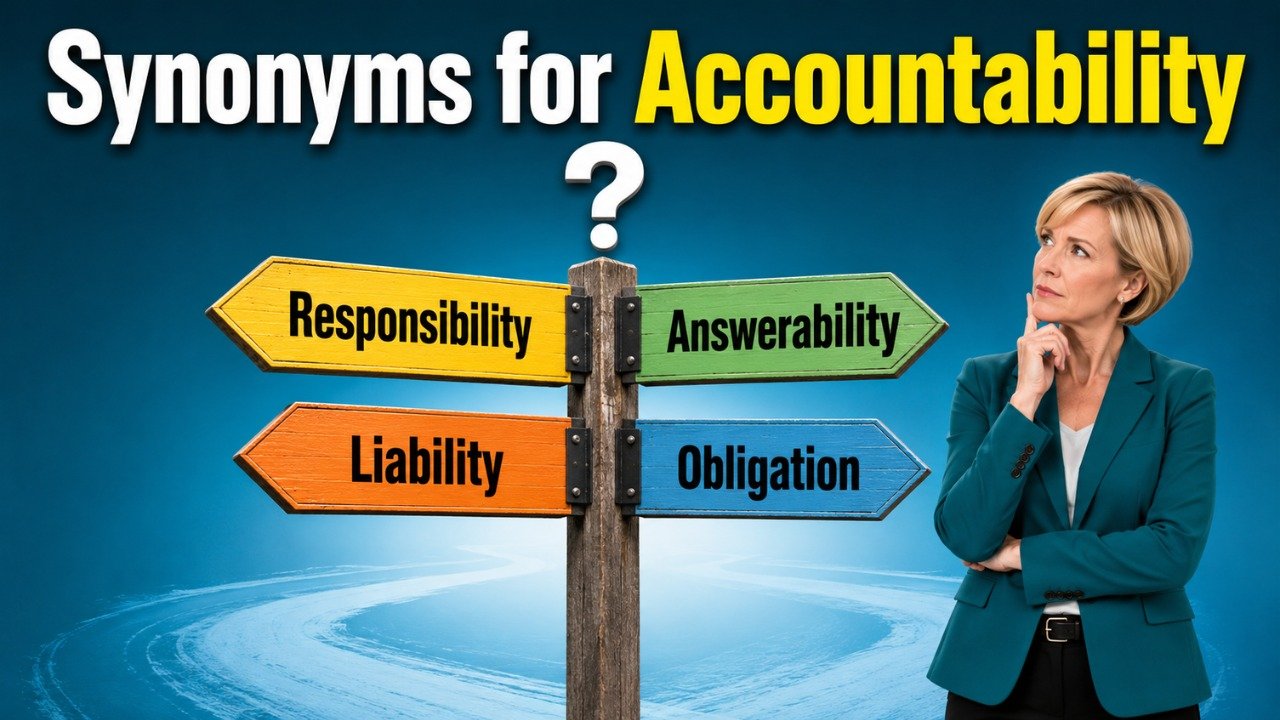
Quick Answer: The best synonyms for accountability are responsibility, answerability, ownership, liability, obligation, duty, transparency, integrity, stewardship, and dependability. Use responsibility as the most versatile alternative in everyday and professional writing. Choose answerability when someone must explain a decision, ownership when a person accepts a result, liability in legal or financial contexts, transparency for open reporting, and stewardship when someone is trusted to manage resources carefully.
Pronunciation and Word Details
Word: Accountability
Pronunciation: /əˌkaʊn.təˈbɪl.ə.ti/
Part of Speech: Noun
Meaning: The duty to accept responsibility, explain decisions, and face the results of actions.
US Pronunciation:
UK Pronunciation:
What Does “Accountability” Mean?
Accountability means being responsible for an action, decision, duty, or result and being willing to explain what happened. It is a noun commonly connected with responsibility, trust, performance, leadership, rules, and consequences.
The word can describe personal behavior, workplace expectations, legal duties, public service, financial management, or organizational leadership. A person shows accountability by admitting mistakes, completing assigned work, reporting results honestly, and accepting appropriate consequences.
In a workplace sentence, accountability may refer to an employee taking ownership of a project. In government or leadership writing, it can describe the duty to explain decisions to the public. In personal development, it often means keeping promises and accepting responsibility for choices.
Accountability does not only mean receiving blame. It also includes clear expectations, honest communication, reliable performance, and recognition for positive results.
Meaning, Tone, and Context of “Accountability”
Accountability has a serious, professional, and generally neutral tone. It can become positive when it describes honesty, dependable leadership, or responsible behavior. It can sound critical when it appears in discussions about failure, misconduct, poor performance, or consequences.
The word is common in business, education, law, finance, healthcare, government, management, ethics, and personal development. It frequently appears in reports, policies, performance reviews, professional emails, team discussions, and academic essays.
In formal writing, accountability often refers to systems that require people or organizations to explain decisions and provide evidence of performance. In conversation, it may describe someone admitting a mistake or keeping a promise.
The meaning changes slightly according to context. Personal accountability emphasizes individual choices. Professional accountability focuses on duties and performance. Legal accountability concerns liability and compliance. Public accountability involves openness, reporting, and answerability to a community.
When and How to Use “Accountability”
For Personal Responsibility: Use accountability when someone accepts the results of personal choices or behavior.
Example: Taking accountability for the mistake helped her rebuild trust.
For Workplace Performance: Use accountability when employees are expected to complete duties and report progress.
Example: Clear deadlines improve accountability across the team.
For Leadership: Use accountability when leaders must explain decisions and accept responsibility for outcomes.
Example: Strong leadership requires accountability as well as authority.
For Legal Duties: Use accountability when a person or organization may face legal consequences for an action.
Example: The new policy increases legal accountability for unsafe practices.
For Financial Management: Use accountability when money, budgets, expenses, or public resources must be managed responsibly.
Example: Regular audits support financial accountability.
For Transparency: Use accountability when decisions, records, and results should be available for review.
Example: Public reporting creates greater accountability and trust.
For Education: Use accountability when students, teachers, or institutions must meet agreed expectations.
Example: The learning plan gives students greater accountability for their progress.
For Teamwork: Use accountability when each person understands and completes an assigned role.
Example: Shared goals create accountability without encouraging unnecessary blame.
Best Synonyms for Accountability
Responsibility: The duty to manage an action, role, or result.
Example: Each manager has responsibility for the performance of the department.
Answerability: The obligation to explain or justify decisions and actions.
Example: Public officials have answerability for the use of public funds.
Ownership: The willingness to accept personal responsibility for a task or outcome.
Example: She showed ownership by correcting the problem immediately.
Liability: Legal or financial responsibility for an action, loss, or damage.
Example: The contract clearly defines liability for damaged equipment.
Obligation: A duty created by a promise, rule, agreement, or moral expectation.
Example: Employers have an obligation to provide a safe environment.
Duty: A task or responsibility that someone is expected to perform.
Example: It is the supervisor’s duty to review the final report.
Transparency: Openness in communication, decisions, records, and processes.
Example: Financial transparency helped restore public confidence.
Integrity: Honest and principled behavior, especially when no one is watching.
Example: Her integrity encouraged others to admit their mistakes.
Stewardship: Responsible management of resources, property, or authority entrusted to someone.
Example: Careful stewardship protected the organization’s limited resources.
Dependability: The quality of being trustworthy and consistently reliable.
Example: His dependability made him suitable for the leadership role.
50 Synonyms for Accountability with Short Meanings
- Responsibility: The duty to manage actions or results.
- Answerability: The obligation to explain or justify conduct.
- Ownership: Personal acceptance of a task or outcome.
- Liability: Legal or financial responsibility.
- Obligation: A required moral, professional, or legal duty.
- Duty: Something a person is expected to do.
- Stewardship: Responsible care of entrusted resources.
- Custodianship: Protection and management of something valuable.
- Trusteeship: Responsibility for property, authority, or interests held in trust.
- Guardianship: The duty to protect or care for someone or something.
- Commitment: A firm promise to complete a responsibility.
- Dependability: The quality of being consistently reliable.
- Reliability: The ability to perform as expected.
- Trustworthiness: The quality of deserving confidence.
- Integrity: Honest behavior guided by strong principles.
- Honesty: Truthful and sincere conduct.
- Transparency: Openness about actions, records, and decisions.
- Openness: Willingness to share information honestly.
- Disclosure: The act of making information known.
- Reporting: Providing information about actions or results.
- Compliance: Following rules, standards, or requirements.
- Governance: The system used to direct and control an organization.
- Oversight: Careful monitoring of work or decisions.
- Supervision: The act of directing and checking performance.
- Scrutiny: Close and careful examination.
- Review: Formal examination of actions, work, or results.
- Auditability: The ability of records and actions to be examined.
- Traceability: The ability to follow the history of an action or decision.
- Responsiveness: Willingness to answer concerns and take action.
- Conscientiousness: Careful attention to duties and standards.
- Diligence: Steady and careful effort.
- Discipline: Controlled behavior that supports reliable performance.
- Faithfulness: Consistent loyalty to a duty or promise.
- Care: Serious attention given to a responsibility.
- Charge: A duty or responsibility entrusted to someone.
- Trust: Responsibility placed in a person’s care.
- Mandate: Official authority combined with a required duty.
- Requirement: Something that must be completed or followed.
- Expectation: A standard of behavior or performance.
- Management: The responsibility for directing work or resources.
- Administration: The organized handling of duties and operations.
- Control: Authority over decisions, activities, or results.
- Regulation: Control through official rules and standards.
- Justification: A clear explanation supporting an action or decision.
- Explanation: A statement that clarifies why something happened.
- Consequence Acceptance: Willingness to face the results of an action.
- Personal Responsibility: Individual ownership of choices and behavior.
- Professional Responsibility: Duty connected with a job or profession.
- Ethical Responsibility: The obligation to act according to moral principles.
- Legal Responsibility: Accountability required by law.
Read Also:
Synonyms for Failure

Synonyms for Accountability by Context
When Accountability Means Personal Responsibility
Responsibility, ownership, commitment, discipline, conscientiousness, and consequence acceptance work well when a person must accept the results of personal choices.
Responsibility is the broadest choice. Ownership emphasizes willingly accepting a problem or result. Discipline focuses on consistently completing what was promised.
Example: He accepted responsibility for missing the deadline.
Example: Her ownership of the mistake prevented it from happening again.
Example: Personal discipline helped him meet every commitment.
When Accountability Means Answerability
Answerability, justification, explanation, reporting, responsiveness, and disclosure are useful when someone must explain actions or decisions.
Answerability is especially suitable in formal, political, professional, and leadership contexts. Reporting focuses on providing information, while justification involves giving reasons for a decision.
Example: The board demanded greater answerability from senior managers.
Example: The department provided a detailed explanation of the delay.
Example: Regular reporting allows leaders to evaluate progress.
When Accountability Means Legal Liability
Liability, legal responsibility, obligation, compliance, regulation, and duty are suitable when rules, laws, contracts, or financial consequences are involved.
Liability usually concerns responsibility for damage, loss, debt, or unlawful conduct. Compliance refers to following established standards or legal requirements.
Example: The agreement limits the company’s liability for indirect losses.
Example: Regular inspections ensure compliance with safety rules.
Example: The employer has a legal obligation to protect workers.
When Accountability Means Transparency
Transparency, openness, disclosure, traceability, auditability, review, and scrutiny are useful when processes and decisions must be visible and open to examination.
Transparency emphasizes clear access to information. Traceability allows a person to follow how a decision was made. Auditability means records can be formally checked.
Example: Greater transparency improved confidence in the selection process.
Example: Digital records provide traceability for every transaction.
Example: Accurate documentation improves auditability.
When Accountability Means Dependable Performance
Dependability, reliability, commitment, diligence, faithfulness, care, and conscientiousness describe people who complete their duties consistently.
Dependability and reliability are strong choices for employees, leaders, services, and systems. Diligence emphasizes careful effort, while conscientiousness describes serious attention to responsibilities.
Example: Her reliability made her a trusted member of the team.
Example: The project succeeded because of his diligence.
Example: Conscientiousness is essential when handling private information.
When Accountability Means Responsible Leadership
Stewardship, governance, oversight, supervision, management, administration, and trusteeship work well when someone is trusted with people, authority, money, or resources.
Stewardship suggests careful and ethical management. Governance describes the complete system of leadership and control. Oversight focuses on monitoring decisions and performance.
Example: Responsible stewardship protected the organization’s resources.
Example: Effective governance reduces confusion and misconduct.
Example: Independent oversight strengthened the approval process.
Another Word for Accountability
Responsibility is the best general replacement for accountability because it works in personal, professional, educational, and organizational contexts. However, the best alternative depends on the exact meaning.
Use answerability when someone must provide an explanation. Choose ownership when a person willingly accepts a result. Use liability for legal or financial consequences and transparency when the focus is open reporting.
Original: The manager accepted accountability for the failed project.
Better Option: The manager accepted responsibility for the failed project.
Original: The policy creates accountability for financial decisions.
Better Option: The policy creates answerability for financial decisions.
Original: Team members need greater accountability for their tasks.
Better Option: Team members need greater ownership of their tasks.
Original: The agreement explains accountability for property damage.
Better Option: The agreement explains liability for property damage.
When Not to Use “Accountability”
Accountability can become vague when a sentence does not explain who is responsible, what duty exists, or what result is being measured. A more precise synonym may make the meaning clearer.
Weak: We need more accountability.
Better: Each department must report its monthly spending and explain major changes.
Avoid using accountability as a polite replacement for blame. Healthy accountability focuses on responsibility, improvement, and clear expectations rather than public embarrassment.
Weak: The meeting was held to force accountability on one employee.
Better: The meeting was held to review the mistake and agree on corrective steps.
Do not use accountability when liability is the intended legal meaning.
Weak: The contract describes accountability for personal injury.
Better: The contract describes liability for personal injury.
Avoid the word when transparency is the real concern.
Weak: The public requested more accountability in financial records.
Better: The public requested greater transparency in financial records.
Do not use accountability repeatedly without explaining the action involved.
Weak: Accountability creates accountability by making people accountable.
Better: Clear duties and regular reporting encourage responsible performance.
Words Commonly Confused With Accountability
Accountability vs Responsibility: Responsibility is the duty to perform a task or manage a result. Accountability includes being required to explain the result and accept the consequences.
Accountability vs Ownership: Ownership is the personal willingness to accept responsibility. Accountability may be created by rules, authority, or external expectations.
Accountability vs Liability: Liability is usually legal or financial responsibility. Accountability is broader and may involve professional, moral, personal, or organizational duties.
Accountability vs Transparency: Transparency means making information and decisions visible. Accountability means explaining actions and accepting responsibility for outcomes.
Accountability vs Integrity: Integrity is the quality of behaving honestly and ethically. Accountability is the duty to answer for actions, although integrity often encourages responsible behavior.
Accountability vs Answerability: Answerability is the requirement to provide explanations. Accountability also includes responsibility, performance expectations, and consequences.
Accountability vs Blame: Accountability aims to identify responsibility and improve future behavior. Blame often focuses only on fault and may not produce a useful solution.
Which Synonym Should You Choose?
Choose responsibility for the broadest alternative in everyday, academic, and professional writing.
Choose answerability when someone must explain a decision to a manager, board, authority, or community.
Choose ownership when emphasizing a person’s willingness to accept a task, mistake, or result.
Choose liability in contracts, legal documents, insurance discussions, and financial claims.
Choose obligation when a duty comes from a promise, agreement, rule, or moral principle.
Choose duty when describing a specific role or expected action.
Choose transparency when records, processes, decisions, or finances should be open to examination.
Choose integrity when the focus is honest and ethical behavior.
Choose stewardship when someone is trusted to manage money, authority, natural resources, or property responsibly.
Choose compliance when rules, regulations, or professional standards must be followed.
Choose governance when discussing the leadership and control of an organization.
Choose oversight when someone monitors decisions, performance, or spending.
Choose reliability or dependability when describing consistent performance.
Choose diligence when careful and persistent effort is the main idea.
Choose legal responsibility when the sentence needs a direct and easily understood alternative to liability.
Real Life Examples of “Accountability” in Sentences
Original: The supervisor encouraged accountability among team members.
Better Option: The supervisor encouraged responsibility among team members.
Original: She accepted accountability for entering the incorrect information.
Better Option: She took ownership of entering the incorrect information.
Original: The policy improves accountability for public spending.
Better Option: The policy improves transparency in public spending.
Original: Leaders must demonstrate accountability for their decisions.
Better Option: Leaders must show answerability for their decisions.
Original: The contract establishes accountability for repair costs.
Better Option: The contract establishes liability for repair costs.
Original: Regular meetings create accountability for project deadlines.
Better Option: Regular meetings create clear responsibility for project deadlines.
Original: Financial accountability is essential in charitable organizations.
Better Option: Responsible financial stewardship is essential in charitable organizations.
Original: The new system increases accountability across every department.
Better Option: The new system strengthens oversight across every department.
Original: Personal accountability helped him change his habits.
Better Option: Personal responsibility helped him change his habits.
Original: The report calls for greater accountability from senior leaders.
Better Option: The report calls for greater transparency and answerability from senior leaders.
Synonym Groups and Usage Differences
Responsibility Group
Responsibility, obligation, duty, charge, trust, and requirement describe work or conduct expected from a person. Responsibility is general, while obligation often comes from a promise, agreement, or rule.
Example: Every employee has a responsibility to protect confidential records.
Answerability Group
Answerability, explanation, justification, reporting, responsiveness, and disclosure involve explaining decisions or sharing information. Answerability is the strongest formal substitute for accountability.
Example: Senior leaders have answerability for major spending decisions.
Ownership Group
Ownership, commitment, consequence acceptance, personal responsibility, and professional responsibility describe willing acceptance of a role or result.
Example: She demonstrated ownership by proposing a solution instead of making excuses.
Legal Group
Liability, legal responsibility, compliance, regulation, obligation, and mandate relate to laws, contracts, standards, and official requirements.
Example: The court determined legal responsibility for the damage.
Transparency Group
Transparency, openness, disclosure, auditability, traceability, scrutiny, and review describe visible processes that can be examined.
Example: Public disclosure increased confidence in the final decision.
Reliability Group
Dependability, reliability, trustworthiness, diligence, conscientiousness, faithfulness, and discipline describe consistent and careful performance.
Example: His dependability allowed the manager to assign him important tasks.
Leadership Group
Stewardship, governance, oversight, supervision, management, administration, custodianship, and trusteeship describe responsible control of people or resources.
Example: Strong governance creates clear roles and ethical decision making.
Antonyms of Accountability
The opposite of accountability depends on whether the word refers to responsibility, openness, reliable performance, or legal duty.
Irresponsibility: Failure to act with proper care or duty.
Unaccountability: Freedom from the requirement to explain actions.
Negligence: Failure to provide reasonable care or attention.
Carelessness: Lack of proper thought or caution.
Evasion: An attempt to avoid a duty, question, or consequence.
Denial: Refusal to accept a fact, action, or responsibility.
Avoidance: The act of staying away from an obligation.
Secrecy: Deliberate concealment of information.
Dishonesty: Untruthful or deceptive behavior.
Opacity: Lack of openness or clarity.
Unreliability: Failure to perform consistently as expected.
Noncompliance: Failure to follow a rule or requirement.
Impunity: Freedom from punishment or negative consequences.
Blamelessness: The state of having no responsibility for a fault.
Exemption: Official freedom from a duty or requirement.
Comparison: Accountability vs Related Words
Accountability vs Responsibility
Responsibility is the duty to perform an action. Accountability adds the expectation that the person will explain the result and face appropriate consequences.
Example With Accountability: The director has accountability for the final budget.
Example With Responsibility: The accountant has responsibility for preparing the budget.
Accountability vs Answerability
Answerability focuses on explaining decisions to another person or authority. Accountability includes explanation but may also include ownership, performance, and consequences.
Example With Accountability: The committee introduced measures to improve accountability.
Example With Answerability: Department heads have answerability to the committee.
Accountability vs Ownership
Ownership is usually internal and voluntary. Accountability can be created through a role, policy, agreement, or reporting system.
Example With Accountability: The policy gives each manager accountability for safety results.
Example With Ownership: The manager showed ownership by correcting the safety problem immediately.
Accountability vs Liability
Liability is commonly used for legal or financial responsibility. Accountability applies to a much wider range of personal, ethical, and professional situations.
Example With Accountability: The leader accepted accountability for the poor decision.
Example With Liability: The company accepted liability for the damaged property.
Accountability vs Transparency
Transparency provides access to information. Accountability determines who must explain decisions and accept responsibility for results.
Example With Accountability: Clear roles improve accountability.
Example With Transparency: Published records improve transparency.
Accountability vs Integrity
Integrity describes honest behavior and strong moral principles. Accountability describes the duty to answer for actions.
Example With Accountability: Employees must accept accountability for inaccurate reports.
Example With Integrity: Employees with integrity report errors honestly.
Accountability vs Blame
Accountability focuses on understanding responsibility and improving future performance. Blame often focuses on criticism without creating a solution.
Example With Accountability: The team reviewed the failure and assigned corrective actions.
Example With Blame: The discussion focused only on identifying someone to criticize.
Common Phrases and Expressions With Accountability
Personal Accountability: Responsibility for personal actions, choices, and results.
Professional Accountability: Responsibility connected with a job or professional role.
Financial Accountability: Responsible management and reporting of money.
Public Accountability: The duty to explain actions to citizens or a community.
Legal Accountability: Responsibility created or enforced by law.
Ethical Accountability: The duty to follow moral and professional principles.
Shared Accountability: Responsibility divided among several people or groups.
Individual Accountability: Responsibility assigned to one specific person.
Accountability System: A process for assigning duties and reviewing results.
Accountability Partner: A person who helps someone remain committed to a goal.
Common Mistakes to Avoid
Confusing Accountability With Blame: Accountability should encourage responsibility, learning, and improvement. It should not be used only to criticize or embarrass someone.
Using the Word Vaguely: Explain who is accountable, what the duty involves, and how results will be reviewed.
Choosing Accountability Instead of Liability: Use liability when discussing legal claims, financial loss, property damage, or contractual responsibility.
Choosing Accountability Instead of Transparency: Use transparency when the main point is open records, clear communication, or visible decision making.
Repeating the Word Excessively: Use responsibility, ownership, answerability, or oversight when they communicate the intended meaning more precisely.
Ignoring Shared Responsibility: Some results involve several people. Assigning accountability to only one person may be misleading when duties were shared.
Using Accountability Without Authority: A person should have enough authority, information, and resources to complete the duty for which they are accountable.
Failing to Define Expectations: Accountability becomes unfair when deadlines, quality standards, responsibilities, and reporting methods are unclear.
Using Unnatural Phrasing: Write “take accountability,” “accept accountability,” or “hold someone accountable.” Avoid phrases that do not fit standard usage.
Incorrect: She did accountability for the mistake.
Correct: She accepted accountability for the mistake.
Conclusion
Understanding synonyms for accountability makes it easier to describe responsibility, ownership, legal duty, reliable performance, and open leadership. Responsibility is the best general substitute, while answerability suits explanations and ownership emphasizes personal acceptance. Use liability for legal consequences, transparency for open reporting, and stewardship for careful resource management. The strongest word depends on who holds the duty, what must be explained, and whether the context is personal, professional, ethical, financial, or legal.
FAQs About Synonyms for Accountability
What Is the Best Synonym for Accountability?
Responsibility is the best general synonym. Answerability, ownership, liability, and transparency may be more accurate in specific contexts.
Is Accountability the Same as Responsibility?
Not completely. Responsibility is the duty to perform a task, while accountability includes explaining the result and accepting consequences.
What Is Another Word for Personal Accountability?
Personal responsibility, ownership, self discipline, commitment, and consequence acceptance are useful alternatives.
What Is a Formal Synonym for Accountability?
Answerability is a strong formal synonym. Liability, governance, oversight, and compliance also work in legal or organizational contexts.
What Is the Difference Between Accountability and Ownership?
Accountability may be assigned by another person or system. Ownership is the personal willingness to accept responsibility for a task or outcome.
Is Transparency a Synonym for Accountability?
Transparency is a close alternative rather than an exact synonym. It supports accountability by making decisions, records, and results open to examination.
What Is the Opposite of Accountability?
Common opposites include irresponsibility, negligence, evasion, secrecy, unaccountability, dishonesty, and avoidance.
