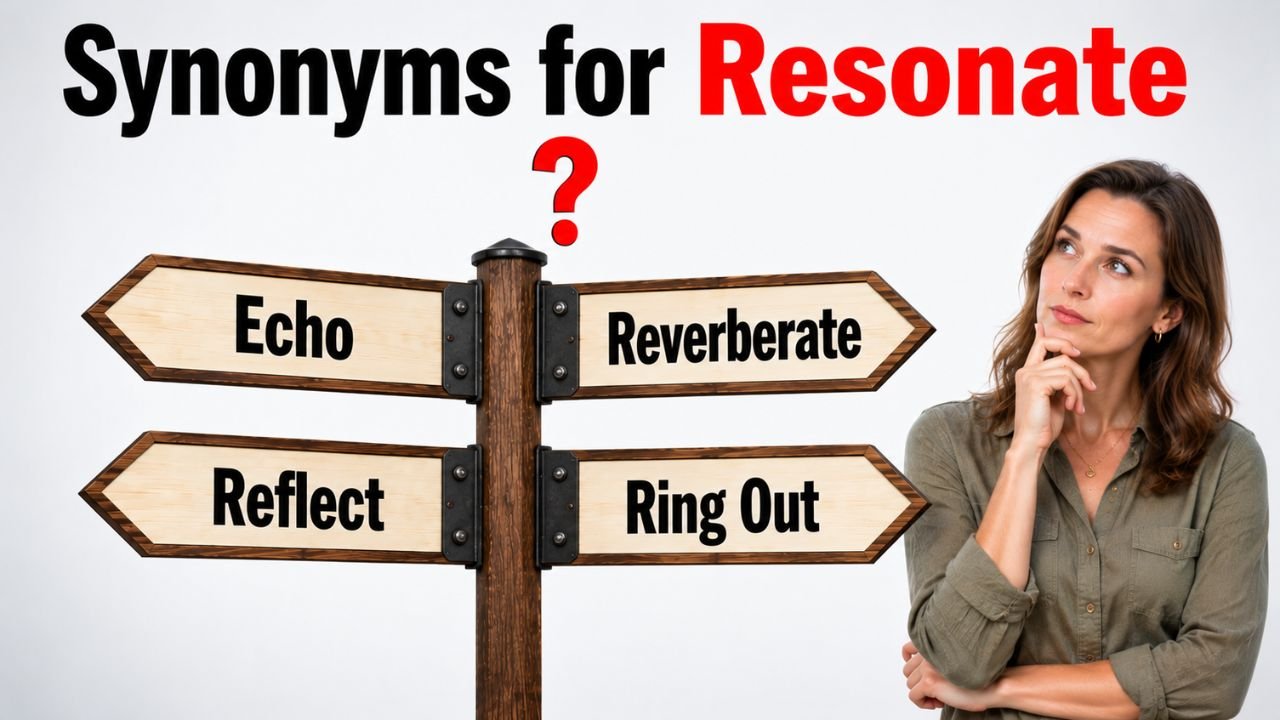
Quick Answer: Synonyms for resonate include echo, reverberate, resound, connect, relate, appeal, inspire, affect, align, and strike a chord. Echo and reverberate are best when describing sound. Connect and relate work well when an idea feels personally relevant. Strike a chord is useful for emotional impact, while align and correspond are better for agreement, values, or shared beliefs. Inspire and affect suit messages that create a strong or lasting response.
Pronunciation and Word Details
Word: Resonate
Pronunciation: /ˈrez.ə.neɪt/
Part of Speech: Verb
Meaning: To produce a deep sound or create a strong emotional, personal, or intellectual response.
US Pronunciation:
UK Pronunciation:
What Does “Resonate” Mean?
Resonate means to produce a deep, continuing sound or to create a strong emotional or personal connection.
It is a verb commonly used for sound, ideas, memories, experiences, messages, and emotions. In a physical sense, an object resonates when it vibrates and produces sound. In a figurative sense, a statement resonates when it feels meaningful, familiar, relevant, or emotionally powerful.
The word can also describe agreement. An idea may resonate with someone because it matches their beliefs, values, experiences, or concerns.
In sentences, resonate often appears with the word with.
Example: Her message resonated with young readers.
It may also appear without an object when describing a lasting sound or effect.
Example: The final note resonated throughout the hall.
Meaning, Tone, and Context of “Resonate”
Resonate usually has a thoughtful, positive, and emotionally expressive tone. It is widely used in formal writing, academic discussions, professional communication, speeches, reviews, essays, and everyday conversation.
In emotional contexts, resonate suggests that something creates a meaningful inner response. A story can resonate because it reminds people of their own lives.
In professional or persuasive writing, resonate often describes a message that successfully connects with an audience.
In discussions about values or opinions, the word may show agreement or compatibility. A proposal resonates with a person when it reflects their priorities or beliefs.
In scientific or musical contexts, resonate has a more technical meaning connected with vibration, frequency, and sound.
Because the word has several meanings, the best synonym depends on whether the sentence refers to sound, emotion, agreement, relevance, or lasting influence.
When and How to Use “Resonate”
For Emotional Connection: Use resonate when a story, idea, image, or message creates a deep personal feeling.
Example: The character’s struggle resonated with readers who had faced similar challenges.
For Personal Relevance: Use resonate when something feels familiar or meaningful because it reflects someone’s experience.
Example: Her description of family life resonated with many parents.
For Agreement: Use resonate when an opinion, belief, or proposal matches another person’s values.
Example: The speaker’s ideas resonated with the community.
For Lasting Impact: Use resonate when words, events, or experiences continue to influence people over time.
Example: His final advice continued to resonate years later.
For Sound: Use resonate when a sound vibrates, echoes, or continues through a space.
Example: The bell resonated across the quiet valley.
For Audience Response: Use resonate when content successfully attracts attention and creates interest.
Example: The simple message resonated with a broad audience.
Best Synonyms for Resonate
Echo: To repeat a sound, idea, feeling, or opinion.
Example: Her concerns echoed those expressed by other students.
Reverberate: To continue or repeat as a sound or powerful effect.
Example: The announcement reverberated throughout the organization.
Resound: To fill a place with a loud or continuing sound.
Example: Applause resounded through the auditorium.
Connect: To create a meaningful relationship or shared understanding.
Example: The story connected with readers of different ages.
Relate: To understand something through personal experience.
Example: Many people could relate to his fear of failure.
Appeal: To attract, interest, or emotionally influence someone.
Example: The practical advice appealed to new learners.
Strike a Chord: To cause a strong emotional response or feeling of recognition.
Example: Her words struck a chord with everyone in the room.
Align: To match or agree with particular beliefs, values, or goals.
Example: The proposal aligned with the group’s priorities.
Affect: To create a change in someone’s feelings or thoughts.
Example: The film deeply affected its viewers.
Inspire: To create motivation, emotion, or creative thought.
Example: Her determination inspired the entire team.
50 Synonyms for Resonate with Short Meanings
- Echo: To repeat a sound, idea, or feeling.
- Reverberate: To continue as a repeated sound or effect.
- Resound: To produce or fill a place with sound.
- Ring: To sound clearly or remain in the mind.
- Vibrate: To move rapidly and produce sound.
- Pulsate: To move or beat with a regular rhythm.
- Thrum: To make a continuous low sound.
- Hum: To produce a steady, quiet sound.
- Sound: To produce or communicate an audible tone.
- Carry: To travel clearly across a distance.
- Boom: To make a deep and powerful sound.
- Rumble: To produce a low, heavy sound.
- Chime: To produce a musical sound or agree with something.
- Peal: To sound loudly and repeatedly.
- Toll: To ring slowly and repeatedly.
- Linger: To remain present after the original moment.
- Persist: To continue to exist or influence.
- Endure: To remain meaningful or effective over time.
- Remain: To continue to be present.
- Connect: To create understanding or emotional closeness.
- Relate: To understand through personal experience.
- Appeal: To attract interest, sympathy, or approval.
- Strike a Chord: To create emotional recognition.
- Touch: To create a gentle emotional response.
- Move: To cause strong emotion.
- Inspire: To create motivation or meaningful thought.
- Affect: To influence feelings, thoughts, or behavior.
- Engage: To hold attention or interest.
- Captivate: To attract and hold strong attention.
- Influence: To shape feelings, beliefs, or actions.
- Impact: To create a noticeable or lasting effect.
- Matter: To have importance or personal meaning.
- Register: To be noticed, understood, or remembered.
- Land: To be understood or received successfully.
- Hit Home: To feel especially true or personal.
- Speak To: To connect with someone’s feelings or interests.
- Align: To match beliefs, values, or goals.
- Correspond: To match or be similar to something.
- Agree: To share the same view or opinion.
- Match: To be equal, similar, or compatible.
- Fit: To suit a situation, need, or belief.
- Harmonize: To combine or agree pleasantly.
- Accord: To be consistent or in agreement.
- Reflect: To express or represent an idea or feeling.
- Mirror: To closely represent another experience or condition.
- Evoke: To bring a feeling, memory, or image to mind.
- Awaken: To cause a feeling or memory to become active.
- Stir: To create emotion or thought.
- Recall: To bring a past experience to mind.
- Remind: To cause someone to remember something.
Read Also:
Synonyms for Luxury

Synonyms for Resonate by Context
When Resonate Means Produce or Continue a Sound
Echo, reverberate, resound, ring, vibrate, hum, thrum, boom, and rumble work when resonate refers to sound.
Echo describes a repeated sound, while reverberate suggests that the sound continues through a space. Resound is best for a loud, impressive noise.
Example: The singer’s final note reverberated through the hall.
Example: The sound of applause resounded across the room.
When Resonate Means Create Emotional Connection
Connect, relate, touch, move, strike a chord, speak to, and hit home describe emotional understanding or recognition.
Strike a chord suggests that something creates a strong personal reaction. Touch and move emphasize emotion, while relate focuses on shared experience.
Example: The story struck a chord with people who had experienced loss.
Example: Her honest words deeply moved the audience.
When Resonate Means Appeal to an Audience
Appeal, engage, captivate, connect, influence, and land are useful when discussing communication, writing, speeches, or public messages.
Appeal means to attract interest or approval. Engage suggests holding attention, while land means that a message is successfully understood.
Example: The clear explanation appealed to both beginners and experienced readers.
Example: The final message landed successfully with the audience.
When Resonate Means Agree or Match
Align, correspond, agree, accord, harmonize, fit, and match describe consistency between ideas, values, beliefs, or goals.
Align is especially useful in formal or professional writing. Agree is more direct and conversational.
Example: Her values aligned with the goals of the project.
Example: His explanation corresponded with the available evidence.
When Resonate Means Create a Lasting Effect
Persist, linger, endure, remain, influence, impact, and register describe an idea or emotion that continues over time.
Linger often refers to memories or feelings that remain. Endure suggests that something stays relevant for a long period.
Example: The meaning of the poem lingered in her mind.
Example: The lesson continued to influence him years later.
When Resonate Means Bring Back a Memory
Evoke, awaken, recall, remind, stir, reflect, and mirror are useful when something brings an earlier feeling or experience to mind.
Evoke is common in formal and descriptive writing. Remind is more direct and conversational.
Example: The familiar scent evoked memories of childhood.
Example: The scene reminded her of summers spent with her family.
Another Word for Resonate
Connect is often the best general replacement for resonate when the sentence refers to emotional relevance or audience response.
However, the best alternative depends on context. Use echo for repeated sounds or ideas, align for agreement, strike a chord for emotional impact, and reverberate for a continuing sound or powerful effect.
Original: The message resonated with young readers.
Better Option: The message connected with young readers.
Original: Her concerns resonated with the views of the community.
Better Option: Her concerns aligned with the views of the community.
Original: The final note resonated through the room.
Better Option: The final note reverberated through the room.
Original: His personal story resonated with the audience.
Better Option: His personal story struck a chord with the audience.
When Not to Use “Resonate”
Avoid resonate when a simpler or more precise verb would make the sentence clearer.
The word can sound vague when the writer does not explain whether something created emotion, agreement, relevance, or sound. It may also feel repetitive when used several times in a short paragraph.
In highly technical descriptions, use vibrate, reverberate, or produce sound when physical movement is the main meaning.
In casual conversation, relate, connect, or agree may sound more natural.
Weak: The idea resonated because everyone liked it.
Better: The idea appealed to everyone because it was practical.
Weak: The report resonated with the available facts.
Better: The report corresponded with the available facts.
Weak: The machine resonated loudly.
Better: The machine vibrated loudly.
Weak: I resonate with your opinion.
Better: I agree with your opinion.
Words Commonly Confused With Resonate
Resonate vs Relate: Resonate means that something creates a strong emotional or intellectual response. Relate means that someone understands an experience because it is familiar.
Resonate vs Echo: Resonate can describe sound or emotional impact. Echo mainly means to repeat a sound, idea, phrase, or opinion.
Resonate vs Reverberate: Both words can describe continuing sound. Reverberate emphasizes repeated sound or widespread consequences, while resonate may also describe personal meaning.
Resonate vs Appeal: Resonate suggests deep relevance or emotional connection. Appeal means to attract interest, approval, or enjoyment.
Resonate vs Align: Resonate can describe emotional connection, while align means that ideas, goals, or values agree or match.
Resonate vs Reflect: Resonate describes the effect something has on a person. Reflect means to represent, express, or show a quality or idea.
Resonate vs Affect: Resonate suggests a meaningful or lasting response. Affect is broader and simply means to influence or change something.
Which Synonym Should You Choose?
Choose echo when a sound, phrase, opinion, or concern is repeated.
Choose reverberate when a sound or important event continues to have a strong effect.
Choose resound when describing a loud sound that fills a space.
Choose connect when a message feels meaningful or understandable to an audience.
Choose relate when someone recognizes an experience from personal life.
Choose strike a chord when a story, statement, or image creates a strong emotional response.
Choose appeal when something attracts interest, approval, or enjoyment.
Choose align in reports, essays, emails, or professional writing when values, plans, or goals match.
Choose correspond when facts, descriptions, or results agree with one another.
Choose affect when discussing a general influence on feelings, thoughts, or actions.
Choose inspire when a message creates motivation or positive action.
Choose linger when a feeling, memory, sound, or impression remains after an event.
Choose evoke when writing about a memory, image, mood, or emotion being brought to mind.
Choose land in casual communication when a joke, point, or message is successfully understood.
Real Life Examples of “Resonate” in Sentences
Original: Her speech resonated with the students.
Better Option: Her speech connected with the students.
Original: The sound of the drums resonated through the building.
Better Option: The sound of the drums reverberated through the building.
Original: His experience resonated with many parents.
Better Option: Many parents could relate to his experience.
Original: The message continued to resonate after the meeting.
Better Option: The message continued to linger after the meeting.
Original: The writer’s honesty resonated with readers.
Better Option: The writer’s honesty struck a chord with readers.
Original: The proposal resonated with the organization’s values.
Better Option: The proposal aligned with the organization’s values.
Original: The film resonated with people from different backgrounds.
Better Option: The film appealed to people from different backgrounds.
Original: Her warning resonated throughout the community.
Better Option: Her warning echoed throughout the community.
Original: The childhood scene resonated with him.
Better Option: The childhood scene evoked a familiar memory for him.
Original: The final paragraph resonated strongly.
Better Option: The final paragraph had a powerful impact.
Synonym Groups and Usage Differences
Sound Group
Echo, reverberate, resound, ring, vibrate, hum, boom, and rumble describe sound or physical vibration.
Echo suggests repetition. Reverberate suggests continuation, while resound emphasizes loudness.
Example: The music reverberated through the empty hall.
Emotional Connection Group
Connect, relate, strike a chord, touch, move, speak to, and hit home describe a personal or emotional response.
Connect is broad and neutral. Strike a chord and hit home suggest a stronger emotional reaction.
Example: Her explanation hit home because it reflected their own experience.
Agreement Group
Align, agree, correspond, accord, harmonize, match, and fit describe shared beliefs, values, facts, or purposes.
Align is common in professional communication. Accord and correspond are more formal.
Example: The new plan aligned with the team’s long term goals.
Influence Group
Affect, inspire, influence, impact, engage, and captivate describe the power to shape attention, feelings, or behavior.
Affect is broad, while inspire suggests positive motivation. Captivate means to hold complete attention.
Example: The teacher’s encouragement inspired the students.
Memory and Reflection Group
Evoke, awaken, stir, recall, remind, reflect, and mirror relate to memories, emotions, or recognizable experiences.
Evoke is useful in descriptive and formal writing. Remind is clearer in everyday conversation.
Example: The old photograph evoked memories of family celebrations.
Lasting Effect Group
Persist, linger, endure, remain, register, and matter describe something that continues to be felt, remembered, or valued.
Linger often describes feelings and memories. Endure suggests long term importance.
Example: The emotional effect of the story lingered for several days.
Antonyms of Resonate
The opposite of resonate depends on whether the word refers to agreement, emotional connection, sound, or lasting influence.
Clash: To conflict strongly with an idea, style, or value.
Conflict: To be incompatible or opposed.
Disagree: To hold a different opinion.
Oppose: To resist or reject an idea.
Contradict: To express the opposite of a statement or belief.
Alienate: To make someone feel disconnected or excluded.
Repel: To create dislike or rejection.
Disconnect: To fail to create understanding or emotional closeness.
Fade: To gradually lose strength or importance.
Disappear: To stop being present or noticeable.
Silence: The absence of sound.
Fail to Register: To remain unnoticed or misunderstood.
Comparison Resonate vs Related Words
Resonate vs Echo
Resonate describes a deep sound, emotional response, or meaningful connection. Echo mainly describes repetition.
Example With Resonate: The story resonated with readers who had faced similar difficulties.
Example With Echo: Her comments echoed concerns raised earlier.
Resonate vs Reverberate
Resonate can refer to sound, agreement, or personal meaning. Reverberate usually describes a continuing sound or a powerful effect that spreads.
Example With Resonate: The message resonated with the local community.
Example With Reverberate: The consequences reverberated throughout the industry.
Resonate vs Relate
Resonate describes the effect that an idea or experience creates. Relate describes a person’s ability to understand that experience personally.
Example With Resonate: The character’s fear resonated with many viewers.
Example With Relate: Many viewers could relate to the character’s fear.
Resonate vs Connect
Resonate often suggests a deep or lasting response. Connect is broader and can describe any successful emotional or intellectual relationship.
Example With Resonate: The poem resonated deeply with her.
Example With Connect: The poem connected with readers of all ages.
Resonate vs Align
Resonate focuses on emotional relevance or agreement. Align specifically means that values, beliefs, goals, or plans match.
Example With Resonate: The idea resonated with the volunteers.
Example With Align: The idea aligned with the volunteers’ goals.
Resonate vs Appeal
Resonate suggests personal significance. Appeal means something is attractive, interesting, or enjoyable.
Example With Resonate: The message resonated with people facing uncertainty.
Example With Appeal: The simple design appealed to younger customers.
Common Phrases and Expressions With Resonate
Resonate With Someone: To feel personally meaningful or relevant to a person.
Resonate Deeply: To create a powerful emotional or intellectual response.
Strongly Resonate: To create a clear and intense connection.
Continue to Resonate: To remain meaningful or influential over time.
Resonate Emotionally: To create a strong emotional reaction.
Resonate With Readers: To connect meaningfully with people reading a text.
Resonate With an Audience: To create interest, agreement, or emotion among listeners or viewers.
Resonate Across Generations: To remain meaningful to people of different ages.
Resonate on a Personal Level: To feel closely connected with an individual’s experience.
Resonate as True: To feel believable, accurate, or personally convincing.
Common Mistakes to Avoid
A common mistake is using resonate when agree would be clearer. Saying an opinion resonates may sound natural, but agree is often better when no emotional connection is involved.
Avoid using resonate without identifying who or what receives the effect. A sentence such as “The message resonated” may feel incomplete unless the surrounding context is clear.
Do not confuse resonate with relate. A message resonates with a person, but a person relates to a message or experience.
Avoid repeating resonate throughout an article. Use connect, appeal, align, echo, inspire, affect, or strike a chord according to the intended meaning.
Do not use physical sound synonyms in emotional contexts. Reverberate can describe an emotional effect, but vibrate and rumble usually refer to sound or movement.
Avoid vague claims such as “The content resonates.” Explain whether it connects emotionally, matches values, attracts attention, or remains memorable.
Use the correct preposition. The standard expression is resonate with someone, not resonate to someone.
Conclusion
Synonyms for resonate include echo, connect, relate, align, appeal, reverberate, inspire, and strike a chord. The strongest choice depends on meaning. Use echo or reverberate for sound, connect or relate for personal relevance, and strike a chord for emotional impact. Align and correspond suit agreement, while evoke and remind work for memories. Choosing a precise synonym makes writing clearer and helps readers understand whether something creates sound, emotion, recognition, influence, or lasting meaning.
FAQs About Synonyms for Resonate
What Is the Best Synonym for Resonate?
Connect is the best general synonym when resonate means creating emotional or personal relevance. Echo, align, or reverberate may be better in other contexts.
What Is Another Word for Emotionally Resonate?
Strike a chord, connect, touch, move, and hit home are strong alternatives for emotional resonance.
Is Relate a Synonym for Resonate?
Relate is a close alternative, but the grammar differs. Something resonates with a person, while a person relates to something.
What Is a Formal Synonym for Resonate?
Align, correspond, accord, reverberate, evoke, and influence are useful formal alternatives, depending on context.
Can Echo Replace Resonate?
Echo can replace resonate when referring to repeated sounds, ideas, opinions, or concerns. It is less suitable when the meaning is personal connection.
What Does It Mean When an Idea Resonates?
It means the idea feels meaningful, relevant, believable, or consistent with someone’s experience or values.
What Is the Opposite of Resonate?
Common opposites include clash, conflict, contradict, alienate, repel, disconnect, and fail to register.
