
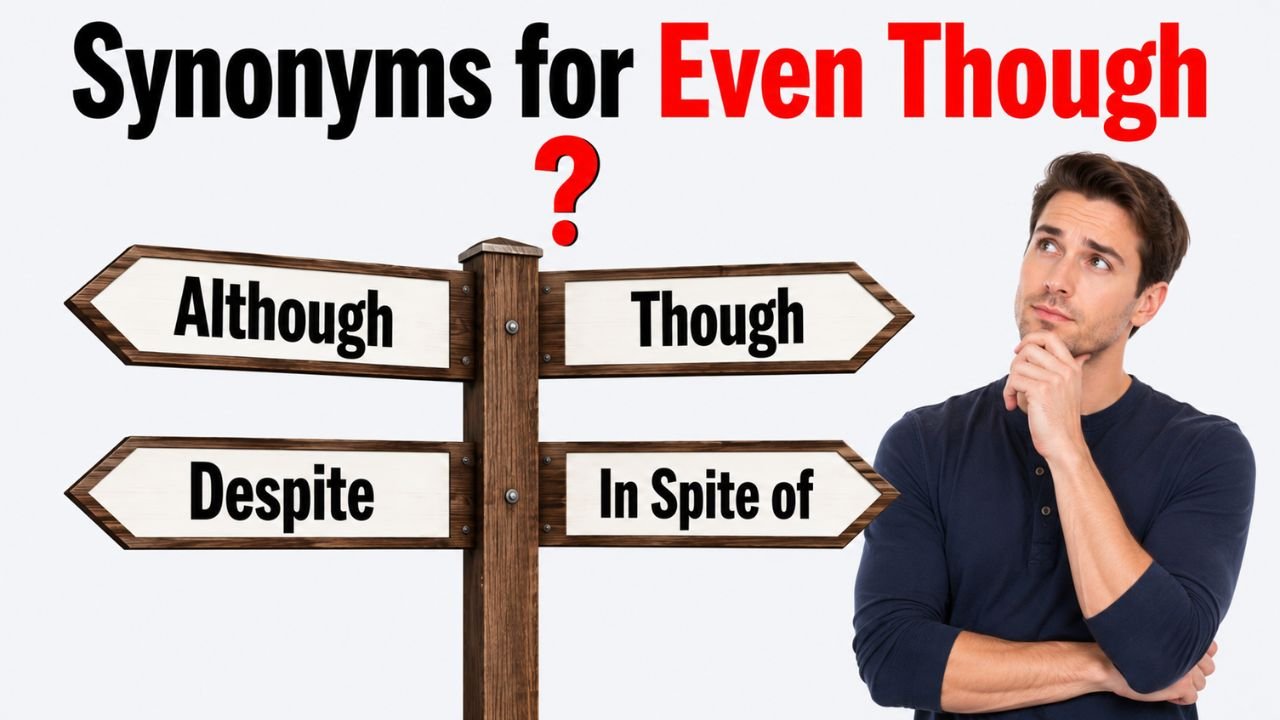
Quick Answer: The best synonyms for even though include although, though, despite the fact that, in spite of the fact that, while, notwithstanding the fact that, much as, nevertheless, nonetheless, and even so. Use although in formal and general writing, though in casual speech, despite the fact that for strong contrast, and nevertheless when starting a separate sentence. The best replacement depends on sentence structure, tone, and the type of contrast being expressed.
Pronunciation and Word Details
Word: Even though
Pronunciation: /ˌiːvən ˈðoʊ/
Part of Speech: Subordinating conjunction
Meaning: Used to introduce a fact that makes the main statement surprising or unexpected.
US Pronunciation:
UK Pronunciation:
What Does “Even Though” Mean?
Even though means despite the fact that something is true. It introduces a contrast between two real situations, especially when the result is surprising or unexpected.
Even though functions as a subordinating conjunction. It connects a dependent clause to a main clause.
Example: Even though it was raining, they continued their journey.
The rain might normally cause the journey to stop, but the travelers continued. This creates a strong contrast between an existing condition and an unexpected result.
Even though can appear at the beginning or in the middle of a sentence.
Beginning Position: Even though she was tired, she completed the assignment.
Middle Position: She completed the assignment even though she was tired.
The meaning remains the same in both positions, but punctuation changes according to the sentence structure.
Meaning, Tone, and Context of “Even Though”
Even though has a neutral and slightly emphatic tone. It is suitable for everyday conversation, essays, reports, emails, explanations, and most forms of general writing.
The phrase introduces a concession. A concession recognizes that one fact is true while showing that another fact remains true despite it.
Even though is stronger than although and though in many sentences. The word even adds emphasis and makes the contrast feel more surprising.
Neutral Contrast: Although the task was difficult, she finished it.
Stronger Contrast: Even though the task was extremely difficult, she finished it.
In formal writing, although or despite the fact that may create a smoother sentence. In casual conversation, though is often the most natural alternative. Nevertheless and nonetheless are useful when the contrast begins a new sentence.
When and How to Use “Even Though”
For Unexpected Results: Use even though when a result occurs despite a condition that should have prevented it.
Example: Even though the road was blocked, the driver found another route.
For Strong Contrast: Use it when two facts appear to oppose each other.
Example: The room felt cold even though the heating was on.
For Recognizing Difficulty: Use it to acknowledge an obstacle before describing progress or success.
Example: Even though the examination was challenging, she remained confident.
For Personal Decisions: Use it when a person acts despite having a reason not to act.
Example: He attended the meeting even though he felt unwell.
For Surprising Behavior: Use it when someone’s behavior does not match the surrounding circumstances.
Example: Even though she knew the answer, she remained silent.
For Formal Explanations: Use it when explaining why a condition did not affect the final result.
Example: The experiment succeeded even though the available equipment was limited.
For Emotional Contrast: Use it when feelings and actions appear inconsistent.
Example: Even though he was disappointed, he congratulated the winner.
For Comparing Expectations With Reality: Use it when the actual result differs from what people expected.
Example: Even though the restaurant was crowded, the service was quick.
Best Synonyms for Even Though
Although: Introduces a true fact that contrasts with the main statement.
Example: Although the weather was unpleasant, the event continued.
Though: A common and slightly more conversational alternative to although.
Example: Though she was nervous, she delivered an excellent speech.
Despite the Fact That: Emphasizes that the contrasting condition is real.
Example: They continued working despite the fact that the power was unreliable.
In Spite of the Fact That: Shows that something happened regardless of an opposing fact.
Example: In spite of the fact that he lacked experience, he performed well.
While: Introduces a contrast or concession, especially in formal and balanced sentences.
Example: While the plan is expensive, it may produce better results.
Notwithstanding the Fact That: A highly formal phrase meaning despite the truth of something.
Example: The agreement remained valid notwithstanding the fact that circumstances had changed.
Much As: Recognizes a feeling or fact before introducing an opposing point.
Example: Much as I respect her opinion, I cannot agree with the decision.
Nevertheless: Connects two contrasting statements and means despite that.
Example: The journey was difficult. Nevertheless, everyone reached the destination safely.
Nonetheless: Means despite what has just been stated.
Example: The evidence was limited. Nonetheless, the researchers reached a reasonable conclusion.
Even So: Introduces a result that remains true despite a previous statement.
Example: The instructions were confusing. Even so, we completed the task correctly.
50 Synonyms for Even Though with Short Meanings
- Although: Introduces a fact that contrasts with another statement.
- Though: A common and conversational form of although.
- Despite the Fact That: Emphasizes a real condition that did not change the result.
- In Spite of the Fact That: Shows that something happened despite an opposing fact.
- Notwithstanding the Fact That: A formal phrase meaning despite the truth that.
- Notwithstanding That: A formal conjunction introducing a contrasting fact.
- While: Introduces a concession or balanced contrast.
- Whereas: Presents a contrast between two facts or situations.
- Albeit: Introduces a brief qualification or contrasting detail.
- Much As: Acknowledges a fact or feeling before presenting opposition.
- For All That: Means despite everything already mentioned.
- Regardless of the Fact That: Shows that a fact did not affect the outcome.
- Granted That: Accepts a fact before presenting a different conclusion.
- While It Is True That: Formally recognizes a fact before introducing contrast.
- Although It Is True That: Introduces an accepted fact followed by an opposing point.
- Even So: Means despite the situation just mentioned.
- Nevertheless: Shows that the next statement remains true despite the first.
- Nonetheless: Introduces a result unaffected by a previous fact.
- However: Connects ideas that contrast with each other.
- Still: Shows that something remains true despite a difficulty.
- Yet: Introduces a surprising or opposing result.
- All the Same: Means despite what has happened or been stated.
- That Said: Introduces a contrast to the previous statement.
- Having Said That: Recognizes the previous point before giving another view.
- Be That As It May: Accepts a fact while introducing an opposing conclusion.
- Despite This: Shows that the previous situation did not change the result.
- In Spite of This: Means regardless of the condition just mentioned.
- Notwithstanding This: A formal way to say despite this.
- Despite That: Shows that a previously stated fact did not prevent something.
- In Spite of That: Introduces a result that happened regardless of a fact.
- Regardless of That: Shows that something remains true without considering a fact.
- Despite: Introduces a noun or phrase describing an opposing condition.
- In Spite of: Means without being prevented by a condition.
- Notwithstanding: A formal preposition meaning despite.
- Regardless of: Means without being affected by something.
- For All: Means despite the existence or amount of something.
- Despite Being: Introduces a contrasting state or quality.
- In Spite of Being: Shows that a condition did not prevent the result.
- Despite Having: Introduces a possession or experience that created contrast.
- In Spite of Having: Means regardless of possessing or experiencing something.
- Despite Knowing That: Shows that an action happened even with particular knowledge.
- In Spite of Knowing That: Emphasizes action taken despite awareness of a fact.
- Despite How: Introduces contrast involving degree or manner.
- In Spite of How: Shows that degree or manner did not affect the result.
- No Matter How: Means regardless of the degree or manner involved.
- Regardless of How: Shows that the method or degree makes no difference.
- Despite What: Introduces contrast involving something said, done, or known.
- In Spite of What: Means regardless of an action, statement, or event.
- No Matter What: Means regardless of any condition or event.
- Regardless of What: Shows that the result will not be changed by another factor.
Read Also:
Synonyms for Play

Synonyms for Even Though by Context
When Even Though Introduces a Direct Contrast
Although, though, while, and whereas can introduce two contrasting facts within one sentence.
Example: Although the house is small, it feels comfortable.
Although is the closest general replacement. Though sounds more conversational, while is useful for balanced arguments, and whereas usually emphasizes a comparison between two subjects.
When Even Though Emphasizes a Real Fact
Despite the fact that, in spite of the fact that, and notwithstanding the fact that strongly recognize that the contrasting condition is true.
Example: Despite the fact that the deadline was close, the team checked every detail.
These alternatives are longer than even though. They are useful when the writer wants to emphasize the reality or importance of the condition.
When Even Though Connects Separate Sentences
Nevertheless, nonetheless, however, even so, still, and yet introduce contrast after a full sentence.
Example: The journey took several hours. Nevertheless, the travelers remained cheerful.
These words cannot always replace even though directly because they require a new sentence structure and different punctuation.
When Even Though Acknowledges an Opinion
Granted that, while it is true that, much as, that said, and having said that recognize one viewpoint before introducing another.
Example: Granted that the proposal has risks, it also offers valuable opportunities.
These expressions are especially useful in essays, discussions, reviews, and persuasive writing.
When Even Though Is Followed by a Noun Idea
Despite, in spite of, notwithstanding, and regardless of can replace even though when the following clause is changed into a noun, pronoun, or gerund phrase.
Original: Even though she was tired, she continued working.
Better Option: Despite her tiredness, she continued working.
Better Option: Despite being tired, she continued working.
When Even Though Expresses Determination
No matter what, no matter how, regardless of what, and regardless of how are useful when the sentence expresses determination or an outcome that will not change.
Example: No matter how difficult the work becomes, we will complete it.
These phrases are broader than even though because they may refer to unknown or future conditions rather than established facts.
Another Word for Even Though
Although is usually the best single replacement for even though. It has almost the same grammatical function and can introduce a dependent clause without requiring major sentence changes.
However, although may sound slightly less emphatic. The best alternative depends on whether the writer needs formal contrast, conversational language, stronger emphasis, or a separate transition.
Original: Even though the room was crowded, everyone remained comfortable.
Better Option: Although the room was crowded, everyone remained comfortable.
Original: She accepted the responsibility even though she was inexperienced.
Better Option: She accepted the responsibility despite the fact that she was inexperienced.
Original: Even though I understand your concern, I support the proposal.
Better Option: While I understand your concern, I support the proposal.
Original: The task was demanding. They completed it on time.
Better Option: The task was demanding. Nevertheless, they completed it on time.
When Not to Use “Even Though”
Do not use even though when the condition is uncertain or hypothetical. Even though normally introduces a fact that is known to be true. Use even if when the condition may or may not happen.
Weak: Even though it rains tomorrow, we will leave early.
Better: Even if it rains tomorrow, we will leave early.
Avoid even though when a shorter expression would make formal writing clearer.
Weak: Even though there was a shortage of resources, the project continued.
Better: Despite the resource shortage, the project continued.
Do not combine even though with but in the same sentence. Both words introduce contrast, so using both creates an unnecessary double connection.
Weak: Even though she was tired, but she continued working.
Better: Even though she was tired, she continued working.
Avoid repeating even though in several nearby sentences.
Weak: Even though it was late, we continued. Even though we were tired, we remained focused.
Better: Although it was late, we continued. Despite our tiredness, we remained focused.
Do not use even though when you are explaining a cause rather than a contrast.
Weak: Even though the road was closed, we had to change our route.
Better: Because the road was closed, we had to change our route.
Words Commonly Confused With Even Though
Even Though vs Although: Both introduce a true contrasting fact. Even though usually adds stronger emphasis and greater surprise.
Even Though vs Though: Though has a similar meaning but sounds more conversational. It can also appear at the end of a sentence, while even though cannot normally be used there.
Even Though vs Even If: Even though introduces a known fact. Even if introduces an uncertain, imagined, or possible condition.
Even Though vs Despite: Even though is followed by a subject and verb. Despite is usually followed by a noun, pronoun, or gerund.
Even Though vs In Spite Of: Even though introduces a complete clause. In spite of introduces a noun phrase or an ing form.
Even Though vs However: Even though connects a dependent clause to a main clause. However usually connects separate statements and requires different punctuation.
Even Though vs Whereas: Even though expresses concession and an unexpected result. Whereas often compares two different people, facts, or situations.
Even Though vs Nevertheless: Even though introduces a dependent clause. Nevertheless is a sentence transition meaning despite what was just stated.
Which Synonym Should You Choose?
Choose although for most formal, academic, and general writing when you need a direct replacement.
Choose though for casual speech, friendly messages, and conversational writing.
Choose despite the fact that when you want to emphasize that the opposing condition is real.
Choose in spite of the fact that when strong contrast matters more than brevity.
Choose while when politely acknowledging one point before presenting another.
Choose notwithstanding the fact that in highly formal, official, or technical language.
Choose much as when recognizing a feeling, preference, or opinion before disagreeing.
Choose nevertheless or nonetheless when the contrasting idea begins a separate sentence.
Choose however when contrasting two complete statements in reports, essays, or professional communication.
Choose despite when you can change the following clause into a noun or gerund phrase.
Choose even if when the condition is uncertain rather than known to be true.
Real Life Examples of “Even Though” in Sentences
Original: Even though the shop was busy, the staff remained helpful.
Better Option: Although the shop was busy, the staff remained helpful.
Original: She went for a walk even though the weather was cold.
Better Option: She went for a walk despite the cold weather.
Original: Even though he lacked experience, he completed the task successfully.
Better Option: In spite of his limited experience, he completed the task successfully.
Original: Even though the evidence was limited, the conclusion was reasonable.
Better Option: While the evidence was limited, the conclusion was reasonable.
Original: They continued the event even though heavy rain had begun.
Better Option: They continued the event despite the fact that heavy rain had begun.
Original: Even though I respect his opinion, I disagree with his conclusion.
Better Option: Much as I respect his opinion, I disagree with his conclusion.
Original: The instructions were difficult even though they appeared simple.
Better Option: The instructions appeared simple, yet they were difficult.
Original: Even though the journey was long, no one complained.
Better Option: The journey was long. Nevertheless, no one complained.
Original: She smiled even though she felt disappointed.
Better Option: She smiled in spite of feeling disappointed.
Original: Even though the plan involves risk, it could produce excellent results.
Better Option: Granted that the plan involves risk, it could produce excellent results.
Synonym Groups and Usage Differences
Direct Conjunction Group
This group includes although, though, while, whereas, and notwithstanding that. These words can introduce a clause containing a subject and verb.
Example: Although the answer was unexpected, it was correct.
Although and though are the closest general alternatives. While and whereas often create a more balanced comparison.
Strong Concession Group
This group includes despite the fact that, in spite of the fact that, regardless of the fact that, and notwithstanding the fact that.
These expressions emphasize that the condition is real but did not prevent the result.
Example: Despite the fact that the road was narrow, the driver continued safely.
Sentence Transition Group
This group includes nevertheless, nonetheless, however, even so, still, yet, and all the same.
These alternatives normally connect complete thoughts rather than introducing dependent clauses.
Example: The available time was limited. Nonetheless, the group completed the work.
Formal Acknowledgment Group
This group includes granted that, while it is true that, although it is true that, and be that as it may.
These expressions accept a point before introducing a different conclusion.
Example: While it is true that the process is slow, it produces accurate results.
Noun Phrase Group
This group includes despite, in spite of, notwithstanding, regardless of, and for all.
These words are followed by nouns, pronouns, or gerunds rather than complete clauses.
Example: Despite feeling nervous, she spoke clearly.
Determination Group
This group includes no matter what, no matter how, regardless of what, and regardless of how.
These phrases show that an action, decision, or result will not change.
Example: No matter how difficult the challenge becomes, the team will continue.
Antonyms of Even Though
Even though expresses contrast or concession, so its opposites are words that introduce cause, agreement, expected results, or direct consequence.
Because: Introduces the reason something happened.
Since: Explains a cause or reason.
As: Introduces a reason in a neutral way.
Therefore: Presents a logical result or consequence.
Consequently: Shows that one event directly resulted from another.
Thus: Introduces a conclusion or expected outcome.
So: Connects a cause with its result in everyday language.
Accordingly: Shows that an action follows logically from the facts.
Because of the Fact That: Explicitly introduces a cause rather than a contrast.
As a Result: Presents an outcome caused by the previous condition.
Comparison: Even Though vs Related Words
Even Though vs Although
Even though and although introduce real contrasting facts. Even though usually creates stronger emphasis.
Example With Even Though: Even though he was exhausted, he continued running.
Example With Although: Although he was exhausted, he continued running.
Even Though vs Though
Though is shorter and more conversational. It may also appear at the end of a sentence as an informal contrast marker.
Example With Even Though: She attended even though she felt unwell.
Example With Though: She felt unwell. She attended, though.
Even Though vs Even If
Even though introduces a condition known to be true. Even if introduces a possible or imagined condition.
Example With Even Though: Even though it is raining, we are leaving.
Example With Even If: Even if it rains, we will leave.
Even Though vs Despite
Even though is followed by a complete clause. Despite is followed by a noun, pronoun, or gerund phrase.
Example With Even Though: Even though she was tired, she continued.
Example With Despite: Despite being tired, she continued.
Even Though vs While
Even though emphasizes an unexpected outcome. While often presents a more balanced or polite contrast.
Example With Even Though: Even though the plan is costly, we will approve it.
Example With While: While the plan is costly, it offers lasting benefits.
Even Though vs However
Even though joins a dependent clause with a main clause. However normally connects two complete sentences or independent thoughts.
Example With Even Though: Even though it was difficult, we succeeded.
Example With However: It was difficult. However, we succeeded.
Even Though vs Nevertheless
Even though introduces the opposing condition. Nevertheless introduces the result that remains true despite that condition.
Example With Even Though: Even though the route was dangerous, they continued.
Example With Nevertheless: The route was dangerous. Nevertheless, they continued.
Common Phrases and Expressions With “Even Though”
Even Though It Was Difficult: Used when something happened despite difficulty.
Even Though I Know: Introduces an action or feeling that conflicts with personal knowledge.
Even Though It Seems: Contrasts an appearance with the actual situation.
Even Though You May: Recognizes a possible opinion, feeling, or condition.
Even Though We Tried: Shows that an effort did not produce the expected result.
Even Though They Had: Introduces a contrast involving something already possessed or experienced.
Even Though This Is True: Accepts a fact before introducing another point.
Even Though There Are: Recognizes the existence of problems, differences, or limitations.
Even Though He Said: Contrasts someone’s statement with another fact or action.
Even Though She Felt: Shows that an action occurred despite an emotion or physical condition.
Common Mistakes to Avoid
A common mistake is using even though and but together. Even though already introduces contrast, so but is unnecessary in the same sentence.
Incorrect: Even though the task was difficult, but we completed it.
Correct: Even though the task was difficult, we completed it.
Writers also confuse even though with even if. Use even though for facts and even if for uncertain possibilities.
Fact: Even though she is busy, she answers every message.
Possibility: Even if she is busy, she will answer the message.
Another mistake is placing despite before a complete clause without adding the fact that.
Incorrect: Despite she was tired, she continued.
Correct: Despite being tired, she continued.
Correct: Despite the fact that she was tired, she continued.
Use a comma after an introductory even though clause.
Correct: Even though the office was closed, the staff answered urgent calls.
A comma is not normally needed when the even though clause comes after the main clause.
Correct: The staff answered urgent calls even though the office was closed.
Avoid using formal alternatives such as notwithstanding the fact that in relaxed conversation. Similarly, avoid casual choices such as though when a highly formal sentence requires a more precise tone.
Conclusion
Understanding synonyms for even though helps you express contrast with greater clarity and variety. Although is the closest general replacement, while though suits casual conversation. Use despite the fact that for strong emphasis, while for balanced arguments, and nevertheless for contrast between separate sentences. Despite and in spite of are useful when the sentence can be changed into a noun or gerund structure. Always consider grammar, tone, and whether the condition is factual or only possible before choosing an alternative.
FAQs About Synonyms for Even Though
What is the best synonym for even though?
Although is usually the best direct synonym because it has the same grammatical function and works in both formal and general writing.
Is though the same as even though?
Though has a similar meaning, but it is usually less emphatic and more conversational than even though.
Can despite replace even though?
Yes, but the sentence structure must change. Even though is followed by a clause, while despite is followed by a noun, pronoun, or gerund.
What is a formal alternative to even though?
Although, notwithstanding the fact that, while it is true that, and despite the fact that are useful formal alternatives.
What is the difference between even though and even if?
Even though introduces a known fact. Even if introduces an uncertain, imagined, or future condition.
Can however replace even though?
However can express the same general contrast, but it usually connects separate sentences and requires different punctuation.
Is even though stronger than although?
Yes. Even though often emphasizes that the result is especially surprising despite the stated condition.
