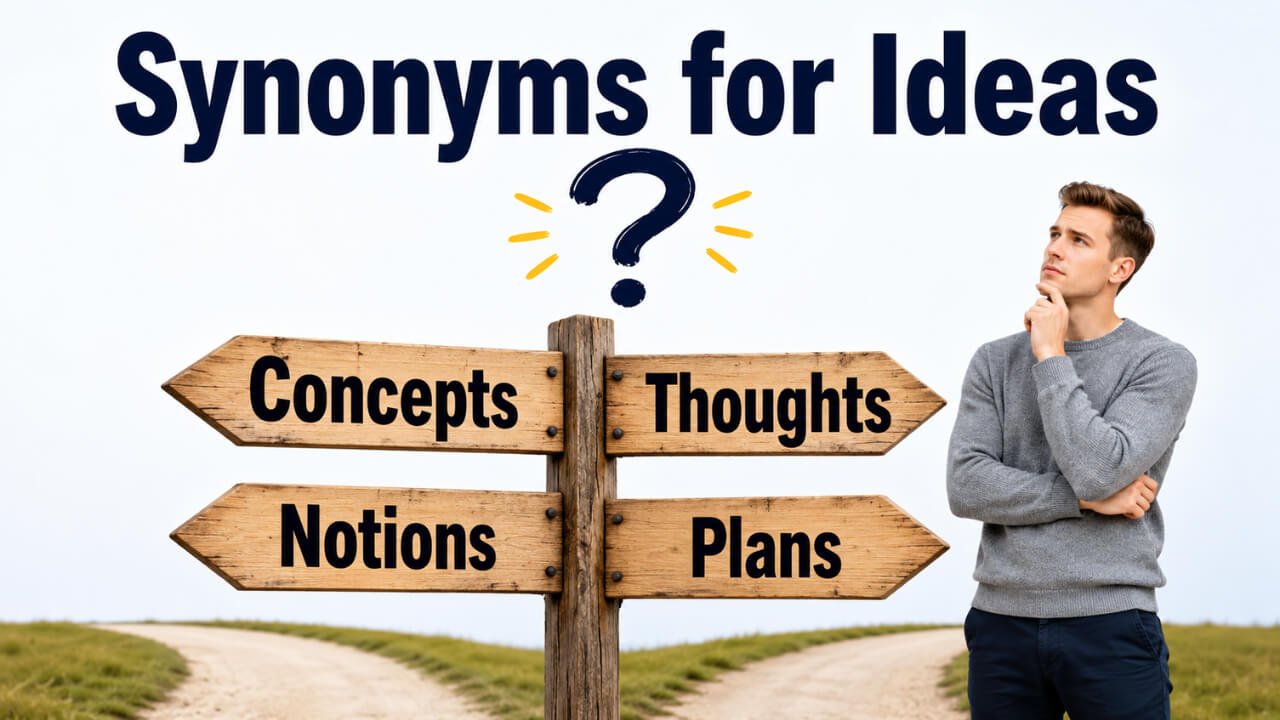
Quick Answer: Synonyms for ideas include thoughts, concepts, notions, views, opinions, plans, suggestions, proposals, insights, and theories. Use concepts for formal or academic writing, thoughts for casual expression, suggestions when sharing possible actions, proposals for business or official plans, views for personal beliefs, and insights for deeper understanding. The best synonym for ideas depends on whether you mean creative thoughts, opinions, plans, mental images, or possible solutions.
Pronunciation and Word Details
Word: Ideas
Pronunciation: /aɪˈdiːəz/
Part of Speech: Noun
Meaning: Ideas are thoughts, plans, opinions, suggestions, or mental concepts formed in the mind.
US Pronunciation:
UK Pronunciation:
What Do “Ideas” Mean?
Ideas mean thoughts, plans, beliefs, suggestions, or concepts that a person thinks about, creates, or shares. The word ideas is the plural form of idea, and it is commonly used when talking about thinking, creativity, problem solving, opinions, and planning.
Ideas can be simple or complex. In casual speech, ideas may mean thoughts or suggestions. In academic writing, ideas often mean concepts, theories, arguments, or interpretations. In business, ideas may refer to plans, proposals, strategies, or solutions.
Example: She shared several ideas for improving the project.
Example: His ideas about education are thoughtful and practical.
Meaning, Tone, and Context of “Ideas”
Ideas is a neutral and flexible word. It can sound casual, formal, creative, academic, or professional depending on the sentence. In everyday conversation, ideas often means thoughts or suggestions. In writing, ideas can mean concepts, arguments, themes, or viewpoints.
The word is common in school, work, writing, planning, research, design, discussion, and problem solving. It is not emotional by itself, but it can become strong when paired with words like brilliant, fresh, original, powerful, or controversial.
For more precise writing, choose a synonym that matches the meaning. Use concepts for abstract understanding, plans for action, opinions for personal views, suggestions for advice, and insights for deep understanding.
When and How to Use “Ideas”
For Creative Thinking: Use ideas when talking about new thoughts, imagination, or invention.
Example: We need fresh ideas for the campaign.
For Suggestions: Use ideas when someone gives possible choices or solutions.
Example: Do you have any ideas for dinner?
For Opinions: Use ideas when referring to beliefs, views, or personal thinking.
Example: Her ideas about leadership are very clear.
For Planning: Use ideas when discussing possible actions, methods, or future steps.
Example: They discussed ideas for the next project.
For Academic Writing: Use ideas when referring to concepts, arguments, theories, or themes.
Example: The essay explains several important ideas about freedom.
Best Synonyms for Ideas
Thoughts: Things formed in the mind.
Example: She wrote down her thoughts after the meeting.
Concepts: General mental understandings or abstract ideas.
Example: The lesson explains basic concepts in grammar.
Notions: Simple ideas, beliefs, or impressions.
Example: He had a strange notion about how the system worked.
Views: Personal opinions or beliefs.
Example: Her views on education are practical and balanced.
Opinions: Personal judgments or beliefs about something.
Example: Everyone shared their opinions during the discussion.
Plans: Ideas about what to do in the future.
Example: We made plans for the new website.
Suggestions: Ideas offered for consideration.
Example: The teacher gave useful suggestions for improvement.
Proposals: Formal ideas or plans presented for approval.
Example: The team submitted three proposals.
Insights: Deep or clear understandings of something.
Example: His insights helped us understand the problem.
Theories: Organized ideas that explain something.
Example: Scientists discussed several theories about the results.
50 Synonyms for Ideas with Short Meanings
- Thoughts: Things formed in the mind.
- Concepts: Abstract or general ideas.
- Notions: Simple beliefs or impressions.
- Views: Personal ways of thinking.
- Opinions: Personal judgments or beliefs.
- Plans: Ideas for future action.
- Suggestions: Ideas offered for consideration.
- Proposals: Formal plans or recommendations.
- Insights: Deep understandings or realizations.
- Theories: Organized explanations or possibilities.
- Beliefs: Things accepted as true.
- Impressions: Feelings or first thoughts about something.
- Perceptions: Ways of seeing or understanding something.
- Perspectives: Particular points of view.
- Concepts: Mental models or general meanings.
- Understandings: Knowledge or interpretation of something.
- Reflections: Careful thoughts about something.
- Considerations: Thoughts taken into account.
- Assumptions: Ideas accepted without full proof.
- Possibilities: Things that may happen or be true.
- Solutions: Ideas that solve problems.
- Strategies: Planned ways to reach a goal.
- Approaches: Ways of dealing with something.
- Methods: Planned ways of doing something.
- Designs: Planned ideas for structure or style.
- Schemes: Organized plans or ideas.
- Blueprints: Detailed plans or models.
- Visions: Clear mental pictures of what could happen.
- Dreams: Hopes or imagined future possibilities.
- Inspirations: Ideas that spark creativity.
- Brainstorms: Many ideas produced quickly.
- Suggestions: Helpful ideas for action.
- Recommendations: Advice based on judgment.
- Advice: Guidance or useful suggestions.
- Input: Ideas or comments given to help.
- Feedback: Reactions or suggestions about something.
- Points: Specific ideas in speech or writing.
- Arguments: Ideas used to support a position.
- Themes: Main ideas in writing or discussion.
- Messages: Main meanings or ideas communicated.
- Principles: Basic ideas or rules.
- Values: Important beliefs or standards.
- Ideals: Perfect standards or guiding ideas.
- Conclusions: Final ideas reached after thinking.
- Interpretations: Ways of explaining meaning.
- Observations: Ideas based on noticing details.
- Findings: Ideas or results discovered through study.
- Hypotheses: Testable ideas or explanations.
- Innovations: New and useful ideas.
- Inventions: New ideas made into something practical.
Read Also:
Synonyms for Ask

Synonyms for Ideas by Context
When Ideas Means Thoughts
Use these synonyms when ideas means mental activity, thinking, or something in the mind.
Thoughts: She kept her thoughts private during the meeting.
Reflections: His reflections on the book were meaningful.
Considerations: Safety was one of our main considerations.
Impressions: My first impressions of the place were positive.
When Ideas Means Concepts
Use these synonyms when ideas means abstract meanings, subjects, or principles.
Concepts: Students learned key concepts in writing.
Principles: The lesson explained basic principles of grammar.
Themes: The story explores themes of courage and change.
Understandings: Different cultures may have different understandings of respect.
When Ideas Means Opinions
Use these synonyms when ideas means personal beliefs, views, or judgments.
Views: Her views on teamwork are thoughtful.
Opinions: Everyone expressed their opinions respectfully.
Perspectives: The article presents several perspectives on learning.
Beliefs: His beliefs shaped his decisions.
When Ideas Means Plans
Use these synonyms when ideas means possible actions or future steps.
Plans: We discussed plans for the next lesson.
Strategies: The manager shared strategies for growth.
Approaches: The teacher tried different approaches.
Proposals: The committee reviewed several proposals.
When Ideas Means Suggestions
Use these synonyms when ideas means advice or possible choices.
Suggestions: She gave practical suggestions for improvement.
Recommendations: His recommendations helped the team decide.
Advice: I followed her advice carefully.
Input: We need your input before making changes.
Another Word for Ideas
Another word for ideas is thoughts when you mean things formed in the mind. However, the best replacement depends on context. Use concepts for academic or abstract ideas, suggestions for possible actions, plans for future steps, and opinions for personal beliefs.
Original: She shared her ideas about the story.
Better Option: She shared her thoughts about the story.
Original: The teacher explained the main ideas of the lesson.
Better Option: The teacher explained the main concepts of the lesson.
Original: Do you have any ideas for improving this page?
Better Option: Do you have any suggestions for improving this page?
Original: Their ideas for the project were detailed.
Better Option: Their plans for the project were detailed.
When Not to Use “Ideas”
Do not use ideas when a more exact word would make the sentence clearer. Ideas can sound too general if you are writing about formal plans, expert advice, research results, personal beliefs, or main points in an essay.
Use proposals for formal plans, concepts for academic topics, opinions for personal judgments, insights for deep understanding, and solutions for answers to problems.
Weak: The report includes good ideas.
Better: The report includes practical recommendations.
Weak: The essay discusses many ideas.
Better: The essay discusses several major themes.
Weak: Her ideas about the issue were strong.
Better: Her opinions about the issue were strong.
Weak: We need ideas for fixing the problem.
Better: We need solutions for fixing the problem.
Words Commonly Confused With Ideas
Ideas vs Thoughts: Ideas are often more developed, while thoughts can be quick, personal, or unfinished.
Ideas vs Concepts: Ideas is general, while concepts are more abstract and often used in learning, theory, or academic writing.
Ideas vs Opinions: Ideas may be suggestions, plans, or thoughts, while opinions are personal judgments or beliefs.
Ideas vs Plans: Ideas may be possible thoughts, while plans are more organized and action focused.
Ideas vs Suggestions: Ideas can be broad, while suggestions are ideas offered to help someone decide or improve something.
Ideas vs Insights: Ideas can be simple or general, while insights show deep understanding.
Ideas vs Theories: Ideas can be any thoughts, while theories are organized explanations based on reasoning or evidence.
Which Synonym Should You Choose?
Choose thoughts when writing about personal thinking, reflection, or casual expression.
Choose concepts when writing about learning, theory, grammar, education, or abstract meaning.
Choose opinions when writing about personal beliefs, judgments, or viewpoints.
Choose views when discussing someone’s position on a topic.
Choose suggestions when offering possible actions or helpful advice.
Choose recommendations when giving stronger advice based on experience or judgment.
Choose plans when the ideas are connected to future action.
Choose proposals when the ideas are formal and need approval.
Choose insights when the ideas show deep understanding.
Choose solutions when the ideas are meant to fix a problem.
Real Life Examples of “Ideas” in Sentences
Original: She shared her ideas after the meeting.
Better Option: She shared her thoughts after the meeting.
Original: The book explains important ideas about courage.
Better Option: The book explains important themes about courage.
Original: We need ideas for solving this issue.
Better Option: We need solutions for solving this issue.
Original: His ideas about health are practical.
Better Option: His views about health are practical.
Original: The teacher explained difficult ideas clearly.
Better Option: The teacher explained difficult concepts clearly.
Original: They presented new ideas to the manager.
Better Option: They presented new proposals to the manager.
Original: I like your ideas for the article.
Better Option: I like your suggestions for the article.
Original: Her ideas helped us understand the topic.
Better Option: Her insights helped us understand the topic.
Original: The team discussed ideas for next month.
Better Option: The team discussed plans for next month.
Original: The study introduced several ideas.
Better Option: The study introduced several theories.
Synonym Groups and Usage Differences
Thought Group
This group includes words related to mental activity and personal reflection. Use thoughts, reflections, impressions, and considerations when ideas are personal or internal.
Example: His reflections on the problem were thoughtful.
Concept Group
This group works best for abstract, academic, or educational meaning. Use concepts, principles, themes, and understandings when writing about learning or theory.
Example: The article explains key concepts in communication.
Opinion Group
This group includes words for personal belief or judgment. Use opinions, views, perspectives, and beliefs when ideas show what someone thinks about a topic.
Example: Different people have different perspectives on success.
Planning Group
This group refers to future action. Use plans, strategies, approaches, and proposals when ideas are practical and organized.
Example: The team created strategies for better results.
Solution Group
This group is best for problem solving. Use solutions, recommendations, advice, and input when ideas are meant to help or improve something.
Example: Her recommendations made the process easier.
Antonyms of Ideas
The opposite of ideas depends on meaning. If ideas means thoughts, antonyms may relate to confusion or lack of thought. If ideas means plans, antonyms may suggest inaction or uncertainty.
Confusion: Lack of clear understanding.
Ignorance: Lack of knowledge or awareness.
Uncertainty: Lack of a clear thought or decision.
Doubt: Lack of confidence in an idea.
Silence: Absence of expressed thoughts.
Inaction: Lack of action or planning.
Fact: Something known to be true, not just an idea.
Reality: What actually exists, not only what is imagined.
Proof: Evidence that supports or confirms something.
Disagreement: A different view or rejection of an idea.
Comparison: Ideas vs Related Words
Ideas vs Thoughts
Ideas are often more shaped or useful, while thoughts may be casual, personal, or unfinished.
Example With Ideas: Her ideas for the lesson were helpful.
Example With Thoughts: Her thoughts about the lesson were honest.
Ideas vs Concepts
Ideas is a broad everyday word. Concepts are usually more abstract, organized, or academic.
Example With Ideas: The article has many useful ideas.
Example With Concepts: The article explains many useful concepts.
Ideas vs Opinions
Ideas can be plans, thoughts, or suggestions. Opinions are personal judgments about something.
Example With Ideas: He shared ideas for the new design.
Example With Opinions: He shared opinions about the new design.
Ideas vs Suggestions
Ideas can be broad or undeveloped. Suggestions are ideas offered as possible advice or action.
Example With Ideas: I have some ideas for the project.
Example With Suggestions: I have some suggestions for the project.
Ideas vs Plans
Ideas may still be early thoughts. Plans are more organized and ready for action.
Example With Ideas: We discussed ideas for the event.
Example With Plans: We discussed plans for the event.
Ideas vs Insights
Ideas can be simple thoughts. Insights show deeper understanding or a clearer view of something.
Example With Ideas: The speaker gave us new ideas.
Example With Insights: The speaker gave us valuable insights.
Common Phrases and Expressions With Ideas
Big Ideas: Important or ambitious thoughts.
New Ideas: Fresh thoughts or suggestions.
Fresh Ideas: Original or creative thoughts.
Creative Ideas: Imaginative or inventive thoughts.
Good Ideas: Useful or sensible thoughts.
Bad Ideas: Unwise or risky thoughts.
Main Ideas: The most important points or meanings.
Bright Ideas: Clever or useful thoughts.
Original Ideas: New thoughts that are not copied.
Share Ideas: To express thoughts or suggestions with others.
Common Mistakes to Avoid
A common mistake is using ideas too often when a more specific word would improve meaning. For example, use concepts in academic writing, opinions for personal beliefs, suggestions for advice, and plans for future action.
Another mistake is treating every idea as a fact. An idea may be possible, creative, or interesting, but it is not always proven. Use words like theory, assumption, or hypothesis when the meaning is uncertain.
Avoid vague phrases like “many ideas” when the reader needs detail. Say several proposals, three solutions, or key themes if that is what you mean.
Also avoid using highly formal synonyms in casual sentences. For example, proposals may sound too official when you simply mean dinner ideas or weekend thoughts.
Conclusion
Synonyms for ideas help you write with more clarity and purpose. Use thoughts for personal thinking, concepts for academic meaning, opinions for beliefs, suggestions for advice, plans for future action, and insights for deeper understanding. The word ideas is useful and natural, but stronger writing often needs a more exact synonym. Choose the word that best matches your context, tone, and purpose.
FAQs About Synonyms for Ideas
What are the best synonyms for ideas?
The best synonyms for ideas are thoughts, concepts, notions, views, opinions, plans, suggestions, proposals, insights, and theories.
What is a formal synonym for ideas?
A formal synonym for ideas is concepts. Other formal options include proposals, theories, principles, recommendations, and perspectives.
What is another word for creative ideas?
Another word for creative ideas is inspirations. You can also use innovations, concepts, visions, or original thoughts.
What is another word for ideas in an essay?
In an essay, strong alternatives include concepts, themes, arguments, points, interpretations, and perspectives.
What is the difference between ideas and opinions?
Ideas can be thoughts, plans, or suggestions. Opinions are personal beliefs or judgments about a topic.
What is another word for ideas in business writing?
In business writing, use proposals, plans, strategies, recommendations, solutions, or approaches, depending on the context.
What is the best synonym for ideas in casual speech?
The best casual synonym for ideas is thoughts. It sounds natural when talking about personal thinking or simple suggestions.
