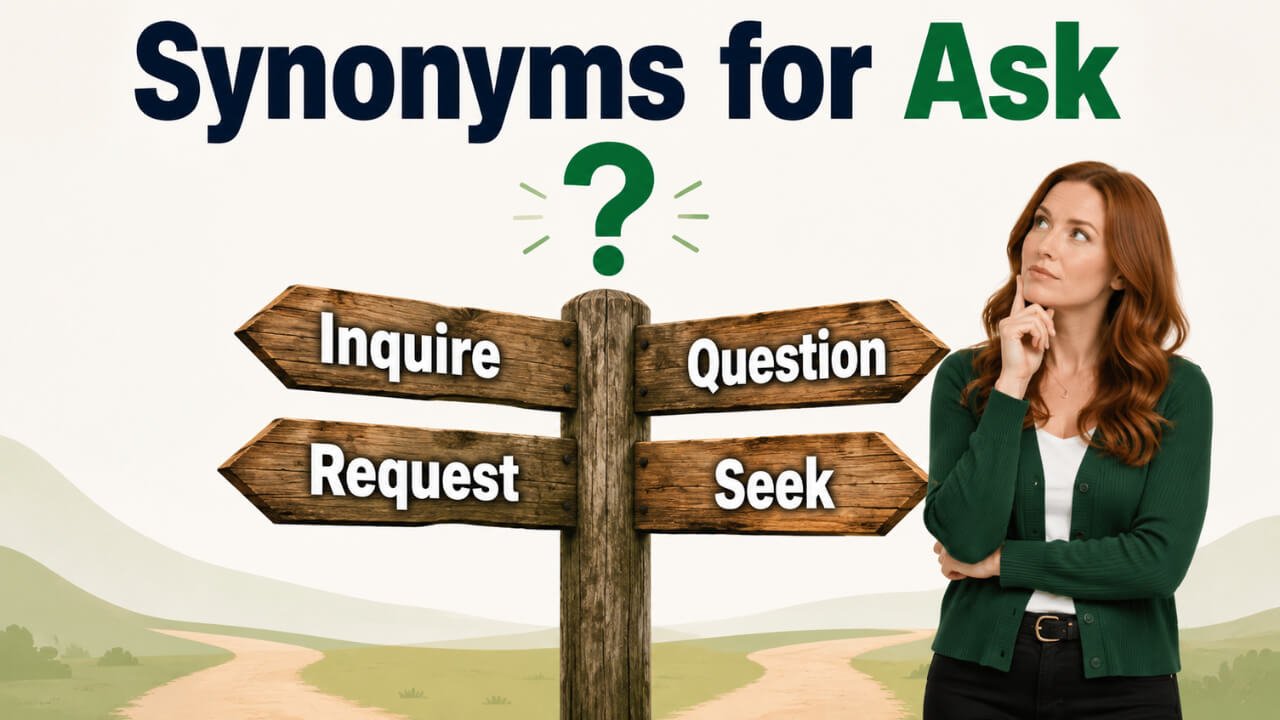
Quick Answer: Synonyms for ask include inquire, request, question, query, seek, demand, invite, consult, interview, and petition. Use inquire in formal writing, request when politely asking for something, question when asking for information, seek when looking for help or advice, and demand when the tone is strong or urgent. The best synonym depends on whether you mean asking a question, asking for permission, asking for help, or asking someone to do something.
Pronunciation and Word Details
Word: Ask
Pronunciation: /æsk/
Part of Speech: Verb
Meaning: To say or write something in order to get information, help, permission, or a response.
US Pronunciation:
UK Pronunciation:
What Does “Ask” Mean?
Ask means to speak or write to someone because you want information, help, permission, an answer, or action. It is a common verb used in everyday conversation, formal communication, interviews, instructions, and requests.
Ask can work in many sentence patterns. You can ask a question, ask for help, ask someone to do something, ask about a topic, or ask whether something is possible.
Example: She asked a clear question.
Example: I asked for more details.
Example: They asked him to join the meeting.
Meaning, Tone, and Context of “Ask”
Ask is a neutral and common word. It is neither too formal nor too casual, which makes it useful in many situations. You can use it in speech, emails, classroom writing, business communication, and daily conversation.
The tone changes with context. Ask can sound polite when used with please, direct when used in instructions, serious when used in interviews, and strong when used with repeated or urgent requests.
In formal writing, words like inquire, request, seek, and consult may sound more polished. In casual speech, ask is usually the most natural choice.
When and How to Use “Ask”
For Information: Use ask when someone wants an answer, explanation, or detail.
Example: I asked the teacher about the assignment.
For Help: Use ask when someone needs support, guidance, or assistance.
Example: You should ask your friend for help.
For Permission: Use ask when someone needs approval before doing something.
Example: He asked if he could leave early.
For a Request: Use ask when someone wants another person to do something.
Example: They asked me to review the report.
For Advice: Use ask when someone wants an opinion or suggestion.
Example: She asked her mentor for advice.
Best Synonyms for Ask
Inquire: To ask for information in a formal or polite way.
Example: Please inquire at the front desk for more details.
Request: To ask for something politely or officially.
Example: He requested extra time to complete the work.
Question: To ask someone about something, often to get facts or explanations.
Example: The officer questioned the witness carefully.
Query: To ask a question, often in a formal, written, or technical context.
Example: The customer queried the charge on the bill.
Seek: To ask for or try to get advice, help, or information.
Example: She decided to seek professional guidance.
Consult: To ask someone for expert advice or information.
Example: You should consult a specialist before making a decision.
Interview: To ask questions in a formal conversation.
Example: The manager interviewed five candidates.
Demand: To ask for something firmly, strongly, or forcefully.
Example: The workers demanded better conditions.
Invite: To ask someone to attend, join, or take part.
Example: They invited her to speak at the event.
Petition: To formally ask an authority for action or change.
Example: Residents petitioned the council for safer roads.
50 Synonyms for Ask with Short Meanings
- Inquire: To ask for information formally.
- Request: To ask for something politely.
- Question: To ask for an answer or explanation.
- Query: To ask a formal or technical question.
- Seek: To try to get information, help, or advice.
- Consult: To ask an expert for guidance.
- Interview: To ask questions in a formal discussion.
- Demand: To ask strongly or firmly.
- Invite: To ask someone to come or join.
- Petition: To formally ask for action or change.
- Beg: To ask urgently or emotionally.
- Plead: To ask with strong emotion.
- Appeal: To ask sincerely for help or support.
- Solicit: To ask for support, money, opinions, or business.
- Probe: To ask deeply to discover more information.
- Examine: To question carefully for details.
- Interrogate: To question someone intensely or officially.
- Cross examine: To question someone closely, often in legal settings.
- Quiz: To ask questions to test knowledge.
- Survey: To ask people for opinions or information.
- Poll: To ask a group for their views.
- Challenge: To question the truth or value of something.
- Wonder: To ask silently or think about a question.
- Check: To ask or confirm information.
- Verify: To ask or examine in order to confirm truth.
- Confirm: To ask whether something is correct.
- Clarify: To ask for clearer meaning.
- Find out: To ask or learn information.
- Look into: To ask about or investigate something.
- Bring up: To ask about a topic in conversation.
- Raise: To ask or mention a question or issue.
- Put forward: To ask, suggest, or present something for discussion.
- Submit: To formally ask for consideration or approval.
- Apply: To ask officially for a job, place, or permission.
- Call for: To publicly ask for action or response.
- Press: To ask firmly or repeatedly.
- Urge: To ask strongly and seriously.
- Implore: To ask with deep emotion.
- Entreat: To ask earnestly or seriously.
- Beseech: To ask urgently and emotionally.
- Require: To ask for something as necessary.
- Call on: To ask someone to speak, act, or respond.
- Turn to: To ask someone for help or support.
- Approach: To ask someone about something directly.
- Address: To ask or speak about an issue formally.
- Put a question to: To ask someone a specific question.
- Ask for: To request something directly.
- Ask about: To request information on a topic.
- Ask after: To ask about someone’s health or condition.
- Ask around: To ask several people for information.
Read Also:
Synonyms for Specific

Synonyms for Ask by Context
When Ask Means Request
Use these synonyms when ask means to want something from someone, such as help, permission, time, money, or action.
Request: He requested a copy of the document.
Seek: She sought advice before signing the form.
Apply: He applied for permission to enter the program.
Solicit: The group solicited support from local residents.
Appeal: They appealed for urgent help.
When Ask Means Question
Use these synonyms when ask means to say or write a question.
Question: The student questioned the result.
Inquire: She inquired about the schedule.
Query: The client queried the final amount.
Quiz: The teacher quizzed the class on grammar.
Probe: The reporter probed for more details.
When Ask Means Seek Advice
Use these synonyms when ask means to get guidance, opinion, or expert help.
Consult: You should consult a lawyer before replying.
Seek: He sought advice from a trusted teacher.
Turn to: She turned to her parents for guidance.
Approach: They approached an expert for suggestions.
When Ask Means Demand
Use these synonyms when ask has a strong, firm, or urgent tone.
Demand: The customer demanded a refund.
Press: Reporters pressed the official for answers.
Urge: They urged the manager to act quickly.
Call for: The report called for immediate changes.
When Ask Means Invite
Use these synonyms when ask means to include someone, invite them, or request their presence.
Invite: We invited them to dinner.
Call on: The teacher called on him to answer.
Ask over: She asked her cousins over for lunch.
Ask out: He asked her out for coffee.
Another Word for Ask
Another word for ask is inquire when you mean asking for information politely or formally. However, the best replacement depends on the context. Use request for asking for something, question for asking about facts, seek for asking for help or advice, and demand for strong or urgent asking.
Original: I want to ask about the price.
Better Option: I want to inquire about the price.
Original: She asked for more time.
Better Option: She requested more time.
Original: They asked the witness about the event.
Better Option: They questioned the witness about the event.
Original: He asked for professional advice.
Better Option: He sought professional advice.
When Not to Use “Ask”
Do not use ask too often in the same paragraph when a more exact verb would improve clarity. Ask can sound weak if the sentence needs a formal, strong, or specific word.
Use request in polite formal writing, inquire for information, consult for expert advice, question for investigation, and demand for a forceful request.
Weak: She asked about the rule and asked for help.
Better: She inquired about the rule and requested help.
Weak: The lawyer asked the witness for details.
Better: The lawyer questioned the witness for details.
Weak: He asked a doctor about the pain.
Better: He consulted a doctor about the pain.
Weak: The workers asked for safer conditions.
Better: The workers demanded safer conditions.
Words Commonly Confused With Ask
Ask vs Inquire: Ask is general and common, while inquire sounds more formal and polite. Use inquire in professional or official contexts.
Ask vs Request: Ask can mean question or request, while request usually means politely asking for something or action.
Ask vs Question: Ask is broad, while question focuses on asking someone for information, facts, or explanation.
Ask vs Query: Query is more formal and often used in written, business, customer service, or technical contexts.
Ask vs Consult: Ask can be general, while consult means asking an expert or experienced person for advice.
Ask vs Demand: Ask is neutral, while demand is strong, firm, or forceful.
Ask vs Seek: Ask is direct, while seek can mean trying to find, obtain, or request something in a broader sense.
Which Synonym Should You Choose?
Choose inquire when writing formally about information, schedules, prices, rules, or details.
Choose request when politely asking for help, permission, documents, time, or action.
Choose question when asking someone for facts, reasons, answers, or explanations.
Choose query in formal, business, technical, or written communication.
Choose seek when asking for advice, support, help, permission, or guidance.
Choose consult when asking an expert, doctor, lawyer, teacher, or advisor.
Choose demand when the request is strong, urgent, forceful, or non negotiable.
Choose invite when asking someone to attend, join, speak, or participate.
Choose petition when asking an authority, organization, or official group for change.
Choose ask in normal conversation because it is simple, clear, and natural.
Real Life Examples of “Ask” in Sentences
Original: I will ask about the meeting time.
Better Option: I will inquire about the meeting time.
Original: She asked for a copy of the file.
Better Option: She requested a copy of the file.
Original: The manager asked each candidate several questions.
Better Option: The manager interviewed each candidate carefully.
Original: He asked a doctor about his symptoms.
Better Option: He consulted a doctor about his symptoms.
Original: They asked for better safety rules.
Better Option: They demanded better safety rules.
Original: I asked my teacher for advice.
Better Option: I sought advice from my teacher.
Original: The officer asked the driver what happened.
Better Option: The officer questioned the driver about what happened.
Original: She asked everyone about their opinion.
Better Option: She surveyed everyone about their opinion.
Original: He asked if the answer was correct.
Better Option: He confirmed whether the answer was correct.
Original: They asked the speaker to join the event.
Better Option: They invited the speaker to join the event.
Synonym Groups and Usage Differences
Request Group
This group includes words used when someone wants help, permission, action, or something specific. Request, seek, apply, and solicit are useful choices.
Example: She requested a meeting with the director.
Question Group
This group includes words used when someone wants information, answers, or explanation. Question, inquire, query, and quiz belong here.
Example: The student inquired about the exam format.
Advice Group
This group works when someone needs guidance or an expert opinion. Consult, seek, turn to, and approach fit this meaning.
Example: He consulted an advisor before choosing a course.
Strong Request Group
This group includes forceful words. Demand, press, urge, and call for show stronger pressure than ask.
Example: The committee called for immediate action.
Formal Appeal Group
This group includes serious or emotional asking. Appeal, petition, plead, implore, and beseech are more intense or official.
Example: Residents petitioned for cleaner water.
Antonyms of Ask
Opposites of ask depend on the meaning. If ask means to question, the opposite may be answer. If ask means to request, the opposite may be refuse, deny, or offer, depending on the sentence.
Answer: To respond to a question.
Reply: To give a response.
Tell: To give information instead of asking for it.
State: To express information directly.
Declare: To say something clearly and officially.
Refuse: To say no to a request.
Deny: To reject or not allow something.
Reject: To refuse an offer, request, or idea.
Offer: To give or present something without being asked.
Volunteer: To give help or information freely.
Comparison: Ask vs Related Words
Ask vs Inquire
Ask is simple and common. Inquire is more formal and often used in professional communication.
Example With Ask: I want to ask about the room price.
Example With Inquire: I want to inquire about the room price.
Ask vs Request
Ask can mean question or request. Request specifically means to ask politely or formally for something.
Example With Ask: She asked for more time.
Example With Request: She requested more time.
Ask vs Question
Ask is broader. Question usually means asking to get information, test truth, or examine details.
Example With Ask: The teacher asked him about the answer.
Example With Question: The teacher questioned him about the answer.
Ask vs Query
Ask is everyday language. Query sounds more formal and is often used in written or technical communication.
Example With Ask: The customer asked about the extra charge.
Example With Query: The customer queried the extra charge.
Ask vs Consult
Ask can be used with anyone. Consult means to ask someone with knowledge, authority, or expertise.
Example With Ask: I asked my friend about the problem.
Example With Consult: I consulted an expert about the problem.
Ask vs Demand
Ask is neutral and polite. Demand is strong, firm, and sometimes forceful.
Example With Ask: They asked for a refund.
Example With Demand: They demanded a refund.
Common Phrases and Expressions With Ask
Ask a Question: To say or write something to get an answer.
Ask for Help: To request support or assistance.
Ask for Permission: To request approval before doing something.
Ask About: To request information on a topic.
Ask Around: To ask several people for information.
Ask After Someone: To ask about someone’s health or condition.
Ask Someone Out: To invite someone on a date or social meeting.
Ask Over: To invite someone to your home or place.
Ask Too Much: To request more than is reasonable.
Ask Nicely: To make a request in a polite way.
Common Mistakes to Avoid
One common mistake is using ask in every sentence when a more specific word would be better. For example, use inquire for formal information, request for polite action, consult for expert advice, and question for investigation.
Another mistake is confusing ask and request. Request is usually more formal and focuses on getting something, while ask can mean either asking a question or making a request.
Avoid unnatural phrasing such as “ask a doubt.” A more natural choice is ask a question or raise a concern.
Also avoid using strong synonyms like demand or interrogate when the tone should be polite. These words can sound too forceful if the context is simple or friendly.
Conclusion
Synonyms for ask help you choose clearer words for different situations. Use inquire for formal information, request for polite needs, question for facts, seek for advice, consult for expert help, and demand for strong requests. The word ask is still the best choice for everyday speech because it is simple and natural. For stronger writing, choose the synonym that matches your tone, purpose, and sentence context.
FAQs About Synonyms for Ask
What are the best synonyms for ask?
The best synonyms for ask are inquire, request, question, query, seek, consult, interview, demand, invite, and petition.
What is a formal synonym for ask?
A formal synonym for ask is inquire. You can also use request, seek, consult, or query, depending on the sentence.
What is another word for ask for help?
Another word for ask for help is seek help. You can also say request help, appeal for help, or turn to someone for help.
What is the difference between ask and request?
Ask is a general word that can mean question or request. Request is more specific and usually means politely asking for something.
Is demand a synonym for ask?
Demand can be a synonym for ask when the tone is strong or forceful. It is not suitable for polite or casual requests.
What is another word for ask a question?
Another word for ask a question is inquire, question, query, quiz, or probe, depending on the context.
What is the best synonym for ask in business writing?
The best synonym for ask in business writing is often request. Use inquire when asking for information and consult when asking for expert advice.
