
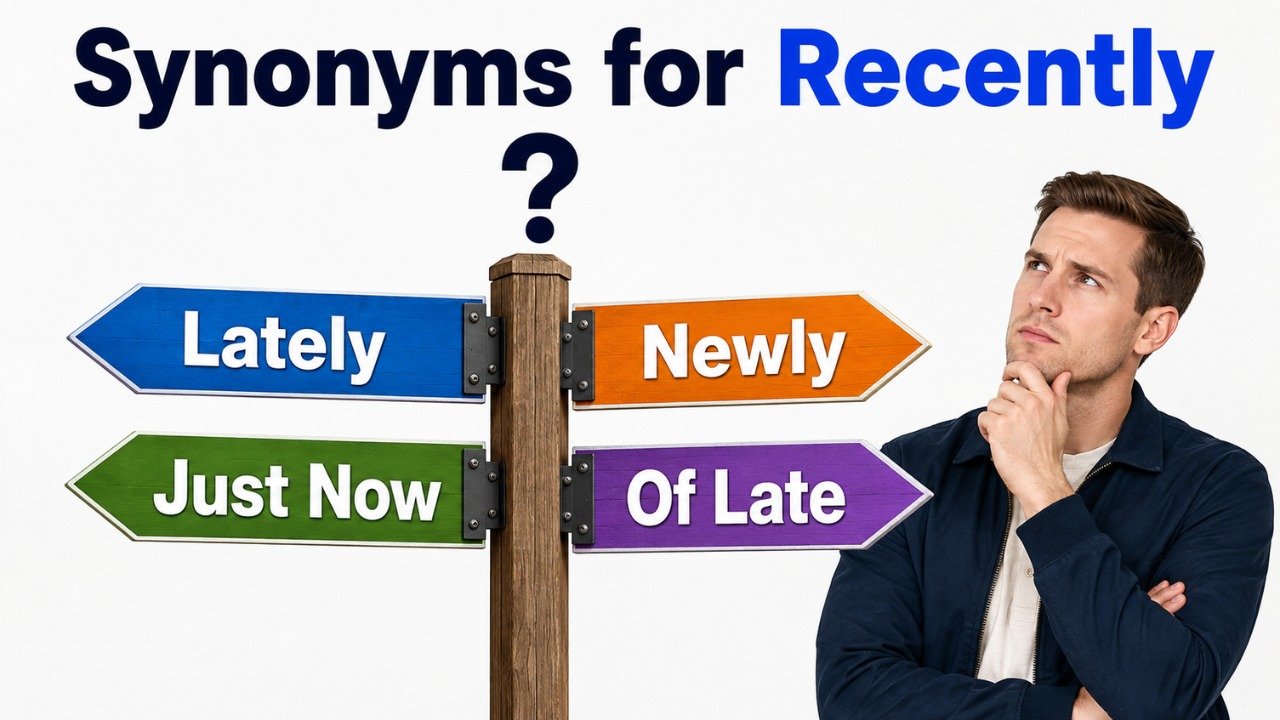
Quick Answer: Common synonyms for recently include lately, newly, freshly, just, of late, not long ago, a short time ago, in recent times, in the recent past, and only recently. The best synonym depends on context. Use lately for ongoing recent situations, newly for something that has just begun or been created, freshly for something newly made or completed, just for very recent actions, and in recent times for more formal or academic writing.
Pronunciation and Word Details
Word: Recently.
Pronunciation: /ˈriːsəntli/
Part of Speech: Adverb.
Meaning: At a time not long before the present or before another point being discussed.
US Pronunciation:
UK Pronunciation:
What Does “Recently” Mean?
Recently means not long ago or during a period close to the present time.
It is an adverb used to describe actions, events, discoveries, changes, experiences, or situations that happened a relatively short time ago.
For example, “She recently moved to a new apartment” means the move happened not long ago.
The exact amount of time covered by recently depends on context. In one sentence, it may refer to something that happened a few minutes ago. In another, it may describe an event from several weeks or months earlier.
Recently can also refer to a short period before another past event.
Example: He had recently started the job when the company changed its schedule.
Meaning, Tone, and Context of “Recently”
Recently has a neutral and flexible tone. It works naturally in casual conversation, formal writing, academic discussion, reports, news style writing, professional communication, and everyday descriptions.
The word does not specify an exact time. Instead, it tells the reader that something happened comparatively close to the present or to another time being discussed.
In conversation, lately and just are common alternatives.
In formal writing, recently, in recent times, in the recent past, and as of late may be suitable depending on the sentence.
Newly often describes a recent change in condition or status, such as newly appointed, newly opened, or newly discovered.
Freshly usually emphasizes something that has just been prepared, created, completed, or produced.
The best synonym therefore depends on both timing and the type of action being described.
When and How to Use “Recently”
For Recent Actions: Use recently when something happened not long ago.
Example: She recently completed her training.
For Life Changes: Recently works well for moves, jobs, relationships, decisions, and other changes.
Example: They recently moved to a larger home.
For New Discoveries: Use recently to describe information or findings that became known not long ago.
Example: Researchers recently identified a new pattern.
For Current Developments: Recently can introduce a change that has occurred within the near past.
Example: The neighborhood has recently become much busier.
For Personal Experiences: Use recently when describing something a person has done or experienced.
Example: I recently visited the museum.
For Past Reference Points: Recently may refer to a short period before another past event.
Example: She had recently joined the team when the project began.
Best Synonyms for Recently
Lately: During the recent past, especially over a continuing period.
Example: I have been reading more lately.
Newly: Very recently created, appointed, formed, or changed.
Example: The newly appointed manager introduced several changes.
Freshly: Recently prepared, produced, completed, or made.
Example: The room was freshly painted.
Just: A very short time ago.
Example: She just arrived home.
Of Late: During the recent past.
Example: He has been unusually busy of late.
Not Long Ago: At a fairly recent time.
Example: We discussed the issue not long ago.
A Short Time Ago: During a recent period before now.
Example: She called me a short time ago.
In Recent Times: During a comparatively recent period.
Example: The area has changed significantly in recent times.
In the Recent Past: During a period not far before the present.
Example: Similar problems occurred in the recent past.
Only Recently: Not until a short time ago.
Example: The building was only recently reopened.
50 Synonyms for Recently with Short Meanings
- Lately: During the recent past.
- Newly: Very recently created or changed.
- Freshly: Recently prepared, produced, or completed.
- Just: A very short time ago.
- Of Late: During recent times.
- Not Long Ago: At a fairly recent time.
- A Short Time Ago: Shortly before the present.
- In Recent Times: During the recent period.
- In the Recent Past: Not far back in time.
- Only Recently: Not until a short time ago.
- Just Now: A moment or very short time ago.
- A Moment Ago: Very shortly before now.
- A Little While Ago: A short period before now.
- A While Ago: Some time ago, but still relatively recently.
- Shortly Ago: A short time before the present.
- Not Long Before: A short period before another event.
- Just Before: Immediately or shortly before.
- Previously: At an earlier time.
- Earlier: Before the present or another specified time.
- Newly Arrived: Having arrived only a short time ago.
- Newly Created: Made only recently.
- Newly Formed: Established a short time ago.
- Newly Opened: Opened only recently.
- Newly Introduced: Brought into use recently.
- Newly Discovered: Found or identified recently.
- Newly Released: Made available recently.
- Freshly Made: Made a short time ago.
- Freshly Prepared: Prepared only recently.
- Freshly Completed: Finished not long ago.
- Freshly Updated: Updated only a short time ago.
- In Lately: Current or fashionable in the recent period.
- These Days: During the present general period.
- Nowadays: During the present period compared with the past.
- As of Late: During recent times.
- Until Recently: Up to a short time ago.
- Quite Recently: At a fairly recent time.
- Very Recently: Only a short time ago.
- Most Recently: At the latest point in time.
- More Recently: At a later recent time.
- Comparatively Recently: At a relatively recent time.
- Relatively Recently: Not very long ago in comparison.
- Just Lately: Only during the recent period.
- In Lately Times: During a recent period.
- Within Recent Memory: During a period people can readily remember.
- In the Last Little While: During a short recent period.
- In the Past Few Days: During the immediately preceding days.
- In the Past Few Weeks: During the immediately preceding weeks.
- Over Recent Days: During the latest several days.
- Over Recent Weeks: During the latest several weeks.
- In Recent Days: During the days immediately before now.
Read Also:
Synonyms for Downplay

Synonyms for Recently by Context
When Recently Means Not Long Ago
Not long ago, a short time ago, a little while ago, shortly ago, and a while ago are useful when the main idea is that an event happened fairly close to the present.
Example: I recently spoke with her about the project.
Alternative: I spoke with her not long ago about the project.
These phrases work especially well in everyday communication because they sound natural and direct.
When Recently Means Lately
Lately and of late are useful when describing something that has been happening repeatedly or continuously during the recent past.
Example: She has recently been working from home more often.
Alternative: She has been working from home more often lately.
Lately is especially common with continuing situations and present perfect constructions.
When Recently Means Just
Just and just now emphasize that something happened only moments or a very short time ago.
Example: He recently arrived.
Alternative: He just arrived.
Just usually suggests a shorter time period than recently.
When Recently Means Newly
Newly is useful when recently describes a new status, condition, role, object, or development.
Example: The recently appointed director addressed the staff.
Alternative: The newly appointed director addressed the staff.
Newly often appears directly before another adjective or participle.
When Recently Means Freshly
Freshly emphasizes that something was made, prepared, painted, completed, or produced not long ago.
Example: The recently painted walls looked bright.
Alternative: The freshly painted walls looked bright.
Freshly is more specific than recently because it often suggests newness or freshness as well as timing.
When Recently Means During Modern Times
In recent times, in recent years, these days, and nowadays can describe broader recent periods.
Example: Shopping habits have changed recently.
Alternative: Shopping habits have changed considerably in recent times.
These alternatives are useful when the time period is broader than a few hours or days.
Another Word for Recently
The best single replacement for recently is often lately, but the two words are not interchangeable in every sentence.
Lately works best for situations continuing across the recent past. Just is better for events that happened moments ago. Newly works for recent changes in status, while freshly works for newly prepared or completed things.
Original: I have recently been feeling more productive.
Better Option: I have been feeling more productive lately.
Original: She recently arrived at the office.
Better Option: She just arrived at the office.
Original: The recently appointed manager introduced herself.
Better Option: The newly appointed manager introduced herself.
Original: We entered the recently renovated room.
Better Option: We entered the freshly renovated room.
When Not to Use “Recently”
Recently may be too vague when an exact time is important.
Weak: The payment was received recently.
Better: The payment was received three days ago.
Avoid recently when just communicates that something happened only moments ago.
Weak: She recently walked through the door.
Better: She just walked through the door.
Recently may also sound repetitive when several nearby sentences describe recent events.
Weak: She recently moved, recently started a new job, and recently joined a fitness class.
Better: She recently moved, started a new job not long afterward, and has lately been attending a fitness class.
Do not automatically replace recently with lately. Lately often describes an ongoing or repeated situation rather than one completed event.
Weak: She lately graduated from college.
Better: She recently graduated from college.
Use newly when the focus is a new status rather than simply the timing of an event.
Weak: The recently elected representative spoke first.
Better: The newly elected representative spoke first.
Words Commonly Confused With Recently
Recently vs Lately: Recently can describe a completed event or a continuing situation. Lately is especially common for actions or conditions continuing through the recent past.
Recently vs Just: Recently means not long ago, while just normally suggests a much shorter time before the present.
Recently vs Newly: Recently describes when something happened. Newly commonly describes a recent state, role, creation, or change.
Recently vs Freshly: Recently is general, while freshly often describes something newly prepared, made, painted, produced, or completed.
Recently vs Previously: Recently emphasizes closeness to the present. Previously simply means earlier and does not necessarily suggest a recent time.
Recently vs Earlier: Earlier means before a particular point in time. It may refer to either the recent or distant past.
Recently vs Nowadays: Recently normally looks backward to events that happened not long ago. Nowadays describes the present period more broadly.
Which Synonym Should You Choose?
Choose lately when describing an ongoing feeling, behavior, habit, or situation during the recent past.
Choose just when something happened moments or a very short time ago.
Choose newly for recent appointments, discoveries, creations, openings, roles, and changes in status.
Choose freshly for food, paint, completed work, preparation, production, or anything that feels new because it was recently made.
Choose not long ago for natural everyday conversation.
Choose in recent times for formal, academic, analytical, or historical discussion.
Choose in the recent past when contrasting present conditions with an earlier but still relatively recent period.
Choose of late when you want a slightly more literary or formal alternative to lately.
Choose most recently when comparing several events and identifying the latest one.
Choose previously when the important idea is simply that something happened earlier rather than specifically not long ago.
Real Life Examples of “Recently” in Sentences
Original: I recently started exercising in the morning.
Better Option: I have lately started exercising in the morning.
Original: She recently arrived at the station.
Better Option: She just arrived at the station.
Original: They recently opened a new office.
Better Option: They newly opened an office in the area.
Original: The house was recently painted.
Better Option: The house was freshly painted.
Original: We recently discussed the proposal.
Better Option: We discussed the proposal not long ago.
Original: He has recently seemed more confident.
Better Option: He has seemed more confident lately.
Original: The recently discovered documents provided new information.
Better Option: The newly discovered documents provided new information.
Original: Technology has developed rapidly recently.
Better Option: Technology has developed rapidly in recent times.
Original: I recently received a message from her.
Better Option: I received a message from her a short time ago.
Original: The policy was recently updated.
Better Option: The policy was freshly updated.
Synonym Groups and Usage Differences
Immediate Past Group
Just, just now, a moment ago, shortly ago, and a short time ago refer to events close to the present moment.
Just is usually the most concise option.
Example: She just finished the meeting.
Continuing Recent Period Group
Lately, of late, as of late, and just lately describe conditions or activities occurring through the recent past.
These choices work especially well with continuing actions.
Example: He has been traveling frequently lately.
New Status Group
Newly, newly appointed, newly created, newly formed, and newly discovered emphasize a recent change or beginning.
Example: The newly appointed director met the staff.
Fresh Completion Group
Freshly, freshly made, freshly prepared, freshly completed, and freshly updated emphasize that something was created or completed a short time ago.
Example: The freshly prepared meal smelled wonderful.
Broader Recent Period Group
In recent times, in the recent past, these days, and within recent memory refer to a broader period near the present.
Example: Remote communication has become more widespread in recent times.
Earlier Time Group
Previously, earlier, not long before, and just before refer to something occurring before another event or time.
These alternatives do not always imply the same degree of recency.
Example: She had previously worked in another department.
Antonyms of Recently
The opposite of recently depends on whether the sentence emphasizes the distant past, long duration, or an earlier period.
Long Ago: At a distant time in the past.
Ages Ago: A very long time ago.
Formerly: At an earlier period, often significantly earlier.
Previously: Earlier, though not necessarily recently.
Historically: During past historical periods.
Anciently: In ancient times.
Long Before: A considerable period earlier.
Years Ago: At a time several years in the past.
In the Distant Past: During a period far removed from the present.
Once: At some previous time.
Originally: At the beginning or first stage.
Earlier: Before a particular time.
Comparison: Recently vs Related Words
Recently vs Lately
Recently can refer to a single completed event or a continuing condition. Lately is especially natural for repeated or ongoing situations.
Example With Recently: She recently completed the course.
Example With Lately: She has been studying more lately.
Recently vs Just
Recently suggests something happened not long ago. Just normally indicates a much shorter interval.
Example With Recently: We recently moved to another neighborhood.
Example With Just: We just arrived home.
Recently vs Newly
Recently functions as a general time adverb. Newly often modifies a word describing a new condition or status.
Example With Recently: She was recently promoted.
Example With Newly: The newly promoted manager thanked her team.
Recently vs Freshly
Recently simply refers to timing. Freshly often emphasizes newness, freshness, or recent completion.
Example With Recently: The room was recently decorated.
Example With Freshly: The freshly decorated room looked brighter.
Recently vs Previously
Recently means not long ago. Previously means at an earlier time and may refer to something that happened much further in the past.
Example With Recently: He recently worked on a similar project.
Example With Previously: He previously worked for another organization.
Recently vs Earlier
Recently emphasizes how close an event is to the present. Earlier simply places one event before another.
Example With Recently: I recently read the report.
Example With Earlier: I read the report earlier in the day.
Recently vs Nowadays
Recently looks backward toward the near past. Nowadays describes what is generally true during the current period.
Example With Recently: Online services have recently expanded.
Example With Nowadays: Many services are available online nowadays.
Common Phrases and Expressions With Recently
Recently Added: Included or introduced not long ago.
Recently Updated: Changed or revised a short time ago.
Recently Released: Made available not long ago.
Recently Published: Published during the recent past.
Recently Discovered: Found or identified not long ago.
Recently Opened: Started operating a short time ago.
Recently Completed: Finished not long ago.
Recently Appointed: Given a position or role a short time ago.
Recently Announced: Made publicly known not long ago.
Recently Changed: Altered during the near past.
Common Mistakes to Avoid
A common mistake is treating recently and lately as perfect synonyms. Lately is especially suitable for ongoing or repeated situations, while recently can describe one completed event.
Incorrect: She lately graduated.
Better: She recently graduated.
Another mistake is placing recently awkwardly in a sentence. Recently usually appears before the main verb, after an auxiliary verb, or at the beginning or end of a sentence depending on emphasis.
Natural: She recently started a new job.
Natural: She has recently started a new job.
Avoid using recently when the exact date or time is essential. A specific time expression provides clearer information.
Do not confuse recently with previously. Previously only tells the reader that something happened earlier. It does not necessarily mean the event was close to the present.
Writers should also avoid unnecessary repetition. If recently appears several times, alternatives such as lately, newly, just, not long ago, or in recent times may improve variety when they preserve the intended meaning.
Finally, choose the alternative according to the amount of time involved. Just suggests a very short interval, while in recent times can describe a much broader period.
Conclusion
Synonyms for recently include lately, newly, freshly, just, of late, not long ago, a short time ago, and in recent times. Use lately for continuing recent situations, just for events that happened moments ago, newly for changes in status, and freshly for recently completed or prepared things. In recent times works well for broader formal discussion. Because recently does not specify an exact duration, choosing a more precise alternative can make your sentence clearer and better express how recently an action, change, or event occurred.
FAQs About Synonyms for Recently
What Is the Best Synonym for Recently?
Lately is one of the closest alternatives, especially for ongoing recent situations. Just, newly, or not long ago may be better in other contexts.
What Is Another Word for Recently in Formal Writing?
In recent times, in the recent past, of late, and most recently can work well in formal writing depending on context.
What Is the Difference Between Recently and Lately?
Recently can describe a single completed event or a continuing situation. Lately is more commonly used for ongoing or repeated conditions during the recent past.
Can Just Replace Recently?
Yes, when the event happened a very short time ago. Just normally suggests greater immediacy than recently.
What Is Another Word for Very Recently?
Just, just now, a moment ago, only recently, and a short time ago are useful alternatives.
Is Newly a Synonym for Recently?
Newly is a close alternative when describing a recent change, appointment, discovery, creation, or status.
What Is Another Word for Recently in an Essay?
In recent times, in the recent past, lately, most recently, and relatively recently can work depending on the meaning and level of formality.
