
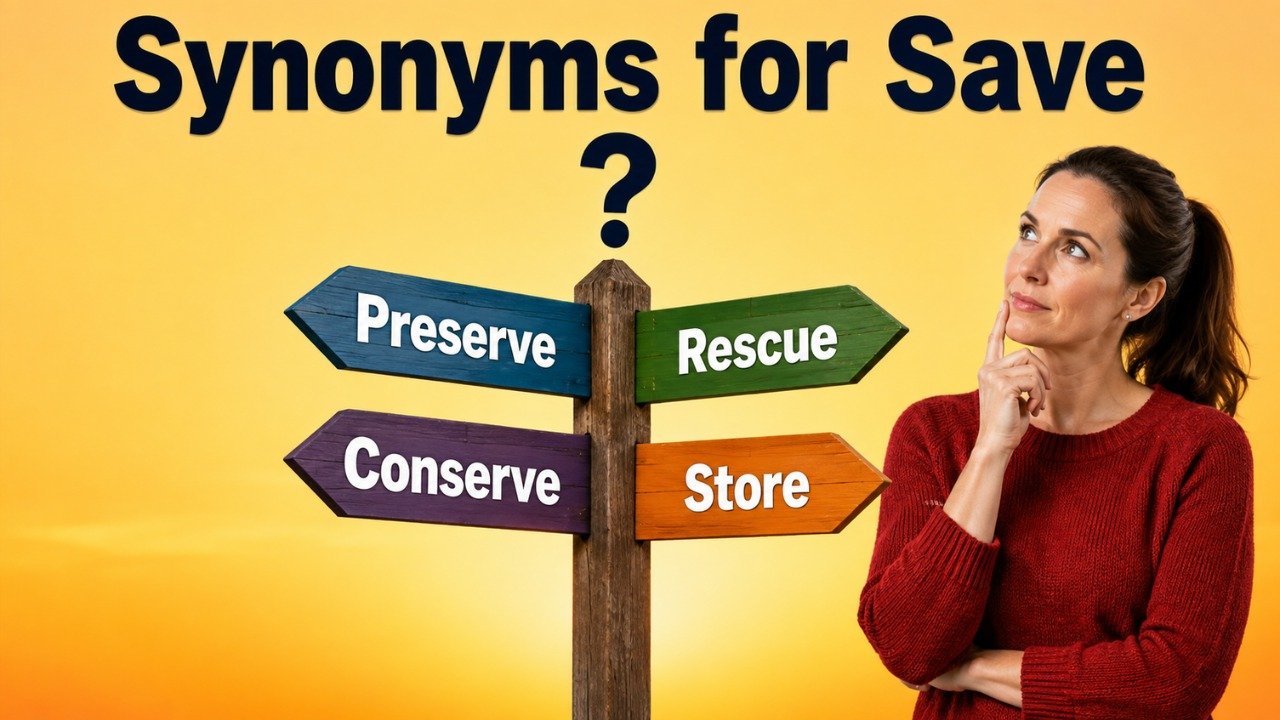
Quick Answer: Common synonyms for save include rescue, protect, preserve, conserve, safeguard, spare, retain, store, reserve, and economize. Use rescue when removing someone from danger, protect when preventing harm, preserve when keeping something in its original condition, conserve when reducing waste, spare when preventing pain or loss, store when keeping information or objects for future use, reserve when setting something aside, and economize when saving money or resources.
Pronunciation and Word Details
Word: Save.
Pronunciation: /seɪv/
Part of Speech: Verb, noun, preposition, and conjunction.
Meaning: To prevent harm or loss, keep something for future use, reduce spending, store information, or stop an opponent from scoring.
US Pronunciation:
UK Pronunciation:
What Does “Save” Mean?
Save means to prevent someone or something from being harmed, lost, destroyed, wasted, or used immediately.
As a verb, save has several common meanings. It can describe rescuing a person from danger, protecting an object, preserving a resource, storing information, keeping money, avoiding time or effort, and stopping a goal in sport.
Rescue: The firefighter saved the child from the building.
Protection: This cover will save the table from scratches.
Money: She saves part of her income every month.
Resources: Turning off unused lights saves electricity.
Storage: Remember to save the document before closing it.
Time: The new route saved us twenty minutes.
Sport: The goalkeeper saved the final shot.
As a noun, a save is an action that prevents a goal, loss, or failure.
Example: The goalkeeper made an excellent save.
Save can also mean except when used as a preposition or conjunction, although this use sounds formal or literary.
Example: Everyone attended save one employee.
Meaning, Tone, and Context of “Save”
Save is a common, neutral, and highly flexible word. It appears naturally in casual conversation, formal writing, financial advice, technical instructions, environmental discussions, emergency situations, and sports reporting.
When save means rescue, it often carries an urgent or emotional tone.
Example: The emergency team saved several people from the flood.
When it refers to money, time, or resources, the tone is practical.
Example: Buying only what you need can save money.
In computing, save is a technical but familiar instruction. It means recording information so it can be accessed later.
Example: Save your changes before leaving the page.
In environmental contexts, save may express protection or conservation.
Example: The campaign aims to save endangered wildlife.
In sport, save is a precise term for preventing an opponent from scoring.
Example: The goalkeeper made a difficult save.
The word may sound vague when the sentence does not explain what is being protected, stored, reduced, or rescued. A more specific synonym can make the meaning clearer.
When and How to Use “Save”
For Rescuing Someone
Use save when someone is removed from danger, injury, or death.
Example: The lifeguard saved the swimmer from drowning.
For Protecting Something
Use save when preventing damage, destruction, or loss.
Example: Quick repairs saved the roof from further damage.
For Preserving an Object
Use save when keeping something in its original or useful condition.
Example: Careful storage saved the photographs from fading.
For Keeping Money
Use save when money is not spent immediately and is kept for future needs.
Example: She saves a fixed amount from every payment.
For Reducing Costs
Use save when an action lowers an expense.
Example: Cooking at home can save a significant amount of money.
For Conserving Resources
Use save when avoiding unnecessary use of water, electricity, fuel, food, or materials.
Example: Repairing the leak will save hundreds of liters of water.
For Keeping Something for Later
Use save when reserving food, space, time, or another item for future use.
Example: Please save a seat for me.
For Storing Information
Use save when recording a digital file, document, image, or change.
Example: Save the file in the correct folder.
For Avoiding Time or Effort
Use save when an action reduces the time, energy, or work required.
Example: Preparing the ingredients early will save time later.
For Preventing an Unwanted Result
Use save when something stops a situation from becoming worse.
Example: A clear explanation saved the discussion from becoming an argument.
For Stopping a Goal
Use save when a player prevents the opposing team from scoring.
Example: The goalkeeper saved the penalty attempt.
Best Synonyms for Save
Rescue
Synonym: Rescue means to remove a person, animal, or object from danger.
Example: The crew rescued the passengers from the damaged boat.
Protect
Synonym: Protect means to keep someone or something safe from harm.
Example: Strong packaging protects the glass during transport.
Preserve
Synonym: Preserve means to keep something in its original, valuable, or usable condition.
Example: The archive preserves historic documents.
Conserve
Synonym: Conserve means to prevent the waste or unnecessary use of a resource.
Example: The new system conserves water during dry periods.
Safeguard
Synonym: Safeguard means to protect something valuable from danger, damage, or misuse.
Example: Strong passwords safeguard private information.
Spare
Synonym: Spare means to prevent someone from experiencing harm, pain, effort, or expense.
Example: The shortcut spared us a long walk.
Retain
Synonym: Retain means to continue keeping, possessing, or remembering something.
Example: The company retained the original records.
Store
Synonym: Store means to keep information, materials, or objects for future use.
Example: The device stores thousands of photographs.
Reserve
Synonym: Reserve means to keep something available for a particular person, time, or purpose.
Example: We reserved several seats for the guests.
Economize
Synonym: Economize means to reduce spending or use resources carefully.
Example: The family economized by planning meals in advance.
50 Synonyms for Save with Short Meanings
- Rescue: Remove someone or something from danger.
- Protect: Keep someone or something safe from harm.
- Preserve: Keep something in its original or valuable condition.
- Conserve: Prevent the waste of resources.
- Safeguard: Protect something valuable from danger or misuse.
- Defend: Protect someone or something against attack.
- Secure: Make something safe or protected.
- Shield: Place a barrier between something and possible harm.
- Spare: Prevent someone from suffering pain, effort, or loss.
- Keep: Continue to have or hold something.
- Retain: Continue possessing, using, or remembering something.
- Hold: Keep something in a particular place or condition.
- Store: Keep something for later use.
- Archive: Preserve information or records for future reference.
- Record: Store information in a lasting form.
- Back Up: Create a copy of digital information for protection.
- Set Aside: Keep something for a future purpose.
- Reserve: Keep something available for a particular use.
- Stash: Store something in a safe or private place.
- Stockpile: Collect and store a large supply.
- Accumulate: Gather something gradually over time.
- Collect: Bring items together and keep them.
- Economize: Spend less money or use fewer resources.
- Budget: Plan spending carefully.
- Cut Costs: Reduce the amount of money being spent.
- Reduce Spending: Use less money than before.
- Avoid Waste: Prevent unnecessary use or loss.
- Prevent: Stop something from happening.
- Avert: Prevent an unwanted or dangerous event.
- Avoid: Keep away from a harmful or unwanted result.
- Stop: Prevent an action or event from continuing.
- Salvage: Recover something useful from damage or loss.
- Recover: Get something back after it has been lost.
- Restore: Return something to its former condition.
- Retrieve: Find and bring back something stored or lost.
- Reclaim: Recover possession or use of something.
- Redeem: Recover something valuable or prevent failure.
- Deliver: Free someone from danger or difficulty.
- Free: Release someone from danger, control, or restriction.
- Liberate: Set someone or something free.
- Exempt: Release someone from a duty or requirement.
- Except: Leave someone or something out of a general statement.
- Exclude: Prevent something from being included.
- Block: Stop a shot, action, or attempt.
- Parry: Deflect an attack, blow, or shot.
- Repel: Drive back an attack or threat.
- Catch: Stop or control a moving ball or object.
- Intercept: Stop something before it reaches its destination.
- Deny: Prevent an opponent from achieving a goal.
- Preserve From Harm: Keep someone or something safe from injury or damage.
Read Also:
Synonyms for weapon

Synonyms for Save by Context
When Save Means Rescue
Use rescue, deliver, free, liberate, recover, or salvage when someone or something is removed from danger.
Rescue: The firefighters rescued the residents from the upper floor.
Deliver: The guide delivered the travelers from a dangerous situation.
Free: Workers freed the animal from the fence.
Liberate: The group worked to liberate people from unfair control.
Recover: Divers recovered the equipment from the water.
Salvage: The crew salvaged valuable materials from the damaged ship.
When Save Means Protect
Use protect, safeguard, defend, secure, shield, or preserve when preventing damage or harm.
Protect: Sunscreen protects the skin from harmful exposure.
Safeguard: The policy safeguards confidential records.
Defend: The barrier defended the village against rising water.
Secure: The lock secured the equipment overnight.
Shield: The wall shielded the garden from strong winds.
Preserve: The protective case preserved the fragile object.
When Save Means Keep for Later
Use keep, retain, reserve, set aside, store, or stash when something is held for future use.
Keep: Keep the remaining food for tomorrow.
Retain: The office retained copies of the original forms.
Reserve: Reserve one portion for the final guest.
Set Aside: She set aside part of her income for emergencies.
Store: Store the supplies in a dry place.
Stash: He stashed the spare key in a secure location.
When Save Means Store Information
Use store, record, archive, back up, retain, or preserve when keeping digital or written information.
Store: The application stores user preferences.
Record: The system records every completed transaction.
Archive: The department archived the older reports.
Back Up: Back up important files before updating the device.
Retain: The database retains information for future use.
Preserve: The process preserves the original formatting.
When Save Means Conserve Resources
Use conserve, economize, reduce, avoid waste, preserve, or use carefully when discussing resources.
Conserve: Shorter showers help conserve water.
Economize: The household economized during a period of reduced income.
Reduce: Better insulation reduces energy use.
Avoid Waste: Accurate planning helps avoid waste.
Preserve: Responsible farming preserves fertile soil.
Use Carefully: Use limited supplies carefully during the journey.
When Save Means Keep Money
Use economize, budget, set aside, reserve, accumulate, or cut costs when discussing finances.
Economize: They economized by limiting unnecessary purchases.
Budget: She budgets carefully for household expenses.
Set Aside: He sets aside money for future education.
Reserve: The organization reserved part of its income for emergencies.
Accumulate: Small regular deposits can accumulate over time.
Cut Costs: The business cut costs by reducing waste.
When Save Means Prevent
Use prevent, avert, avoid, stop, spare, or protect when an action blocks an unwanted result.
Prevent: Early action prevented further damage.
Avert: Careful planning averted a serious problem.
Avoid: Clear instructions helped everyone avoid confusion.
Stop: The barrier stopped water from entering the building.
Spare: The change spared employees unnecessary paperwork.
Protect: A written agreement protected both parties from misunderstandings.
When Save Means Reduce Time or Effort
Use spare, reduce, shorten, simplify, avoid, or eliminate when something requires less time or work.
Spare: The automatic process spared us hours of manual work.
Reduce: The new arrangement reduced preparation time.
Shorten: The direct route shortened the journey.
Simplify: A checklist simplified the inspection process.
Avoid: Planning ahead helped us avoid repeated work.
Eliminate: The revised form eliminated several unnecessary steps.
When Save Means Stop a Goal
Use block, parry, catch, intercept, repel, or deny in sports contexts.
Block: The defender blocked the shot.
Parry: The goalkeeper parried the ball away from the net.
Catch: The goalkeeper caught the high shot.
Intercept: The player intercepted the pass near the goal.
Repel: The defense repelled the final attack.
Deny: The goalkeeper denied the opposing team an equalizing goal.
When Save Means Except
Use except, excluding, apart from, other than, or with the exception of when leaving someone or something out.
Except: Everyone completed the task except one participant.
Excluding: The total includes all expenses, excluding delivery.
Apart From: Apart from one error, the report was accurate.
Other Than: No one other than the manager could approve the request.
With the Exception of: Every room was occupied, with the exception of the smallest one.
Another Word for Save
Protect is often the best general replacement for save when the meaning involves preventing harm or damage. However, no single synonym works in every context.
Use rescue for danger, preserve for condition, conserve for resources, store for information, economize for money, reserve for future use, and block for sport.
Original: The lifeguard saved the swimmer.
Better Option: The lifeguard rescued the swimmer.
Original: This treatment will save the wooden surface.
Better Option: This treatment will preserve the wooden surface.
Original: Turn off the tap to save water.
Better Option: Turn off the tap to conserve water.
Original: Save the document before closing it.
Better Option: Store the document before closing it.
When Not to Use “Save”
Save can sound vague because it has many meanings. A more exact synonym may communicate the intended action more clearly.
When Describing an Emergency Rescue
Rescue is often stronger and more specific than save.
Weak: The crew saved the hikers from the mountain.
Better: The crew rescued the hikers from the mountain.
When Describing Historic Protection
Preserve is more precise for buildings, traditions, documents, and artifacts.
Weak: The museum saved the ancient manuscript.
Better: The museum preserved the ancient manuscript.
When Discussing Resources
Conserve is usually more formal and exact for water, energy, fuel, and natural materials.
Weak: The program helps save natural resources.
Better: The program helps conserve natural resources.
When Discussing Digital Files
Store, record, archive, or back up may explain the action more clearly.
Weak: The system saves customer information.
Better: The system stores customer information securely.
When Discussing Money
Save may not show whether someone is reducing expenses or keeping money for later.
Weak: The family saved during the winter.
Better: The family reduced spending during the winter.
When Describing Prevention
Prevent or avert may communicate the result more directly.
Weak: Regular inspections saved the machine from failure.
Better: Regular inspections prevented the machine from failing.
When Describing a Sports Action
Use block, catch, parry, or intercept when the exact action matters.
Weak: The goalkeeper saved the ball.
Better: The goalkeeper caught the ball securely.
Words Commonly Confused With Save
Save vs Rescue: Save is broad and can refer to money, files, time, or danger. Rescue specifically means removing someone or something from danger.
Save vs Protect: Save often describes preventing a particular loss or harmful result. Protect focuses on providing continuing safety.
Save vs Preserve: Save may prevent immediate damage. Preserve emphasizes keeping something in its original or valuable condition over time.
Save vs Conserve: Save can refer to keeping or reducing many things. Conserve specifically emphasizes careful use and the prevention of waste.
Save vs Store: Save is commonly used for digital files and future use. Store focuses on placing information or objects somewhere for later access.
Save vs Retain: Save may involve setting something aside or preventing loss. Retain means continuing to possess, employ, remember, or control it.
Save vs Spare: Save may protect someone from serious harm. Spare often means preventing someone from experiencing pain, effort, expense, or punishment.
Save vs Salvage: Save can happen before or during danger. Salvage usually means recovering something useful after damage or loss has occurred.
Save vs Reserve: Save may mean keeping something generally. Reserve means keeping it available for a specific person, time, or purpose.
Save vs Except: Save is usually a verb, but in formal language it can mean except. Except is clearer in most modern sentences.
Which Synonym Should You Choose?
Choose rescue when removing a person or animal from immediate danger.
Choose protect when providing safety from harm, loss, or attack.
Choose preserve when keeping historic objects, traditions, food, records, or natural features in good condition.
Choose conserve when discussing water, energy, fuel, wildlife, or other limited resources.
Choose safeguard when protecting important information, rights, systems, or valuable property.
Choose defend when resisting an attack, criticism, or threat.
Choose shield when a barrier provides physical or figurative protection.
Choose spare when preventing pain, effort, expense, punishment, or embarrassment.
Choose retain when continuing to keep employees, information, control, knowledge, or ownership.
Choose store when keeping physical objects or digital information for future use.
Choose archive when preserving records for long term reference.
Choose back up when creating an additional digital copy.
Choose reserve when keeping a seat, room, amount, or resource for a specific purpose.
Choose set aside when keeping money, food, time, or materials for later.
Choose economize when reducing spending or using resources more carefully.
Choose budget when planning how money will be spent and saved.
Choose prevent when stopping an unwanted event from happening.
Choose avert when preventing a serious problem, danger, or crisis.
Choose salvage when recovering useful property from damage or destruction.
Choose block, catch, or parry when describing a specific sports save.
Real Life Examples of “Save” in Sentences
Original: The firefighter saved the child from the house.
Better Option: The firefighter rescued the child from the house.
Original: This cover will save the furniture from dust.
Better Option: This cover will protect the furniture from dust.
Original: The organization works to save historic buildings.
Better Option: The organization works to preserve historic buildings.
Original: We should save water during dry weather.
Better Option: We should conserve water during dry weather.
Original: She saves part of her income each month.
Better Option: She sets aside part of her income each month.
Original: Save these records for future reference.
Better Option: Archive these records for future reference.
Original: The new process will save employees several hours.
Better Option: The new process will spare employees several hours of work.
Original: Careful planning saved the event from failure.
Better Option: Careful planning prevented the event from failing.
Original: The goalkeeper saved the powerful shot.
Better Option: The goalkeeper parried the powerful shot.
Original: The crew saved several items from the damaged building.
Better Option: The crew salvaged several items from the damaged building.
Synonym Groups and Usage Differences
Rescue Group
Rescue, deliver, free, liberate, and recover describe removing someone or something from danger, restriction, or loss.
Rescue is the clearest general choice for emergencies. Free emphasizes release from a trap or restriction. Recover focuses on getting back something that was lost.
Example: Emergency workers rescued the family from the flooded home.
Protection Group
Protect, safeguard, defend, secure, and shield describe preventing harm or attack.
Protect is the broadest term. Safeguard often applies to rights, information, and valuable systems. Shield suggests a barrier between something and a threat.
Example: The new procedure safeguards confidential information.
Preservation Group
Preserve, conserve, retain, keep, and archive describe keeping something valuable or useful.
Preserve focuses on condition. Conserve emphasizes preventing waste. Retain means continuing to possess something. Archive is best for records and files.
Example: The library archived the original documents.
Financial Group
Economize, budget, set aside, reserve, accumulate, and cut costs relate to managing money.
Economize means spending less. Budget means planning spending. Set aside and reserve mean keeping money for a future purpose. Accumulate suggests gradual growth.
Example: She set aside a small amount for emergencies.
Storage Group
Store, record, archive, back up, retain, and stash describe keeping information or objects.
Store is the broadest option. Record focuses on creating a lasting account. Back up means creating a protective copy. Stash is informal and often suggests a hidden place.
Example: Back up important documents before changing the system.
Prevention Group
Prevent, avert, avoid, stop, spare, and block describe stopping an unwanted result.
Prevent is neutral and direct. Avert often applies to serious dangers. Avoid focuses on staying away from a problem. Spare emphasizes freedom from discomfort or loss.
Example: Early repairs averted a larger problem.
Recovery Group
Salvage, recover, restore, retrieve, reclaim, and redeem describe getting something back or preventing permanent loss.
Salvage often follows damage. Restore means returning something to an earlier condition. Retrieve means finding and bringing something back. Reclaim means recovering ownership or use.
Example: Specialists restored the damaged painting.
Sports Group
Save, block, parry, catch, intercept, repel, and deny describe stopping an opponent from scoring.
Block means physically stopping the ball. Parry means deflecting it away. Catch means controlling it securely. Deny emphasizes preventing a scoring opportunity.
Example: The goalkeeper denied the striker with a quick reaction.
Antonyms of Save
The opposite of save depends on whether the word refers to rescue, protection, money, storage, resources, or prevention.
Endanger: Place someone or something at risk.
Harm: Cause physical, emotional, or practical damage.
Damage: Reduce the condition, value, or usefulness of something.
Destroy: Ruin something completely.
Abandon: Leave someone or something without help or protection.
Waste: Use money, time, energy, or resources carelessly.
Spend: Use money to buy something.
Squander: Waste money, time, or an opportunity recklessly.
Consume: Use up a resource.
Deplete: Greatly reduce the available amount of something.
Delete: Remove stored information.
Erase: Remove writing, records, or digital information.
Discard: Throw something away because it is no longer wanted.
Lose: Fail to keep or recover something.
Expose: Leave someone or something without protection.
Risk: Place something valuable in possible danger.
Cause: Make an unwanted event happen.
Allow: Let an event or result occur.
Concede: Allow an opponent to score.
Surrender: Give up control, possession, or resistance.
Comparison: Save vs Related Words
Save vs Rescue
Save has many meanings, while rescue specifically describes removing someone or something from danger.
Example With Save: Quick action saved the injured animal.
Example With Rescue: Volunteers rescued the injured animal from the road.
Save vs Protect
Save often refers to preventing a particular loss. Protect suggests continuing safety against possible harm.
Example With Save: The cover saved the book from water damage.
Example With Protect: The cover protects the book from moisture.
Save vs Preserve
Save can describe immediate protection. Preserve focuses on maintaining condition, value, or history over time.
Example With Save: The repair saved the old building from collapse.
Example With Preserve: The restoration preserved the building’s original features.
Save vs Conserve
Save is a broad everyday word. Conserve is more precise for resources and environmental protection.
Example With Save: Turn off the lights to save electricity.
Example With Conserve: Turn off the lights to conserve electricity.
Save vs Spare
Save may involve rescue or protection from serious loss. Spare means preventing someone from experiencing discomfort, effort, punishment, or expense.
Example With Save: The treatment saved his life.
Example With Spare: The new process spared him several hours of work.
Save vs Store
Save is common in digital instructions. Store emphasizes keeping information or materials in a specific place.
Example With Save: Save the document before closing it.
Example With Store: Store the document in the project folder.
Save vs Retain
Save means preventing loss or keeping something for later. Retain means continuing to possess, remember, employ, or control something.
Example With Save: Save a copy of the receipt.
Example With Retain: Retain the receipt for your records.
Save vs Salvage
Save may prevent damage before it becomes permanent. Salvage means recovering something useful after damage has occurred.
Example With Save: Firefighters saved the building from complete destruction.
Example With Salvage: Workers salvaged furniture from the damaged building.
Save vs Reserve
Save means keeping something generally. Reserve means keeping it available for a particular person, time, or purpose.
Example With Save: Save some food for later.
Example With Reserve: Reserve one portion for the late guest.
Save vs Prevent
Save emphasizes protecting someone or something from an outcome. Prevent focuses directly on stopping that outcome from occurring.
Example With Save: The barrier saved the garden from flooding.
Example With Prevent: The barrier prevented water from entering the garden.
Common Phrases and Expressions With “Save”
Save Money: Keep money for future use or reduce expenses.
Save Time: Reduce the amount of time needed for an activity.
Save Energy: Use less physical effort, fuel, or electricity.
Save a Life: Prevent someone from dying.
Save for Later: Keep something to use at another time.
Save a Seat: Keep a place available for someone.
Save the Day: Prevent a situation from ending badly.
Save Face: Avoid embarrassment or loss of respect.
Save One’s Breath: Avoid speaking because the words will not change anything.
Save Up: Gradually collect money for a future purpose.
Common Mistakes to Avoid
Using Save for Every Type of Protection
Save is broad, but a more precise word often improves the sentence.
Vague: The policy saves customer information.
Clear: The policy safeguards customer information.
Confusing Save and Safe
Save is usually a verb. Safe is usually an adjective or noun.
Incorrect: This lock will safe your belongings.
Correct: This lock will save your belongings from theft.
Better: This lock will keep your belongings safe.
Confusing Save and Except
Save can mean except in formal language, but except is usually clearer.
Formal: Everyone agreed save one participant.
Natural: Everyone agreed except one participant.
Using Save When Store Is More Accurate
In technical writing, save may describe recording a file, while store describes where the information remains.
Vague: The application saves the data on a remote system.
Clear: The application stores the data on a remote system.
Confusing Saving Money With Cutting Costs
Saving money may mean keeping it for later. Cutting costs means reducing expenses.
Unclear: The company saved money.
Clear: The company cut operating costs.
Choosing Rescue for Objects Without Danger
Rescue is most natural when something is in danger or serious difficulty.
Awkward: I rescued the document on my computer.
Better: I recovered the document on my computer.
Using Preserve for Immediate Emergencies
Preserve usually emphasizes long term protection rather than urgent rescue.
Awkward: The lifeguard preserved the swimmer.
Better: The lifeguard rescued the swimmer.
Repeating Save Too Often
Repeated use can make writing sound vague and monotonous.
Repetitive: Save money, save time, and save resources by using this method.
Improved: Reduce expenses, shorten preparation time, and conserve resources by using this method.
Forgetting the Past Forms
The past tense and past participle of save are both saved.
Incorrect: She has save enough money.
Correct: She has saved enough money.
Using the Wrong Sports Synonym
Block, catch, parry, and intercept describe different actions.
Vague: The goalkeeper stopped every ball.
Precise: The goalkeeper caught two shots and parried another.
Conclusion
Synonyms for save include rescue, protect, preserve, conserve, safeguard, spare, retain, store, reserve, and economize. Choose rescue for emergencies, preserve for valuable objects, conserve for resources, and set aside for money. Store and back up suit digital information, while prevent and avert describe stopping unwanted results. In sport, block, catch, and parry provide greater detail. Selecting the right alternative makes your meaning more precise and shows exactly what was protected, kept, reduced, recovered, or prevented.
FAQs About Synonyms for Save
What Is the Best Synonym for Save?
Protect is a strong general synonym, but rescue, preserve, conserve, store, and reserve may be more accurate in specific contexts.
What Is Another Word for Save a Person?
Rescue, protect, free, deliver, and recover are useful alternatives depending on the danger or situation.
What Is Another Word for Save Money?
Economize, budget, set aside, reserve, accumulate, and cut costs can replace save money in different contexts.
What Is Another Word for Save a File?
Store, record, archive, retain, and back up are useful alternatives for saving digital information.
What Is a Formal Synonym for Save?
Preserve, safeguard, conserve, retain, avert, and reserve are suitable formal synonyms.
What Is Another Word for Save Time?
Spare, reduce, shorten, simplify, avoid, and eliminate can express a reduction in time or effort.
What Is the Opposite of Save?
Common opposites include waste, spend, harm, endanger, destroy, delete, lose, and abandon.
