
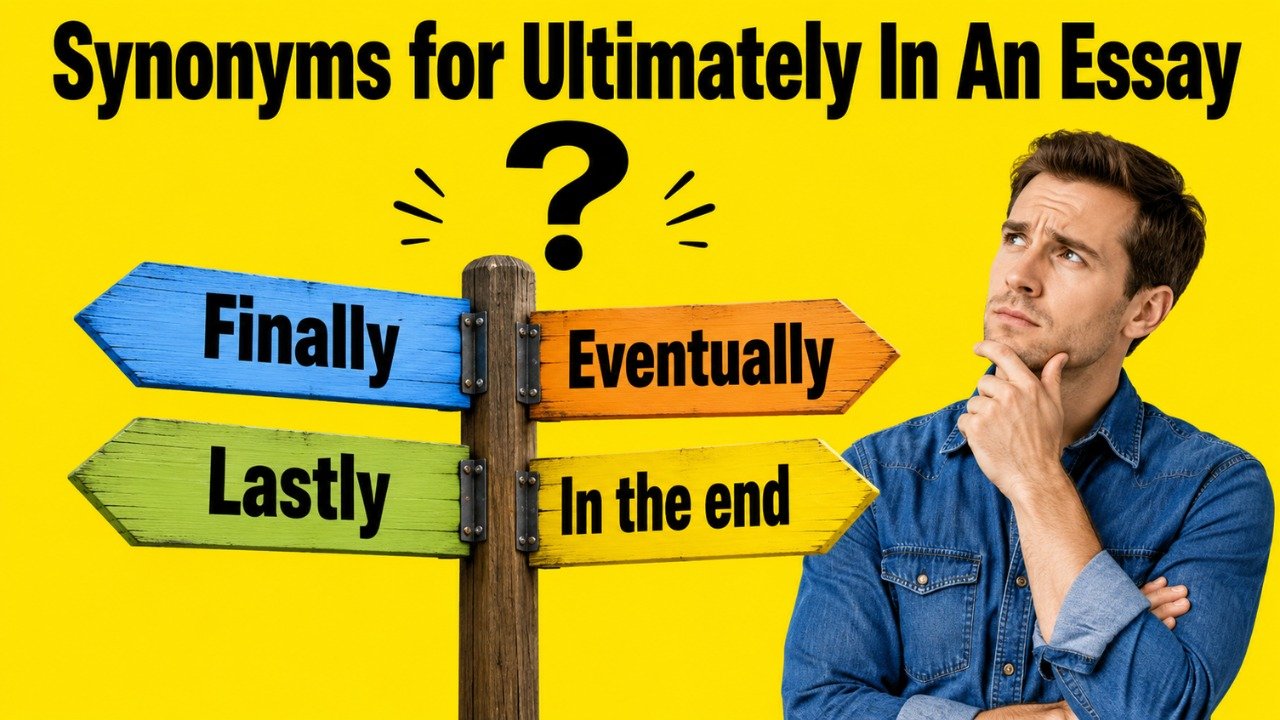
Quick Answer: The best synonyms for ultimately in an essay include finally, eventually, in the end, in the final analysis, on balance, all things considered, fundamentally, essentially, conclusively, and inevitably. Use finally to introduce the last point in a sequence, eventually for an outcome reached over time, and in the end for the final result. Choose on balance or all things considered for a carefully weighed judgment. Fundamentally and essentially are best when ultimately refers to the central truth of an argument.
Pronunciation and Word Details
Word: Ultimately.
Pronunciation: /ˈʌltɪmətli/.
Part of Speech: Adverb.
Meaning: In the end, after everything has been considered, or at the most basic and important level.
US Pronunciation:
UK Pronunciation:
What Does “Ultimately” Mean?
Ultimately means in the end, after a process has been completed, or after all relevant facts have been considered. It is an adverb commonly used to introduce a final outcome, judgment, conclusion, or underlying truth.
In an essay, ultimately often signals that the writer is moving toward the most important conclusion.
Final Outcome: The policy ultimately failed to achieve its main objective.
Final Judgment: Ultimately, the evidence supports a change in strategy.
Central Truth: The debate is ultimately about individual responsibility.
Eventual Result: The early disagreements ultimately led to a stronger proposal.
The meaning changes slightly according to context. Sometimes ultimately refers to time and means eventually. In other sentences, it introduces a reasoned conclusion or reveals the fundamental point of an argument.
Meaning, Tone, and Context of “Ultimately”
Ultimately has a neutral to formal tone. It is especially common in academic essays, analytical writing, reports, persuasive arguments, and professional discussions.
Academic Tone: Ultimately is appropriate when presenting a conclusion based on evidence or analysis.
Formal Tone: The word sounds natural in reports, research discussions, and carefully developed arguments.
Analytical Use: It can show that several facts, causes, or viewpoints have been considered before a final judgment is offered.
Persuasive Use: Writers use ultimately to emphasize the conclusion they want readers to accept.
Narrative Use: It can describe the eventual result of a sequence of events.
Conversational Use: Ultimately also appears in ordinary speech, although in the end or eventually may sound more natural in casual conversation.
Ultimately is useful, but it can become repetitive when used several times in one essay. Choosing a more precise alternative can improve clarity and sentence variety.
When and How to Use “Ultimately”
For a Final Outcome
Use ultimately to explain what happened after a process, debate, conflict, or series of events.
Example: The negotiations ultimately produced an agreement acceptable to both groups.
For a Reasoned Conclusion
Use ultimately before the main judgment reached after considering evidence.
Example: Ultimately, the available evidence supports the argument that early intervention is more effective.
For the Central Issue
Use ultimately when identifying the deepest or most important part of a subject.
Example: The discussion is ultimately about how limited resources should be distributed.
For a Long Term Result
Use ultimately when an action produces a result after time has passed.
Example: Consistent investment in education can ultimately improve economic opportunity.
For a Final Decision
Use ultimately when identifying the person, institution, or factor that determines an outcome.
Example: The committee may offer advice, but the director will ultimately make the decision.
For a Concluding Statement
Use ultimately near the end of an essay when presenting the final lesson or position.
Example: Ultimately, lasting change requires both public support and responsible leadership.
Best Synonyms for Ultimately
Finally
Synonym: Finally means at the last point in a sequence or after a period of delay.
Example: Finally, the essay considers the long term effects of the policy.
Eventually
Synonym: Eventually means at some later time after a process, delay, or series of events.
Example: The temporary measures eventually became permanent regulations.
In the End
Synonym: In the end means after everything has happened or been considered.
Example: In the end, cooperation proved more effective than competition.
In the Final Analysis
Synonym: In the final analysis introduces the most important conclusion reached after careful examination.
Example: In the final analysis, the success of the program depends on public participation.
On Balance
Synonym: On balance means after weighing the advantages, disadvantages, and available evidence.
Example: On balance, the benefits of the proposal appear greater than its risks.
All Things Considered
Synonym: All things considered means after examining every important factor.
Example: All things considered, the revised approach offers the most practical solution.
Fundamentally
Synonym: Fundamentally means at the most basic or essential level.
Example: The disagreement is fundamentally a conflict between personal freedom and public responsibility.
Essentially
Synonym: Essentially means when reduced to the most important idea or feature.
Example: The argument is essentially a demand for greater accountability.
Conclusively
Synonym: Conclusively means in a way that settles a question or establishes a final result.
Example: The evidence does not conclusively prove that the change caused the improvement.
Inevitably
Synonym: Inevitably means in a way that cannot reasonably be prevented or avoided.
Example: Continued neglect will inevitably create more serious problems.
50 Synonyms for Ultimately in an Essay with Short Meanings
- Finally: At the last point in a sequence.
- Eventually: At a later time after a process or delay.
- In the End: After everything has happened or been considered.
- At Last: After a long wait, effort, or delay.
- At Length: After a considerable period of time.
- In Conclusion: As a signal that the final conclusion is beginning.
- To Conclude: To introduce the closing judgment or summary.
- In Summary: To present the main points in a condensed form.
- In the Final Analysis: After all evidence and arguments have been examined.
- On Balance: After weighing advantages, disadvantages, and evidence.
- All Things Considered: After considering every important factor.
- After All: When introducing a final reason or supporting point.
- When All Is Said and Done: After every relevant action or discussion is complete.
- At the End of the Day: When the most important practical fact is considered.
- In the Long Run: Over an extended period of time.
- Sooner or Later: At some future point that is expected to arrive.
- As a Final Outcome: As the last result of a process.
- As a Final Result: As the consequence reached at the end.
- In the Final Reckoning: When the final judgment or evaluation is made.
- On Final Consideration: After giving the issue complete thought.
- Upon Reflection: After thinking carefully about the matter.
- After Careful Consideration: Following a thoughtful review of the evidence.
- Therefore: For that reason or as a logical result.
- Thus: In this way or as a result of what was discussed.
- Hence: For this reason or from this point.
- Consequently: As a result of a previous action or condition.
- Accordingly: In a way that follows logically from the evidence.
- For This Reason: Because of the point or evidence already presented.
- Fundamentally: At the most basic and important level.
- Essentially: In relation to the central nature of something.
- In Essence: When expressed through the most important idea.
- At Heart: At the central or deepest level.
- At Its Core: At the most basic part of an issue.
- Basically: In the simplest or most fundamental sense.
- Above All: More importantly than every other consideration.
- Most Importantly: To emphasize the point of greatest importance.
- Primarily: Mainly or for the most important reason.
- Chiefly: Mainly or principally.
- Decisively: In a way that settles an issue or produces a clear result.
- Conclusively: In a way that establishes a definite conclusion.
- Definitively: In a final and authoritative manner.
- Inevitably: In a way that cannot reasonably be avoided.
- Unavoidably: In a manner that cannot be prevented.
- Inescapably: In a way that cannot be escaped or ignored.
- Over Time: Gradually as time passes.
- In Due Course: At the proper or expected future time.
- In Time: Eventually or after enough time has passed.
- As Events Unfold: Gradually as a situation develops.
- In the Fullness of Time: After the necessary amount of time has passed.
- At the Final Stage: During the last part of a process or discussion.
Read Also:
Synonyms for Frost

Synonyms for Ultimately in an Essay by Context
When Ultimately Means In the End
Use these alternatives when describing the final outcome of an event, decision, process, or argument.
In the End: Introduces the result reached after everything happened.
Example: In the end, the reform failed because it lacked sufficient funding.
Finally: Introduces the last development or point in a sequence.
Example: Finally, the committee approved the revised proposal.
As a Final Result: Emphasizes the result produced at the end of a process.
Example: As a final result, the organization adopted a more flexible policy.
When All Is Said and Done: Refers to the conclusion reached after all discussion or activity is complete.
Example: When all is said and done, effective leadership depends on trust.
When Ultimately Means Eventually
These alternatives work when the word describes something that happens after time, delay, or gradual development.
Eventually: At an unspecified later time.
Example: The small disagreement eventually developed into a wider conflict.
In the Long Run: Over an extended period.
Example: In the long run, preventive measures may reduce public spending.
Over Time: Gradually as time passes.
Example: Over time, repeated exposure changed public attitudes.
In Due Course: At the expected or appropriate future time.
Example: The benefits of the reform may become visible in due course.
When Ultimately Introduces a Final Judgment
Use these phrases when presenting a conclusion after examining several arguments or pieces of evidence.
In the Final Analysis: Introduces the most important conclusion after analysis.
Example: In the final analysis, the plan depends on reliable local support.
On Balance: Presents a judgment after comparing positive and negative factors.
Example: On balance, the evidence favors gradual implementation.
All Things Considered: Shows that multiple relevant factors have been reviewed.
Example: All things considered, the second proposal is more realistic.
After Careful Consideration: Emphasizes that the conclusion follows serious thought.
Example: After careful consideration, the committee rejected the original recommendation.
When Ultimately Means Fundamentally
These alternatives identify the deepest, most basic, or most important nature of an issue.
Fundamentally: At the most basic level.
Example: The conflict is fundamentally about access to limited resources.
Essentially: In relation to the central nature of the matter.
Example: The policy is essentially an attempt to balance freedom and security.
In Essence: When reduced to the main idea.
Example: In essence, the author argues that institutions require public trust.
At Its Core: At the central part of an issue.
Example: At its core, the debate concerns the meaning of fairness.
When Ultimately Indicates a Logical Result
Use these transitions when the sentence introduces a conclusion caused or supported by earlier evidence.
Therefore: Introduces a conclusion that follows from stated facts.
Example: The earlier method produced inconsistent results. Therefore, a new approach was required.
Consequently: Introduces a result caused by a previous event.
Example: Funding was reduced significantly. Consequently, several services were discontinued.
Thus: Connects evidence with a logical conclusion.
Example: The sample was too small. Thus, the findings cannot represent the entire population.
Accordingly: Shows that an action or conclusion follows from existing circumstances.
Example: The original data contained several errors. Accordingly, the calculations were repeated.
When Ultimately Emphasizes Certainty
These alternatives work when the outcome is definite, unavoidable, or firmly established.
Conclusively: In a way that settles a question through strong proof.
Example: The available evidence does not conclusively establish a direct connection.
Definitively: In a final and authoritative way.
Example: The study cannot definitively answer every question raised by the debate.
Inevitably: In a way that is certain to occur.
Example: A continued shortage of housing will inevitably increase competition.
Unavoidably: In a way that cannot be prevented.
Example: Any major reform will unavoidably create a period of adjustment.
Another Word for Ultimately
In the end is often the best general replacement for ultimately because it clearly expresses a final outcome. However, the best alternative depends on the sentence.
Use eventually when time passes before the result occurs. Choose in the final analysis for a formal academic judgment, on balance for a conclusion based on competing evidence, and fundamentally when identifying the central nature of an issue.
Original: Ultimately, the new system improved access to essential services.
Better Option: In the end, the new system improved access to essential services.
Original: The disagreement ultimately became a legal dispute.
Better Option: The disagreement eventually became a legal dispute.
Original: Ultimately, the benefits are greater than the disadvantages.
Better Option: On balance, the benefits are greater than the disadvantages.
Original: The novel is ultimately about the search for identity.
Better Option: The novel is fundamentally about the search for identity.
When Not to Use “Ultimately”
Ultimately should not be used automatically whenever a writer wants to end a paragraph. Its meaning must fit the relationship between the ideas.
When Referring Only to the Next Point
Do not use ultimately when simply adding another supporting detail.
Weak: Ultimately, another cause of pollution is industrial waste.
Better: Additionally, another cause of pollution is industrial waste.
When Describing an Immediate Result
Ultimately usually suggests a final or eventual outcome. It may sound inaccurate when the result happens immediately.
Weak: The alarm sounded and ultimately everyone left the building.
Better: The alarm sounded, and everyone immediately left the building.
When Introducing a Direct Cause
Use therefore, consequently, or as a result when the sentence presents a clear consequence.
Weak: The roads were flooded. Ultimately, the event was cancelled.
Better: The roads were flooded. Consequently, the event was cancelled.
When Beginning Every Conclusion
Repeated use can make an essay sound mechanical.
Weak: Ultimately, the policy was costly. Ultimately, it was also ineffective. Ultimately, it was abandoned.
Better: The policy was costly and ineffective. In the end, officials abandoned it.
When the Meaning Is Fundamental
Use fundamentally, essentially, or at its core when discussing the basic nature of an argument.
Weak: The essay is ultimately a criticism of unequal opportunity.
Better: The essay is fundamentally a criticism of unequal opportunity.
When the Conclusion Is Not Supported
Ultimately can make a statement sound final and confident. Avoid it when the evidence is incomplete or uncertain.
Weak: Ultimately, the treatment is effective for every participant.
Better: The available results suggest that the treatment may benefit some participants.
Words Commonly Confused With Ultimately
Ultimately vs Finally: Ultimately emphasizes the final result or most important conclusion. Finally often introduces the last point in a sequence or something that happened after a delay.
Ultimately vs Eventually: Ultimately can introduce a judgment, central truth, or final outcome. Eventually refers mainly to something that happens after time has passed.
Ultimately vs Fundamentally: Ultimately means in the end or after everything is considered. Fundamentally means at the most basic level.
Ultimately vs Therefore: Ultimately introduces a final judgment or outcome. Therefore introduces a logical conclusion caused or supported by the previous statement.
Ultimately vs In Conclusion: Ultimately can appear anywhere in an essay when discussing a final result or central truth. In conclusion normally signals the beginning of the closing section.
Ultimately vs Consequently: Ultimately emphasizes the end of a process. Consequently emphasizes a direct result caused by something previously mentioned.
Ultimately vs Essentially: Ultimately focuses on a final result or judgment. Essentially focuses on the main nature or defining feature of something.
Ultimately vs Inevitably: Ultimately does not always suggest certainty. Inevitably means that an outcome cannot reasonably be avoided.
Which Synonym Should You Choose?
Choose finally when introducing the last point in a sequence or the final stage of an argument.
Choose eventually when an event occurs after time, delay, effort, or gradual development.
Choose in the end when stating the final result in clear and natural language.
Choose in the final analysis for a formal judgment reached after examining evidence and competing arguments.
Choose on balance when comparing benefits, disadvantages, strengths, weaknesses, or opposing viewpoints.
Choose all things considered when several different factors influence the final conclusion.
Choose fundamentally when identifying the basic nature, cause, or principle of an issue.
Choose essentially when explaining the main character or meaning of something in simpler terms.
Choose therefore when a conclusion follows logically from the evidence presented immediately before it.
Choose consequently when describing a direct result caused by an earlier condition or event.
Choose conclusively when evidence settles a question with a high degree of certainty.
Choose inevitably when an outcome appears unavoidable.
Choose in conclusion only when beginning the final section of an essay.
Choose at the end of the day carefully because it is more conversational and may sound informal in academic writing.
Real Life Examples of “Ultimately” in Essay Sentences
Original: Ultimately, the success of the program depends on public trust.
Better Option: In the final analysis, the success of the program depends on public trust.
Original: The two organizations ultimately agreed to cooperate.
Better Option: The two organizations eventually agreed to cooperate.
Original: Ultimately, the advantages of the proposal exceed its costs.
Better Option: On balance, the advantages of the proposal exceed its costs.
Original: The conflict is ultimately a struggle for political influence.
Better Option: The conflict is fundamentally a struggle for political influence.
Original: Poor planning ultimately caused the project to fail.
Better Option: Poor planning eventually caused the project to fail.
Original: Ultimately, the evidence does not support the original claim.
Better Option: After careful consideration, the evidence does not support the original claim.
Original: The decision will ultimately affect every department.
Better Option: In the long run, the decision will affect every department.
Original: Ultimately, the study demonstrates the importance of early education.
Better Option: In conclusion, the study demonstrates the importance of early education.
Original: Continued inaction will ultimately increase the cost of reform.
Better Option: Continued inaction will inevitably increase the cost of reform.
Original: Ultimately, the debate concerns the limits of personal freedom.
Better Option: At its core, the debate concerns the limits of personal freedom.
Synonym Groups and Usage Differences
Final Outcome Group
Finally, in the end, as a final outcome, and when all is said and done describe what happens after a process is complete.
Finally often introduces the last step. In the end focuses on the final result. As a final outcome sounds more formal, while when all is said and done is more conversational.
Example: In the end, the original proposal was replaced by a more practical alternative.
Eventual Result Group
Eventually, over time, in due course, in time, and in the long run describe outcomes that develop after time has passed.
Eventually is the most direct alternative. Over time emphasizes gradual development. In due course suggests an expected future result, while in the long run emphasizes lasting effects.
Example: Over time, the reform produced improvements that were not immediately visible.
Final Judgment Group
In the final analysis, on balance, all things considered, upon reflection, and after careful consideration present reasoned conclusions.
In the final analysis sounds formal and decisive. On balance is best for comparing competing factors. Upon reflection and after careful consideration emphasize thoughtful evaluation.
Example: On balance, the evidence supports a limited rather than complete change.
Fundamental Meaning Group
Fundamentally, essentially, in essence, at heart, and at its core explain the central nature of an issue.
Fundamentally emphasizes basic principles. Essentially summarizes the main character of something. At heart and at its core focus on the deepest issue.
Example: At its core, the disagreement concerns the fair distribution of responsibility.
Logical Conclusion Group
Therefore, thus, hence, consequently, accordingly, and for this reason connect evidence with a conclusion or result.
Therefore and thus introduce logical conclusions. Consequently emphasizes cause and effect. Accordingly often introduces an appropriate response based on earlier facts.
Example: The evidence was incomplete. Therefore, the original conclusion required revision.
Certainty Group
Conclusively, definitively, inevitably, unavoidably, and inescapably express different levels of certainty.
Conclusively and definitively describe firmly established answers. Inevitably, unavoidably, and inescapably describe outcomes that cannot reasonably be prevented.
Example: Continued delay will inevitably make the problem more difficult to solve.
Importance Group
Above all, most importantly, primarily, and chiefly emphasize the most significant factor.
Above all and most importantly highlight priority. Primarily and chiefly identify the main cause, purpose, or feature.
Example: Most importantly, the proposal protects the interests of vulnerable communities.
Antonyms of Ultimately
The opposite of ultimately changes according to whether the word refers to time, finality, certainty, or a central truth.
Initially: At the beginning rather than at the end.
Firstly: In the first position in a sequence.
Immediately: Without delay or the passage of time.
Temporarily: For a limited period rather than as a final result.
Provisionally: In a manner that may be changed later.
Tentatively: Without complete confidence or final commitment.
Indecisively: Without reaching a clear or final decision.
Inconclusively: Without establishing a definite answer.
Possibly: In a way that may happen but is not certain.
Superficially: At the surface level rather than fundamentally.
Incidentally: As a minor or secondary point rather than the main conclusion.
Partially: To a limited degree rather than completely or finally.
Comparison: Ultimately vs Related Words
Ultimately vs Finally
Ultimately focuses on the final outcome, judgment, or central truth. Finally often marks the last step in an ordered sequence.
Example With Ultimately: Ultimately, the reform depends on consistent public funding.
Example With Finally: Finally, the essay examines the financial cost of the reform.
Ultimately vs Eventually
Ultimately has both logical and time related meanings. Eventually mainly means after some time has passed.
Example With Ultimately: Ultimately, the evidence favors the second explanation.
Example With Eventually: The temporary arrangement eventually became permanent.
Ultimately vs Fundamentally
Ultimately means in the end or after full consideration. Fundamentally means at the most basic level.
Example With Ultimately: Ultimately, the committee approved the proposal.
Example With Fundamentally: The proposal is fundamentally different from the existing policy.
Ultimately vs Therefore
Ultimately introduces a final judgment or eventual result. Therefore introduces a logical consequence of the previous information.
Example With Ultimately: Ultimately, public participation will determine the program’s success.
Example With Therefore: Public participation remained low. Therefore, the program did not reach its target.
Ultimately vs In Conclusion
Ultimately can appear in body paragraphs as well as conclusions. In conclusion normally signals the closing paragraph or section.
Example With Ultimately: Economic conditions will ultimately influence the final decision.
Example With In Conclusion: In conclusion, the policy requires further revision.
Ultimately vs On Balance
Ultimately can express any final result or judgment. On balance specifically indicates that positive and negative factors have been weighed.
Example With Ultimately: Ultimately, the organization adopted the new system.
Example With On Balance: On balance, the new system offers more benefits than disadvantages.
Ultimately vs Inevitably
Ultimately indicates what finally happens. Inevitably suggests that the outcome cannot be avoided.
Example With Ultimately: The dispute ultimately reached the courts.
Example With Inevitably: A complete refusal to negotiate will inevitably prolong the dispute.
Common Phrases and Expressions With “Ultimately”
Ultimately Responsible: Having the final duty or accountability.
Ultimately Decide: Make the final choice after considering other opinions.
Ultimately Determine: Have the greatest influence on the final result.
Ultimately Depend On: Be decided by a particular factor in the end.
Ultimately Lead To: Produce a particular result after a process.
Ultimately Result In: Cause a final outcome.
Ultimately Prove: Become clear or established in the end.
Ultimately Fail: Be unsuccessful as the final result.
Ultimately Succeed: Achieve the intended result after effort or difficulty.
Ultimately Matter: Be the most important consideration in the final judgment.
Common Mistakes to Avoid
Using Ultimately as a General Transition
Ultimately should introduce a final outcome, judgment, or central truth. It should not replace ordinary transitions such as additionally, however, or for example.
Incorrect: Ultimately, another example appears in the second chapter.
Correct: Additionally, another example appears in the second chapter.
Confusing Ultimately With Eventually
Use eventually when the main idea is the passage of time.
Less Precise: The seedlings ultimately developed into mature plants.
More Precise: The seedlings eventually developed into mature plants.
Confusing Ultimately With Fundamentally
Use fundamentally when referring to the essential nature of an idea.
Less Precise: The disagreement is ultimately philosophical.
More Precise: The disagreement is fundamentally philosophical.
Using Ultimately and In Conclusion Together
Using both expressions in the same sentence is unnecessary because they perform similar concluding functions.
Wordy: In conclusion, ultimately, the evidence supports reform.
Improved: In conclusion, the evidence supports reform.
Repeating Ultimately Too Often
Frequent repetition makes an essay sound predictable and reduces the impact of the word.
Repetitive: Ultimately, the law changed. Ultimately, public attitudes changed. Ultimately, institutions adapted.
Improved: The law changed first. Over time, public attitudes shifted, and institutions eventually adapted.
Using a Casual Alternative in Formal Writing
At the end of the day and when all is said and done may sound too conversational for a formal academic essay.
Casual: At the end of the day, the policy was unsuccessful.
Formal: In the final analysis, the policy was unsuccessful.
Using Therefore Without a Logical Connection
Therefore should only appear when the conclusion follows directly from earlier evidence.
Incorrect: The author uses vivid imagery. Therefore, the novel was published in spring.
Correct: The results were inconsistent. Therefore, additional testing was necessary.
Making an Unsupported Final Claim
Ultimately can create a strong sense of certainty. The evidence must justify that confidence.
Unsupported: Ultimately, the policy will solve every economic problem.
Improved: Ultimately, the policy may address several of the economic problems identified in the report.
Conclusion
The best synonyms for ultimately in an essay depend on the meaning you want to express. Use in the end or finally for a final outcome, eventually for a result reached over time, and in the final analysis for a reasoned academic judgment. On balance works well when comparing evidence, while fundamentally and essentially identify the central nature of an issue. Therefore and consequently are better for direct logical results. Selecting the most precise alternative will make an essay clearer, more varied, and more persuasive.
FAQs About Synonyms for Ultimately in an Essay
What Is the Best Synonym for Ultimately in an Essay?
In the final analysis is a strong formal alternative when introducing a reasoned conclusion. In the end is better for a general final outcome, while eventually suits a result reached over time.
Can I Use Finally Instead of Ultimately?
Yes, but the words are not always identical. Finally usually introduces the last point or event in a sequence. Ultimately focuses more strongly on the final outcome, judgment, or underlying truth.
Is Eventually a Formal Synonym for Ultimately?
Eventually is acceptable in formal essays when describing something that happens after time or gradual development. It should not replace ultimately when the sentence presents a final judgment or central argument.
What Can I Use Instead of Ultimately in a Conclusion?
Useful alternatives include in conclusion, in the final analysis, on balance, all things considered, and after careful consideration. The best choice depends on whether you are summarizing, evaluating evidence, or presenting a final judgment.
Is At the End of the Day Suitable for an Essay?
At the end of the day is common in conversation but may sound too informal or overused in an academic essay. In the final analysis, on balance, or in the end usually sounds more professional.
What Is a Formal Alternative to Ultimately?
Formal alternatives include in the final analysis, on balance, all things considered, conclusively, fundamentally, consequently, and after careful consideration.
How Can I Avoid Repeating Ultimately in an Essay?
Choose alternatives according to meaning. Use eventually for time, fundamentally for the central issue, therefore for a logical result, on balance for evaluation, and in the end for a final outcome.
