
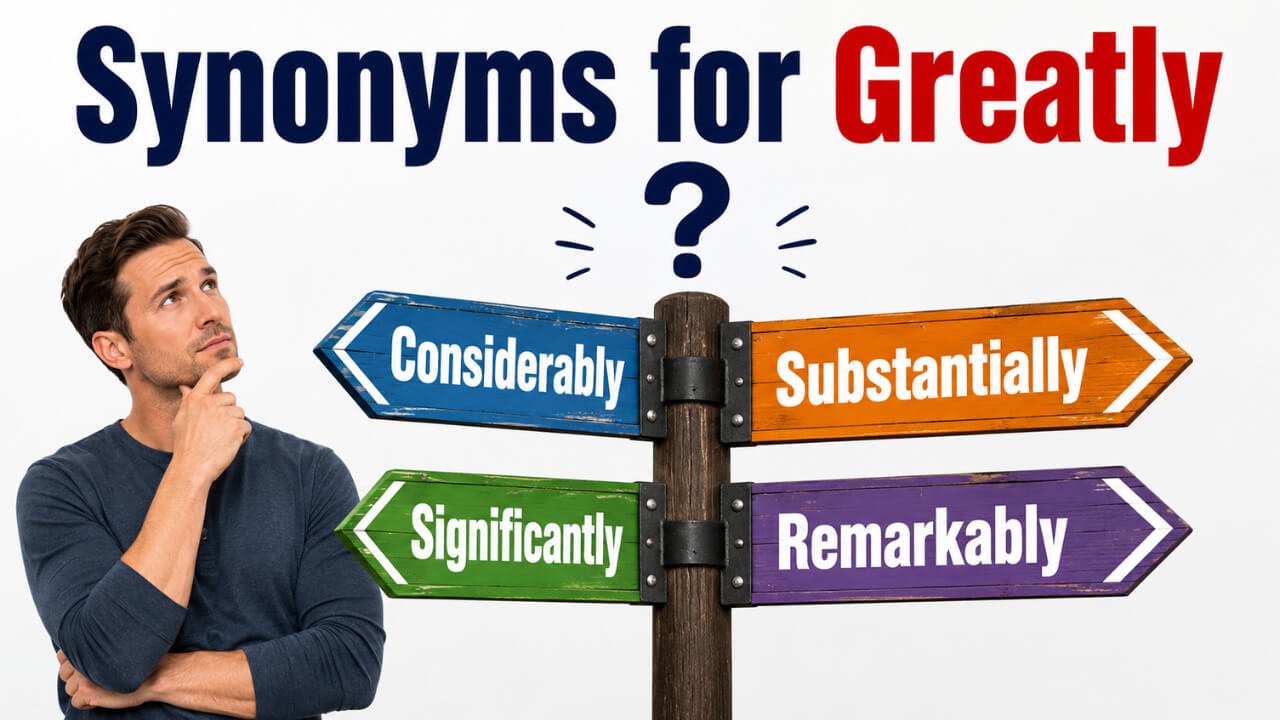
Quick Answer: The best synonyms for greatly include significantly, considerably, substantially, enormously, immensely, highly, deeply, profoundly, remarkably, and tremendously. Use significantly for measurable changes, considerably for noticeable differences, and substantially for large amounts or effects. Highly works well with praise, value, and probability, while deeply and profoundly express strong emotions or influence. Enormously, immensely, and tremendously provide strong emphasis in descriptive or conversational writing.
Pronunciation and Word Details
Word: Greatly.
Pronunciation: /ˈɡreɪtli/.
Part of Speech: Adverb.
Meaning: Greatly means to a large degree, by a considerable amount, or very much.
US Pronunciation:
UK Pronunciation:
What Does “Greatly” Mean?
Greatly means to a large degree or by a considerable amount. It is an adverb used to strengthen the meaning of a verb, adjective, or complete statement.
The word can describe major changes, strong emotions, important effects, or high levels of appreciation. For example, something may improve greatly, differ greatly, or affect someone greatly.
Greatly often appears before a past participle, as in greatly appreciated, greatly admired, and greatly influenced. It can also follow a verb, as in opinions vary greatly.
The exact meaning changes with context. In a formal report, greatly may describe a significant increase. In a personal message, it may express sincere appreciation or emotional impact.
Meaning, Tone, and Context of “Greatly”
Greatly has a neutral to formal tone. It is common in professional communication, academic writing, reports, essays, formal requests, and polite expressions of gratitude.
The word adds emphasis without sounding overly dramatic. However, it can feel less natural in relaxed conversation, where very much, a lot, or really may sound more conversational.
In analytical writing, greatly often describes substantial changes or differences. In emotional writing, it can show strong appreciation, concern, relief, admiration, or influence.
Greatly is also useful when the writer wants to emphasize importance without using an extreme word. For example, greatly improved sounds strong but controlled, while enormously improved sounds more dramatic.
When and How to Use “Greatly”
For Significant Change: Use greatly when an action creates a large or noticeable difference.
Example: The new schedule greatly improved productivity.
For Appreciation: Use greatly to express sincere gratitude in polite or formal communication.
Example: Your patience is greatly appreciated.
For Strong Influence: Use greatly when a person, idea, or experience has an important effect.
Example: Her teaching greatly influenced his career choice.
For Major Differences: Use greatly when two or more things are very different.
Example: Prices vary greatly between regions.
For Emotional Impact: Use greatly when an event causes a strong emotional response.
Example: The family was greatly relieved by the positive news.
For Increased Degree: Use greatly when an amount, level, or intensity becomes much higher.
Example: Demand for the service has greatly increased.
For Reduced Degree: Use greatly when an amount or problem becomes much smaller.
Example: The updated process greatly reduced waiting times.
For Praise or Value: Use greatly when showing that someone or something is highly respected.
Example: Her contribution was greatly valued by the team.
Best Synonyms for Greatly
Significantly: To an important, noticeable, or measurable degree.
Example: Customer satisfaction increased significantly during the year.
Considerably: By a large or noticeable amount.
Example: The repair cost was considerably lower than expected.
Substantially: To a large and meaningful extent.
Example: The changes substantially improved the final result.
Enormously: To an extremely large degree.
Example: Regular practice helped her enormously.
Immensely: To a very great degree, especially in emotional or descriptive contexts.
Example: He enjoyed the performance immensely.
Tremendously: To an exceptionally large or impressive degree.
Example: The organization benefited tremendously from the new strategy.
Highly: To a high degree or with strong approval.
Example: The book is highly respected by language teachers.
Deeply: With strong emotion, seriousness, or influence.
Example: She was deeply affected by the experience.
Profoundly: In a deep, important, or lasting way.
Example: The discovery profoundly changed their understanding of the subject.
Remarkably: To an unusual or impressive degree.
Example: The two designs are remarkably similar.
50 Synonyms for Greatly with Short Meanings
- Considerably: By a noticeably large amount.
- Significantly: To an important or measurable degree.
- Substantially: To a large and meaningful extent.
- Enormously: To an extremely great degree.
- Immensely: To a very large degree.
- Tremendously: To an exceptionally great extent.
- Highly: To a high degree.
- Deeply: With strong feeling or influence.
- Profoundly: In a deep and lasting way.
- Markedly: In a clearly noticeable manner.
- Notably: To a degree worth noticing.
- Vastly: By a very large amount.
- Exceedingly: To an unusually high degree.
- Exceptionally: To a degree beyond what is normal.
- Extremely: To a very high degree.
- Remarkably: To an impressive or unusual degree.
- Dramatically: In a striking or major way.
- Appreciably: By an amount that can be noticed.
- Seriously: To a considerable or important degree.
- Strongly: With great force, intensity, or conviction.
- Intensely: To a powerful or concentrated degree.
- Abundantly: In a plentiful or more than sufficient way.
- Extensively: Over a large amount or area.
- Hugely: To a very large degree.
- Massively: By an extremely large amount.
- Extraordinarily: To an unusual or exceptional degree.
- Particularly: To a greater degree than usual.
- Especially: More than normally or generally.
- Decidedly: In a clear and definite way.
- Distinctly: In a clearly noticeable manner.
- Materially: In an important or meaningful way.
- Meaningfully: In a way that creates a real difference.
- Powerfully: With strong force or influence.
- Heavily: To a large or serious degree.
- Keenly: With strong awareness or feeling.
- Acutely: With great intensity or sensitivity.
- Thoroughly: Completely or to a full degree.
- Fully: Completely or to the greatest necessary degree.
- Sincerely: With genuine and strong feeling.
- Dearly: Very much, especially when expressing love or value.
- Overwhelmingly: To an extremely dominant degree.
- Immeasurably: To a degree too great to measure.
- Incalculably: To an extent too large to calculate.
- Infinitely: To an unlimited or extremely great degree.
- Very Much: To a great degree.
- To a Great Extent: Over a large degree or range.
- A Great Deal: By a considerable amount.
- By Far: To a clearly greater degree than others.
- In Large Measure: To a considerable extent.
- Beyond Measure: To an extremely great or immeasurable degree.
Read Also:
Synonyms for Broken

Synonyms for Greatly by Context
When Greatly Means Significantly
Significantly, considerably, substantially, materially, markedly, appreciably, and meaningfully describe an important or noticeable change.
These alternatives are useful in formal writing, reports, research, and explanations involving measurable results.
Example: The revised plan significantly reduced unnecessary spending.
Example: Performance improved considerably after additional training.
Example: Better communication substantially increased efficiency.
When Greatly Means Very Much
Very much, immensely, enormously, tremendously, hugely, and a great deal express a large degree of feeling, enjoyment, benefit, or effect.
These options work well in both conversational and descriptive writing.
Example: We enjoyed the event immensely.
Example: Your advice helped me a great deal.
Example: The community benefited enormously from the project.
When Greatly Means Deeply
Deeply, profoundly, intensely, acutely, keenly, and powerfully describe strong emotions, awareness, influence, or concern.
Deeply is natural for emotions, while profoundly suggests a lasting intellectual or emotional effect.
Example: She was deeply concerned about the situation.
Example: The experience profoundly influenced his beliefs.
Example: Residents were keenly aware of the risks.
When Greatly Means Highly
Highly, exceptionally, exceedingly, extraordinarily, remarkably, especially, and particularly describe a high level of quality, value, respect, or probability.
Highly often appears with words such as respected, recommended, skilled, valued, and successful.
Example: She is highly regarded for her professional judgment.
Example: The solution proved exceptionally effective.
Example: His explanation was remarkably clear.
When Greatly Means Dramatically
Dramatically, massively, overwhelmingly, vastly, markedly, and enormously describe major differences, increases, reductions, or transformations.
These words create stronger emphasis and may sound more forceful than greatly.
Example: Production increased dramatically within six months.
Example: One proposal was overwhelmingly preferred.
Example: The revised version was vastly more accurate.
When Greatly Expresses Appreciation
Sincerely, deeply, highly, very much, immensely, and beyond measure can express appreciation, gratitude, respect, or personal value.
Sincerely is appropriate for formal gratitude, while very much is natural in everyday communication.
Example: Your thoughtful assistance is sincerely appreciated.
Example: We value your contribution very much.
Example: Her continued support was deeply appreciated.
Another Word for Greatly
Significantly is often the best formal replacement for greatly. It clearly communicates that a change, difference, effect, or improvement is important and noticeable.
The best alternative still depends on context. Use deeply for emotions, highly for praise, immensely for enjoyment, and considerably for measurable differences.
Original: The new method greatly improved accuracy.
Better Option: The new method significantly improved accuracy.
Original: I greatly enjoyed our conversation.
Better Option: I immensely enjoyed our conversation.
Original: Her advice greatly influenced my decision.
Better Option: Her advice profoundly influenced my decision.
Original: The two estimates differ greatly.
Better Option: The two estimates differ considerably.
When Not to Use “Greatly”
Avoid greatly when the sentence requires a precise measurement. The word indicates a large degree, but it does not explain exactly how much something changed.
In reports involving percentages, amounts, distances, or time, include the actual figure whenever it is available.
Greatly may also sound overly formal in relaxed conversation. Very much, really, or a lot may sound more natural, depending on the sentence.
Do not use greatly with an adjective when highly or very is grammatically more natural. For example, greatly successful sounds unnatural, while highly successful is correct.
Weak: Sales were greatly successful this month.
Better: Sales were highly successful this month.
Weak: The temperature greatly changed.
Better: The temperature changed significantly.
Weak: I greatly like this design.
Better: I like this design very much.
Weak: The second room is greatly larger.
Better: The second room is considerably larger.
Weak: The number greatly increased by 25 percent.
Better: The number increased by 25 percent.
Words Commonly Confused With Greatly
Greatly vs Highly: Greatly usually modifies actions or changes, while highly commonly modifies qualities, opinions, and past participles. A situation can improve greatly, while a person can be highly respected.
Greatly vs Significantly: Greatly is a broad intensifier. Significantly suggests an important, noticeable, or measurable difference and is often better for reports and academic writing.
Greatly vs Considerably: Both describe a large degree. Considerably is especially natural when comparing amounts, sizes, costs, or differences.
Greatly vs Deeply: Greatly expresses a large degree in general. Deeply is more appropriate for emotions, beliefs, concern, influence, and personal experiences.
Greatly vs Very: Greatly usually modifies verbs and past participles. Very most commonly modifies adjectives and other adverbs.
Greatly vs Largely: Greatly means to a large degree. Largely means mainly, mostly, or for the most part.
Greatly vs Enormously: Greatly provides controlled emphasis, while enormously sounds stronger and more dramatic.
Greatly vs Substantially: Greatly is suitable for general emphasis. Substantially often describes large, meaningful changes in formal, financial, technical, or analytical contexts.
Which Synonym Should You Choose?
Choose significantly when discussing measurable changes, results, differences, or effects in formal writing.
Choose considerably when comparing prices, sizes, distances, amounts, or levels.
Choose substantially when a change is large, meaningful, and important.
Choose highly when describing respect, value, skill, quality, probability, or recommendations.
Choose deeply when writing about emotions, concern, regret, appreciation, or personal influence.
Choose profoundly when an idea or experience creates a deep and lasting effect.
Choose immensely when describing enjoyment, satisfaction, gratitude, or personal benefit.
Choose enormously when emphasizing a very large effect, advantage, amount, or improvement.
Choose dramatically when a change is sudden, striking, or visually noticeable.
Choose remarkably when something is unusually impressive, surprising, or noticeable.
Choose very much for natural conversation and personal messages.
Choose materially when discussing an important practical, legal, financial, or factual difference.
Real Life Examples of “Greatly” in Sentences
Original: The new software greatly improved the speed of the process.
Better Option: The new software significantly improved the speed of the process.
Original: We greatly appreciate your continued support.
Better Option: We sincerely appreciate your continued support.
Original: The two versions differ greatly in quality.
Better Option: The two versions differ considerably in quality.
Original: Her childhood experiences greatly influenced her writing.
Better Option: Her childhood experiences profoundly influenced her writing.
Original: He was greatly concerned about the delay.
Better Option: He was deeply concerned about the delay.
Original: The revised design greatly reduced production costs.
Better Option: The revised design substantially reduced production costs.
Original: She greatly enjoyed learning a new language.
Better Option: She immensely enjoyed learning a new language.
Original: The final result was greatly better than expected.
Better Option: The final result was considerably better than expected.
Original: His work is greatly respected by other professionals.
Better Option: His work is highly respected by other professionals.
Original: Improved lighting greatly changed the appearance of the room.
Better Option: Improved lighting dramatically changed the appearance of the room.
Synonym Groups and Usage Differences
Measurable Change Group
Significantly, considerably, substantially, materially, markedly, and appreciably describe changes that are important or noticeable.
Significantly emphasizes importance, considerably focuses on size, and substantially suggests a large and meaningful difference.
Example: The updated system substantially reduced processing time.
Strong Emotion Group
Deeply, profoundly, intensely, acutely, and keenly describe strong emotional reactions or awareness.
Deeply is widely used for concern and gratitude. Profoundly suggests lasting influence, while acutely describes sharp awareness or strong sensitivity.
Example: The community was deeply saddened by the loss.
Extreme Degree Group
Enormously, immensely, tremendously, hugely, massively, and extraordinarily create strong emphasis.
These words are more expressive than greatly and should be used when the degree is genuinely very large.
Example: The additional funding benefited the program enormously.
Praise and Value Group
Highly, exceptionally, remarkably, especially, and particularly express strong approval, importance, or distinction.
Highly works naturally with respected, valued, recommended, and regarded. Exceptionally emphasizes unusual quality.
Example: The candidate was highly recommended for the position.
Noticeable Difference Group
Markedly, distinctly, decidedly, notably, dramatically, and vastly describe clear differences or changes.
Dramatically suggests a striking transformation, while markedly and distinctly emphasize that the difference is easy to notice.
Example: The second draft was markedly clearer than the first.
Appreciation Group
Sincerely, deeply, immensely, very much, dearly, and beyond measure communicate gratitude, affection, or emotional value.
Sincerely suits formal messages, very much sounds natural in conversation, and dearly is commonly connected with love or personal value.
Example: Your kindness is sincerely appreciated.
Antonyms of Greatly
The opposite of greatly depends on whether the word describes degree, importance, change, or emotional intensity.
Slightly: To a small degree.
Minimally: To the smallest possible extent.
Barely: Only just or by a very small amount.
Hardly: Almost not at all.
Mildly: With limited strength or intensity.
Moderately: To an average or controlled degree.
Somewhat: To a limited but noticeable extent.
Insignificantly: In an unimportant or barely noticeable way.
Negligibly: By an amount too small to matter.
Marginally: By only a slight amount.
Partly: To some extent but not completely.
Little: To a small degree.
Weakly: Without much strength or force.
Superficially: Without depth or strong influence.
Inconsequentially: In a way that has little importance or effect.
Comparison: Greatly vs Related Words
Greatly vs Significantly
Greatly expresses a large degree in a general way. Significantly suggests an important, noticeable, or measurable change.
Example With Greatly: The new routine greatly improved her confidence.
Example With Significantly: The new routine significantly improved her test results.
Greatly vs Considerably
Greatly is a general intensifier. Considerably is especially useful for comparisons involving amounts, costs, size, time, or degree.
Example With Greatly: The conditions have greatly improved.
Example With Considerably: The journey was considerably shorter than expected.
Greatly vs Substantially
Greatly emphasizes a large degree. Substantially suggests a major and meaningful difference, often in formal writing.
Example With Greatly: The changes greatly improved performance.
Example With Substantially: The changes substantially reduced operating costs.
Greatly vs Highly
Greatly often modifies verbs and changes. Highly commonly appears with qualities, opinions, and forms such as respected or recommended.
Example With Greatly: The experience greatly influenced her decision.
Example With Highly: Her work is highly valued by her colleagues.
Greatly vs Deeply
Greatly has a broad meaning, while deeply is closely connected with emotions, beliefs, concern, and lasting influence.
Example With Greatly: We greatly appreciate your assistance.
Example With Deeply: We are deeply grateful for your assistance.
Greatly vs Immensely
Greatly offers controlled emphasis. Immensely sounds more expressive and often describes enjoyment, satisfaction, benefit, or gratitude.
Example With Greatly: She greatly enjoyed the course.
Example With Immensely: She enjoyed the course immensely.
Greatly vs Largely
Greatly means to a large degree. Largely means mainly or mostly, so the words are not usually interchangeable.
Example With Greatly: Better tools greatly improved the outcome.
Example With Largely: The improved outcome was largely due to better tools.
Common Phrases and Expressions With “Greatly”
Greatly Appreciated: Valued or received with strong gratitude.
Greatly Improved: Made much better than before.
Greatly Admired: Respected or praised to a high degree.
Greatly Affected: Strongly influenced or emotionally impacted.
Greatly Increased: Raised by a large amount.
Greatly Reduced: Lowered by a considerable amount.
Greatly Influenced: Strongly shaped by a person, idea, or experience.
Greatly Concerned: Feeling serious worry about something.
Greatly Relieved: Feeling much less worried or anxious.
Greatly Valued: Considered highly important or useful.
Common Mistakes to Avoid
A common mistake is using greatly directly before an adjective when very or highly would sound more natural. Write highly successful instead of greatly successful and considerably larger instead of greatly larger.
Do not confuse greatly with largely. Greatly describes degree, while largely means mainly or mostly.
Avoid using greatly when exact data is available. In analytical writing, a percentage or specific figure provides more useful information than a vague intensifier.
Writers should also avoid repeating greatly throughout a paragraph. Use significantly, considerably, deeply, highly, or substantially according to the intended meaning.
Be careful with exaggerated alternatives such as infinitely, immeasurably, and enormously. These words create strong emphasis and may not suit objective or technical writing.
Finally, place greatly near the word it modifies. Clear placement prevents ambiguity and helps readers understand which action or effect occurred to a large degree.
Conclusion
Learning synonyms for greatly allows you to express degree, change, emotion, appreciation, and influence more precisely. Use significantly for measurable results, considerably for noticeable differences, and substantially for major formal changes. Highly suits praise and value, while deeply and profoundly communicate strong emotions or lasting influence. Immensely, enormously, and tremendously add greater emphasis. Choosing an alternative that matches the context will make your sentences clearer, more natural, and more effective in essays, reports, professional messages, and everyday communication.
FAQs About Synonyms for Greatly
What Is the Best Synonym for Greatly?
Significantly is the best general formal synonym when greatly describes an important change, difference, improvement, or effect.
What Is a Simple Synonym for Greatly?
Very much is a simple and natural alternative. It works especially well in conversation and personal writing.
What Is a Formal Synonym for Greatly?
Significantly, substantially, considerably, materially, and appreciably are suitable formal alternatives.
What Is Another Word for Greatly Appreciated?
Sincerely appreciated, deeply appreciated, highly valued, and very much appreciated are useful alternatives.
Are Greatly and Highly the Same?
Not always. Greatly usually modifies actions or changes, while highly often modifies opinions, qualities, and words such as respected or recommended.
Can Greatly Mean Deeply?
Yes. Greatly can mean deeply when describing emotions, concern, appreciation, or influence. However, deeply is often more natural in emotional contexts.
What Is the Opposite of Greatly?
Common opposites include slightly, minimally, barely, mildly, marginally, negligibly, and insignificantly.
