
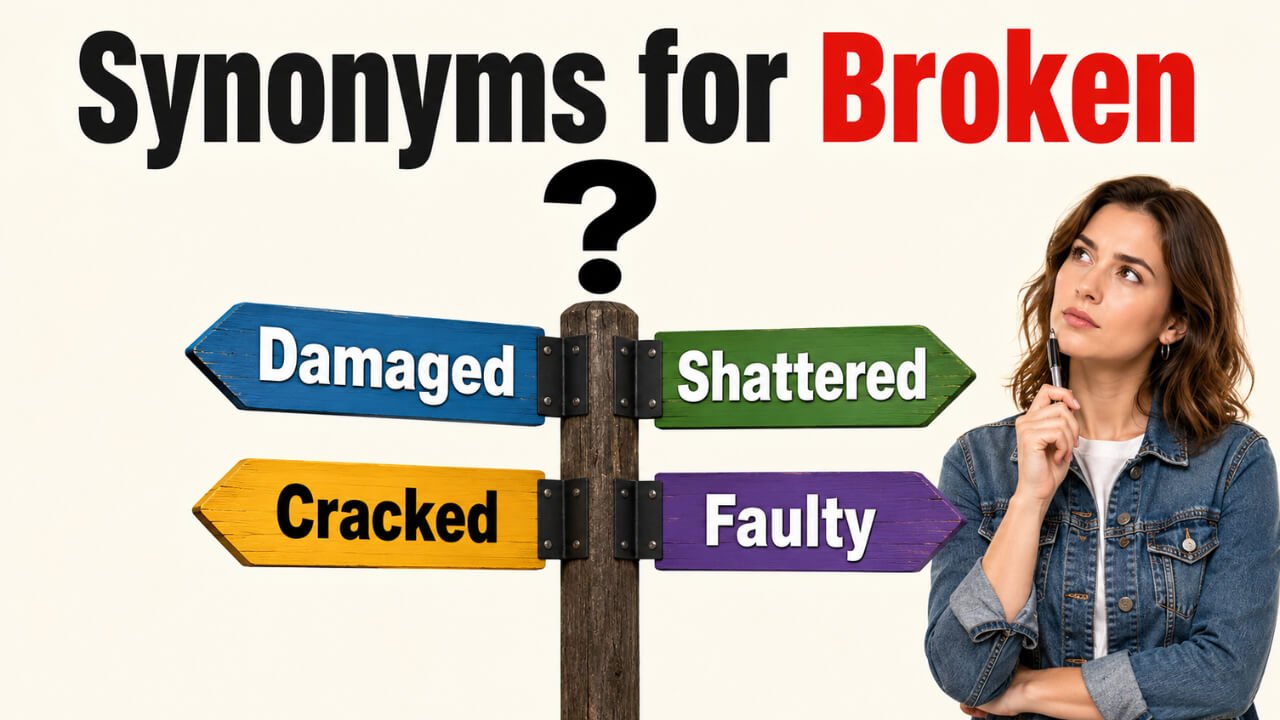
Quick Answer: Common synonyms for broken include damaged, shattered, fractured, cracked, ruined, defective, interrupted, violated, heartbroken, and incomplete. Use damaged for something physically harmed, shattered for something broken into many pieces, and defective for an object that does not work correctly. Interrupted suits a process or connection, while violated describes a broken rule, agreement, or promise. Heartbroken is best for deep emotional pain, and incomplete describes something unfinished or missing important parts.
Pronunciation and Word Details
Word: Broken.
Pronunciation: /ˈbroʊkən/.
Part of Speech: Adjective and past participle of the verb break.
Meaning: Broken describes something damaged, divided, interrupted, violated, emotionally hurt, or unable to function properly.
US Pronunciation:
UK Pronunciation:
What Does “Broken” Mean?
Broken means damaged, separated into pieces, unable to work, interrupted, or no longer complete. It commonly functions as an adjective, although it is also the past participle form of the verb break.
The word can describe physical objects, machines, promises, rules, relationships, systems, communication, and emotional conditions. A broken glass is physically damaged, while a broken machine no longer works correctly. A broken promise has not been kept, and a broken heart refers to deep emotional sadness.
The intended meaning depends on the noun that follows the word. Because broken has several meanings, choosing a more precise synonym can make a sentence clearer and more expressive.
Meaning, Tone, and Context of “Broken”
Broken is a common and generally neutral word. Its emotional strength changes according to context.
In physical descriptions, broken simply explains that something has been damaged or separated. In technical contexts, it may sound less precise than faulty, defective, or inoperative. In emotional writing, broken can sound powerful because it suggests deep sadness, weakness, or loss.
The word is common in both casual speech and formal writing. However, professional reports often require a more specific term. A technician may describe equipment as malfunctioning rather than broken, while a doctor may describe a bone as fractured.
Broken can also have a figurative meaning. Writers may describe a broken system, broken trust, broken spirit, or broken relationship to show failure, damage, or emotional suffering.
When and How to Use “Broken”
For Physical Damage: Use broken when an object has been cracked, divided, or damaged.
Example: The broken chair was unsafe to use.
For Mechanical Failure: Use broken when a machine, device, or tool does not work.
Example: The broken fan stopped turning during the night.
For Injuries: Use broken when a bone has been fractured.
Example: He was treated for a broken wrist.
For Interrupted Communication: Use broken when speech, sound, or a connection is unclear or repeatedly interrupted.
Example: Her voice sounded broken during the call.
For Unkept Promises: Use broken when an agreement, promise, or commitment has not been honored.
Example: The broken promise damaged their trust.
For Emotional Pain: Use broken to describe someone who feels deeply hurt, defeated, or hopeless.
Example: She felt broken after losing someone close to her.
For Failed Systems: Use broken when a system, process, or institution no longer functions effectively.
Example: Residents demanded changes to the broken process.
For Incomplete Patterns: Use broken when something lacks continuity or regularity.
Example: A broken line marked the center of the road.
Best Synonyms for Broken
Damaged: Harmed physically or reduced in quality.
Example: The damaged table needed several repairs.
Shattered: Broken suddenly into many small pieces.
Example: The shattered window covered the floor with glass.
Fractured: Cracked or broken, especially when referring to bones or solid materials.
Example: The scan revealed a fractured ankle.
Cracked: Marked by a narrow split without being completely separated.
Example: Water leaked through the cracked pipe.
Ruined: Damaged so badly that value, usefulness, or appearance is lost.
Example: Heavy rain ruined the outdoor decorations.
Defective: Made incorrectly or containing a fault.
Example: The defective part was removed from the machine.
Malfunctioning: Operating incorrectly or unpredictably.
Example: A malfunctioning sensor caused the warning light to appear.
Interrupted: Temporarily stopped or prevented from continuing smoothly.
Example: The interrupted service returned later that afternoon.
Violated: Disobeyed, ignored, or acted against.
Example: The company violated the terms of the agreement.
Heartbroken: Experiencing intense emotional pain or sadness.
Example: He was heartbroken when the relationship ended.
50 Synonyms for Broken with Short Meanings
- Damaged: Harmed or reduced in condition.
- Shattered: Broken into many small pieces.
- Fractured: Cracked or partly broken.
- Cracked: Split along the surface.
- Smashed: Broken through a powerful impact.
- Crushed: Pressed or damaged by strong force.
- Splintered: Broken into thin, sharp pieces.
- Fragmented: Divided into separate parts.
- Severed: Completely cut or separated.
- Torn: Pulled apart or ripped.
- Snapped: Broken suddenly with a sharp movement.
- Chipped: Damaged by losing a small piece.
- Ruined: Damaged beyond useful recovery.
- Wrecked: Severely damaged or destroyed.
- Destroyed: Completely damaged or ended.
- Defective: Containing a fault or manufacturing problem.
- Faulty: Not working correctly because of a problem.
- Malfunctioning: Operating in an incorrect way.
- Nonfunctional: Unable to perform its intended purpose.
- Inoperative: Not currently working or operating.
- Unusable: Too damaged or unsuitable to use.
- Disabled: Prevented from working normally.
- Impaired: Weakened or reduced in function.
- Out of order: Not functioning properly.
- Disrupted: Prevented from continuing normally.
- Interrupted: Temporarily stopped or disturbed.
- Disconnected: Separated from a connection.
- Separated: Moved or divided into different parts.
- Divided: Split into sections or groups.
- Breached: Broken through or acted against.
- Violated: Disobeyed or treated without respect.
- Unkept: Not fulfilled or honored.
- Unfulfilled: Not completed or carried out.
- Dishonored: Failed to respect or fulfill.
- Abandoned: Left without support or completion.
- Failed: Unsuccessful or unable to function.
- Collapsed: Fallen down or failed completely.
- Defeated: Overcome or deprived of hope.
- Insolvent: Unable to pay financial debts.
- Bankrupt: Financially unable to meet obligations.
- Exhausted: Completely drained of strength or resources.
- Weakened: Made less strong or effective.
- Devastated: Extremely damaged or emotionally distressed.
- Heartbroken: Deeply saddened by loss or disappointment.
- Distressed: Experiencing pain, worry, or suffering.
- Wounded: Physically or emotionally hurt.
- Traumatized: Deeply affected by a painful experience.
- Hopeless: Feeling that improvement is impossible.
- Incomplete: Missing necessary parts or details.
- Disjointed: Lacking a clear or continuous connection.
Read Also:
Synonyms for Excited and Happy

Synonyms for Broken by Context
When Broken Means Physically Damaged
Damaged, cracked, shattered, smashed, splintered, fractured, chipped, torn, and crushed describe physical harm. The best choice depends on the material and the extent of the damage.
Example: The cracked plate could still be used carefully.
Example: The shattered plate had broken into dozens of pieces.
Example: The chipped plate had lost only a small section near its edge.
When Broken Means Not Working
Defective, faulty, malfunctioning, nonfunctional, inoperative, disabled, unusable, and out of order describe an object or system that cannot operate correctly.
Example: The faulty switch caused the lights to flicker.
Example: The machine remained inoperative until a replacement part arrived.
Example: The damaged screen made the device unusable.
When Broken Means Emotionally Hurt
Heartbroken, devastated, distressed, wounded, traumatized, defeated, and hopeless describe different levels of emotional pain.
Example: She felt heartbroken after hearing the news.
Example: The experience left him emotionally wounded.
Example: Although disappointed, she refused to feel defeated.
When Broken Means Interrupted
Interrupted, disrupted, disconnected, fragmented, and disjointed describe communication, routines, systems, or ideas that do not continue smoothly.
Example: The disrupted schedule caused several delays.
Example: His explanation sounded fragmented and difficult to follow.
Example: A disconnected cable caused the loss of service.
When Broken Means Violated
Violated, breached, dishonored, unkept, and unfulfilled describe promises, laws, rules, agreements, and responsibilities that have not been respected.
Example: The broken agreement caused a serious dispute.
Example: The breached contract resulted in financial losses.
Example: Her unkept promise weakened their friendship.
When Broken Means Failed
Failed, collapsed, ruined, wrecked, destroyed, weakened, and abandoned describe plans, systems, businesses, or efforts that have ended unsuccessfully.
Example: The collapsed plan required a complete redesign.
Example: Poor communication ruined the partnership.
Example: The abandoned project remained unfinished for years.
Another Word for Broken
Damaged is often the best general replacement for broken because it works for objects, materials, structures, and property. However, the most accurate alternative depends on what has happened.
Choose shattered for something divided into many pieces, defective for something made incorrectly, malfunctioning for a machine that operates poorly, and heartbroken for emotional suffering.
Original: The broken door would not close.
Better Option: The damaged door would not close.
Original: She replaced the broken product.
Better Option: She replaced the defective product.
Original: The broken glass covered the kitchen floor.
Better Option: The shattered glass covered the kitchen floor.
Original: He felt broken after the painful separation.
Better Option: He felt heartbroken after the painful separation.
When Not to Use “Broken”
Avoid broken when a more specific word can explain the exact condition. It may sound vague in medical, technical, legal, or professional writing.
A bone is usually fractured, a machine may be malfunctioning, a contract may be breached, and a computer connection may be interrupted. These alternatives provide clearer information.
Broken can also sound overly dramatic when the damage is minor. A cup with a small missing piece is chipped rather than completely broken.
Weak: The equipment is broken.
Better: The equipment is malfunctioning because of a damaged motor.
Weak: She has a broken leg bone.
Better: She has a fractured leg bone.
Weak: They broke the agreement.
Better: They violated the agreement.
Weak: The conversation was broken.
Better: The conversation was repeatedly interrupted.
Weak: The paint on the wall is broken.
Better: The paint on the wall is cracked and peeling.
Words Commonly Confused With Broken
Broken vs Damaged: Broken often suggests that something cannot function or has separated into pieces. Damaged simply means harmed and may describe something that still works.
Broken vs Shattered: Broken is a general term, while shattered means divided into many small pieces through force.
Broken vs Cracked: A cracked object has a split or narrow opening but may remain in one piece. A broken object may be completely separated or unusable.
Broken vs Fractured: Fractured is more precise in medical and technical contexts. Broken is more common in everyday conversation.
Broken vs Defective: Broken describes something that has stopped working or become damaged. Defective means it contained a fault from the beginning.
Broken vs Faulty: Faulty describes something that works incorrectly. Broken may mean that it does not work at all.
Broken vs Ruined: Ruined suggests that value, appearance, usefulness, or success has been severely damaged. Broken usually refers to physical damage or lost function.
Broken vs Interrupted: Broken may describe an uneven or unclear connection, while interrupted means that continuity has been temporarily stopped.
Broken vs Heartbroken: Broken can refer broadly to emotional weakness. Heartbroken specifically describes intense sadness caused by loss, rejection, or disappointment.
Which Synonym Should You Choose?
Choose damaged when describing general physical harm to an object, building, vehicle, or material.
Choose cracked when something has developed a narrow split but remains mostly complete.
Choose shattered when an object has broken into many pieces.
Choose fractured when discussing bones, rocks, or other solid materials in medical or formal writing.
Choose defective when a product or component contains a fault.
Choose malfunctioning when equipment operates incorrectly rather than stopping completely.
Choose inoperative when writing a formal report about machinery or equipment that is not working.
Choose interrupted when communication, service, speech, or activity has temporarily stopped.
Choose breached when discussing a contract, security barrier, agreement, or legal duty.
Choose violated when a rule, law, right, or principle has been disobeyed.
Choose heartbroken when describing deep sadness after loss, rejection, or disappointment.
Choose devastated when the emotional or physical damage is extreme.
Choose incomplete when something is unfinished or missing important parts.
Choose disjointed when writing, speech, or ideas lack a smooth connection.
Real Life Examples of “Broken” in Sentences
Original: The broken window allowed cold air into the room.
Better Option: The shattered window allowed cold air into the room.
Original: My watch is broken and no longer shows the correct time.
Better Option: My watch is malfunctioning and no longer shows the correct time.
Original: The player continued despite his broken finger.
Better Option: The player continued despite his fractured finger.
Original: The storm left several broken trees across the road.
Better Option: The storm left several splintered trees across the road.
Original: Their broken promise caused disappointment.
Better Option: Their unkept promise caused disappointment.
Original: The broken connection made the conversation difficult.
Better Option: The interrupted connection made the conversation difficult.
Original: She felt broken after the friendship ended.
Better Option: She felt heartbroken after the friendship ended.
Original: The broken system delayed every application.
Better Option: The failed system delayed every application.
Original: He tried to repair the broken chair.
Better Option: He tried to repair the damaged chair.
Original: The report contained broken and confusing ideas.
Better Option: The report contained disjointed and confusing ideas.
Synonym Groups and Usage Differences
Physical Damage Group
Damaged, cracked, shattered, smashed, fractured, chipped, torn, and splintered describe visible physical harm. Cracked and chipped suggest limited damage, while shattered and smashed suggest severe destruction.
Example: The cracked mirror remained in one piece, but the shattered vase did not.
Mechanical Failure Group
Defective, faulty, malfunctioning, inoperative, nonfunctional, disabled, and out of order describe machines, tools, systems, and equipment.
Defective often refers to an original manufacturing fault. Malfunctioning describes incorrect operation, while inoperative means completely unable to work.
Example: The faulty motor continued running, but the inoperative pump stopped completely.
Emotional Pain Group
Heartbroken, devastated, distressed, wounded, traumatized, hopeless, and defeated describe emotional suffering.
Heartbroken is strongly connected with sadness and loss. Traumatized suggests a lasting emotional effect, while distressed may describe temporary worry or pain.
Example: She was distressed by the argument and heartbroken by the final decision.
Promise and Agreement Group
Breached, violated, unkept, unfulfilled, and dishonored describe commitments that have not been respected.
Breached is common for formal agreements and security. Violated works with rules, laws, rights, and principles. Unkept is most natural for promises.
Example: The breached agreement contained several unfulfilled commitments.
Continuity Group
Interrupted, disrupted, disconnected, fragmented, and disjointed describe something that does not continue smoothly.
Interrupted often suggests a temporary pause. Fragmented means divided into separate parts, while disjointed describes poor organization or connection.
Example: The interrupted speech became disjointed and difficult to understand.
Failure Group
Failed, collapsed, ruined, wrecked, destroyed, and abandoned describe unsuccessful plans, structures, systems, or relationships.
Collapsed suggests sudden failure, while abandoned means that people stopped supporting or completing something.
Example: The failed proposal was eventually abandoned.
Antonyms of Broken
The opposite of broken changes according to its meaning. Something physically broken may be whole, while broken equipment may be functional. A broken promise may be fulfilled, and a broken person may feel healed or hopeful.
Whole: Complete and not divided into pieces.
Intact: Undamaged and still complete.
Unbroken: Not damaged, interrupted, or divided.
Functional: Able to operate correctly.
Operational: Ready and available for use.
Working: Performing its intended purpose.
Repaired: Restored after damage or failure.
Fixed: Corrected and made usable again.
Sound: Strong, stable, and free from damage.
Complete: Containing every necessary part.
Continuous: Continuing without interruption.
Connected: Joined or linked properly.
Fulfilled: Completed or carried out as promised.
Honored: Respected and properly observed.
Healed: Recovered from physical or emotional harm.
Hopeful: Feeling positive about future improvement.
Comparison: Broken vs Related Words
Broken vs Damaged
Broken suggests serious damage, lost function, or separation into pieces. Damaged covers any level of harm, including minor harm.
Example With Broken: The broken lock could not secure the door.
Example With Damaged: The damaged lock still worked with some difficulty.
Broken vs Shattered
Broken is general, while shattered describes something violently divided into many small pieces.
Example With Broken: She placed the broken dish on the table.
Example With Shattered: She swept the shattered dish from the floor.
Broken vs Cracked
Broken may mean completely separated or unusable. Cracked means that a split has formed without complete separation.
Example With Broken: The broken handle fell from the cup.
Example With Cracked: The cracked cup began to leak.
Broken vs Fractured
Broken is common in casual speech. Fractured is more precise for bones and certain solid materials.
Example With Broken: He said that he had broken his arm.
Example With Fractured: The examination confirmed that he had fractured his arm.
Broken vs Defective
Broken usually means that damage or failure has occurred. Defective means something contains a fault, often from the time it was produced.
Example With Broken: The lamp broke after it fell.
Example With Defective: The defective lamp never worked correctly.
Broken vs Malfunctioning
Broken may suggest complete failure. Malfunctioning means something still operates but does so incorrectly.
Example With Broken: The printer would not turn on because it was broken.
Example With Malfunctioning: The malfunctioning printer produced blank pages.
Broken vs Ruined
Broken focuses on condition or function. Ruined means severely damaged in value, quality, appearance, or success.
Example With Broken: The broken zipper needed replacement.
Example With Ruined: The spilled paint ruined the jacket.
Broken vs Heartbroken
Broken can describe general emotional weakness or suffering. Heartbroken refers specifically to intense sadness.
Example With Broken: He felt emotionally broken after years of hardship.
Example With Heartbroken: He was heartbroken when his closest friend moved away.
Common Phrases and Expressions With “Broken”
Broken Heart: Deep emotional pain caused by loss, rejection, or disappointment.
Broken Promise: A promise that someone did not keep.
Broken Trust: Confidence in someone that has been damaged by dishonesty or betrayal.
Broken Record: Something repeated many times in an annoying or unnecessary way.
Broken Home: A family situation affected by separation, conflict, or instability.
Broken English: English spoken with limited fluency or incomplete grammar.
Broken Bone: A bone that has cracked or fractured.
Broken Line: A line containing spaces or interruptions.
Broken Connection: A lost, weak, or interrupted link.
Broken System: A process or organization that no longer works effectively.
Common Mistakes to Avoid
One common mistake is using broken for every kind of damage. More precise words make descriptions clearer. Use cracked for a narrow split, chipped for a small missing piece, and shattered for an object divided into many pieces.
Avoid using technical synonyms without understanding their differences. A malfunctioning machine still operates incorrectly, while an inoperative machine does not operate at all.
Do not use fractured unnecessarily in casual descriptions of ordinary objects. It is most natural for bones, rocks, and solid structures.
Writers should also avoid repeating broken several times in the same paragraph. Replace it with damaged, defective, interrupted, violated, or heartbroken when the context supports the change.
Be careful with emotional descriptions. Calling someone broken can sound harsh, permanent, or insensitive. Hurt, distressed, grieving, or overwhelmed may sound more compassionate.
Finally, consider whether broken is literal or figurative. A broken cup is physically damaged, while broken trust describes lost confidence rather than a physical object.
Conclusion
Understanding synonyms for broken helps you describe physical damage, mechanical failure, interrupted communication, violated promises, and emotional pain more accurately. Choose damaged for general harm, shattered for severe physical destruction, defective for faulty products, and malfunctioning for equipment that operates incorrectly. Interrupted suits communication and services, breached works for agreements, and heartbroken expresses deep sadness. Selecting the right alternative makes sentences clearer, more precise, and better suited to formal writing, everyday speech, technical reports, and emotional descriptions.
FAQs About Synonyms for Broken
What Is the Most Common Synonym for Broken?
Damaged is the most common general synonym. It describes something that has been physically harmed without always suggesting complete destruction.
What Is a Stronger Word for Broken?
Shattered, destroyed, wrecked, or devastated can be stronger alternatives. The right choice depends on whether the damage is physical or emotional.
What Is a Formal Synonym for Broken?
Inoperative is suitable for equipment, fractured for bones, breached for contracts, and defective for products or components.
What Is Another Word for a Broken Machine?
A broken machine may be described as faulty, malfunctioning, nonfunctional, inoperative, disabled, or out of order.
What Is Another Word for Emotionally Broken?
Heartbroken, devastated, distressed, wounded, traumatized, defeated, and hopeless are useful choices for emotional contexts.
Are Broken and Damaged the Same?
They are similar but not identical. Damaged means harmed, while broken often suggests that something has lost its function, structure, or completeness.
What Is the Opposite of Broken?
Common opposites include whole, intact, functional, operational, repaired, complete, connected, and healed. The best antonym depends on the context.
