
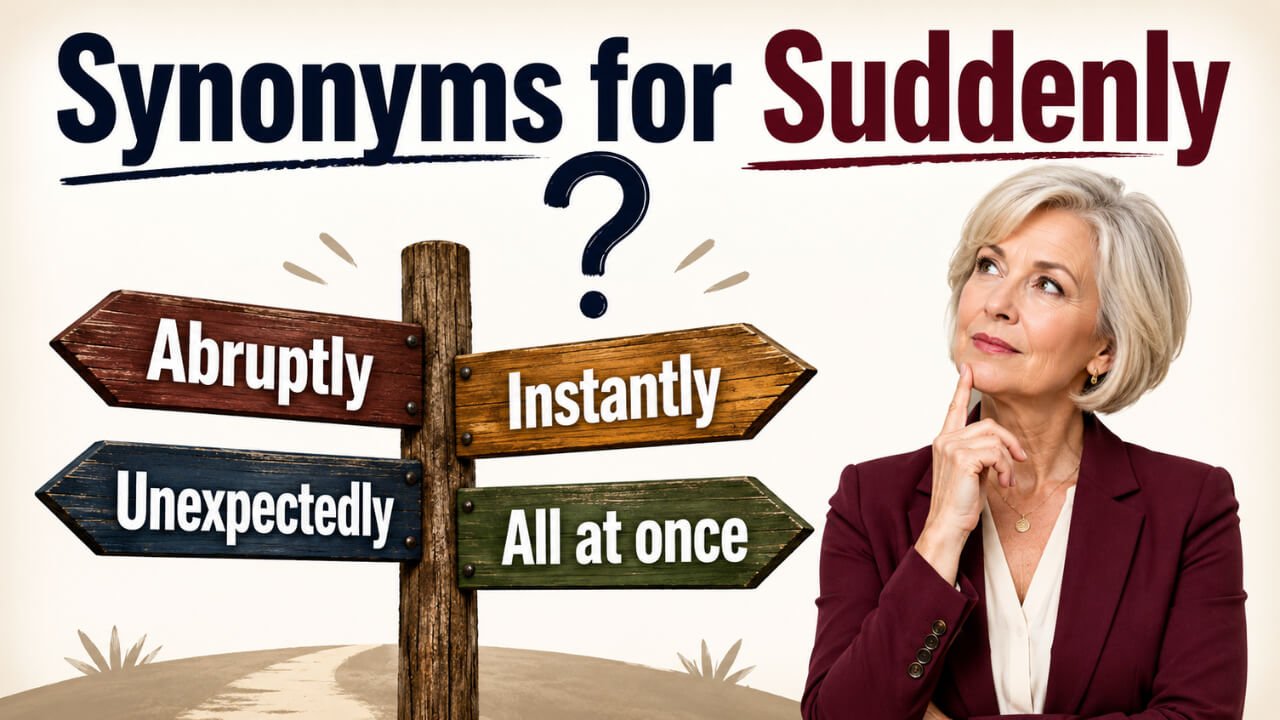
Quick Answer: Synonyms for suddenly include abruptly, unexpectedly, instantly, immediately, all at once, without warning, out of nowhere, in a flash, quickly, and sharply. Use abruptly when something happens in a quick and surprising way. Use unexpectedly when the focus is surprise. Use instantly or immediately for time. Use without warning for events that happen with no sign before them. Use out of nowhere in casual speech, and use sharply for sudden changes in amount, direction, sound, or feeling.
Pronunciation and Word Details
Word: Suddenly
Pronunciation: /ˈsʌdənli/
Part of Speech: Adverb
Meaning: Suddenly means quickly, unexpectedly, or without warning.
US Pronunciation:
UK Pronunciation:
What Does “Suddenly” Mean?
Suddenly means that something happens quickly and often without warning. It is an adverb because it describes how an action happens.
The word suddenly is commonly used for actions, events, changes, emotions, sounds, and interruptions. It can describe a car stopping, a person appearing, a storm beginning, a thought entering the mind, or a feeling changing very quickly.
Example: The lights suddenly went out.
In this sentence, suddenly explains how the lights went out. It tells the reader that the action happened quickly and unexpectedly.
Suddenly can appear before a verb, after a subject, or near the end of a sentence.
Before a Verb: Suddenly, the dog started barking.
After a Subject: The dog suddenly started barking.
At the End: The dog started barking suddenly.
The most natural position is usually before the main verb or at the beginning of the sentence when you want to create surprise.
Meaning, Tone, and Context of “Suddenly”
Suddenly has a neutral tone. It is not too formal or too casual, so it works well in everyday speech, stories, essays, reports, and general writing.
In storytelling, suddenly creates movement, surprise, and tension. It helps readers feel that something changed fast.
Example: Suddenly, the door opened.
In academic or formal writing, suddenly can be used, but more precise words may sound better depending on the context. For example, abruptly may sound stronger, while unexpectedly may sound clearer when the focus is surprise.
Formal Context: The temperature dropped abruptly.
Casual Context: She suddenly remembered the answer.
Emotional Context: He suddenly felt nervous.
Technical Context: The system suddenly stopped responding.
Suddenly is useful when the exact reason or timing of an event is less important than the quick and surprising nature of the event.
When and How to Use “Suddenly”
For Unexpected Events: Use suddenly when something happens without warning.
Example: The alarm suddenly started ringing.
For Fast Changes: Use suddenly when a situation changes quickly.
Example: The weather suddenly became cold.
For Surprise in Stories: Use suddenly to create drama or tension.
Example: Suddenly, a shadow moved across the wall.
For Emotional Shifts: Use suddenly when a feeling appears quickly.
Example: She suddenly felt afraid.
For Interruptions: Use suddenly when an action breaks the normal flow.
Example: He was speaking when the phone suddenly rang.
For Quick Realizations: Use suddenly when a person understands or remembers something at once.
Example: I suddenly realized my mistake.
Best Synonyms for Suddenly
Abruptly: In a quick, unexpected, and often sharp way.
Example: The meeting ended abruptly.
Unexpectedly: In a way that was not expected.
Example: She arrived unexpectedly at noon.
Instantly: At once, with no delay.
Example: He instantly understood the problem.
Immediately: Right away or without waiting.
Example: The manager responded immediately.
All at Once: Happening suddenly and together.
Example: All at once, the crowd became silent.
Without Warning: Happening with no sign before it.
Example: The storm began without warning.
Out of Nowhere: Appearing or happening unexpectedly, often in casual speech.
Example: A loud noise came out of nowhere.
In a Flash: Very quickly.
Example: The bird disappeared in a flash.
Sharply: Suddenly and strongly, often for changes, movements, sounds, or emotions.
Example: Prices rose sharply in June.
Quickly: At high speed or in a short time.
Example: The situation changed quickly.
50 Synonyms for Suddenly with Short Meanings
- Abruptly: Quickly and unexpectedly.
- Unexpectedly: In a surprising way.
- Instantly: At once.
- Immediately: Without delay.
- Instantaneously: Happening at the same moment.
- All at once: Happening suddenly together.
- All of a sudden: Very suddenly.
- Without warning: With no sign beforehand.
- Without notice: With no advance information.
- Out of nowhere: Appearing unexpectedly.
- Out of the blue: Happening as a surprise.
- In a flash: Very quickly.
- In an instant: In a very short moment.
- In a split second: Almost immediately.
- In a heartbeat: Very fast.
- At once: Immediately.
- Right away: Without waiting.
- Straightaway: Immediately after something.
- Promptly: Quickly and without delay.
- Quickly: At a fast speed.
- Rapidly: Very quickly.
- Swiftly: Quickly and smoothly.
- Speedily: In a fast manner.
- Hastily: Quickly, often with little care.
- Sharply: Suddenly and strongly.
- Startlingly: In a surprising or shocking way.
- Shockingly: In a way that causes surprise.
- Surprisingly: In an unexpected way.
- Astonishingly: In a very surprising way.
- Unpredictably: In a way that cannot be expected.
- Unforeseeably: In a way that could not be predicted.
- Unannounced: Without being introduced or expected.
- Spontaneously: Without planning.
- Impulsively: Suddenly because of a quick feeling or desire.
- Forthwith: Immediately, in a formal style.
- Directly: Immediately, in some contexts.
- In no time: Very soon.
- Like lightning: Extremely fast.
- Overnight: Suddenly over a short period, often for major change.
- Precipitously: Suddenly and steeply, often for drops or declines.
- Dramatically: Suddenly and noticeably.
- In short order: Very soon or quickly.
- On the spot: Immediately, at that moment.
- At a moment’s notice: With very little warning.
- In the blink of an eye: Extremely quickly.
- With no warning: Without any sign before it.
- With little warning: With almost no time to prepare.
- On impulse: Because of a sudden decision.
- Without delay: Immediately.
- In one quick move: Done suddenly and quickly.
Read Also:
Synonyms for Ideas

Synonyms for Suddenly by Context
When Suddenly Means Unexpectedly
Use these synonyms when the main idea is surprise.
Unexpectedly: She unexpectedly changed her decision.
Without warning: The fire alarm rang without warning.
Out of nowhere: A cyclist appeared out of nowhere.
Out of the blue: He called out of the blue after many years.
Surprisingly: The quiet student surprisingly gave the best answer.
When Suddenly Means Immediately
Use these synonyms when the main idea is no delay.
Immediately: Please leave immediately.
Instantly: The child instantly smiled.
At once: The teacher asked them to stop at once.
Right away: She replied right away.
Without delay: The doctor treated the patient without delay.
When Suddenly Means Quickly
Use these synonyms when the main idea is speed.
Quickly: The clouds moved quickly across the sky.
Rapidly: The water level rose rapidly.
Swiftly: The bird flew swiftly over the trees.
In a flash: The cat ran away in a flash.
Like lightning: He moved like lightning.
When Suddenly Means Sharply or Abruptly
Use these synonyms when something changes in a strong or sharp way.
Abruptly: The speaker stopped abruptly.
Sharply: The temperature fell sharply.
Precipitously: Sales dropped precipitously.
Dramatically: The mood changed dramatically.
Startlingly: The lights flashed startlingly.
When Suddenly Means Without Planning
Use these synonyms when an action happens because of a quick decision.
Spontaneously: They spontaneously decided to travel.
Impulsively: He impulsively bought the jacket.
On impulse: She accepted the offer on impulse.
Unannounced: He arrived unannounced at the office.
Another Word for Suddenly
Another word for suddenly is abruptly. It is one of the best single replacements because it shows that something happened quickly and unexpectedly. However, the best alternative depends on context. Use instantly for time, unexpectedly for surprise, and sharply for sudden changes.
Original: The car suddenly stopped.
Better Option: The car abruptly stopped.
Original: She suddenly remembered his name.
Better Option: She instantly remembered his name.
Original: The price suddenly increased.
Better Option: The price rose sharply.
Original: He suddenly appeared at the door.
Better Option: He appeared out of nowhere at the door.
When Not to Use “Suddenly”
Do not use suddenly too many times in the same paragraph. Repetition can make writing sound plain or dramatic without purpose.
Weak: Suddenly, the door opened. Suddenly, the dog barked. Suddenly, the lights went out.
Better: The door opened abruptly. The dog barked, and then the lights went out without warning.
Avoid suddenly when a more specific synonym gives clearer meaning.
Weak: The report suddenly changed.
Better: The report changed unexpectedly.
Do not use suddenly when you mean accurately, completely, or carefully. Suddenly describes speed or surprise, not correctness.
Weak: She suddenly answered the question.
Better: She answered the question accurately.
Avoid suddenly in very formal data writing when sharply, rapidly, or abruptly is more precise.
Weak: The figures suddenly increased.
Better: The figures increased sharply.
Words Commonly Confused With Suddenly
Suddenly vs Abruptly: Suddenly means quickly and unexpectedly. Abruptly adds a sharper or more forceful feeling.
Suddenly vs Unexpectedly: Suddenly focuses on quick timing. Unexpectedly focuses more on surprise.
Suddenly vs Immediately: Suddenly often means without warning. Immediately means without delay.
Suddenly vs Instantly: Suddenly suggests surprise or quick change. Instantly means something happens at once.
Suddenly vs Quickly: Suddenly often includes surprise. Quickly only means fast.
Suddenly vs Sharply: Suddenly describes fast timing. Sharply describes a strong, noticeable, or steep change.
Suddenly vs Spontaneously: Suddenly describes how fast something happens. Spontaneously means without planning.
Which Synonym Should You Choose?
Choose abruptly when something happens quickly, unexpectedly, and with a sharp feeling.
Choose unexpectedly when the main idea is surprise.
Choose instantly when something happens at the exact moment or with no delay.
Choose immediately when giving instructions or describing urgent action.
Choose without warning when there was no sign before the event.
Choose out of nowhere for casual writing or storytelling.
Choose sharply when writing about sudden changes in price, sound, direction, temperature, or emotion.
Choose rapidly when describing fast growth, movement, decline, or development.
Choose spontaneously when the action was not planned.
Choose in a flash when you want a vivid and informal expression for speed.
Real Life Examples of “Suddenly” in Sentences
Original: The baby suddenly started crying.
Better Option: The baby unexpectedly started crying.
Original: The lights suddenly turned off.
Better Option: The lights went out without warning.
Original: She suddenly understood the lesson.
Better Option: She instantly understood the lesson.
Original: The wind suddenly became stronger.
Better Option: The wind strengthened sharply.
Original: He suddenly left the room.
Better Option: He left the room abruptly.
Original: A car suddenly appeared behind us.
Better Option: A car appeared out of nowhere behind us.
Original: The mood suddenly changed.
Better Option: The mood changed dramatically.
Original: Prices suddenly increased.
Better Option: Prices rose sharply.
Original: I suddenly remembered the appointment.
Better Option: I instantly remembered the appointment.
Original: The crowd suddenly became quiet.
Better Option: The crowd became silent all at once.
Synonym Groups and Usage Differences
Surprise Group
This group is best when something was not expected.
Synonyms: Unexpectedly, surprisingly, out of the blue, out of nowhere, without warning.
Example: She unexpectedly received the news.
Speed Group
This group is best when something happens very fast.
Synonyms: Quickly, rapidly, swiftly, in a flash, like lightning.
Example: The runner moved swiftly toward the finish line.
Immediate Action Group
This group is best when there is no delay.
Synonyms: Immediately, instantly, at once, right away, without delay.
Example: The team responded immediately.
Sharp Change Group
This group is best for strong changes in amount, feeling, movement, or sound.
Synonyms: Abruptly, sharply, precipitously, dramatically, startlingly.
Example: The temperature dropped sharply after sunset.
Unplanned Action Group
This group is best when the action was not planned.
Synonyms: Spontaneously, impulsively, on impulse, unannounced.
Example: They spontaneously decided to visit the beach.
Antonyms of Suddenly
Suddenly has different opposites depending on meaning. If suddenly means quickly, the opposite may be slowly. If it means unexpectedly, the opposite may be predictably or expectedly.
Gradually: Happening little by little.
Slowly: Happening at a low speed.
Expectedly: Happening as people thought it would.
Predictably: Happening in a way that can be expected.
Deliberately: Done with careful thought.
Eventually: Happening after some time.
Later: Happening after the present moment.
Steadily: Happening in a regular and controlled way.
Calmly: Happening without panic or rush.
Carefully: Done with attention and caution.
Comparison: Suddenly vs Related Words
Suddenly vs Abruptly
Suddenly means something happens quickly and unexpectedly. Abruptly suggests a sharper, more forceful, or less smooth action.
Example With Suddenly: She suddenly stopped speaking.
Example With Abruptly: She abruptly ended the conversation.
Suddenly vs Unexpectedly
Suddenly focuses on fast timing. Unexpectedly focuses on surprise or lack of prediction.
Example With Suddenly: The rain suddenly started.
Example With Unexpectedly: The rain unexpectedly started before noon.
Suddenly vs Immediately
Suddenly often includes surprise. Immediately means with no delay and may not include surprise.
Example With Suddenly: He suddenly stood up.
Example With Immediately: He stood up immediately when the judge entered.
Suddenly vs Instantly
Suddenly suggests a quick and possibly surprising event. Instantly means something happens at once.
Example With Suddenly: She suddenly smiled.
Example With Instantly: She instantly recognized his voice.
Suddenly vs Sharply
Suddenly describes quick timing. Sharply describes a strong or steep change.
Example With Suddenly: The road suddenly turned left.
Example With Sharply: The road turned sharply left.
Common Phrases and Expressions With Suddenly
Suddenly Realized: Understood something quickly.
Suddenly Appeared: Came into view unexpectedly.
Suddenly Stopped: Ended or paused without warning.
Suddenly Changed: Became different very quickly.
Suddenly Remembered: Recalled something at once.
Suddenly Felt: Experienced a feeling quickly.
Suddenly Went Silent: Became quiet all at once.
Suddenly Turned: Changed direction quickly.
Suddenly Began: Started without warning.
Suddenly Disappeared: Went away unexpectedly.
Common Mistakes to Avoid
One common mistake is using suddenly too often in storytelling. Too much repetition can make every action feel dramatic, even when it is not important.
Another mistake is choosing a synonym that does not match the context. For example, immediately is good for urgency, but it does not always show surprise. Unexpectedly is good for surprise, but it does not always show speed.
Writers also confuse suddenly with accurately. Suddenly describes timing, not correctness.
Avoid placing suddenly awkwardly in a sentence. It usually sounds natural before the main verb or at the beginning of a sentence.
Weak: He opened suddenly the box.
Better: He suddenly opened the box.
Weak: The sales suddenly were higher.
Better: Sales rose sharply.
Weak: She suddenly answered correctly.
Better: She answered correctly at once.
Conclusion
Synonyms for suddenly help you describe fast, surprising, immediate, and unplanned actions with more precision. Use abruptly for sharp actions, unexpectedly for surprise, instantly or immediately for no delay, without warning for events with no sign before them, and sharply for strong changes. The best synonym depends on what you want to emphasize. Clear word choice makes your writing more natural, vivid, and accurate.
FAQs About Synonyms for Suddenly
What is the best synonym for suddenly?
The best synonym for suddenly is abruptly when something happens quickly and unexpectedly. For time, instantly or immediately may be better.
What is a formal synonym for suddenly?
A formal synonym for suddenly is abruptly. In reports or data writing, sharply and rapidly can also sound natural.
What is a casual synonym for suddenly?
A casual synonym for suddenly is out of nowhere. All of a sudden is also common in everyday speech.
Is suddenly the same as immediately?
No. Suddenly often means quickly and unexpectedly. Immediately means without delay, but it does not always suggest surprise.
What can I say instead of suddenly in a story?
You can use abruptly, without warning, out of nowhere, all at once, in a flash, or out of the blue, depending on the scene.
What is the opposite of suddenly?
Common opposites of suddenly include gradually, slowly, expectedly, predictably, and steadily.
Can suddenly be used in formal writing?
Yes, suddenly can be used in formal writing, but abruptly, sharply, rapidly, or unexpectedly may be more precise in some contexts.
