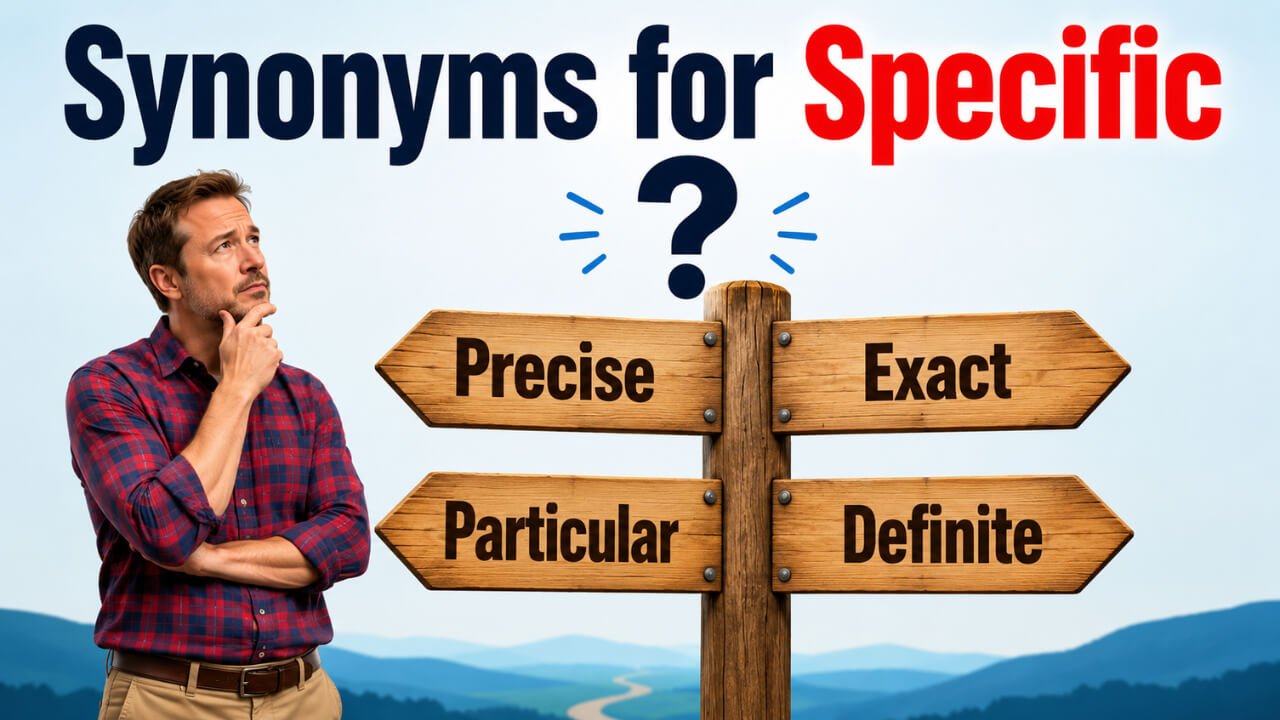
Quick Answer: The best synonyms for specific include precise, exact, particular, definite, clear, detailed, explicit, distinct, concrete, and targeted. Use precise for accuracy, exact for numbers or details, particular for one chosen thing, definite for certainty, explicit for clear statements, detailed for full explanation, and targeted for a focused purpose or audience.
Pronunciation and Word Details
Word: Specific
Pronunciation: /spəˈsɪfɪk/
Part of Speech: Adjective
Meaning: Specific means clearly identified, exact, particular, or related to one clear thing rather than something general.
US Pronunciation:
UK Pronunciation:
What Does “Specific” Mean?
Specific means exact, clear, particular, or clearly identified. It is an adjective used when something is not general, vague, or broad. A specific answer gives clear details. A specific person means one particular person. A specific time means an exact time.
The word works in many sentence contexts. You can use it for instructions, examples, names, numbers, places, reasons, goals, details, questions, tasks, and requirements. In writing, specific helps make meaning clearer because it tells the reader exactly what you mean.
Meaning, Tone, and Context of “Specific”
Specific has a neutral, clear, and practical tone. It is common in everyday speech, academic writing, business communication, instructions, reports, and professional discussions. It is not emotional or overly formal, but it sounds more careful and exact than words like clear or certain.
In academic writing, specific often means detailed and clearly limited. In business writing, it can mean targeted, measurable, or exact. In conversation, it often means not vague. In grammar and vocabulary, it helps separate broad words from exact words.
For example, food is general, but fresh fruit is more specific. A meeting is general, but a team meeting at 10 a.m. is specific. This makes the word useful whenever accuracy and clarity matter.
When and How to Use “Specific”
For Exact Details: Use specific when you want to describe something clearly and exactly.
Example: Please give me a specific reason for the delay.
For Particular Things: Use specific when referring to one clear person, place, idea, or item.
Example: She asked for a specific book from the shelf.
For Clear Instructions: Use specific when instructions should not be vague.
Example: The teacher gave specific rules for the assignment.
For Focused Goals: Use specific when a goal is clear, limited, and easy to understand.
Example: His specific goal is to improve his writing speed.
For Better Examples: Use specific when an example needs detail.
Example: Give a specific example to support your answer.
For Targeted Meaning: Use specific when something is meant for a certain group, purpose, or situation.
Example: This guide is written for a specific audience.
Best Synonyms for Specific
Precise: Exact and carefully stated.
Example: She gave a precise answer to the question.
Exact: Completely correct in detail, number, or fact.
Example: Tell me the exact time of the event.
Particular: Referring to one certain thing, person, or case.
Example: I am looking for a particular document.
Definite: Clear, certain, and decided.
Example: We need a definite answer by tomorrow.
Clear: Easy to understand and not confusing.
Example: The manager gave clear instructions.
Detailed: Including many facts or pieces of information.
Example: The report gave a detailed explanation.
Explicit: Stated clearly and directly.
Example: The contract includes explicit conditions.
Distinct: Clearly different or easy to recognize.
Example: Each chapter has a distinct purpose.
Concrete: Real, clear, and based on exact facts rather than general ideas.
Example: The proposal needs concrete examples.
Targeted: Focused on a particular purpose, group, or result.
Example: The campaign used targeted messages.
50 Synonyms for Specific with Short Meanings
- Precise: Exact and carefully stated.
- Exact: Correct in every detail.
- Particular: Related to one certain thing.
- Definite: Clear and certain.
- Clear: Easy to understand.
- Detailed: Full of useful information.
- Explicit: Directly and clearly stated.
- Distinct: Clearly different or recognizable.
- Concrete: Real, clear, and factual.
- Targeted: Focused on a certain purpose.
- Certain: Known or clearly identified.
- Individual: Related to one person or thing.
- Separate: Not general or mixed with others.
- Identified: Clearly recognized or named.
- Named: Mentioned clearly by name.
- Stated: Expressed clearly in words.
- Express: Clearly and directly stated.
- Direct: Clear and straight to the point.
- Focused: Concentrated on one thing.
- Narrow: Limited to a smaller area or meaning.
- Specialized: Designed for a special purpose.
- Defined: Clearly explained or limited.
- Fixed: Set and not changing.
- Set: Decided or established.
- Selected: Chosen from several options.
- Chosen: Picked for a reason.
- Designated: Officially chosen or identified.
- Intended: Planned for a certain purpose.
- Relevant: Closely connected to the topic.
- Applicable: Suitable for a certain situation.
- Appropriate: Right for a particular use.
- Unambiguous: Having only one clear meaning.
- Plain: Clear and simple.
- Evident: Easy to see or understand.
- Obvious: Clear without much explanation.
- Categorical: Clear, firm, and direct.
- Expressed: Put clearly into words.
- Itemized: Listed in separate details.
- Descriptive: Giving clear details.
- Informative: Giving useful information.
- Exacting: Careful and strict about details.
- Finite: Limited and clearly bounded.
- Limited: Restricted to a certain amount or area.
- Singular: Related to one single thing.
- Unique: Different from all others.
- Discrete: Separate and individually distinct.
- Custom: Made for a certain need.
- Tailored: Adjusted for a particular person or purpose.
- To the point: Clear and directly relevant.
- Well defined: Clearly described or limited.
Read Also:
Synonyms for Valuable
Synonyms for Specific by Context
When Specific Means Precise
Use these synonyms when specific means exact, accurate, or carefully stated.
Precise: The scientist gave a precise measurement.
Exact: Please write the exact address.
Accurate: The answer must be accurate.
Clear: Her explanation was clear.
Unambiguous: The rule should be unambiguous.
When Specific Means Particular
Use these synonyms when specific means one certain thing, person, case, or example.
Particular: I remember one particular day from childhood.
Certain: A certain student asked the question.
Individual: Each individual case needs attention.
Selected: Only selected members can join the meeting.
Designated: Use the designated area for parking.
When Specific Means Detailed
Use these synonyms when specific means full of information, examples, or explanation.
Detailed: The guide gives detailed steps.
Descriptive: Her writing is descriptive and clear.
Itemized: The bill includes an itemized list.
Informative: The article is informative for beginners.
Explicit: The instructions are explicit.
When Specific Means Targeted
Use these synonyms when specific means focused on a purpose, audience, problem, or goal.
Targeted: The lesson is targeted at new learners.
Focused: The discussion stayed focused on grammar.
Specialized: The course teaches specialized vocabulary.
Tailored: The advice was tailored to her needs.
Intended: The message is intended for teachers.
When Specific Means Clearly Defined
Use these synonyms when specific means not vague, broad, or open to many meanings.
Defined: The project needs a defined purpose.
Definite: They gave us a definite answer.
Fixed: The meeting has a fixed time.
Set: The rules are set for everyone.
Well defined: The plan has a well defined goal.
Another Word for Specific
A strong single replacement for specific is precise, especially when you mean exact, clear, or detailed. However, the best alternative depends on context. Use particular when you mean one certain thing, detailed when you mean full of information, explicit when you mean clearly stated, and targeted when you mean focused on a certain purpose.
Original: Please give a specific answer.
Better Option: Please give a precise answer.
Original: She wanted a specific dress.
Better Option: She wanted a particular dress.
Original: The teacher gave specific instructions.
Better Option: The teacher gave detailed instructions.
Original: This message is for a specific audience.
Better Option: This message is for a targeted audience.
When Not to Use “Specific”
Do not use specific when another word gives a clearer meaning. If you mean exact numbers, use exact or precise. If you mean one chosen thing, use particular. If you mean full explanation, use detailed. If you mean clearly stated, use explicit.
Also avoid using specific too many times in one paragraph. Repetition can make writing sound weak. Choose a synonym that matches the intended meaning.
Weak: The report gives specific specific details about the case.
Better: The report gives detailed information about the case.
Weak: Give me the specific number of people who attended.
Better: Give me the exact number of people who attended.
Weak: She has a specific interest in one specific topic.
Better: She has a particular interest in one focused topic.
Weak: The rule is specific and easy to understand.
Better: The rule is explicit and easy to understand.
Words Commonly Confused With Specific
Specific vs Precise: Specific means clearly identified or particular. Precise means exact and carefully accurate.
Specific vs Exact: Specific can describe a clear thing, detail, or purpose. Exact focuses more on complete accuracy in number, time, wording, or fact.
Specific vs Particular: Specific and particular are often close. Specific sounds more focused on clarity, while particular often points to one chosen person, thing, or case.
Specific vs Detailed: Specific means clearly identified. Detailed means full of information. A sentence can be specific without being very detailed.
Specific vs Explicit: Specific means clear and exact. Explicit means directly stated without hidden meaning.
Specific vs Concrete: Specific means not general. Concrete means real, clear, and based on facts or examples rather than abstract ideas.
Which Synonym Should You Choose?
Choose precise when writing about exact wording, measurements, facts, times, or instructions.
Choose exact when writing about numbers, dates, prices, locations, or details that must be completely correct.
Choose particular when referring to one person, thing, case, or example from a larger group.
Choose detailed when writing about full explanations, steps, descriptions, reports, or examples.
Choose explicit when something must be stated clearly and directly.
Choose clear when the main goal is easy understanding.
Choose targeted when something is focused on a certain group, audience, problem, or purpose.
Choose concrete when replacing vague or abstract language with real examples or facts.
Choose definite when you want to show certainty or a clear decision.
Choose specialized when something is designed for a special field, skill, or purpose.
Real Life Examples of “Specific” in Sentences
Original: Please be specific about what you need.
Better Option: Please be precise about what you need.
Original: She gave a specific reason for leaving.
Better Option: She gave a clear reason for leaving.
Original: We need a specific date for the event.
Better Option: We need an exact date for the event.
Original: He asked for a specific type of phone.
Better Option: He asked for a particular type of phone.
Original: The article gives specific advice for students.
Better Option: The article gives targeted advice for students.
Original: The teacher wanted a specific example.
Better Option: The teacher wanted a concrete example.
Original: The rules are specific and easy to follow.
Better Option: The rules are explicit and easy to follow.
Original: She has specific knowledge of grammar.
Better Option: She has specialized knowledge of grammar.
Original: The plan includes specific steps.
Better Option: The plan includes detailed steps.
Original: I need specific information before I decide.
Better Option: I need definite information before I decide.
Synonym Groups and Usage Differences
Accuracy Group
This group includes precise, exact, accurate, and correct. Use these words when the main focus is correctness, numbers, facts, or measurements.
Example: The form asks for an exact date of birth.
Particularity Group
This group includes particular, certain, individual, selected, and chosen. Use these words when you mean one person, thing, or case from a larger group.
Example: She wanted a particular color for the design.
Clarity Group
This group includes clear, explicit, plain, direct, and unambiguous. Use these words when the meaning should be easy to understand.
Example: The message gave explicit instructions.
Detail Group
This group includes detailed, descriptive, itemized, and informative. Use these words when something includes supporting facts, examples, or explanation.
Example: The guide provides detailed instructions for beginners.
Focus Group
This group includes targeted, focused, specialized, tailored, and intended. Use these words when something is made for a certain purpose, person, or audience.
Example: The course offers targeted lessons for advanced learners.
Antonyms of Specific
General: Broad and not limited to one thing.
Vague: Not clear or exact.
Broad: Covering many things rather than one clear area.
Unclear: Difficult to understand.
Indefinite: Not fixed, certain, or clearly stated.
Ambiguous: Having more than one possible meaning.
Universal: Related to all people or things rather than one case.
Common: General or shared by many things.
Random: Not chosen for a clear reason.
Unspecified: Not clearly named or identified.
Open ended: Not limited to one clear answer or result.
Approximate: Close but not exact.
Comparison: Specific vs Related Words
Specific vs Precise
Specific means clearly identified or not general. Precise means exact and carefully accurate.
Example With Specific: Give me a specific reason for your answer.
Example With Precise: Give me a precise measurement of the room.
Specific vs Exact
Specific can refer to a clear thing, purpose, or detail. Exact means completely correct with no difference or mistake.
Example With Specific: She asked for a specific topic.
Example With Exact: She asked for the exact page number.
Specific vs Particular
Specific focuses on clarity and exactness. Particular points to one certain person, thing, or case.
Example With Specific: The instructions were specific.
Example With Particular: I remember one particular moment from the trip.
Specific vs Detailed
Specific means clear and not general. Detailed means containing many facts or explanations.
Example With Specific: The question needs a specific answer.
Example With Detailed: The answer needs a detailed explanation.
Specific vs Explicit
Specific means clearly identified. Explicit means clearly and directly stated.
Example With Specific: The form asks for specific information.
Example With Explicit: The rules are explicit about late submissions.
Specific vs Concrete
Specific means exact or particular. Concrete means real, clear, and based on facts or examples.
Example With Specific: Give a specific reason for your opinion.
Example With Concrete: Give a concrete example to support your opinion.
Common Phrases and Expressions With Specific
Specific Reason: A clear reason, not a general one.
Specific Example: One clear example that supports a point.
Specific Detail: A particular piece of information.
Specific Time: An exact or clearly stated time.
Specific Place: A clearly identified location.
Specific Purpose: A clear reason or goal.
Specific Audience: A certain group of people.
Specific Question: A clear and focused question.
Specific Instruction: A clear direction that explains what to do.
Specific Requirement: A clearly stated condition or need.
Common Mistakes to Avoid
A common mistake is using specific when the meaning should be exact. For numbers, times, dates, addresses, and measurements, exact is often stronger.
Another mistake is using specific with vague language. A sentence like specific thing may still be unclear if the thing is not named or explained. Add real details when needed.
Do not confuse specific with detailed. A specific answer can be short. A detailed answer usually gives more explanation.
Avoid repeating specific too often. Replace it with precise, particular, clear, explicit, targeted, or detailed when those words fit better.
Also avoid using specific when you mean special. Specific means exact or particular, while special means different, important, or meaningful.
Conclusion
Synonyms for specific help you write with more clarity, accuracy, and purpose. Use precise for careful accuracy, exact for numbers and facts, particular for one chosen thing, detailed for full explanation, explicit for direct wording, and targeted for a focused audience or goal. The best synonym depends on whether you mean exact, clear, detailed, particular, or purpose based. Choosing the right word makes your writing stronger, cleaner, and easier to understand.
FAQs About Synonyms for Specific
What is the best synonym for specific?
The best synonym for specific is precise when you mean exact and clear. In other contexts, particular, exact, detailed, or explicit may fit better.
What is another word for specific information?
Another word for specific information is detailed information. You can also use exact information, clear information, or precise information, depending on the sentence.
Is specific the same as exact?
Specific and exact are close, but they are not always the same. Specific means clearly identified, while exact means completely correct in detail.
What is a formal synonym for specific?
Formal synonyms for specific include precise, explicit, defined, particular, unambiguous, and well defined.
What is a casual synonym for specific?
Casual synonyms for specific include clear, exact, particular, direct, and to the point.
What is the opposite of specific?
The opposite of specific can be general, vague, broad, unclear, ambiguous, or unspecified, depending on the context.
How do you use specific in a sentence?
You can use specific when something is clear and not general. For example, Please give a specific example to support your answer.
