
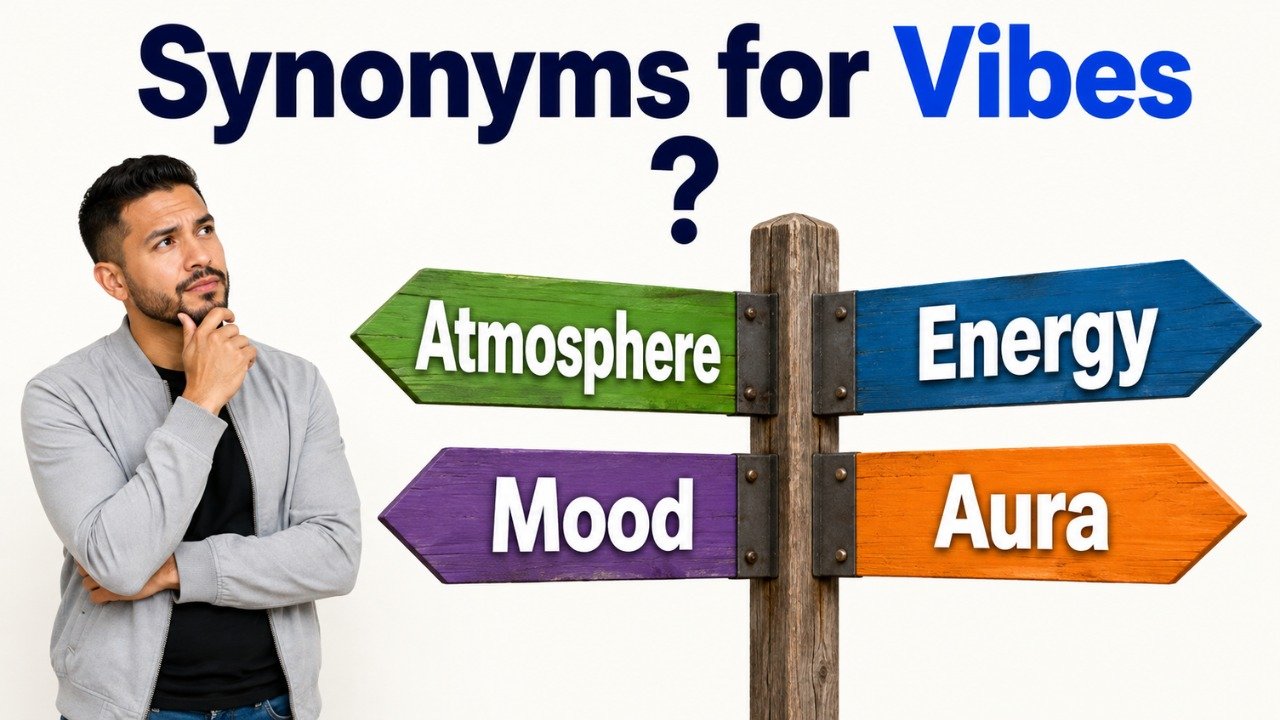
Quick Answer: Synonyms for vibes include atmosphere, energy, mood, feeling, ambiance, impression, aura, character, tone, and spirit. The best replacement depends on context. Use atmosphere for the overall feeling of a place, energy for the emotional effect created by a person or situation, mood for an emotional state, ambiance for the character of a setting, impression for how something initially feels, and aura for a distinctive quality that seems to surround a person or place.
Pronunciation and Word Details
Word: Vibes
Pronunciation: /vaɪbz/
Part of Speech: Plural noun
Meaning: The feelings, atmosphere, emotional signals, or general impression associated with a person, place, situation, or experience.
US Pronunciation:
UK Pronunciation:
What Does “Vibes” Mean?
Vibes means the feelings, emotional signals, atmosphere, or general impression that a person, place, object, or situation creates.
The word is the plural form of vibe, which developed from the idea of vibrations but is now commonly used to describe an emotional or intuitive feeling.
For example, saying that a restaurant has relaxing vibes means its setting, lighting, sounds, people, and overall character create a relaxed feeling.
The word can also describe the impression someone gives. If a person gives friendly vibes, their behavior, expression, or manner makes them seem approachable and pleasant.
Vibes is conversational and informal. In formal writing, words such as atmosphere, impression, mood, tone, character, or environment are usually more precise.
Meaning, Tone, and Context of “Vibes”
Vibes is generally an informal and conversational word. It sounds natural when people are describing places, personalities, emotions, social situations, music, fashion, experiences, or environments.
The word can have positive, negative, or neutral meaning depending on the adjective used with it.
Positive vibes suggest happiness, comfort, optimism, friendliness, or pleasant energy.
Negative vibes suggest discomfort, tension, suspicion, hostility, or uneasiness.
The expression can also be intentionally vague. Someone might say, “I like the vibes here,” without identifying one specific reason. The speaker may be responding to several details at once, such as lighting, conversation, music, decoration, and the behavior of other people.
In formal or academic writing, it is usually better to identify the exact meaning rather than rely on vibes.
When and How to Use “Vibes”
For Places: Use vibes when describing the overall feeling created by a location.
Example: The small café has peaceful vibes in the early morning.
For People: Use vibes when talking about the impression or emotional signals someone gives.
Example: She gives friendly vibes whenever she meets someone new.
For Social Situations: Vibes can describe the emotional character of a gathering or interaction.
Example: The celebration had cheerful vibes from beginning to end.
For Emotional Reactions: Use vibes when you sense something positive or negative without being able to explain it precisely.
Example: I was getting strange vibes from the conversation.
For Style and Appearance: Vibes can describe the character suggested by clothing, decoration, colors, or visual choices.
Example: The room has calm coastal vibes.
For Experiences: Use vibes to summarize how an event or activity feels overall.
Example: The outdoor dinner had relaxed and welcoming vibes.
Best Synonyms for Vibes
Atmosphere: The overall feeling or emotional quality of a place or situation.
Example: The restaurant had a calm and inviting atmosphere.
Energy: The emotional force or feeling communicated by a person, group, or setting.
Example: Her cheerful energy made everyone feel comfortable.
Mood: The emotional feeling associated with a person, place, or moment.
Example: Soft lighting created a peaceful mood.
Feeling: The emotional impression produced by something.
Example: The old house had a mysterious feeling.
Ambiance: The distinctive atmosphere or character of a place.
Example: The music contributed to the elegant ambiance.
Impression: The feeling or opinion something creates in someone’s mind.
Example: His warm greeting created a positive impression.
Aura: A distinctive quality or feeling that seems to surround someone or something.
Example: The garden had an aura of complete tranquility.
Character: The distinctive nature or personality of a place or thing.
Example: Wooden details gave the room a rustic character.
Tone: The general emotional quality of a situation, message, or environment.
Example: Her opening remarks established a friendly tone.
Spirit: The general attitude, emotional quality, or character of a group or occasion.
Example: A spirit of celebration filled the room.
50 Synonyms for Vibes With Short Meanings
- Atmosphere: The overall emotional quality of a place or situation.
- Energy: The emotional force communicated by someone or something.
- Mood: The emotional state or feeling of a moment.
- Feeling: The emotional impression something creates.
- Ambiance: The distinctive atmosphere of a setting.
- Impression: The feeling or opinion created in the mind.
- Aura: A distinctive quality surrounding a person or place.
- Character: The recognizable nature or personality of something.
- Tone: The general emotional quality of a situation.
- Spirit: The prevailing attitude or emotional character.
- Air: A noticeable quality or manner surrounding something.
- Sense: A general feeling or intuitive impression.
- Environment: The surrounding conditions that influence a feeling.
- Climate: The prevailing emotional or social atmosphere.
- Temper: The general emotional character of a situation.
- Undertone: A subtle feeling beneath the obvious surface.
- Overtone: A noticeable secondary quality or implication.
- Presence: The effect created by a person’s manner or appearance.
- Magnetism: A compelling or attractive personal quality.
- Charisma: A naturally appealing personal presence.
- Warmth: A friendly, caring, or welcoming quality.
- Chill: A relaxed and easygoing feeling.
- Comfort: A pleasant sense of ease and security.
- Harmony: A feeling of balance and peaceful agreement.
- Tension: A feeling of emotional strain or uneasiness.
- Unease: A subtle feeling of discomfort or worry.
- Excitement: A lively feeling of enthusiasm or anticipation.
- Positivity: An optimistic and encouraging emotional quality.
- Negativity: An unpleasant, pessimistic, or discouraging quality.
- Attitude: A recognizable manner or emotional outlook.
- Disposition: A person’s characteristic emotional tendency.
- Manner: The way someone’s behavior creates an impression.
- Personality: The distinctive character conveyed by someone or something.
- Flavor: A distinctive quality or style of an experience.
- Feel: The overall impression or character of something.
- Essence: The fundamental quality that defines something.
- Nature: The basic character or quality of something.
- Quality: A noticeable characteristic or emotional feature.
- Sensation: A feeling produced through experience or perception.
- Emotion: A feeling such as happiness, sadness, excitement, or fear.
- Sentiment: A particular emotional attitude or feeling.
- Temperament: A characteristic emotional nature or manner.
- Surroundings: The conditions and features that shape an experience.
- Setting: The environment in which an experience takes place.
- Backdrop: The surrounding context that contributes to a feeling.
- Rapport: A comfortable and harmonious connection between people.
- Chemistry: A natural emotional connection between people.
- Connection: A sense of emotional understanding or compatibility.
- Resonance: A quality that creates a strong emotional response.
- Pulse: The distinctive energy or rhythm of a place or situation.
Read Also:
Synonyms for Frightened
Synonyms for Vibes by Context
When Vibes Means Atmosphere
Use atmosphere, ambiance, mood, setting, character, or environment when describing the feeling created by a place.
Example: The candlelight created an intimate atmosphere.
These alternatives are especially useful when discussing restaurants, homes, events, offices, hotels, or public spaces.
When Vibes Means Personal Energy
Use energy, presence, aura, charisma, magnetism, or personality when talking about the impression created by a person.
Example: Her positive energy immediately made the group feel more comfortable.
Energy is conversational but more precise than vibes, while presence and charisma can work well in professional descriptions.
When Vibes Means Emotional Mood
Use mood, feeling, tone, sentiment, spirit, or emotion when describing the emotional character of an experience.
Example: The music created a reflective mood.
Mood works particularly well when describing emotional conditions created by music, lighting, writing, conversation, or surroundings.
When Vibes Means an Intuitive Impression
Use impression, sense, feeling, aura, or undertone when describing something you notice without having clear evidence for it.
Example: I had a sense that something about the situation had changed.
These words are useful when vibes would sound too casual or unclear.
When Vibes Means Social Connection
Use chemistry, rapport, connection, harmony, or energy when talking about how people interact.
Example: The two colleagues developed an easy rapport during the project.
Chemistry often suggests a natural connection, while rapport emphasizes comfortable communication and mutual understanding.
When Vibes Means a Distinctive Style
Use character, flavor, feel, essence, personality, or tone when describing a visual or stylistic impression.
Example: Natural materials give the interior a relaxed character.
These alternatives can make descriptions of design, fashion, art, and creative work more precise.
Another Word for Vibes
Another word for vibes is atmosphere when describing the overall feeling of a place or situation.
However, the best alternative changes with context. Energy works better for people, mood fits emotional settings, impression describes how something comes across, and aura suggests a distinctive quality that seems to surround someone or something.
Original: I really like the vibes in this room.
Better Option: I really like the atmosphere in this room.
Original: She gives very positive vibes.
Better Option: She gives off very positive energy.
Original: The dinner had romantic vibes.
Better Option: The dinner had a romantic ambiance.
Original: I was getting strange vibes from him.
Better Option: I was getting a strange impression from him.
When Not to Use “Vibes”
Vibes may sound too informal in academic, professional, technical, or highly formal writing.
Weak: The workplace has productive vibes.
Better: The workplace has a productive atmosphere.
Avoid vibes when you can name the exact feeling more clearly.
Weak: The meeting had bad vibes.
Better: The meeting had a tense atmosphere.
The word may also be too vague when readers need a specific explanation.
Weak: The speaker gave unusual vibes.
Better: The speaker created an uneasy impression through his hesitant manner.
Avoid using vibes repeatedly in descriptive writing because it can make different experiences sound identical.
Weak: The café had relaxing vibes, the music had relaxing vibes, and the staff gave relaxing vibes.
Better: The café had a peaceful atmosphere, the music created a calm mood, and the staff had a welcoming manner.
Words Commonly Confused With Vibes
Vibes vs Mood: Vibes describes a broader impression or feeling, while mood often refers to a particular emotional state.
Vibes vs Atmosphere: Vibes is informal and broad. Atmosphere is more neutral and commonly describes the emotional quality of a place or situation.
Vibes vs Energy: Energy usually refers to the emotional force or liveliness communicated by a person, group, or environment.
Vibes vs Aura: Aura suggests a distinctive quality that seems to surround a person, object, or place. It can sound more mysterious or figurative than vibes.
Vibes vs Ambiance: Ambiance usually refers specifically to the atmosphere and character of a physical setting.
Vibes vs Impression: Impression describes the idea or feeling someone forms after encountering a person, place, or situation.
Vibes vs Tone: Tone describes the emotional quality or attitude communicated through words, behavior, writing, or a situation.
Which Synonym Should You Choose?
Choose atmosphere when describing the general feeling of a room, event, workplace, restaurant, or location.
Choose energy when describing the emotional effect created by a person or group.
Choose mood when the main idea is a particular emotional state.
Choose ambiance when describing the sensory and emotional character of a physical setting.
Choose impression when explaining how a person, situation, or place initially seems.
Choose aura when describing a distinctive or almost intangible quality surrounding someone or something.
Choose tone in reports, essays, emails, and formal writing when describing an emotional attitude.
Choose rapport when referring to comfortable communication between people.
Choose chemistry when describing an immediate natural connection between individuals.
Choose vibes in casual conversation when a broad, intuitive, and informal description is appropriate.
Real Life Examples of “Vibes” in Sentences
Original: This café has really relaxing vibes.
Better Option: This café has a wonderfully relaxing atmosphere.
Original: She always brings positive vibes to the group.
Better Option: She always brings positive energy to the group.
Original: The room had romantic vibes.
Better Option: The room had a romantic ambiance.
Original: I got friendly vibes from our new neighbor.
Better Option: I got a friendly impression from our new neighbor.
Original: The meeting had uncomfortable vibes.
Better Option: The meeting had an uncomfortable tone.
Original: The garden gives peaceful vibes.
Better Option: The garden creates a peaceful feeling.
Original: His confident vibes were immediately noticeable.
Better Option: His confident presence was immediately noticeable.
Original: The celebration had joyful vibes.
Better Option: The celebration had a joyful spirit.
Original: Something about the place gave me strange vibes.
Better Option: Something about the place gave me a strange sense of unease.
Original: They had good vibes during their first conversation.
Better Option: They developed an easy rapport during their first conversation.
Synonym Groups and Usage Differences
Atmosphere Group
This group includes atmosphere, ambiance, environment, setting, and climate.
These words describe the general feeling created by surroundings or circumstances.
Example: The soft music helped create a peaceful atmosphere.
Personal Energy Group
This group includes energy, presence, aura, charisma, and magnetism.
These words describe the effect someone’s personality or behavior has on other people.
Example: Her calm presence made the conversation easier.
Emotional Feeling Group
This group includes mood, feeling, sentiment, emotion, and spirit.
They focus on the emotional quality of a person, moment, event, or experience.
Example: The ending created a hopeful mood.
Intuitive Impression Group
This group includes impression, sense, aura, undertone, and feeling.
These alternatives describe subtle reactions that may be difficult to explain precisely.
Example: His answer gave me the impression that he was uncertain.
Social Connection Group
This group includes rapport, chemistry, connection, and harmony.
They are useful when vibes describes the way people relate to each other.
Example: The team developed strong rapport after working together closely.
Antonyms of Vibes
The opposite of vibes depends on the type of feeling or atmosphere being described.
Discord: Lack of harmony or agreement.
Tension: Emotional strain between people or within a situation.
Discomfort: A feeling of uneasiness or lack of ease.
Unease: A subtle feeling of worry or nervousness.
Hostility: An unfriendly or aggressive atmosphere.
Coldness: Lack of friendliness, warmth, or emotional connection.
Detachment: Lack of emotional involvement or connection.
Apathy: Lack of enthusiasm, interest, or emotional response.
Negativity: A pessimistic or discouraging emotional quality.
Disharmony: Lack of balance or pleasant connection.
Awkwardness: Social discomfort or lack of natural ease.
Distance: Emotional separation or lack of closeness.
Comparison: Vibes vs Related Words
Vibes vs Atmosphere
Vibes is informal and can refer to any general emotional impression. Atmosphere is more neutral and precise when describing a place or situation.
Example With Vibes: The bookstore has peaceful vibes.
Example With Atmosphere: The bookstore has a peaceful atmosphere.
Vibes vs Energy
Vibes can refer to an overall impression, while energy often focuses on the emotional force communicated by someone or something.
Example With Vibes: He brought cheerful vibes to the gathering.
Example With Energy: He brought cheerful energy to the gathering.
Vibes vs Mood
Vibes can combine several impressions at once. Mood usually identifies a more specific emotional state.
Example With Vibes: The room had mysterious vibes.
Example With Mood: The dim lighting created a mysterious mood.
Vibes vs Ambiance
Vibes is broad and conversational. Ambiance generally refers to the atmosphere created by a physical environment.
Example With Vibes: The restaurant has elegant vibes.
Example With Ambiance: The restaurant has an elegant ambiance.
Vibes vs Aura
Vibes can come from people, places, events, or situations. Aura often suggests an intangible quality that seems to surround a person or thing.
Example With Vibes: She gives confident vibes.
Example With Aura: She has an aura of confidence.
Vibes vs Impression
Vibes describes a general feeling, while impression describes the conclusion or feeling formed in someone’s mind.
Example With Vibes: I got welcoming vibes from the neighborhood.
Example With Impression: The neighborhood made a welcoming first impression.
Common Phrases and Expressions With Vibes
Good Vibes: Positive, pleasant, or encouraging feelings.
Positive Vibes: Optimistic and uplifting emotional energy.
Bad Vibes: Unpleasant, uncomfortable, or suspicious feelings.
Chill Vibes: Relaxed and easygoing feelings.
Relaxing Vibes: A peaceful and calming atmosphere.
Cozy Vibes: A comfortable, welcoming, and intimate feeling.
Friendly Vibes: An approachable and pleasant impression.
Summer Vibes: Feelings or imagery associated with summer.
Romantic Vibes: A mood suggesting affection, intimacy, or romance.
Creative Vibes: An atmosphere that feels imaginative and inspiring.
Common Mistakes to Avoid
One common mistake is using vibes in formal writing when a more precise word would communicate the meaning better.
Instead of saying a workplace has good vibes, explain whether it has a supportive atmosphere, positive culture, cooperative environment, or welcoming tone.
Another mistake is treating every synonym as interchangeable. Ambiance usually describes places, while charisma refers primarily to personal appeal. Rapport describes relationships between people, while mood describes emotional conditions.
Writers should also avoid repeating vibes too frequently. Repetition can make descriptions sound vague.
Be careful with phrases such as bad vibes when accuracy matters. If you mean tension, suspicion, hostility, discomfort, or anxiety, naming that specific feeling makes the sentence stronger.
Finally, avoid forcing formal alternatives into casual sentences. Atmosphere, impression, and energy are versatile, but words such as disposition or temperament have more specialized meanings and should be chosen only when they fit naturally.
Conclusion
Synonyms for vibes include atmosphere, energy, mood, feeling, ambiance, impression, aura, character, tone, and spirit. The best choice depends on what creates the feeling. Use atmosphere for places, energy for people, mood for emotional settings, ambiance for surroundings, and impression for intuitive reactions. Vibes works naturally in casual conversation, while more specific alternatives can make formal, descriptive, and professional writing clearer and more precise.
FAQs About Synonyms for Vibes
What Is the Best Synonym for Vibes?
Answer: Atmosphere is one of the best general synonyms for vibes, especially when describing a place or situation. Energy, mood, and feeling are better in other contexts.
What Is Another Word for Good Vibes?
Answer: Positive energy, pleasant atmosphere, good feeling, warmth, harmony, and positivity can all express the idea of good vibes.
What Is a Formal Word for Vibes?
Answer: Atmosphere, impression, tone, mood, environment, or ambiance can replace vibes in more formal writing, depending on the sentence.
Is Energy a Synonym for Vibes?
Answer: Yes. Energy is a strong synonym when vibes refers to the emotional effect created by a person, group, event, or place.
What Is Another Word for Someone’s Vibe?
Answer: Presence, energy, aura, personality, manner, character, or impression can describe the feeling someone gives to others.
What Is Another Word for the Vibe of a Place?
Answer: Atmosphere, ambiance, character, mood, setting, and environment are useful alternatives for the vibe of a place.
What Is the Difference Between Vibes and Atmosphere?
Answer: Vibes is more informal and can describe people, places, or situations. Atmosphere is more neutral and usually refers to the emotional quality of a place or situation.
