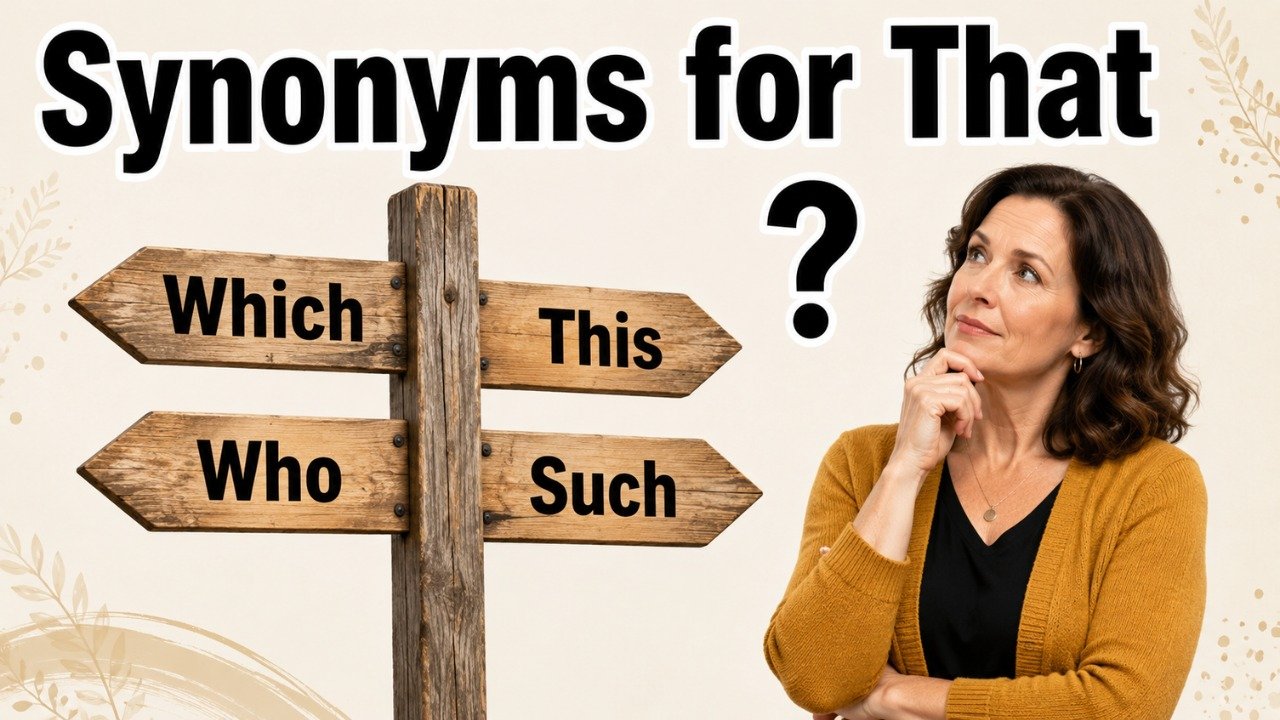
Quick Answer: Synonyms for that include which, who, whom, what, the one, the thing, the person, such, so, and because, depending on context. Use which for objects or ideas, who for people, the one for a specific person or thing, such for a type or kind, so for degree, and because when that introduces a reason. The best synonym depends on whether that works as a pronoun, determiner, conjunction, or adverb.
Pronunciation and Word Details
Word: That
Pronunciation: /ðæt/
Part of Speech: Pronoun, determiner, conjunction, and adverb
Meaning: That points to a specific person, thing, idea, statement, reason, or degree in a sentence.
US Pronunciation:
UK Pronunciation:
What Does “That” Mean?
That means a specific person, thing, idea, statement, or situation already known, already mentioned, or being pointed out. It is a very common word with several grammar uses.
As a pronoun, that can replace a noun. As a determiner, it points to a noun. As a conjunction, it connects one clause to another. As an adverb, it shows degree or extent. For example, that can appear in sentences like “That is useful,” “That idea works,” “She said that she agreed,” and “It was not that hard.”
Meaning, Tone, and Context of “That”
That has a neutral tone. It is common in formal writing, casual speech, grammar explanations, instructions, essays, reports, and daily conversation.
The meaning changes by sentence structure. When that points to something, it works like a pronoun or determiner. When it connects clauses, it works like a conjunction. When it shows degree, it works like an adverb. Because that has many uses, the best synonym is always context based.
In many sentences, that is necessary for clarity. In other sentences, it can be removed or replaced with a more specific word such as which, who, what, because, or so.
When and How to Use “That”
For Pointing To Something: Use that when you want to point to a specific person, object, idea, or situation.
Example: That is the answer I was looking for.
For Identifying A Noun: Use that before a noun when you mean a specific thing or person.
Example: That book explains the topic clearly.
For Connecting Clauses: Use that to connect a main clause with another idea.
Example: She believes that practice improves confidence.
For Reported Speech: Use that after verbs like said, thought, believed, explained, or noticed.
Example: He said that the meeting was important.
For Degree Or Extent: Use that when showing how much, how far, or how strong something is.
Example: The test was not that difficult.
Best Synonyms for That
Which: Used for things, ideas, or clauses.
Example: The rule which applies here is simple.
Who: Used for people as the subject of a clause.
Example: The person who called you is waiting outside.
Whom: Used for people as the object of a clause in formal writing.
Example: The student whom the teacher selected gave the answer.
What: Used when referring to the thing or idea involved.
Example: I understand what you mean.
The One: Used for a specific person or thing.
Example: This is the one I wanted.
The Thing: Used when referring to an object, idea, or matter.
Example: The thing I like most is the clear explanation.
The Person: Used when that refers to a human being.
Example: The person who helped me was very kind.
Such: Used to mean that kind or that type.
Example: Such behavior is not acceptable.
So: Used when that means to that degree.
Example: I did not know it was so important.
Because: Used when that introduces a reason in certain sentence patterns.
Example: I am glad because you came early.
50 Synonyms for That with Short Meanings
- Which: Refers to a thing or idea.
- Who: Refers to a person as the subject.
- Whom: Refers to a person as the object.
- What: Refers to the thing or idea involved.
- The One: Means a specific person or thing.
- The Thing: Means the specific matter or object.
- The Person: Means the specific human being.
- The Idea: Means the specific thought or concept.
- The Fact: Means the specific truth or reality.
- The Statement: Means the specific thing said.
- The Matter: Means the specific issue.
- The Point: Means the specific main idea.
- The Reason: Means the specific cause.
- The Case: Means the specific situation.
- The Matter In Question: Means the topic being discussed.
- This: Refers to something near or current.
- Such: Means that kind or type.
- So: Means to that degree.
- Therefore: Means for that reason.
- Because: Introduces a reason.
- Since: Gives a reason or cause.
- As: Gives a reason in some contexts.
- In Which: Refers to a place, case, or situation.
- Where: Refers to a place or situation.
- When: Refers to a time.
- Why: Refers to a reason.
- Whereby: Means by which.
- Wherein: Means in which.
- Thereby: Means by that action.
- Thereupon: Means after that event.
- Accordingly: Means as a result.
- Consequently: Means as a result.
- Thus: Means in that way or therefore.
- In Order That: Shows purpose.
- So That: Shows purpose or result.
- To Such A Degree: Means that much.
- To That Extent: Means to that level.
- Of That Kind: Means similar in type.
- Of That Sort: Means similar in kind.
- The Same: Means not different.
- The Very: Adds emphasis to a specific noun.
- Said: Refers to something already mentioned.
- Aforementioned: Refers to something mentioned earlier.
- Such A: Means that type of.
- Such An: Means that type of before a vowel sound.
- A Thing Which: Refers to a thing with extra detail.
- A Person Who: Refers to a person with extra detail.
- An Idea Which: Refers to an idea with extra detail.
- A Fact That: Refers to a specific truth.
- A Reason Why: Refers to a specific cause.
Read Also:
Synonyms for Allow

Synonyms for That by Context
When That Means Which
Use which when that refers to a thing, object, idea, or statement. This is common in descriptive clauses.
Example: The book that helped me was simple.
Better Option: The book which helped me was simple.
When That Means Who
Use who when that refers to a person. This makes the sentence more natural and human focused.
Example: The teacher that explained the lesson was patient.
Better Option: The teacher who explained the lesson was patient.
When That Means The One
Use the one when that points to a specific person or thing already known.
Example: That is my favorite answer.
Better Option: The one I like most is my favorite answer.
When That Means Such
Use such when that describes a kind, type, or quality.
Example: That behavior should not continue.
Better Option: Such behavior should not continue.
When That Means So
Use so when that shows degree, amount, or intensity.
Example: I did not know it was that serious.
Better Option: I did not know it was so serious.
When That Means Because
Use because when that gives a reason or cause in a clearer way.
Example: I am happy that you arrived safely.
Better Option: I am happy because you arrived safely.
Another Word for That
Another word for that is which when you are referring to a thing, idea, or statement. However, the best alternative depends on grammar. Use who for people, the one for a specific person or thing, such for a type, so for degree, and because for reason.
Original: The article that explains this topic is useful.
Better Option: The article which explains this topic is useful.
Original: The person that called you is outside.
Better Option: The person who called you is outside.
Original: I did not know it was that difficult.
Better Option: I did not know it was so difficult.
Original: That kind of mistake is common.
Better Option: Such a mistake is common.
When Not to Use “That”
Do not use that too often when a more specific word is clearer. Repeating that can make a sentence sound plain or crowded. In sentences about people, who often sounds better. In sentences about objects or ideas, which may be clearer. In sentences about degree, so is usually smoother.
Weak: The person that helped me was kind.
Better: The person who helped me was kind.
Weak: The method that works best is simple.
Better: The method which works best is simple.
Weak: I did not think it was that important.
Better: I did not think it was so important.
Weak: That problem that we discussed needs attention.
Better: The problem we discussed needs attention.
Words Commonly Confused With That
That vs Which: That often introduces essential information, while which often adds extra information or sounds more descriptive.
That vs Who: That can refer to people in casual use, but who is usually better and more natural for people.
That vs This: That usually points to something farther away, already mentioned, or less immediate. This points to something nearer, current, or about to be discussed.
That vs What: That points to a specific known thing. What refers to the thing or idea itself, often when it is unknown or being identified.
That vs So: That can show degree in casual speech, while so is often smoother and more direct.
That vs Because: That can introduce a reason after emotion words, but because makes the cause clearer.
Which Synonym Should You Choose?
Choose which when writing about objects, ideas, facts, statements, or clauses.
Choose who when writing about people as the subject of a sentence.
Choose whom when writing formally about people as the object of a verb or preposition.
Choose what when the sentence refers to the thing, idea, or meaning itself.
Choose the one when you want to identify a specific person or thing.
Choose such when that means that kind or that type.
Choose so when that means to that degree or amount.
Choose because when that introduces a reason after words such as happy, glad, sad, or surprised.
Choose this when the idea is close, current, or about to be explained.
Real Life Examples of “That” in Sentences
Original: The answer that you gave was correct.
Better Option: The answer which you gave was correct.
Original: The man that fixed the door was polite.
Better Option: The man who fixed the door was polite.
Original: I know that you are busy.
Better Option: I know you are busy.
Original: She said that the task was complete.
Better Option: She said the task was complete.
Original: I did not expect it to be that easy.
Better Option: I did not expect it to be so easy.
Original: That is the book I wanted.
Better Option: The one I wanted is this book.
Original: I am glad that you came.
Better Option: I am glad because you came.
Original: That kind of response is helpful.
Better Option: Such a response is helpful.
Original: The issue that matters most is clarity.
Better Option: The issue which matters most is clarity.
Original: The student that answered first won the prize.
Better Option: The student who answered first won the prize.
Synonym Groups and Usage Differences
Reference Group
This group includes which, what, the thing, the idea, the fact, and the statement. These options are useful when that points to an object, idea, sentence, or matter.
Example: The fact that matters most is honesty.
Person Group
This group includes who, whom, the person, and a person who. These choices are best when that refers to a human being.
Example: The person who helped us deserves thanks.
Specific Choice Group
This group includes the one, the same, the very, this, and said. These options are useful when that identifies a specific person, object, or idea.
Example: The one I selected was the clearest answer.
Degree Group
This group includes so, to such a degree, and to that extent. These choices are best when that means very much, so much, or to a certain level.
Example: The lesson was so useful that everyone understood it.
Reason Group
This group includes because, since, as, therefore, consequently, and accordingly. These options are useful when that relates to cause, reason, or result.
Example: I am pleased because your answer is clear.
Antonyms of That
This: Refers to something nearer, current, or immediate.
These: Refers to nearby plural things.
Here: Refers to a nearby place instead of a farther one.
Now: Refers to the present time instead of a past or distant idea.
Another: Refers to a different person or thing.
Different: Means not the same as the thing mentioned.
Unrelated: Means not connected to the thing mentioned.
Other: Refers to something separate or different.
Comparison: That vs Related Words
That vs Which
That often gives necessary information. Which often gives descriptive or extra information and is more common for things or ideas.
Example With That: The rule that applies here is important.
Example With Which: The rule which applies here is important.
That vs Who
That can refer to people, but who is usually better for people because it sounds more natural and respectful.
Example With That: The student that asked the question was confident.
Example With Who: The student who asked the question was confident.
That vs This
That points to something farther away, already mentioned, or less immediate. This points to something closer, current, or about to be introduced.
Example With That: That answer was helpful.
Example With This: This answer explains the topic clearly.
That vs What
That points to a known thing. What refers to the thing itself, especially when the identity or meaning is being explained.
Example With That: I remember that clearly.
Example With What: I remember what you said.
That vs So
That can show degree, but so is often smoother when describing intensity.
Example With That: I did not know it was that cold.
Example With So: I did not know it was so cold.
Common Phrases and Expressions With That
That Is: Used to identify or explain something.
That Was: Used to refer to a past thing or event.
That Kind Of: Used to describe a type or category.
That Sort Of: Used to describe a kind or style.
That One: Used to point to a specific choice.
That Person: Used to point to a specific human being.
That Thing: Used to refer to a specific object or matter.
That Much: Used to show amount or degree.
That Way: Used to show method, direction, or manner.
Now That: Used to show a situation after something has happened.
Common Mistakes to Avoid
Avoid using that in every clause when it is not needed. Sometimes removing that makes the sentence smoother.
Do not use that for people when who sounds more natural. For example, “the person who helped me” is usually better than “the person that helped me.”
Do not replace every that with which. Which is best for things, ideas, and descriptive clauses, not every sentence.
Do not confuse that with this. Use this for something close, current, or about to be discussed. Use that for something farther away or already mentioned.
Do not use so and that in the same place unless the sentence structure needs both, as in “so clear that everyone understood.”
Conclusion
Synonyms for that depend on grammar and sentence meaning. Use which for things and ideas, who for people, the one for a specific choice, such for a type, so for degree, and because for reason. Since that works as a pronoun, determiner, conjunction, and adverb, no single synonym fits every sentence. Choosing the right replacement makes your writing clearer, smoother, and more precise.
FAQs About Synonyms for That
What is the best synonym for that?
The best synonym for that is which when referring to things or ideas. For people, who is usually better.
Can I use who instead of that?
Yes, use who instead of that when referring to people. It sounds more natural and clearer.
Can I remove that from a sentence?
Yes, that can often be removed after verbs like said, believed, knew, and thought when the sentence remains clear.
Is which the same as that?
Which and that can be similar, but they are not always the same. That often gives necessary information, while which often adds descriptive information.
What is another word for that in casual speech?
In casual speech, the best replacement depends on meaning. Use who for people, which for things, and so for degree.
What is the opposite of that?
The opposite of that is often this when comparing distance or immediacy. That points farther away, while this points closer.
Why is that used so often in English?
That is used often because it has many grammar roles. It can point to something, describe a noun, connect clauses, or show degree.
