
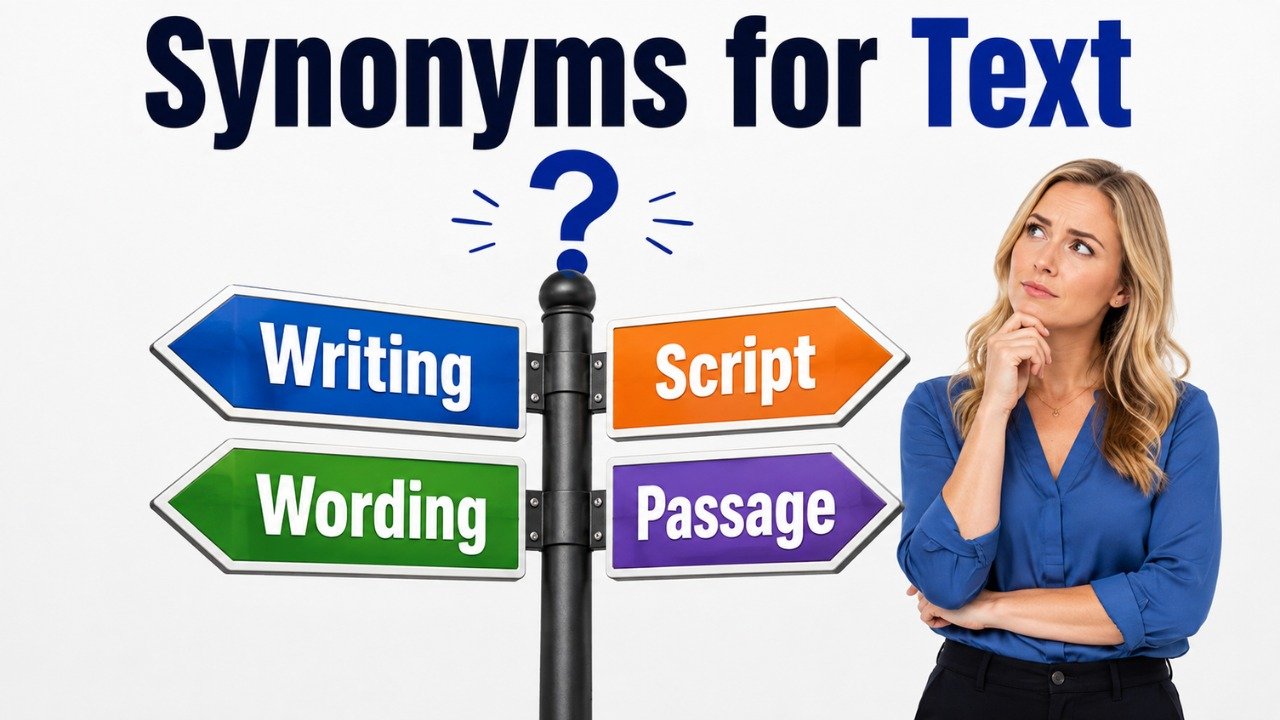
Quick Answer: The best synonyms for text include writing, content, words, passage, document, copy, message, material, script, and wording. Among these synonyms for text, writing is the best general replacement for written language, while passage works for a section of a larger work. Document is better for formal written material, copy fits prepared written content, message works for communication, and wording is best when referring to the specific words used to express an idea.
Pronunciation and Word Details
Word: Text.
Pronunciation: /tekst/
Part of Speech: Noun and verb.
Meaning: Written or printed words that communicate information, ideas, or meaning.
US Pronunciation:
UK Pronunciation:
What Does “Text” Mean?
Text means written or printed words that communicate information, ideas, instructions, stories, or messages.
As a noun, text can refer to an entire written work, a short passage, the wording within a document, or material displayed on a screen.
As a verb, text means to send a written electronic message to another person.
The word is neutral and widely used in education, literature, publishing, communication, technology, and everyday conversation.
Written Material: The teacher asked students to analyze the text carefully.
Passage: The text contains several important arguments.
Digital Content: The text on the page was difficult to read.
Message: She sent a short text explaining the change.
Meaning, Tone, and Context of “Text”
Text is generally a neutral word. It can sound academic, technical, literary, or conversational depending on its context.
In academic writing, text often means a written work being studied or analyzed.
In publishing and design, it may refer to the words appearing on a page, screen, advertisement, or document.
In literature, a text may be a poem, story, essay, play, or other written composition.
In everyday communication, text can also mean a short written message.
Academic Tone: Text refers to material being read, interpreted, or analyzed.
Literary Tone: Text can describe a complete literary work or selected passage.
Professional Tone: Text may refer to copy, wording, or written content.
Conversational Tone: Text can mean a short written message.
Technical Tone: Text often describes character based information displayed or stored digitally.
When and How to Use “Text”
For Written Material
Use text when referring generally to words presented in written or printed form.
Example: The text explains how the process works.
For Academic Reading
Use text when discussing material that students, researchers, or readers examine closely.
Example: Students compared the two texts in class.
For a Specific Passage
Text can describe a particular section of written material.
Example: The selected text provides evidence for the argument.
For Digital Content
Use text for written information appearing on a website, screen, application, or digital document.
Example: The text needs to be larger for easier reading.
For Messaging
Text can refer to a short electronic message sent to another person.
Example: I received a text confirming the meeting time.
For Exact Wording
Text may refer to the precise language of a document, statement, or agreement.
Example: The text of the policy clearly defines the requirements.
Best Synonyms for Text
Writing: Written words used to express information, thoughts, or ideas.
Example: Her writing clearly explains the main concept.
Content: Information or material presented in written form.
Example: The content of the article was easy to understand.
Passage: A section taken from a larger written work.
Example: Read the passage before answering the questions.
Document: A written or digital record containing information.
Example: The document outlines the new procedures.
Copy: Written material prepared for publication, promotion, or presentation.
Example: The editor reviewed the copy before publication.
Message: Written communication sent from one person to another.
Example: His message explained why he would arrive late.
Material: Information prepared for reading, learning, or reference.
Example: The course material covers several important topics.
Wording: The exact words chosen to communicate an idea.
Example: The wording of the sentence could be clearer.
Script: Written words prepared for a performance, presentation, or recording.
Example: She reviewed the script before the rehearsal.
Composition: A piece of writing created as a complete work.
Example: His composition showed strong writing skills.
50 Synonyms for Text with Short Meanings
- Writing: Words expressed in written form.
- Content: Information presented through words.
- Passage: A section of a larger written work.
- Document: A written or digital record.
- Copy: Written material prepared for publication.
- Message: Written communication sent to someone.
- Material: Information intended for reading or study.
- Wording: The particular words used.
- Script: Written words prepared for performance or presentation.
- Composition: A complete piece of writing.
- Words: Units of language used in writing.
- Language: Words and expressions used to communicate.
- Prose: Ordinary written language that is not poetry.
- Passagework: Written material considered as connected passages.
- Manuscript: An original written work before final publication.
- Draft: A preliminary version of written material.
- Article: A piece of writing on a particular subject.
- Essay: A structured piece of writing exploring a subject.
- Paragraph: A group of related written sentences.
- Excerpt: A short part taken from a longer work.
- Extract: A selected section from a larger text.
- Selection: A chosen part of written material.
- Statement: A written or spoken expression of information.
- Narrative: A written account of events or experiences.
- Account: A written description of an event or subject.
- Description: Written words explaining what something is like.
- Explanation: Written information that makes something clear.
- Record: Written information preserved for reference.
- Transcript: A written version of spoken material.
- Notation: Written symbols or brief recorded information.
- Inscription: Words written or engraved on a surface.
- Caption: Short text explaining an image or illustration.
- Label: Brief written information identifying something.
- Note: A short piece of written information.
- Memo: A short written professional communication.
- Letter: Written communication addressed to someone.
- Correspondence: Written communication exchanged between people.
- Communication: Information conveyed through written language.
- Information: Facts or details presented in writing.
- Literature: Written works considered collectively.
- Work: A complete written creation.
- Piece: A single item of writing.
- Copywriting: Written material created for a particular audience or purpose.
- Verbiage: The words or phrasing used in writing.
- Phraseology: A particular choice or arrangement of words.
- Terminology: Specialized words used in a subject area.
- Expression: Words used to communicate an idea or feeling.
- Statementing: Written presentation of an idea or position.
- Body Copy: The main written content within a document or publication.
- Written Matter: Material consisting primarily of written words.
Read Also:
Synonyms for Fortunate
Synonyms for Text by Context
When Text Means Written Material
Useful alternatives include writing, content, material, words, prose, and written matter.
Example: The text contains useful information.
Alternative: The written material contains useful information.
When Text Means a Passage
Useful alternatives include passage, excerpt, extract, selection, and paragraph.
Example: Read the text carefully before answering.
Alternative: Read the passage carefully before answering.
When Text Means a Formal Document
Useful alternatives include document, record, manuscript, statement, and composition.
Example: The text describes the terms of the agreement.
Alternative: The document describes the terms of the agreement.
When Text Means Exact Wording
Useful alternatives include wording, language, phraseology, expression, and verbiage.
Example: The text of the statement was changed.
Alternative: The wording of the statement was changed.
When Text Means a Message
Useful alternatives include message, note, communication, memo, and correspondence.
Example: She sent me a text this morning.
Alternative: She sent me a message this morning.
When Text Means Published Content
Useful alternatives include copy, content, article, writing, and material.
Example: The text needs editing before publication.
Alternative: The copy needs editing before publication.
Another Word for Text
Another word for text is writing when referring generally to written words. However, the best alternative depends on what kind of text you mean.
Use passage for a section of a larger work, document for formal material, message for personal communication, and wording for exact language.
Original: The text explains the problem clearly.
Better Option: The writing explains the problem clearly.
Original: Read the text on page ten.
Better Option: Read the passage on page ten.
Original: The text contains the official requirements.
Better Option: The document contains the official requirements.
Original: I received your text yesterday.
Better Option: I received your message yesterday.
When Not to Use “Text”
Text is useful but can sometimes be too general. A more specific synonym can make your meaning clearer.
Avoid using text repeatedly when you can identify exactly what kind of written material you mean.
Weak: The text in the text explains the meaning of the text.
Better: The passage in the document explains the meaning of the statement.
Use passage when discussing part of a book or article.
Weak: This text from the novel describes the main character.
Better: This passage from the novel describes the main character.
Use wording when discussing exact language.
Weak: I dislike the text of this sentence.
Better: I dislike the wording of this sentence.
Use document for formal records.
Weak: Please sign the text before Friday.
Better: Please sign the document before Friday.
Use message when referring to personal communication.
Weak: I saw your text communication this morning.
Better: I saw your message this morning.
Words Commonly Confused With Text
Text vs Content: Text specifically refers to written words, while content can include writing, images, audio, video, and other forms of information.
Text vs Passage: Text can describe an entire written work, while passage usually means a selected section of that work.
Text vs Copy: Text is a broad term for written words, while copy usually refers to writing prepared for publication or a specific communication purpose.
Text vs Document: Text refers to the words themselves, while document refers to the complete written or digital file containing them.
Text vs Writing: Writing can refer to both the activity and the result of creating written language, while text usually describes the resulting words.
Text vs Wording: Text can include an entire written piece, while wording refers specifically to the choice and arrangement of words.
Text vs Message: A text may mean any written material, while message usually focuses on communication between people.
Which Synonym Should You Choose?
Choose writing when referring generally to written expression.
Choose passage when discussing a section from a book, article, essay, or other work.
Choose document when referring to formal, official, business, or administrative material.
Choose content when discussing information presented to readers.
Choose copy when referring to written material prepared for publication or presentation.
Choose message when referring to communication between people.
Choose wording when focusing on the exact language used.
Choose script when discussing prepared dialogue, speeches, performances, or presentations.
Choose material for educational, instructional, or reference information.
Choose excerpt when referring to a short portion taken from a larger work.
Real Life Examples of “Text” in Sentences
Original: The text explains the historical event clearly.
Better Option: The passage explains the historical event clearly.
Original: Please review the text before submitting it.
Better Option: Please review the document before submitting it.
Original: The text on the page needs to be shorter.
Better Option: The copy on the page needs to be shorter.
Original: She analyzed the text for her assignment.
Better Option: She analyzed the passage for her assignment.
Original: The text contains several useful examples.
Better Option: The material contains several useful examples.
Original: He changed the text of the announcement.
Better Option: He changed the wording of the announcement.
Original: I received a text from my colleague.
Better Option: I received a message from my colleague.
Original: The text was difficult for beginners to understand.
Better Option: The writing was difficult for beginners to understand.
Original: The text includes all the necessary information.
Better Option: The document includes all the necessary information.
Original: We need stronger text for this section.
Better Option: We need stronger content for this section.
Synonym Groups and Usage Differences
General Writing Group
Writing, words, prose, content, and written matter describe written language broadly.
Use these when the exact type of written material is not important.
Example: Her writing presents the idea in a clear and engaging way.
Passage Group
Passage, excerpt, extract, selection, and paragraph describe smaller sections of larger works.
These are especially useful in academic and literary contexts.
Example: The excerpt reveals the author’s main argument.
Formal Document Group
Document, record, manuscript, statement, and transcript refer to organized or recorded written information.
These words are useful in academic, professional, administrative, and official contexts.
Example: The document contains the final recommendations.
Communication Group
Message, note, letter, memo, correspondence, and communication describe writing intended to convey information to another person.
Example: She left a short note explaining the situation.
Wording Group
Wording, phraseology, language, expression, terminology, and verbiage focus on how ideas are expressed through particular words.
Example: The wording makes the instruction easier to understand.
Published Content Group
Copy, article, content, piece, and composition describe material prepared for readers.
Example: The editor revised the copy before publication.
Antonyms of Text
Because text has several meanings, its opposites depend on the context.
Speech: Spoken rather than written communication.
Silence: Absence of written or spoken communication.
Image: Visual information rather than written words.
Illustration: A visual representation instead of written explanation.
Graphic: Information communicated visually.
Sound: Audio rather than written information.
Blankness: Absence of written material.
Empty Space: An area containing no written content.
Speechlessness: Lack of expressed words.
Nonverbal Communication: Communication that does not depend on written words.
Comparison: Text vs Related Words
Text vs Writing
Text refers to written words or a written work. Writing can refer both to written material and the activity of producing it.
Example With Text: The text contains several technical terms.
Example With Writing: Her writing is clear and concise.
Text vs Passage
Text may refer to an entire written work, while passage refers to a specific section.
Example With Text: The entire text explores the theme of identity.
Example With Passage: This passage introduces the central conflict.
Text vs Content
Text refers specifically to written words. Content is broader and can include several types of information.
Example With Text: Increase the size of the text.
Example With Content: The content provides useful information for beginners.
Text vs Copy
Text is a general term for written words. Copy usually means prepared writing intended for publication or communication.
Example With Text: The text appears below the image.
Example With Copy: The editor shortened the copy before publication.
Text vs Document
Text means the written words themselves, while document means the complete file or record.
Example With Text: The text of the agreement is clear.
Example With Document: Please save the document before closing it.
Text vs Wording
Text may describe all written material, while wording refers to the particular words chosen.
Example With Text: The text contains three paragraphs.
Example With Wording: The wording sounds too formal.
Text vs Message
Text can refer to any written material. Message focuses on information communicated to someone.
Example With Text: The text discusses environmental change.
Example With Message: I received your message this morning.
Common Phrases and Expressions With “Text”
Text Message: A short written message sent electronically.
Body Text: The main written content of a page or document.
Text Document: A file containing primarily written information.
Text Analysis: Careful examination of written material.
Text Editor: A tool used for creating or changing written material.
Text Format: The visual or structural presentation of written words.
Text Content: Written information appearing within a larger work.
Text Passage: A selected portion of written material.
Text Description: Written language describing an object, event, or idea.
Text of the Agreement: The exact written language contained in an agreement.
Common Mistakes to Avoid
One common mistake is treating every synonym for text as interchangeable. Passage, document, wording, message, and content describe different types or aspects of written material.
Avoid excessive repetition of text when a more specific noun would improve clarity.
Do not use passage for an entire book unless you are referring to one specific section.
Do not use document when you mean only the individual words appearing inside it.
Avoid using message for academic or literary material unless communication is the intended meaning.
Remember that content is broader than text. Content may include visual or other material in addition to words.
Choose wording when discussing the exact phrases used rather than the complete document.
When discussing literature, academic writing, or formal communication, select the synonym that identifies the type of material as precisely as possible.
Conclusion
Synonyms for text include writing, content, passage, document, copy, message, material, wording, script, and composition. The best choice depends on what the written material represents. Use passage for a selected section, document for formal information, message for communication, wording for exact language, and copy for prepared published content. Understanding these differences helps you choose clearer vocabulary and makes academic, professional, literary, and everyday writing more precise and natural.
FAQs About Synonyms for Text
What Is the Best Synonym for Text?
The best general synonym for text is writing. Passage, document, content, and message may be better in more specific contexts.
What Is Another Word for Text in Academic Writing?
Passage, material, writing, document, and source material can work depending on what type of text you are discussing.
What Is Another Word for a Piece of Text?
Passage, excerpt, extract, paragraph, selection, or piece can describe a smaller section of written material.
Is Content a Synonym for Text?
Yes, content can be a synonym for text when referring to written information. However, content is broader because it can include nonwritten material as well.
What Is a Formal Synonym for Text?
Document, manuscript, written material, composition, and record are useful formal alternatives.
What Is Another Word for Text Message?
Message, note, communication, or written message can replace text message depending on the situation.
What Is the Difference Between Text and Wording?
Text refers to written material as a whole, while wording refers specifically to the exact words and phrases chosen to express an idea.
