
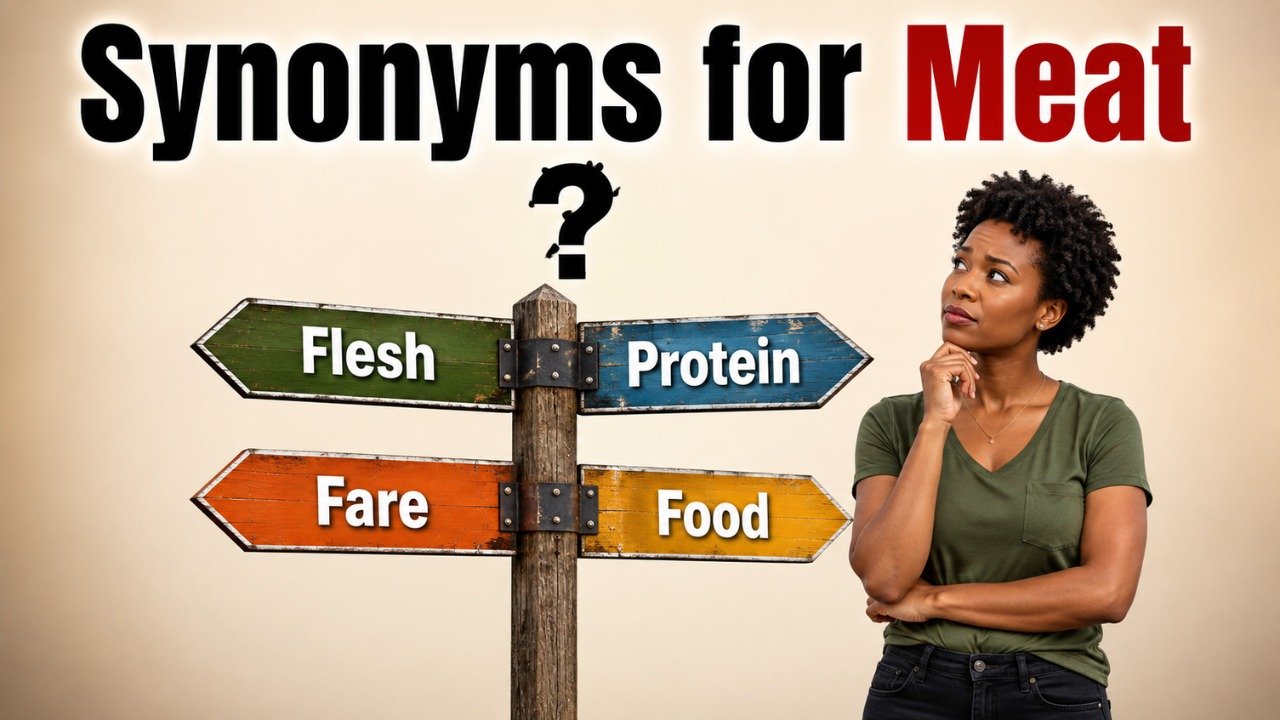
Quick Answer: The best synonyms for meat include flesh, animal flesh, edible flesh, animal protein, protein, beef, pork, poultry, game, and substance. Use flesh in anatomical or descriptive writing, animal protein in nutritional or general food contexts, and beef, pork, poultry, or game when the animal category is known. In figurative writing, substance, essence, core, or heart can replace meat when it means the most important part of a subject.
Pronunciation and Word Details
Word: Meat
Pronunciation: /miːt/
Part of Speech: Noun
Meaning: The flesh of an animal used as food, or figuratively, the main and most valuable part of something.
US Pronunciation:
UK Pronunciation:
What Does “Meat” Mean?
Meat means animal flesh that is prepared or intended for food.
The word meat is mainly a noun. It can refer generally to edible animal tissue or more specifically to products such as beef, pork, lamb, poultry, venison, and game.
Example: The cook prepared the meat with vegetables and herbs.
Meat can also refer to a particular portion or cut.
Example: Choose a tender cut of meat for this recipe.
In some contexts, meat is used as a broad food category that contrasts with vegetables, grains, fruit, or plant foods.
Example: The meal included meat, rice, and fresh vegetables.
The word can also have a figurative meaning. In expressions such as “the meat of the argument,” meat means the main substance, central point, or most valuable part.
Example: The final section contains the real meat of the report.
The best synonym depends on whether the sentence concerns food, anatomy, nutrition, cooking, farming, food preparation, or the central part of an idea.
Meaning, Tone, and Context of “Meat”
Meat is a common, neutral, and widely understood word. It appears in everyday conversation, recipes, restaurant descriptions, food writing, farming discussions, nutritional language, and figurative expressions.
In culinary writing, meat is a broad category. More specific terms such as beef, pork, poultry, lamb, venison, or game usually give readers clearer information.
Example: Add the meat after the vegetables have softened.
In anatomical or descriptive writing, flesh or muscle tissue may be more suitable. Flesh can sound clinical, literary, serious, or vivid depending on the sentence.
Example: The injury affected the surrounding muscle tissue.
In nutritional discussions, animal protein or protein may be used when the focus is on the food category rather than a particular cut.
Example: Beans can be served alongside animal protein.
In food retail and preparation contexts, terms such as cut, fillet, tenderloin, mince, ground meat, cured meat, and deli meat identify the form or preparation method.
In figurative writing, meat has an informal but expressive tone. Substance, essence, core, and heart are often smoother choices in formal reports, essays, or professional communication.
Neutral Tone: Common in everyday food discussions.
Culinary Tone: Broad unless the particular type or cut is identified.
Technical Tone: Muscle tissue or animal protein may be more precise.
Literary Tone: Flesh can create a stronger or more vivid image.
Figurative Tone: Informal and expressive when meaning the main substance.
When and How to Use “Meat”
For General Food References
Use meat when the exact animal or cut is unknown, unimportant, or already understood.
Example: Store the meat in a properly sealed container.
For a Specific Animal Source
Use beef, pork, lamb, poultry, venison, or game when the source matters.
Example: The stew contains beef and root vegetables.
For Poultry
Use poultry as the broad category for chicken, turkey, duck, and goose.
Example: The shop sells fresh poultry and prepared cuts.
For Nutrition
Use animal protein or protein when discussing the nutritional or food group role of meat.
Example: The meal combines vegetables with a serving of animal protein.
For Anatomy
Use flesh or muscle tissue when describing the physical tissue of an animal or person.
Example: The medical report described damage to the muscle tissue.
For Prepared Products
Use sausage, ham, bacon, deli meat, cured meat, or smoked meat when the preparation style is important.
Example: The sandwich contains sliced deli meat and salad leaves.
For Cuts and Portions
Use steak, chop, fillet, tenderloin, brisket, roast, or ribs when naming a particular cut.
Example: The chef prepared a fillet with a light sauce.
For Minced or Ground Products
Use mince or ground meat when the meat has been finely chopped or processed into small pieces.
Example: The filling is made with seasoned ground meat.
For Wild Animals
Use game, game meat, venison, rabbit, bison, or boar when discussing meat from hunted or wild animals.
Example: The menu includes several traditional game dishes.
For Figurative Meaning
Use substance, essence, core, or heart when meat means the most important part of an idea.
Example: The middle chapters contain the substance of the argument.
Best Synonyms for Meat
Flesh
Synonym: The soft tissue of an animal or person, especially beneath the skin.
Example: The recipe uses the flesh of the fish after the bones are removed.
Animal Flesh
Synonym: The physical tissue of an animal, especially when used as food.
Example: The term animal flesh is more descriptive than culinary.
Edible Flesh
Synonym: Animal tissue that is suitable for eating.
Example: The edible flesh was separated from the bones.
Animal Protein
Synonym: Food protein obtained from animal sources.
Example: The plate included vegetables, grains, and animal protein.
Protein
Synonym: A general food term that may refer to meat or another protein rich item.
Example: Choose a protein to serve with the rice.
Beef
Synonym: Meat obtained from cattle.
Example: The cook added sliced beef to the stew.
Pork
Synonym: Meat obtained from pigs.
Example: The dish contains roasted pork and vegetables.
Poultry
Synonym: Meat from domesticated birds such as chicken, turkey, duck, or goose.
Example: Poultry should be stored separately from ready to eat foods.
Game
Synonym: Meat from wild animals or birds hunted for food.
Example: The restaurant offers seasonal game dishes.
Substance
Synonym: The main, meaningful, or valuable part of a subject.
Example: The second section contains the substance of the proposal.
50 Synonyms for Meat With Short Meanings
- Flesh: The soft tissue of an animal or person.
- Animal Flesh: Animal tissue considered as food.
- Edible Flesh: Flesh that is suitable for eating.
- Animal Protein: Protein rich food obtained from animals.
- Protein: A broad food term that can refer to meat.
- Muscle Tissue: The physical tissue that forms much edible meat.
- Meat Product: Food made wholly or partly from meat.
- Cut of Meat: A portion taken from a particular part of an animal.
- Beef: Meat obtained from cattle.
- Pork: Meat obtained from pigs.
- Poultry: Meat from domesticated birds.
- Chicken: Meat obtained from a chicken.
- Turkey: Meat obtained from a turkey.
- Duck: Meat obtained from a duck.
- Goose: Meat obtained from a goose.
- Lamb: Meat from a young sheep.
- Mutton: Meat from an adult sheep.
- Veal: Meat from a young calf.
- Venison: Meat from deer.
- Game: Wild animals or birds used as food.
- Game Meat: Meat obtained from hunted or wild animals.
- Rabbit: Meat obtained from a rabbit.
- Goat Meat: Meat obtained from a goat.
- Bison: Meat obtained from a bison.
- Buffalo Meat: Meat obtained from a buffalo.
- Boar: Meat obtained from a wild boar.
- Ham: Pork from the upper part of a pig’s leg.
- Bacon: Cured meat usually taken from a pig.
- Sausage: Seasoned ground meat formed into a casing or shape.
- Steak: A thick slice of meat prepared as a portion.
- Roast: A large cut of meat intended for roasting.
- Chop: A small cut of meat usually containing a bone.
- Fillet: A boneless piece of meat or fish.
- Tenderloin: A tender cut from the loin area.
- Brisket: A cut taken from the breast or lower chest.
- Ribs: Meat attached to or cut from the rib bones.
- Mince: Meat chopped into very small pieces.
- Ground Meat: Meat processed into small particles.
- Offal: Edible internal organs and other selected animal parts.
- Organ Meat: Edible organs such as liver, heart, or kidney.
- Cold Cuts: Cooked or cured meat served in thin slices.
- Deli Meat: Prepared sliced meat commonly used in sandwiches.
- Cured Meat: Meat preserved with salt or another curing method.
- Smoked Meat: Meat flavored and preserved through smoke.
- Red Meat: A broad category including beef, lamb, and similar meats.
- White Meat: Pale meat commonly associated with poultry.
- Substance: The meaningful or important content of something.
- Essence: The central quality or most important part.
- Core: The main or central part of a subject.
- Heart: The most important or essential part of something.
Read Also:
Synonyms for Gather

Synonyms for Meat by Context
When Meat Means Animal Flesh
Flesh, animal flesh, edible flesh, muscle tissue, animal protein, and protein are useful general alternatives.
Example: The recipe calls for tender meat.
Alternative: The recipe calls for tender animal flesh.
Flesh is the closest literal synonym, but it can sound more anatomical or literary than meat. Animal protein is useful when discussing food groups or meal composition.
When Meat Means Beef
Beef, steak, brisket, tenderloin, roast, ribs, mince, and ground beef are useful when the meat comes from cattle.
Example: Brown the meat before adding the sauce.
Alternative: Brown the beef before adding the sauce.
Beef is more precise than meat when the animal source is known. Steak, brisket, and tenderloin identify particular cuts.
When Meat Means Pork
Pork, ham, bacon, sausage, chop, roast, and tenderloin can describe meat obtained from pigs.
Example: The dish combines meat with beans.
Alternative: The dish combines pork with beans.
Pork names the general category, while ham, bacon, and sausage indicate a particular product or preparation.
When Meat Means Poultry
Poultry, chicken, turkey, duck, goose, white meat, breast, and thigh are appropriate when discussing domesticated birds.
Example: Keep raw meat away from cooked food.
Alternative: Keep raw poultry away from cooked food.
Poultry is a formal collective term. Chicken and turkey are more specific and natural in recipes.
When Meat Means Wild Game
Game, game meat, venison, rabbit, bison, buffalo meat, boar, and wild meat describe meat obtained from wild or hunted animals.
Example: The traditional meal included locally sourced meat.
Alternative: The traditional meal included locally sourced game.
Game is the strongest broad alternative for wild animals and birds used as food.
When Meat Means a Prepared Product
Sausage, ham, bacon, cold cuts, deli meat, cured meat, smoked meat, mince, and ground meat identify prepared forms.
Example: Add the meat to the sandwich.
Alternative: Add the deli meat to the sandwich.
The more specific term tells the reader how the product was prepared, preserved, or served.
When Meat Means a Particular Cut
Steak, chop, fillet, tenderloin, brisket, ribs, roast, and cut are useful for portions taken from particular areas.
Example: Choose a lean piece of meat.
Alternative: Choose a lean fillet.
Cut of meat is useful when the exact name is unknown. The name of the cut is better when precision matters.
When Meat Means the Main Substance
Substance, essence, core, heart, main point, central idea, and meaningful content can replace meat in figurative writing.
Example: The final pages contain the meat of the discussion.
Alternative: The final pages contain the substance of the discussion.
Substance is suitable for formal writing. Core and heart are concise and expressive. Essence emphasizes the defining quality of an idea.
Another Word for Meat
Flesh is the closest literal replacement for meat, but it is not the best choice in every sentence. Flesh often sounds anatomical, descriptive, or literary, while meat is more natural in recipes and everyday food discussions.
When the animal source is known, beef, pork, poultry, lamb, or venison is usually more precise. When meat has a figurative meaning, substance, core, essence, or heart may be more appropriate.
Original: Place the meat in the cooking dish.
Better Option: Place the beef in the cooking dish.
Original: The shop sells fresh meat from local farms.
Better Option: The shop sells fresh animal protein from local farms.
Original: Remove the meat from the bones.
Better Option: Remove the edible flesh from the bones.
Original: This chapter contains the meat of the argument.
Better Option: This chapter contains the substance of the argument.
When Not to Use “Meat”
Avoid meat when the animal source is important to the reader.
Weak: The recipe requires two portions of meat.
Better: The recipe requires two portions of chicken.
Do not use meat when a particular cut would provide clearer cooking instructions.
Weak: Cook the meat slowly until tender.
Better: Cook the brisket slowly until tender.
Avoid using flesh in ordinary menu or recipe writing unless a descriptive or anatomical tone is intended.
Weak: Serve the roasted flesh with potatoes.
Better: Serve the roasted meat with potatoes.
Do not use animal protein when a natural everyday word would be clearer.
Weak: She ordered an animal protein sandwich.
Better: She ordered a turkey sandwich.
Avoid meat in figurative writing when the expression may sound too casual for the context.
Weak: The middle section contains the meat of the legal analysis.
Better: The middle section contains the substance of the legal analysis.
Do not treat beef, pork, poultry, and meat as exact synonyms in every sentence. Each specific word identifies a narrower category.
Weak: All meat is beef.
Better: Beef is one type of meat.
Avoid repeating meat when the exact product has already been named.
Weak: The meat was a tenderloin. The meat was seasoned, and the meat was roasted.
Better: The meat was a tenderloin. It was seasoned and roasted.
Words Commonly Confused With Meat
Meat vs Flesh: Meat usually refers to animal tissue used as food. Flesh refers more broadly to soft body tissue and may not imply food.
Meat vs Beef: Meat is a broad category. Beef specifically means meat obtained from cattle.
Meat vs Pork: Meat can come from many animals. Pork specifically refers to meat obtained from pigs.
Meat vs Poultry: Meat is the general category. Poultry refers to domesticated birds and the food obtained from them.
Meat vs Protein: Meat is a particular food category. Protein is a nutrient and can also refer informally to the protein portion of a meal.
Meat vs Game: Meat includes both farmed and wild animal products. Game specifically refers to wild animals or birds hunted for food.
Meat vs Offal: Meat commonly refers to muscle tissue. Offal refers to edible organs and selected internal parts.
Meat vs Deli Meat: Meat is broad. Deli meat is prepared, cooked, or cured meat sliced for convenient serving.
Meat vs Mince: Meat can appear in many forms. Mince is meat chopped or ground into very small pieces.
Meat vs Substance: Meat is literal when referring to food. Substance can replace meat only when meat figuratively means the main content or value.
Which Synonym Should You Choose?
Choose flesh when writing about soft animal tissue or when using a descriptive or anatomical tone.
Choose animal flesh when you need a direct and literal explanation.
Choose edible flesh when distinguishing food from bones, skin, or other parts.
Choose animal protein when discussing meal composition or food categories.
Choose protein in casual food planning when the exact source is not yet selected.
Choose beef when the meat comes from cattle.
Choose pork when the meat comes from pigs.
Choose poultry when referring collectively to chicken, turkey, duck, or goose.
Choose lamb or mutton when identifying meat from sheep.
Choose venison when the meat comes from deer.
Choose game when referring broadly to hunted wild animals or birds.
Choose steak, chop, fillet, tenderloin, brisket, ribs, or roast when naming a particular cut.
Choose mince or ground meat when the food has been finely chopped or processed.
Choose ham, bacon, sausage, deli meat, cured meat, or smoked meat when the preparation method matters.
Choose offal or organ meat when referring to edible organs.
Choose substance in formal writing when meat means the important content of a subject.
Choose core or heart when you want a concise and expressive figurative alternative.
Choose essence when referring to the defining quality of an idea or issue.
Real Life Examples of “Meat” in Sentences
Original: The cook added the meat after the onions softened.
Better Option: The cook added the beef after the onions softened.
Original: The restaurant serves several kinds of meat.
Better Option: The restaurant serves beef, poultry, lamb, and game.
Original: Place the meat on a clean cutting surface.
Better Option: Place the chicken on a clean cutting surface.
Original: The butcher recommended a tender piece of meat.
Better Option: The butcher recommended a tender fillet.
Original: The filling contains finely chopped meat.
Better Option: The filling contains seasoned mince.
Original: She added slices of meat to the sandwich.
Better Option: She added slices of deli meat to the sandwich.
Original: The meal included vegetables and meat.
Better Option: The meal included vegetables and animal protein.
Original: The workers separated the meat from the bones.
Better Option: The workers separated the edible flesh from the bones.
Original: The middle chapters contain the meat of the book.
Better Option: The middle chapters contain the substance of the book.
Original: Let us move past the introduction and discuss the meat of the issue.
Better Option: Let us move past the introduction and discuss the core of the issue.
Synonym Groups and Usage Differences
General Food Group
Meat, animal flesh, edible flesh, animal protein, and protein describe the broad food category.
Meat is the most natural everyday word. Animal flesh is more literal. Animal protein is useful when discussing meal structure or food categories.
Example: The meal contains vegetables, grains, and animal protein.
Cattle Meat Group
Beef, steak, brisket, tenderloin, ribs, roast, and ground beef describe meat obtained from cattle.
Beef is the general category. Steak and roast describe serving styles or cuts, while brisket and tenderloin identify particular areas.
Example: The chef prepared the brisket slowly.
Pig Meat Group
Pork, ham, bacon, sausage, chop, roast, and tenderloin describe meat or products obtained from pigs.
Pork is the broad category. Ham and bacon are prepared products, while chop and tenderloin identify cuts.
Example: The dish uses pork tenderloin with herbs.
Poultry Group
Poultry, chicken, turkey, duck, goose, and white meat describe domesticated birds used as food.
Poultry is formal and collective. Chicken, turkey, duck, and goose identify the animal directly.
Example: The market sells fresh poultry throughout the week.
Sheep and Goat Group
Lamb, mutton, and goat meat identify meat from sheep or goats.
Lamb comes from a young sheep, while mutton comes from an adult sheep. Goat meat should be named directly when that is the source.
Example: The stew is prepared with tender lamb.
Wild Game Group
Game, game meat, venison, rabbit, bison, buffalo meat, and boar describe meat associated with wild or hunted animals.
Game is a broad collective term. Venison specifically refers to deer meat.
Example: The menu includes venison and other game meats.
Prepared Meat Group
Ham, bacon, sausage, cold cuts, deli meat, cured meat, and smoked meat describe products changed through cooking, seasoning, curing, slicing, or smoking.
These terms are not interchangeable because each preparation method creates a different product.
Example: The platter included several cured meats.
Ground and Chopped Group
Mince, ground meat, sausage filling, and chopped meat describe meat divided into small pieces.
Mince is common in recipes, while ground meat is a direct descriptive term.
Example: Brown the ground meat before adding the tomatoes.
Cut Group
Steak, chop, fillet, tenderloin, brisket, ribs, and roast identify portions or cuts.
These words are more precise than meat because they often guide cooking time, serving style, and preparation.
Example: The tenderloin was cut into equal portions.
Figurative Group
Substance, essence, core, heart, main point, and central idea describe the important part of a subject.
Substance suits formal writing. Core and heart are more expressive. Essence refers to the defining nature of something.
Example: The conclusion captures the essence of the discussion.
Antonyms of Meat
The opposite of meat depends on whether the word refers to animal food or the main substance of an idea.
Vegetable: An edible plant or part of a plant.
Fruit: The edible seed bearing part of a plant.
Plant Food: Food obtained from plants rather than animals.
Meat Substitute: A food designed to replace meat in a meal.
Plant Protein: Protein obtained from beans, grains, nuts, seeds, or other plants.
Grain: A seed used as food, such as rice, wheat, or oats.
Legume: A plant food category that includes beans, peas, and lentils.
Dairy Product: Food produced from milk rather than animal flesh.
Surface: The outer part rather than the inner substance.
Shell: An outer covering rather than the central content.
Detail: A small point rather than the main substance.
Triviality: Something unimportant or lacking meaningful substance.
Padding: Unnecessary content added around the main information.
Periphery: The outer area rather than the central part.
Comparison: Meat vs Related Words
Meat vs Flesh
Meat normally refers to animal tissue prepared or intended for food. Flesh refers broadly to soft body tissue and can describe humans, animals, fruit, or fish.
Example With Meat: The cook cut the meat into small pieces.
Example With Flesh: The flesh separated easily from the bone.
Meat vs Beef
Meat is a general category. Beef is specifically meat obtained from cattle.
Example With Meat: The shop sells several kinds of meat.
Example With Beef: The stew contains slow cooked beef.
Meat vs Pork
Meat can refer to food from many animals. Pork only refers to meat obtained from pigs.
Example With Meat: The recipe can be prepared with different meats.
Example With Pork: The recipe uses pork and vegetables.
Meat vs Poultry
Meat is broad and may include beef, pork, lamb, and game. Poultry refers to domesticated birds such as chicken, turkey, duck, and goose.
Example With Meat: Keep the meat refrigerated.
Example With Poultry: Store the poultry in a sealed container.
Meat vs Protein
Meat is a food made from animal tissue. Protein is a nutrient found in meat and many other foods. In casual meal planning, protein can also mean the main protein rich item.
Example With Meat: The dish contains meat and vegetables.
Example With Protein: Choose a protein to serve with the salad.
Meat vs Game
Meat includes food from domesticated and wild animals. Game refers specifically to wild animals or birds hunted for food.
Example With Meat: The market offers locally produced meat.
Example With Game: The seasonal menu includes several game dishes.
Meat vs Offal
Meat commonly means edible muscle tissue. Offal refers to edible internal organs and selected animal parts.
Example With Meat: The meat was cut into portions.
Example With Offal: The traditional recipe includes offal.
Meat vs Mince
Meat can be whole, sliced, chopped, or ground. Mince specifically refers to meat chopped into very small pieces.
Example With Meat: Add the meat to the pan.
Example With Mince: Break the mince apart while it cooks.
Meat vs Deli Meat
Meat is the broad category. Deli meat is prepared and sliced for sandwiches, platters, or convenient serving.
Example With Meat: The refrigerator contains fresh meat.
Example With Deli Meat: The sandwich contains sliced deli meat.
Meat vs Substance
Meat is literal when referring to food. Substance is a figurative replacement when meat means the central or valuable content.
Example With Meat: The cook seasoned the meat.
Example With Substance: The report lacks substance.
Meat vs Core
Meat can informally describe the main part of a subject. Core is a concise alternative that sounds natural in formal and professional writing.
Example With Meat: We have reached the meat of the discussion.
Example With Core: We have reached the core of the discussion.
Common Phrases and Expressions With “Meat”
Red Meat: A broad category of darker animal meat.
White Meat: Pale meat commonly associated with poultry.
Lean Meat: Meat containing relatively little visible fat.
Fresh Meat: Meat that has not been preserved through curing or smoking.
Ground Meat: Meat processed into very small pieces.
Minced Meat: Meat finely chopped for cooking.
Cured Meat: Meat preserved through a curing process.
Smoked Meat: Meat prepared or flavored using smoke.
Processed Meat: Meat changed through curing, smoking, seasoning, or another preparation method.
Meat of the Matter: The main or most important part of an issue.
Meat and Potatoes: The basic, practical, or most substantial part of something.
Meat Counter: A shop area where meat products are displayed and sold.
Common Mistakes to Avoid
A common mistake is using meat when the animal source is already known. Beef, pork, poultry, lamb, or venison usually creates a clearer sentence.
Do not treat flesh as a completely natural replacement in every recipe. Flesh can sound anatomical or overly descriptive in ordinary food writing.
Weak: Roast the flesh for one hour.
Better: Roast the meat for one hour.
Avoid using protein as though it always means meat. Protein can come from many foods, and the word may refer to the nutrient rather than the food itself.
Do not confuse meat with beef. Beef is only one category of meat.
Weak: Chicken is a type of beef.
Better: Chicken is a type of meat.
Avoid confusing mutton and lamb. Both come from sheep, but they describe meat from animals of different ages.
Do not use game when discussing ordinary farmed meat unless the animal is actually classified as game in that context.
Avoid calling every prepared product fresh meat. Cured, smoked, cooked, or sliced products may require more specific terms.
Do not use cut, steak, fillet, and roast as though they have identical meanings. A cut is a general portion, while the other words identify particular forms or preparations.
Avoid repetition in recipes and descriptions.
Weak: Add the meat to the pan. Stir the meat. Cook the meat until the meat is ready.
Better: Add the meat to the pan, stir it, and cook until ready.
Be careful with figurative expressions. “The meat of the issue” is understandable but informal. Substance, core, essence, or heart may be better in essays and professional reports.
Use the singular and plural forms correctly.
Singular: This meat is tender.
Plural Category: The shop sells several meats.
The plural meats usually refers to different types or varieties rather than several individual pieces.
Conclusion
The best synonyms for meat depend on the animal, cut, preparation, and sentence context. Flesh and animal protein work as broad alternatives, while beef, pork, poultry, lamb, venison, and game identify specific categories. Steak, fillet, brisket, mince, and deli meat provide greater culinary detail. In figurative writing, substance, essence, core, and heart are clearer choices. Using these synonyms for meat helps make recipes, descriptions, essays, and everyday communication more precise and natural.
FAQs About Synonyms for Meat
What Is the Best Synonym for Meat?
Flesh is the closest literal synonym. Animal protein is useful in food discussions, while beef, pork, or poultry is better when the source is known.
What Is Another Word for Meat in a Recipe?
The best replacement is usually the specific type or cut, such as beef, chicken, pork, lamb, steak, fillet, mince, or brisket.
Is Flesh the Same as Meat?
Not exactly. Flesh means soft body tissue, while meat usually refers to animal flesh prepared or intended for food.
Is Protein a Synonym for Meat?
Protein can be a loose alternative in meal planning, but it is not an exact synonym. Protein is a nutrient found in meat and many other foods.
What Is a Formal Word for Meat?
Animal protein, edible flesh, muscle tissue, meat product, or cut of meat may be suitable, depending on the context.
What Is Another Word for the Meat of an Argument?
Substance, core, essence, heart, central point, and main idea are useful figurative alternatives.
What Is the Opposite of Meat?
Possible opposites include vegetables, plant food, plant protein, legumes, grains, and meat substitutes. The most suitable opposite depends on the sentence.
