
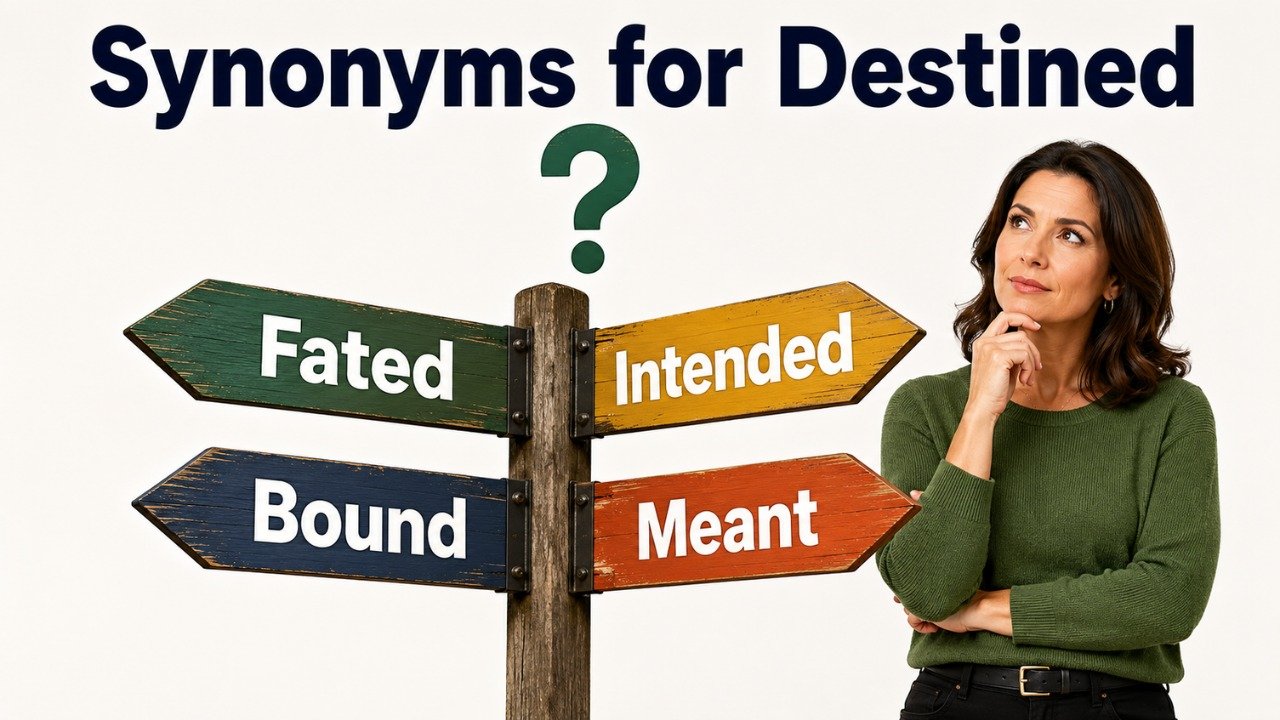
Quick Answer: The best synonyms for destined include fated, meant, bound, intended, predetermined, predestined, ordained, certain, designated, and appointed. The best choice depends on context. Use fated or predestined when discussing fate, meant when something seems naturally intended, bound when an outcome appears certain, intended for purpose, designated for an assigned role, and predetermined when an outcome was decided in advance.
Pronunciation and Word Details
Word: Destined.
Pronunciation: /ˈdɛstɪnd/
Part of Speech: Adjective and past participle.
Meaning: Certain or intended to experience a particular future, purpose, place, or result.
US Pronunciation:
UK Pronunciation:
What Does “Destined” Mean?
Destined means certain, intended, or expected to reach a particular place, role, condition, or future result.
The word often suggests that an outcome has already been decided by fate, circumstances, intention, or a strong likelihood of happening.
As an adjective, destined commonly appears with for or to.
Example: She seemed destined for success.
Example: The building was destined to become a cultural center.
Destined can describe people, objects, plans, careers, relationships, events, and outcomes. It may carry a sense of fate, purpose, certainty, or direction depending on the sentence.
In emotional or literary writing, destined often suggests fate. In practical writing, it can simply mean intended for a particular purpose or place.
Meaning, Tone, and Context of “Destined”
Destined has a generally neutral to slightly dramatic tone. Its exact feeling depends on context.
In literary or emotional writing, destined can sound powerful because it suggests fate or an unavoidable future.
In everyday conversation, phrases such as destined for success or destined to meet can suggest that an outcome feels naturally meant to happen.
In formal writing, destined can describe something intended for a particular use, recipient, or destination.
The word can also be positive or negative.
Positive Context: She was destined for greatness.
Negative Context: The neglected project seemed destined to fail.
Because destined can imply certainty, writers should avoid using it when an outcome is merely possible or uncertain.
When and How to Use “Destined”
For Fate: Use destined when an event seems decided by fate or beyond personal control.
Example: They believed they were destined to meet.
For Future Success: Use destined when someone appears highly likely to achieve an important result.
Example: Her talent suggested that she was destined for a remarkable career.
For Purpose: Use destined when something is intended for a specific use.
Example: The materials were destined for the new community center.
For Direction: Use destined when a person or object is going toward a particular place.
Example: The shipment was destined for another city.
For Certain Outcomes: Use destined when a result seems almost unavoidable.
Example: Without major changes, the plan was destined to fail.
For Assigned Roles: Use destined when someone appears intended for a particular position or responsibility.
Example: He seemed destined to lead the organization.
Best Synonyms for Destined
Fated: Certain to happen because of fate.
Example: Their meeting seemed fated from the beginning.
Meant: Intended or naturally expected to happen.
Example: She felt that she was meant to become a teacher.
Bound: Certain or very likely to experience a particular result.
Example: With that preparation, the team was bound to improve.
Intended: Planned or designed for a particular purpose.
Example: This room was intended for private meetings.
Predetermined: Decided or established in advance.
Example: The final route followed a predetermined course.
Predestined: Believed to have been decided by fate beforehand.
Example: He viewed the encounter as predestined.
Ordained: Decided or established by a higher power, authority, or fate.
Example: She believed the outcome had been ordained.
Certain: Sure or highly likely to happen.
Example: Further improvement seemed certain.
Designated: Officially chosen for a particular purpose or role.
Example: The area was designated for future development.
Appointed: Chosen or assigned to a particular position or purpose.
Example: She was appointed to lead the new committee.
50 Synonyms for Destined with Short Meanings
- Fated: Certain to happen because of fate.
- Meant: Intended or naturally expected.
- Bound: Certain or highly likely to happen.
- Intended: Planned for a particular purpose.
- Predetermined: Decided before something happens.
- Predestined: Decided by fate in advance.
- Ordained: Established by fate, authority, or higher power.
- Certain: Sure to happen or occur.
- Designated: Chosen for a specific purpose.
- Appointed: Selected for a particular role.
- Foreordained: Determined beforehand by fate or authority.
- Preordained: Decided or arranged in advance.
- Inevitable: Impossible or very difficult to avoid.
- Assured: Considered certain or secure.
- Guaranteed: Certain to produce a particular outcome.
- Sure: Expected to happen with confidence.
- Fixed: Established and unlikely to change.
- Settled: Decided and no longer uncertain.
- Determined: Decided or established beforehand.
- Decided: Already established or resolved.
- Planned: Arranged in advance.
- Scheduled: Arranged to happen at a particular time.
- Arranged: Organized or prepared beforehand.
- Designed: Created or intended for a purpose.
- Assigned: Given a particular role or destination.
- Allocated: Set aside for a specific purpose.
- Reserved: Kept for a particular person or use.
- Selected: Chosen for a specific purpose.
- Chosen: Picked for a role, purpose, or outcome.
- Marked: Identified for a particular purpose or future.
- Set: Fixed or expected to happen.
- Due: Expected or scheduled to happen.
- Expected: Considered likely to happen.
- Anticipated: Expected before it occurs.
- Foreseen: Expected or predicted beforehand.
- Projected: Expected according to plans or estimates.
- Forecast: Predicted to happen in the future.
- Prospective: Expected or likely to happen in the future.
- Impending: About to happen soon.
- Approaching: Drawing nearer in time or development.
- Coming: Expected to happen in the future.
- Future: Related to what is yet to happen.
- Directed: Sent or guided toward a destination.
- Headed: Moving toward a particular place or result.
- Committed: Firmly directed toward a course or purpose.
- Doomed: Destined for an unfortunate outcome.
- Condemned: Destined to suffer an unwanted result.
- Compelled: Forced toward a particular action or outcome.
- Called: Felt to be intended for a particular role.
- Chosen for: Selected or intended for a particular purpose.
Read Also:
Synonyms for Down

Synonyms for Destined by Context
When Destined Means Fated
When destined refers to fate, the strongest alternatives include fated, predestined, foreordained, preordained, and ordained.
These words often appear in literary, emotional, philosophical, or dramatic writing.
Example: They believed they were destined to find each other.
Alternative: They believed they were fated to find each other.
Example: His rise seemed destined from the beginning.
Alternative: His rise seemed predestined from the beginning.
When Destined Means Intended
When destined describes purpose, use intended, designed, designated, assigned, allocated, or reserved.
These alternatives are useful for objects, money, resources, places, and responsibilities.
Example: The funds were destined for educational programs.
Alternative: The funds were allocated to educational programs.
Example: This space was destined for community use.
Alternative: This space was intended for community use.
When Destined Means Certain
When an outcome is highly likely or unavoidable, use bound, certain, inevitable, assured, guaranteed, or sure.
Example: The strategy was destined to succeed.
Alternative: The strategy was bound to succeed.
Example: Without maintenance, the equipment was destined to fail.
Alternative: Without maintenance, the equipment was certain to fail.
When Destined Means Going Somewhere
When destined describes movement toward a place or result, use headed, directed, assigned, or bound.
Example: The package was destined for the main office.
Alternative: The package was headed for the main office.
When Destined Means Chosen for a Role
When destined refers to a future role or purpose, useful alternatives include meant, chosen, appointed, designated, and called.
Example: She seemed destined to become a leader.
Alternative: She seemed meant to become a leader.
Another Word for Destined
Another word for destined is fated when the sentence involves fate. However, the best replacement depends on what destined means in a particular sentence.
Use bound for a highly likely result, intended for purpose, designated for an assigned role, and meant for a natural or personal sense of purpose.
Original: She was destined for a successful career.
Better Option: She was bound for a successful career.
Original: They believed they were destined to meet.
Better Option: They believed they were fated to meet.
Original: The room was destined for private meetings.
Better Option: The room was intended for private meetings.
Original: He seemed destined to become a doctor.
Better Option: He seemed meant to become a doctor.
When Not to Use “Destined”
Destined can sound too certain when an outcome is only possible. In these situations, likely, expected, or projected may be more accurate.
Weak: The new employee is destined to become the manager.
Better: The new employee is likely to become a manager.
Avoid destined when describing a simple plan if intended or scheduled communicates the meaning more clearly.
Weak: The meeting is destined for Friday.
Better: The meeting is scheduled for Friday.
Destined can also sound unnecessarily dramatic in straightforward business or academic writing.
Weak: The research was destined to reveal several patterns.
Better: The research was expected to reveal several patterns.
Use destined carefully in negative statements because it can suggest that failure or difficulty is unavoidable.
Weak: The project is destined to fail because of one small delay.
Better: The project may face difficulties because of the delay.
Words Commonly Confused With Destined
Destined vs Fated: Destined can refer to fate, intention, purpose, or direction. Fated has a stronger connection with fate and unavoidable events.
Destined vs Intended: Intended describes something planned for a purpose. Destined can suggest either intention or an unavoidable future.
Destined vs Bound: Bound commonly means certain to experience an outcome or moving toward a destination. Destined often carries a stronger sense of future purpose or fate.
Destined vs Predestined: Predestined specifically suggests that an outcome was decided beforehand. Destined is broader and does not always imply a predetermined fate.
Destined vs Designated: Designated means officially selected or assigned. Destined can describe a broader future purpose without an official decision.
Destined vs Inevitable: Inevitable describes something that cannot be avoided. Destined may imply certainty but can also describe intention or purpose.
Destined vs Expected: Expected indicates likelihood based on knowledge or prediction. Destined sounds stronger and suggests greater certainty.
Which Synonym Should You Choose?
Choose fated when writing about fate, dramatic events, relationships, or unavoidable circumstances.
Choose meant when describing natural purpose, personal calling, or something that feels right.
Choose bound when an outcome appears highly likely.
Choose intended when describing purpose, design, plans, or intended recipients.
Choose predetermined when a decision, result, or process was established in advance.
Choose predestined in literary or philosophical contexts involving fate.
Choose designated for formal assignments, places, roles, or purposes.
Choose certain when you need a direct and neutral expression of confidence.
Choose expected in reports, essays, research, and professional writing when the result is probable rather than guaranteed.
Choose headed when describing movement toward a place, condition, or result.
Real Life Examples of “Destined” in Sentences
Original: She always believed she was destined to become a writer.
Better Option: She always believed she was meant to become a writer.
Original: The young athlete seemed destined for success.
Better Option: The young athlete seemed bound for success.
Original: The package was destined for the regional office.
Better Option: The package was headed for the regional office.
Original: Without changes, the project was destined to fail.
Better Option: Without changes, the project was certain to fail.
Original: The money was destined for community programs.
Better Option: The money was allocated to community programs.
Original: They felt destined to meet again.
Better Option: They felt fated to meet again.
Original: The old building was destined to become a museum.
Better Option: The old building was intended to become a museum.
Original: His talent made him seem destined for greatness.
Better Option: His talent made him seem bound for greatness.
Original: The land was destined for future development.
Better Option: The land was designated for future development.
Original: She felt destined to work in education.
Better Option: She felt called to work in education.
Synonym Groups and Usage Differences
Fate Group
Fated, predestined, foreordained, preordained, and ordained all suggest that an event has been decided beyond ordinary human planning.
Fated is the most natural everyday alternative when fate is the central idea. Predestined and foreordained sound more formal or philosophical.
Example: Their unexpected reunion seemed fated.
Certainty Group
Bound, certain, inevitable, assured, guaranteed, and sure communicate a strong expectation that something will happen.
Bound works especially well with future outcomes, while inevitable emphasizes that something cannot be avoided.
Example: Continued effort is bound to produce improvement.
Purpose Group
Intended, designed, designated, allocated, reserved, and assigned describe something given a particular use or purpose.
Intended is broad, while designated and allocated are more formal and specific.
Example: The new space is intended for training sessions.
Planning Group
Predetermined, planned, scheduled, arranged, set, and decided emphasize advance preparation or decision.
These words usually describe human planning rather than fate.
Example: The presentation followed a predetermined order.
Direction Group
Headed, directed, bound, and assigned can describe movement toward a place, role, or result.
Example: The supplies were headed for the distribution center.
Negative Fate Group
Doomed and condemned can replace destined when the expected outcome is strongly negative.
These words carry much darker meanings and should not be used for neutral or positive situations.
Example: Without proper support, the effort seemed doomed to fail.
Antonyms of Destined
The opposite of destined depends on whether the word means certain, planned, intended, or fated.
Uncertain: Not known or guaranteed.
Undecided: Not yet determined.
Unplanned: Not arranged beforehand.
Unintended: Not deliberately planned or meant.
Accidental: Happening unexpectedly rather than by design.
Random: Occurring without a clear plan or predictable pattern.
Optional: Left to personal choice rather than necessity.
Avoidable: Capable of being prevented.
Unassigned: Not given a particular role or purpose.
Undesignated: Not officially selected for a use.
Changeable: Capable of being altered.
Open: Not yet fixed or decided.
Comparison: Destined vs Related Words
Destined vs Fated
Destined is broad and can describe fate, purpose, direction, or certainty. Fated focuses mainly on events believed to be controlled by fate.
Example With Destined: She seemed destined for an important career.
Example With Fated: They believed they were fated to meet.
Destined vs Meant
Destined often sounds stronger and more certain. Meant feels more natural and conversational when discussing purpose or personal calling.
Example With Destined: He was destined to become a leader.
Example With Meant: He felt he was meant to become a teacher.
Destined vs Bound
Destined can suggest fate or purpose. Bound mainly communicates strong likelihood or direction.
Example With Destined: She appeared destined for greatness.
Example With Bound: With enough practice, she was bound to improve.
Destined vs Intended
Destined may involve fate or certainty, while intended usually refers to deliberate planning or purpose.
Example With Destined: He seemed destined to lead.
Example With Intended: The guide was intended for beginners.
Destined vs Predetermined
Destined can have an emotional or literary sense. Predetermined means something was specifically decided before it happened.
Example With Destined: Their paths seemed destined to cross.
Example With Predetermined: Participants completed the tasks in a predetermined order.
Destined vs Inevitable
Destined can describe something intended or fated. Inevitable specifically means impossible to prevent or avoid.
Example With Destined: She was destined for a successful career.
Example With Inevitable: Some changes became inevitable as the organization expanded.
Common Phrases and Expressions With Destined
Destined for Greatness: Expected or believed to achieve something remarkable.
Destined for Success: Highly likely to become successful.
Destined to Fail: Expected to end unsuccessfully.
Destined to Meet: Believed to be fated to encounter one another.
Destined to Be Together: Believed to have a future relationship determined by fate.
Destined for a Purpose: Intended to serve a particular role or goal.
Destined to Become: Expected or meant to develop into something.
Destined for Change: Expected to undergo significant transformation.
Destined for Someone: Intended for a particular person.
Destined for a Particular Place: Intended or directed toward a specific destination.
Common Mistakes to Avoid
One common mistake is treating destined as a synonym for possible. Destined suggests strong certainty, while possible simply means something may happen.
Incorrect: She is destined to win because she entered the competition.
Better: She has a chance to win because she entered the competition.
Another mistake is using destined where intended would be clearer.
Unclear: These instructions are destined for new employees.
Better: These instructions are intended for new employees.
Avoid using fated when the sentence only describes a practical plan. Fated suggests destiny rather than deliberate organization.
Unnatural: The supplies were fated for the storage room.
Better: The supplies were designated for the storage room.
Do not overuse destined in formal reports when expected, projected, planned, or scheduled provides more precise information.
Writers should also remember the natural patterns destined for and destined to.
Use destined for before a noun.
Example: She was destined for success.
Use destined to before a verb.
Example: She was destined to succeed.
Choosing the correct structure makes sentences clearer and more natural.
Conclusion
Synonyms for destined include fated, meant, bound, intended, predetermined, predestined, certain, and designated. The best choice depends on the idea you want to express. Use fated for fate, meant for personal purpose, bound for a highly likely result, intended for planned use, and designated for formal assignments. Predetermined works when something was decided in advance, while inevitable emphasizes an unavoidable result. Understanding these differences helps you choose a precise alternative and communicate future outcomes, purpose, and certainty more naturally.
FAQs About Synonyms for Destined
What Is the Best Synonym for Destined?
Fated is one of the closest synonyms when destined refers to fate. Meant, bound, intended, and predetermined may be better in other contexts.
What Is Another Word for Destined for Success?
Bound for success, certain to succeed, meant to succeed, and expected to succeed are useful alternatives.
Does Destined Mean Fated?
Yes, destined can mean fated, especially when an event seems decided by fate. However, destined can also mean intended, directed, or highly likely.
What Is a Formal Synonym for Destined?
Predetermined, designated, intended, ordained, and foreordained can work in formal contexts depending on the meaning.
What Is the Difference Between Destined and Meant?
Destined often suggests stronger certainty or fate. Meant usually describes purpose, intention, or something that feels naturally appropriate.
What Is the Opposite of Destined?
Common antonyms include uncertain, unplanned, unintended, accidental, avoidable, and undecided.
Can Destined Have a Negative Meaning?
Yes. Destined can describe an unfavorable outcome, such as being destined to fail. Doomed is a stronger negative synonym when failure or destruction appears unavoidable.
vSEO Title: Synonyms for Destined with Meanings, Context, and Examples
Meta Description: Explore useful synonyms for destined, including fated, meant, bound, and certain. Learn which word best fits fate, purpose, plans, or future outcomes.
50 Synonyms for Destined with Meanings and Examples
Quick Answer: The best synonyms for destined include fated, meant, bound, intended, predetermined, predestined, ordained, certain, designated, and appointed. The best choice depends on context. Use fated or predestined when discussing fate, meant when something seems naturally intended, bound when an outcome appears certain, intended for purpose, designated for an assigned role, and predetermined when an outcome was decided in advance.
Pronunciation and Word Details
Word: Destined.
Pronunciation: /ˈdɛstɪnd/
Part of Speech: Adjective and past participle.
Meaning: Certain or intended to experience a particular future, purpose, place, or result.
US Pronunciation:
UK Pronunciation:
What Does “Destined” Mean?
Destined means certain, intended, or expected to reach a particular place, role, condition, or future result.
The word often suggests that an outcome has already been decided by fate, circumstances, intention, or a strong likelihood of happening.
As an adjective, destined commonly appears with for or to.
Example: She seemed destined for success.
Example: The building was destined to become a cultural center.
Destined can describe people, objects, plans, careers, relationships, events, and outcomes. It may carry a sense of fate, purpose, certainty, or direction depending on the sentence.
In emotional or literary writing, destined often suggests fate. In practical writing, it can simply mean intended for a particular purpose or place.
Meaning, Tone, and Context of “Destined”
Destined has a generally neutral to slightly dramatic tone. Its exact feeling depends on context.
In literary or emotional writing, destined can sound powerful because it suggests fate or an unavoidable future.
In everyday conversation, phrases such as destined for success or destined to meet can suggest that an outcome feels naturally meant to happen.
In formal writing, destined can describe something intended for a particular use, recipient, or destination.
The word can also be positive or negative.
Positive Context: She was destined for greatness.
Negative Context: The neglected project seemed destined to fail.
Because destined can imply certainty, writers should avoid using it when an outcome is merely possible or uncertain.
When and How to Use “Destined”
For Fate: Use destined when an event seems decided by fate or beyond personal control.
Example: They believed they were destined to meet.
For Future Success: Use destined when someone appears highly likely to achieve an important result.
Example: Her talent suggested that she was destined for a remarkable career.
For Purpose: Use destined when something is intended for a specific use.
Example: The materials were destined for the new community center.
For Direction: Use destined when a person or object is going toward a particular place.
Example: The shipment was destined for another city.
For Certain Outcomes: Use destined when a result seems almost unavoidable.
Example: Without major changes, the plan was destined to fail.
For Assigned Roles: Use destined when someone appears intended for a particular position or responsibility.
Example: He seemed destined to lead the organization.
Best Synonyms for Destined
Fated: Certain to happen because of fate.
Example: Their meeting seemed fated from the beginning.
Meant: Intended or naturally expected to happen.
Example: She felt that she was meant to become a teacher.
Bound: Certain or very likely to experience a particular result.
Example: With that preparation, the team was bound to improve.
Intended: Planned or designed for a particular purpose.
Example: This room was intended for private meetings.
Predetermined: Decided or established in advance.
Example: The final route followed a predetermined course.
Predestined: Believed to have been decided by fate beforehand.
Example: He viewed the encounter as predestined.
Ordained: Decided or established by a higher power, authority, or fate.
Example: She believed the outcome had been ordained.
Certain: Sure or highly likely to happen.
Example: Further improvement seemed certain.
Designated: Officially chosen for a particular purpose or role.
Example: The area was designated for future development.
Appointed: Chosen or assigned to a particular position or purpose.
Example: She was appointed to lead the new committee.
50 Synonyms for Destined with Short Meanings
- Fated: Certain to happen because of fate.
- Meant: Intended or naturally expected.
- Bound: Certain or highly likely to happen.
- Intended: Planned for a particular purpose.
- Predetermined: Decided before something happens.
- Predestined: Decided by fate in advance.
- Ordained: Established by fate, authority, or higher power.
- Certain: Sure to happen or occur.
- Designated: Chosen for a specific purpose.
- Appointed: Selected for a particular role.
- Foreordained: Determined beforehand by fate or authority.
- Preordained: Decided or arranged in advance.
- Inevitable: Impossible or very difficult to avoid.
- Assured: Considered certain or secure.
- Guaranteed: Certain to produce a particular outcome.
- Sure: Expected to happen with confidence.
- Fixed: Established and unlikely to change.
- Settled: Decided and no longer uncertain.
- Determined: Decided or established beforehand.
- Decided: Already established or resolved.
- Planned: Arranged in advance.
- Scheduled: Arranged to happen at a particular time.
- Arranged: Organized or prepared beforehand.
- Designed: Created or intended for a purpose.
- Assigned: Given a particular role or destination.
- Allocated: Set aside for a specific purpose.
- Reserved: Kept for a particular person or use.
- Selected: Chosen for a specific purpose.
- Chosen: Picked for a role, purpose, or outcome.
- Marked: Identified for a particular purpose or future.
- Set: Fixed or expected to happen.
- Due: Expected or scheduled to happen.
- Expected: Considered likely to happen.
- Anticipated: Expected before it occurs.
- Foreseen: Expected or predicted beforehand.
- Projected: Expected according to plans or estimates.
- Forecast: Predicted to happen in the future.
- Prospective: Expected or likely to happen in the future.
- Impending: About to happen soon.
- Approaching: Drawing nearer in time or development.
- Coming: Expected to happen in the future.
- Future: Related to what is yet to happen.
- Directed: Sent or guided toward a destination.
- Headed: Moving toward a particular place or result.
- Committed: Firmly directed toward a course or purpose.
- Doomed: Destined for an unfortunate outcome.
- Condemned: Destined to suffer an unwanted result.
- Compelled: Forced toward a particular action or outcome.
- Called: Felt to be intended for a particular role.
- Chosen for: Selected or intended for a particular purpose.
Read Also:
Synonyms for Down
Synonyms for Destined by Context
When Destined Means Fated
When destined refers to fate, the strongest alternatives include fated, predestined, foreordained, preordained, and ordained.
These words often appear in literary, emotional, philosophical, or dramatic writing.
Example: They believed they were destined to find each other.
Alternative: They believed they were fated to find each other.
Example: His rise seemed destined from the beginning.
Alternative: His rise seemed predestined from the beginning.
When Destined Means Intended
When destined describes purpose, use intended, designed, designated, assigned, allocated, or reserved.
These alternatives are useful for objects, money, resources, places, and responsibilities.
Example: The funds were destined for educational programs.
Alternative: The funds were allocated to educational programs.
Example: This space was destined for community use.
Alternative: This space was intended for community use.
When Destined Means Certain
When an outcome is highly likely or unavoidable, use bound, certain, inevitable, assured, guaranteed, or sure.
Example: The strategy was destined to succeed.
Alternative: The strategy was bound to succeed.
Example: Without maintenance, the equipment was destined to fail.
Alternative: Without maintenance, the equipment was certain to fail.
When Destined Means Going Somewhere
When destined describes movement toward a place or result, use headed, directed, assigned, or bound.
Example: The package was destined for the main office.
Alternative: The package was headed for the main office.
When Destined Means Chosen for a Role
When destined refers to a future role or purpose, useful alternatives include meant, chosen, appointed, designated, and called.
Example: She seemed destined to become a leader.
Alternative: She seemed meant to become a leader.
Another Word for Destined
Another word for destined is fated when the sentence involves fate. However, the best replacement depends on what destined means in a particular sentence.
Use bound for a highly likely result, intended for purpose, designated for an assigned role, and meant for a natural or personal sense of purpose.
Original: She was destined for a successful career.
Better Option: She was bound for a successful career.
Original: They believed they were destined to meet.
Better Option: They believed they were fated to meet.
Original: The room was destined for private meetings.
Better Option: The room was intended for private meetings.
Original: He seemed destined to become a doctor.
Better Option: He seemed meant to become a doctor.
When Not to Use “Destined”
Destined can sound too certain when an outcome is only possible. In these situations, likely, expected, or projected may be more accurate.
Weak: The new employee is destined to become the manager.
Better: The new employee is likely to become a manager.
Avoid destined when describing a simple plan if intended or scheduled communicates the meaning more clearly.
Weak: The meeting is destined for Friday.
Better: The meeting is scheduled for Friday.
Destined can also sound unnecessarily dramatic in straightforward business or academic writing.
Weak: The research was destined to reveal several patterns.
Better: The research was expected to reveal several patterns.
Use destined carefully in negative statements because it can suggest that failure or difficulty is unavoidable.
Weak: The project is destined to fail because of one small delay.
Better: The project may face difficulties because of the delay.
Words Commonly Confused With Destined
Destined vs Fated: Destined can refer to fate, intention, purpose, or direction. Fated has a stronger connection with fate and unavoidable events.
Destined vs Intended: Intended describes something planned for a purpose. Destined can suggest either intention or an unavoidable future.
Destined vs Bound: Bound commonly means certain to experience an outcome or moving toward a destination. Destined often carries a stronger sense of future purpose or fate.
Destined vs Predestined: Predestined specifically suggests that an outcome was decided beforehand. Destined is broader and does not always imply a predetermined fate.
Destined vs Designated: Designated means officially selected or assigned. Destined can describe a broader future purpose without an official decision.
Destined vs Inevitable: Inevitable describes something that cannot be avoided. Destined may imply certainty but can also describe intention or purpose.
Destined vs Expected: Expected indicates likelihood based on knowledge or prediction. Destined sounds stronger and suggests greater certainty.
Which Synonym Should You Choose?
Choose fated when writing about fate, dramatic events, relationships, or unavoidable circumstances.
Choose meant when describing natural purpose, personal calling, or something that feels right.
Choose bound when an outcome appears highly likely.
Choose intended when describing purpose, design, plans, or intended recipients.
Choose predetermined when a decision, result, or process was established in advance.
Choose predestined in literary or philosophical contexts involving fate.
Choose designated for formal assignments, places, roles, or purposes.
Choose certain when you need a direct and neutral expression of confidence.
Choose expected in reports, essays, research, and professional writing when the result is probable rather than guaranteed.
Choose headed when describing movement toward a place, condition, or result.
Real Life Examples of “Destined” in Sentences
Original: She always believed she was destined to become a writer.
Better Option: She always believed she was meant to become a writer.
Original: The young athlete seemed destined for success.
Better Option: The young athlete seemed bound for success.
Original: The package was destined for the regional office.
Better Option: The package was headed for the regional office.
Original: Without changes, the project was destined to fail.
Better Option: Without changes, the project was certain to fail.
Original: The money was destined for community programs.
Better Option: The money was allocated to community programs.
Original: They felt destined to meet again.
Better Option: They felt fated to meet again.
Original: The old building was destined to become a museum.
Better Option: The old building was intended to become a museum.
Original: His talent made him seem destined for greatness.
Better Option: His talent made him seem bound for greatness.
Original: The land was destined for future development.
Better Option: The land was designated for future development.
Original: She felt destined to work in education.
Better Option: She felt called to work in education.
Synonym Groups and Usage Differences
Fate Group
Fated, predestined, foreordained, preordained, and ordained all suggest that an event has been decided beyond ordinary human planning.
Fated is the most natural everyday alternative when fate is the central idea. Predestined and foreordained sound more formal or philosophical.
Example: Their unexpected reunion seemed fated.
Certainty Group
Bound, certain, inevitable, assured, guaranteed, and sure communicate a strong expectation that something will happen.
Bound works especially well with future outcomes, while inevitable emphasizes that something cannot be avoided.
Example: Continued effort is bound to produce improvement.
Purpose Group
Intended, designed, designated, allocated, reserved, and assigned describe something given a particular use or purpose.
Intended is broad, while designated and allocated are more formal and specific.
Example: The new space is intended for training sessions.
Planning Group
Predetermined, planned, scheduled, arranged, set, and decided emphasize advance preparation or decision.
These words usually describe human planning rather than fate.
Example: The presentation followed a predetermined order.
Direction Group
Headed, directed, bound, and assigned can describe movement toward a place, role, or result.
Example: The supplies were headed for the distribution center.
Negative Fate Group
Doomed and condemned can replace destined when the expected outcome is strongly negative.
These words carry much darker meanings and should not be used for neutral or positive situations.
Example: Without proper support, the effort seemed doomed to fail.
Antonyms of Destined
The opposite of destined depends on whether the word means certain, planned, intended, or fated.
Uncertain: Not known or guaranteed.
Undecided: Not yet determined.
Unplanned: Not arranged beforehand.
Unintended: Not deliberately planned or meant.
Accidental: Happening unexpectedly rather than by design.
Random: Occurring without a clear plan or predictable pattern.
Optional: Left to personal choice rather than necessity.
Avoidable: Capable of being prevented.
Unassigned: Not given a particular role or purpose.
Undesignated: Not officially selected for a use.
Changeable: Capable of being altered.
Open: Not yet fixed or decided.
Comparison: Destined vs Related Words
Destined vs Fated
Destined is broad and can describe fate, purpose, direction, or certainty. Fated focuses mainly on events believed to be controlled by fate.
Example With Destined: She seemed destined for an important career.
Example With Fated: They believed they were fated to meet.
Destined vs Meant
Destined often sounds stronger and more certain. Meant feels more natural and conversational when discussing purpose or personal calling.
Example With Destined: He was destined to become a leader.
Example With Meant: He felt he was meant to become a teacher.
Destined vs Bound
Destined can suggest fate or purpose. Bound mainly communicates strong likelihood or direction.
Example With Destined: She appeared destined for greatness.
Example With Bound: With enough practice, she was bound to improve.
Destined vs Intended
Destined may involve fate or certainty, while intended usually refers to deliberate planning or purpose.
Example With Destined: He seemed destined to lead.
Example With Intended: The guide was intended for beginners.
Destined vs Predetermined
Destined can have an emotional or literary sense. Predetermined means something was specifically decided before it happened.
Example With Destined: Their paths seemed destined to cross.
Example With Predetermined: Participants completed the tasks in a predetermined order.
Destined vs Inevitable
Destined can describe something intended or fated. Inevitable specifically means impossible to prevent or avoid.
Example With Destined: She was destined for a successful career.
Example With Inevitable: Some changes became inevitable as the organization expanded.
Common Phrases and Expressions With Destined
Destined for Greatness: Expected or believed to achieve something remarkable.
Destined for Success: Highly likely to become successful.
Destined to Fail: Expected to end unsuccessfully.
Destined to Meet: Believed to be fated to encounter one another.
Destined to Be Together: Believed to have a future relationship determined by fate.
Destined for a Purpose: Intended to serve a particular role or goal.
Destined to Become: Expected or meant to develop into something.
Destined for Change: Expected to undergo significant transformation.
Destined for Someone: Intended for a particular person.
Destined for a Particular Place: Intended or directed toward a specific destination.
Common Mistakes to Avoid
One common mistake is treating destined as a synonym for possible. Destined suggests strong certainty, while possible simply means something may happen.
Incorrect: She is destined to win because she entered the competition.
Better: She has a chance to win because she entered the competition.
Another mistake is using destined where intended would be clearer.
Unclear: These instructions are destined for new employees.
Better: These instructions are intended for new employees.
Avoid using fated when the sentence only describes a practical plan. Fated suggests destiny rather than deliberate organization.
Unnatural: The supplies were fated for the storage room.
Better: The supplies were designated for the storage room.
Do not overuse destined in formal reports when expected, projected, planned, or scheduled provides more precise information.
Writers should also remember the natural patterns destined for and destined to.
Use destined for before a noun.
Example: She was destined for success.
Use destined to before a verb.
Example: She was destined to succeed.
Choosing the correct structure makes sentences clearer and more natural.
Conclusion
Synonyms for destined include fated, meant, bound, intended, predetermined, predestined, certain, and designated. The best choice depends on the idea you want to express. Use fated for fate, meant for personal purpose, bound for a highly likely result, intended for planned use, and designated for formal assignments. Predetermined works when something was decided in advance, while inevitable emphasizes an unavoidable result. Understanding these differences helps you choose a precise alternative and communicate future outcomes, purpose, and certainty more naturally.
FAQs About Synonyms for Destined
What Is the Best Synonym for Destined?
Fated is one of the closest synonyms when destined refers to fate. Meant, bound, intended, and predetermined may be better in other contexts.
What Is Another Word for Destined for Success?
Bound for success, certain to succeed, meant to succeed, and expected to succeed are useful alternatives.
Does Destined Mean Fated?
Yes, destined can mean fated, especially when an event seems decided by fate. However, destined can also mean intended, directed, or highly likely.
What Is a Formal Synonym for Destined?
Predetermined, designated, intended, ordained, and foreordained can work in formal contexts depending on the meaning.
What Is the Difference Between Destined and Meant?
Destined often suggests stronger certainty or fate. Meant usually describes purpose, intention, or something that feels naturally appropriate.
What Is the Opposite of Destined?
Common antonyms include uncertain, unplanned, unintended, accidental, avoidable, and undecided.
Can Destined Have a Negative Meaning?
Yes. Destined can describe an unfavorable outcome, such as being destined to fail. Doomed is a stronger negative synonym when failure or destruction appears unavoidable.
