
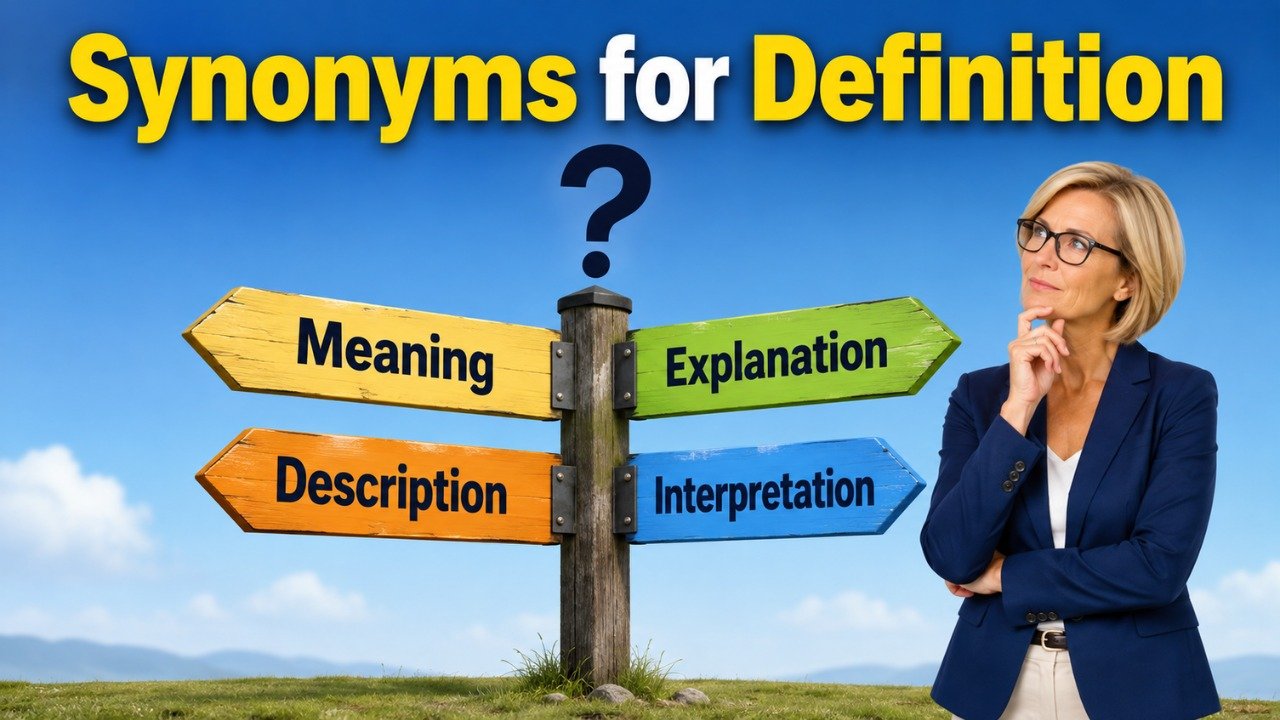
Quick Answer: Common synonyms for definition include meaning, explanation, description, interpretation, sense, clarification, specification, description, account, and wording. Use meaning when explaining what a word or idea signifies, explanation when giving fuller details, description when identifying features, interpretation when meaning depends on viewpoint, clarification when removing confusion, and specification when exact requirements or limits are important. The best synonym depends on whether definition refers to meaning, explanation, precision, description, or a formal statement.
Pronunciation and Word Details
Word: Definition
Pronunciation: /ˌdefɪˈnɪʃən/
Part of Speech: Noun
Meaning: A statement that explains the exact meaning, nature, scope, or characteristics of a word, idea, object, or concept.
US Pronunciation:
UK Pronunciation:
What Does “Definition” Mean?
Definition means a statement that explains what a word, concept, object, or idea means.
As a noun, definition is commonly used in vocabulary, academic writing, technical communication, law, science, education, and everyday explanation.
Example: The teacher asked the students to write a definition of the term.
Definition can also refer to the act of making something clearer or more precise.
Example: The project requires a clearer definition of its goals.
In another context, definition may describe sharpness, detail, or clarity.
Example: The photograph has excellent definition.
The word therefore has several connected uses involving meaning, explanation, boundaries, precision, and clarity.
Meaning Use: A definition explains what a word signifies.
Concept Use: A definition identifies the essential features of an idea.
Technical Use: A definition can establish exact limits, categories, or conditions.
Clarity Use: Definition can refer to how clearly something is seen or understood.
The most accurate synonym depends on which of these meanings is intended.
Meaning, Tone, and Context of “Definition”
Definition is generally a neutral, formal, and precise word.
It appears frequently in dictionaries, classrooms, academic papers, reports, technical documents, legal writing, scientific discussions, and explanatory content.
Academic Context: Definition introduces the meaning of a concept before deeper discussion.
Example: The essay begins with a clear definition of social responsibility.
Vocabulary Context: Definition explains the meaning of a word or phrase.
Example: The student checked the definition before using the word.
Technical Context: Definition can establish exact boundaries, requirements, or characteristics.
Example: The technical definition includes several specific conditions.
Legal Context: Precise definitions help determine how terms should be understood.
Example: The agreement provides a detailed definition of confidential information.
Conversational Context: In everyday speech, simpler words such as meaning or explanation may sound more natural.
Clarity Context: Definition can describe visual or conceptual sharpness.
Example: The image lacks clear definition around the edges.
Because definition is precise and somewhat formal, replacing it with a more specific synonym can make writing clearer and more natural.
When and How to Use “Definition”
For Word Meaning: Use definition when explaining what a particular word or phrase means.
Example: The definition of the term appears at the top of the page.
For Concepts: Use definition when identifying the central meaning of an idea.
Example: Scholars continue to debate the definition of creativity.
For Formal Rules: Definition works well when exact conditions or boundaries must be established.
Example: The policy includes a formal definition of acceptable conduct.
For Clarification: Use definition when an unclear concept needs greater precision.
Example: The project needs a clearer definition of its objectives.
For Technical Writing: Definition can establish exact meanings that prevent ambiguity.
Example: Each technical term is followed by a precise definition.
For Visual Clarity: Definition may describe sharpness or detail.
Example: The image has strong definition and clear contrast.
Best Synonyms for Definition
Meaning: What a word, expression, or concept signifies.
Example: The meaning of the phrase changes according to context.
Explanation: A statement that makes something easier to understand.
Example: The teacher gave a clear explanation of the concept.
Description: An account of the qualities or characteristics of something.
Example: The report contains a detailed description of the system.
Interpretation: A particular understanding of meaning.
Example: Her interpretation of the passage differed from his.
Sense: A particular meaning of a word or expression.
Example: The word has a different sense in this sentence.
Clarification: Information that removes confusion or uncertainty.
Example: The manager requested clarification of the new rule.
Specification: A precise statement of requirements or characteristics.
Example: The design specification includes exact measurements.
Account: A description or explanation of something.
Example: The witness gave a detailed account of the event.
Wording: The exact language used to express a meaning.
Example: The wording of the definition needs improvement.
Characterization: A description of the essential qualities of something.
Example: The study offers a useful characterization of the problem.
50 Synonyms for Definition with Short Meanings
- Meaning: What a word or concept signifies.
- Explanation: A statement that makes something understandable.
- Description: An account of qualities or features.
- Interpretation: A particular understanding of meaning.
- Sense: A specific meaning of a word or phrase.
- Clarification: Information that removes confusion.
- Specification: A precise statement of requirements or qualities.
- Account: An explanation or description of something.
- Wording: The exact language used to express an idea.
- Characterization: A description of essential qualities.
- Description Statement: A statement explaining features or qualities.
- Explanation Statement: A statement that makes meaning clearer.
- Interpretive Statement: A statement expressing an understood meaning.
- Meaning Statement: A direct expression of what something signifies.
- Delineation: A precise description of limits or features.
- Designation: A name or description assigned to something.
- Identification: The act of recognizing and naming something.
- Classification: The act of placing something into a category.
- Description of Meaning: An explanation of what something signifies.
- Interpretive Explanation: An explanation based on understanding or viewpoint.
- Clarifying Statement: A statement that removes uncertainty.
- Specification Statement: A precise account of requirements or details.
- Description of Terms: An explanation of important words or conditions.
- Explication: A detailed explanation of meaning.
- Elucidation: A clear explanation of something difficult.
- Exposition: A detailed explanation or presentation of an idea.
- Rendering: A particular way of expressing or interpreting meaning.
- Paraphrase: A restatement using different wording.
- Gloss: A brief explanation of a word or phrase.
- Annotation: An explanatory note added to a text.
- Notation: A system or statement used to represent information.
- Statement: A clear expression of information or meaning.
- Formulation: A carefully constructed expression of an idea.
- Description of Scope: A statement of limits or boundaries.
- Boundary: A limit that helps determine meaning or extent.
- Criterion: A standard used to identify or define something.
- Standard: An established measure or requirement.
- Qualification: A condition that limits or modifies meaning.
- Conceptualization: A way of forming or understanding a concept.
- Representation: A way of expressing or presenting something.
- Explanation of Terms: A statement clarifying specific vocabulary.
- Lexical Meaning: The meaning associated with a word.
- Concept Description: An account explaining an idea or concept.
- Term Description: An explanation of a particular term.
- Semantic Meaning: Meaning connected with language or symbols.
- Definition Statement: A direct statement explaining meaning.
- Description of Nature: An explanation of essential qualities.
- Outline: A brief statement of main features.
- Summary: A short statement of essential information.
- Characterization Statement: A concise description of defining qualities.
Read Also:
Synonyms for Anyways

Synonyms for Definition by Context
When Definition Means Meaning
When definition refers to what a word, phrase, or idea signifies, useful alternatives include meaning, sense, interpretation, lexical meaning, and semantic meaning.
Meaning: The broadest and most natural substitute.
Example: The meaning of the word changes in different contexts.
Sense: Useful when one word has several possible meanings.
Example: The word is used in a different sense here.
Interpretation: Appropriate when understanding may vary between readers or situations.
Example: His interpretation of the phrase was more literal.
When Definition Means Explanation
When definition refers to explaining something clearly, good alternatives include explanation, clarification, explication, elucidation, and exposition.
Explanation: Best for general use.
Example: The teacher gave a simple explanation of the term.
Clarification: Best when confusion needs to be removed.
Example: The instructions require further clarification.
Explication: More formal and suitable for detailed interpretation.
Example: The chapter provides an explication of the theory.
Elucidation: Formal and useful when making a difficult concept clearer.
Example: Her elucidation of the concept helped the students understand it.
When Definition Means Description
When definition explains the characteristics or nature of something, useful alternatives include description, account, characterization, delineation, and outline.
Description: Best for general features and qualities.
Example: The report provides a detailed description of the process.
Characterization: Useful when identifying essential qualities.
Example: His characterization of the issue was accurate.
Delineation: More formal and emphasizes clear boundaries or details.
Example: The document contains a precise delineation of responsibilities.
When Definition Means Specification
When definition establishes exact requirements, conditions, or limits, useful alternatives include specification, criterion, standard, qualification, and boundary.
Specification: Best for technical requirements.
Example: The equipment must meet the stated specification.
Criterion: Best when something must satisfy a condition to fit a category.
Example: Accuracy is an important criterion for selection.
Boundary: Useful when defining limits or scope.
Example: The policy establishes a clear boundary between acceptable and unacceptable behavior.
When Definition Means Clarity
When definition refers to sharpness or clear detail, alternatives include clarity, sharpness, detail, distinction, and resolution.
Clarity: Best for general visual or conceptual clearness.
Example: The image has remarkable clarity.
Sharpness: Useful for visible edges and detail.
Example: The photograph has excellent sharpness.
Detail: Appropriate when fine features are clearly visible.
Example: The image captures every detail.
Another Word for Definition
The best general replacement for definition is usually meaning when referring to a word or concept.
However, the best choice depends on context. Use explanation for fuller detail, description for qualities and features, interpretation for a particular understanding, and specification when precision and requirements matter.
Original: What is the definition of this word?
Better Option: What is the meaning of this word?
Original: The report gives a clear definition of the problem.
Better Option: The report gives a clear explanation of the problem.
Original: The policy includes a strict definition of acceptable behavior.
Better Option: The policy includes a precise specification of acceptable behavior.
Original: Their definition of success differs greatly.
Better Option: Their interpretation of success differs greatly.
When Not to Use “Definition”
Definition can sound too formal, vague, or repetitive when another word communicates the idea more naturally.
When You Simply Mean Meaning
In everyday conversation, meaning is usually simpler.
Weak: I do not understand the definition of that sentence.
Better: I do not understand the meaning of that sentence.
When You Need a Detailed Explanation
Definition may be too brief when the reader needs reasoning or background.
Weak: The chapter gives a definition of how the system works.
Better: The chapter gives an explanation of how the system works.
When You Mean Physical Characteristics
Description may be more accurate than definition.
Weak: The report gives a definition of the building’s appearance.
Better: The report gives a description of the building’s appearance.
When You Mean Exact Requirements
Specification is often clearer in technical writing.
Weak: The engineer reviewed the product definition.
Better: The engineer reviewed the product specification.
When Definition Becomes Repetitive
Repeated use can make academic writing sound mechanical.
Weak: The definition explains the term, and another definition provides a broader definition.
Better: The explanation introduces the term, while another interpretation provides a broader meaning.
Words Commonly Confused With Definition
Definition vs Meaning: Meaning is what something signifies, while definition is a statement that explains that meaning.
Definition vs Explanation: A definition usually gives essential meaning, while an explanation can provide causes, examples, background, and greater detail.
Definition vs Description: A definition identifies what something is, while a description explains what it looks like, contains, or is like.
Definition vs Interpretation: Definition aims for a clear meaning, while interpretation can reflect a particular viewpoint or understanding.
Definition vs Clarification: Clarification removes confusion, while definition explains meaning or establishes boundaries.
Definition vs Specification: A specification gives exact technical requirements, while a definition explains what something means.
Definition vs Characterization: Characterization describes important qualities, while definition identifies essential meaning.
Definition vs Sense: Sense refers to one possible meaning of a word or phrase, while definition is the statement used to explain that meaning.
Which Synonym Should You Choose?
Choose meaning when explaining what a word, phrase, or concept signifies.
Choose explanation when readers need more detail, reasoning, or background.
Choose description when discussing characteristics, appearance, or features.
Choose interpretation when meaning depends on viewpoint, context, or analysis.
Choose clarification when the goal is to remove uncertainty.
Choose specification in technical writing when exact requirements or standards matter.
Choose sense when a word has several possible meanings.
Choose characterization when explaining the essential qualities of a person, concept, or situation.
Choose delineation in formal writing when emphasizing precise boundaries or distinctions.
Choose explication in academic writing when explaining a complex idea or text in detail.
For essays, meaning, interpretation, explanation, characterization, and explication are useful choices.
For technical reports, specification, criterion, delineation, and clarification may be more precise.
For everyday conversation, meaning, explanation, and description usually sound the most natural.
Real Life Examples of “Definition” in Sentences
Original: I searched for the definition of the word.
Better Option: I searched for the meaning of the word.
Original: The teacher provided a definition of the concept.
Better Option: The teacher provided an explanation of the concept.
Original: Their definition of fairness is different.
Better Option: Their interpretation of fairness is different.
Original: The report includes a definition of the system.
Better Option: The report includes a description of the system.
Original: The policy needs a clearer definition of responsibility.
Better Option: The policy needs a clearer specification of responsibility.
Original: His definition of the problem was too broad.
Better Option: His characterization of the problem was too broad.
Original: The technical definition lists several conditions.
Better Option: The technical specification lists several conditions.
Original: The definition helped remove confusion.
Better Option: The clarification helped remove confusion.
Original: This definition focuses on the essential features.
Better Option: This description focuses on the essential features.
Original: The definition of the phrase depends on context.
Better Option: The meaning of the phrase depends on context.
Synonym Groups and Usage Differences
Meaning Group
Meaning, sense, lexical meaning, and semantic meaning explain what words, phrases, or symbols signify.
Example: The meaning of the term becomes clearer in context.
Explanation Group
Explanation, clarification, explication, elucidation, and exposition help readers understand ideas more fully.
Example: The explanation includes several useful examples.
Description Group
Description, account, characterization, outline, and delineation focus on features, qualities, or boundaries.
Example: The report provides a detailed description of the problem.
Interpretation Group
Interpretation, rendering, conceptualization, and representation focus on how an idea is understood or expressed.
Example: Her interpretation emphasizes the emotional meaning of the passage.
Technical Precision Group
Specification, criterion, standard, qualification, and boundary help define requirements, limits, or conditions.
Example: The specification states the exact dimensions.
Language Group
Gloss, paraphrase, wording, annotation, and term description are useful when explaining or restating language.
Example: A brief gloss appears beside the unfamiliar term.
Antonyms of Definition
The opposite of definition depends on whether definition means clarity, explanation, precision, or exact meaning.
Ambiguity: Lack of one clear meaning.
Vagueness: Lack of precision or detail.
Uncertainty: Lack of definite understanding.
Confusion: Failure to understand something clearly.
Obscurity: Lack of clarity or easy understanding.
Indefiniteness: Absence of exact limits or meaning.
Imprecision: Lack of exactness.
Unclarity: Lack of clear expression or understanding.
Generalization: A broad statement lacking specific definition.
Misinterpretation: An incorrect understanding of meaning.
Distortion: A misleading or inaccurate representation.
Undefinedness: The state of lacking a clear definition.
Comparison: Definition vs Related Words
Definition vs Meaning
Meaning is the idea or sense that a word or concept communicates. A definition is a statement explaining that meaning.
Example With Definition: The definition appears beneath the vocabulary word.
Example With Meaning: The meaning becomes clearer when the word is used in a sentence.
Definition vs Explanation
A definition tells what something is. An explanation often tells how or why it works.
Example With Definition: The teacher gave a definition of gravity.
Example With Explanation: The teacher gave an explanation of how gravity affects falling objects.
Definition vs Description
Definition identifies essential meaning, while description presents qualities, appearance, or characteristics.
Example With Definition: The book provides a definition of architecture.
Example With Description: The book provides a description of the building.
Definition vs Interpretation
Definition generally aims for a clear and stable meaning, while interpretation may vary between people.
Example With Definition: The glossary gives a definition of the term.
Example With Interpretation: Her interpretation of the poem emphasizes loss.
Definition vs Clarification
A definition introduces or establishes meaning. Clarification makes something already stated easier to understand.
Example With Definition: The policy gives a definition of misconduct.
Example With Clarification: The manager provided clarification about how the rule applies.
Definition vs Specification
Definition explains meaning, while specification states exact requirements or characteristics.
Example With Definition: The document defines the term equipment.
Example With Specification: The specification lists the required size and material.
Definition vs Characterization
Definition identifies what something fundamentally is, while characterization emphasizes its notable qualities.
Example With Definition: The article gives a definition of leadership.
Example With Characterization: The article offers a positive characterization of effective leaders.
Common Phrases and Expressions With Definition
Clear Definition: A meaning stated in an understandable and precise way.
Example: The report begins with a clear definition of the concept.
Working Definition: A practical definition used for a particular discussion or purpose.
Example: The researchers agreed on a working definition before collecting data.
Broad Definition: A meaning that includes many cases or possibilities.
Example: Under a broad definition, several activities qualify as exercise.
Narrow Definition: A meaning limited to a smaller set of cases.
Example: A narrow definition excludes informal forms of learning.
Formal Definition: A precise definition used in academic, legal, or technical contexts.
Example: The document provides a formal definition of the term.
Simple Definition: An easy explanation of meaning.
Example: The teacher gave a simple definition for younger students.
Exact Definition: A highly precise statement of meaning.
Example: Experts disagree about the exact definition of the concept.
Standard Definition: A commonly accepted explanation of meaning.
Example: The article uses the standard definition of the term.
Legal Definition: A meaning established for legal purposes.
Example: The legal definition determines how the rule applies.
Technical Definition: A specialized meaning used in a particular field.
Example: The technical definition differs from everyday usage.
Common Mistakes to Avoid
Using Definition When You Mean Explanation: A definition usually explains what something is, while an explanation may include how, why, or background information.
Weak: The article gives a definition of why the machine failed.
Better: The article gives an explanation of why the machine failed.
Confusing Definition With Description: A definition establishes meaning, while a description focuses on characteristics.
Weak: Her definition of the mountain mentioned its height, shape, color, and landscape.
Better: Her description of the mountain mentioned its height, shape, color, and landscape.
Using Interpretation as an Exact Replacement: Interpretation may be subjective, while a definition is often intended to be precise.
Weak: The technical interpretation lists the official meaning of the term.
Better: The technical definition lists the official meaning of the term.
Using Specification in General Vocabulary Contexts: Specification sounds technical and is not a natural replacement for ordinary word meanings.
Weak: I checked the specification of the word cheerful.
Better: I checked the definition of the word cheerful.
Repeating Definition Too Often: Repetition can weaken academic or explanatory writing.
Weak: The definition gives one meaning, while another definition gives a broader definition.
Better: The first explanation gives one meaning, while another interpretation offers a broader sense.
Using Vague Definitions: A useful definition should identify the essential meaning rather than simply repeat the original word.
Weak: Happiness is the state of being happy.
Better: Happiness is a positive emotional state involving pleasure, satisfaction, or contentment.
Ignoring Context: The right synonym depends on what definition means in the sentence. Use meaning for vocabulary, explanation for detail, description for characteristics, interpretation for viewpoint, and specification for exact requirements.
Conclusion
The best synonyms for definition depend on whether you are explaining meaning, describing characteristics, clarifying an idea, or establishing precise requirements. Meaning is the strongest general alternative for vocabulary, while explanation provides more detail and description focuses on qualities. Interpretation suits contextual understanding, clarification removes uncertainty, and specification works well for technical precision. Choosing the right synonym makes your writing clearer, more accurate, and better matched to the reader’s needs.
FAQs About Synonyms for Definition
What Is the Best Synonym for Definition?
Meaning is often the best general synonym for definition when referring to what a word or concept signifies. Explanation, description, and interpretation may be better in other contexts.
What Is Another Word for Definition?
Common alternatives include meaning, explanation, description, interpretation, sense, clarification, specification, account, and characterization.
What Is a Formal Synonym for Definition?
Explication, delineation, specification, characterization, and elucidation are useful formal alternatives depending on context.
Are Definition and Meaning the Same?
Not exactly. Meaning is what a word or concept signifies, while a definition is a statement used to explain that meaning.
What Is the Difference Between Definition and Explanation?
A definition usually states what something is. An explanation may also describe how it works, why it happens, or how it relates to other ideas.
What Is a Synonym for Clear Definition?
Useful alternatives include precise explanation, clear meaning, exact description, detailed specification, and clear characterization.
What Is the Opposite of Definition?
Depending on context, common opposites include ambiguity, vagueness, uncertainty, confusion, obscurity, and imprecision.
