
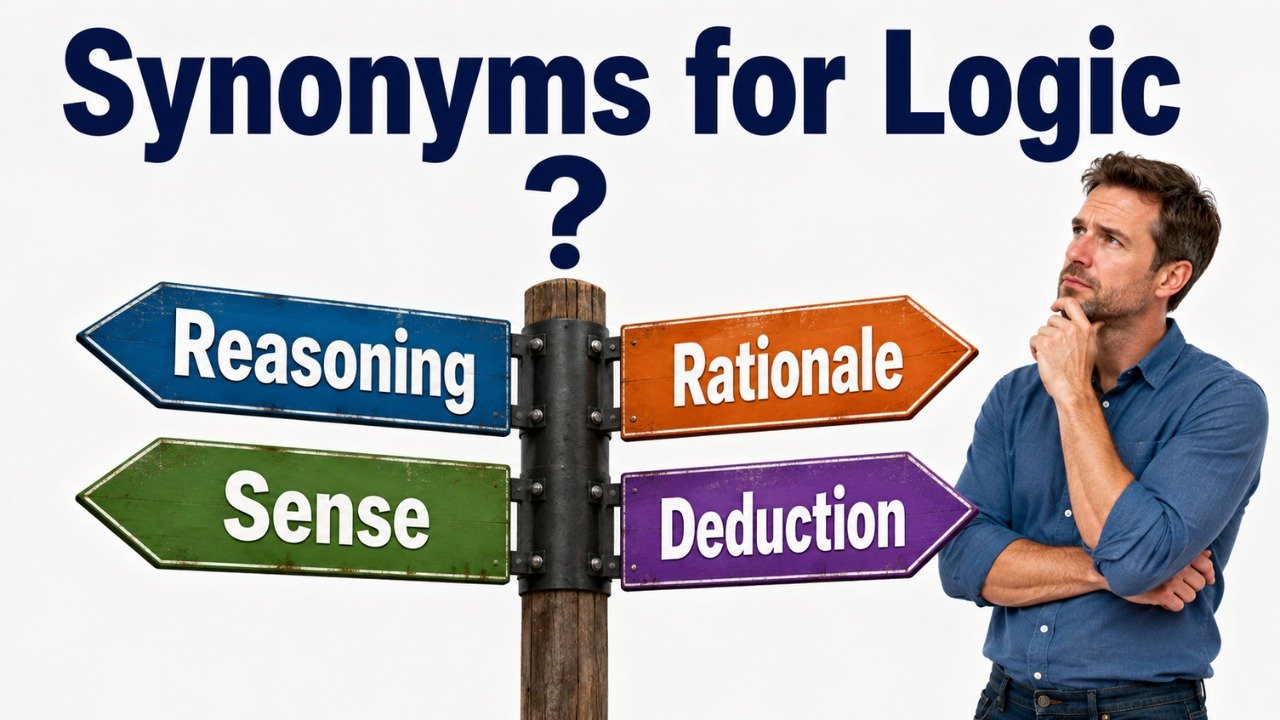
Quick Answer: The best synonyms for logic include reasoning, rationale, reason, sense, rationality, coherence, analysis, deduction, inference, and judgment. Among these synonyms for logic, reasoning is the best general replacement when describing how someone reaches a conclusion. Rationale works well for explaining why a decision was made, coherence fits ideas that connect clearly, deduction and inference suit formal reasoning, analysis is useful in academic and professional contexts, and sense works naturally in everyday conversation.
Pronunciation and Word Details
Word: Logic.
Pronunciation: /ˈlɑːdʒɪk/
Part of Speech: Noun.
Meaning: A system or process of clear reasoning used to understand ideas, evaluate arguments, and reach sensible conclusions.
US Pronunciation:
UK Pronunciation:
What Does “Logic” Mean?
Logic means the process or system of reasoning used to connect ideas and reach sensible conclusions.
As a noun, logic can describe the way a person thinks, the reasoning behind a decision, the structure of an argument, or the principles used to determine whether a conclusion follows from given information.
In academic contexts, logic is closely connected with philosophy, mathematics, argumentation, deduction, and critical thinking.
In everyday speech, logic often means practical sense or reasonable thinking.
Example: I understand the logic behind her decision.
Here, logic means the reasoning or rationale that explains why the decision makes sense.
The word can also describe internal consistency.
Example: The argument lacks logic.
In this sentence, logic refers to clear connections between ideas and conclusions.
Meaning, Tone, and Context of “Logic”
Logic is generally neutral, formal, analytical, and intellectual.
It is common in academic writing, philosophy, mathematics, science, technology, business, problem solving, debate, and everyday reasoning.
In formal contexts, logic often refers to structured reasoning or the validity of an argument.
In casual conversation, logic may simply mean common sense or sensible thinking.
Academic Tone: Logic refers to structured reasoning and valid argument.
Formal Tone: Logic can describe the rationale behind a decision, policy, or conclusion.
Technical Tone: Logic may refer to rule based processes, conditions, calculations, or systems.
Conversational Tone: Logic can mean sense, reason, or practical thinking.
Analytical Tone: Logic helps explain how facts and ideas connect.
When and How to Use “Logic”
For Reasoning
Use logic when describing the process of thinking clearly and reaching a conclusion.
Example: Her logic was easy to follow.
For Explaining Decisions
Use logic when discussing the reason behind a choice, action, or policy.
Example: I understand the logic behind the new procedure.
For Arguments
Use logic when evaluating whether an argument is consistent and reasonable.
Example: The argument is based on clear logic.
For Problem Solving
Use logic when a solution requires careful reasoning.
Example: Solving the puzzle requires logic and patience.
For Academic Writing
Use logic when discussing deduction, inference, validity, or reasoning.
Example: The essay examines the logic of the argument.
For Everyday Sense
Use logic when something appears sensible or reasonable.
Example: There is some logic in his suggestion.
Best Synonyms for Logic
Reasoning: The process of thinking carefully to reach a conclusion.
Example: Her reasoning was clear and convincing.
Rationale: The explanation or reason behind a decision or action.
Example: The manager explained the rationale for the change.
Reason: A sensible basis for a belief, decision, or action.
Example: There is good reason to reconsider the plan.
Sense: Practical or understandable reasoning.
Example: His explanation makes sense.
Rationality: The quality of being based on reason rather than emotion.
Example: The decision showed rationality and careful thought.
Coherence: Clear and logical connection between ideas.
Example: The argument has strong coherence.
Analysis: Careful examination used to understand or evaluate something.
Example: Her analysis revealed several weaknesses in the proposal.
Deduction: A conclusion reached by applying general principles to specific facts.
Example: His deduction followed directly from the evidence.
Inference: A conclusion reached from available evidence or information.
Example: The inference was reasonable based on the data.
Judgment: The ability to make sensible decisions after careful thought.
Example: Good judgment helped her choose the best option.
50 Synonyms for Logic with Short Meanings
- Reasoning: The process of reaching conclusions through thought.
- Rationale: The reason or explanation behind something.
- Reason: A sensible basis for an idea or action.
- Sense: Practical or understandable thinking.
- Rationality: The quality of being reasonable and logical.
- Coherence: Clear connection between ideas.
- Consistency: Agreement between ideas without contradiction.
- Analysis: Careful examination of information or ideas.
- Deduction: Reasoning from general principles to a conclusion.
- Inference: A conclusion drawn from evidence.
- Argumentation: The process of presenting connected reasons.
- Thinking: The mental process of considering ideas.
- Thought: Mental consideration or reasoning.
- Judgment: Ability to make sensible decisions.
- Discernment: Ability to understand and judge clearly.
- Understanding: Ability to recognize meaning or relationships.
- Intellect: Capacity for reasoning and thought.
- Intelligence: Ability to understand, learn, and reason.
- Soundness: Quality of being reasonable and well supported.
- Validity: Quality of being logically acceptable.
- Justification: A reason that supports an action or belief.
- Grounds: Reasons supporting a conclusion or decision.
- Basis: The underlying reason or foundation.
- Principle: A rule or idea guiding reasoning.
- Method: An organized way of thinking or acting.
- System: An organized set of connected principles.
- Structure: The organized arrangement of ideas.
- Order: Clear arrangement or organization.
- Pattern: A recognizable arrangement or relationship.
- Sequence: A logical order of steps or ideas.
- Connection: A relationship between ideas or facts.
- Relation: A link between concepts or events.
- Causality: The relationship between cause and effect.
- Induction: Reasoning from examples toward a general conclusion.
- Syllogism: A formal form of deductive reasoning.
- Proposition: A statement considered in logical reasoning.
- Argument: A set of reasons supporting a conclusion.
- Evidence: Information supporting a claim or conclusion.
- Explanation: Information showing why something happens or makes sense.
- Calculation: Careful reasoning used to reach a result.
- Deliberation: Careful consideration before making a decision.
- Reflection: Serious and thoughtful consideration.
- Assessment: Careful evaluation of information or circumstances.
- Evaluation: Judgment based on evidence and reasoning.
- Interpretation: Explanation of the meaning of information.
- Critical Thinking: Careful examination of claims and evidence.
- Logical Thinking: Reasoning in a clear and connected way.
- Common Sense: Practical and sensible judgment.
- Train of Thought: Connected sequence of ideas in the mind.
- Reasoning Process: The steps used to reach a conclusion.
Read Also:
Synonyms for Knew

Synonyms for Logic by Context
When Logic Means Reasoning
Useful synonyms include reasoning, thought, thinking, rationality, logical thinking, and critical thinking.
Example: His logic led him to the correct conclusion.
Alternative: His reasoning led him to the correct conclusion.
When Logic Means Rationale
Useful synonyms include rationale, reason, justification, grounds, basis, and explanation.
Example: What is the logic behind this decision?
Alternative: What is the rationale behind this decision?
When Logic Means Internal Consistency
Useful synonyms include coherence, consistency, soundness, validity, order, and structure.
Example: The proposal lacks logic.
Alternative: The proposal lacks coherence.
When Logic Means Formal Reasoning
Useful synonyms include deduction, inference, induction, syllogism, argumentation, and reasoning.
Example: The conclusion follows the logic of the argument.
Alternative: The conclusion follows the reasoning of the argument.
When Logic Means Practical Sense
Useful synonyms include sense, common sense, judgment, discernment, and rationality.
Example: There is logic in her suggestion.
Alternative: There is good sense in her suggestion.
When Logic Means Analytical Thinking
Useful synonyms include analysis, evaluation, assessment, reflection, interpretation, and critical thinking.
Example: The problem requires careful logic.
Alternative: The problem requires careful analysis.
Another Word for Logic
Another word for logic is reasoning when referring generally to the process of thinking clearly and reaching conclusions.
However, the best alternative depends on context. Use rationale when explaining why a decision was made, coherence when discussing how ideas connect, and sense when describing practical reasoning.
Original: I understand the logic behind the decision.
Better Option: I understand the rationale behind the decision.
Original: Her logic was difficult to follow.
Better Option: Her reasoning was difficult to follow.
Original: The argument has strong logic.
Better Option: The argument has strong coherence.
Original: There is no logic in that suggestion.
Better Option: There is little sense in that suggestion.
When Not to Use “Logic”
Logic can sometimes sound too broad when a more precise term would improve clarity.
In academic writing, reasoning, deduction, inference, validity, or coherence may describe the exact concept more accurately.
Weak: The logic proves the conclusion.
Better: The reasoning supports the conclusion.
When explaining a business or policy decision, rationale is often more precise.
Weak: The report explains the logic for the change.
Better: The report explains the rationale for the change.
When discussing writing quality, coherence may be clearer than logic.
Weak: The paragraph has weak logic.
Better: The paragraph lacks coherence.
Avoid using logic when you actually mean evidence.
Weak: The logic shows that the claim is true.
Better: The evidence supports the claim.
Logic should also not be treated as a synonym for intelligence in every context. A person can be intelligent while still using flawed reasoning in a particular argument.
Words Commonly Confused With Logic
Logic vs Reasoning: Logic refers to principles or patterns of valid thought, while reasoning describes the actual process of thinking toward a conclusion.
Logic vs Rationale: Logic can describe a complete reasoning system, while rationale specifically explains why a decision or action was chosen.
Logic vs Reason: Logic concerns structured thinking, while reason can mean a single explanation, cause, or justification.
Logic vs Evidence: Logic connects ideas and conclusions, while evidence provides facts or information supporting a claim.
Logic vs Analysis: Logic focuses on relationships between ideas and conclusions, while analysis involves examining information in detail.
Logic vs Coherence: Logic concerns sound reasoning, while coherence describes how clearly ideas connect and fit together.
Logic vs Common Sense: Logic can be formal and systematic, while common sense usually means practical everyday judgment.
Which Synonym Should You Choose?
Choose reasoning when describing how a conclusion was reached.
Choose rationale when explaining the reason behind a decision, rule, policy, or action.
Choose reason when you need a simple and natural everyday alternative.
Choose sense in casual conversation when something seems understandable or practical.
Choose rationality when contrasting reason with emotion or irrational behavior.
Choose coherence when evaluating the connection between ideas in essays, reports, arguments, or presentations.
Choose analysis when examining facts, data, problems, or evidence.
Choose deduction when a conclusion follows from general principles.
Choose inference when drawing a conclusion from available information.
Choose validity when evaluating whether an argument is logically acceptable.
Choose critical thinking for academic, educational, analytical, and problem solving contexts.
Choose judgment when emphasizing sensible decision making.
Real Life Examples of “Logic” in Sentences
Original: I understand the logic behind her decision.
Better Option: I understand the rationale behind her decision.
Original: His logic was easy to follow.
Better Option: His reasoning was easy to follow.
Original: The argument lacks logic.
Better Option: The argument lacks coherence.
Original: There is some logic in the proposal.
Better Option: There is some sense in the proposal.
Original: The conclusion follows the logic presented earlier.
Better Option: The conclusion follows the reasoning presented earlier.
Original: She used logic to solve the problem.
Better Option: She used analytical thinking to solve the problem.
Original: The logic of the report is convincing.
Better Option: The rationale of the report is convincing.
Original: His logic was based on several assumptions.
Better Option: His reasoning was based on several assumptions.
Original: Good logic is essential in an argument.
Better Option: Sound reasoning is essential in an argument.
Original: The plan follows a clear logic.
Better Option: The plan follows a clear structure.
Synonym Groups and Usage Differences
Reasoning Group
Reasoning, logical thinking, critical thinking, thought, and rationality describe the mental process of reaching conclusions.
Example: Careful reasoning helped her identify the strongest solution.
Explanation Group
Rationale, reason, justification, grounds, basis, and explanation describe why something is believed, chosen, or done.
Example: The committee provided a clear rationale for its decision.
Consistency Group
Coherence, consistency, soundness, validity, structure, and order describe how well ideas fit together.
Example: The essay has strong coherence from beginning to end.
Formal Logic Group
Deduction, induction, inference, syllogism, proposition, and argumentation are useful in philosophical, academic, and analytical contexts.
Example: The conclusion was reached through deduction.
Judgment Group
Judgment, discernment, understanding, common sense, and intellect relate to sensible thinking and decision making.
Example: Good judgment prevented an unnecessary mistake.
Analysis Group
Analysis, assessment, evaluation, interpretation, reflection, and deliberation emphasize careful examination.
Example: Detailed analysis revealed the source of the problem.
Antonyms of Logic
The opposite of logic depends on whether the word refers to reasoning, consistency, or sensible judgment.
Irrationality: Thinking that is not based on reason.
Illogic: Lack of logical reasoning.
Nonsense: Words or ideas that lack reasonable meaning.
Confusion: Lack of clear understanding or organization.
Inconsistency: Lack of agreement between ideas.
Contradiction: A conflict between statements or ideas.
Unreason: Lack of rational thought.
Absurdity: Something extremely unreasonable or illogical.
Disorder: Lack of clear organization.
Incoherence: Lack of clear connection between ideas.
Guesswork: Conclusions made without sufficient reasoning or evidence.
Impulsiveness: Acting quickly without careful thought.
Comparison: Logic vs Related Words
Logic vs Reasoning
Logic refers to principles of sound thought, while reasoning is the actual process used to reach a conclusion.
Example With Logic: The argument follows clear logic.
Example With Reasoning: Her reasoning explains how she reached the conclusion.
Logic vs Rationale
Logic can describe an entire structure of reasoning. Rationale refers to the specific reason behind a choice or decision.
Example With Logic: I understand the logic of the system.
Example With Rationale: I understand the rationale for changing the system.
Logic vs Reason
Logic describes structured thought, while reason can mean one particular cause or explanation.
Example With Logic: His logic was consistent.
Example With Reason: His reason for leaving was understandable.
Logic vs Analysis
Logic focuses on whether ideas connect properly. Analysis focuses on examining something carefully.
Example With Logic: The argument contains a flaw in logic.
Example With Analysis: The analysis identifies the weaknesses in the argument.
Logic vs Evidence
Logic explains how conclusions follow from information. Evidence is the information used to support those conclusions.
Example With Logic: The logic connects the facts to the conclusion.
Example With Evidence: The evidence supports the conclusion.
Logic vs Coherence
Logic concerns sound reasoning, while coherence concerns the smooth and understandable connection of ideas.
Example With Logic: The conclusion follows the logic of the argument.
Example With Coherence: The essay has strong coherence between paragraphs.
Logic vs Common Sense
Logic can involve formal reasoning, while common sense focuses on practical judgment in ordinary situations.
Example With Logic: Formal logic is useful when testing an argument.
Example With Common Sense: Common sense suggested that we should check the weather first.
Common Phrases and Expressions With “Logic”
Logical Reasoning: Clear thinking used to reach a conclusion.
Sound Logic: Reasoning that is valid and well supported.
Basic Logic: Simple principles of reasonable thinking.
Formal Logic: Structured study of valid reasoning.
Clear Logic: Reasoning that is easy to understand.
Internal Logic: Consistency within a system, story, argument, or idea.
Logic Behind Something: The reasoning or rationale explaining it.
Follow the Logic: Understand the sequence of reasoning.
Apply Logic: Use reasoning to solve a problem.
Lack of Logic: Absence of clear or sensible reasoning.
Common Mistakes to Avoid
A common mistake is assuming every synonym for logic has exactly the same meaning.
Reasoning is broad and usually describes the thinking process, while rationale explains why a particular choice was made.
Do not use evidence as a direct replacement for logic. Evidence provides support, while logic explains how that support connects to a conclusion.
Avoid confusing coherence with validity. A piece of writing can be coherent and easy to follow while still containing weak reasoning.
Do not use deduction for every type of reasoning. Deduction has a specific meaning in formal thought.
In academic writing, avoid repeatedly using logic when more precise words such as reasoning, inference, coherence, validity, or analysis would provide clearer meaning.
In casual writing, sense or reason may sound more natural than formal terms such as rationality or argumentation.
Conclusion
Synonyms for logic include reasoning, rationale, reason, sense, rationality, coherence, analysis, deduction, inference, and judgment. The best choice depends on context. Use reasoning for the thinking process, rationale for explaining decisions, coherence for connected ideas, deduction or inference for formal reasoning, analysis for careful examination, and sense for everyday judgment. Understanding these differences helps make academic, professional, technical, and conversational writing clearer, more precise, and more natural.
FAQs About Synonyms for Logic
What Is the Best Synonym for Logic?
The best general synonym for logic is reasoning because it describes the process of thinking clearly and reaching conclusions.
What Is Another Word for Logic in Academic Writing?
Reasoning, rationale, deduction, inference, analysis, validity, and coherence are useful alternatives depending on the subject.
What Is a Formal Synonym for Logic?
Rationale, reasoning, rationality, deduction, inference, and argumentation are suitable formal alternatives.
What Is Another Word for the Logic Behind a Decision?
Rationale is usually the best choice because it directly refers to the reason or explanation behind a decision.
Is Reasoning the Same as Logic?
They are closely related but not identical. Logic refers to principles of valid thought, while reasoning is the process of applying thought to reach a conclusion.
What Is Another Word for Logical Thinking?
Reasoning, rational thinking, critical thinking, analysis, and sound judgment are useful alternatives.
What Is the Opposite of Logic?
Common opposites include irrationality, illogic, nonsense, inconsistency, confusion, incoherence, and unreason.
