
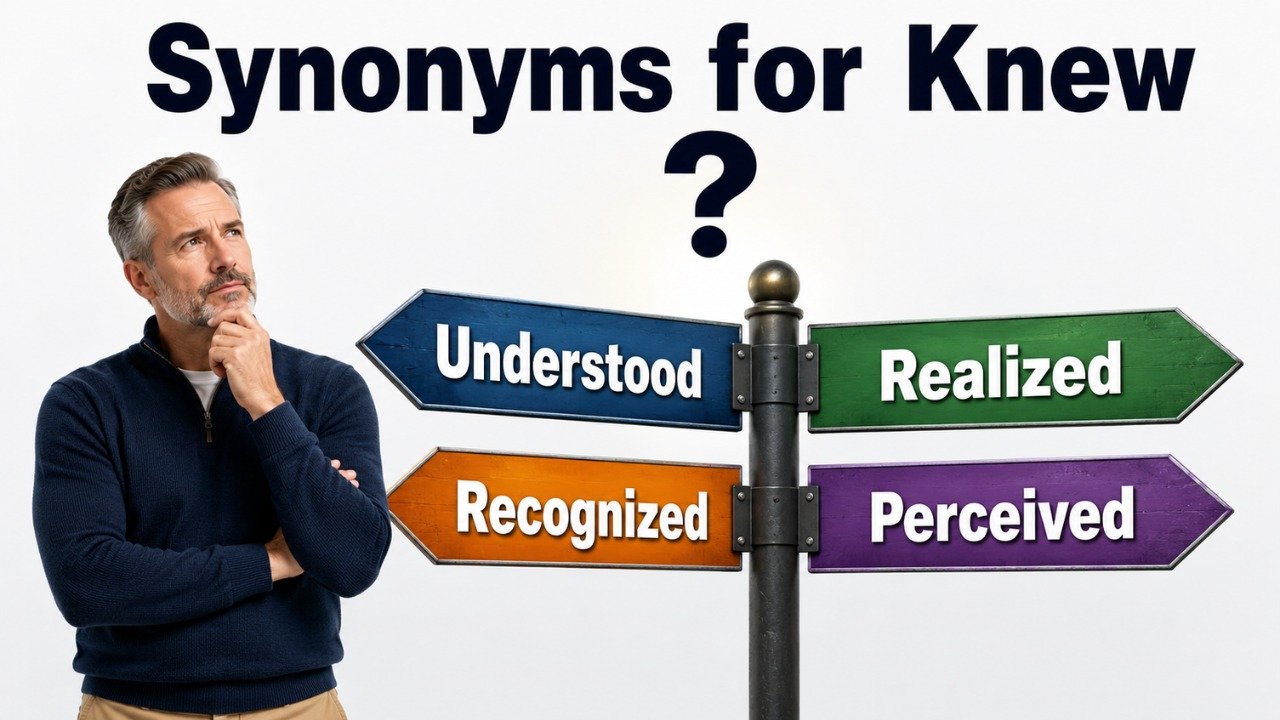
Quick Answer: The best synonyms for knew include understood, realized, recognized, remembered, perceived, comprehended, grasped, identified, was aware of, and was familiar with. The best choice depends on context. Use understood for comprehension, realized for sudden awareness, recognized for identifying someone or something, remembered for recalling information, perceived for noticing or interpreting something, and was aware of when referring to existing knowledge of a fact or situation.
Pronunciation and Word Details
Word: Knew.
Pronunciation: /nuː/
Part of Speech: Verb, past tense of know.
Meaning: Had knowledge, understanding, awareness, recognition, or familiarity in the past.
US Pronunciation:
UK Pronunciation:
What Does “Knew” Mean?
Knew is the past tense of know. It means that someone had information, understanding, awareness, familiarity, or recognition at an earlier time.
The word can describe knowing a fact, understanding an idea, recognizing a person, remembering information, or being familiar with a place or situation.
Example: She knew the answer before anyone else spoke.
In this sentence, knew means had knowledge of.
Example: He knew that something was wrong.
Here, knew expresses awareness or certainty.
Example: I knew her from school.
In this context, knew means was familiar or acquainted with someone.
Because knew has several meanings, the best synonym depends on whether the sentence refers to knowledge, understanding, realization, recognition, memory, familiarity, or certainty.
Meaning, Tone, and Context of “Knew”
Knew is a common and neutral word used in both spoken and written English.
It works naturally in casual conversation, storytelling, essays, reports, descriptions, and personal writing. However, more precise alternatives can make a sentence clearer when the exact type of knowledge matters.
When discussing comprehension, understood or grasped may be stronger.
When someone suddenly becomes aware of something, realized is usually more precise.
When identifying a person, place, sound, or object, recognized works better.
When referring to previous familiarity, was familiar with or was acquainted with may be more accurate.
Knew can also express certainty.
Example: She knew the plan would work.
Here, knew suggests confidence or strong belief rather than simple factual knowledge.
When and How to Use “Knew”
For Knowledge: Use knew when someone possessed information or facts.
Example: He knew the correct answer.
For Understanding: Use knew when someone understood how something worked or what something meant.
Example: She knew how the system operated.
For Awareness: Use knew when someone was conscious of a fact or situation.
Example: They knew about the upcoming changes.
For Recognition: Use knew when someone identified a familiar person, place, or thing.
Example: I knew his voice immediately.
For Familiarity: Use knew when someone had previous experience with a person or subject.
Example: She knew the neighborhood well.
For Certainty: Use knew when someone felt strongly certain that something was true.
Example: He knew they would eventually succeed.
Best Synonyms for Knew
Understood: Had a clear idea of the meaning or nature of something.
Example: She understood the instructions immediately.
Realized: Became aware of a fact or situation.
Example: He realized that he had taken the wrong road.
Recognized: Identified someone or something from previous knowledge.
Example: She recognized his voice instantly.
Remembered: Recalled information or an experience from memory.
Example: I remembered where I had placed the keys.
Perceived: Became aware of or interpreted something through observation or thought.
Example: She perceived a change in his attitude.
Comprehended: Fully understood something, especially something complex.
Example: He comprehended the importance of the decision.
Grasped: Understood an idea or concept clearly.
Example: The students quickly grasped the main point.
Identified: Recognized or established who or what something was.
Example: The witness identified the correct building.
Was Aware Of: Had knowledge or consciousness of something.
Example: She was aware of the risks before making the decision.
Was Familiar With: Had previous knowledge or experience of something.
Example: He was familiar with the process before joining the team.
50 Synonyms for Knew with Short Meanings
- Understood: Had a clear understanding of something.
- Realized: Became aware of a fact or situation.
- Recognized: Identified something already familiar.
- Remembered: Recalled something from memory.
- Perceived: Became aware of something through observation.
- Comprehended: Fully understood something.
- Grasped: Understood an idea clearly.
- Identified: Determined who or what something was.
- Noticed: Became aware of something through attention.
- Discerned: Recognized or understood something not immediately obvious.
- Detected: Noticed the presence of something.
- Sensed: Became aware of something intuitively or physically.
- Observed: Noticed or became aware through attention.
- Learned: Gained knowledge or discovered information.
- Discovered: Found out something previously unknown.
- Found Out: Became informed about something.
- Gathered: Understood something from available information.
- Inferred: Reached an understanding from evidence.
- Deduced: Reached a conclusion through reasoning.
- Concluded: Formed a judgment after considering information.
- Appreciated: Fully understood the importance of something.
- Acknowledged: Recognized a fact as true or valid.
- Accepted: Recognized something as true or real.
- Anticipated: Expected something before it happened.
- Expected: Believed something was likely to happen.
- Suspected: Believed something was probably true.
- Believed: Accepted something as true.
- Was Certain: Felt sure that something was true.
- Was Sure: Had confidence about a fact or outcome.
- Was Aware: Had knowledge of a situation.
- Was Aware Of: Had information about something.
- Was Conscious Of: Was mentally aware of something.
- Was Mindful Of: Kept something in awareness.
- Was Informed Of: Had been given information about something.
- Was Familiar With: Had previous knowledge or experience.
- Was Acquainted With: Had familiarity with a person or subject.
- Had Knowledge Of: Possessed information about something.
- Had Learned: Had gained information earlier.
- Had Heard Of: Was aware of something by name or reputation.
- Had Experienced: Knew something through personal experience.
- Recalled: Brought something back to mind.
- Recollected: Remembered something from the past.
- Recognized Clearly: Identified something with certainty.
- Saw: Understood or realized something.
- Saw Through: Understood the true nature of something.
- Got: Informally understood something.
- Followed: Understood an explanation or line of reasoning.
- Registered: Became mentally aware of something.
- Apprehended: Understood or perceived something clearly.
- Was Cognizant Of: Had awareness or knowledge of something.
Read Also:
Synonyms for Destined

Synonyms for Knew by Context
When Knew Means Understood
When knew means understood an idea, explanation, system, or meaning, useful alternatives include understood, comprehended, grasped, followed, apprehended, and got.
Example: She knew what the teacher meant.
Alternative: She understood what the teacher meant.
Example: He knew the basic concept after one explanation.
Alternative: He grasped the basic concept after one explanation.
When Knew Means Realized
When knew refers to becoming aware of something, use realized, noticed, perceived, sensed, discovered, or registered.
Example: She knew immediately that something had changed.
Alternative: She realized immediately that something had changed.
Example: He knew there was tension in the room.
Alternative: He sensed there was tension in the room.
When Knew Means Recognized
When knew means identifying someone or something familiar, use recognized, identified, discerned, or detected.
Example: I knew the voice as soon as I heard it.
Alternative: I recognized the voice as soon as I heard it.
Example: She knew the building from the photograph.
Alternative: She identified the building from the photograph.
When Knew Means Remembered
When knew refers to stored information or memory, useful alternatives include remembered, recalled, recollected, and had learned.
Example: He knew the address from memory.
Alternative: He remembered the address from memory.
When Knew Means Was Aware
When someone had information about a situation, use was aware, was conscious of, was informed of, or had knowledge of.
Example: They knew about the delay before the announcement.
Alternative: They were aware of the delay before the announcement.
When Knew Means Was Familiar With
When knew refers to familiarity with a person, place, subject, or process, use was familiar with, was acquainted with, or had experienced.
Example: She knew the city well.
Alternative: She was familiar with the city.
Another Word for Knew
Another word for knew is understood when the sentence refers to comprehension. However, the best replacement changes according to meaning.
Use realized for new awareness, recognized for identification, remembered for memory, and was aware of for existing knowledge.
Original: She knew what the instructions meant.
Better Option: She understood what the instructions meant.
Original: He knew that he had made a mistake.
Better Option: He realized that he had made a mistake.
Original: I knew his face immediately.
Better Option: I recognized his face immediately.
Original: They knew about the change beforehand.
Better Option: They were aware of the change beforehand.
When Not to Use “Knew”
Knew is useful but can sometimes be too general. A more specific synonym often gives readers a clearer picture of what type of knowledge is involved.
Weak: She knew the problem.
Better: She understood the problem.
If the person suddenly becomes aware of something, realized is usually clearer.
Weak: He knew he had forgotten his wallet when he reached the store.
Better: He realized he had forgotten his wallet when he reached the store.
When identification is involved, recognized is more precise.
Weak: She knew the song as soon as it started.
Better: She recognized the song as soon as it started.
Avoid using knew repeatedly in the same paragraph when different meanings are involved.
Weak: He knew the rules, knew the manager, and knew something was wrong.
Better: He understood the rules, was acquainted with the manager, and sensed that something was wrong.
In formal writing, phrases such as was aware of, understood, identified, or recognized may provide greater precision.
Words Commonly Confused With Knew
Knew vs Understood: Knew can mean possessing information, while understood specifically refers to comprehension.
Knew vs Realized: Knew often describes existing knowledge. Realized usually means becoming aware of something at a particular moment.
Knew vs Recognized: Knew can refer broadly to knowledge or familiarity. Recognized means identifying something previously encountered.
Knew vs Remembered: Knew describes having information, while remembered describes bringing information back into conscious memory.
Knew vs Learned: Knew describes knowledge already possessed. Learned emphasizes the process of gaining that knowledge.
Knew vs Believed: Knew suggests certainty or accepted knowledge. Believed can involve an opinion that may or may not be correct.
Knew vs Suspected: Knew implies greater certainty. Suspected means thinking something is probably true without complete proof.
Which Synonym Should You Choose?
Choose understood when writing about comprehension, explanations, ideas, instructions, or concepts.
Choose realized when someone suddenly becomes aware of a fact.
Choose recognized when identifying a familiar person, voice, object, place, or pattern.
Choose remembered when information is recalled from memory.
Choose perceived in formal or descriptive writing when someone notices or interprets something.
Choose grasped when someone successfully understands a difficult idea.
Choose identified in reports, analysis, investigations, or precise descriptions.
Choose was aware of in professional writing when describing existing knowledge.
Choose was familiar with when referring to previous experience with a place, person, subject, or process.
Choose suspected when the person was not completely certain.
Real Life Examples of “Knew” in Sentences
Original: She knew the answer before the question was finished.
Better Option: She understood the answer before the question was finished.
Original: He knew that something was wrong.
Better Option: He sensed that something was wrong.
Original: I knew her voice immediately.
Better Option: I recognized her voice immediately.
Original: They knew about the policy change.
Better Option: They were aware of the policy change.
Original: She knew the neighborhood very well.
Better Option: She was familiar with the neighborhood.
Original: He knew he had made the wrong decision.
Better Option: He realized he had made the wrong decision.
Original: I knew the name but could not remember where I had heard it.
Better Option: I recognized the name but could not remember where I had heard it.
Original: She knew why the plan had failed.
Better Option: She understood why the plan had failed.
Original: We knew the storm was coming.
Better Option: We anticipated the storm.
Original: He knew the information from previous training.
Better Option: He had learned the information during previous training.
Synonym Groups and Usage Differences
Understanding Group
Understood, comprehended, grasped, followed, apprehended, and got all refer to understanding information or ideas.
Understood is the broadest choice. Comprehended sounds more formal, while grasped suggests successfully understanding something that may have been difficult.
Example: She quickly grasped the reasoning behind the decision.
Awareness Group
Realized, perceived, noticed, sensed, registered, and was aware all relate to becoming or being conscious of something.
Realized often describes a specific moment of awareness, while was aware describes knowledge that already existed.
Example: He realized that the deadline had changed.
Recognition Group
Recognized, identified, discerned, and detected relate to distinguishing or identifying something.
Recognized usually involves previous familiarity, while detected means noticing the presence of something.
Example: She recognized the handwriting immediately.
Memory Group
Remembered, recalled, recollected, and had learned relate to information stored in memory.
Remembered is the most common everyday choice, while recollected is more formal.
Example: He recalled the conversation from the previous week.
Certainty Group
Was certain, was sure, believed, expected, and suspected describe different levels of confidence.
Was certain and was sure suggest strong confidence. Believed is less definite, while suspected expresses uncertainty.
Example: She was certain that the information was correct.
Familiarity Group
Was familiar with, was acquainted with, had experienced, and had heard of describe different kinds of previous knowledge.
Was familiar with works for subjects, places, methods, and people. Was acquainted with is commonly used for people or subjects.
Example: He was familiar with the software before starting the project.
Antonyms of Knew
The opposite of knew depends on whether the word refers to knowledge, understanding, recognition, memory, or awareness.
Did Not Know: Lacked information about something.
Ignored: Failed to notice or consider something.
Misunderstood: Understood something incorrectly.
Forgot: Failed to remember information.
Overlooked: Failed to notice something important.
Missed: Did not notice or understand something.
Misidentified: Identified someone or something incorrectly.
Doubted: Was uncertain about whether something was true.
Questioned: Felt uncertainty about a fact or claim.
Was Unaware: Had no knowledge of something.
Was Unfamiliar With: Lacked previous knowledge or experience.
Was Ignorant Of: Lacked knowledge about something.
Comparison: Knew vs Related Words
Knew vs Understood
Knew is broader and can describe information, familiarity, recognition, or certainty. Understood specifically emphasizes comprehension.
Example With Knew: She knew the rules.
Example With Understood: She understood why the rules were necessary.
Knew vs Realized
Knew usually describes knowledge someone already had. Realized describes the moment someone becomes aware of something.
Example With Knew: He knew the deadline was Friday.
Example With Realized: He realized that Friday was the deadline.
Knew vs Recognized
Knew can indicate familiarity, while recognized describes identifying something as familiar.
Example With Knew: I knew the neighborhood well.
Example With Recognized: I recognized the street from an earlier visit.
Knew vs Remembered
Knew refers to possessing knowledge. Remembered refers to recalling knowledge from memory.
Example With Knew: She knew his phone number.
Example With Remembered: She remembered his phone number when she needed it.
Knew vs Believed
Knew generally suggests confidence that something is true. Believed may describe an opinion or assumption without complete certainty.
Example With Knew: She knew the meeting started at nine.
Example With Believed: She believed the meeting started at nine.
Knew vs Suspected
Knew suggests certainty, while suspected suggests that someone thought something was probably true.
Example With Knew: He knew who had sent the message.
Example With Suspected: He suspected who had sent the message.
Common Phrases and Expressions With Knew
Knew About: Had information concerning something.
Knew Better: Understood that a particular action was unwise or wrong.
Knew Well: Had strong familiarity with someone or something.
Knew For Certain: Had complete confidence that something was true.
Knew From Experience: Had knowledge gained through personal experience.
Knew Immediately: Recognized or understood something without delay.
Knew Instantly: Became certain or aware at once.
Knew in Advance: Had information before an event occurred.
Knew What to Do: Understood the correct action to take.
Knew the Answer: Possessed the correct information needed to respond.
Common Mistakes to Avoid
One common mistake is using knew and realized as if they always mean the same thing. Knew usually refers to existing knowledge, while realized often describes a new moment of awareness.
Incorrect: She realized the answer for several years.
Better: She knew the answer for several years.
Another mistake is using recognized when the sentence refers to understanding rather than identification.
Unnatural: He recognized the complicated theory after studying it.
Better: He understood the complicated theory after studying it.
Writers also sometimes confuse knew with new because the two words sound alike but have completely different meanings. Knew is the past tense of know, while new describes something recent or not previously existing.
Avoid unnecessary repetition.
Repetitive: She knew the rules, knew the risks, and knew the reasons.
Better: She understood the rules, was aware of the risks, and recognized the reasons.
Choose a synonym that matches the exact type of knowledge. This makes writing clearer, more accurate, and more natural.
Conclusion
Synonyms for knew include understood, realized, recognized, remembered, perceived, grasped, and was aware of. The best alternative depends on the meaning of the sentence. Use understood for comprehension, realized for sudden awareness, recognized for identification, remembered for memory, and was familiar with for previous experience. When certainty is involved, was sure or was certain may work better. Choosing a precise synonym helps distinguish between knowledge, awareness, memory, familiarity, and understanding.
FAQs About Synonyms for Knew
What Is the Best Synonym for Knew?
Understood is one of the best alternatives when knew refers to comprehension. Realized, recognized, remembered, and was aware of work better in other contexts.
What Is Another Word for Knew in an Essay?
Understood, recognized, perceived, identified, comprehended, and was aware of are useful choices for essays, depending on the intended meaning.
What Is a Synonym for Knew Something Was Wrong?
Sensed, realized, perceived, suspected, or recognized can work. Sensed is especially natural when the awareness is intuitive.
What Is Another Word for Knew About?
Was aware of, had knowledge of, was informed of, and had heard of are useful alternatives for knew about.
What Is the Difference Between Knew and Realized?
Knew usually describes knowledge someone already possessed. Realized refers to becoming aware of something, often at a particular moment.
What Is the Difference Between Knew and Recognized?
Knew is a broad word for knowledge or familiarity. Recognized specifically means identifying someone or something as familiar.
What Is the Opposite of Knew?
Common opposites include did not know, was unaware, forgot, misunderstood, overlooked, and was unfamiliar with.
