
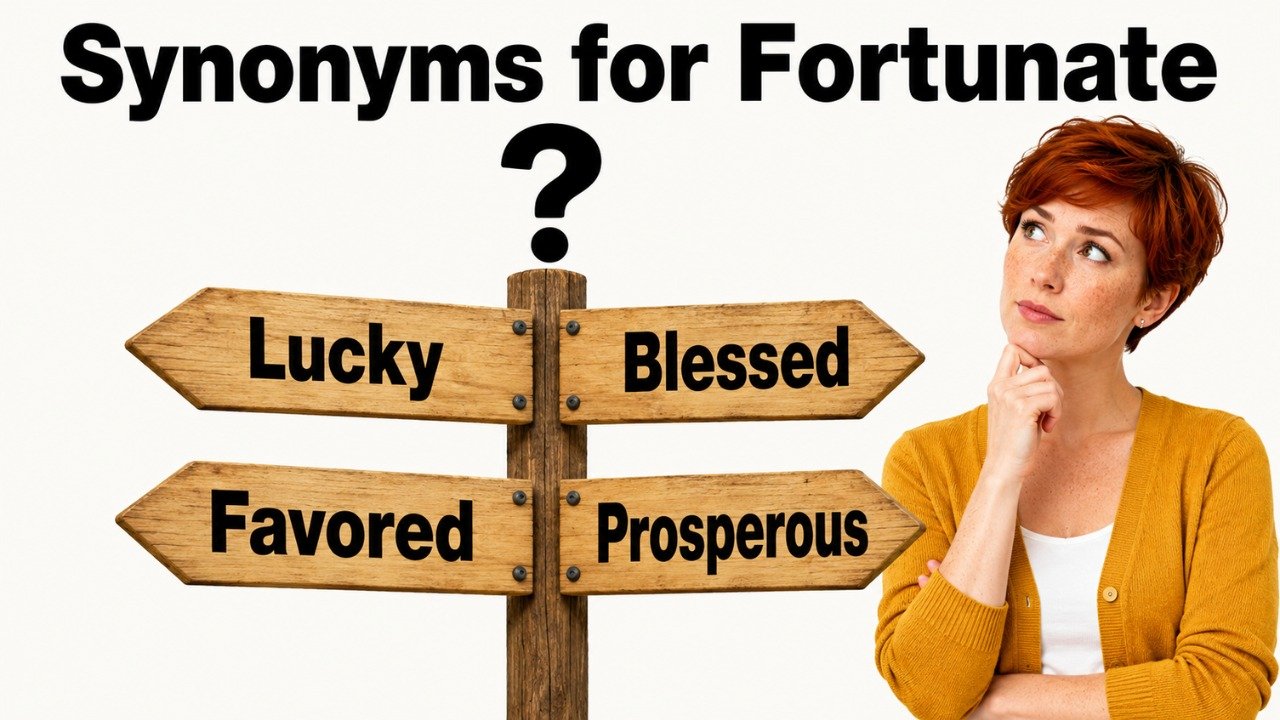
Quick Answer: Synonyms for fortunate include lucky, blessed, favored, privileged, prosperous, auspicious, favorable, advantageous, fortuitous, and serendipitous. Lucky is the best general choice for casual speech, while favorable and advantageous work well in formal writing. Blessed expresses gratitude, privileged describes access to special advantages, and prosperous relates to financial success. Use fortuitous for an unexpectedly helpful event and auspicious for a promising beginning or occasion.
Pronunciation and Word Details
Word: Fortunate.
Pronunciation: /ˈfɔːrtʃənət/
Part of Speech: Adjective.
Meaning: Having good luck, receiving an advantage, or experiencing a favorable result.
US Pronunciation:
UK Pronunciation:
What Does “Fortunate” Mean?
Fortunate means having good luck, receiving favorable opportunities, or experiencing a positive result.
Fortunate is an adjective. It can describe a person, event, decision, situation, opportunity, coincidence, or outcome. A fortunate person benefits from good circumstances, while a fortunate event produces a welcome result.
The word can describe luck that happens by chance.
Example: We were fortunate to find shelter before the storm began.
It can also describe a favorable situation that creates an advantage.
Example: The business is in the fortunate position of having several reliable suppliers.
Fortunate may express gratitude for something valuable.
Example: She feels fortunate to have supportive friends.
It can also refer to wealth, comfort, opportunity, or privilege.
Example: The fortunate students had access to excellent learning resources.
The comparative form is more fortunate, and the superlative form is most fortunate.
Example: He was more fortunate than the other travelers.
Example: It was the most fortunate outcome anyone could have expected.
Meaning, Tone, and Context of “Fortunate”
Fortunate has a positive, neutral, and slightly formal tone. It is usually more polished than lucky, making it suitable for essays, reports, professional communication, speeches, and thoughtful conversation.
In casual speech, fortunate may sound more reflective or grateful than lucky.
Casual: We were lucky to catch the last train.
Reflective: We were fortunate to catch the last train.
In formal writing, fortunate can describe favorable circumstances without sounding overly emotional.
Example: The organization was fortunate to receive additional funding.
The word may also carry an emotional tone when someone expresses appreciation.
Example: I feel fortunate to be surrounded by people who support me.
In discussions of wealth or social opportunity, fortunate can politely refer to people who have advantages. However, privileged, affluent, or advantaged may be more precise when the source of the advantage matters.
Fortunate is common in conversations about luck, timing, opportunity, success, safety, health, family, education, employment, and financial security.
When and How to Use “Fortunate”
For Good Luck
Use fortunate when someone experiences a positive result because of chance.
Example: We were fortunate to avoid the heavy traffic.
For a Favorable Outcome
Use fortunate when an event ends in a positive or helpful way.
Example: The discussion reached a fortunate conclusion for both sides.
For Gratitude
Use fortunate when expressing appreciation for people, opportunities, or circumstances.
Example: I feel fortunate to work with such a supportive team.
For an Advantage
Use fortunate when someone has access to useful opportunities or resources.
Example: She was fortunate to receive guidance from an experienced teacher.
For Safety
Use fortunate when someone escapes harm, danger, or loss.
Example: The passengers were fortunate to leave the vehicle without serious injuries.
For Financial Comfort
Use fortunate when referring politely to wealth or material security.
Example: He came from a fortunate background and received an excellent education.
For Good Timing
Use fortunate when something happens at the most helpful moment.
Example: Her arrival was fortunate because the group needed an experienced leader.
For Positive Circumstances
Use fortunate when several conditions support a successful result.
Example: The farmers were fortunate to receive steady rain throughout the season.
Best Synonyms for Fortunate
Lucky: Experiencing a good result because of chance.
Example: We were lucky to find the missing documents.
Blessed: Feeling grateful for valuable people, opportunities, or circumstances.
Example: She feels blessed to have a loving family.
Favored: Receiving special support, approval, or advantage.
Example: The region is favored with fertile soil and a mild climate.
Privileged: Having special opportunities, rights, or social advantages.
Example: He felt privileged to learn from respected experts.
Auspicious: Suggesting that future events will be successful or positive.
Example: The clear morning seemed like an auspicious beginning.
Favorable: Helpful, positive, or likely to produce a good result.
Example: The proposal received a favorable response.
Advantageous: Creating a practical benefit or stronger position.
Example: The agreement was advantageous to both parties.
Fortuitous: Happening by chance and producing a useful result.
Example: A fortuitous meeting led to a valuable partnership.
Prosperous: Financially successful, comfortable, or thriving.
Example: The town became prosperous through trade and agriculture.
Serendipitous: Happening unexpectedly and leading to a pleasant discovery.
Example: Their serendipitous encounter developed into a lasting friendship.
50 Synonyms for Fortunate with Short Meanings
- Lucky: Receiving a positive result through chance.
- Blessed: Grateful for valuable circumstances or opportunities.
- Favored: Given special support, approval, or advantage.
- Charmed: Seeming to enjoy unusually consistent good luck.
- Fortuitous: Happening by chance with a beneficial result.
- Serendipitous: Unexpectedly producing a pleasant discovery.
- Providential: Happening at exactly the right time as though guided by fate.
- Auspicious: Suggesting future success or good fortune.
- Propitious: Creating conditions that support a successful result.
- Favorable: Helpful, positive, or beneficial.
- Advantageous: Providing a practical benefit or stronger position.
- Beneficial: Producing a helpful or positive effect.
- Opportune: Happening at a particularly useful time.
- Timely: Occurring when it is most needed.
- Well Timed: Happening at the most effective moment.
- Promising: Showing signs of future success.
- Encouraging: Giving hope that something positive will happen.
- Positive: Producing or suggesting a desirable result.
- Welcome: Received with pleasure or relief.
- Desirable: Worth having because it offers benefits.
- Ideal: Perfectly suited to a particular purpose.
- Felicitous: Especially appropriate, pleasing, or well chosen.
- Golden: Offering an unusually valuable opportunity.
- Heaven Sent: Arriving at exactly the right and most helpful time.
- Rewarding: Producing satisfaction, benefit, or success.
- Fruitful: Producing valuable or successful results.
- Successful: Achieving the intended result.
- Prosperous: Enjoying financial or general success.
- Thriving: Growing, developing, or succeeding strongly.
- Flourishing: Developing successfully in favorable conditions.
- Affluent: Having considerable wealth and comfort.
- Wealthy: Possessing a large amount of money or valuable resources.
- Well Off: Living in comfortable financial circumstances.
- Comfortable: Having enough resources for a secure life.
- Privileged: Having special rights, access, or advantages.
- Advantaged: Placed in circumstances that support success.
- Well Placed: Positioned to receive opportunities or benefits.
- Well Situated: Existing in a favorable or secure position.
- Secure: Protected from serious risk, loss, or uncertainty.
- Happy: Fortunate, pleasing, or successful in a particular situation.
- Pleasing: Producing satisfaction or enjoyment.
- Gratifying: Giving pleasure because of a positive result.
- Enviable: So favorable that others may wish to have it.
- Rosy: Appearing hopeful, successful, or positive.
- Bright: Showing strong promise for the future.
- Hopeful: Giving reason to expect a favorable result.
- In Luck: Currently experiencing good fortune.
- Smiled Upon: Treated favorably by luck or circumstances.
- Well Provided For: Having enough money, resources, or support.
- Born Lucky: Seeming naturally likely to experience good fortune.
Read Also:
Synonyms for Portal

Synonyms for Fortunate by Context
When Fortunate Means Lucky
Use lucky, charmed, blessed, favored, or in luck when fortunate describes a person who experiences a positive result.
Lucky: The most common and natural alternative in everyday speech.
Example: We were lucky to find an available table.
Charmed: Suggests repeated or unusually strong good luck.
Example: He seemed to live a charmed life filled with opportunity.
Favored: Suggests that circumstances or people have provided special support.
Example: The coastal region is favored by a warm climate.
In Luck: A casual expression for experiencing good fortune at a particular moment.
Example: You are in luck because one ticket is still available.
When Fortunate Means Favorable
Use favorable, positive, beneficial, advantageous, or desirable when discussing conditions, decisions, reports, or results.
Favorable: Suitable for formal writing about reactions, circumstances, and outcomes.
Example: The project received a favorable evaluation.
Positive: Useful when discussing results, feedback, or developments.
Example: The changes produced a positive outcome.
Beneficial: Emphasizes a helpful effect.
Example: Regular practice was beneficial to her progress.
Advantageous: Emphasizes a practical or strategic benefit.
Example: The new location is advantageous for customers and employees.
When Fortunate Means Prosperous
Use prosperous, affluent, wealthy, thriving, flourishing, or well off when fortunate refers to financial comfort or success.
Prosperous: Describes a person, business, community, or period of financial success.
Example: The village became prosperous after improving its trade routes.
Affluent: Describes people or areas with substantial wealth.
Example: The school is located in an affluent neighborhood.
Thriving: Emphasizes active growth and continuing success.
Example: She manages a thriving design business.
Well Off: A natural conversational term for financial comfort.
Example: His family was reasonably well off.
When Fortunate Means Privileged
Use privileged, advantaged, well placed, or well situated when someone has access to special opportunities or resources.
Privileged: Highlights rights, access, education, wealth, or social advantages.
Example: She felt privileged to attend the private workshop.
Advantaged: Commonly used when comparing social, educational, or economic conditions.
Example: Students from advantaged backgrounds often have access to more resources.
Well Placed: Suggests that a person is in a strong position to benefit.
Example: He is well placed to lead the new department.
Well Situated: Describes someone or something in a secure and favorable position.
Example: The organization is well situated for future growth.
When Fortunate Means Well Timed
Use timely, opportune, providential, heaven sent, or well timed when something happens at a helpful moment.
Timely: Emphasizes that something happened when it was needed.
Example: Her timely warning prevented a serious mistake.
Opportune: Describes a particularly suitable or convenient moment.
Example: The announcement came at an opportune time.
Providential: Suggests that an event happened at exactly the right moment.
Example: Their providential arrival brought help when it was most needed.
Heaven Sent: An emotional and informal expression for something extremely helpful.
Example: The unexpected assistance was heaven sent.
When Fortunate Means Promising
Use auspicious, propitious, promising, encouraging, bright, or rosy when something suggests future success.
Auspicious: Often used for beginnings, ceremonies, dates, or signs.
Example: The successful launch marked an auspicious beginning.
Propitious: A formal term for conditions that support success.
Example: The weather was propitious for planting.
Promising: Shows clear potential for future success.
Example: The first results are promising.
Encouraging: Gives confidence or hope.
Example: The early response from readers was encouraging.
When Fortunate Means Unexpectedly Helpful
Use fortuitous or serendipitous when a helpful event happens without being planned.
Fortuitous: Emphasizes chance and a useful outcome.
Example: A fortuitous delay allowed the engineers to discover the fault.
Serendipitous: Emphasizes a pleasant discovery made unexpectedly.
Example: The book was a serendipitous discovery during her visit.
Another Word for Fortunate
Another word for fortunate is lucky. It is the clearest general replacement when someone experiences a positive result through chance.
However, the best alternative depends on the context. Use blessed for gratitude, favorable for positive conditions, advantageous for practical benefits, prosperous for financial success, and privileged for special access or opportunity.
Original: We were fortunate to find an open restaurant.
Better Option: We were lucky to find an open restaurant.
Original: She feels fortunate to have supportive parents.
Better Option: She feels blessed to have supportive parents.
Original: The company is in a fortunate financial position.
Better Option: The company is in a prosperous financial position.
Original: The weather conditions were fortunate for the event.
Better Option: The weather conditions were favorable for the event.
When Not to Use “Fortunate”
Avoid fortunate when a more precise word would explain why a situation is positive.
Weak: The new schedule is fortunate for employees.
Better: The new schedule is advantageous for employees.
Do not use fortunate when success mainly comes from effort, expertise, or planning. The word may incorrectly suggest that chance was the main cause.
Weak: Her fortunate research earned international recognition.
Better: Her outstanding research earned international recognition.
Avoid fortunate when discussing serious inequality if privileged or advantaged would identify the issue more clearly.
Weak: Fortunate students have access to better educational resources.
Better: Advantaged students have access to better educational resources.
Fortunate may sound overly formal in relaxed conversation.
Formal: I was fortunate to find my keys.
Natural: I was lucky to find my keys.
Do not use fortunate to describe something that is merely suitable rather than lucky.
Weak: Tuesday is a fortunate day for the meeting.
Better: Tuesday is a convenient day for the meeting.
Avoid the word when it could minimize someone’s preparation or ability.
Weak: She was fortunate to win after months of intense training.
Better: She was successful because months of intense training prepared her well.
Words Commonly Confused With Fortunate
Fortunate vs Lucky: Both describe good fortune. Lucky is more common and casual, while fortunate is slightly more formal and reflective.
Fortunate vs Fortuitous: Fortunate means having a positive result. Fortuitous means happening by chance and does not always mean beneficial, although it is often used that way.
Fortunate vs Auspicious: Fortunate describes an existing positive situation. Auspicious describes a sign, beginning, or occasion that appears likely to bring future success.
Fortunate vs Favorable: Fortunate often relates to luck or personal circumstances. Favorable describes conditions, opinions, responses, or results that support success.
Fortunate vs Blessed: Fortunate focuses on good circumstances. Blessed often expresses deeper gratitude, spiritual appreciation, or emotional thankfulness.
Fortunate vs Prosperous: Fortunate has a broad meaning connected with luck and advantage. Prosperous specifically describes financial success, growth, or material comfort.
Fortunate vs Privileged: Fortunate may describe any positive circumstance. Privileged refers more specifically to special rights, access, wealth, status, or opportunities.
Fortunate vs Advantageous: Fortunate may result from chance. Advantageous describes something that creates a practical or strategic benefit.
Fortunate vs Happy: Fortunate means lucky or favorable. Happy normally means pleased or joyful, although it can mean fortunate in phrases such as happy coincidence.
Which Synonym Should You Choose?
Choose lucky for natural conversation about chance and positive outcomes.
Choose fortunate for polished, thoughtful, or slightly formal writing.
Choose blessed when expressing gratitude for family, health, support, or opportunity.
Choose favored when someone or something receives special support or suitable conditions.
Choose favorable when discussing conditions, opinions, reviews, decisions, or responses.
Choose advantageous when describing a practical, competitive, or strategic benefit.
Choose auspicious when discussing a promising beginning, ceremony, date, or sign.
Choose propitious for formal writing about conditions that support future success.
Choose fortuitous when an unexpected event happens by chance and proves helpful.
Choose serendipitous when an accidental discovery creates a pleasant result.
Choose prosperous when discussing financial success or economic growth.
Choose thriving or flourishing when emphasizing continued growth and development.
Choose affluent or well off when describing financial comfort.
Choose privileged when someone has special access, rights, status, or opportunities.
Choose advantaged when comparing social, educational, or economic circumstances.
Choose timely or opportune when something happens at a useful moment.
Choose promising or encouraging when early signs suggest future success.
Real Life Examples of “Fortunate” in Sentences
Original: We were fortunate to find a mechanic nearby.
Better Option: We were lucky to find a mechanic nearby.
Original: She feels fortunate to have caring neighbors.
Better Option: She feels blessed to have caring neighbors.
Original: The company received a fortunate response from investors.
Better Option: The company received a favorable response from investors.
Original: He grew up in fortunate financial circumstances.
Better Option: He grew up in affluent financial circumstances.
Original: The team made a fortunate decision to change its strategy.
Better Option: The team made an advantageous decision to change its strategy.
Original: Their fortunate meeting led to years of collaboration.
Better Option: Their fortuitous meeting led to years of collaboration.
Original: It was a fortunate beginning for the new business.
Better Option: It was an auspicious beginning for the new business.
Original: She was fortunate to study with experienced teachers.
Better Option: She was privileged to study with experienced teachers.
Original: His fortunate arrival prevented further confusion.
Better Option: His timely arrival prevented further confusion.
Original: The region enjoyed several fortunate years of economic growth.
Better Option: The region enjoyed several prosperous years of economic growth.
Synonym Groups and Usage Differences
Luck Group
This group includes lucky, fortunate, charmed, favored, blessed, and in luck.
Lucky is the most common general term. Fortunate sounds more formal and thoughtful. Charmed suggests repeated good luck, while favored suggests support from people, nature, or circumstances.
Example: She was lucky to receive help at exactly the right moment.
Gratitude Group
This group includes blessed, thankful, grateful, and favored.
Blessed describes a person who deeply appreciates a positive situation. It often carries stronger emotion than fortunate.
Example: He felt blessed to return safely to his family.
Favorable Conditions Group
This group includes favorable, beneficial, positive, desirable, ideal, and advantageous.
Favorable describes conditions that support success. Beneficial focuses on a helpful effect. Advantageous emphasizes a practical benefit, while ideal suggests the best possible situation.
Example: The mild weather created favorable conditions for the event.
Chance Event Group
This group includes fortuitous, serendipitous, providential, and heaven sent.
Fortuitous describes an event that happens by chance. Serendipitous adds the idea of an unexpected pleasant discovery. Providential suggests remarkably perfect timing.
Example: A serendipitous conversation introduced her to a new career path.
Promising Future Group
This group includes auspicious, propitious, promising, encouraging, rosy, bright, and hopeful.
Auspicious often describes a beginning or sign. Propitious describes conditions that support success. Promising and encouraging are more common in reports and everyday writing.
Example: The encouraging results suggest that the project has a bright future.
Prosperity Group
This group includes prosperous, affluent, wealthy, thriving, flourishing, comfortable, and well off.
Prosperous suggests financial or general success. Affluent and wealthy focus on money and property. Thriving and flourishing emphasize active growth.
Example: The once quiet village developed into a thriving commercial center.
Advantage Group
This group includes privileged, advantaged, well placed, well situated, and secure.
Privileged highlights special access or rights. Advantaged describes favorable social or economic conditions. Well placed suggests a strong position for future opportunity.
Example: She was well placed to apply for the leadership role.
Timing Group
This group includes timely, opportune, well timed, providential, and heaven sent.
Timely means arriving when needed. Opportune suggests a particularly suitable moment. Heaven sent expresses strong relief or gratitude.
Example: The timely support helped the community recover quickly.
Antonyms of Fortunate
The opposite of fortunate depends on whether the word refers to luck, conditions, wealth, timing, or opportunity.
Unfortunate: Experiencing or causing an undesirable result.
Unlucky: Having bad luck or an unfavorable outcome.
Ill Fated: Destined to experience failure or tragedy.
Hapless: Consistently unlucky or unsuccessful.
Disadvantaged: Lacking opportunities, resources, or social benefits.
Underprivileged: Having fewer social or economic advantages.
Deprived: Lacking essential resources, support, or opportunities.
Unfavorable: Unhelpful or unlikely to produce success.
Adverse: Harmful, difficult, or opposed to success.
Inauspicious: Suggesting that future events may not succeed.
Unpropitious: Creating poor conditions for success.
Untimely: Happening at an unsuitable or inconvenient moment.
Regrettable: Causing disappointment, sadness, or concern.
Unwelcome: Not wanted or received with pleasure.
Disastrous: Causing severe damage, failure, or loss.
Comparison: Fortunate vs Related Words
Fortunate vs Lucky
Fortunate and lucky both describe positive circumstances. Lucky is more conversational, while fortunate is more polished and reflective.
Example With Fortunate: We were fortunate to receive help so quickly.
Example With Lucky: We were lucky to receive help so quickly.
Fortunate vs Blessed
Fortunate focuses on favorable circumstances. Blessed expresses stronger gratitude and may carry emotional or spiritual meaning.
Example With Fortunate: She feels fortunate to have a secure home.
Example With Blessed: She feels blessed to have a loving family.
Fortunate vs Favorable
Fortunate commonly describes people, events, or outcomes connected with luck. Favorable usually describes conditions, opinions, decisions, or responses.
Example With Fortunate: He was fortunate to escape without injury.
Example With Favorable: The doctor gave a favorable report.
Fortunate vs Fortuitous
Fortunate means lucky or beneficial. Fortuitous means accidental or happening by chance.
Example With Fortunate: We were fortunate to find another route.
Example With Fortuitous: A fortuitous conversation revealed another route.
Fortunate vs Auspicious
Fortunate describes a positive situation or result. Auspicious describes a beginning or sign that suggests future success.
Example With Fortunate: The event had a fortunate outcome.
Example With Auspicious: The event marked an auspicious beginning.
Fortunate vs Advantageous
Fortunate suggests luck or positive circumstances. Advantageous highlights a practical benefit.
Example With Fortunate: She was fortunate to receive two job offers.
Example With Advantageous: The second offer was more advantageous because it included flexible hours.
Fortunate vs Prosperous
Fortunate has a broad meaning related to luck and positive circumstances. Prosperous focuses on wealth, growth, or financial success.
Example With Fortunate: The family was fortunate to find a safe home.
Example With Prosperous: The family operated a prosperous farming business.
Fortunate vs Privileged
Fortunate may refer to any positive situation. Privileged describes special access, rights, status, or opportunity.
Example With Fortunate: I was fortunate to attend the lecture.
Example With Privileged: I felt privileged to meet the speaker afterward.
Common Phrases and Expressions With Fortunate
Fortunate Enough: Having the luck or opportunity to experience something positive.
Example: She was fortunate enough to study abroad.
Feel Fortunate: To feel grateful for favorable circumstances.
Example: I feel fortunate to have such dependable friends.
Consider Yourself Fortunate: To recognize that your situation is better than it might have been.
Example: You should consider yourself fortunate that the damage was minor.
Fortunate Position: A situation that provides security or advantage.
Example: The organization is in the fortunate position of having several funding options.
Fortunate Circumstances: Conditions that provide comfort, opportunity, or success.
Example: He grew up in fortunate circumstances.
Fortunate Outcome: A positive result, especially after uncertainty or danger.
Example: Everyone was relieved by the fortunate outcome.
Fortunate Coincidence: An accidental event that produces a helpful result.
Example: Meeting the doctor on the train was a fortunate coincidence.
Fortunate Opportunity: A valuable chance that becomes available.
Example: The internship was a fortunate opportunity to gain experience.
Fortunate Few: A small group with special advantages or opportunities.
Example: Only a fortunate few received invitations to the private event.
More Fortunate Than Most: Having better circumstances than many other people.
Example: She knew that she was more fortunate than most.
Common Mistakes to Avoid
Confusing Fortunate and Fortuitous
Fortunate means lucky or favorable. Fortuitous means happening by chance.
Incorrect: The result was completely fortuitous because everyone benefited.
Correct: The result was fortunate because everyone benefited.
Use fortuitous when the accidental nature of the event matters.
Correct: Their fortuitous meeting led to a successful project.
Using Fortunate for Earned Success
Fortunate may imply that luck caused the result. Avoid it when effort, talent, or preparation deserves emphasis.
Weak: He was fortunate to earn the highest score after months of study.
Better: He earned the highest score through months of focused study.
Using the Wrong Preposition
Fortunate commonly appears with to, in, or that.
Correct: She was fortunate to receive an invitation.
Correct: He was fortunate in his choice of mentor.
Correct: We were fortunate that no one was injured.
Using Fortunate as an Adverb
Fortunate is an adjective. Fortunately is the adverb.
Incorrect: Fortunate, the rain stopped before the ceremony.
Correct: Fortunately, the rain stopped before the ceremony.
Using Fortunate as a Noun
Fortunate cannot normally replace fortune.
Incorrect: His fortunate changed after he accepted the position.
Correct: His fortune changed after he accepted the position.
Choosing an Inaccurate Synonym
Prosperous relates mainly to success or wealth, while auspicious refers to promising beginnings. They cannot replace fortunate in every sentence.
Unnatural: We were prosperous that no one was injured.
Natural: We were fortunate that no one was injured.
Repeating Fortunate Too Often
Use context specific alternatives to make writing clearer.
Repetitive: She was fortunate to receive a fortunate opportunity during a fortunate period.
Improved: She was lucky to receive a valuable opportunity during a prosperous period.
Using More Fortunater
The correct comparative form is more fortunate.
Incorrect: He was fortunater than the other applicants.
Correct: He was more fortunate than the other applicants.
Sounding Insensitive
Calling someone fortunate may ignore hardship, effort, or inequality. Choose language that accurately recognizes the situation.
Insensitive: Disadvantaged families are simply less fortunate.
Clearer: Disadvantaged families often face limited access to essential resources.
Conclusion
Synonyms for fortunate help describe good luck, positive conditions, valuable opportunities, and financial comfort with greater precision. Lucky is best for casual speech, while favorable and advantageous suit formal writing. Blessed expresses gratitude, privileged identifies special access, and prosperous describes financial success. Fortuitous and serendipitous are useful for unexpected events, while auspicious suggests a promising beginning. Choose the synonym that explains whether the good result came from chance, timing, opportunity, wealth, or supportive circumstances.
FAQs About Synonyms for Fortunate
What Is the Best Synonym for Fortunate?
Lucky is the best general synonym for fortunate. It is natural, common, and suitable when a positive result happens by chance.
What Is a Formal Synonym for Fortunate?
Favorable, advantageous, auspicious, propitious, privileged, and prosperous are useful formal alternatives, depending on the context.
Is Blessed a Synonym for Fortunate?
Yes. Blessed is suitable when someone feels deeply grateful for positive circumstances, supportive people, health, safety, or opportunity.
What Is the Difference Between Fortunate and Fortuitous?
Fortunate means lucky or favorable. Fortuitous means happening by chance, whether or not the result is positive.
Can Prosperous Replace Fortunate?
Prosperous can replace fortunate when discussing financial success, economic growth, or material comfort. It does not work for every type of luck.
Which Synonym Describes a Fortunate Beginning?
Auspicious is the best choice for a beginning, event, date, or sign that appears likely to bring future success.
What Is the Opposite of Fortunate?
Common opposites include unfortunate, unlucky, hapless, disadvantaged, unfavorable, adverse, and inauspicious.
The tone, length, or section depth can be adjusted for another site version.
