
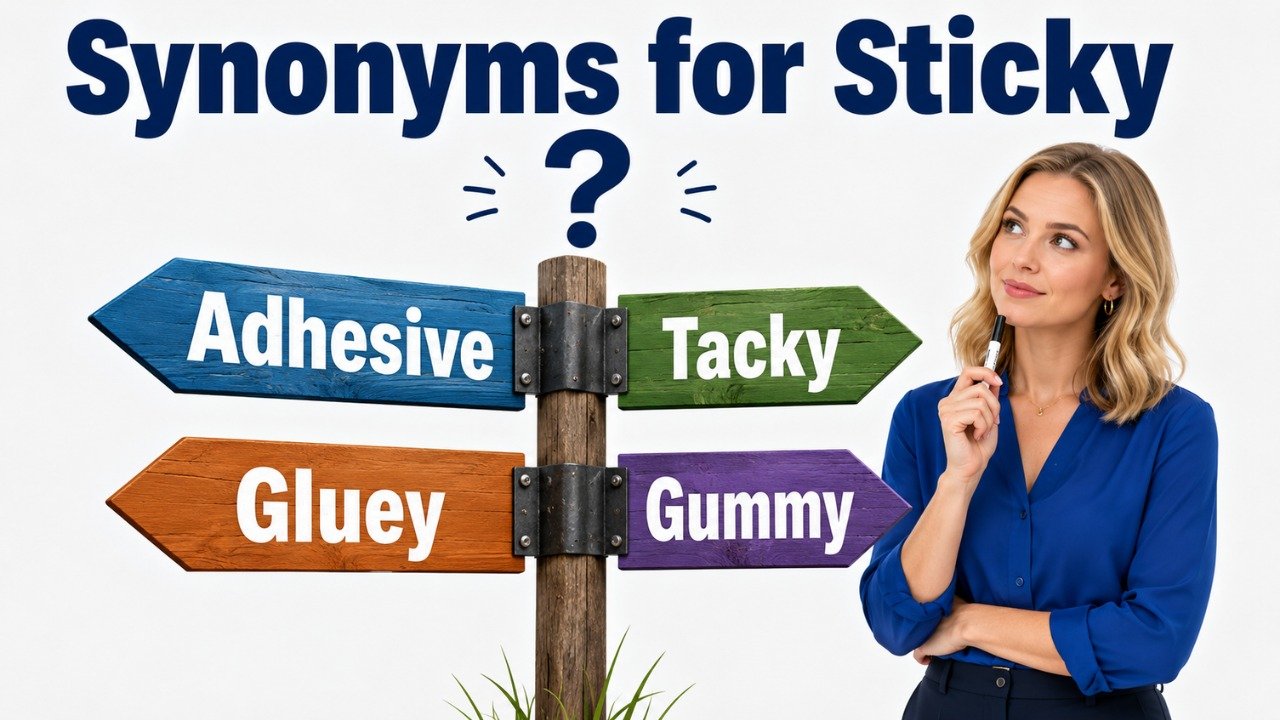
Quick Answer: The best synonyms for sticky are adhesive, tacky, gluey, gummy, viscous, clammy, humid, tricky, awkward, and persistent. Use adhesive in formal descriptions of surfaces or materials, tacky for something slightly sticky, and gluey or gummy for thick substances. Clammy and humid describe uncomfortable moisture or weather. Tricky and awkward suit difficult situations, while persistent works for ideas, feelings, or problems that remain for a long time.
Pronunciation and Word Details
Word: Sticky.
Pronunciation: /ˈstɪki/.
Part of Speech: Adjective.
Meaning: Able to attach to a surface, unpleasantly moist, difficult to manage, or likely to remain in the mind.
US Pronunciation:
UK Pronunciation:
What Does “Sticky” Mean?
Sticky means having a surface or texture that attaches easily to another object. It commonly describes substances such as glue, syrup, melted sugar, wet paint, and food residue.
Sticky is an adjective, but its meaning changes according to the sentence. It may describe physical adhesion, uncomfortable weather, a difficult problem, dependent behavior, or an idea that remains memorable.
A sticky surface holds onto anything that touches it. Sticky weather feels hot, humid, and uncomfortable. A sticky situation is difficult or embarrassing. A sticky idea is memorable and remains in a person’s mind.
Physical Meaning: Something that attaches easily or leaves residue.
Weather Meaning: Hot, humid, and unpleasantly moist.
Situational Meaning: Difficult, sensitive, or awkward to manage.
Memory Meaning: Easy to remember or difficult to forget.
Behavioral Meaning: Too dependent, attached, or unwilling to separate.
Meaning, Tone, and Context of “Sticky”
Sticky is generally a neutral and conversational word. It is common in everyday descriptions of food, surfaces, weather, problems, and uncomfortable situations.
When describing materials, sticky is direct and practical. In scientific, technical, or formal writing, adhesive, viscous, cohesive, or resinous may provide greater precision.
When describing weather, sticky has an informal and emotional tone. It expresses how the humidity feels rather than simply reporting the moisture level. Humid is usually more suitable for formal weather descriptions.
Sticky can also have a figurative meaning. A sticky problem is complicated, while a sticky conversation concerns a sensitive subject. In these contexts, the word sounds informal but expressive.
When used for ideas, messages, or memories, sticky means memorable or lasting. This use is common when discussing communication, learning, and creative concepts.
Formal Context: Adhesive, viscous, difficult, sensitive, or persistent may be more precise.
Casual Context: Sticky sounds natural when describing food, hands, floors, weather, and everyday problems.
Emotional Context: Sticky may express discomfort, embarrassment, irritation, or frustration.
Technical Context: Adhesive, cohesive, resinous, gelatinous, or viscous may be better choices.
Figurative Context: Sticky can describe a difficult issue, memorable idea, or persistent problem.
When and How to Use “Sticky”
For Adhesive Surfaces
Use sticky when a surface attaches to fingers, clothing, paper, or other objects.
Example: The table felt sticky after the juice spilled.
For Thick Substances
Use sticky for substances that are thick, gluey, gummy, or difficult to remove.
Example: The melted candy formed a sticky layer on the plate.
For Humid Weather
Use sticky when warm air and moisture make the skin feel uncomfortable.
Example: The afternoon was hot and sticky.
For Difficult Situations
Use sticky informally for a problem that requires careful handling.
Example: The disagreement placed the manager in a sticky situation.
For Sensitive Subjects
Use sticky for issues that may cause conflict, embarrassment, or strong reactions.
Example: Money became a sticky subject during the discussion.
For Persistent Problems
Use sticky when a problem remains unresolved or continues to create difficulty.
Example: Late payments became a sticky issue for the small business.
For Memorable Ideas
Use sticky for a thought, phrase, or concept that remains in the mind.
Example: The teacher used a sticky example that students remembered easily.
For Dependent Behavior
Use sticky informally for someone or something that stays too closely attached.
Example: The frightened child became sticky and refused to leave his father’s side.
Best Synonyms for Sticky
Adhesive
Synonym: Able to attach firmly to a surface.
Example: The adhesive backing held the label securely in place.
Tacky
Synonym: Slightly sticky, especially when a substance is not completely dry.
Example: The paint was still tacky several hours later.
Gluey
Synonym: Thick and sticky like glue.
Example: Overcooking made the rice soft and gluey.
Gummy
Synonym: Soft, thick, and unpleasantly sticky.
Example: The old sweets had developed a gummy texture.
Viscous
Synonym: Thick and slow flowing because of internal resistance.
Example: The mechanic examined the dark, viscous liquid.
Clammy
Synonym: Unpleasantly cool and slightly wet.
Example: His hands became clammy before the interview.
Humid
Synonym: Containing a high amount of moisture in the air.
Example: The humid weather made outdoor work uncomfortable.
Tricky
Synonym: Difficult and requiring careful thought or skill.
Example: Reaching an agreement proved tricky.
Awkward
Synonym: Uncomfortable, embarrassing, or difficult to manage.
Example: The unexpected question created an awkward silence.
Persistent
Synonym: Continuing for a long time or refusing to disappear.
Example: The team finally solved the persistent technical problem.
50 Synonyms for Sticky with Short Meanings
- Adhesive: Able to attach firmly to a surface.
- Tacky: Slightly sticky or not completely dry.
- Gluey: Thick and sticky like glue.
- Gummy: Soft, thick, and unpleasantly sticky.
- Glutinous: Having a glue like or strongly adhesive texture.
- Viscous: Thick and slow flowing.
- Gooey: Soft, wet, and pleasantly or unpleasantly sticky.
- Pasty: Thick, soft, and similar to paste.
- Syrupy: Thick, sweet, and slow flowing.
- Resinous: Containing or resembling sticky resin.
- Gelatinous: Soft, thick, and similar to jelly.
- Slimy: Wet, slippery, and unpleasant to touch.
- Greasy: Covered with an oily or slippery substance.
- Clammy: Unpleasantly damp and cool.
- Damp: Slightly wet.
- Moist: Containing a small amount of moisture.
- Humid: Having a high level of moisture in the air.
- Muggy: Unpleasantly warm and humid.
- Sultry: Very hot, humid, and uncomfortable.
- Sweltering: Extremely and uncomfortably hot.
- Clinging: Holding closely to a person or surface.
- Adhering: Remaining attached to something.
- Attached: Joined or connected firmly.
- Bonded: Joined together through a strong connection.
- Cohesive: Tending to hold together.
- Tenacious: Holding firmly and refusing to let go.
- Gripping: Holding something tightly or firmly.
- Clingy: Overly dependent or unwilling to separate.
- Catchy: Easy to remember and attractive to the mind.
- Memorable: Likely to remain in the mind.
- Unforgettable: Impossible or very difficult to forget.
- Lasting: Continuing for a long period.
- Persistent: Continuing despite efforts to remove or stop it.
- Lingering: Remaining longer than expected.
- Difficult: Hard to complete, understand, or manage.
- Tricky: Requiring careful thought or skill.
- Awkward: Uncomfortable or hard to handle.
- Complicated: Containing several difficult parts.
- Troublesome: Causing problems or inconvenience.
- Problematic: Creating difficulty or concern.
- Delicate: Requiring careful and sensitive treatment.
- Sensitive: Likely to cause strong feelings or disagreement.
- Contentious: Likely to produce argument or conflict.
- Embarrassing: Causing discomfort or shame.
- Uncomfortable: Causing physical or emotional unease.
- Messy: Dirty, disorganized, or difficult to control.
- Unpleasant: Causing discomfort or dislike.
- Precarious: Uncertain, risky, or unstable.
- Knotty: Complicated and difficult to solve.
- Thorny: Difficult, sensitive, and likely to cause disagreement.
Read Also:
Synonyms for Regular
Synonyms for Sticky by Context
When Sticky Means Adhesive
Adhesive, tacky, gluey, gummy, glutinous, and adhering describe something that attaches to another surface.
Adhesive is the best formal choice for materials designed to join objects. Tacky describes a surface that is only slightly sticky. Gluey and gummy emphasize a thick or unpleasant texture.
Example: The adhesive strip remained firmly attached to the package.
Example: The paint felt tacky because it had not dried completely.
Example: The sauce became gluey after being reheated several times.
When Sticky Means Thick or Gooey
Gooey, viscous, pasty, syrupy, resinous, and gelatinous describe thick substances.
Gooey is conversational and often describes melted food. Viscous is formal and technical. Syrupy suggests a smooth, thick liquid, while pasty describes a dense substance resembling paste.
Example: The chocolate center was warm and gooey.
Example: The liquid became more viscous as its temperature dropped.
Example: The mixture had a thick, pasty consistency.
When Sticky Describes Weather
Humid, muggy, sultry, sweltering, damp, and moist relate to warm or wet conditions.
Humid objectively describes moisture in the air. Muggy expresses discomfort caused by warmth and humidity. Sultry usually describes intense heat, while sweltering emphasizes extreme discomfort.
Example: The humid air made the room feel warmer.
Example: It was a muggy evening with little wind.
Example: Workers rested in the shade during the sweltering afternoon.
When Sticky Means Difficult
Tricky, awkward, complicated, troublesome, problematic, knotty, and thorny describe challenging situations.
Tricky is appropriate for a problem requiring careful judgment. Awkward is best for socially uncomfortable situations. Thorny and contentious suit sensitive matters that may cause disagreement.
Example: The legal question was more complicated than expected.
Example: She handled the awkward conversation calmly.
Example: Funding remained a thorny issue for the committee.
When Sticky Means Memorable
Catchy, memorable, unforgettable, lasting, and lingering describe ideas or experiences that remain in the mind.
Catchy suits phrases, tunes, titles, and slogans that are easy to remember. Memorable is neutral and broad. Lingering often describes an impression, feeling, thought, smell, or memory that remains.
Example: The speaker opened with a catchy phrase.
Example: The lesson became memorable because of its practical examples.
Example: The story left a lingering impression on the audience.
When Sticky Means Closely Attached
Clinging, adhering, attached, bonded, tenacious, gripping, and clingy describe a strong physical or emotional connection.
Clinging describes something holding closely to a surface or person. Adhering is more formal and usually relates to physical attachment. Clingy describes emotionally dependent behavior and may sound critical.
Example: Wet leaves were clinging to the pavement.
Example: Dust was adhering to the freshly painted wall.
Example: The anxious puppy became clingy in unfamiliar places.
Another Word for Sticky
Adhesive is often the best single replacement for sticky when describing a surface or material. However, the most accurate alternative depends on the intended meaning.
Use tacky for a slightly sticky surface, viscous for a thick liquid, humid for moist air, awkward for an uncomfortable situation, and memorable for an idea that remains in the mind.
Original: The tape has a sticky surface.
Better Option: The tape has an adhesive surface.
Original: The paint is still sticky.
Better Option: The paint is still tacky.
Original: The weather feels sticky today.
Better Option: The weather feels humid today.
Original: We faced a sticky problem during the negotiations.
Better Option: We faced a tricky problem during the negotiations.
When Not to Use “Sticky”
Do not use sticky when a more precise word can clearly identify a texture, weather condition, emotional response, or difficult situation.
Sticky may sound too casual in technical reports, scientific descriptions, formal essays, legal documents, and professional analysis. Choose adhesive, viscous, humid, sensitive, complicated, or persistent when precision matters.
Avoid using sticky for every thick substance. A substance can be thick without attaching to a surface. Viscous may be more accurate when describing how slowly a liquid flows.
Do not describe a person as sticky when you mean emotionally dependent. Clingy is more familiar, although it can sound judgmental. Attached or dependent may be more respectful in serious writing.
Weak: The laboratory sample was very sticky.
Better: The laboratory sample was highly viscous.
Weak: The report discusses a sticky political matter.
Better: The report discusses a sensitive political matter.
Weak: The air contained sticky conditions.
Better: The air was warm and humid.
Weak: She has a sticky personality.
Better: She becomes overly dependent in unfamiliar situations.
Weak: The agreement created a sticky issue.
Better: The agreement created a complicated legal issue.
Words Commonly Confused With Sticky
Sticky vs Adhesive: Sticky describes the quality of attaching to a surface. Adhesive can describe that quality or a substance specifically created to join materials.
Sticky vs Tacky: Sticky suggests noticeable adhesion. Tacky usually means slightly sticky, especially when paint, glue, or another coating has partly dried.
Sticky vs Viscous: Sticky describes attachment to a surface. Viscous describes a liquid that is thick and flows slowly. Some substances are both sticky and viscous, but the words are not identical.
Sticky vs Gooey: Sticky emphasizes adhesion. Gooey emphasizes a soft, wet, thick texture, especially in food.
Sticky vs Gummy: Sticky is a general description. Gummy suggests a soft, chewy, or unpleasantly glue like texture.
Sticky vs Clammy: Sticky can describe heat and moisture. Clammy usually means unpleasantly damp and cool, particularly when describing skin.
Sticky vs Humid: Sticky describes how humid weather feels. Humid directly describes the amount of moisture in the air.
Sticky vs Clingy: Sticky usually describes a surface, substance, problem, or weather condition. Clingy describes someone who remains too emotionally or physically attached.
Sticky vs Catchy: Sticky can informally describe an idea that remains in the mind. Catchy describes something immediately appealing and easy to remember.
Which Synonym Should You Choose?
Choose adhesive when describing a material, coating, label, strip, or surface that attaches firmly.
Choose tacky when paint, glue, or another substance is only slightly sticky or partly dry.
Choose gluey when food or another substance has become unpleasantly thick and sticky.
Choose gummy when describing a soft, chewy, or glue like texture.
Choose gooey for soft melted food, such as chocolate, cheese, or caramel.
Choose viscous in scientific, medical, mechanical, or technical descriptions of thick liquids.
Choose clammy when skin feels unpleasantly cool and damp.
Choose humid when discussing moisture in the air in formal or neutral language.
Choose muggy for casual descriptions of warm, uncomfortable, humid weather.
Choose tricky when a task or problem requires careful judgment.
Choose awkward when a situation causes social discomfort or embarrassment.
Choose sensitive when a subject requires tact and careful language.
Choose thorny when a difficult issue is likely to cause disagreement.
Choose persistent when a problem, feeling, stain, or symptom continues.
Choose catchy when a phrase, title, or tune is easy to remember.
Choose memorable when an experience or idea creates a strong, lasting impression.
Choose clingy when describing dependent behavior in informal conversation.
Choose attached when describing a close connection without sounding critical.
Real Life Examples of “Sticky” in Sentences
Original: My hands became sticky after cutting the fruit.
Better Option: My hands became tacky after cutting the fruit.
Original: The sticky substance was difficult to wash away.
Better Option: The gluey substance was difficult to wash away.
Original: The soup developed a sticky consistency.
Better Option: The soup developed a thick, viscous consistency.
Original: The weather remained sticky throughout the afternoon.
Better Option: The weather remained humid throughout the afternoon.
Original: The spilled drink left the floor sticky.
Better Option: The spilled drink left an adhesive residue on the floor.
Original: The manager faced a sticky situation.
Better Option: The manager faced a tricky situation.
Original: Salary became a sticky subject during the meeting.
Better Option: Salary became a sensitive subject during the meeting.
Original: The team encountered a sticky legal problem.
Better Option: The team encountered a complicated legal problem.
Original: The lesson contained a sticky idea.
Better Option: The lesson contained a memorable idea.
Original: The child became sticky around unfamiliar adults.
Better Option: The child became clingy around unfamiliar adults.
Synonym Groups and Usage Differences
Adhesion Group
Adhesive, tacky, gluey, adhering, clinging, and bonded relate to physical attachment.
Adhesive is formal and precise. Tacky indicates mild adhesion. Adhering and clinging focus on the action of remaining attached.
Example: The adhesive layer prevented the material from moving.
Texture Group
Gummy, gooey, viscous, pasty, gelatinous, and syrupy describe different kinds of thickness.
Gooey often has a soft or melted quality. Viscous focuses on slow movement. Pasty suggests a dense, smooth mixture, while gelatinous suggests a soft substance similar to jelly.
Example: The filling was thick, gooey, and warm.
Moisture Group
Clammy, damp, moist, humid, muggy, and sultry relate to wetness or moisture.
Clammy commonly describes uncomfortable skin. Damp and moist describe objects or environments. Humid and muggy describe the air.
Example: The humid room felt warm and uncomfortable.
Difficulty Group
Difficult, tricky, awkward, complicated, troublesome, knotty, and thorny describe challenging circumstances.
Tricky suggests that care or skill is needed. Awkward indicates social discomfort. Knotty and thorny suggest complex problems without simple solutions.
Example: The committee faced a thorny ethical question.
Persistence Group
Persistent, lingering, lasting, tenacious, and gripping describe something that remains or holds firmly.
Persistent often describes continuing problems. Lingering describes something that remains gradually. Tenacious suggests a strong refusal to let go.
Example: A lingering smell remained in the kitchen.
Memory Group
Catchy, memorable, unforgettable, lasting, and gripping describe ideas or experiences that hold attention.
Catchy is best for phrases, tunes, and titles. Memorable is broader, while unforgettable communicates an especially powerful effect.
Example: The author created a memorable opening sentence.
Attachment Group
Clinging, attached, bonded, clingy, and tenacious describe physical or emotional closeness.
Attached and bonded are generally neutral or positive. Clingy often has a negative tone because it suggests excessive dependence.
Example: The rescued animal quickly became attached to its new caregiver.
Antonyms of Sticky
The opposite of sticky depends on whether the word describes adhesion, moisture, weather, difficulty, memory, or attachment.
Nonadhesive: Unable to attach easily to a surface.
Dry: Free from moisture or wetness.
Smooth: Having an even surface without rough or gummy residue.
Clean: Free from dirt, grease, or sticky material.
Slippery: Difficult to grip because of a smooth or wet surface.
Loose: Not firmly attached or tightly held.
Detached: Emotionally or physically separate.
Cool: Moderately cold and comfortable.
Fresh: Pleasantly cool, clean, or free from stale humidity.
Easy: Requiring little effort or difficulty.
Simple: Clear and not complicated.
Straightforward: Easy to understand or manage.
Comfortable: Not causing physical or emotional unease.
Forgettable: Unlikely to remain in the mind.
Temporary: Lasting for only a short time.
Fleeting: Disappearing quickly.
Comparison: Sticky vs Related Words
Sticky vs Adhesive
Sticky is a broad everyday word for something that attaches to a surface. Adhesive is more formal and may describe either an attaching quality or a material used to join objects.
Example With Sticky: The back of the label is sticky.
Example With Adhesive: The label has a strong adhesive backing.
Sticky vs Tacky
Sticky indicates clear adhesion, while tacky means slightly sticky or partly dry. Tacky is especially common for paint, glue, polish, and coatings.
Example With Sticky: The syrup made the counter sticky.
Example With Tacky: The second coat of paint was still tacky.
Sticky vs Gluey
Sticky refers to the ability to attach. Gluey describes a thick texture resembling glue and often has a negative meaning.
Example With Sticky: The mixture stuck to the spoon.
Example With Gluey: The overcooked pasta became gluey.
Sticky vs Gooey
Sticky emphasizes attachment, while gooey emphasizes softness, moisture, and thickness. Gooey can sound positive when describing melted food.
Example With Sticky: The candy left my fingers sticky.
Example With Gooey: The cake had a warm, gooey center.
Sticky vs Viscous
Sticky means able to adhere. Viscous means thick and slow flowing. Viscous is more precise in technical and scientific contexts.
Example With Sticky: The liquid left a sticky residue.
Example With Viscous: The viscous liquid moved slowly through the tube.
Sticky vs Clammy
Sticky often describes warm moisture, while clammy usually describes an unpleasant combination of coolness and dampness.
Example With Sticky: My skin felt sticky in the humid room.
Example With Clammy: His hands felt clammy before the presentation.
Sticky vs Humid
Sticky expresses the uncomfortable feeling caused by warm moisture. Humid objectively describes air containing a high level of moisture.
Example With Sticky: It feels sticky outside today.
Example With Humid: The region experiences humid summers.
Sticky vs Tricky
Sticky can informally describe a difficult situation. Tricky directly means difficult and requiring careful handling.
Example With Sticky: They found themselves in a sticky situation.
Example With Tricky: They faced a tricky decision about the budget.
Sticky vs Awkward
Sticky suggests a complicated problem, while awkward emphasizes discomfort, embarrassment, or social difficulty.
Example With Sticky: The contract created a sticky legal issue.
Example With Awkward: The personal question created an awkward moment.
Sticky vs Catchy
Sticky can describe information that remains in the mind. Catchy describes something attractive, appealing, and immediately easy to remember.
Example With Sticky: The teacher designed a sticky learning concept.
Example With Catchy: The writer created a catchy title.
Common Phrases and Expressions With “Sticky”
Sticky Surface: A surface that easily attaches to objects.
Sticky Fingers: Fingers covered with an adhesive, sugary, or greasy substance.
Sticky Situation: A difficult or embarrassing circumstance.
Sticky Weather: Warm, humid weather that feels uncomfortable.
Sticky Residue: Material that remains attached after a substance is removed.
Sticky Substance: A material that adheres easily to surfaces.
Sticky Texture: A texture that feels tacky, gummy, or gluey.
Sticky Mess: A dirty and difficult to clean spill or substance.
Sticky Problem: A complicated issue without an easy solution.
Sticky Subject: A sensitive topic that may cause discomfort or disagreement.
Common Mistakes to Avoid
Using Sticky for Every Thick Liquid
A liquid may be thick without being adhesive. Use viscous when flow and thickness are the main qualities.
Incorrect: The engine contained sticky oil.
Better: The engine contained highly viscous oil.
Confusing Sticky With Humid
Sticky describes how humid weather feels. Humid describes the moisture level in the air.
Incorrect: The weather report predicts sticky air levels.
Better: The weather report predicts high humidity levels.
Confusing Sticky With Clammy
Sticky skin is often warm and moist. Clammy skin is usually cool and damp.
Incorrect: His skin became sticky and cold.
Better: His skin became clammy and cold.
Using Sticky in Formal Reports
Sticky may sound too conversational in academic, legal, scientific, or technical writing.
Weak: The project encountered a sticky issue.
Better: The project encountered a complicated regulatory issue.
Choosing Tacky for the Wrong Meaning
Tacky can mean slightly sticky, but it can also mean cheap, unfashionable, or lacking good taste. Make the intended meaning clear through context.
Unclear: The decoration looked tacky.
Clear Texture Meaning: The painted decoration still felt tacky.
Describing People as Sticky
Calling someone sticky sounds unnatural in most contexts. Use clingy, dependent, attached, or persistent according to the intended meaning.
Unnatural: The new employee was sticky.
Better: The new employee was overly dependent on the supervisor.
Repeating Sticky Too Often
Repeated use can make a paragraph sound simple or imprecise. Replace it with accurate alternatives based on texture, moisture, difficulty, or attachment.
Repetitive: The sticky sauce left a sticky layer on the sticky plate.
Better: The gooey sauce left an adhesive layer on the plate.
Ignoring Context
Do not replace sticky with the same synonym in every sentence. Adhesive does not naturally describe weather, and humid does not describe glue.
Incorrect: We entered an adhesive situation.
Better: We entered an awkward situation.
Conclusion
The most suitable synonyms for sticky depend on what the word describes. Adhesive and tacky work well for surfaces, while gluey, gummy, gooey, and viscous describe different textures. Humid, muggy, and clammy relate to moisture and discomfort. Tricky, awkward, sensitive, and thorny are stronger choices for difficult situations. Catchy and memorable suit ideas that remain in the mind. Choosing a context specific alternative makes sentences clearer, more natural, and more precise.
FAQs About Synonyms for Sticky
What Is the Best Synonym for Sticky?
Adhesive is the best general synonym when sticky describes a surface or material that attaches easily.
What Is Another Word for a Slightly Sticky Surface?
Tacky is the most natural word for a surface that feels slightly sticky or has not completely dried.
What Is a Formal Word for Sticky?
Adhesive is suitable for surfaces, while viscous is appropriate for thick liquids. Difficult, sensitive, or complicated may replace sticky in formal descriptions of problems.
What Is a Synonym for Sticky Weather?
Humid and muggy are the best alternatives. Humid is neutral and precise, while muggy emphasizes discomfort.
What Is a Synonym for a Sticky Situation?
Tricky, awkward, difficult, complicated, delicate, and thorny can describe a sticky situation.
Are Gooey and Sticky the Same?
Not exactly. Sticky means able to attach to a surface, while gooey means soft, wet, and thick. A substance can be both gooey and sticky.
Can Sticky Mean Memorable?
Yes. Sticky can informally describe an idea, phrase, or lesson that remains in the mind. Catchy, memorable, and lasting are clearer alternatives.
