
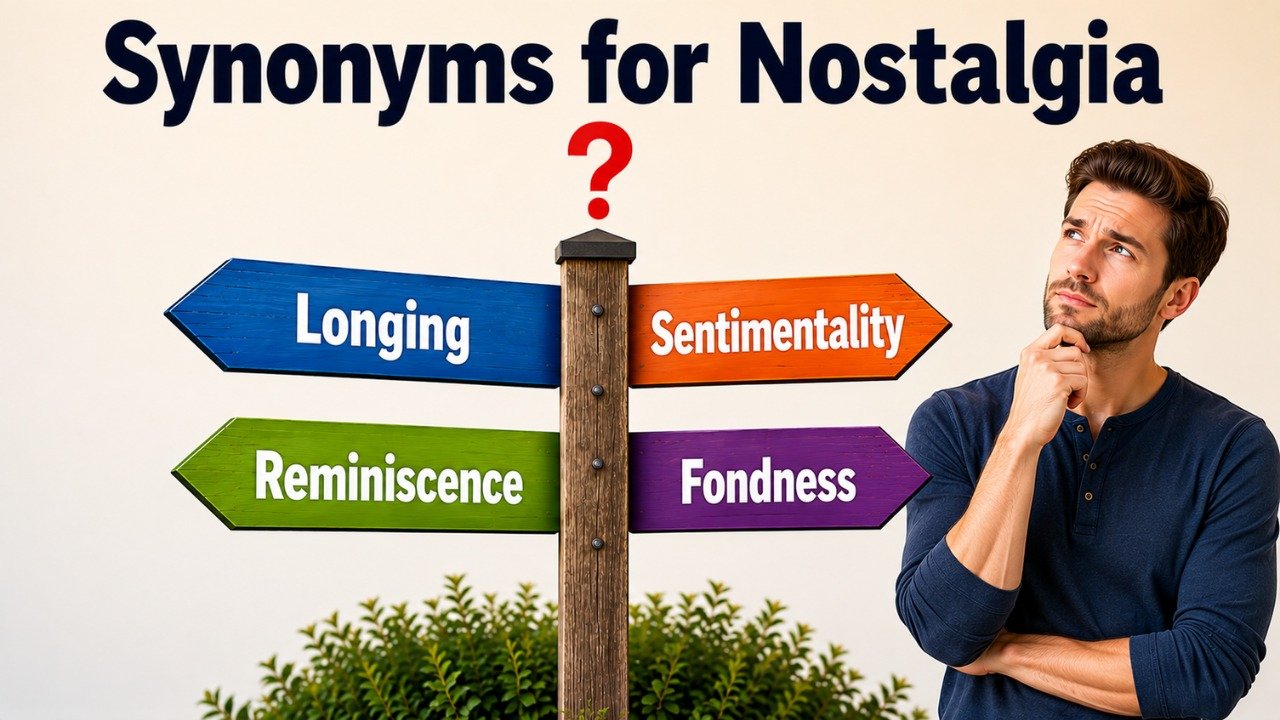
Quick Answer: The best synonyms for nostalgia are wistfulness, longing, reminiscence, sentimentality, yearning, remembrance, homesickness, recollection, retrospection, and fondness. Use wistfulness for gentle sadness about the past, reminiscence for the act of recalling earlier experiences, sentimentality for strong emotional attachment, and homesickness when someone misses a place or home. Longing and yearning express a powerful desire to return to an earlier time, while recollection works well in formal writing about remembered events.
Pronunciation and Word Details
Word: Nostalgia
Pronunciation: /nɒˈstæl.dʒə/
Part of Speech: Noun
Meaning: A warm, emotional, and sometimes sad feeling caused by remembering a meaningful time, place, person, or experience from the past.
US Pronunciation:
UK Pronunciation:
What Does “Nostalgia” Mean?
Nostalgia means a sentimental longing for a meaningful part of the past. It is a noun used to describe the emotional feeling that appears when someone remembers childhood, family traditions, former homes, old friendships, past experiences, or earlier periods of life.
Nostalgia often combines happiness and sadness. A person may feel happy because the memory was enjoyable, but sad because the experience has ended or cannot be repeated in exactly the same way.
The word can appear in several sentence contexts.
Personal Memory: She felt nostalgia while looking through her childhood photographs.
Place: The familiar streets filled him with nostalgia for his hometown.
Time Period: The music created nostalgia for the summers of her youth.
Shared Experience: Their conversation brought back nostalgia for their school days.
Culture: Traditional decorations can create nostalgia for older customs and celebrations.
Nostalgia does not simply mean remembering something. It describes the emotional reaction connected to that memory.
Meaning, Tone, and Context of “Nostalgia”
Nostalgia usually has a reflective, emotional, and bittersweet tone. It can communicate warmth, affection, longing, sadness, comfort, or appreciation for the past.
The word is neutral enough for everyday conversation, essays, personal writing, literary discussion, cultural analysis, and formal commentary. However, its emotional meaning often makes it especially effective in descriptive and reflective writing.
Conversational Tone: People commonly use nostalgia when discussing childhood, family, music, clothing, celebrations, and old places.
Emotional Tone: Nostalgia can express deep affection for something that is no longer present.
Literary Tone: Writers use nostalgia to create atmosphere, emotional depth, and reflective mood.
Academic Tone: The word may describe attitudes toward history, culture, identity, social change, or collective memory.
Positive Context: Nostalgia can provide comfort and strengthen a sense of personal identity.
Sad Context: It can also highlight loss, separation, change, or the passing of time.
The meaning depends on what caused the feeling and whether the speaker views the past with joy, sadness, regret, or affection.
When and How to Use “Nostalgia”
Use nostalgia when a memory creates a strong emotional connection to the past. The word works best when the feeling involves more than simple remembering.
For Childhood Memories: Use nostalgia when someone remembers early experiences with warmth or longing.
Example: The smell of fresh bread filled her with nostalgia for mornings at her grandmother’s house.
For Former Places: Use nostalgia when a location reminds someone of an earlier period of life.
Example: Walking through the old neighborhood created a powerful sense of nostalgia.
For Family Traditions: Use nostalgia when customs, meals, celebrations, or objects bring back emotional memories.
Example: The familiar holiday decorations awakened nostalgia for family gatherings.
For Past Relationships: Use nostalgia when remembering former friendships or meaningful personal connections.
Example: Their old letters brought a wave of nostalgia for their younger years.
For Cultural Memories: Use nostalgia when people feel emotionally connected to earlier styles, customs, entertainment, or social experiences.
Example: The exhibition appealed to visitors through its sense of cultural nostalgia.
For Reflective Writing: Use nostalgia to describe the emotional effect of looking back at a meaningful experience.
Example: His memoir is filled with nostalgia for village life.
Best Synonyms for Nostalgia
Wistfulness
Synonym: A gentle feeling of sadness and longing for something from the past.
Example: She looked at the empty playground with quiet wistfulness.
Longing
Synonym: A strong emotional desire for a person, place, time, or experience.
Example: He felt a deep longing for the peaceful days of his childhood.
Reminiscence
Synonym: The act of remembering and talking about past experiences.
Example: The evening became a warm reminiscence about their school years.
Sentimentality
Synonym: Strong emotional attachment to memories, people, or objects.
Example: She kept the faded letters because of their emotional sentimentality.
Yearning
Synonym: A powerful desire to return to something meaningful or distant.
Example: The photograph created a yearning for the simplicity of earlier years.
Remembrance
Synonym: The act or feeling of keeping a past person or experience in memory.
Example: The ceremony was held in remembrance of the community’s founders.
Homesickness
Synonym: Sadness or longing caused by being away from home.
Example: The familiar recipe eased his homesickness.
Recollection
Synonym: A remembered experience or the ability to remember something.
Example: Her recollection of the event remained clear after many years.
Retrospection
Synonym: The thoughtful act of considering past events or experiences.
Example: In retrospection, she appreciated how much the journey had changed her.
Fondness
Synonym: Warm affection for a person, place, object, or memory.
Example: He spoke with fondness about his first home.
50 Synonyms for Nostalgia With Short Meanings
- Wistfulness: Gentle sadness mixed with longing.
- Longing: A strong desire for something absent.
- Yearning: Deep emotional desire for something distant.
- Reminiscence: The act of recalling past experiences.
- Remembrance: The process of keeping something in memory.
- Recollection: A memory or the act of remembering.
- Sentimentality: Strong emotional attachment to memories.
- Homesickness: Longing for home while being away.
- Retrospection: Thoughtful reflection on past events.
- Reflection: Careful thought about earlier experiences.
- Fondness: Warm affection for someone or something.
- Pining: Suffering caused by longing for something lost.
- Melancholy: Quiet sadness connected to thought or memory.
- Bittersweetness: A mixture of happiness and sadness.
- Heartache: Emotional pain caused by loss or separation.
- Regret: Sadness about something that happened or ended.
- Sadness: Emotional unhappiness connected to loss.
- Affection: A warm feeling of care and attachment.
- Attachment: A strong emotional connection.
- Tenderness: Gentle affection and emotional warmth.
- Memory: A remembered person, place, event, or experience.
- Remembering: The act of bringing the past to mind.
- Recalling: Thinking about something experienced before.
- Reminiscing: Enjoying thoughts or conversations about the past.
- Reverie: A dreamy state of pleasant reflection.
- Musing: Quiet and thoughtful reflection.
- Looking Back: Thinking about an earlier time.
- Backward Glance: A brief reflection on the past.
- Fond Remembrance: Warm and affectionate memory.
- Warm Remembrance: A comforting memory of the past.
- Cherished Memory: A memory valued with deep affection.
- Fond Memory: A pleasant and emotionally meaningful recollection.
- Happy Memory: A remembered experience that creates joy.
- Sentimental Memory: A memory carrying strong personal emotion.
- Wistful Memory: A memory that creates gentle sadness.
- Childhood Memory: A remembered experience from early life.
- Emotional Recollection: A memory connected to strong feelings.
- Tender Recollection: A gentle and affectionate memory.
- Affectionate Remembrance: Loving reflection on someone or something.
- Sentimental Longing: Emotional desire for something from the past.
- Wistful Longing: Quiet sadness caused by wanting the past again.
- Longing for the Past: Desire to return to an earlier time.
- Yearning for Earlier Times: Strong desire for a former period.
- Homesick Longing: Emotional desire to return home.
- Memory Lane: A mental journey through pleasant past experiences.
- The Good Old Days: An affectionate view of an earlier period.
- Days Gone By: Times and experiences from the past.
- Old Times: A familiar expression for earlier experiences.
- Reflective Sadness: Sadness created by thoughtful memories.
- Past Reflection: Careful consideration of earlier experiences.
Read Also:
Synonyms for Restaurant

Synonyms for Nostalgia by Context
When Nostalgia Means Emotional Longing
Longing, yearning, wistfulness, and pining are useful when nostalgia describes a desire to return to an earlier time.
Longing: Emphasizes strong emotional desire.
Example: She felt a longing for the quiet summers of her childhood.
Yearning: Expresses an intense and continuing desire.
Example: His stories revealed a yearning for his former way of life.
Wistfulness: Combines longing with gentle sadness.
Example: She watched the old recording with wistfulness.
Pining: Suggests painful or persistent longing.
Example: He spent years pining for the village he had left behind.
When Nostalgia Means Remembering the Past
Reminiscence, recollection, remembrance, remembering, and retrospection focus more on memory than emotion.
Reminiscence: Often involves enjoyable memories or conversations.
Example: Their lunch was filled with reminiscence about college life.
Recollection: Refers to a particular memory or the ability to remember.
Example: Her recollection of the old house remained detailed.
Remembrance: Emphasizes preserving someone or something in memory.
Example: They planted a tree in remembrance of their teacher.
Retrospection: Suggests thoughtful examination of the past.
Example: The final chapter offers a calm retrospection on his career.
When Nostalgia Means Missing Home
Homesickness, homesick longing, attachment, and yearning for home work when the emotion is connected to a familiar place.
Homesickness: Describes sadness caused by being away from home.
Example: Hearing his family’s voices increased his homesickness.
Attachment: Describes a lasting emotional connection to a place.
Example: Her attachment to the coastal town remained strong.
Yearning for Home: Emphasizes the desire to return.
Example: The cold winter deepened his yearning for home.
When Nostalgia Means Sentimental Warmth
Sentimentality, fondness, affection, tenderness, and warm remembrance express loving emotional connections.
Sentimentality: Highlights strong emotion connected to memories or objects.
Example: He kept the old watch because of its sentimentality.
Fondness: Expresses warm and pleasant affection.
Example: She remembered her first teacher with fondness.
Tenderness: Suggests gentle care and emotional softness.
Example: He spoke with tenderness about his childhood pet.
When Nostalgia Means Bittersweet Sadness
Melancholy, bittersweetness, heartache, reflective sadness, and wistful memory are suitable when the past causes both comfort and pain.
Melancholy: Describes quiet and thoughtful sadness.
Example: The abandoned house filled her with melancholy.
Bittersweetness: Expresses happiness and sadness at the same time.
Example: Graduation photographs brought a sense of bittersweetness.
Heartache: Communicates stronger emotional pain.
Example: Remembering their final goodbye still caused heartache.
Another Word for Nostalgia
The best single replacement for nostalgia is often wistfulness when the sentence focuses on emotional longing and gentle sadness. Reminiscence is better when the sentence describes recalling or discussing past experiences.
The ideal alternative depends on whether the intended meaning is memory, affection, sadness, homesickness, or desire for an earlier time.
Original: The old photographs filled her with nostalgia.
Better Option: The old photographs filled her with wistfulness.
Original: Their conversation was full of nostalgia for school.
Better Option: Their conversation was full of reminiscence about school.
Original: He experienced nostalgia after moving abroad.
Better Option: He experienced homesickness after moving abroad.
Original: She spoke with nostalgia about her childhood home.
Better Option: She spoke with fondness about her childhood home.
When Not to Use “Nostalgia”
Do not use nostalgia for every thought or memory about the past. The word should involve an emotional connection, usually affection, longing, sadness, or warmth.
A factual memory without emotional feeling is usually better described as a recollection or memory.
Weak: I have nostalgia that the meeting started at nine.
Better: I remember that the meeting started at nine.
Nostalgia may also sound too emotional in factual reports, research summaries, or technical descriptions.
Weak: The report presents nostalgia about last year’s sales results.
Better: The report presents a review of last year’s sales results.
Do not use nostalgia when someone specifically misses home. Homesickness is usually clearer.
Weak: She experienced nostalgia because she had been away from home for months.
Better: She experienced homesickness because she had been away from home for months.
Avoid using nostalgia when regret is the main emotion.
Weak: He felt nostalgia for not accepting the opportunity.
Better: He felt regret about not accepting the opportunity.
Nostalgia can also become repetitive when used several times in one paragraph.
Weak: The nostalgic music created nostalgia and made everyone feel nostalgic.
Better: The familiar music created wistfulness and brought back warm memories.
Words Commonly Confused With Nostalgia
Nostalgia vs Reminiscence: Nostalgia is the emotional longing connected to the past, while reminiscence is the act of recalling or discussing past experiences.
Nostalgia vs Memory: A memory is any remembered experience. Nostalgia is the emotional response caused by a meaningful memory.
Nostalgia vs Homesickness: Nostalgia can involve any past time, place, person, or experience. Homesickness specifically describes missing home.
Nostalgia vs Sentimentality: Nostalgia focuses on emotional longing for the past. Sentimentality describes strong emotional attachment and may not always involve the past.
Nostalgia vs Melancholy: Nostalgia often mixes happiness and sadness. Melancholy mainly describes quiet or thoughtful sadness.
Nostalgia vs Regret: Nostalgia involves longing or affection for the past. Regret involves sadness about a decision, action, or missed opportunity.
Nostalgia vs Recollection: Nostalgia is a feeling, while recollection is a memory or the act of remembering.
Nostalgia vs Yearning: Nostalgia is specifically connected to the past. Yearning can describe a strong desire for anything, including a future goal.
Which Synonym Should You Choose?
Choose wistfulness when a memory creates gentle sadness and longing.
Choose reminiscence when people are recalling or discussing enjoyable past experiences.
Choose recollection when writing formally about a remembered fact, event, or detail.
Choose remembrance when honoring or preserving the memory of a person, place, or event.
Choose homesickness when someone misses home, family, or a familiar environment.
Choose sentimentality when emotional attachment is stronger than the desire to return to the past.
Choose longing when the desire for an earlier time is strong and direct.
Choose yearning when the emotional desire feels deep, intense, or continuing.
Choose retrospection in essays, reports, memoirs, and formal discussions that examine previous events.
Choose fondness in emails and conversations when the tone should feel warm but not overly sad.
Choose melancholy when a memory creates quiet and serious sadness.
Choose bittersweetness when the past creates happiness and sadness at the same time.
Real Life Examples of “Nostalgia” in Sentences
Original: The old family recipe filled her with nostalgia.
Better Option: The old family recipe filled her with warm remembrance.
Original: He felt nostalgia while visiting his former school.
Better Option: He felt wistfulness while visiting his former school.
Original: Their photographs created nostalgia for their younger years.
Better Option: Their photographs created longing for their younger years.
Original: The familiar song brought a sudden feeling of nostalgia.
Better Option: The familiar song brought a sudden feeling of sentimentality.
Original: She spoke with nostalgia about summers in the countryside.
Better Option: She spoke with fondness about summers in the countryside.
Original: Moving overseas caused him to experience nostalgia for home.
Better Option: Moving overseas caused him to experience homesickness.
Original: The reunion was filled with nostalgia.
Better Option: The reunion was filled with reminiscence.
Original: His book expresses nostalgia for a disappearing way of life.
Better Option: His book expresses yearning for a disappearing way of life.
Original: The empty theater gave her a feeling of nostalgia.
Better Option: The empty theater gave her a feeling of melancholy.
Original: Looking through the album created powerful nostalgia.
Better Option: Looking through the album created powerful emotional recollection.
Synonym Groups and Usage Differences
Emotional Longing Group
Longing, yearning, pining, and wistfulness describe the desire to return to something meaningful. Wistfulness is gentle, while pining suggests stronger emotional pain.
Example: She felt wistfulness whenever she remembered the family garden.
Memory and Reflection Group
Reminiscence, recollection, reflection, remembrance, and retrospection focus on remembering or examining the past. They are useful in essays, memoirs, reports, and personal stories.
Example: The discussion became a thoughtful retrospection on their early work.
Homesickness Group
Homesickness, homesick longing, yearning for home, and attachment describe emotional connections to home or a familiar place.
Example: The traditional meal temporarily eased his homesickness.
Sentimental Warmth Group
Fondness, affection, tenderness, sentimentality, and warm remembrance communicate loving or comforting emotional connections.
Example: She remembered her childhood neighbor with great fondness.
Reflective Sadness Group
Melancholy, bittersweetness, heartache, regret, and reflective sadness express the painful side of remembering the past.
Example: The final visit carried an unmistakable sense of bittersweetness.
Pleasant Memory Group
Fond memory, cherished memory, happy memory, and affectionate remembrance focus on positive experiences without strongly emphasizing sadness.
Example: Their annual picnic remained a cherished memory.
Antonyms of Nostalgia
The opposite of nostalgia depends on whether the word refers to emotional attachment, remembering, longing, or focus on the past.
Indifference: Lack of emotional interest or concern.
Detachment: Emotional separation from a person, place, or memory.
Forgetfulness: Failure or inability to remember.
Emotional Distance: Lack of personal connection to an experience.
Contentment: Satisfaction with the present situation.
Present Mindedness: Strong attention to current experiences rather than the past.
Forward Thinking: Concentration on future goals and possibilities.
Anticipation: Excitement or expectation about something in the future.
Disinterest: Absence of curiosity or emotional involvement.
Unconcern: Lack of worry, affection, or emotional attachment.
Nostalgia: She longed to return to her childhood home.
Opposite: She felt completely detached from the place where she grew up.
Comparison of Nostalgia vs Related Words
Nostalgia vs Wistfulness
Nostalgia is an emotional longing specifically connected to the past. Wistfulness is gentle sadness or longing and can relate to the past, present, or an unrealized wish.
Example With Nostalgia: The old photographs created nostalgia for her childhood.
Example With Wistfulness: She watched the departing train with wistfulness.
Nostalgia vs Reminiscence
Nostalgia describes a feeling, while reminiscence describes remembering or talking about past events.
Example With Nostalgia: The familiar scent filled him with nostalgia.
Example With Reminiscence: Their conversation became a cheerful reminiscence about school.
Nostalgia vs Sentimentality
Nostalgia involves longing for the past. Sentimentality refers to strong or tender emotion connected to people, objects, stories, or memories.
Example With Nostalgia: The old house created nostalgia for her early years.
Example With Sentimentality: She kept the broken ornament because of its sentimentality.
Nostalgia vs Homesickness
Nostalgia can involve any meaningful part of the past. Homesickness specifically involves missing home or familiar surroundings.
Example With Nostalgia: He felt nostalgia for the music of his youth.
Example With Homesickness: He felt homesickness during his first month abroad.
Nostalgia vs Melancholy
Nostalgia often includes pleasant affection as well as sadness. Melancholy is a broader feeling of quiet, reflective sadness.
Example With Nostalgia: The reunion awakened nostalgia for their school days.
Example With Melancholy: The empty building filled her with melancholy.
Nostalgia vs Recollection
Nostalgia is the emotional response to a memory. Recollection is the remembered information or experience itself.
Example With Nostalgia: The letter caused a sudden wave of nostalgia.
Example With Recollection: Her recollection of the conversation was detailed.
Common Phrases and Expressions With Nostalgia
A Wave of Nostalgia: A sudden and powerful feeling connected to the past.
A Sense of Nostalgia: A general emotional awareness of earlier times.
Filled With Nostalgia: Experiencing strong sentimental feelings about the past.
Nostalgia for Childhood: Longing for experiences from early life.
Nostalgia for Home: Emotional longing for a former or distant home.
Nostalgia for the Past: A desire to return to an earlier time.
Deep Nostalgia: A powerful emotional connection to past experiences.
Bittersweet Nostalgia: A mixture of happiness and sadness about the past.
Childhood Nostalgia: Warm feelings connected to childhood memories.
Cultural Nostalgia: Emotional attachment to earlier customs, styles, or shared experiences.
Pure Nostalgia: Something that strongly and immediately brings back the past.
Overcome With Nostalgia: Suddenly experiencing intense memories and emotions.
Common Mistakes to Avoid
One common mistake is using nostalgia as a synonym for every type of memory. A memory may be neutral, factual, happy, unpleasant, or unclear. Nostalgia specifically includes emotional attachment or longing.
Avoid saying “a nostalgia” in ordinary sentences because nostalgia is usually treated as an uncountable noun.
Incorrect: She felt a nostalgia for her school days.
Correct: She felt nostalgia for her school days.
Do not confuse nostalgia with homesickness. Homesickness is limited to missing home, while nostalgia has a broader meaning.
Do not choose sentimentality when the main idea is returning to an earlier time. Sentimentality emphasizes emotion, but nostalgia emphasizes emotion connected to the past.
Avoid repeating nostalgic and nostalgia too closely.
Repetitive: The nostalgic photograph created nostalgia during the nostalgic conversation.
Improved: The old photograph created wistfulness during their reflective conversation.
Do not assume nostalgia is always positive. It may be comforting, painful, joyful, regretful, or bittersweet.
Choose a more precise synonym when the context requires clarity. Use recollection for remembered details, retrospection for thoughtful review, and reminiscence for sharing past experiences.
Conclusion
Understanding synonyms for nostalgia makes it easier to express different kinds of memory and emotion accurately. Wistfulness works well for gentle sadness, while longing and yearning communicate a stronger desire for the past. Reminiscence and recollection focus on remembering, homesickness describes missing home, and sentimentality highlights emotional attachment. Words such as fondness, melancholy, and bittersweetness can further clarify the tone. The best choice depends on whether the sentence emphasizes affection, sadness, memory, reflection, or the desire to return to an earlier time.
FAQs About Synonyms for Nostalgia
What Is the Best Synonym for Nostalgia?
Wistfulness is a strong general synonym when nostalgia involves gentle sadness and longing. Reminiscence is better when the focus is on remembering past experiences.
Is Reminiscence the Same as Nostalgia?
Not exactly. Reminiscence is the act of recalling or discussing the past, while nostalgia is the emotional longing caused by those memories.
Can Homesickness Be a Synonym for Nostalgia?
Homesickness can be a synonym when the nostalgia is specifically connected to home, family, or familiar surroundings.
Is Nostalgia a Positive or Negative Feeling?
Nostalgia can be both positive and negative. It often combines warm, pleasant memories with sadness because the past cannot be fully recovered.
What Is a Formal Synonym for Nostalgia?
Retrospection, recollection, and reminiscence are suitable formal alternatives, although each emphasizes a slightly different meaning.
What Word Describes Sad Nostalgia?
Wistfulness, melancholy, heartache, and bittersweetness can describe nostalgia that contains sadness or emotional pain.
What Is the Difference Between Nostalgia and Longing?
Nostalgia is longing specifically connected to the past. Longing is broader and may describe a strong desire for a person, place, object, experience, or future goal.
