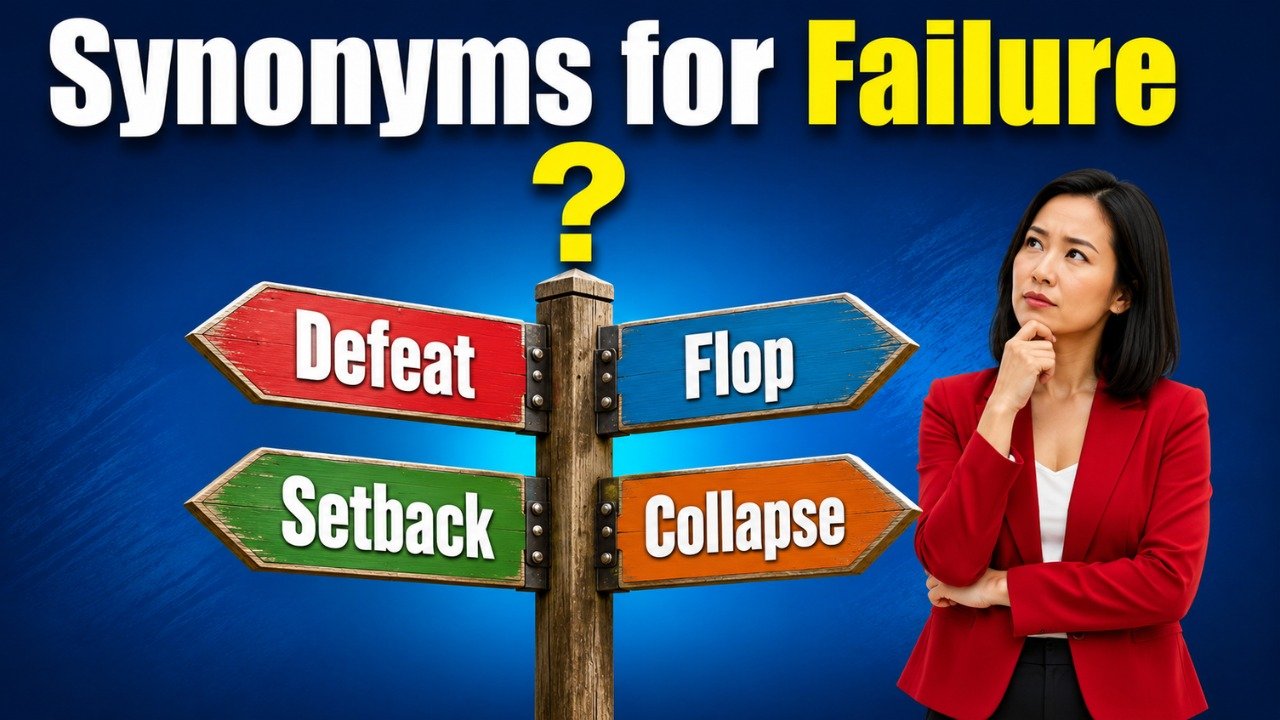
Quick Answer: The best synonyms for failure include defeat, setback, collapse, breakdown, fiasco, disappointment, shortcoming, malfunction, loss, and nonachievement. Use defeat for losing a competition, setback for a temporary problem, collapse for the complete ending of a plan or system, breakdown for a machine or process that stops working, fiasco for an embarrassing result, and shortcoming for a weakness in a person, idea, or method.
Pronunciation and Word Details
Word: Failure.
Pronunciation: /ˈfeɪl.jər/
Part of Speech: Noun.
Meaning: Failure means a lack of success, an inability to achieve a goal, or the breakdown of a person, plan, system, or machine.
US Pronunciation:
UK Pronunciation:
What Does “Failure” Mean?
Failure means the absence of success or the inability to achieve an intended result. It is a noun that can describe an unsuccessful action, plan, person, machine, system, business, or responsibility.
The word has several common uses. It can refer to losing a competition, not passing an examination, failing to complete a duty, or producing a poor result. It can also describe a mechanical problem, such as engine failure, or the collapse of a system, such as communication failure.
Failure may describe one unsuccessful event rather than a permanent condition. A failed attempt can provide useful information and lead to improvement.
In personal contexts, the word can sound strong or judgmental. Calling an action a failure is usually more accurate and respectful than calling a person a failure.
Meaning, Tone, and Context of “Failure”
Failure usually has a negative, serious, and sometimes emotional tone. It communicates disappointment, loss, weakness, or the absence of an expected result.
In everyday conversation, failure may describe a plan that did not work, an examination that was not passed, or an effort that produced no useful outcome. In professional writing, it may refer to missed objectives, poor performance, technical problems, or organizational weaknesses.
In academic and technical contexts, failure often has a neutral and analytical meaning. Researchers may discuss system failure, structural failure, equipment failure, or method failure without placing blame on an individual.
The word can sound harsh when used to describe a person. Expressions such as unsuccessful attempt, learning experience, temporary setback, or area for improvement may be more constructive.
The exact tone depends on context. Fiasco is strongly negative and often embarrassing, while setback suggests that progress can continue.
When and How to Use “Failure”
For an Unsuccessful Attempt: Use failure when an effort does not achieve its intended goal.
Example: The first experiment ended in failure because the temperature was not controlled.
For Defeat: Use it when a person or team loses a competition, argument, or conflict.
Example: The team learned important lessons from its failure in the final match.
For Poor Performance: Failure can describe results that do not meet an expected standard.
Example: The failure to complete the assignment affected his final grade.
For Technical Problems: Use failure when a machine, system, or component stops working.
Example: A power failure interrupted production for several hours.
For Unfulfilled Responsibility: The word may describe not performing an expected duty.
Example: The delay resulted from a failure to check the documents carefully.
For Business Problems: Failure can describe a company, project, or investment that becomes unsuccessful.
Example: Poor planning contributed to the failure of the new business.
For Personal Development: Use setback when the problem is temporary and improvement remains possible.
Example: She viewed the rejection as a setback rather than a permanent failure.
Best Synonyms for Failure
Defeat: The experience of losing a contest, struggle, or conflict.
Example: The players accepted defeat and prepared for the next tournament.
Setback: A problem that delays progress without necessarily ending it.
Example: The damaged equipment caused a temporary setback.
Collapse: The complete failure or sudden ending of a system, plan, or organization.
Example: Rising costs led to the collapse of the project.
Breakdown: A situation in which a machine, relationship, or process stops functioning properly.
Example: A communication breakdown caused confusion between the departments.
Fiasco: A complete and embarrassing failure.
Example: Poor organization turned the event into a fiasco.
Disappointment: A result that fails to meet hopes or expectations.
Example: The cancelled performance was a major disappointment for the audience.
Shortcoming: A weakness or fault that limits success.
Example: Lack of detail was the main shortcoming of the report.
Malfunction: The failure of a machine or system to operate correctly.
Example: A sensor malfunction caused the warning light to appear.
Loss: A failure to win, keep, or gain something.
Example: The team suffered its first loss of the season.
Nonachievement: The failure to accomplish an intended objective.
Example: The report examined the reasons for nonachievement of the annual targets.
50 Synonyms for Failure with Short Meanings
- Defeat: The experience of losing a contest or struggle.
- Setback: A problem that delays progress.
- Collapse: The complete ending of a system, plan, or organization.
- Breakdown: The failure of a process, machine, or relationship.
- Fiasco: A complete and embarrassing failure.
- Flop: Something that is noticeably unsuccessful.
- Disaster: A result that causes serious damage or disappointment.
- Debacle: A sudden and humiliating failure.
- Disappointment: A result that does not meet expectations.
- Loss: The failure to win or keep something.
- Downfall: The event that causes a person or organization to lose success.
- Ruin: Complete destruction or loss of success.
- Deficiency: A lack of something necessary for success.
- Shortcoming: A fault or weakness that limits effectiveness.
- Weakness: A quality that reduces strength or success.
- Fault: A mistake or problem that causes a poor result.
- Flaw: An imperfection in a plan, product, or argument.
- Defect: A fault that prevents proper functioning.
- Error: A mistake in action, judgment, or calculation.
- Mistake: An incorrect action or decision.
- Misstep: A poorly judged action that causes difficulty.
- Blunder: A serious or careless mistake.
- Oversight: A mistake caused by failing to notice something.
- Omission: The failure to include or perform something.
- Neglect: Failure to provide proper care or attention.
- Nonperformance: Failure to carry out an expected duty.
- Nonfulfillment: Failure to complete a promise, duty, or condition.
- Nonachievement: Failure to accomplish a goal.
- Unsuccessfulness: The condition of not achieving success.
- Ineffectiveness: The inability to produce the intended result.
- Inadequacy: A lack of sufficient quality, ability, or resources.
- Incompetence: Lack of the skill needed to perform successfully.
- Inability: Lack of power, knowledge, or skill to do something.
- Malfunction: Incorrect operation of a machine or system.
- Stoppage: A situation in which operation or progress ends.
- Outage: A period when a service or system is unavailable.
- Crash: A sudden and serious system or business failure.
- Rejection: Refusal to accept an idea, request, or application.
- Refusal: An unwillingness to accept or perform something.
- Denial: Refusal to approve or provide something requested.
- Bankruptcy: Legal or financial failure caused by unpaid debts.
- Insolvency: Inability to pay financial obligations.
- Closure: The ending of a business, service, or operation.
- Abandonment: The act of giving up a plan or activity.
- Frustration: Disappointment caused by blocked progress.
- Reverse: An event that interrupts success or progress.
- Defeatism: The belief that failure cannot be avoided.
- Washout: A person or event that proves completely unsuccessful.
- Miscarriage: The failure of a plan or process to achieve its purpose.
- Dead End: A situation offering no further progress or solution.
Read Also:
Synonyms for Memories

Synonyms for Failure by Context
When Failure Means Defeat
Use these words when someone loses a competition, argument, conflict, or struggle.
Defeat: The state of being beaten by an opponent.
Example: The team responded to defeat with determination.
Loss: An unsuccessful result in a game or competition.
Example: The loss ended the team’s unbeaten record.
Downfall: A serious loss of power, status, or success.
Example: Poor judgment contributed to the leader’s downfall.
Reverse: An unexpected problem that interrupts success.
Example: The election result was a major reverse for the movement.
When Failure Means a Temporary Problem
These alternatives suggest that progress has been delayed rather than permanently ended.
Setback: A difficulty that slows development or recovery.
Example: The funding delay was a setback, but the project continued.
Obstacle: A problem that stands in the way of success.
Example: Limited access to materials became a significant obstacle.
Difficulty: A problem that requires additional effort to overcome.
Example: The team experienced difficulty during the testing stage.
Frustration: Disappointment caused by an inability to make progress.
Example: Repeated delays created frustration among the participants.
When Failure Means Complete Collapse
Use these words when a plan, business, organization, or system ends completely.
Collapse: The sudden or complete failure of something important.
Example: The collapse of the agreement ended months of negotiation.
Ruin: Complete destruction of success, value, or stability.
Example: Heavy debt brought the business to ruin.
Disaster: A failure that produces serious negative consequences.
Example: The poorly planned campaign became a financial disaster.
Debacle: A highly visible and humiliating failure.
Example: Conflicting instructions turned the launch into a debacle.
Fiasco: A badly managed and embarrassing failure.
Example: The lack of preparation made the meeting a fiasco.
When Failure Means a Mistake
These words describe incorrect actions, decisions, judgments, or calculations.
Error: An incorrect action, belief, or calculation.
Example: A calculation error changed the final result.
Mistake: A general term for something done incorrectly.
Example: Forgetting to save the document was a simple mistake.
Misstep: An action that shows poor judgment.
Example: The public statement was a serious misstep.
Blunder: A careless or serious mistake.
Example: Sending the confidential file to the wrong address was a major blunder.
Oversight: A mistake caused by not noticing something.
Example: The missing signature was an administrative oversight.
When Failure Means a Weakness
Use these words when discussing a problem within a person, plan, argument, method, or product.
Shortcoming: A weakness that prevents something from being fully successful.
Example: Poor organization was the proposal’s main shortcoming.
Deficiency: A lack of an important quality, resource, or feature.
Example: The study revealed a deficiency in staff training.
Flaw: An imperfection in design, reasoning, or character.
Example: The reviewer identified a flaw in the argument.
Defect: A physical or functional problem in a product or system.
Example: A manufacturing defect caused the component to break.
Inadequacy: A lack of sufficient quality, strength, or ability.
Example: The inadequacy of the available data limited the research.
When Failure Means a Technical Problem
These alternatives describe machines, systems, services, or processes that stop operating correctly.
Malfunction: Incorrect operation of equipment or technology.
Example: A software malfunction delayed the report.
Breakdown: A complete or serious loss of normal operation.
Example: A mechanical breakdown stopped the vehicle.
Outage: A temporary loss of electricity, communication, or another service.
Example: The power outage affected the entire building.
Crash: A sudden system failure.
Example: A server crash caused the temporary loss of access.
Stoppage: An interruption that ends work or movement.
Example: A production stoppage lasted nearly two hours.
When Failure Means Not Performing a Duty
Use these alternatives when a person or organization does not complete an expected responsibility.
Nonperformance: Failure to perform an agreed duty.
Example: The contract included penalties for nonperformance.
Nonfulfillment: Failure to complete a promise or requirement.
Example: Nonfulfillment of the conditions resulted in cancellation.
Neglect: Failure to give proper care or attention.
Example: The damage resulted from years of neglect.
Omission: Failure to include or do something necessary.
Example: The omission of an important detail confused readers.
Incompetence: Lack of the skill needed to perform properly.
Example: The repeated errors raised concerns about incompetence.
Another Word for Failure
Setback is often the best constructive replacement for failure when the problem is temporary and future success remains possible. However, the strongest alternative depends on the situation.
Use defeat for losing a competition, breakdown for a failed process, flaw for a weakness, malfunction for equipment, and fiasco for an embarrassing result.
Original: The rejected application was a complete failure for her.
Better Option: The rejected application was a temporary setback for her.
Original: The team experienced failure in the final match.
Better Option: The team experienced defeat in the final match.
Original: The machine stopped because of a failure.
Better Option: The machine stopped because of a malfunction.
Original: The event was a badly organized failure.
Better Option: The event was a badly organized fiasco.
When Not to Use “Failure”
Avoid failure when the word sounds more severe than the situation requires. A temporary delay or minor problem may be better described as a setback, difficulty, error, or obstacle.
Weak: The late delivery was a complete failure.
Better: The late delivery was an unfortunate setback.
Do not call a person a failure because of one unsuccessful action. Describe the event rather than making a permanent judgment about the individual.
Weak: He is a failure because he did not pass the examination.
Better: He did not pass the examination, but he can prepare and try again.
Avoid failure when a precise technical term is available.
Weak: The computer experienced a failure.
Better: The computer experienced a system crash.
Do not use failure when the real issue is a small weakness rather than a total lack of success.
Weak: The entire report was a failure because it lacked examples.
Better: The lack of examples was a shortcoming of the report.
Avoid repeating failure several times in one paragraph. Replace it with setback, defeat, breakdown, flaw, or disappointment according to context.
Weak: The project failure caused financial failure and a failure of confidence.
Better: The project collapse caused financial losses and weakened public confidence.
Words Commonly Confused With Failure
Failure vs Mistake: Failure is an unsuccessful result, while a mistake is an incorrect action or decision. A mistake may contribute to failure, but the words are not identical.
Failure vs Setback: Failure may suggest that a goal was not achieved. A setback usually describes a temporary problem that delays progress.
Failure vs Defeat: Failure is broad and can involve any unsuccessful result. Defeat specifically refers to losing against an opponent or competing force.
Failure vs Flaw: Failure describes an outcome or breakdown. A flaw is a weakness or imperfection that may cause failure.
Failure vs Malfunction: Failure can describe people, plans, systems, or results. Malfunction specifically refers to equipment or systems that operate incorrectly.
Failure vs Collapse: Failure may be partial or complete. Collapse usually suggests a sudden or total ending.
Failure vs Fiasco: Failure is neutral and broad. Fiasco describes an embarrassing and badly managed failure.
Failure vs Disappointment: Failure describes lack of success. Disappointment describes the emotional response to an unsatisfactory result.
Failure vs Incompetence: Failure is an event or outcome. Incompetence is a lack of the skill required to perform successfully.
Which Synonym Should You Choose?
Choose setback when a problem is temporary and progress can continue.
Choose defeat when someone loses a competition, election, battle, argument, or struggle.
Choose loss when discussing sports results, money, property, opportunities, or relationships.
Choose collapse when a system, agreement, business, or plan ends completely.
Choose breakdown when communication, machinery, relationships, or processes stop functioning.
Choose malfunction when a machine, device, or technical system operates incorrectly.
Choose flaw when discussing an imperfection in a design, argument, method, or personality.
Choose shortcoming when describing a weakness that limits quality or effectiveness.
Choose deficiency when something important is missing or insufficient.
Choose mistake for an ordinary incorrect action or decision.
Choose error for factual, technical, mathematical, or written inaccuracies.
Choose blunder for a serious mistake caused by carelessness or poor judgment.
Choose fiasco when an event or plan fails in an embarrassing way.
Choose debacle for a highly visible, confusing, or humiliating failure.
Choose disappointment when emphasizing unmet hopes or emotional dissatisfaction.
Choose nonperformance in contracts, reports, and formal discussions of uncompleted duties.
Choose inadequacy when a person, plan, resource, or system does not meet the required standard.
Real Life Examples of “Failure” in Sentences
Original: The first business failure taught her to manage money more carefully.
Better Option: The first business setback taught her to manage money more carefully.
Original: The team accepted its failure in the championship match.
Better Option: The team accepted its defeat in the championship match.
Original: A failure in communication delayed the project.
Better Option: A communication breakdown delayed the project.
Original: The equipment failure stopped production.
Better Option: The equipment malfunction stopped production.
Original: The public event became a complete failure.
Better Option: The public event became a complete fiasco.
Original: The failure of the negotiations surprised both groups.
Better Option: The collapse of the negotiations surprised both groups.
Original: The report’s main failure was its lack of reliable evidence.
Better Option: The report’s main shortcoming was its lack of reliable evidence.
Original: The failure to include the date caused confusion.
Better Option: The omission of the date caused confusion.
Original: His failure to follow the instructions damaged the device.
Better Option: His neglect of the instructions damaged the device.
Original: The experiment ended in failure after several measurements were recorded incorrectly.
Better Option: The experiment was unsuccessful because several measurements were recorded incorrectly.
Synonym Groups and Usage Differences
Defeat and Loss Group
Defeat, loss, reverse, downfall, and rejection describe different forms of unsuccessful outcomes.
Defeat usually involves an opponent. Loss can describe competition, money, property, or opportunity. A reverse is an unexpected interruption to success, while downfall suggests a serious loss of power or position.
Example: The unexpected loss encouraged the team to improve its defensive strategy.
Temporary Difficulty Group
Setback, obstacle, difficulty, frustration, and disappointment describe problems that may be overcome.
Setback suggests delayed progress. Obstacle describes something blocking progress. Frustration emphasizes the emotional effect, while disappointment focuses on unmet expectations.
Example: The missing equipment created a setback rather than ending the project.
Complete Failure Group
Collapse, disaster, fiasco, debacle, ruin, flop, and washout describe severe or complete failure.
Collapse emphasizes complete breakdown. Disaster highlights damaging consequences. Fiasco and debacle suggest embarrassment, while flop is informal and commonly used for unsuccessful performances, products, or events.
Example: Conflicting instructions turned the activity into a complete fiasco.
Mistake Group
Error, mistake, misstep, blunder, oversight, omission, and fault describe actions or decisions that contribute to poor results.
Error is useful in formal and technical writing. Mistake is the most general choice. Blunder is serious, while oversight happens when someone fails to notice an important detail.
Example: The incorrect total resulted from a calculation error.
Weakness Group
Shortcoming, deficiency, flaw, defect, weakness, inadequacy, and incompetence identify problems that reduce quality or effectiveness.
Flaw often relates to design or reasoning. Defect commonly describes a physical product. Inadequacy means something is insufficient, while incompetence refers to a lack of ability.
Example: The absence of clear evidence was a major flaw in the proposal.
Technical Failure Group
Malfunction, breakdown, outage, crash, and stoppage describe different operational problems.
Malfunction means incorrect operation. Breakdown suggests a serious loss of function. Outage applies to services, while crash commonly describes sudden computer or system failure.
Example: A network outage prevented employees from accessing the files.
Duty and Responsibility Group
Nonperformance, nonfulfillment, neglect, omission, refusal, and abandonment describe duties that are not completed.
Nonperformance is common in contracts. Neglect suggests insufficient care. Refusal is intentional, while omission may be accidental.
Example: The organization faced criticism for neglect of basic safety procedures.
Antonyms of Failure
The opposite of failure depends on whether the word describes results, performance, ability, or technical operation.
Success: The achievement of an intended goal.
Achievement: Something completed through ability or effort.
Accomplishment: A successful result produced through work.
Victory: Success in a competition or conflict.
Triumph: A great or impressive victory.
Progress: Movement toward a desired goal.
Improvement: A change that makes something better.
Breakthrough: An important development that overcomes a problem.
Fulfillment: Successful completion of a promise, duty, or purpose.
Completion: The act of finishing something successfully.
Performance: Successful execution of a duty or function.
Competence: The ability to perform a task properly.
Effectiveness: The ability to produce the intended result.
Reliability: The quality of working correctly and consistently.
Recovery: A return to a successful or stable condition.
Comparison: Failure vs Related Words
Failure vs Setback
Failure suggests that a goal was not achieved. Setback describes a temporary problem that delays progress but does not necessarily end it.
Example With Failure: The plan ended in failure because it lacked sufficient funding.
Example With Setback: The funding delay was a setback, but the team found another solution.
Failure vs Defeat
Failure is a broad term for an unsuccessful result. Defeat usually involves losing to an opponent in a competition, argument, or conflict.
Example With Failure: The experiment ended in failure.
Example With Defeat: The team accepted defeat after a closely contested match.
Failure vs Mistake
Failure describes an outcome. Mistake describes an incorrect action or judgment that may contribute to that outcome.
Example With Failure: The project was considered a failure because it achieved none of its goals.
Example With Mistake: Choosing the wrong material was a costly mistake.
Failure vs Flaw
Failure is the lack of success or proper operation. A flaw is a weakness or imperfection that may lead to failure.
Example With Failure: The bridge failure blocked the main road.
Example With Flaw: Engineers discovered a flaw in the original design.
Failure vs Breakdown
Failure can describe any unsuccessful result. Breakdown usually means that a machine, process, relationship, or communication system stops working.
Example With Failure: The campaign was a failure because it attracted little interest.
Example With Breakdown: A breakdown in communication caused repeated delays.
Failure vs Fiasco
Failure is neutral and general. Fiasco is informal and describes a complete, embarrassing, and badly managed failure.
Example With Failure: The first event was a financial failure.
Example With Fiasco: Missing equipment and confused instructions turned the event into a fiasco.
Failure vs Disappointment
Failure describes what happened. Disappointment describes the feeling caused by an unsatisfactory result.
Example With Failure: The application process ended in failure.
Example With Disappointment: The rejection was a major disappointment.
Common Phrases and Expressions With Failure
Fear of Failure: Anxiety about not achieving a goal.
Example: Fear of failure prevented him from trying new activities.
Complete Failure: An effort that achieves none of its intended goals.
Example: The poorly tested system was a complete failure.
Total Failure: A result with no meaningful success.
Example: The first attempt was a total failure because the equipment was unsuitable.
Failure to Act: Not taking necessary or expected action.
Example: The damage increased because of a failure to act quickly.
Failure to Communicate: Not sharing information clearly or successfully.
Example: A failure to communicate created confusion between the teams.
System Failure: The breakdown of an organized technical process.
Example: A system failure prevented customers from completing their requests.
Engine Failure: A situation in which an engine stops operating properly.
Example: The driver stopped safely after an engine failure.
Business Failure: The unsuccessful ending of a commercial activity.
Example: Poor financial planning can contribute to business failure.
Failure Rate: The percentage of attempts, products, or systems that do not succeed.
Example: Improved testing reduced the failure rate.
Point of Failure: The place or stage where a system stops working.
Example: The inspection identified the exact point of failure.
Common Mistakes to Avoid
A common mistake is using failure for every negative result. A delay, weakness, mistake, or temporary problem is not always a complete failure.
Avoid calling a person a failure. The expression can be unnecessarily harsh and may suggest that one unsuccessful event defines the individual. Describe the action, result, or area for improvement instead.
Do not confuse failure with mistake. A mistake is an incorrect action, while failure is the unsuccessful outcome that may follow.
Use technical words when they improve clarity. Choose malfunction for faulty equipment, outage for unavailable services, and crash for sudden computer problems.
Avoid using fiasco or disaster for small problems. These words are stronger than failure and suggest serious consequences or public embarrassment.
Do not repeat failure throughout the same paragraph. Replace it with setback, collapse, loss, shortcoming, flaw, or breakdown when those words match the context.
Be careful with phrases such as failure of a person. In professional and academic writing, it is often better to discuss failure of a method, policy, process, or responsibility.
Use fail as the verb and failure as the noun. Write “the plan failed” or “the plan was a failure,” not “the plan failure” without additional grammatical structure.
Conclusion
The best synonyms for failure depend on the type and seriousness of the unsuccessful result. Use setback for a temporary difficulty, defeat for losing a competition, breakdown for a failed process, and malfunction for technical problems. Shortcoming and flaw describe weaknesses, while fiasco and debacle suit embarrassing outcomes. Choosing a precise alternative makes your writing clearer and prevents every mistake, delay, or disappointment from sounding like a complete failure.
FAQs About Synonyms for Failure
What Is the Best General Synonym for Failure?
Defeat, setback, and lack of success are useful general alternatives. The best choice depends on whether the situation is permanent, temporary, competitive, or technical.
What Is a Positive Synonym for Failure?
Setback and learning experience are more constructive alternatives. They suggest that improvement and future success remain possible.
What Is a Formal Synonym for Failure?
Nonachievement, nonperformance, nonfulfillment, inadequacy, and ineffectiveness are suitable formal alternatives.
What Is Another Word for a Complete Failure?
Fiasco, disaster, debacle, collapse, flop, and washout can describe a complete failure. Fiasco and debacle often suggest embarrassment.
What Is a Synonym for Technical Failure?
Malfunction, breakdown, outage, crash, defect, and stoppage are useful technical alternatives.
Are Failure and Mistake the Same?
No. A mistake is an incorrect action or decision, while failure is the unsuccessful result. One or more mistakes may cause a failure.
What Is the Opposite of Failure?
Success is the direct opposite. Other antonyms include achievement, victory, accomplishment, progress, fulfillment, and triumph.
