
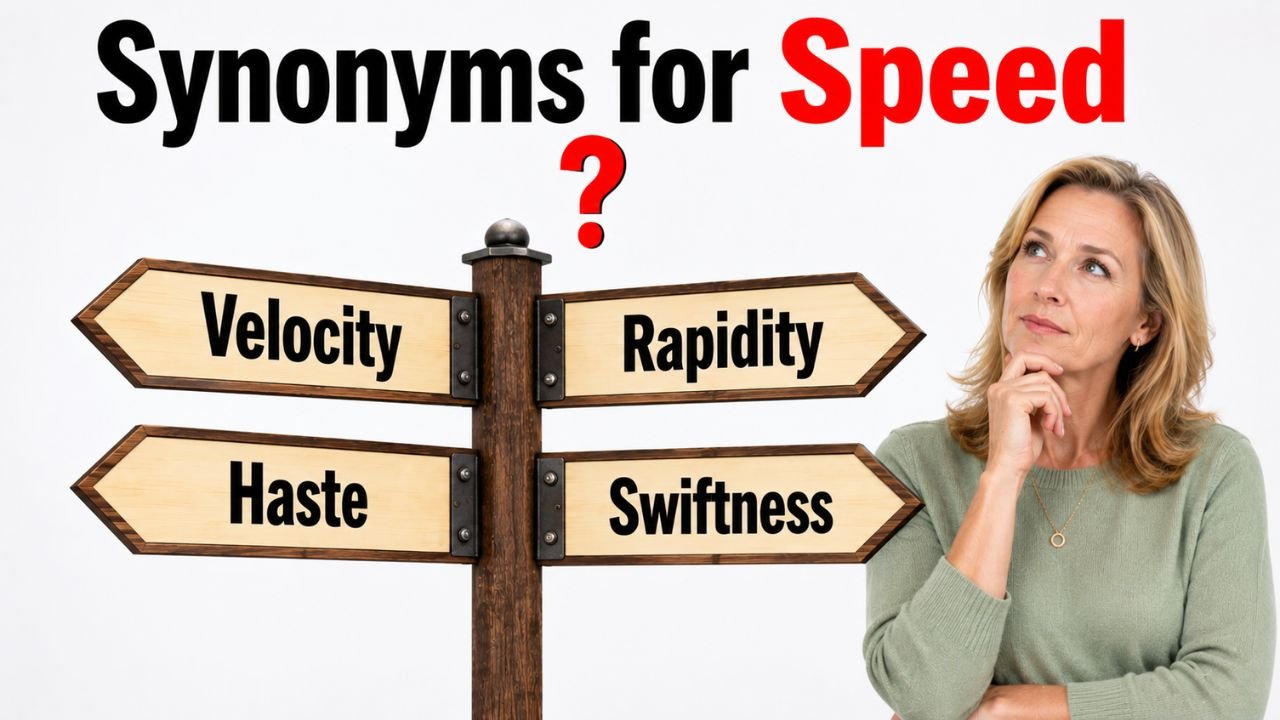
Quick Answer: The best synonyms for speed include quickness, swiftness, rapidity, velocity, pace, rate, haste, acceleration, momentum, and tempo. In general writing, quickness and swiftness describe fast movement or action. Velocity is best for formal, scientific, or technical contexts. Pace describes how quickly an activity progresses, while rate suits measurements, production, and change. Haste suggests urgency and may imply insufficient care. Acceleration refers to increasing speed, momentum describes continued movement or progress, and tempo works well for music, performance, and activity.
Pronunciation and Word Details
Word: Speed.
Pronunciation: /spiːd/
Part of Speech: Noun and verb.
Meaning: Speed is the rate at which someone or something moves, works, happens, or changes.
US Pronunciation:
UK Pronunciation:
What Does “Speed” Mean?
Speed means the rate at which movement, action, progress, or change takes place.
As a noun, speed can describe how fast an object moves, how quickly a person completes a task, or how rapidly an event develops.
Movement Context: The car increased its speed on the open road.
Work Context: The team completed the project with impressive speed.
Change Context: The speed of technological change surprised many observers.
Reaction Context: She responded with great speed.
Speed can also function as a verb. In this use, it means to move quickly, cause something to move faster, or help a process happen sooner.
Verb Example: The train sped through the countryside.
Process Example: Better planning can speed the approval process.
The word is flexible because it can refer to physical motion, mental response, work performance, communication, production, change, music, sports, and many other activities.
Meaning, Tone, and Context of “Speed”
Speed is generally a neutral word, but its tone changes according to context.
Neutral Context: Speed simply describes how quickly something happens.
Example: The machine operates at a steady speed.
Formal Context: Speed appears in reports, instructions, technical writing, transportation discussions, and scientific explanations.
Example: The researchers measured the speed of the moving object.
Conversational Context: In everyday speech, speed commonly refers to fast movement or quick completion.
Example: I was impressed by the speed of her response.
Technical Context: In science, speed measures how much distance is covered during a particular amount of time.
Example: The speed was recorded in meters per second.
Professional Context: In business or workplace writing, speed may refer to efficiency, delivery, response time, production, or decision making.
Example: The new process improved the speed of customer support.
Emotional Context: Speed can suggest excitement, urgency, danger, pressure, or impatience.
Example: The speed of the approaching storm caused concern.
Positive Tone: Speed may communicate efficiency, skill, responsiveness, and progress.
Negative Tone: Excessive speed may suggest carelessness, risk, poor judgment, or lack of attention.
Because speed covers many meanings, the best synonym depends on whether the sentence concerns movement, measurement, urgency, work, progress, rhythm, or increasing motion.
When and How to Use “Speed”
For Physical Movement: Use speed to describe how fast a person, animal, vehicle, or object moves.
Example: The cyclist maintained a high speed throughout the race.
For Work Completion: Use speed when discussing how quickly someone finishes a task.
Example: Her speed did not reduce the quality of her work.
For Response Time: Use speed to describe quick reactions, replies, or decisions.
Example: The emergency team acted with remarkable speed.
For Progress: Use speed to explain how rapidly a project, process, or situation develops.
Example: The speed of construction increased after more workers arrived.
For Measurement: Use speed when discussing distance traveled during a specific period.
Example: The device calculates speed in meters per second.
For Change: Use speed to describe how quickly conditions, prices, opinions, or systems change.
Example: The speed of economic change created new challenges.
For Technology: Use speed when discussing processing, loading, communication, or data transfer.
Example: The system processes information at greater speed.
For Sports: Use speed when describing athletic movement, reactions, or performance.
Example: The player combined speed with excellent control.
For Urgency: Use speed when an action must be completed without delay.
Example: The situation required both speed and accuracy.
For Increasing Movement: Use speed as a verb when something begins moving faster.
Example: The driver sped toward the hospital.
Best Synonyms for Speed
Quickness: The ability to move, think, or act rapidly.
Example: The goalkeeper reacted with impressive quickness.
Swiftness: Fast and smooth movement or action.
Example: The swiftness of the rescue prevented further harm.
Rapidity: A formal word for great speed or fast development.
Example: The rapidity of the changes surprised the entire team.
Velocity: The speed of movement, especially in scientific or technical writing.
Example: The instrument measured the object’s velocity.
Pace: The rate at which an activity, process, or movement continues.
Example: The project moved forward at a steady pace.
Rate: A measured amount of movement, activity, or change over time.
Example: The rate of production increased during the final month.
Haste: Great speed caused by urgency, sometimes without enough care.
Example: In her haste, she forgot to check the final page.
Acceleration: An increase in speed or rate.
Example: The vehicle’s acceleration was smooth and controlled.
Momentum: The force or progress gained by continued movement.
Example: The campaign gained momentum after the public meeting.
Tempo: The speed or rhythm of music, performance, work, or activity.
Example: The conductor increased the tempo of the music.
50 Synonyms for Speed with Short Meanings
- Quickness: The quality of moving or acting rapidly.
- Swiftness: Fast, smooth, and immediate movement.
- Rapidity: A high rate of movement or change.
- Velocity: Measured speed, especially in technical contexts.
- Pace: The rate at which movement or progress continues.
- Rate: The amount of movement, activity, or change over time.
- Haste: Speed caused by urgency.
- Acceleration: An increase in speed.
- Momentum: Continued force or growing progress.
- Tempo: The speed or rhythm of an activity.
- Celerity: Great quickness of movement or action.
- Fleetness: The ability to move very quickly.
- Briskness: Quick, energetic movement or activity.
- Promptness: The quality of acting without delay.
- Dispatch: Quick and efficient completion of a task.
- Expedition: Speed and efficiency in completing something.
- Urgency: A need for immediate action.
- Rush: A sudden period of fast movement or activity.
- Hurry: Movement or action completed quickly.
- Rapid Movement: Motion taking place at great speed.
- Fast Pace: A quick rate of movement or progress.
- High Velocity: A very fast rate of physical movement.
- Fastness: The quality of being fast.
- Nimbleness: Quick and light movement or thought.
- Agility: The ability to move or react quickly.
- Alacrity: Cheerful and eager quickness.
- Readiness: The state of being prepared to act quickly.
- Immediacy: The quality of happening without delay.
- Instantaneity: The quality of occurring almost immediately.
- Efficiency: The ability to complete work quickly with little waste.
- Productivity: The rate at which useful work is completed.
- Turnaround: The time required to complete a process.
- Response Time: The period needed to react or reply.
- Processing Rate: The speed at which information or material is handled.
- Work Rate: The speed at which a person or system performs tasks.
- Production Rate: The amount produced within a certain period.
- Flow Rate: The quantity moving through a system over time.
- Travel Rate: The speed at which a journey progresses.
- Motion: The act or process of moving.
- Movement: A change in physical position.
- Progression: Forward movement or development.
- Advance: Forward movement or improvement.
- Drive: Strong energy that produces fast action or progress.
- Dash: A sudden burst of quick movement.
- Sprint: A short period of movement at maximum speed.
- Surge: A sudden increase in movement, activity, or force.
- Burst: A brief period of intense speed or activity.
- Headway: Forward progress made toward a goal.
- Rhythm: A regular pattern or rate of movement.
- Cadence: The measured flow or pace of movement or sound.
Read Also:
Synonyms for Luxury

Synonyms for Speed by Context
When Speed Means Fast Movement
Quickness, swiftness, rapidity, velocity, fleetness, celerity, and fastness describe rapid physical motion.
Quickness is natural in everyday speech. Swiftness often suggests smooth or graceful movement. Rapidity sounds more formal. Velocity is useful for scientific measurement.
Example With Speed: The bird changed direction without losing speed.
Example With Quickness: The bird changed direction with remarkable quickness.
Example With Velocity: The researchers calculated the bird’s velocity.
When Speed Means the Rate of Progress
Pace, rate, progression, headway, momentum, and advance describe how quickly a task, project, or situation develops.
Pace is the most natural choice for ongoing progress. Rate emphasizes measurement. Momentum suggests that progress is becoming stronger or easier to maintain.
Example With Speed: The speed of the project increased after the meeting.
Example With Pace: The pace of the project increased after the meeting.
Example With Momentum: The project gained momentum after the meeting.
When Speed Means Urgent Action
Haste, hurry, rush, urgency, promptness, dispatch, and immediacy describe action completed without delay.
Haste can suggest carelessness. Promptness is positive and professional. Dispatch emphasizes efficient completion. Urgency focuses on the importance of acting quickly.
Example With Speed: The matter was handled with speed.
Example With Promptness: The matter was handled with promptness.
Example With Urgency: The team treated the matter with urgency.
When Speed Means Efficient Work
Efficiency, productivity, work rate, processing rate, turnaround, dispatch, and expedition relate to fast task completion.
Efficiency includes both speed and careful use of resources. Productivity refers to the amount of useful work completed. Turnaround describes the total time required to finish a process.
Example With Speed: The new method improved the speed of production.
Example With Efficiency: The new method improved production efficiency.
Example With Production Rate: The new method increased the production rate.
When Speed Means an Increase in Movement
Acceleration, surge, burst, drive, and momentum describe movement or progress becoming faster or stronger.
Acceleration is technically precise when speed is increasing. Surge suggests a sudden rise. Momentum describes continued movement that becomes difficult to stop.
Example With Speed: The vehicle gained speed on the straight road.
Example With Acceleration: The vehicle showed strong acceleration on the straight road.
Example With Momentum: The vehicle maintained its momentum on the straight road.
When Speed Means Rhythm or Performance Rate
Tempo, rhythm, cadence, pace, and flow describe the speed and pattern of music, speech, performance, or repeated action.
Tempo is most precise for music. Cadence describes a measured pattern. Rhythm emphasizes repetition and timing. Pace suits speech, storytelling, and performance.
Example With Speed: The speed of the music increased.
Example With Tempo: The tempo of the music increased.
Example With Pace: The pace of the performance became more energetic.
Another Word for Speed
The best general replacement for speed is quickness because it naturally describes fast movement, thought, reaction, or action. However, the ideal synonym depends on the context.
Use velocity for scientific measurement, pace for ongoing progress, rate for measurable change, haste for hurried action, and acceleration for increasing speed.
Original: The athlete’s speed impressed the spectators.
Better Option: The athlete’s quickness impressed the spectators.
Original: The speed of the project has improved.
Better Option: The pace of the project has improved.
Original: The device records the speed of the object.
Better Option: The device records the velocity of the object.
Original: The vehicle gained speed within seconds.
Better Option: The vehicle showed rapid acceleration within seconds.
When Not to Use “Speed”
Speed should not be used when a more exact word would make the sentence clearer.
When Scientific Precision Is Needed: Use velocity when direction and technical measurement are important.
Weak: The report calculated the speed of the object in a specific direction.
Better: The report calculated the velocity of the object in a specific direction.
When Describing Project Progress: Pace often sounds more natural than speed.
Weak: The speed of the writing project remained steady.
Better: The pace of the writing project remained steady.
When Discussing Measured Change: Rate may provide greater accuracy.
Weak: The speed of population growth decreased.
Better: The rate of population growth decreased.
When Referring to Music: Tempo is usually more precise.
Weak: The musician changed the speed of the song.
Better: The musician changed the tempo of the song.
When Urgency Causes Carelessness: Haste communicates the negative meaning more clearly.
Weak: Because of his speed, he made several mistakes.
Better: Because of his haste, he made several mistakes.
When Describing Increased Motion: Acceleration is more precise than speed if the rate is rising.
Weak: The driver noticed the speed of the vehicle increasing.
Better: The driver noticed the vehicle’s acceleration.
When the Word Becomes Repetitive: Replace repeated uses with pace, rate, quickness, or velocity.
Weak: The speed of the runner increased as the speed of the race increased.
Better: The runner’s pace increased as the race became faster.
Words Commonly Confused With Speed
Speed vs Velocity: Speed measures how fast something moves. Velocity describes speed in a particular direction.
Speed vs Pace: Speed often describes physical movement or general quickness. Pace describes the rate at which an activity or process continues.
Speed vs Rate: Speed is one type of rate. Rate is broader and can measure growth, production, change, payment, or frequency.
Speed vs Acceleration: Speed describes how fast something is moving. Acceleration describes how quickly that speed changes.
Speed vs Momentum: Speed refers to movement rate. Momentum refers to the force or progress produced by continued movement.
Speed vs Haste: Speed is neutral. Haste suggests hurried action and may imply carelessness.
Speed vs Quickness: Speed often refers to sustained movement. Quickness often refers to fast reaction, short movement, or mental response.
Speed vs Swiftness: Speed is neutral and widely used. Swiftness is more expressive and often suggests smooth, immediate action.
Speed vs Tempo: Speed is broad. Tempo specifically describes the rate of music or another rhythmic activity.
Speed vs Efficiency: Speed concerns quick completion. Efficiency concerns achieving results with minimal waste, effort, or cost.
Which Synonym Should You Choose?
Choose quickness for natural everyday writing about rapid movement, thought, or reaction.
Choose swiftness when you want to emphasize smooth, graceful, or immediate action.
Choose rapidity in formal writing about fast development, movement, or change.
Choose velocity in scientific, mathematical, engineering, or technical contexts.
Choose pace when describing the progress of work, study, exercise, conversation, or a project.
Choose rate when discussing measurable growth, production, change, flow, or frequency.
Choose haste when fast action causes mistakes or insufficient care.
Choose promptness for professional communication, service, replies, attendance, or action without delay.
Choose acceleration when describing an increase in speed.
Choose momentum when progress is continuing and becoming stronger.
Choose tempo when discussing music, performance, rhythm, or the energy of an activity.
Choose efficiency when speed is combined with careful use of time, effort, and resources.
Choose turnaround when discussing the total time needed to complete a service or process.
Choose response time when describing how quickly a person, system, or organization reacts.
Choose sprint or dash for a short burst of maximum physical speed.
Real Life Examples of “Speed” in Sentences
Original: The speed of her reply surprised me.
Better Option: The promptness of her reply surprised me.
Original: The runner’s speed increased near the finish line.
Better Option: The runner’s pace increased near the finish line.
Original: The machine operates at a greater speed.
Better Option: The machine operates at a higher rate.
Original: The speed of the rescue saved several lives.
Better Option: The swiftness of the rescue saved several lives.
Original: The project gained speed after additional funding arrived.
Better Option: The project gained momentum after additional funding arrived.
Original: The speed of the music made the dance more energetic.
Better Option: The tempo of the music made the dance more energetic.
Original: The speed of the vehicle increased sharply.
Better Option: The vehicle’s acceleration increased sharply.
Original: She completed the assignment with speed.
Better Option: She completed the assignment with impressive efficiency.
Original: The speed of change created uncertainty.
Better Option: The rapidity of change created uncertainty.
Original: The athlete depended on speed and balance.
Better Option: The athlete depended on quickness and balance.
Synonym Groups and Usage Differences
Physical Movement Group
Quickness, swiftness, rapidity, velocity, fleetness, fastness, celerity, dash, and sprint relate to physical movement.
Quickness often describes reaction or short movement. Swiftness suggests smooth action. Velocity is technical. Sprint and dash describe short bursts of high speed.
Example: The runner’s swiftness gave her an early lead.
Progress and Development Group
Pace, rate, momentum, progression, advance, and headway describe movement toward a goal.
Pace shows how quickly progress continues. Rate measures change. Momentum suggests growing strength. Headway focuses on useful progress.
Example: The team made steady headway during the final week.
Urgency Group
Haste, hurry, rush, urgency, immediacy, and promptness describe action without delay.
Haste may be careless. Hurry and rush are conversational. Urgency emphasizes importance. Promptness has a positive and professional tone.
Example: The request was answered with admirable promptness.
Technical Measurement Group
Speed, velocity, acceleration, flow rate, processing rate, and travel rate appear in measured or technical contexts.
Velocity includes direction. Acceleration measures change in speed. Flow rate measures movement through a system. Processing rate measures how quickly information is handled.
Example: The engineers measured the flow rate through the pipe.
Work and Productivity Group
Efficiency, productivity, work rate, production rate, turnaround, dispatch, and expedition describe fast and effective work.
Efficiency focuses on minimizing waste. Productivity measures useful output. Turnaround refers to completion time. Dispatch suggests quick and capable handling.
Example: The improved system reduced the turnaround for each request.
Rhythm and Performance Group
Tempo, rhythm, cadence, pace, and flow describe the timing of music, speech, movement, or performance.
Tempo is the most direct musical term. Rhythm concerns repeated patterns. Cadence describes measured flow. Pace controls how quickly a performance develops.
Example: The speaker maintained a calm and steady cadence.
Increasing Movement Group
Acceleration, momentum, surge, burst, and drive describe growing speed, energy, or progress.
Acceleration is measurable. Momentum develops through continued movement. A surge is sudden. A burst is brief. Drive suggests strong internal energy.
Example: The project gained momentum after the first successful result.
Antonyms of Speed
The opposite of speed depends on whether the sentence describes movement, response, progress, or work.
Slowness: The quality of moving or happening slowly.
Delay: A period in which action is postponed.
Lateness: Failure to happen at the expected time.
Leisureliness: A relaxed and unhurried pace.
Inactivity: A lack of movement or action.
Stillness: The complete absence of movement.
Stagnation: A condition in which progress stops.
Deceleration: A reduction in speed.
Hesitation: A pause caused by uncertainty.
Idleness: A state of not working or acting.
Drag: A force or condition that slows movement or progress.
Pause: A temporary stop in activity.
Standstill: A complete stop in movement or development.
Sluggishness: Slow, heavy, or low energy movement.
Inefficiency: Poor use of time, effort, or resources.
Comparison: Speed vs Related Words
Speed vs Quickness
Speed often describes how fast movement continues over a distance or period. Quickness commonly describes fast reactions, short actions, or mental responses.
Example With Speed: The train maintained its speed throughout the journey.
Example With Quickness: The goalkeeper reacted with remarkable quickness.
Speed vs Swiftness
Speed is neutral and widely applicable. Swiftness sounds more expressive and often emphasizes smooth or immediate action.
Example With Speed: The speed of the vehicle was carefully controlled.
Example With Swiftness: The swiftness of the response prevented further damage.
Speed vs Rapidity
Speed is common in everyday and technical language. Rapidity is more formal and often describes fast change, growth, or repeated action.
Example With Speed: The speed of the process improved.
Example With Rapidity: The rapidity of the transformation surprised the observers.
Speed vs Velocity
Speed states how fast something moves. Velocity states how fast it moves in a particular direction.
Example With Speed: The vehicle traveled at a constant speed.
Example With Velocity: The vehicle maintained a constant velocity toward the east.
Speed vs Pace
Speed commonly relates to movement. Pace refers to the rate of progress, work, exercise, speech, or storytelling.
Example With Speed: The car reduced its speed near the crossing.
Example With Pace: The instructor adjusted the pace of the lesson.
Speed vs Rate
Speed is a specific measure of movement. Rate is a broader measure of change, activity, frequency, or quantity over time.
Example With Speed: The speed of the bicycle reached its highest point.
Example With Rate: The rate of production increased during the month.
Speed vs Haste
Speed can be positive, negative, or neutral. Haste usually suggests urgency and possible carelessness.
Example With Speed: She completed the task with speed and accuracy.
Example With Haste: She made several errors because of her haste.
Speed vs Acceleration
Speed describes current movement. Acceleration describes an increase or decrease in that movement.
Example With Speed: The vehicle maintained a steady speed.
Example With Acceleration: The vehicle showed strong acceleration after the turn.
Speed vs Momentum
Speed describes how fast something moves. Momentum describes the force or progress gained through continued movement.
Example With Speed: The runner increased her speed.
Example With Momentum: The campaign gained momentum after the announcement.
Speed vs Tempo
Speed is a general term. Tempo refers specifically to the rate or rhythm of music and performance.
Example With Speed: The speed of the activity increased.
Example With Tempo: The conductor increased the tempo of the final section.
Common Phrases and Expressions With “Speed”
At Full Speed: Moving or operating as fast as possible.
High Speed: Involving very fast movement or operation.
Top Speed: The greatest speed something can reach.
Average Speed: The typical speed calculated over a complete distance or period.
Speed Limit: The highest legal or permitted speed.
Speed of Light: An expression referring to extremely rapid movement.
Pick Up Speed: To begin moving or progressing faster.
Gather Speed: To increase gradually in movement or development.
Reduce Speed: To begin moving more slowly.
With Great Speed: Very quickly.
Speed Up: To make something happen or move faster.
Up to Speed: Fully informed, prepared, or performing at the required level.
Common Mistakes to Avoid
Confusing Speed With Velocity: Use speed for movement rate and velocity when direction is also important.
Using Speed for Every Type of Progress: Pace, rate, momentum, or headway may sound more natural when discussing projects, learning, or development.
Confusing Speed With Acceleration: Speed is how fast something moves. Acceleration is the change in that speed.
Using Haste as a Positive Synonym: Haste may imply carelessness. Use promptness or efficiency when you want a positive meaning.
Choosing a Technical Word in Casual Speech: Velocity may sound unnatural in an ordinary conversation about walking, running, or completing work.
Using Tempo Outside a Rhythmic Context: Tempo works best for music, performance, speech, and repeated activity.
Repeating Speed Too Often: Use pace, quickness, rate, swiftness, or momentum to improve variety.
Ignoring the Part of Speech: Speed can be a noun or a verb. Make sure the sentence structure matches its grammatical role.
Using Fastness Unnaturally: Although fastness can mean the quality of being fast, quickness or speed usually sounds more natural.
Assuming Faster Always Means Better: Speed without accuracy, safety, or quality may produce poor results.
Conclusion
Understanding synonyms for speed helps you choose a word that matches the exact situation. Quickness and swiftness suit fast movement, while velocity works best in technical writing. Pace and rate describe progress or measurable change. Haste suggests rushed action, whereas promptness and efficiency have a more positive tone. Acceleration refers to increasing speed, momentum shows growing progress, and tempo describes rhythm. Selecting the right alternative makes writing clearer, more precise, and more natural.
FAQs About Synonyms for Speed
What is the best synonym for speed?
Quickness is the best general synonym. However, pace, rate, velocity, or swiftness may be more accurate in specific contexts.
What is a formal synonym for speed?
Rapidity, velocity, celerity, and dispatch are formal alternatives. The correct choice depends on whether the sentence describes movement, urgency, or task completion.
What is another word for moving at great speed?
Swiftness, rapidity, fleetness, and high velocity can describe movement at great speed.
What is the difference between speed and velocity?
Speed measures how fast something moves. Velocity measures how fast it moves in a particular direction.
What synonym for speed is best for work?
Efficiency, productivity, work rate, turnaround, and pace are useful when discussing work or task completion.
Is haste a positive synonym for speed?
Not usually. Haste often suggests that something was done too quickly and without enough care.
What is the opposite of speed?
Slowness is the most direct opposite. Delay, stagnation, deceleration, and sluggishness are useful alternatives in particular contexts.
