
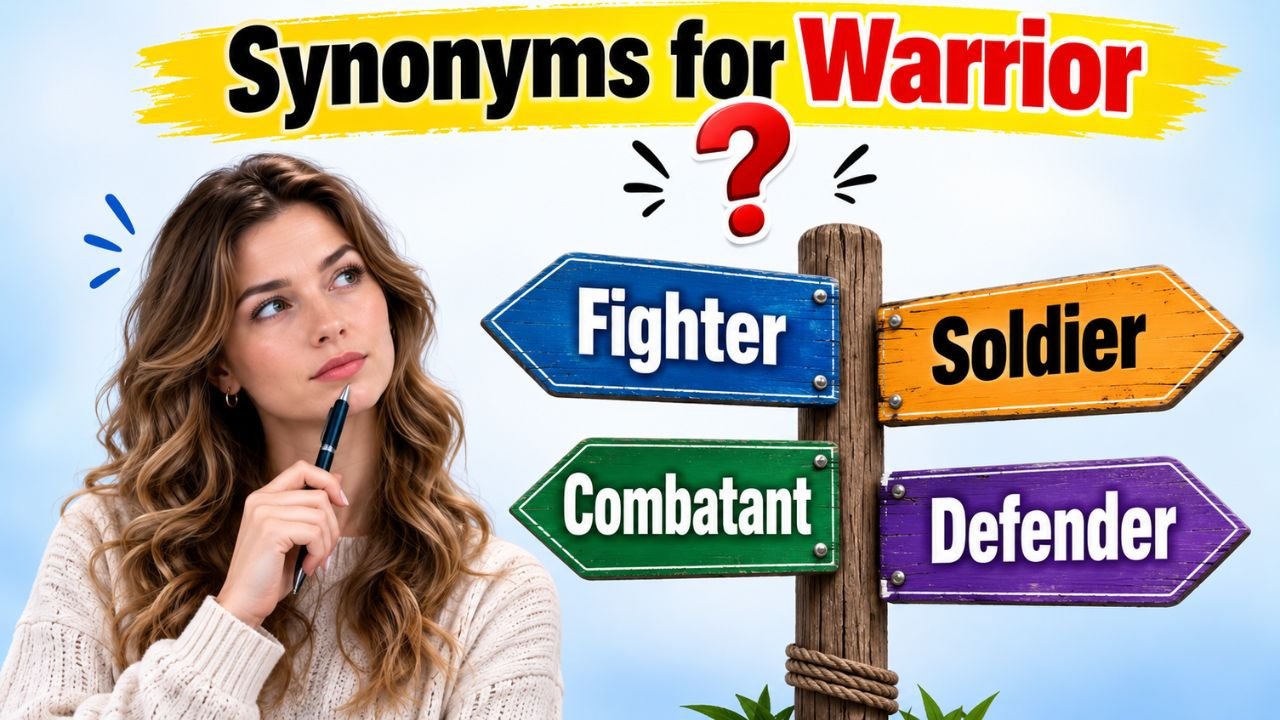
Quick Answer: The best synonyms for warrior include fighter, soldier, combatant, champion, defender, guardian, hero, veteran, knight, and battler. Use soldier for an officially trained member of an army, combatant for someone actively involved in fighting, and fighter as the broadest everyday alternative. Champion works well for someone defending a cause, while guardian and defender emphasize protection. Knight suits historical settings, veteran highlights experience, and hero expresses admiration for courage.
Pronunciation and Word Details
Word: Warrior.
Pronunciation: /ˈwɔːriər/
Part of Speech: Noun.
Meaning: A brave or skilled person who fights in a battle or struggles strongly for a cause.
US Pronunciation:
UK Pronunciation:
What Does “Warrior” Mean?
A warrior is a person who fights bravely in a battle, conflict, competition, or difficult struggle.
The word warrior is a countable noun. Its plural form is warriors. Traditionally, it describes someone trained or experienced in warfare, especially a fighter from an ancient, tribal, or historical culture.
In modern language, warrior can also describe someone who shows courage, strength, and determination while facing illness, hardship, injustice, or personal challenges. In this figurative sense, the person does not need to take part in physical combat.
Literal Use: The warrior carried a shield into battle.
Historical Use: The ancient warriors protected their settlement.
Figurative Use: She remained a warrior throughout every difficult stage of her recovery.
Admiring Use: He is a true warrior who never abandons the people who depend on him.
The intended meaning usually depends on whether the sentence describes warfare, protection, competition, personal courage, or commitment to a cause.
Meaning, Tone, and Context of “Warrior”
Warrior is a strong and emotionally powerful word. It commonly suggests bravery, discipline, endurance, loyalty, and readiness to face danger.
Formal Tone: Warrior can appear in historical, military, cultural, and academic writing when discussing people known for combat or martial traditions.
Conversational Tone: In everyday speech, it is often used as praise for someone who remains strong during a difficult experience.
Historical Context: The word frequently describes knights, samurai, gladiators, tribal fighters, swordsmen, and other people associated with earlier forms of warfare.
Military Context: Warrior may describe a courageous fighter, but soldier is usually more precise for a member of a modern organized army.
Emotional Context: Calling someone a warrior expresses admiration for that person’s courage and endurance.
Figurative Context: The word can describe an advocate, survivor, campaigner, or determined person fighting for a goal.
Competitive Context: In sports and contests, warrior may describe an athlete who competes with unusual courage and persistence.
Because warrior carries a heroic and dramatic feeling, it should be used carefully when a neutral word such as soldier, competitor, or advocate would be more accurate.
When and How to Use “Warrior”
For Physical Combat: Use warrior for someone known for bravery, skill, or strength in battle.
Example: The warrior defended the village against the invading force.
For Historical Descriptions: Use warrior when discussing fighters from ancient, medieval, or traditional societies.
Example: The young warrior trained with a sword and shield.
For Protection: Use warrior for a person who bravely protects a community, family, country, or belief.
Example: The warrior stood at the entrance to protect the people inside.
For Personal Struggles: Use warrior figuratively for someone showing determination during hardship.
Example: She faced every setback like a warrior.
For Supporting a Cause: Use warrior for a passionate person who works persistently for justice, reform, or social improvement.
Example: He became a warrior for equal access to education.
For Sports and Competition: Use warrior to praise a competitor who refuses to give up.
Example: The exhausted runner showed the heart of a warrior.
For Emotional Praise: Use warrior when you want to emphasize courage rather than simply describe someone’s role.
Example: Her family called her a warrior because of her remarkable strength.
Best Synonyms for Warrior
Fighter: A person who fights physically or struggles strongly against difficulty.
Example: The determined fighter refused to surrender.
Soldier: A trained member of an organized army.
Example: The soldier followed the commander’s instructions.
Combatant: A person actively participating in armed conflict.
Example: Every combatant was ordered to leave the restricted area.
Champion: A person who strongly supports or defends a cause.
Example: She became a champion of fair treatment.
Defender: Someone who protects a person, place, belief, or community.
Example: The defender remained at the gate throughout the night.
Guardian: A person responsible for protecting someone or something.
Example: The guardian watched over the sacred grounds.
Hero: A person admired for courage, sacrifice, or noble actions.
Example: The villagers remembered him as a hero.
Veteran: A person with extensive experience in military service or another demanding field.
Example: The veteran shared lessons from years of service.
Knight: A mounted or armored warrior from a historical European tradition.
Example: The knight rode toward the castle.
Battler: A person who fights persistently against an opponent or hardship.
Example: She is a courageous battler who never loses hope.
50 Synonyms for Warrior with Short Meanings
- Fighter: A person who fights or resists strongly.
- Soldier: A trained member of an army.
- Combatant: Someone actively involved in armed conflict.
- Battler: A person who struggles persistently.
- Veteran: An experienced former or current service member.
- Trooper: A soldier, especially one serving in a particular military unit.
- Service Member: A person serving in an organized military force.
- Guardsman: A soldier assigned to guard or protect.
- Defender: Someone who protects against attack or criticism.
- Protector: A person who keeps others safe.
- Guardian: Someone trusted to watch over a person or place.
- Champion: A strong defender of a cause or person.
- Hero: Someone admired for bravery or sacrifice.
- Conqueror: A fighter who defeats and gains control over an opponent.
- Mercenary: A professional fighter hired for payment.
- Commando: A specially trained soldier used for difficult operations.
- Rebel: A person fighting against established authority.
- Insurgent: A fighter taking part in an organized rebellion.
- Resistance Fighter: A person opposing an occupying or controlling force.
- Freedom Fighter: A person fighting for political or national freedom.
- Knight: An armored warrior from medieval history.
- Gladiator: A trained fighter who competed in ancient public contests.
- Samurai: A member of the historical Japanese warrior class.
- Paladin: A heroic knight or noble defender.
- Legionary: A soldier serving in an ancient Roman legion.
- Hoplite: A heavily armed foot soldier from ancient Greece.
- Musketeer: A historical soldier armed with a musket.
- Swordsman: A person skilled in fighting with a sword.
- Spearman: A warrior who fights using a spear.
- Archer: A fighter skilled in using a bow and arrows.
- Cavalryman: A soldier who traditionally fought on horseback.
- Infantryman: A soldier trained to fight on foot.
- Berserker: A fierce warrior associated with uncontrolled battle rage.
- Raider: A fighter who attacks suddenly to capture or destroy.
- Shield Bearer: A warrior who carries a shield for protection.
- War Chief: A leader responsible for directing warriors in conflict.
- Duelist: A person trained to fight an individual opponent.
- Martial Artist: Someone trained in a system of physical combat.
- Boxer: A person who competes using boxing skills.
- Pugilist: A formal word for a boxer or fist fighter.
- Wrestler: A person trained to compete through grappling.
- Brawler: Someone who fights roughly and aggressively.
- Survivor: A person who endures and overcomes severe hardship.
- Struggler: Someone who continues despite difficulty.
- Crusader: A determined supporter or campaigner for a cause.
- Advocate: A person who publicly supports or defends something.
- Campaigner: Someone working actively toward a social or political goal.
- Activist: A person taking action to create change.
- Contender: A person competing seriously for success.
- Competitor: Someone taking part in a contest or struggle.
Read Also:
Synonyms for Play

Synonyms for Warrior by Context
When Warrior Means a Person in Battle
Fighter, soldier, combatant, trooper, commando, and infantryman describe people involved in physical or military conflict.
Fighter is the most flexible choice. Soldier refers specifically to a trained member of an organized army. Combatant is more formal and emphasizes direct participation in conflict.
Example With Warrior: The warrior advanced toward the enemy position.
Example With Soldier: The soldier advanced toward the enemy position.
Example With Combatant: The combatant was actively involved in the fighting.
When Warrior Means a Protector
Defender, protector, guardian, champion, and guardsman emphasize safety, loyalty, and protection.
Defender is suitable for physical, legal, moral, or verbal protection. Guardian suggests responsibility and watchfulness. Champion often describes someone who strongly supports another person or cause.
Example With Warrior: She became a warrior for vulnerable children.
Example With Defender: She became a defender of vulnerable children.
Example With Champion: She became a champion for vulnerable children.
When Warrior Refers to a Historical Fighter
Knight, gladiator, samurai, legionary, hoplite, musketeer, swordsman, and spearman are more precise in historical settings.
These words should not be treated as perfect replacements in every sentence because each one belongs to a specific time, culture, military system, or fighting style.
Example With Warrior: The warrior wore heavy armor.
Example With Knight: The knight wore heavy armor.
Example With Legionary: The legionary carried equipment used by the ancient army.
When Warrior Describes Personal Courage
Fighter, battler, survivor, struggler, and hero can describe someone enduring illness, loss, pressure, or hardship.
Fighter is direct and common. Survivor emphasizes endurance after danger or suffering. Battler highlights an ongoing struggle. Hero expresses strong admiration.
Example With Warrior: She was a warrior during the most difficult year of her life.
Example With Fighter: She was a fighter during the most difficult year of her life.
Example With Survivor: She was a survivor who rebuilt her life with courage.
When Warrior Means a Supporter of a Cause
Champion, advocate, campaigner, activist, crusader, and defender describe people working for change.
Advocate is usually professional and neutral. Campaigner emphasizes organized effort. Activist suggests direct action. Crusader is stronger and can sound dramatic.
Example With Warrior: He is a warrior for environmental protection.
Example With Advocate: He is an advocate for environmental protection.
Example With Campaigner: He is a campaigner for environmental protection.
When Warrior Describes a Determined Competitor
Competitor, contender, fighter, boxer, wrestler, and champion fit sports and competitive contexts.
Competitor is neutral. Contender suggests a strong chance of winning. Fighter works for combat sports and figurative struggles. Champion may refer to a winner or a person with exceptional ability.
Example With Warrior: The player competed like a warrior.
Example With Competitor: The player was a fearless competitor.
Example With Contender: The player proved that she was a serious contender.
Another Word for Warrior
The best general replacement for warrior is fighter. It can describe physical combat, emotional struggle, competition, or persistent resistance. However, the most accurate alternative depends on the sentence.
Use soldier for organized military service, defender for protection, champion for support of a cause, survivor for overcoming hardship, and knight for a specific historical setting.
Original: The warrior entered the battlefield.
Better Option: The soldier entered the battlefield.
Original: She is a warrior for disability rights.
Better Option: She is an advocate for disability rights.
Original: He remained a warrior throughout his recovery.
Better Option: He remained a fighter throughout his recovery.
Original: The warrior guarded the palace entrance.
Better Option: The guardsman protected the palace entrance.
When Not to Use “Warrior”
Warrior should not be used when a more precise role, profession, historical identity, or relationship is important.
When Military Precision Is Needed: Soldier, officer, infantryman, or commander may communicate the person’s role more accurately.
Weak: The warrior reported to his military unit.
Better: The soldier reported to his military unit.
When the Tone Should Be Neutral: Warrior can sound heroic or dramatic when the sentence only needs a factual description.
Weak: Every warrior completed the basic training form.
Better: Every service member completed the basic training form.
When Describing Peaceful Advocacy: Calling every supporter a warrior may exaggerate the situation.
Weak: She is a warrior who writes letters supporting library funding.
Better: She is an advocate who writes letters supporting library funding.
When Historical Accuracy Matters: Do not replace a specific term such as knight, samurai, or legionary with warrior when the exact identity is important.
Weak: The warrior served in an ancient Roman legion.
Better: The legionary served in an ancient Roman legion.
When It Could Sound Insensitive: Avoid automatically calling someone a warrior during illness or grief unless that person is comfortable with the description.
Weak: Every patient must become a warrior.
Better: Every patient deserves support while facing the experience in a personal way.
When the Word Becomes Repetitive: Use precise synonyms to improve variety and clarity.
Weak: The warrior was a brave warrior who inspired other warriors.
Better: The courageous fighter inspired the other soldiers.
Words Commonly Confused With Warrior
Warrior vs Fighter: Warrior often suggests bravery, honor, training, or a strong identity. Fighter is broader and can describe anyone who fights physically or figuratively.
Warrior vs Soldier: A warrior is any person associated with courageous combat or struggle. A soldier is an official member of an organized army.
Warrior vs Combatant: Warrior carries an emotional or heroic tone. Combatant is a neutral and formal term for someone directly participating in conflict.
Warrior vs Champion: A warrior fights or struggles. A champion supports, defends, or represents a person, belief, or cause.
Warrior vs Defender: A warrior may attack or defend. A defender specifically protects someone or something.
Warrior vs Guardian: Warrior focuses on fighting ability and courage. Guardian focuses on responsibility, safety, and watchfulness.
Warrior vs Hero: A warrior is defined by combat or struggle. A hero is admired for courage, sacrifice, or achievement and may never fight.
Warrior vs Knight: Warrior is a general term. Knight refers to a particular historical and social role.
Warrior vs Veteran: Warrior describes a fighter or determined person. Veteran describes someone with long experience, especially in military service.
Warrior vs Survivor: Warrior emphasizes active struggle and courage. Survivor emphasizes living through danger, loss, illness, or hardship.
Which Synonym Should You Choose?
Choose fighter when you need a broad and natural replacement for someone who fights or struggles.
Choose soldier when describing a trained member of a modern organized army.
Choose combatant in formal reports, legal discussions, academic writing, or neutral descriptions of armed conflict.
Choose defender when the person protects a place, belief, person, or community.
Choose guardian when protection involves responsibility, watchfulness, or care.
Choose champion when someone strongly supports a cause, group, principle, or reform.
Choose hero when you want to emphasize courage, sacrifice, and admiration.
Choose veteran when experience and years of service are important.
Choose knight, samurai, gladiator, legionary, or hoplite when historical accuracy matters.
Choose survivor when describing someone who has endured a dangerous or painful experience.
Choose battler when the struggle is continuing and persistence is the main idea.
Choose advocate for formal writing about someone who supports a policy, right, or cause.
Choose campaigner or activist when describing organized efforts to create change.
Choose contender or competitor when discussing sports, contests, or professional rivalry.
Real Life Examples of “Warrior” in Sentences
Original: The warrior protected the northern gate.
Better Option: The defender protected the northern gate.
Original: Every warrior followed the army commander.
Better Option: Every soldier followed the army commander.
Original: She became a warrior for educational equality.
Better Option: She became an advocate for educational equality.
Original: He faced the long recovery like a warrior.
Better Option: He faced the long recovery like a fighter.
Original: The warrior competed despite his injury.
Better Option: The competitor continued despite his injury.
Original: The ancient warrior fought with a sword.
Better Option: The swordsman fought with a sword.
Original: The warrior guarded the royal family.
Better Option: The guardsman protected the royal family.
Original: The warrior had survived many battles.
Better Option: The veteran had survived many battles.
Original: Her courage made her a warrior in the eyes of her family.
Better Option: Her courage made her a hero in the eyes of her family.
Original: The warrior refused to abandon the campaign.
Better Option: The campaigner refused to abandon the cause.
Synonym Groups and Usage Differences
General Combat Group
Fighter, warrior, battler, and combatant all describe someone involved in conflict.
Fighter is the broadest option. Combatant is formal and neutral. Battler emphasizes persistent effort. Warrior adds courage, identity, and emotional strength.
Example: The experienced fighter remained calm during the confrontation.
Military Service Group
Soldier, trooper, service member, infantryman, commando, and guardsman refer to organized military roles.
These words are more precise than warrior when the person’s position or type of service matters.
Example: The infantryman carried equipment across the field.
Protection Group
Defender, protector, guardian, guardsman, and champion focus on keeping people, places, beliefs, or rights safe.
Defender is versatile. Protector suggests physical or emotional safety. Guardian suggests responsibility. Champion is often connected to ideas and causes.
Example: She became a respected defender of individual rights.
Historical Warrior Group
Knight, gladiator, samurai, legionary, hoplite, musketeer, swordsman, and spearman identify particular historical fighters.
Each word carries cultural and historical information that the general word warrior does not provide.
Example: The knight prepared his armor before the journey.
Courage and Survival Group
Fighter, survivor, battler, struggler, and hero describe people facing serious hardship.
Survivor focuses on endurance. Fighter emphasizes resistance. Hero adds praise. Struggler highlights difficulty but may sound less complimentary.
Example: The survivor rebuilt her future with patience and courage.
Cause and Advocacy Group
Champion, advocate, campaigner, activist, defender, and crusader describe people committed to a cause.
Advocate is professional and balanced. Campaigner suggests organized effort. Activist emphasizes action. Crusader sounds forceful and strongly committed.
Example: He became a leading advocate for safer working conditions.
Sports and Competition Group
Competitor, contender, fighter, boxer, wrestler, and champion relate to contests and athletic performance.
Competitor is neutral. Contender suggests someone likely to win. Champion can describe an actual winner. Fighter is most suitable for combat sports.
Example: The young contender impressed the judges with her discipline.
Antonyms of Warrior
There is no single perfect antonym for warrior because the word can refer to combat, courage, protection, or personal struggle. The most suitable opposite depends on the intended meaning.
Civilian: A person who is not a member of the military.
Noncombatant: Someone who does not participate in fighting.
Pacifist: A person who opposes war and violence.
Peacemaker: Someone who tries to end conflict and create agreement.
Coward: A person who lacks courage when facing danger.
Deserter: Someone who abandons a military position or duty.
Captive: A person held under the control of an opposing force.
Bystander: Someone present at an event without taking part.
Opponent: A person positioned against another in a contest or conflict.
Surrenderer: A person who stops resisting and accepts defeat.
Comparison: Warrior vs Related Words
Warrior vs Fighter
Warrior often suggests bravery, honor, discipline, or a historical fighting identity. Fighter is more general and can refer to combat, sports, debate, illness, or hardship.
Example With Warrior: The warrior defended his people with courage.
Example With Fighter: She has always been a determined fighter.
Warrior vs Soldier
A warrior may belong to any fighting tradition or may be used figuratively. A soldier is officially trained and organized within an army.
Example With Warrior: The ancient warrior carried a decorated shield.
Example With Soldier: The soldier completed military training.
Warrior vs Combatant
Warrior is expressive and often admiring. Combatant is factual, formal, and focused on direct participation in armed conflict.
Example With Warrior: The story celebrates a fearless warrior.
Example With Combatant: The agreement applied to every active combatant.
Warrior vs Defender
A warrior may fight offensively or defensively. A defender specifically acts to protect someone or something.
Example With Warrior: The warrior advanced toward the opposing force.
Example With Defender: The defender prevented the attackers from entering.
Warrior vs Guardian
Warrior emphasizes combat and strength. Guardian emphasizes protection, care, supervision, or responsibility.
Example With Warrior: The warrior prepared for battle.
Example With Guardian: The guardian watched over the entrance.
Warrior vs Champion
Warrior suggests struggle or combat. Champion often describes someone who strongly supports a cause or has won a competition.
Example With Warrior: He was known as a warrior for justice.
Example With Champion: He became a champion of justice reform.
Warrior vs Hero
A warrior is a fighter or courageous struggler. A hero is anyone admired for bravery, sacrifice, or noble action.
Example With Warrior: The warrior fought to protect the village.
Example With Hero: The rescuer became a hero after saving the family.
Warrior vs Knight
Warrior is a broad term for a fighter. Knight identifies a specific historical social and military position.
Example With Warrior: The warrior crossed the battlefield.
Example With Knight: The knight served the royal court.
Warrior vs Veteran
Warrior describes someone who fights or struggles. Veteran emphasizes extensive experience or previous service.
Example With Warrior: The warrior showed remarkable courage.
Example With Veteran: The veteran shared knowledge gained through years of service.
Warrior vs Survivor
Warrior focuses on active resistance, determination, and courage. Survivor focuses on continuing to live or recover after danger or hardship.
Example With Warrior: She approached treatment with a warrior spirit.
Example With Survivor: She is a survivor who rebuilt her life after the crisis.
Common Phrases and Expressions With “Warrior”
Brave Warrior: A fighter known for courage.
Fierce Warrior: A powerful and aggressive fighter.
Mighty Warrior: A warrior with exceptional strength or influence.
Skilled Warrior: A person highly trained in combat.
Fearless Warrior: Someone who faces danger without showing fear.
Warrior Spirit: A courageous and determined attitude.
Warrior Mindset: A disciplined way of thinking focused on endurance and success.
Weekend Warrior: A person who takes part in a demanding activity mainly during free time.
Road Warrior: A person who travels frequently for work or competition.
Keyboard Warrior: A person who expresses aggressive opinions through online writing but may avoid direct confrontation.
Warrior Poet: A person who combines physical courage with creativity, wisdom, or artistic sensitivity.
True Warrior: Someone believed to represent courage, discipline, and persistence.
Common Mistakes to Avoid
Using Warrior as an Exact Synonym for Soldier: Not every warrior is a soldier, and not every soldier is described as a warrior. Use soldier when official military membership is important.
Ignoring Historical Accuracy: Knight, samurai, legionary, and gladiator refer to different cultures and roles. Do not exchange these words without checking the historical context.
Overusing Figurative Language: Calling every determined person a warrior can make the word lose its emotional power. Use fighter, advocate, survivor, or competitor when they are more precise.
Using Warrior in a Neutral Report: Warrior may sound admiring or dramatic. Combatant, soldier, or service member may be more appropriate in factual writing.
Choosing an Unnatural Synonym: A boxer may be a warrior figuratively, but boxer is not suitable in a sentence about ancient sword fighting.
Confusing Defender With Warrior: A defender protects, while a warrior may attack, defend, compete, or struggle.
Confusing Hero With Warrior: A hero does not need to fight. Heroism may involve rescue, sacrifice, leadership, honesty, or service.
Repeating the Same Word: Avoid using warrior several times in one paragraph. Replace it with fighter, soldier, defender, champion, or a specific historical term when appropriate.
Using Insensitive Labels: Some people may not want difficult personal experiences described as battles. Consider the individual’s preference before using warrior, fighter, or survivor.
Forgetting the Context: Select synonyms based on the exact idea. Soldier fits military service, advocate fits support for a cause, and contender fits competition.
Conclusion
The keyword synonyms for warrior includes words connected to combat, courage, protection, history, competition, and personal strength. Fighter is the broadest alternative, while soldier and combatant suit military contexts. Defender, guardian, and champion emphasize protection or support. Knight, samurai, and gladiator provide historical precision. Survivor and battler work well for personal hardship, while advocate and campaigner suit important causes. Choosing the right synonym makes each sentence more accurate, natural, and emotionally appropriate.
FAQs About Synonyms for Warrior
What is the best synonym for warrior?
Fighter is the best general synonym because it can describe physical combat, competition, resistance, or personal struggle.
Is soldier another word for warrior?
Yes, but only in military contexts. Soldier refers specifically to a trained member of an organized army, while warrior has a broader meaning.
What is a formal synonym for warrior?
Combatant is a formal and neutral synonym when referring to someone actively involved in armed conflict.
What is a strong synonym for warrior?
Champion, defender, hero, fighter, and guardian are strong alternatives. The best choice depends on whether the person fights, protects, supports, or survives.
What is another word for a female warrior?
Warrior can describe any gender. More specific alternatives include fighter, soldier, champion, heroine, knight, defender, or guardian.
Can warrior be used figuratively?
Yes. Warrior can describe someone who faces illness, hardship, injustice, competition, or another difficult struggle with courage.
What is the difference between a warrior and a fighter?
Warrior often suggests courage, honor, discipline, or historical identity. Fighter is broader and may describe anyone involved in physical or figurative struggle.
