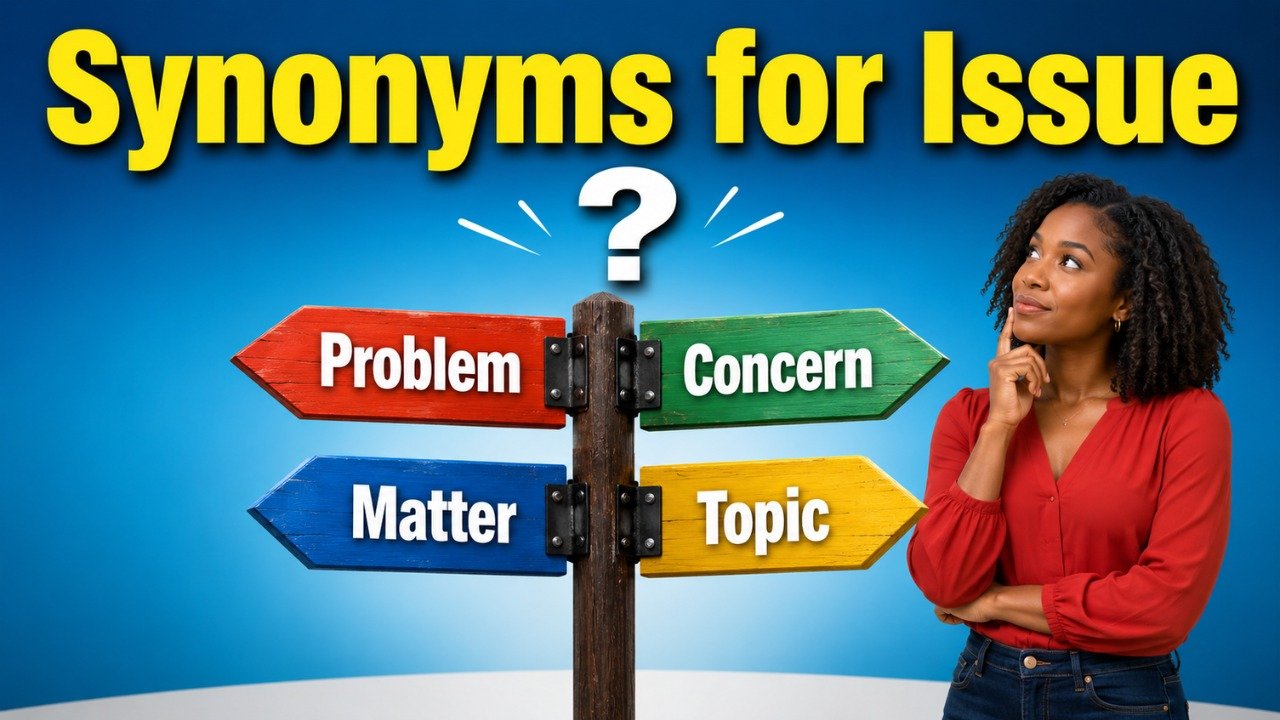
Quick Answer: Synonyms for issue include problem, matter, topic, concern, question, subject, difficulty, challenge, dispute, and edition. Use problem when talking about something wrong, matter for a general subject, concern for something that needs attention, topic for discussion, question for uncertainty, dispute for disagreement, and edition when issue means a published number of a magazine, journal, or series.
Pronunciation and Word Details
Word: Issue
Pronunciation: ˈɪʃuː
Part of Speech: Noun and verb
Meaning: An issue is a problem, topic, concern, or published release that needs attention, discussion, or action.
US Pronunciation:
UK Pronunciation:
What Does “Issue” Mean?
Issue means a matter, problem, subject, or point that people discuss, solve, question, or deal with. It is most often used as a noun, but it can also work as a verb when it means to give, release, publish, or send out something officially.
As a noun, issue can describe a problem, topic, disagreement, public concern, technical error, legal matter, or published edition. In a sentence, it can sound neutral, formal, professional, or serious depending on the context.
Example: The main issue is the lack of clear communication.
In this sentence, issue means the main problem or matter that needs attention.
Meaning, Tone, and Context of “Issue”
Issue is a neutral and flexible word. It is common in everyday speech, business writing, academic writing, news style writing, legal language, technical support, and formal discussion.
Formal Context: The committee discussed the issue in detail.
Casual Context: I had an issue with my phone this morning.
Business Context: The team must resolve the issue before launch.
Academic Context: The essay explores the issue of climate responsibility.
Technical Context: The update fixed several performance issues.
Publishing Context: The latest issue includes an interview and three essays.
Issue can sound more polite than problem because it feels less direct. For example, saying “customer issue” may sound softer than saying “customer complaint” or “customer problem.”
When and How to Use “Issue”
For Problems: Use issue when something is wrong, difficult, or needs fixing.
Example: The software issue caused a delay.
For Topics: Use issue when discussing a subject, idea, or matter.
Example: Education is an important issue in the debate.
For Concerns: Use issue when something needs attention or careful thought.
Example: Safety is the biggest issue for the workers.
For Disagreements: Use issue when people do not agree about something.
Example: The budget became a major issue during the meeting.
For Publications: Use issue when talking about one release of a magazine, journal, or series.
Example: The new issue will be available next week.
For Official Release: Use issue as a verb when something is given, published, or sent out officially.
Example: The office will issue new identity cards tomorrow.
Best Synonyms for Issue
Problem: A difficult situation that needs a solution.
Example: The main problem is poor planning.
Matter: A subject, situation, or thing being discussed.
Example: We need to discuss this matter carefully.
Topic: A subject that people write about, talk about, or study.
Example: The topic of the meeting is employee training.
Concern: Something that causes worry or needs attention.
Example: Safety remains a serious concern.
Question: A point that is uncertain or needs an answer.
Example: The question is whether the plan is realistic.
Subject: The main thing being discussed, studied, or written about.
Example: The subject of the article is personal finance.
Difficulty: Something hard to do, understand, or manage.
Example: The team faced a difficulty during testing.
Challenge: A demanding situation that requires effort or skill.
Example: Finding skilled workers is a major challenge.
Dispute: A disagreement between people, groups, or sides.
Example: The dispute continued for several weeks.
Edition: One published version or release of a newspaper, magazine, book, or journal.
Example: The latest edition includes updated grammar tips.
50 Synonyms for Issue with Short Meanings
- Problem: A difficult situation that needs fixing.
- Matter: A subject or situation under discussion.
- Topic: A subject for discussion or writing.
- Subject: The main thing being discussed.
- Concern: Something that needs attention or causes worry.
- Question: A point that needs an answer.
- Point: A specific idea or detail in discussion.
- Case: A particular situation or example.
- Situation: A set of conditions or circumstances.
- Affair: A matter, event, or concern.
- Difficulty: Something hard to handle or solve.
- Trouble: A problem or source of difficulty.
- Challenge: A demanding problem or task.
- Obstacle: Something that blocks progress.
- Complication: Something that makes a situation harder.
- Snag: A small problem or difficulty.
- Drawback: A disadvantage or negative point.
- Dilemma: A difficult choice between options.
- Predicament: A difficult or unpleasant situation.
- Dispute: A disagreement that needs settlement.
- Conflict: A serious disagreement or clash.
- Controversy: A public disagreement or debate.
- Debate: A discussion with opposing views.
- Argument: A disagreement or reasoned discussion.
- Disagreement: A lack of agreement.
- Grievance: A complaint about unfair treatment.
- Complaint: A statement about something wrong.
- Fault: A weakness, error, or defect.
- Defect: A flaw that makes something imperfect.
- Flaw: A weakness or mistake.
- Weakness: A point that is not strong.
- Risk: A possible danger or problem.
- Crisis: A serious and urgent problem.
- Concern Point: A point that needs attention.
- Discussion Point: A topic raised for discussion.
- Edition: A published version or release.
- Number: One release in a publication series.
- Installment: One part of a series.
- Release: Something made available to people.
- Publication: A printed or digital work released to readers.
- Copy: One individual published item.
- Printing: A particular printed version.
- Version: A specific form or release.
- Volume: A collected or numbered publication.
- Distribution: The act of giving or sending out.
- Issuance: The act of officially giving or releasing.
- Supply: The act or amount of something provided.
- Delivery: The act of sending or handing over.
- Allocation: The act of assigning or distributing.
- Circulation: The spreading or distribution of something.
Read Also:
Synonyms for Effect

Synonyms for Issue by Context
When Issue Means Problem
Use these synonyms when issue means something wrong, difficult, broken, unclear, or in need of a solution.
Problem: The problem started after the update.
Trouble: We had trouble connecting to the system.
Difficulty: The main difficulty was limited time.
Complication: A new complication appeared during the process.
Snag: There was a small snag in the plan.
When Issue Means Topic or Matter
Use these words when issue means a subject for discussion, writing, study, or debate.
Matter: The matter requires careful attention.
Topic: The topic was discussed in class.
Subject: The subject of the report is workplace safety.
Point: She raised an important point during the meeting.
Question: The question remains open.
When Issue Means Concern
Use these synonyms when issue means something that causes worry, attention, or responsibility.
Concern: Security is a major concern for the company.
Risk: Data loss is a serious risk.
Challenge: Cost is the biggest challenge.
Drawback: The main drawback is the high price.
Weakness: The plan has one clear weakness.
When Issue Means Disagreement
Use these words when issue means a disagreement, conflict, or public debate.
Dispute: The dispute was settled peacefully.
Conflict: The conflict affected the whole team.
Controversy: The decision created controversy.
Debate: The debate focused on public spending.
Argument: The argument started over a small detail.
When Issue Means Publication
Use these synonyms when issue means one release of a magazine, journal, newspaper, or series.
Edition: The latest edition has new examples.
Number: The April number includes a special article.
Installment: The next installment continues the story.
Publication: The publication covers grammar and vocabulary.
Copy: I saved a copy of the latest issue.
When Issue Means Official Release
Use these alternatives when issue works as a verb meaning to give, send, publish, or release officially.
Release: The office will release the notice today.
Distribute: The school will distribute the forms.
Provide: The manager will provide new instructions.
Supply: The department will supply new equipment.
Deliver: The company will deliver the documents tomorrow.
Another Word for Issue
Another word for issue is problem when you mean something wrong or difficult. However, the best alternative depends on context. Use matter for a general subject, topic for discussion, concern for something important, dispute for disagreement, and edition when talking about a published release.
Original: We need to fix this issue quickly.
Better Option: We need to fix this problem quickly.
Original: The issue of safety came up again.
Better Option: The matter of safety came up again.
Original: The issue for today is healthy communication.
Better Option: The topic for today is healthy communication.
Original: I read the newest issue last night.
Better Option: I read the newest edition last night.
When Not to Use “Issue”
Do not use issue when a more specific word would make the sentence clearer. Issue can be useful, but it may sound vague if the reader does not know whether you mean problem, topic, concern, disagreement, or publication.
Weak: There is an issue with the report.
Better: There is a factual error in the report.
Weak: We discussed many issues.
Better: We discussed budget problems, safety concerns, and hiring plans.
Weak: The issue was interesting.
Better: The topic was interesting.
Weak: The issue caused tension.
Better: The disagreement caused tension.
Weak: The new issue is available.
Better: The new edition is available.
Avoid using issue too often in professional writing. Repetition can make your writing sound unclear. Replace it with problem, matter, concern, topic, dispute, or edition when those words fit better.
Words Commonly Confused With Issue
Issue vs Problem: Issue can mean a problem, but it is softer and more general. Problem is more direct and clearly means something wrong.
Issue vs Matter: Issue often suggests something that needs attention, while matter can mean any subject, situation, or concern.
Issue vs Topic: Issue can be serious or debatable, while topic simply means the subject of discussion, writing, or study.
Issue vs Concern: Issue can be neutral, but concern often suggests worry, risk, or importance.
Issue vs Dispute: Issue can mean a point of discussion, while dispute means a clear disagreement between sides.
Issue vs Edition: Issue can mean one release of a publication, while edition usually means a specific published version.
Issue vs Release: Issue as a noun can mean a publication number. Release can mean the act of making something available.
Which Synonym Should You Choose?
Choose problem when something is wrong, broken, difficult, or needs a solution.
Choose matter when you want a neutral word for a subject or situation.
Choose topic when writing about a subject for discussion, essay writing, teaching, or study.
Choose concern when the issue involves worry, safety, risk, or responsibility.
Choose question when the issue is uncertain or needs an answer.
Choose challenge when the issue requires effort, planning, or skill.
Choose difficulty when the issue is hard to manage or complete.
Choose dispute when people disagree about the issue.
Choose controversy when the issue creates public disagreement or strong opposing views.
Choose edition when issue means one published release of a newspaper, magazine, journal, or series.
Real Life Examples of “Issue” in Sentences
Original: The issue was caused by a weak internet connection.
Better Option: The problem was caused by a weak internet connection.
Original: We need to discuss this issue tomorrow.
Better Option: We need to discuss this matter tomorrow.
Original: The teacher introduced a new issue in class.
Better Option: The teacher introduced a new topic in class.
Original: Safety is the most important issue here.
Better Option: Safety is the most important concern here.
Original: The issue divided the whole committee.
Better Option: The dispute divided the whole committee.
Original: The project has one small issue.
Better Option: The project has one small drawback.
Original: The issue is whether we have enough time.
Better Option: The question is whether we have enough time.
Original: The latest issue includes helpful examples.
Better Option: The latest edition includes helpful examples.
Original: The company will issue new guidelines.
Better Option: The company will release new guidelines.
Original: A technical issue delayed the meeting.
Better Option: A technical problem delayed the meeting.
Synonym Groups and Usage Differences
Problem Group
These synonyms describe something wrong, difficult, or in need of a solution. Problem, difficulty, trouble, complication, snag, and obstacle work well in practical situations.
Example: The main problem was poor communication.
Topic Group
These words describe subjects for discussion, writing, teaching, or analysis. Matter, topic, subject, point, and question are useful when issue does not mean something negative.
Example: The topic of the article is sentence clarity.
Concern Group
These synonyms describe something important that needs attention. Concern, risk, drawback, weakness, and challenge are useful in reports, planning, and decision making.
Example: Cost remains a serious concern.
Disagreement Group
These words describe conflict or opposing views. Dispute, disagreement, conflict, controversy, debate, and argument are useful when people do not agree.
Example: The dispute was resolved after a long meeting.
Publication Group
These synonyms describe a released part of a series. Edition, number, installment, publication, copy, and volume are useful when writing about magazines, journals, newspapers, or serial content.
Example: The newest edition contains updated examples.
Release Group
These words work when issue is a verb meaning to give, publish, or send out officially. Release, distribute, provide, deliver, supply, and circulate are useful alternatives.
Example: The office will release the notice today.
Antonyms of Issue
Solution: An answer or fix for a problem.
Answer: A response that solves a question.
Resolution: The act of solving a problem or disagreement.
Agreement: A shared decision or accepted position.
Harmony: A peaceful state without conflict.
Clarity: Clear understanding without confusion.
Advantage: A helpful point instead of a drawback.
Benefit: A positive result or helpful effect.
Strength: A good quality instead of a weakness.
Settlement: An agreement that ends a dispute.
Comparison: Issue vs Related Words
Issue vs Problem
Issue is broader and can mean a problem, topic, concern, or publication. Problem directly means something wrong or difficult.
Example With Issue: We found an issue in the report.
Example With Problem: We found a problem in the report.
Issue vs Matter
Issue often suggests something that needs attention or discussion. Matter is more neutral and can refer to any subject or situation.
Example With Issue: The issue must be solved before Friday.
Example With Matter: The matter must be discussed before Friday.
Issue vs Topic
Issue can sound serious, debatable, or problem based. Topic simply means the subject being discussed, written about, or studied.
Example With Issue: Housing became an important issue in the debate.
Example With Topic: Housing became the main topic of the essay.
Issue vs Concern
Issue can be general, while concern usually suggests worry, risk, or importance.
Example With Issue: The team raised an issue about safety.
Example With Concern: The team raised a concern about safety.
Issue vs Dispute
Issue can mean a point of discussion. Dispute means a disagreement between people, groups, or sides.
Example With Issue: The issue was discussed calmly.
Example With Dispute: The dispute was settled calmly.
Issue vs Edition
Issue and edition can both refer to a publication release. Issue is common for magazines, journals, and newspapers. Edition is also used for books and updated versions.
Example With Issue: The latest issue includes a grammar guide.
Example With Edition: The latest edition includes a grammar guide.
Common Phrases and Expressions With Issue
Main Issue: The most important problem or matter.
Key Issue: A central point that needs attention.
Serious Issue: A problem or concern with important effects.
Technical Issue: A problem related to technology or systems.
Legal Issue: A matter connected to law or rights.
Social Issue: A public matter that affects people or communities.
Unresolved Issue: A problem or matter that has not been solved.
Raise an Issue: To mention a problem or concern.
Address an Issue: To deal with or respond to a problem.
Current Issue: The latest publication or a present concern.
Common Mistakes to Avoid
One common mistake is using issue when the meaning should be more direct. If something is clearly broken, problem may be better.
Weak: The printer has an issue.
Better: The printer has a paper jam.
Another mistake is using issue for every topic. Not every topic is an issue. Issue often sounds more serious or problem based.
Weak: Today’s issue is vocabulary.
Better: Today’s topic is vocabulary.
Do not confuse issue with edition. Issue is common for magazines, journals, and newspapers, while edition can also mean a version of a book or updated work.
Weak: I bought the newest issue of the grammar book.
Better: I bought the newest edition of the grammar book.
Avoid vague phrases like “some issues” when readers need details.
Weak: The project has some issues.
Better: The project has budget delays and unclear deadlines.
Do not overuse issue in the same paragraph. Replace it with problem, concern, topic, dispute, matter, or edition when the context is clear.
Conclusion
Synonyms for issue help you choose a clearer word for each situation. Use problem for something wrong, matter for a general subject, topic for discussion, concern for something important, dispute for disagreement, and edition for a published release. Issue is useful because it covers many meanings, but it can become vague when overused. The best synonym depends on whether you are writing about a difficulty, discussion point, public concern, conflict, publication, or official release.
FAQs About Synonyms for Issue
What is the best synonym for issue?
The best synonym for issue is problem when you mean something wrong or difficult. For a neutral subject, matter or topic may be better.
What is another word for issue in formal writing?
Matter, concern, question, dispute, and challenge are good formal alternatives. The best choice depends on the sentence.
What is a synonym for serious issue?
Serious concern, major problem, crisis, complication, and challenge can all describe a serious issue.
What is a synonym for social issue?
Social concern, public matter, community problem, public question, and civic concern can work depending on the context.
What is the difference between issue and problem?
Issue is broader and softer. Problem directly means something wrong, while issue can mean a problem, topic, concern, or publication.
Can issue mean publication?
Yes, issue can mean one release of a magazine, newspaper, journal, or series. In this context, edition, number, and publication are useful synonyms.
What is the opposite of issue?
The opposite of issue depends on the meaning. For issue as a problem, the opposite is solution. For issue as a dispute, the opposite is agreement or resolution.
