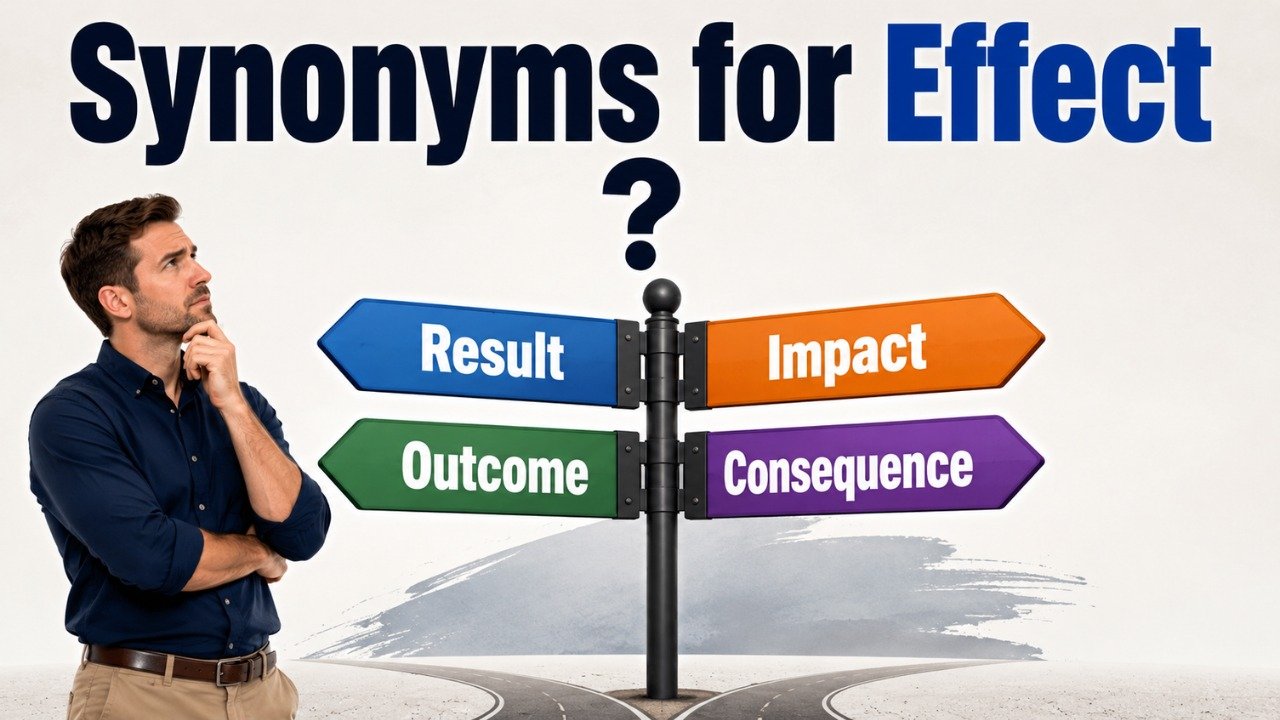
Quick Answer: Synonyms for effect include result, outcome, consequence, impact, influence, impression, change, reaction, repercussion, and aftermath. Use result for a direct ending, outcome for a final situation, consequence for something caused by an action, impact for a strong change, influence for power over someone or something, and impression when talking about how something feels, appears, or is received.
Pronunciation and Word Details
Word: Effect
Pronunciation: ɪˈfekt
Part of Speech: Noun, sometimes verb
Meaning: An effect is a result, change, or influence caused by an action, event, person, or thing.
US Pronunciation:
UK Pronunciation:
What Does “Effect” Mean?
Effect means the result or change that happens because of a cause. It is most commonly used as a noun to describe what follows an action, event, rule, decision, condition, or influence.
Effect can describe a visible result, emotional response, practical change, scientific reaction, or social influence. In grammar, effect is often used in cause and effect writing, where one thing causes another thing to happen.
Example: The new policy had a positive effect on employee performance.
In this sentence, effect means the change or result caused by the new policy.
Meaning, Tone, and Context of “Effect”
Effect is a neutral word. It can fit formal writing, academic writing, business communication, scientific explanation, and everyday conversation. The tone depends on the context around it.
Formal Context: The effect of the decision was measured over several months.
Casual Context: The movie had a strong effect on me.
Academic Context: The study examined the effect of sleep on memory.
Business Context: The discount had a clear effect on sales.
Emotional Context: Her words had a calming effect on the audience.
Effect is useful when you want to explain what changed, what happened afterward, or what influence one thing had on another.
When and How to Use “Effect”
For Results: Use effect when describing what happens because of a cause.
Example: The rain had a cooling effect on the city.
For Influence: Use effect when something changes how a person thinks, feels, or behaves.
Example: The speech had a powerful effect on the crowd.
For Science and Research: Use effect when explaining a measured change or reaction.
Example: The experiment tested the effect of heat on metal.
For Business: Use effect when discussing results, performance, sales, or outcomes.
Example: The new strategy had a positive effect on customer trust.
For Emotions: Use effect when something creates a feeling or response.
Example: The song had a peaceful effect on her mood.
Best Synonyms for Effect
Result: Something that happens because of an action or cause.
Example: The result of the training was better teamwork.
Outcome: The final situation after a process, event, or decision.
Example: The outcome of the meeting was positive.
Consequence: A result that follows an action, often serious or important.
Example: Every choice has a consequence.
Impact: A strong effect or powerful influence.
Example: The campaign had a major impact on public awareness.
Influence: The power to affect someone or something.
Example: Her advice had a strong influence on my decision.
Impression: The effect that someone or something creates in the mind.
Example: His confidence made a good impression.
Change: A difference caused by something.
Example: The new routine created a healthy change.
Reaction: A response caused by an action, event, or situation.
Example: The announcement caused a strong reaction.
Repercussion: A later effect, usually negative or serious.
Example: The mistake had serious repercussions.
Aftermath: The situation that exists after an event, especially a difficult one.
Example: The city struggled in the aftermath of the storm.
50 Synonyms for Effect with Short Meanings
- Result: Something caused by an action.
- Outcome: The final result of a process.
- Consequence: A result that follows an action.
- Impact: A strong or noticeable effect.
- Influence: Power to change or affect something.
- Impression: A feeling or opinion created by something.
- Change: A difference caused by an event or action.
- Reaction: A response to something.
- Repercussion: A later and often serious result.
- Aftermath: The condition after an event.
- Product: Something produced by a cause.
- End Result: The final effect of something.
- Final Result: The last result after a process.
- Concluding Result: The result reached at the end.
- Consequence: A natural result of an action.
- Ramification: A complex or indirect consequence.
- Fallout: Negative effects after an event.
- Aftereffect: A later effect that remains.
- Side Effect: An additional result, often unwanted.
- Influence: A changing force or effect.
- Force: Power that creates change.
- Power: Ability to produce an effect.
- Weight: Importance or influence.
- Significance: Importance or meaningful effect.
- Mark: A lasting effect or sign.
- Trace: A small sign left by something.
- Imprint: A strong lasting effect.
- Impression: A mental effect or feeling.
- Response: A reaction caused by something.
- Consequence: A result connected to a cause.
- Resultant: Something produced as a result.
- Development: A change that happens over time.
- Shift: A change in direction, state, or position.
- Alteration: A change made by something.
- Transformation: A major change in form or condition.
- Modification: A small or controlled change.
- Difference: A change between two states.
- Effectiveness: The ability to produce a result.
- Influential Result: A result that affects other things.
- Practical Result: A result seen in real use.
- Visible Result: A result that can be seen clearly.
- Direct Result: A result clearly caused by something.
- Indirect Result: A result caused in a less obvious way.
- Net Result: The final effect after all factors.
- End Product: The final thing produced.
- Issue: A result or outcome in formal use.
- Yield: A result produced by effort or process.
- Return: A result gained from action or investment.
- Fruit: A result of effort or work.
- Consequence: The effect that follows a cause.
Read Also:
Synonyms for That

Synonyms for Effect by Context
When Effect Means Result
Use these synonyms when effect means what happens after a cause, action, or event.
Result: The result of the change was clear.
Outcome: The outcome of the plan was better than expected.
Consequence: The consequence of poor planning was delay.
End Result: The end result was a stronger team.
When Effect Means Impact
Use these words when effect means a strong or noticeable influence.
Impact: The law had a major impact on small businesses.
Influence: His ideas had a lasting influence on the group.
Power: The story had the power to change minds.
Weight: Her opinion carried great weight in the discussion.
When Effect Means Impression
Use these synonyms when effect means the feeling, image, or opinion something creates.
Impression: The design created a modern impression.
Mark: The teacher left a positive mark on her students.
Imprint: The experience left a deep imprint on his memory.
Trace: A trace of sadness remained in her voice.
When Effect Means Change
Use these alternatives when effect means a difference caused by something.
Change: The new schedule brought a useful change.
Shift: The speech created a shift in public opinion.
Alteration: The medicine caused a slight alteration in sleep patterns.
Transformation: The program led to a major transformation.
When Effect Means Later Result
Use these words when the effect comes after an event, especially a serious one.
Aftermath: The community recovered in the aftermath of the flood.
Aftereffect: Tiredness was an aftereffect of the long trip.
Repercussion: The decision had financial repercussions.
Fallout: The company faced fallout after the error.
Another Word for Effect
Another word for effect is result. It is the best single replacement when you mean something that happens because of a cause. However, the best alternative depends on the sentence. Use impact for a strong effect, consequence for a serious result, influence for power over someone or something, and impression for a feeling created in someone’s mind.
Original: The rule had a good effect on attendance.
Better Option: The rule had a good result for attendance.
Original: The speech had a strong effect on the audience.
Better Option: The speech had a strong impact on the audience.
Original: His mistake had a serious effect on the project.
Better Option: His mistake had a serious consequence for the project.
Original: The painting had a soft effect on the room.
Better Option: The painting created a soft impression in the room.
When Not to Use “Effect”
Do not use effect when a more exact synonym would make the sentence clearer. Effect can sound vague if the reader does not know whether you mean result, influence, impression, reaction, or consequence.
Weak: The decision had an effect on the team.
Better: The decision improved the team’s confidence.
Weak: The medicine had an effect.
Better: The medicine reduced the pain.
Weak: The speech created an effect.
Better: The speech inspired the audience.
Weak: The storm had many effects.
Better: The storm caused flooding, delays, and power loss.
Avoid repeating effect too often in one paragraph. Use result, impact, consequence, or change when they explain the meaning more clearly.
Words Commonly Confused With Effect
Effect vs Affect: Effect is usually a noun that means result. Affect is usually a verb that means to influence or change.
Effect vs Result: Effect often focuses on what a cause produces, while result focuses on the final thing that happens.
Effect vs Impact: Effect can be any result, while impact usually means a strong or noticeable effect.
Effect vs Influence: Effect is the result of a cause, while influence is the power that causes change.
Effect vs Consequence: Effect is neutral, while consequence often suggests an important or serious result.
Effect vs Impression: Effect can be practical or emotional, while impression usually means the feeling or opinion created.
Which Synonym Should You Choose?
Choose result when you want a simple and clear word for what happened.
Choose outcome when writing about the final situation after a plan, process, meeting, or decision.
Choose consequence when the result is serious, important, or caused by someone’s choice.
Choose impact when the effect is strong, visible, or powerful.
Choose influence when something changes thoughts, feelings, actions, or decisions.
Choose impression when something creates a feeling, opinion, or mental image.
Choose reaction when focusing on how someone responds to an event, message, or situation.
Choose aftermath when talking about what remains after a difficult event.
Choose repercussion when the later effect is serious, indirect, or negative.
Real Life Examples of “Effect” in Sentences
Original: The new schedule had a good effect on productivity.
Better Option: The new schedule improved productivity.
Original: The movie had a deep effect on the audience.
Better Option: The movie had a deep impact on the audience.
Original: The decision had a negative effect on sales.
Better Option: The decision had a negative consequence for sales.
Original: The lesson had a strong effect on the students.
Better Option: The lesson had a strong influence on the students.
Original: The color choice had a soft effect.
Better Option: The color choice created a soft impression.
Original: The rain had an effect on traffic.
Better Option: The rain caused traffic delays.
Original: The training had a positive effect on confidence.
Better Option: The training increased confidence.
Original: The announcement had an immediate effect.
Better Option: The announcement caused an immediate reaction.
Original: The storm had a lasting effect on the town.
Better Option: The storm left a lasting mark on the town.
Original: Poor sleep had an effect on his focus.
Better Option: Poor sleep reduced his focus.
Synonym Groups and Usage Differences
Result Group
These synonyms focus on what happens after a cause. Result, outcome, end result, and final result are useful in clear writing.
Example: The result of the change was better communication.
Impact Group
These synonyms show a strong or noticeable effect. Impact, influence, power, and weight work well when something changes people, decisions, or situations.
Example: Her speech had a powerful impact on the audience.
Consequence Group
These words describe effects that follow actions, often serious ones. Consequence, repercussion, ramification, and fallout are useful for warnings, reports, and analysis.
Example: The error had serious repercussions for the project.
Impression Group
These synonyms describe the feeling or opinion something creates. Impression, mark, imprint, and trace are useful for emotional or descriptive writing.
Example: The design made a calm impression on visitors.
Change Group
These words focus on difference. Change, shift, alteration, modification, and transformation are useful when explaining how something becomes different.
Example: The new habit created a positive change in his routine.
Antonyms of Effect
Cause: The reason something happens.
Source: The origin of an action, event, or result.
Origin: The starting point of something.
Reason: The explanation for why something happens.
Basis: The foundation behind a result or decision.
Trigger: Something that starts an action or reaction.
Beginning: The first stage before any result appears.
Start: The point where something begins.
Comparison: Effect vs Related Words
Effect vs Result
Effect focuses on what a cause produces. Result focuses on the final thing that happens.
Example With Effect: Lack of sleep had a bad effect on his focus.
Example With Result: The result was poor performance in class.
Effect vs Impact
Effect can be small, large, direct, or indirect. Impact usually suggests a strong and noticeable effect.
Example With Effect: The change had a mild effect on the process.
Example With Impact: The change had a major impact on the process.
Effect vs Consequence
Effect is neutral and general. Consequence often suggests a serious result, especially after a decision or action.
Example With Effect: The new rule had a clear effect on behavior.
Example With Consequence: Breaking the rule had a serious consequence.
Effect vs Influence
Effect is the result. Influence is the power that helps create the result.
Example With Effect: The teacher’s advice had a positive effect on him.
Example With Influence: The teacher’s advice influenced his decision.
Effect vs Impression
Effect can describe any result. Impression describes the feeling or opinion created in someone’s mind.
Example With Effect: The lighting had a calming effect.
Example With Impression: The lighting created a calm impression.
Common Phrases and Expressions With Effect
Cause and Effect: A relationship where one thing makes another thing happen.
In Effect: Actually operating or active.
Take Effect: To begin working or applying.
Come Into Effect: To officially start being used.
Side Effect: An additional result, often unwanted.
Aftereffect: A result that appears or remains later.
Positive Effect: A helpful or good result.
Negative Effect: A harmful or unwanted result.
Lasting Effect: A result that continues for a long time.
Desired Effect: The result someone wants to create.
Common Mistakes to Avoid
One common mistake is confusing effect with affect. Effect is usually a noun, while affect is usually a verb.
Incorrect: The weather had a bad affect on the game.
Correct: The weather had a bad effect on the game.
Another mistake is using effect when a stronger word is available. If you know the exact result, write it directly.
Weak: The rule had an effect on behavior.
Better: The rule improved behavior.
Avoid using effect too many times in one paragraph. Repetition can make writing sound flat.
Weak: The effect of the change had an effect on results.
Better: The change improved the results.
Do not use impact for every effect. Impact sounds stronger than effect, so it may be too intense for small changes.
Weak: The small typo had a major impact on the sentence.
Better: The small typo changed the sentence slightly.
Conclusion
Synonyms for effect help you write with more accuracy and variety. Use result for a simple caused outcome, outcome for a final situation, consequence for a serious result, impact for a strong change, influence for power over actions or thoughts, and impression for a feeling created in the mind. The best synonym depends on whether you are writing about facts, emotions, decisions, research, business, or everyday events. Choosing the right word makes your meaning clearer and more natural.
FAQs About Synonyms for Effect
What is the best synonym for effect?
The best synonym for effect is result when you mean something caused by an action, event, or situation.
What is another word for effect in formal writing?
Impact, consequence, outcome, and result are strong formal alternatives. The best choice depends on the meaning of the sentence.
What is a synonym for strong effect?
Impact is the best synonym for a strong effect. Influence and powerful result can also work in some contexts.
What is a synonym for negative effect?
Consequence, repercussion, fallout, and drawback can describe a negative effect. Repercussion is useful when the result is serious.
What is the difference between effect and affect?
Effect is usually a noun meaning result. Affect is usually a verb meaning to influence or change something.
Can effect mean impression?
Yes, effect can mean the feeling or impression something creates. For example, a room can have a calm effect.
What is the opposite of effect?
The opposite of effect is cause. A cause is the reason something happens, while an effect is what happens afterward.
